

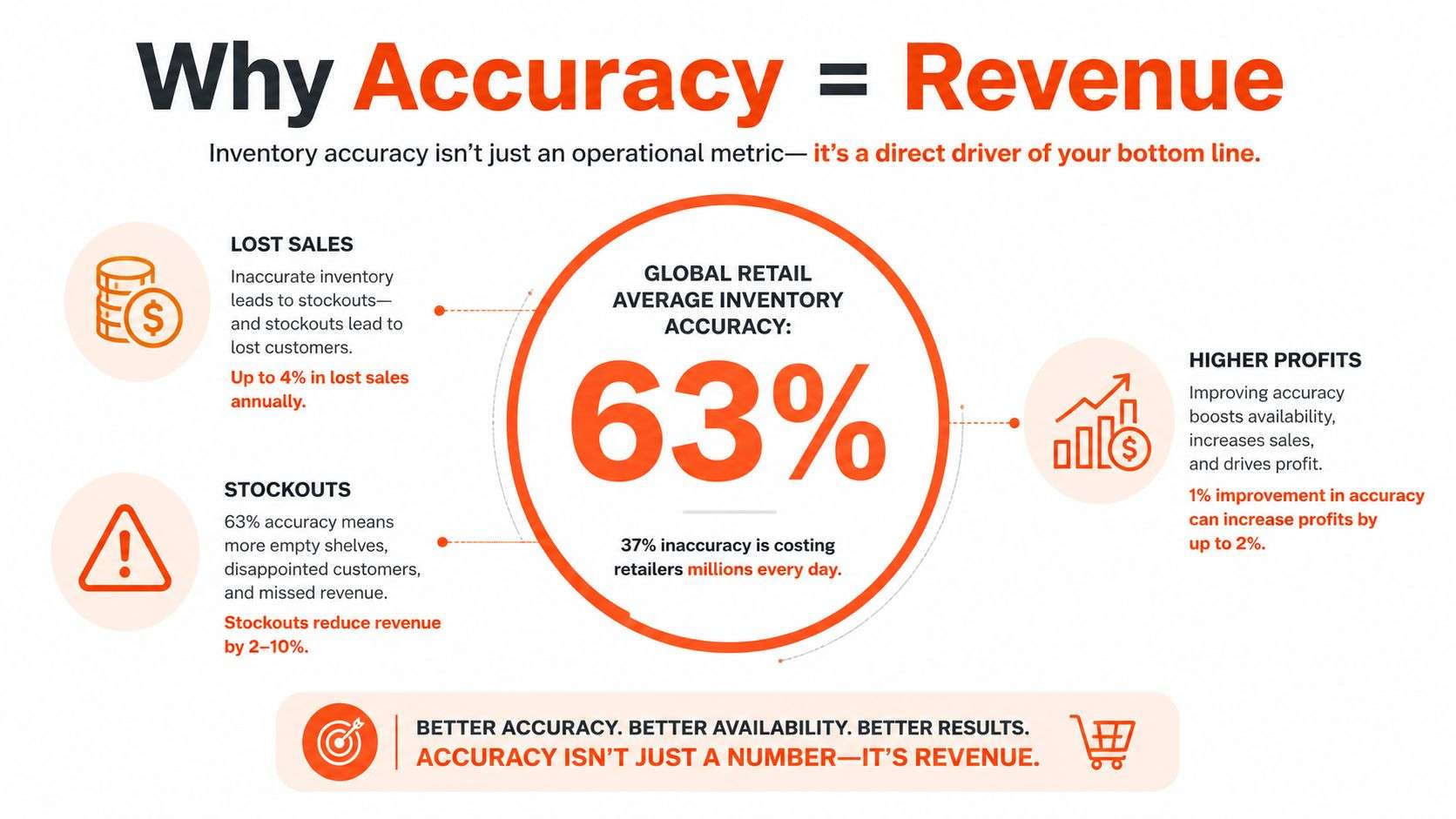
Global retail benchmarks still show 63% average inventory accuracy, and that's why retail inventory management can't be treated like a back-office housekeeping task anymore. When the stock record is wrong, the business doesn't just miscount units, it misreads demand, overorders slow lines, misses fast movers, and damages the customer experience at checkout and online. For Australian retailers dealing with thin margins, long supply chains, and mixed store-and-online fulfilment, stock accuracy sits right at the centre of revenue, cash flow, and credibility.
The practical fix starts with a mindset shift. Inventory is not just what's on the shelf, it's the data layer behind replenishment, merchandising, finance, and promise dates. If the number in the system doesn't match what's physically available, every downstream decision gets harder, from supplier negotiations to click-and-collect. That's why many teams now treat stock visibility as a core management discipline rather than an admin function.
Why Inventory Accuracy Is a Revenue Problem Not a Bookkeeping Task
Global retail benchmarks often show that 58% of retail brands and DTC manufacturers operate below 80% inventory accuracy, and that makes forecasting, replenishment, and supplier negotiations unreliable Unleashed Software. The commercial risk is immediate. A store can look healthy on paper while still losing sales because the system says an item is unavailable, or because replenishment is delayed after a bad count.
What inaccurate stock records do to revenue
The money loss shows up in familiar ways. Click-and-collect orders fail when the online store promises stock that is not there, while false out-of-stocks suppress sales when the item is physically available but hidden by a bad record. The Cardiff inventory inaccuracy report notes that correcting inaccuracies has been shown to lift sales by about 4% to 8% in participating retailers Cardiff University report.
Practical rule: if the record is wrong, the revenue problem appears before the finance team sees it.
Australian retailers feel that pressure in specific ways because inventory errors hit stock availability, omnichannel fulfilment, and working-capital efficiency at the same time. A buyer cannot confidently replenish, a store manager cannot trust shelf counts, and a finance team cannot judge how much cash is trapped in stock. Category mix matters as well, since fashion, grocery, and mixed retail each carry different error patterns and different margin exposure.
That is why stock accuracy belongs in trading meetings, not just warehouse reviews. Merchandising decisions depend on it, finance decisions depend on it, and store teams feel the consequences the moment a customer asks for stock that the system cannot verify.
If you want a useful starting point for eCommerce stock discipline, Grumspot inventory optimization advice is worth reading alongside your own replenishment logic. The best guidance is practical, not theoretical, and it helps you decide which inventory exceptions deserve attention first.
Core Inventory Methods Every Retailer Should Know
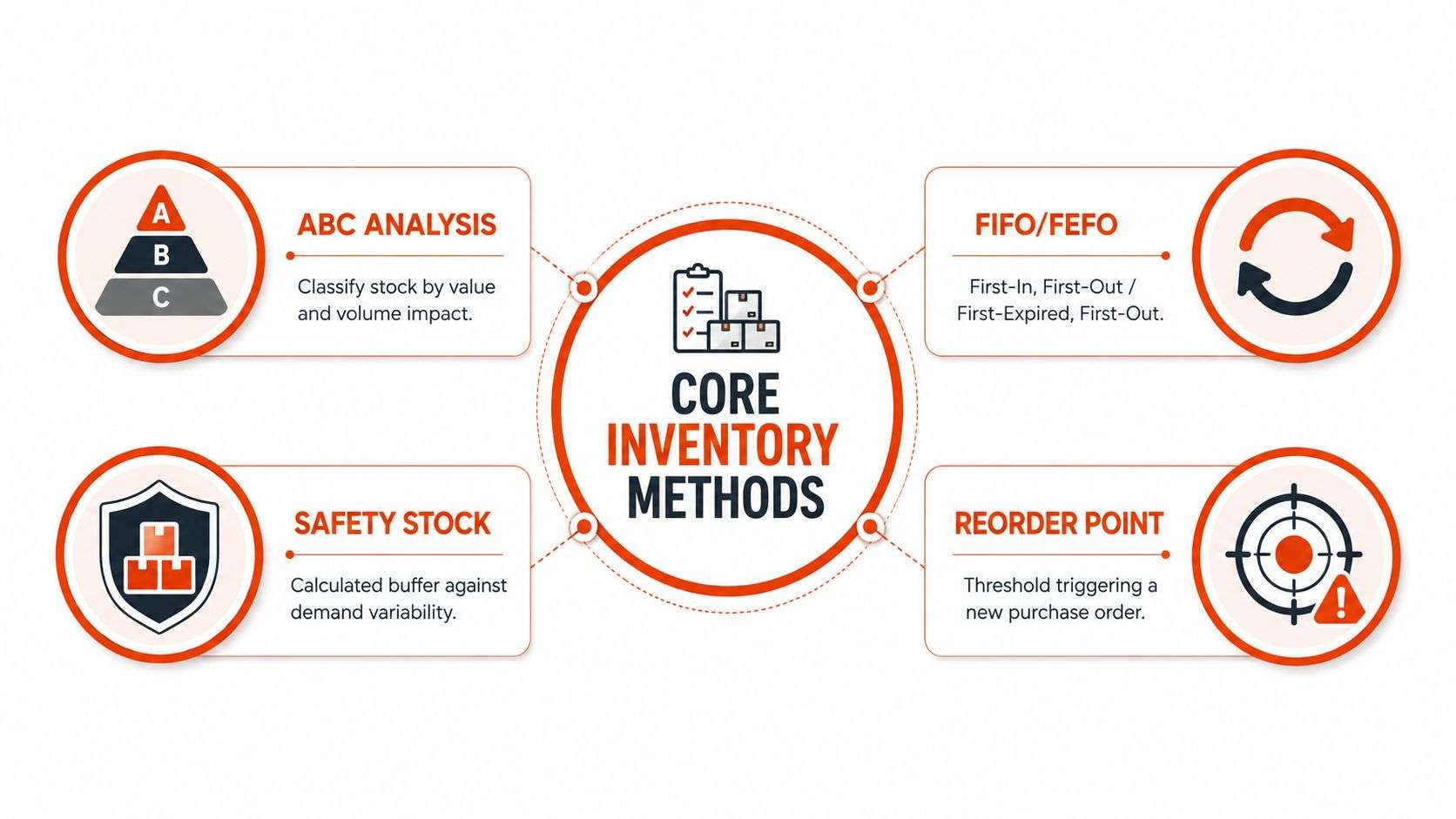
Retail teams do not need a long list of theories. They need the methods that improve buying decisions, protect margin, and stop cash from sitting in the wrong stock. Oracle identifies inventory valuation, physical reconciliation, and ABC prioritisation as core retail techniques, and that is the right starting point because it forces attention onto the SKUs that move the business Oracle Retail inventory management. Category-level control matters because accuracy problems are not spread evenly, and the INFORMS study showed that a large share of the variance in inventory record inaccuracy sat between product categories, not stores INFORMS study.
Start with ABC, then add replenishment rules
ABC analysis should be the first filter for an apparel retailer, because the categories that drive most revenue deserve tighter cycle counts, stronger receiving checks, and more disciplined replenishment review. Lower-value lines still matter, but they do not need the same management effort as the stock that carries the most sales and the highest error exposure.
A grocery chain faces a different trade-off, so FIFO/FEFO usually matters more. First-in, first-out keeps older stock moving through the store and the back room, while first-expired, first-out is the practical rule for perishables and date-sensitive products. That is where waste, write-offs, and shelf-life risk show up in the profit and loss account.
Use stock buffers with discipline
Safety stock protects service levels when supplier lead times drift or demand spikes without warning. Used well, it keeps a retailer from missing sales on fast lines. Used badly, it fills the warehouse with slow stock that ties up cash and eventually needs to be marked down.
Reorder points work better when they are tied to rolling monthly sales data rather than annual averages. The Australian Bureau of Statistics retail turnover series gives a monthly demand signal that matches the pace of retail decisions ABS retail turnover context. For fast-moving categories, that is a better basis for days-of-supply and reorder triggers than a stale yearly average.
For retailers comparing accounting treatments and stock valuation choices, inventory valuation methods for Australian SMEs gives a practical reference point. The core decision is to match the method to the product mix, not force every category into the same control logic.
Key Metrics That Connect Inventory to Financial Outcomes
Inventory metrics only matter when they change decisions. Too many teams track counts that look tidy in a dashboard, but they do not help merchandising, finance, or operations decide what to buy, what to clear, and what to hold back. The better question is which numbers expose the trade-offs between stock availability, cash tied up, and margin erosion.
Carrying inventory is expensive, with widely used benchmarks estimating annual holding costs at 20% to 30% of inventory value Whitebox inventory management statistics. That means a retailer holding AU$1 million in stock may face AU$200,000 to AU$300,000 in yearly carrying costs before shrink, markdowns, or obsolescence are even counted. Those are finance numbers, not warehouse numbers.
The metrics that drive behaviour
| Metric | Formula | Target Benchmark |
|---|---|---|
| Inventory turnover ratio | Cost of goods sold ÷ average inventory | Higher is generally better, by category |
| Days of supply | On-hand stock ÷ average daily sales | Match to lead time and volatility |
| Carrying costs | Inventory value × holding cost rate | Keep as low as service levels allow |
| Sell-through rate | Units sold ÷ units received | Track by season and category |
| GMROI | Gross margin ÷ average inventory cost | Improve by category, not just overall |
If you need a practical way to present these numbers to leadership, the reporting layer matters as much as the metric itself. Wistec's business dashboard reporting is the kind of visibility retailers need when finance and merchandising want the same truth from the same system.
Make the metrics regional, not generic
Australian retailers should not treat demand as one national average when the ABS publishes retail turnover data by state and territory. That regional lens matters because the stock mix that works in one market can create overstock in another. A winter category may need a different reorder rhythm in a cooler state than in a warmer one, even if the same chain operates both.
Practical rule: set targets from live sales patterns, then let finance and merchandising agree on the exceptions.
Category-level accuracy controls matter here too. A chain can have strong overall stock accuracy and still carry bad decisions in a specific range, such as fashion sizes, seasonal grocery, or slow-moving homeware. That is where store managers, buyers, and finance teams need the same view of turn, margin, and risk, because one category can justify extra depth while another should be cut back before it drags cash and margin together.
Inventory management becomes a planning discipline when those measures sit beside each other. The numbers stop being historical trivia and start guiding purchasing, allocation, markdown timing, and cash protection.
Solving Shrinkage and Phantom Stock in Omnichannel Retail
A store can show healthy sales and still be losing money through shrinkage, phantom stock, and bad availability data. Better forecasting does not correct those issues. In practice, it can hide them if the system keeps predicting demand against broken receiving, uncounted losses, or inventory records that no longer match the floor. Samsung's 2024 guide notes that inventory accuracy remains difficult even after years of effort, and recent retail guidance keeps pointing to multichannel syncing issues, inaccurate reporting, theft, and loss as persistent challenges Samsung Insights.
Australian retailers feel that pressure more sharply because many trade across large distances, mixed store-and-online networks, and inventory split across multiple nodes. That structure makes “stock on hand” harder to trust. An item may be physically present in one location, reserved in another, or misreported altogether. The operational result is familiar, click-and-collect failure, overselling, or a team member wasting time looking for stock that never existed in the system.
Controls that reduce loss fastest
Cycle counting is usually the first control to tighten because it finds variance before it spreads into ordering and fulfilment. Item-level visibility comes next, especially in categories where size, colour, or model drives the sale. Barcode receiving closes another common gap, because stock cannot be accurate if receipts are entered loosely or corrected later without an audit trail.
Exception reporting is the practical glue. It shows where the inventory record diverges from physical reality, where transfers go missing, and where fulfilment promises are being made on bad data. For warehouses that need tighter process control, Wistec's WMS and ERP systems is a useful reference point for how receiving, putaway, picking, and reporting fit together.
Practical rule: in a distributed network, fix the process that creates phantom stock before you blame the forecast.
Store-level loss prevention matters as well, especially for high-risk merchandise. Controls that prevent shopping trolley theft fit into the broader loss-prevention mix when shrink comes from handling failures or security gaps rather than demand error. The answer is rarely one control on its own. It is a chain of checks that makes bad stock records harder to create and easier to catch, which is where finance, merchandising, and operations usually need the same truth. In that context, inventory control sits alongside systems design, receiving discipline, and store execution, not as a back-office clean-up task.
Choosing the Right Technology Stack for Your Operation
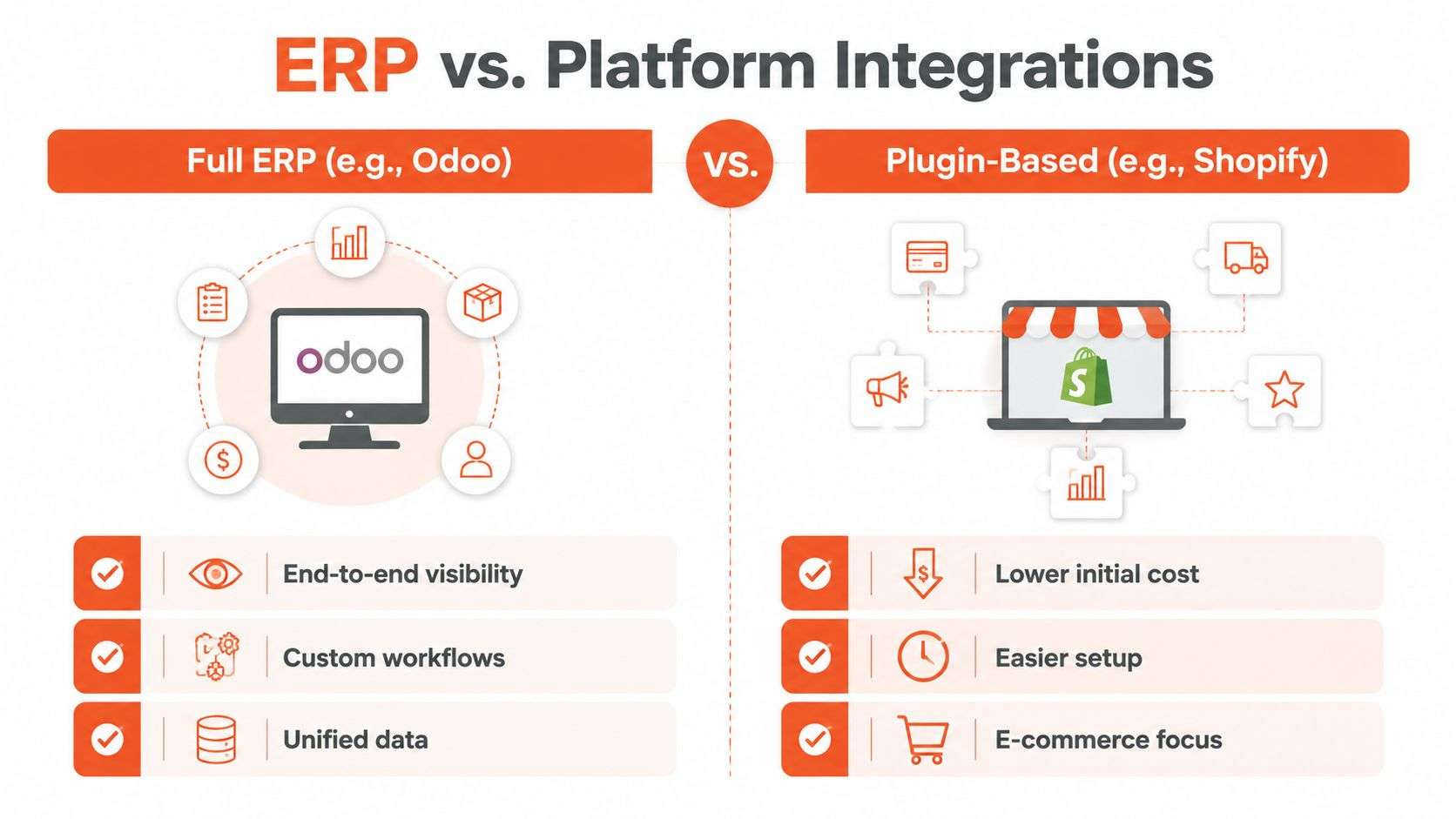
Technology should match operational complexity, not ego. A retailer with one location and straightforward SKU movement may get enough value from a platform with solid inventory sync. A multi-site retailer with warehouse transfers, category rules, or manufacturing inputs usually needs more structure than a storefront plugin can provide.
Where Odoo fits and where it doesn't
Odoo ERP makes sense when inventory needs to connect with purchasing, accounting, approvals, and multi-location fulfilment. It's especially useful when you need category-based replenishment rules, tighter audit trails, and a single operational view across store and warehouse. That said, Odoo implementation isn't a plug-and-play exercise, it needs proper design, clean data, and a partner who understands both process and configuration.
That's where an ODOO partner Sydney Adelaide can add practical value, especially when the business needs local implementation support and hands-on change management. If the system also needs custom workflows or integration work, software development Sydney Adelaide capability becomes part of the selection criteria, not an afterthought. I've seen too many projects fail because the retailer bought software before defining the rules it needed to enforce.
Shopify and WooCommerce for simpler retail stacks
Shopify implementation works well for retailers that want straightforward eCommerce with built-in inventory tracking and fewer moving parts. It's strong for speed to market, but it doesn't give the same depth as an ERP when the operation becomes multi-location or process-heavy.
WooCommerce can be a sensible choice for businesses that want flexibility and already run on WordPress, especially where custom storefront behaviour matters. The trade-off is that integrations, reporting, and stock sync discipline can become your responsibility very quickly.
If you're comparing systems more broadly, best inventory management software guidance is a good internal benchmark for asking the right operational questions. For some retailers, a lightweight platform is enough. For others, Odoo ERP becomes the control centre because the business has outgrown simple sync.
Implementation Checklist for Retail and eCommerce Businesses
The cleanest implementations start with the worst data, not the prettiest process map. If capital, labour, and margin are tight, tackle the categories with the highest error risk first, then build from there. That approach is closer to how real retail teams work, because it avoids wasting effort on SKUs that barely move the profit needle.
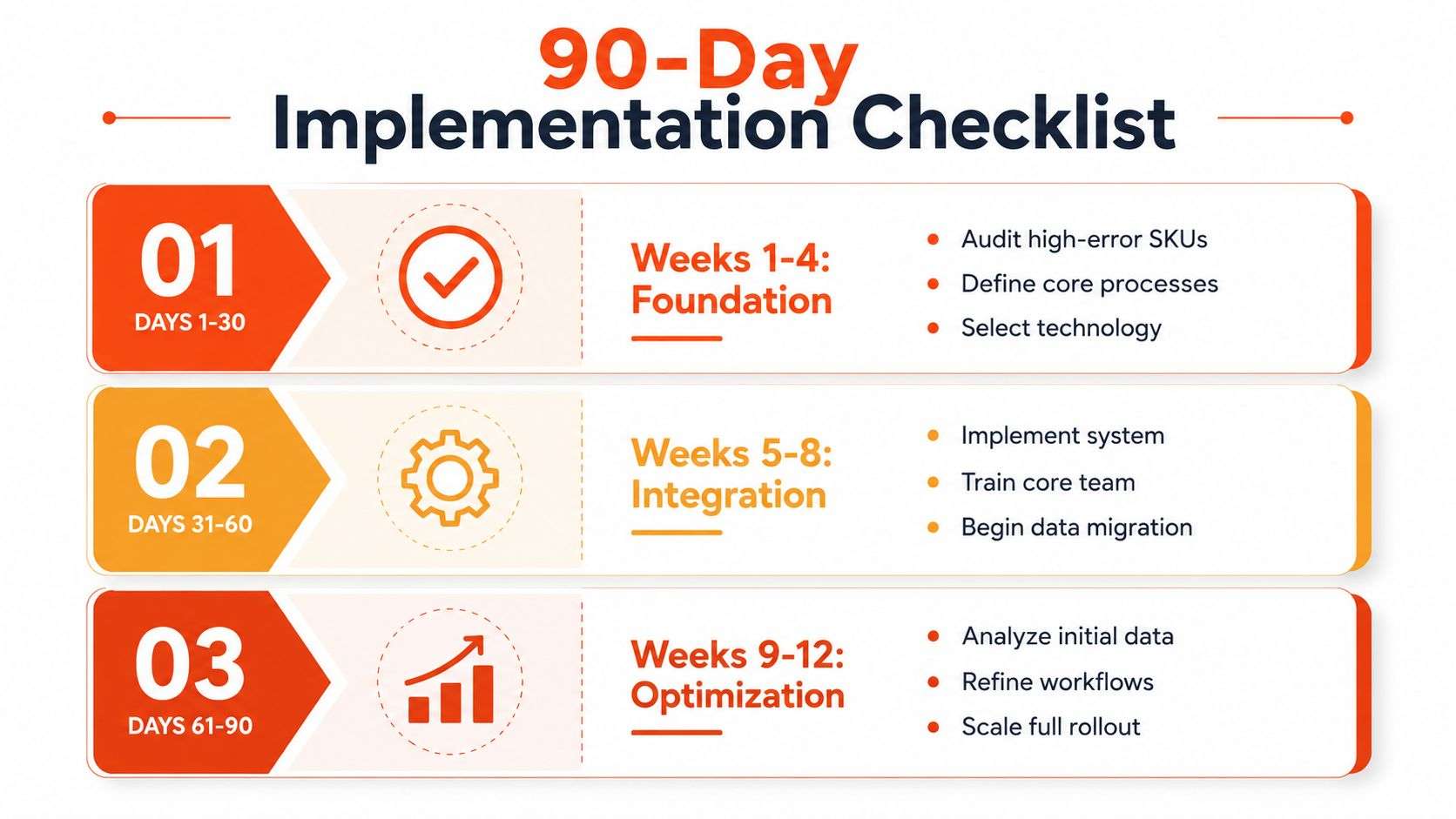
Weeks 1 to 4, foundation
Start with a catalogue audit. Clean up SKU names, variants, duplicate records, supplier fields, and unit-of-measure issues before anyone touches automation.
- Audit high-error SKUs: focus on categories where counts and fulfilment have been unreliable.
- Define core processes: set rules for receiving, transfers, adjustments, and stock corrections.
- Select technology: decide whether the control layer belongs in Odoo, Shopify, WooCommerce, or a linked stack.
For Odoo ERP users, that means checking master data, locations, and stock moves first. For Shopify and WooCommerce, it means making sure product feeds and stock feeds are aligned before a sale goes live.
Weeks 5 to 8, integration
Now the controls get operational. Barcode receiving should be enforced, not optional, and location-level audit trails need to show where the stock moved and who touched it.
- Implement system: configure the inventory rules, not just the screens.
- Train core team: teach the warehouse, store, and finance leads the same process.
- Begin data migration: load only cleaned records, otherwise the old errors follow you in.
An ODDO partner Sydney Adelaide style support model, or the more likely Odoo partner Sydney Adelaide relationship, helps reduce avoidable configuration mistakes. A specialist can also coordinate custom software development Sydney Adelaide work when the stock logic doesn't fit a standard template.
Weeks 9 to 12, optimisation
Once the basics hold, use the first live data to adjust reorder logic, exception reports, and cycle count frequency. The business shouldn't wait for a perfect rollout to start learning.
- Analyse initial data: compare system stock against physical stock.
- Refine workflows: remove steps that create delays or duplicate handling.
- Scale full rollout: extend the controls to other categories and sites.
If you need external implementation support, Wistec offers Odoo implementation and custom software work that can be aligned to retail inventory control, rather than forcing the business into generic settings. The point is not to buy more tech, it's to make the existing operation more accurate and easier to govern.
Common Pitfalls and How to Avoid Them
One of the fastest ways to waste time in retail inventory management is to treat every SKU the same. A fashion chain I've seen in practice had strong stock counts on slow lines and repeated failures on variants, because the team counted by store instead of by category. The fix wasn't a bigger spreadsheet, it was stricter cycle counts on the volatile categories and a better audit trail for receiving.
The usual mistakes
- Using annual averages for reorder points: this smooths out the very volatility you need to see.
- Ignoring category-level variance: the error source is often the assortment, not the store.
- Scaling AI too early: predictive tools can't rescue dirty data.
- Confusing high stock with healthy stock: dead stock can look safe while trapping cash and space.
An electronics retailer can run into trouble when size or colour variants show as unavailable online even though physical stock exists. The customer sees an out-of-stock message, support gets a complaint, and the system still thinks it's technically accurate because the total SKU count looks fine. That's a process failure, not a demand problem.
The corrective action is usually boring, but it works. Tighten receiving checks, count the categories that drive the most variance, and only then scale automation. For manufacturing and logistics teams, the same logic applies to parts, bins, and transfer locations. For eCommerce, the priority is feed accuracy. For retail, it's stock-on-hand discipline at the SKU-location level.
Frequently Asked Questions About Retail Inventory Management
Can improving stock accuracy really increase sales?
Yes. As the Cardiff report found, correcting inventory inaccuracies has been associated with stronger sales performance in participating retailers. In practice, better accuracy cuts false out-of-stocks, protects click-and-collect orders, and stops staff from chasing stock that is sitting in the wrong location or showing under the wrong variant.
Which inventory controls reduce loss fastest in a distributed network?
Cycle counting, barcode receiving, item-level visibility, and exception reporting usually deliver the fastest gains. In Australian networks with multiple stores and fulfilment points, those controls surface phantom stock and shrink before they hit customer promises, and they also give finance a cleaner view of what is on hand versus what the ledger says should be there.
How do I decide which inventory problems to solve first when resources are tight?
Start with the categories creating the most error and the most revenue risk. Per the INFORMS study, a large share of inaccuracy sits between product categories, so category-led prioritisation works better than store-wide averages. That matters in retail because the finance impact and the merchandising impact are rarely spread evenly, a few ranges usually carry the error, the margin pressure, and the customer service fallout.
Should I use Odoo ERP or stick with Shopify for inventory management?
Use Odoo ERP when you need multi-location control, tighter workflows, and deeper operational integration. Use Shopify implementation when the retail model is simpler and the main need is clean eCommerce stock sync. WooCommerce can work well too, but it usually needs more integration discipline as the operation grows. The right choice depends on whether the business is trying to control stock at store, warehouse, and finance level, or mainly keep online availability clean.
How often should I cycle count different product categories?
Count the volatile, high-value, or high-error categories more often, and leave stable categories on a lighter cadence. The right cadence depends on margin pressure, stock movement, and fulfilment risk, not a generic calendar. In practice, the categories that drive markdowns, substitutions, and stock adjustments deserve the tightest control, because that is where counting effort protects both cash and merchandising decisions.
Wistec helps Australian retailers connect inventory control with the systems that run the business, including Odoo implementation, inventory workflows, and custom software development. If you're trying to tighten stock accuracy, reduce phantom stock, or align finance and merchandising on the same numbers, visit Wistec and talk through the inventory problems your team needs to solve first.