

Choosing the right inventory management software isn't just about a technical upgrade. It's a fundamental business decision that gives you real control, directly boosts your bottom line, and sets you up for long-term growth. The right system takes you from simply guessing what’s on the shelves to making sharp, data-driven decisions that prevent lost sales and stop you from tying up cash in stock that won't move.
Stop Guessing and Start Growing Your Business

Every growing business eventually hits a wall. One minute you're celebrating a record sales month, and the next you're apologising to customers because your best-selling product is out of stock again. Meanwhile, other items are just sitting there, gathering dust in the corner. This isn't just a logistical headache; it's a direct hit to your cash flow and, crucially, your customer's trust.
This frustrating cycle is a sure sign that your manual methods, like spreadsheets, just can't keep up anymore. When you're relying on outdated, error-prone systems, you're operating in a constant state of uncertainty. You’re left guessing how much to order, when to reorder, and which products are actually making you money.
A Familiar Story for Australian Retailers
Think about a typical Sydney-based online retailer. Their business is taking off, powered by a popular Shopify store. But that success brings a whole new set of problems. They're trying to manually update inventory between their warehouse and their website, which leads to constant overselling. The result? Cancelled orders and unhappy customers. The team ends up wasting hours every week just reconciling numbers instead of actually growing the business.
It’s at this point they realise they need a single source of truth—a system that can automate all those updates and give them a clear, real-time picture of their stock. This is the exact moment when finding the best inventory management software becomes mission-critical.
Moving from manual tracking to an automated system isn't just about adding a new tool. It’s about building a solid operational backbone that can actually support your business as it scales, preventing costly errors and making everything run more smoothly.
For many businesses, a professional Shopify implementation or a solid WooCommerce integration that syncs inventory automatically is the answer. For others with more complex operations, a complete Odoo implementation in Sydney can bring sales, purchasing, and warehouse management under one roof.
And when off-the-shelf options don't quite fit the bill? Custom software development in Sydney or Adelaide can fill those gaps, creating a solution that feels like it was made just for you. Don’t let inventory chaos put a ceiling on your potential.
Ready to finally get a handle on your stock and build a more profitable business? Contact Wistec today for a consultation and let's find the right technology to drive your growth.
What the Best Inventory Software Actually Does
Let's cut through the noise and talk about what a great inventory system really does for your business. It's so much more than a digital spreadsheet. Think of it as the central command centre for your entire operation—the brain that connects your sales channels, warehouse operations, and purchasing into one seamless, intelligent system.
The main goal? To stop costly mistakes before they happen and uncover opportunities you didn't even know existed.
At its most basic level, the software gives you a single, truthful view of every item you stock. Picture this: a customer in your Adelaide shop buys the very last of a popular product. A top-tier system instantly updates your stock levels everywhere. This means someone trying to buy that same out-of-stock item on your WooCommerce website just moments later can't. No overselling, no apologetic emails, no disappointed customers.
This real-time sync is the foundation, but the real magic comes from a few key capabilities. These are the non-negotiable features that transform a simple tool into a genuine growth engine.
Core Capabilities That Drive Profitability
The difference between a basic inventory tool and a truly exceptional one is its ability to automate the grunt work and give you clear, actionable insights. It doesn't just tell you what you have in stock; it helps you decide what to do next.
So, what should you be looking for?
-
Real-Time Tracking Across All Channels: This is crucial. It ensures your stock numbers are always accurate, whether you sell on Shopify, in a brick-and-mortar store, or through a B2B portal. It's the only way to eliminate overselling for good.
-
Automated Purchasing and Reordering: The system becomes your most reliable employee, automatically generating purchase orders when stock hits a minimum level you've set. This stops you from ever running out of your bestsellers and leaving money on the table.
-
Barcode Scanning Integration: This one is a game-changer for accuracy. It massively reduces human error when receiving new stock, picking orders, or doing stocktakes. Your warehouse becomes faster, more efficient, and far more accurate.
-
Multi-Location Management: If you're running more than one warehouse or store, this isn't a 'nice-to-have'—it's essential. It lets you see and manage stock across every single location from one simple dashboard.
The infographic below really brings this to life, showing how a simple action like scanning a barcode feeds into this powerful, real-time system.
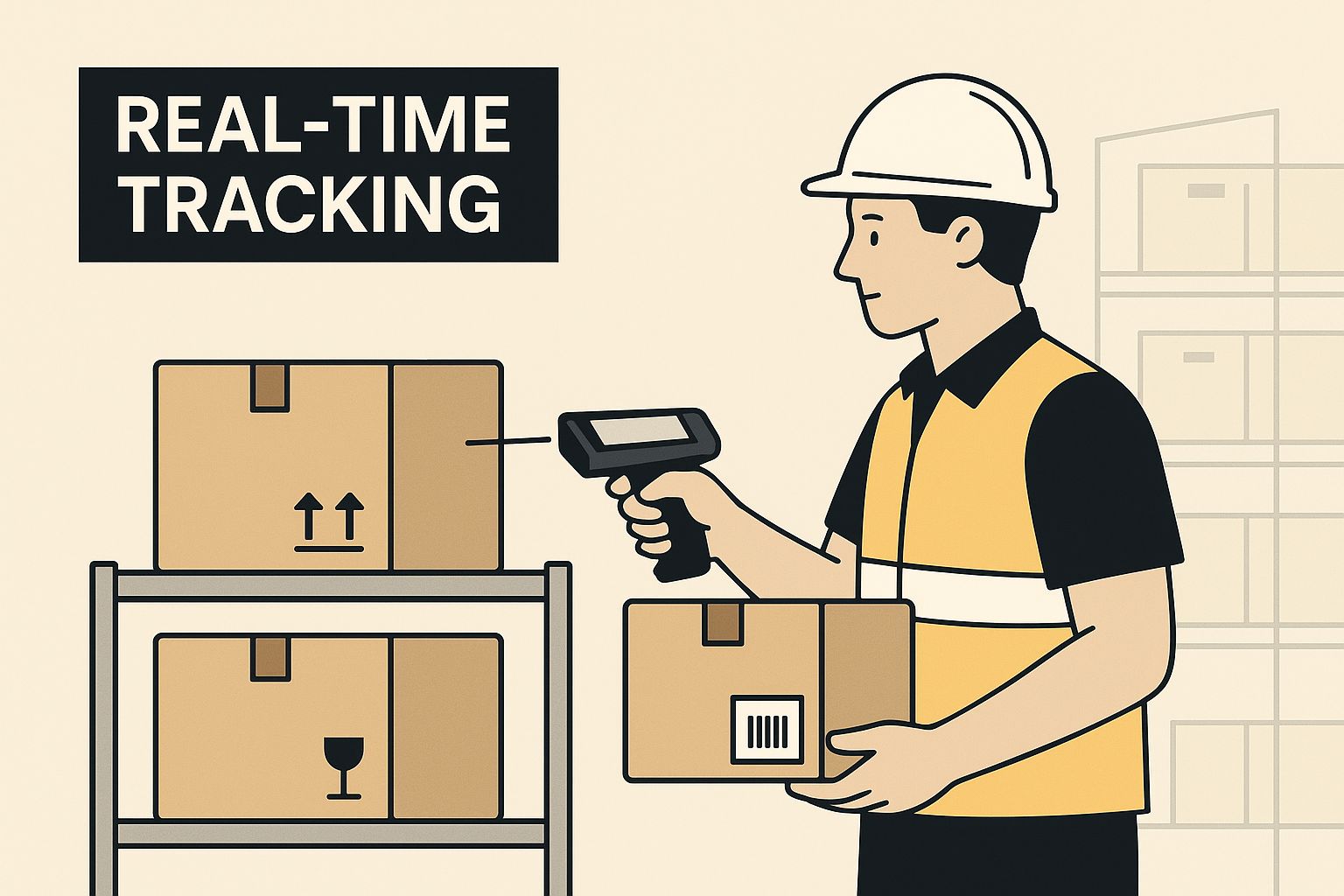
As you can see, every scan is a vital piece of data that instantly updates the central system. It’s what gives you that live, accurate picture of your entire inventory at any given moment.
Essential Inventory Software Features and Their Business Impact
To really understand the value, it helps to connect specific features to tangible business outcomes. This table breaks down what these core functions do and why they matter to your bottom line.
| Feature | What It Does | Why It Matters for Your Business |
|---|---|---|
| Real-Time Synchronisation | Instantly updates stock levels across all sales channels (e.g., online, in-store) the moment a sale is made. | Prevents overselling and backorders, protecting your brand reputation and keeping customers happy. |
| Automated Reordering | Automatically generates purchase orders when inventory levels fall below a pre-set threshold. | Ensures your best-selling products are always in stock, maximising sales and preventing stockouts. |
| Barcode & Scanning Support | Allows staff to use scanners to track items during receiving, picking, packing, and stocktakes. | Drastically reduces human error, speeds up warehouse processes, and improves order accuracy to over 99%. |
| Demand Forecasting | Analyses historical sales data and market trends to predict future product demand. | Helps you make smarter purchasing decisions, reduce carrying costs on slow-moving items, and avoid tying up cash in dead stock. |
| Supplier Management | Stores supplier information, lead times, and purchase histories in one central place. | Streamlines purchasing by making it easy to track orders, manage lead times, and evaluate supplier performance. |
| Reporting & Analytics | Generates detailed reports on sales velocity, stock turnover, profit margins, and inventory valuation. | Provides the hard data you need to identify your most (and least) profitable products, optimising your entire product strategy. |
These features work together to create a system that doesn't just manage stock—it optimises your entire supply chain for profitability and growth.
Turning Data Into Decisions
Beyond just tracking items, the best software turns raw data into reports you can actually use. It will clearly show you which products are flying off the shelves, which ones are gathering dust, and which suppliers are consistently reliable. This is the kind of intelligence you need to fine-tune your purchasing and maximise your return on every dollar invested in stock.
The demand for these capabilities is surging. The Australian enterprise resource planning (ERP) software market, which is where inventory management sits, was valued at $930.2 million USD in 2024 and is expected to climb to $1,170.6 million USD by 2030. This rapid growth isn't surprising; it shows just how critical these tools have become for savvy Australian businesses wanting to compete. You can explore more data on the Australian ERP software market to see the full picture.
Ultimately, it’s all about making smarter decisions, faster. Whether you need a straightforward Shopify implementation or a more customised Odoo implementation in Sydney, the right software gives you the clarity and control you've been missing.
Does your current system give you this level of insight? If the answer is no, it might be holding your business back. Contact our experts in software development in Sydney and Adelaide to talk about a solution that’s genuinely built for your needs.
How to Choose the Right System for Your Business
Searching for the "best inventory management software" can feel like you're drowning in options. But the secret isn't finding the system with the most features; it's about finding the one that fits your business like a glove. You need a solution that solves your specific headaches today and can still keep up as you grow tomorrow.
Before you get lost in technical jargon, take a step back and look at how your business actually runs. Are you a pure-play online retailer? If so, real-time integration with your e-commerce platform is an absolute must-have. A solid Shopify implementation or a deep connection with WooCommerce isn't just a nice feature—it's what stops you from overselling and keeps your customers happy.
Key Factors for Your Decision
It's easy to get wowed by a flashy demo, but the right choice comes down to the practical, day-to-day realities of your operation. To cut through the noise, focus on these critical factors:
-
Integration Capabilities: Does the software play nicely with the tools you already rely on? Think about your e-commerce store, your accounting software like Xero or QuickBooks, and the shipping carriers you use every day. A system that locks your data away in a silo is a step backwards.
-
Scalability: You’re in business to grow, and your software needs to be ready for the ride. Can it handle more products, a surge in orders, and maybe even a second warehouse without forcing you into a costly and painful replacement?
-
Industry-Specific Needs: A local manufacturer has a completely different set of inventory challenges than a retail boutique. Look for software built for your world, whether that means managing a bill of materials (BOM) for production or batch tracking for perishable goods.
These aren't just checkboxes; they're the foundations of a partnership that will help your business thrive.
The right software doesn't force you to change what already works. It moulds itself to your processes, automating the tedious stuff and arming you with the data you need to make smarter, more profitable decisions.
A Practical Case from Adelaide
Think about a mid-sized manufacturing firm right here in Adelaide. As their business took off, their tangled web of spreadsheets became a serious bottleneck. It was causing production delays and costly ordering mistakes. What they needed was one single source of truth to manage raw materials, work-in-progress, and finished goods.
After looking at their options, they went with an Odoo implementation in Adelaide. The modular design of Odoo was the clincher. They started with the core inventory and manufacturing modules. Later, as they expanded, they simply added the purchasing and CRM modules without having to rip everything out and start over. That forward-thinking choice saved them a massive headache and expense down the line. For them, Odoo wasn’t just software; it was a scalable foundation for their future.
This kind of strategic thinking is becoming essential in the Australian market. The inventory management software market here is a big piece of the Asia Pacific region's pie, which is expected to hit $690.77 million USD in 2025. That growth tells you just how vital these systems are for staying competitive. You can discover more insights about the inventory management market to get a feel for the regional trends.
And when an off-the-shelf solution doesn't quite fit your unique way of doing things, custom software development in Sydney or Adelaide can build that missing bridge, giving you a system that feels like it was made just for you.
Ready to find a system that actually gets your business? Contact Wistec for a personalised consultation, and let's build a solution that helps you grow.
Integrating Your Systems for Total Control

An inventory tool that lives on an island creates more problems than it solves. You’re left with disconnected data, frustrating manual workarounds, and a foggy view of your own business. The real power of the best inventory management software is unleashed when it talks to every other part of your operation. This integration is what turns a simple stock-counting tool into the central nervous system of your business.
Think about an online store gearing up for a massive flash sale. Without integration, every single order would demand a manual stock update. That’s a recipe for disaster when sales are flying in every second. This is precisely where a professional Shopify implementation becomes a game-changer.
A Practical Shopify Integration Example
Any successful Shopify store needs its inventory levels synced in real-time. It's non-negotiable. When properly integrated, a sale on your website instantly updates the master inventory count across the board. This one simple, automated action prevents the most common e-commerce nightmare: overselling.
- Before Integration: Your team is stuck manually tweaking stock levels, spending hours cross-checking sales data and, inevitably, selling items you no longer have. Customer satisfaction plummets.
- After Integration: The system automatically syncs every sale. Your website shows spot-on stock levels, even during a huge traffic spike. Overselling is completely eliminated, and your team is freed up to focus on getting orders out the door.
This level of automation is critical, not just for Shopify, but for any WooCommerce store trying to build customer trust and run a tight ship. But what happens when your business is more complex than a single online storefront?
Beyond E-commerce with Odoo
For businesses with more moving parts—think manufacturing, multiple warehouses, or a mix of retail and wholesale channels—you need a much deeper level of integration. This is where a comprehensive Odoo implementation in Sydney or Adelaide can pull your entire business together.
The real goal of integration is to create a single source of truth. When your inventory, accounting, sales, and customer data all live in one connected system, you can finally make decisions based on a complete and accurate picture of your business.
An Odoo system doesn't just manage stock; it connects your inventory to everything else. For example, when you receive new materials, the inventory module updates stock levels while the accounting module logs the supplier invoice. When a sales order is created in the CRM, the inventory module automatically reserves the required items. It’s a seamless flow of information that gets rid of friction and costly human errors.
Of course, sometimes even a powerful platform like Odoo needs a helping hand to connect with specialised legacy systems or third-party tools. This is where custom software development in Sydney or Adelaide provides that crucial link. Our developers can build custom APIs and connectors to bridge any gaps, making sure every piece of your tech stack works together in perfect harmony.
Don't let siloed systems hold your business back. You need a fully connected solution that gives you total control.
Ready to build a unified system that drives real results? Contact Wistec for a consultation on expert Odoo and Shopify implementation.
How We Build Solutions That Actually Fit Your Business
Off-the-shelf software often promises the world but delivers a one-size-fits-all box that just doesn't quite fit. The result? You end up changing your proven processes to suit the software, not the other way around. At Wistec, we flip that script. We believe your software should be moulded to your business, reflecting the unique way you operate.
This is where our deep expertise in Odoo implementation in Sydney really shines. Instead of forcing you to adapt, we meticulously configure Odoo’s powerful modules to mirror your existing workflows. Whether you’re dealing with intricate manufacturing bills of materials or orchestrating logistics across multiple warehouses, our focus is on building a system that feels like it was designed just for you.
Smart Integrations for Australian Operations
An inventory system is only as strong as the connections it has to the rest of your business. Our hands-on experience with both Shopify implementation and WooCommerce integrations means your online storefront and your back-of-house operations are always in perfect sync. We engineer solid connections that put an end to manual data entry, stop you from overselling during flash sales, and give you one single, reliable source of truth for your stock levels.
But what about those unique challenges that no standard integration can solve? That's where our custom software development in Sydney and Adelaide comes in. We build the specific, targeted features you need to bridge any gaps, ensuring every part of your operation works together seamlessly.
“Working with Wistec was a turning point for our Adelaide-based retail business. Their Odoo implementation team didn't just install software; they took the time to understand our entire process. The result was a system that cut our administrative workload by 40% and virtually eliminated stockout issues. They are genuine partners in growth.”
– Satisfied Wistec Client
This commitment to a perfect fit is more critical than ever. Australia's supply chain management software market was valued at around $587.4 million USD in 2024 and is expected to balloon to $1,537.6 million USD by 2033. This massive growth highlights just how vital it is for Australian businesses to adopt systems that give them a clear, real-time view of their operations and drive down costs. You can learn more about the trends shaping the Australian supply chain market to see why a custom-built solution is no longer a luxury, but a necessity.
We’re not just another vendor. We’re your technology partner, invested in seeing you succeed. By blending expert implementation with custom development, we make sure you get an inventory management system that genuinely works for you.
Ready to stop wrestling with generic software and get a system that’s built for your business?
Book a no-obligation consultation with Wistec today.
Got Questions About Inventory Software? We've Got Answers.
Jumping into a new system always kicks up a few questions. To help you feel confident about your next steps, we’ve tackled some of the most common things business owners ask when they’re hunting for the best inventory management software. No jargon, just straight answers.
How Much Should I Expect to Pay for Good Inventory Software?
The cost really depends on what you need it to do. For a small business just getting started, a simple cloud-based tool might only set you back $50 to $150 a month. These are perfect for basic tracking if you’re selling through a single channel.
But for a system that can truly grow with you, like Odoo, the investment is tailored to your business. The price is quoted specifically for you, based on things like how many people will be using it, which features you need, and how deeply it needs to connect with your Shopify implementation or WooCommerce store. Think of it less as a monthly fee and more as an investment in stopping costly stockouts, cutting down on waste, and making your whole operation run smoother. The ROI is where the real value lies.
How Long Does It Take to Get a New System Up and Running?
The timeline all comes down to the complexity of the setup. A standard Shopify implementation, where the main goal is to get your inventory syncing properly, can often be done and dusted in just a few weeks. It's a fairly direct process designed to get you moving quickly.
A full Odoo implementation in Sydney, however, is a much bigger project. A basic setup could take anywhere from one to three months. If you’re dealing with a complex business with multiple departments and need custom software development in Sydney, you might be looking at six months or more. We map everything out from the start with a clear project plan and realistic milestones, so your team is never in the dark.
Can I Bring My Old Inventory Data Across to the New System?
Yes, and you absolutely should! This step is non-negotiable for a successful switch. Our team handles the entire data migration for you, so you don't have to worry about a thing. We carefully pull all your product details, sales records, and supplier information from your old spreadsheets or previous software.
Then, we meticulously clean it up and map it to fit perfectly into the new system.
We do this to make sure your data is clean and reliable from the very beginning. It gives your new software a solid history to work with, which is what powers all the smart forecasting and reporting tools. You get to see the benefits and pull valuable insights right away.
Choosing the right software is a big call, but you don't have to go it alone. Our teams in Adelaide and Sydney are here to walk you through the options and find a solution that’s genuinely right for your business.
Ready to stop guessing and start making decisions backed by real data? The expert team at Wistec builds custom software solutions that help businesses grow. Whether it's a slick Shopify or WooCommerce integration or a complete Odoo implementation, we have the know-how to create a system that works for you. Contact Wistec today for a no-obligation consultation and see what the right technology can do for your bottom line.