

The real difference between a WMS and an ERP system boils down to scope. Think of your ERP as the central nervous system of your business—it’s the big-picture brain, managing everything from finance and HR to sales and customer data. A WMS, on the other hand, is the specialised muscle, laser-focused on one critical area: perfecting every single movement inside your warehouse.
For any Australian business juggling stock, understanding how these two powerhouses work together is the first real step towards operational mastery.
Unlocking Peak Performance with WMS and ERP
Let’s use an analogy. An Enterprise Resource Planning (ERP) system is your company's strategic headquarters. It pulls all your core business functions—accounting, CRM, sales, supply chain—into one unified command centre, giving you a complete, top-down view of the entire operation.
A Warehouse Management System (WMS) is your tactical commander on the ground. Its sole mission is to direct and fine-tune every physical process happening within the four walls of your warehouse. It's all about making sure every item is received, stored, picked, packed, and shipped with absolute precision and efficiency.
The Power of Integration
While each system is powerful on its own, the real magic happens when you connect them. Integrating your WMS and ERP systems turns siloed information into a massive strategic advantage. At their heart, both are types of modern Inventory Systems, but when they talk to each other, they provide a live, end-to-end view of your business that’s crucial for making smart, fast decisions.
Imagine this: a growing eCommerce business using Shopify or WooCommerce sees a sales spike. That sales data flows instantly from the ERP to the WMS, which automatically generates picking lists and shipping labels. This simple handshake between systems gets rid of manual data entry, slashes human error, and gets orders out the door faster. As you grow, that kind of clarity isn't just nice to have; it's essential.
An ERP tells you why your inventory levels are what they are, based on sales forecasts and financial goals. A WMS tells you where every single item is, right now, down to the exact shelf and bin.
This guide will walk you through how integrating these systems, especially on a flexible platform like Odoo, can turn operational chaos into a smooth, well-oiled machine. Working with an expert in Odoo implementation and software development in Sydney and Adelaide makes all the difference, ensuring the technology is built to fuel real business growth.
Ready to build a more efficient future? Contact us today for a no-obligation consultation.
The ERP System: Your Business's Command Centre
Think about trying to run a business with a dozen different spreadsheets, none of which talk to each other. Your finance team has one version of the sales figures, the warehouse has another for inventory, and customer service is working off old order information. It’s a recipe for costly mistakes, wasted time, and missed opportunities.
An Enterprise Resource Planning (ERP) system is the answer to this chaos. It acts as the central nervous system for your entire business, breaking down the walls between departments and creating a single, reliable source of truth. It's the platform that connects every part of your organisation—from finance and sales to HR and the supply chain—on one cohesive dashboard.
The goal is simple: to turn fragmented data into a real strategic asset. By automating workflows and pulling all your information into one place, an ERP gives you the live visibility needed to make smarter, faster decisions that drive growth. This holds true whether you’re managing a complex manufacturing line in Adelaide or a fast-paced retail operation in Sydney.
From Siloed Data to Strategic Insight
An ERP doesn't just hold data; it gives it meaning. When every department is working from the same live dataset, powerful connections start to emerge. For example, your finance module can instantly see the bottom-line impact of a new marketing campaign, while the supply chain team can adjust purchasing based on what’s actually selling, right now.
This deep-seated connection is what makes an ERP so different from standalone software. It gives leaders a complete picture of business health, allowing them to spot trends, forecast demand, and put resources where they'll make the biggest impact. It's why the Australian ERP software market is booming, with a projected value of USD 1.19 billion by 2030. This growth shows a clear understanding that unified data is the backbone of any modern, competitive business. You can explore more data on the Australian ERP market growth and its drivers.
An ERP transforms your business from a collection of separate departments into a single, coordinated entity. It ensures that the left hand not only knows what the right hand is doing but is actively working with it towards the same goal.
Practical Case: Odoo Implementation in Adelaide
Let’s look at a growing manufacturing firm in Adelaide that was struggling with information bottlenecks. Their accounting software didn’t speak to their inventory spreadsheets, leading to constant stockouts and delayed production runs. Big decisions were being made on guesswork and out-of-date reports.
By bringing in an expert Odoo partner in Adelaide, they completed a full Odoo implementation. The difference was night and day.
- Before: Manual data entry between systems was a daily, error-prone headache.
- After: Sales orders now automatically trigger procurement and production workflows without anyone lifting a finger.
- Before: Management had to wait weeks for month-end reports to see how they were tracking.
- After: Live dashboards give them instant visibility into cash flow, production output, and stock levels.
This change gave them the agility to respond to market shifts on the fly. This kind of custom software development in Adelaide didn’t just fix a few problems; it built a foundation for scalable growth. The same logic applies when integrating eCommerce platforms, where a seamless Shopify implementation or WooCommerce connection into an ERP like Odoo can automate the entire order-to-cash cycle.
Ready to stop juggling spreadsheets and start making data-driven decisions? Contact us today to discuss how an Odoo ERP implementation can become your business's command centre.
The WMS: Your Conductor for Warehouse Operations
Trying to run a warehouse without a Warehouse Management System (WMS) is like trying to conduct an orchestra without a score. You'll see a lot of activity, but you won't get any harmony. A WMS is the system that brings order to the operational chaos, coordinating every single movement inside your four walls to deliver precision, speed, and accuracy.
While an ERP looks after the "why" of your business—things like sales forecasts, financial planning, and customer relationships—a WMS is obsessed with the "where" and "how" of your physical stock. It's the boots-on-the-ground system that tells your team exactly where to find every item, maps out their movements for maximum efficiency, and makes sure the right products get to the right customers, every single time. This isn't a nice-to-have anymore; it's fundamental for survival and growth.
Bringing Order to the Warehouse Floor
At its heart, a WMS brings digital intelligence to your physical space. It turns your warehouse from a passive storage area into a dynamic, highly organised fulfilment machine. This is all done through a set of specialised tools designed to get rid of guesswork and tedious manual work.
For any Australian eCommerce business, this kind of control is simply non-negotiable. The Australian warehouse management system market is expected to surge to USD 118.3 million by 2030, a direct result of booming online retail and mounting logistics pressures. Smart businesses are getting ahead of rising labour costs and customer demands for near-instant delivery by integrating a WMS with their ERP, like Odoo. Discover more insights on how WMS is shaping Australian logistics.
This laser focus on warehouse execution pays off with real, tangible benefits that directly boost your bottom line and keep customers happy.
What a WMS Looks Like in Action
Let's get practical. Picture a Sydney-based eCommerce owner running their store on a Shopify implementation. Before a WMS, their small team would spend hours printing out pick lists, wandering up and down aisles hunting for products, and then manually double-checking every order to prevent expensive shipping mistakes.
Now, imagine they've worked with an Odoo partner in Sydney to bring in a proper WMS. The difference is night and day:
- Barcode Scanning: Every item gets scanned when it arrives, when it's put away, when it's picked, and just before it's shipped. This simple step drives inventory accuracy towards 100%, ending the headache of selling products you don't actually have.
- Optimised Picking Paths: The WMS crunches the numbers and figures out the most efficient route for pickers to take through the warehouse. This simple change can slash walking time and speed up order fulfilment by as much as 50%.
- Seamless Shipping and Receiving: The system acts as an air traffic controller for your docks, coordinating inbound and outbound logistics. It ensures receiving bays are clear for new stock and that packed orders are correctly sorted for courier collection.
This is the kind of operational grip you need to scale. It doesn't matter if you're running a WooCommerce store or managing a complex third-party logistics (3PL) operation in Adelaide; a WMS provides the backbone for flawless execution.
A WMS doesn’t just track your inventory; it actively directs and improves the human processes that move it. It's the difference between merely managing stock and mastering fulfilment.
This system is the key to unlocking serious efficiency. If you want to dive deeper into how a platform like Odoo handles inventory with this level of detail, you can learn more about Odoo's inventory capabilities in our article.
Ready to bring this level of control and efficiency to your warehouse? Our expertise in software development in Sydney and Adelaide allows us to create WMS solutions that fit your exact operational needs. Contact Wistec today for a consultation and let's orchestrate your warehouse operations.
Why Integrating Your WMS and ERP Is a Game Changer
Running your business with a standalone Warehouse Management System (WMS) and a separate Enterprise Resource Planning (ERP) system is a decent start. But getting them to talk to each other is what truly sets the market leaders apart from the pack. This isn't just a technical tweak; it's a strategic move that turns your separate departments into a single, intelligent nervous system for your entire operation.
When your WMS and ERP systems are unified, that’s when the magic really happens. Information flows instantly between the company's brain (the ERP) and its hands (the WMS), getting rid of the friction that holds you back. The days of manual data entry, duplicated work, and the costly human errors that come with them are officially over.
This unified approach gives you a live, 360-degree view of your entire business, from the moment a sales order is placed to the second the final invoice is paid. It's the key to unlocking real operational agility.
The Seamless Flow of an Integrated System
To see this in action, let's follow a single customer order from start to finish. Picture a customer placing an order on your Shopify store.
- Order Capture: The order pops up in your ERP system instantly. It's more than just a sales record; the ERP checks the customer's history, updates your financial forecasts, and adjusts high-level inventory numbers.
- Warehouse Trigger: Without anyone lifting a finger, the ERP sends a fulfilment instruction straight to the WMS. This isn't a vague alert; it's a detailed command with product specifics, quantities, and shipping priority.
- WMS Execution: Now the WMS takes the reins. It calculates the most efficient picking route for your warehouse team, guiding them to the exact bin location. They verify the items with a quick barcode scan and are then guided through the packing process.
- Real-Time Update: As soon as the item is packed and shipped, the WMS instantly tells the ERP. This single message sets off a chain reaction: the ERP marks the order as fulfilled, deducts those specific items from your inventory count, generates the customer invoice, and updates your accounting ledgers.
This closed-loop communication ensures every department is on the same page, working with the same up-to-the-minute information. It’s the very foundation of a proactive, data-driven business.
A clear visual of this process shows just how many moving parts there are and why a single source of truth is so critical.
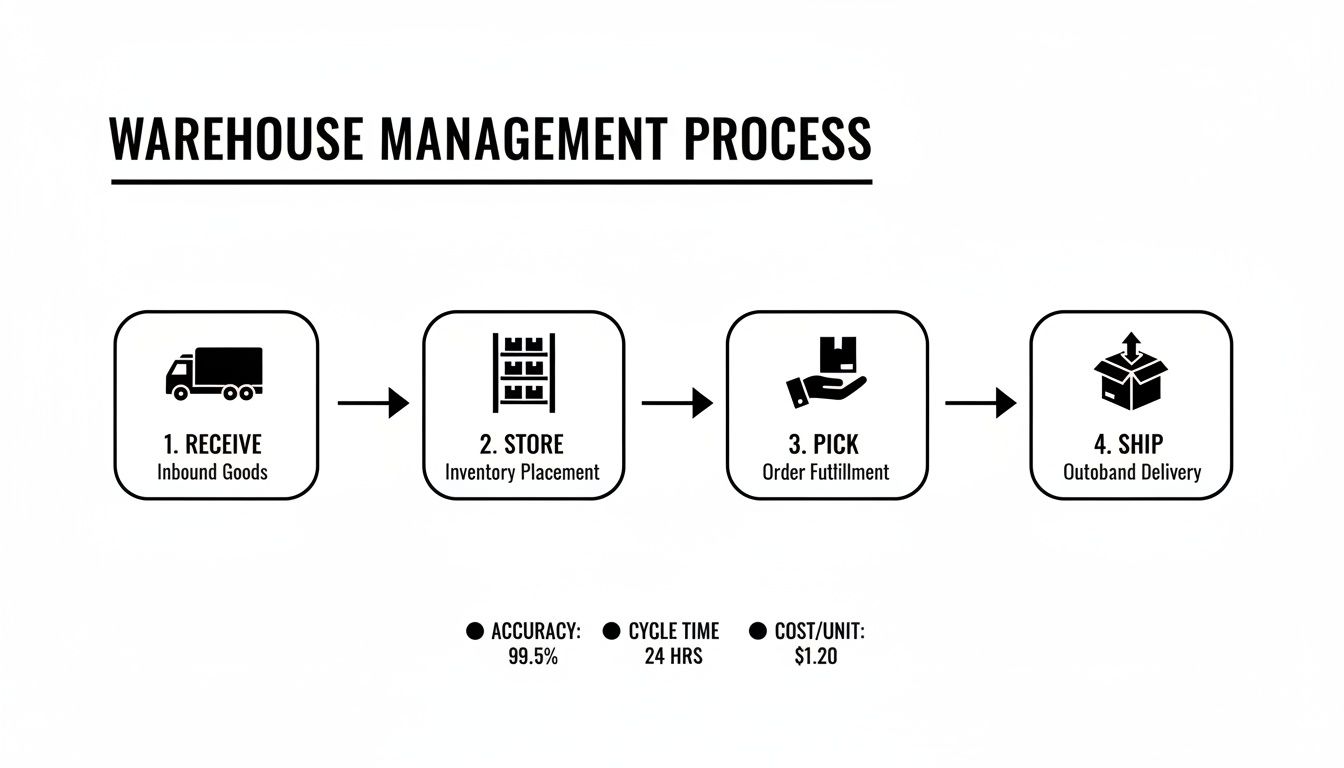
This diagram breaks down how a product moves from receiving to shipping—a journey where integrated data is your best defence against bottlenecks and mistakes.
A Practical Case from an Australian Distributor
Think about a mid-sized distributor in Sydney wrestling with disconnected systems. Their sales team, using a CRM, would often sell stock that the warehouse team, working off spreadsheets, couldn't actually find. It was a recipe for delayed shipments and unhappy customers.
They decided to team up with an expert Odoo partner in Sydney for a complete Odoo implementation. The mission was simple: bring everything together. They integrated their WooCommerce storefront, CRM, accounting, and warehouse operations onto a single Odoo platform.
The change was dramatic. Order fulfilment times plummeted by 40%, and their inventory accuracy shot up to 99.8%. Best of all, the leadership team finally had a single dashboard showing live sales, stock levels, and profitability, giving them the confidence to make sharp, strategic decisions.
This kind of software development in Sydney proves that integration isn't about chasing technology for its own sake. It’s about solving real-world business problems and building a solid foundation for future growth.
This is a massive deal for Australia's mid-market, which punches well above its weight. Disjointed systems are a major roadblock for many business leaders, but modern platforms like Odoo are finally replacing outdated spreadsheets with live analytics and actionable insights. For these businesses, making the switch is no longer a choice—it's how they stay in the game.
Standalone vs Integrated Systems: A Strategic Comparison
The difference between running siloed and unified systems isn't just academic; it has a daily impact on your team's stress levels and your bottom line. This table breaks down the real-world operational differences.
| Operational Area | Standalone Systems (Siloed) | Integrated WMS and ERP System (Unified) |
|---|---|---|
| Visibility | Limited to department-specific data. Sales can't see real-time stock. Finance works with outdated figures. | A single source of truth. Everyone from sales to the CEO sees live, accurate inventory, order status, and financial data. |
| Efficiency | High reliance on manual data entry between systems. Prone to human error, delays, and duplicated effort. | Automated workflows. An order in the ERP instantly triggers a pick list in the WMS. No manual intervention needed. |
| Inventory Accuracy | Frequent discrepancies between what the ERP thinks you have and what's actually on the shelf. Leads to stockouts or overstocking. | Near-perfect accuracy (99%+). Every scan, pick, and shipment in the WMS updates the ERP in real time. |
| Customer Service | Staff struggle to provide accurate order updates. Delays are common due to poor communication between sales and warehouse. | Customer service can see the exact status of any order, from picking to dispatch, leading to faster, more accurate answers. |
| Decision Making | Based on old, often conflicting data from different reports. It's like driving by looking in the rear-view mirror. | Strategic decisions are based on live, comprehensive data. You can spot trends as they happen and react with confidence. |
Ultimately, integration moves your business from a reactive state, where you're constantly putting out fires, to a proactive one, where you have the clarity and control to prevent those fires from starting in the first place.
To really get the most out of your systems, you need to understand how they can communicate flawlessly. You can explore an integrations ecosystem to see how deep these connections can go and the impact they can have on your operations.
If you’re ready to stop firefighting operational problems and start building a more efficient, profitable business, the answer lies in integration. A skilled Odoo partner in Adelaide or Sydney can design a solution that finally brings your entire operation into harmony.
Choosing the Right Integration Path for Your Business
Standing at a technological crossroads can feel daunting. Do you stick with your current ERP and bolt on a specialised, best-of-breed WMS? Or is it time for a bigger leap—an all-in-one platform like Odoo, where every piece is designed to work in perfect harmony from the get-go?
This isn’t just a technical question. It's a strategic business decision that will define your operations for years. The right answer isn’t a one-size-fits-all solution; it depends entirely on your unique situation—your company’s size, the intricacies of your industry, your budget, and most importantly, where you see yourself in five years.
Making the right architectural choice is what separates businesses that just manage their current workload from those that build a scalable foundation to actively drive growth.
All-in-One vs Best-of-Breed Systems
The first major fork in the road is deciding between two core philosophies. An all-in-one system, such as an Odoo implementation, gives you a single, unified platform. Every module—from inventory and accounting to CRM and sales—is built to communicate seamlessly. It simplifies your tech stack and gives you a single source of truth right out of the box.
The alternative is a best-of-breed approach. This involves hand-picking the top-rated standalone software for each specific function. You might pair a highly specialised WMS, renowned for its advanced robotics integration, with your existing financial ERP. This gives you incredibly deep functionality in one specific area, but it comes at a cost—the need for careful, and often expensive, integration to make the two systems talk. To get a handle on the nuts and bolts of connecting separate systems, you can learn more about the principles of system integration in our detailed guide.
The choice really boils down to a trade-off: do you want the seamless, built-in unity of an all-in-one platform, or the specialised power of a best-of-breed tool that needs custom plumbing to work? For most growing businesses, the long-term value is found in unity.
Critical Factors to Guide Your Decision
Before you commit to a path, you need to take an honest look at your business. A clear-eyed view of where you are now and where you’re heading will almost always make the right choice obvious.
- Company Size and Complexity: A small but ambitious WooCommerce store can absolutely thrive with Odoo's native modules, which are more than powerful enough for their needs. In contrast, a massive, multi-national 3PL with unique cold-storage requirements might genuinely need a niche, best-of-breed WMS.
- Budget and Total Cost of Ownership: An all-in-one system often comes with a more predictable cost structure. A best-of-breed strategy might seem cheaper upfront, but the hidden costs of custom integration, ongoing maintenance, and multiple vendor licences can spiral quickly.
- Your Five-Year Growth Plan: Are you planning to expand into new markets or launch new product lines? An integrated platform like Odoo is built to scale with you. You can simply switch on new modules like manufacturing or HR as you need them, without kicking off another complex integration project.
- Industry-Specific Needs: Some industries have non-negotiable demands. For example, pharmaceutical distribution requires ironclad lot and serial tracking, something many specialised WMS modules handle exceptionally well. Always map your must-have operational requirements against the features of any system you’re considering.
Practical Case: A Sydney eCommerce Business Transformation
Let's look at a real-world example. A growing Australian eCommerce business, based in Sydney, started its journey on Shopify. It was perfect in the beginning, but as they scaled, they hit a wall. Their inventory data in Shopify was a completely separate island from their accounting software and customer service platform.
The team was burning hours every day manually reconciling sales data, updating stock levels, and trying to answer customer queries with information that was already out of date. They were simply outgrowing their fragmented setup, and the operational cracks were becoming chasms.
They made the strategic call to migrate to a unified platform. Working with an expert Odoo partner in Sydney, they implemented Odoo to bring their entire operation under one roof, connecting their inventory, sales, accounting, and CRM.
The results were immediate and dramatic:
- Order processing became fully automated, from the moment a customer clicked “buy” to the package leaving the warehouse.
- Inventory accuracy shot up to 99%, which completely eliminated the costly and reputation-damaging problem of overselling.
- The leadership team gained a live, 360-degree view of the business, enabling them to make smart, data-backed decisions on everything from purchasing to marketing.
This kind of custom software development in Sydney didn't just plug the leaks in their operation; it gave them a robust platform that could grow with them. It’s a perfect illustration of how choosing the right integration path is one of the most critical investments you can make in your company’s future.
If you’re standing at this crossroads, unsure of which direction to take, we can help. As specialists in Odoo implementation and custom software solutions in Sydney and Adelaide, we’re here to help you analyse your needs and design a system that’s perfectly aligned with your long-term goals.
Ready to find your path? Let’s talk.
Let's Build Your Unified System Together
Figuring out the difference between a WMS and an ERP is one thing. But turning that knowledge into a real-world, high-performing system for your business? That's a whole different ball game, and it’s where a good partner becomes your most valuable asset. The genuine power of this technology isn't just in the software itself, but in how it's tailored to fit the unique rhythm of your operations.
At Wistec, we don't just sell software licenses. We're solution architects, dedicated to building practical, results-focused systems that tackle your biggest operational headaches and clear the path for growth.
The right technology partner won’t just install a program and walk away. They’ll dig deep into your workflow, pinpoint the real sources of inefficiency, and craft a system that gives you a genuine edge over the competition.
Real-World Solutions for Australian Businesses
We ground our work in practical applications, building systems that deliver measurable results for businesses right here in Australia.
- Manufacturing Overhaul: For a growing Adelaide-based manufacturer, we implemented a custom Odoo system. It bridged the gap between their sales team and the factory floor, slashing lead times and making their demand forecasting far more accurate.
- eCommerce Fulfilment: We helped a Sydney retailer by seamlessly integrating their Shopify store with their warehouse. The result was fully automated, error-free order fulfilment that just works.
- Custom Logistics Module: Our software development team in Sydney built a bespoke module for a third-party logistics provider, automating their complex shipping rules for WooCommerce clients. This simple fix saved their team hours of manual data entry every single day.
As your dedicated Odoo partner in Sydney and Adelaide, we go beyond off-the-shelf solutions. We deliver the whole package—from the initial discovery session and gap analysis right through to custom development and long-term support.
If you’re ready to see what a truly unified system can do for your business, the conversation starts now. Contact Wistec for a consultation, and let’s build your future, together.
Got Questions? We've Got Answers
Thinking about WMS and ERP systems often brings up more questions than answers. That's perfectly normal. Before you make a decision that will become the operational heart of your business, you need clear, honest information. Here are a few of the most common questions we hear, with straight-talking answers to help you see the path forward.
We’ve stripped out the tech jargon to give you the practical insights you need to make your next move with confidence.
How Long Does a WMS and ERP Integration Take?
This is the big one, isn't it? The honest answer is: it depends. The timeline is shaped by the complexity of your business, how many people need to use the system, and the amount of data we need to bring across. But forget the horror stories of multi-year projects that drag on forever – that’s not how modern implementations work.
As an experienced Odoo partner, Wistec takes a phased, agile approach. We don't try to boil the ocean. Instead, we focus on getting your most critical functions up and running first – think inventory, sales, and core accounting. This way, you start seeing real value in a matter of months, not years. You get a return on your investment much faster while we continue to build out and refine the rest of the system.
Can Odoo's WMS Module Replace My Standalone System?
For most retail, eCommerce, and distribution businesses, the answer is a resounding yes. The built-in Odoo WMS is no lightweight. It’s a seriously powerful tool that can manage everything from barcode scanning and smart picking routes to sophisticated inventory across multiple warehouses. The real magic is how it connects seamlessly with everything else in the ERP, creating a single source of truth that standalone systems simply can't offer.
Now, there are exceptions. If your operation involves highly specialised needs, like managing hazardous materials or integrating with advanced robotics, connecting a specialised "best-of-breed" WMS might be the smarter play. Our software development team, with folks in both Sydney and Adelaide, can dig into your specific workflow and help you figure out the best strategic fit.
The key is to assess whether your "specialised needs" are truly unique or if they are standard industry challenges that a flexible, modern ERP like Odoo can already solve efficiently.
What Are the First Steps for an Odoo Implementation?
Getting started with an Odoo implementation isn't a high-pressure sales pitch; it's a conversation. It all begins with us understanding the challenges you face every day.
- Discovery Call: The journey starts with a simple chat. You'll talk to an Odoo partner in Sydney or Adelaide from our team, and we'll just listen. We want to hear about your pain points, operational bottlenecks, and where you want to take the business.
- Gap Analysis: Next, we'll map your current ways of working against what Odoo can do out of the box. This helps us pinpoint exactly where the platform will make the biggest difference and what, if any, customisations are needed to fit you perfectly.
- Solution Design: With that knowledge, we craft an implementation plan designed just for you. It’s not a one-size-fits-all solution. It's a roadmap that directly addresses your goals, whether that means a fresh Shopify implementation, integrating with WooCommerce, or a complete ground-up operational rebuild.
This collaborative process ensures the system you end up with feels like it was built just for your business—because it was.
Ready to transform your operations with a system built for growth? At Wistec, we provide the expertise to unify your business processes seamlessly. Contact us today to schedule your discovery call.