

Why More and More Australian Businesses are Turning to Odoo
For too long, businesses have managed a messy collection of disconnected systems. You’ve likely seen it firsthand: an accounting platform from one vendor, a CRM from another, and a separate inventory tool that refuses to sync with anything else. As a result, this digital patchwork creates isolated data silos, wastes valuable hours on manual data entry, and increases the risk of costly errors.
To really get what makes Odoo special, you first need to understand the concept of Enterprise Resource Planning (ERP). At its heart, an ERP system is all about integrating these separate business functions into a single, cohesive whole.
A Game-Changer for Local SMEs
Let’s look at a practical case. Imagine an Odoo implementation in Sydney for a budding retail chain. They could start by connecting their point-of-sale terminals directly to their inventory and accounting modules. Instantly, they get a live, accurate picture of sales figures and stock levels across all their stores. No more late-night manual reconciliations.
Or consider a manufacturing firm in Adelaide. They could use Odoo to link their production floor operations with their supply chain management. This creates a beautifully efficient workflow, from ordering raw materials right through to shipping finished goods. The payoff is immediate and clear:
- Everything in Sync: Your core business functions finally talk to each other, creating one reliable source of truth for your entire operation.
- Smarter, Faster Decisions: When you have accurate, real-time data at your fingertips, you can make strategic choices with genuine confidence.
- Growth on Your Terms: The platform expands as you do. You can add new features and capabilities without the headache and expense of a complete system overhaul.
Odoo’s flexible, open-source model gives businesses in Sydney and Adelaide the power to finally break free from rigid, disconnected systems. It paves the way for smarter workflows and sustainable growth in a fiercely competitive local market.
This unique adaptability hasn’t gone unnoticed. In fact, Odoo now proudly sits among the top 5 ERP systems in the Australian market, holding its own against long-established giants like Oracle NetSuite and SAP Business One. Its surging popularity is down to its competitive pricing and a strong focus on local adaptations that solve the real-world challenges Australian SMEs face every day.
To give you a clearer picture, here’s a quick summary of what Odoo brings to the table for Australian SMEs.
Odoo Open ERP at a Glance
| Feature | Description | Key Benefit for Australian SMEs |
|---|---|---|
| Modular Architecture | A comprehensive suite of business apps (CRM, Sales, Accounting, Inventory) that can be installed individually. | Start small and only pay for what you need. Add functionality as your business grows without major disruption. |
| Open-Source Core | The source code is available for customisation, allowing for deep integration and tailored workflows. | Ultimate flexibility to adapt the software to unique local business processes, not the other way around. |
| Unified Database | All applications share a single, centralised database, eliminating data silos and manual entry. | A “single source of truth.” Improved data accuracy and real-time insights for better decision-making. |
| Cost-Effectiveness | Lower licensing fees compared to traditional proprietary ERP systems, with a transparent pricing model. | More accessible for SMEs with tighter budgets, offering a powerful ERP solution without the enterprise price tag. |
This table highlights just how well-suited Odoo is for the Australian market, combining powerful features with the flexibility and affordability that growing businesses need.
Whether you’re looking for a full-scale software development Sydney Adelaide team or simply need to integrate your existing Shopify implementation or WooCommerce stores into a more robust back-end system, Odoo provides the perfect foundation.
Ready to see how a truly unified system can transform your business? Contact Wistec today for a no-obligation consultation and discover how a tailored Odoo solution can drive your success.
Building Your Business Engine with Odoo Modules
Think of your business as a high-performance engine. For it to run smoothly, every part needs to work in perfect sync. A standalone sales system that doesn’t talk to your inventory is like a piston firing out of sequence—it creates friction, slows you down, and eventually leads to a breakdown. This is where the modular power of Odoo Open ERP truly shines.
Instead of a single, rigid piece of software, Odoo is a suite of interconnected business apps, or modules. You can start with just the essentials and add more as you grow, ensuring every part of your operational engine is perfectly synchronised. These modules aren’t just separate tools; they were designed from the ground up to share information and automate workflows between departments.
This is what it looks like in practice. You can see how core functions like sales, inventory, and accounting are all connected, creating a single, unified hub for your entire operation.
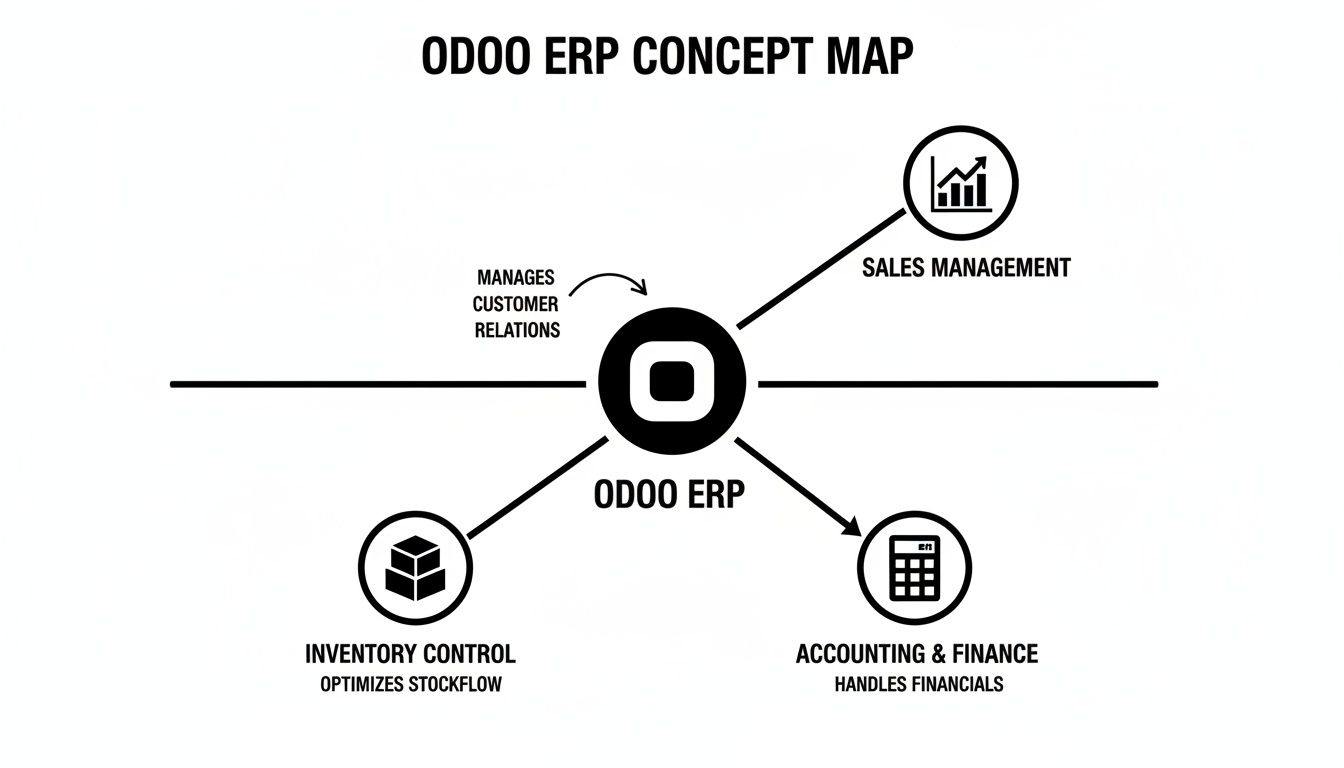
The real magic here is that data flows automatically. You get to eliminate the mind-numbing manual entry and the frustrating data silos that plague businesses using a patchwork of disconnected systems.
The Core Four Odoo Modules
While Odoo offers dozens of specialised apps, most businesses build their foundation on four core modules. Let’s walk through how they work together, using practical examples you’d see in a real Odoo implementation in Sydney or Adelaide.
-
Sales & CRM: This is where it all starts—the customer journey. The CRM module keeps track of every interaction, from the first contact right through to closing the deal. When a sale is confirmed in the Sales module, it doesn’t just sit there; it kicks off a chain reaction across the business.
-
Inventory Management: The moment a sales order is confirmed, the Inventory app gets an automatic notification. It reserves the product, updates stock levels in real-time, and can even generate a picklist for your warehouse team. This is a game-changer for e-commerce businesses managing a WooCommerce or Shopify implementation, as it prevents overselling and keeps stock counts accurate across all channels.
-
Accounting: Once the goods are shipped, the system automatically creates a customer invoice in the Accounting module. No more chasing down sales details or asking your finance team to re-enter data. This direct link gives you an accurate, up-to-the-minute view of your revenue and accounts receivable.
A Practical Case from an Adelaide Retailer
Imagine an Adelaide-based retailer with a physical storefront and a busy WooCommerce website. Before Odoo, managing stock was a complete nightmare. An item sold in-store wouldn’t be reflected online until someone manually updated the website, leading to disappointed customers trying to buy something that was already gone.
After their Odoo implementation in Adelaide, their process was unrecognisable. When a customer buys a product in their shop, the Point of Sale (POS) system—another Odoo module—instantly updates the central inventory. That change is immediately pushed to their WooCommerce store, marking the item as sold. No manual updates. No stockouts. No frustrated customers. That’s the power of a truly integrated system.
By connecting sales, inventory, and accounting, Odoo gives you a complete, 360-degree view of your operations and customer profitability. You can see not just what a customer bought, but also the real cost and margin of every single transaction.
Beyond the Core: Your Growth Partner
This seamless integration extends far beyond just these four modules. Need to manage manufacturing? Add the MRP module. Expanding your team? Implement the HR and Recruitment apps. This is where expert software development in Sydney and Adelaide becomes so valuable. A skilled partner can help you identify the right modules and customise them to fit your unique workflows perfectly.
The beauty of the Odoo Open ERP platform is its ability to scale with you. You build the engine your business needs today, knowing you have a clear, simple path to add more power and capability tomorrow.
Ready to see how these modules can build a more efficient engine for your business? Get in touch with Wistec for a personalised demo and see the synergy in action.
Odoo Implementation Success Stories in Australia
Theory is one thing, but what really matters in business is seeing tangible results. The true power of an Odoo Open ERP system snaps into focus when you see it solving real-world problems for local companies. So, let’s step away from the feature lists and dive into some success stories from Australian businesses that turned operational chaos into streamlined success.
These examples aren’t just one-off wins; they point to a much bigger trend. We’re seeing Australian businesses adopting Odoo achieve massive operational gains. Some are reporting 35% reductions in administrative costs within six months and 40% faster order fulfilment.
One of the most impressive examples comes from a Sydney retailer who integrated Odoo with their e-commerce platform. By finally getting a single view of their inventory, they slashed stock discrepancies by an incredible 95% and boosted their online conversions by 20% in just half a year. You can read more about these impressive trends and what they mean for the future of business management.
From E-commerce Chaos to Clarity in Sydney
Let’s look at a practical case of a fast-growing online brand based in Sydney. Their products are flying off the digital shelves, but behind the curtain, their operations are a tangled mess. They built their business on a popular Shopify implementation, but as orders surged, the cracks started to show.
Their core problem was a classic case of disconnected systems. Shopify was brilliant for sales, but it wasn’t talking to their separate inventory software or their customer database. This created a domino effect of expensive problems:
- Inaccurate Inventory: Stock levels were all over the place, leading to them overselling popular items and having to break the bad news to customers.
- Fragmented Customer Data: Information was scattered, making it nearly impossible to deliver personalised marketing or provide genuinely helpful support.
- Manual Reconciliation: Staff were burning hours every week just trying to match sales orders with stock counts—a tedious and error-prone grind.
The business was hitting a wall, held back by its own clunky processes. They didn’t just need another app; they needed a central nervous system. This is where a strategic Odoo implementation in Sydney became their game-changer.
By integrating Shopify directly with Odoo’s Inventory, Sales, and CRM modules, the business created a single source of truth. The results were immediate and profound.
The moment an order came through on Shopify, Odoo instantly updated inventory levels everywhere. Customer details flowed straight into the Odoo CRM, giving the team a complete picture of every interaction and purchase. The outcome? Stock discrepancies practically vanished, dropping by a staggering 95%. This newfound accuracy didn’t just make customers happier; it freed up the team to focus on growing the business instead of constantly putting out fires.
Manufacturing Efficiency Transformed in Adelaide
Now, let’s head over to Adelaide with another practical case showing how Odoo reshaped a completely different industry. A mid-sized manufacturing firm was stuck in the dark ages with a paper-based workflow. Their production line was a total black box—managers had no real visibility into progress, tracking raw material usage was a guessing game, and coordinating with suppliers was a constant headache.
They knew they needed to modernise, but were wary of the cost and complexity of traditional manufacturing ERPs. The flexible, modular nature of Odoo Open ERP was the perfect fit. They brought in an expert for an Odoo implementation in Adelaide, zeroing in on the Manufacturing and Supply Chain modules.
The change was immediate. Their entire production process—from ordering raw materials to shipping out finished goods—was now managed from one unified system.
- Real-Time Production Tracking: They introduced barcode scanning on the shop floor, which let them track the progress of every single job in real-time.
- Automated Procurement: The system was set up to automatically generate purchase orders when stock levels hit a certain point, preventing costly production delays.
- Streamlined Logistics: Odoo’s supply chain tools helped them optimise their warehousing and delivery routes, cutting costs and getting products to customers on time.
This expert software development in Adelaide delivered far more than just a new program; it gave them a fundamentally smarter way to work. The firm saw huge gains in production efficiency, cut down on material waste, and finally got the clear insights they needed to make confident business decisions.
These stories highlight a crucial point: Odoo isn’t just software. When it’s implemented thoughtfully, it becomes a core engine for business growth and efficiency.
Ready to write your own success story? Book a complimentary consultation with Wistec, and let our experts show you how a tailored Odoo solution can solve your unique business challenges.
Choosing the Right Odoo Deployment Model
Picking the right deployment model for your Odoo Open ERP is a lot like deciding where to build your house. Are you buying a ready-made home in a managed estate, commissioning a custom build on a serviced plot, or buying a block of land and handling everything yourself? Each path has its pros and cons, and your choice will shape everything from your budget and control to the technical know-how you’ll need on hand.
Odoo’s incredible flexibility means you’re not shoehorned into a single option. Instead, you can select a foundation that genuinely fits your company’s scale, resources, and vision for the future. Getting this first step right is crucial for a successful implementation that grows with you.
Cloud vs On-Premise: The Core Decision
At its heart, the decision boils down to a simple question: do you want to manage your own servers, or would you prefer someone else to handle the technical side of things? This is the classic cloud versus on-premise debate. To get a handle on the fundamentals, understanding the differences between on-premises and cloud solutions is a great starting point.
Odoo gives you fantastic options, no matter which way you lean. Let’s unpack the three main ways you can run your system.
Odoo Deployment Model Comparison
Before we dive deep, this table gives a quick snapshot to help you see how the models stack up against each other. It’s a great starting point for figuring out which path aligns best with your business.
| Deployment Model | Best For | Control & Customisation | Cost Structure |
|---|---|---|---|
| Odoo Online (SaaS) | Startups and smaller businesses need a fast, straightforward ERP with standard features. | Low. You can only use the certified apps from the Odoo App Store. | Simple and predictable monthly subscription fee. |
| Odoo.sh (PaaS) | Growing companies that need custom modules or specific integrations (like a Shopify implementation or WooCommerce). | High. Gives you the freedom to install third-party apps and develop your own code. | A flexible subscription based on users, apps, and server resources. |
| On-Premise | Large enterprises with unique compliance rules or those needing deep, complex customisations. | Ultimate. You have total control over the server, the database, and every line of code. | A significant upfront investment in hardware, plus ongoing costs for your IT team. |
Now, let’s explore what each of these options really means for your day-to-day operations.
A Deeper Look at Your Options
Odoo Online (SaaS): The “Just Works” Solution
Think of Odoo Online as the ultimate turnkey option. It’s a Software-as-a-Service (SaaS) model, which means you pay a subscription, and Odoo takes care of absolutely everything else—the hosting, the security, the backups, the updates. It’s the quickest and easiest way to get up and running.
This is the perfect choice for businesses that want all the power of Odoo without any of the IT headaches. The trade-off for this simplicity? Your customisation options are limited to the official apps Odoo provides. You can’t install external modules or make changes to the core code.
Odoo.sh (PaaS): The Sweet Spot for Customisation
Odoo.sh is a Platform-as-a-Service (PaaS) that brilliantly combines the convenience of the cloud with the power of customisation. Odoo still manages the servers and infrastructure for you, but you get full administrative access to your Odoo instance.
This is where things get exciting. You can install any third-party app you like, develop your own custom modules, and build sophisticated integrations with other business systems.
For example, a growing e-commerce business needing a custom link to their Shopify store or a unique workflow for their WooCommerce site would feel right at home on Odoo.sh. It provides the flexibility for specific software development in Sydney and Adelaide without forcing you to become a server management expert.
On-Premise Hosting: The Ultimate in Control
Going On-Premise means you’re in the driver’s seat. You install and run Odoo on your own servers, whether they’re sitting in a rack in your office or hosted in a private cloud environment. This path gives you complete, unfiltered control over every single aspect of the system.
You have the freedom to modify, integrate, and customise Odoo to meet your exact business processes. It’s the go-to solution for companies with strict data security policies, complex integration needs, or those planning a truly bespoke Odoo implementation in Sydney, Adelaide. Of course, with great power comes great responsibility—you’ll need an in-house IT team ready to handle all the maintenance, security, and updates.
Ready to figure out which deployment model makes the most sense for your business? Contact Wistec today for a no-obligation consultation, and let our experts help you build on the right foundation.
The Critical Role of an Expert Implementation Partner
Deciding to invest in a powerful platform like Odoo Open ERP is a fantastic first step. But here’s something I’ve seen time and again: the best software in the world is only as good as its implementation. Thinking you can go it alone is a common, and often costly, mistake that can quickly turn a brilliant strategic investment into a source of endless frustration.

Without an experienced guide, businesses stumble into the same predictable traps. They struggle with messy data migrations, which poison reporting from day one. They try to set up workflows that don’t match how their team actually gets things done, creating friction and pushback. The result? Low user adoption, and your powerful new system ends up gathering digital dust.
Why a Specialist Partner is Non-Negotiable
This is where the value of a specialist implementation partner becomes undeniable. An expert partner does so much more than just install software; they become your strategic guide, making sure the system is purpose-built to smash your specific business goals.
Their work starts long before a single line of code is written. A true partner dives deep into your business with a thorough needs analysis, getting to the heart of your unique challenges, processes, and ambitions. From there, they map out a clear plan that perfectly aligns the technology with your desired outcomes.
An expert partner’s job is to bridge the gap between Odoo’s potential and your reality. They ensure the platform adapts to your business—not the other way around—safeguarding your investment and guaranteeing a return.
This hands-on expertise is especially vital when it comes to customisation. Maybe you have a unique Shopify implementation that needs flawless inventory syncing, or a complex WooCommerce store demanding specific sales workflows. A partner brings the software development know-how to make it happen, seamlessly. They also provide comprehensive training to get your team excited and on board, plus the crucial ongoing support you’ll need down the track.
The Local Advantage for Sydney and Adelaide Businesses
For businesses in Sydney or Adelaide, choosing a local partner adds another powerful layer of value. An Australian-based team doesn’t just get the technology; they get the local business environment. They live and breathe Australian compliance rules, tax laws, and market nuances.
This local knowledge is priceless. Consider this practical case: a manufacturing firm in Adelaide needs Odoo configured for specific state labour regulations, or a Sydney retailer needs their system to handle Australian GST perfectly across every single sales channel. A local partner navigates these complexities without breaking a sweat.
Working with an expert sets your project up for success from the very beginning. You gain a team that can provide on-the-ground support, genuinely understands your market, and is committed to your long-term growth.
Don’t leave your success to chance. Contact Wistec today for a complimentary consultation and discover how our expert Odoo implementation Sydney Adelaide team can make a real difference to your business.
Ready to Take the Next Step?
You’ve seen what’s possible. We’ve walked through how Odoo Open ERP can pull your entire business together, creating a single source of truth and a solid foundation to build on. The next move is yours: turning all that potential into a tangible reality for your company.
This is about more than just swapping out old software; it’s a strategic move towards smarter, more efficient growth. The Australian ERP market is on a steep climb, valued at USD 930.2 million and projected to hit USD 1,170.6 million by 2030. As the market races towards that 1.17 billion mark, Odoo’s smart design gives businesses a real edge. Think about what cutting administrative costs by 35% or slashing inventory waste by 22% could do for your bottom line. This isn’t just theory; it’s why Odoo is fast becoming a go-to for Australian businesses. You can discover more insights about Odoo in Australia right here.
Your Path to a More Connected Business
Getting started might seem like a huge mountain to climb, but it really doesn’t have to be. Whether you’re after a full Odoo implementation Sydney Adelaide businesses trust, or you need expert software development Sydney Adelaide specialists to connect your existing tools, the key is having a clear plan. We specialise in making sure Odoo talks to the platforms you already rely on, creating a truly seamless workflow.
We often help businesses link up popular e-commerce platforms like:
- Shopify implementation: Finally, your online sales, inventory, and accounting can all work as one.
- WooCommerce: Keep your stock levels and customer data perfectly synchronised between your website and your warehouse.
This isn’t just another sales pitch. It’s an opportunity for us to sit down, listen to what’s holding you back, and map out exactly how a properly configured Odoo system can help you get where you want to go.
Why not book a complimentary, no-obligation chat with our team? Let us show you what a difference Odoo can make and help you take that crucial first step towards unlocking your business’s true potential.
Ready to see how it all works? Contact Wistec today for a free consultation, and let’s build your future together.
Your Odoo Questions, Answered
Jumping into the world of enterprise resource planning can feel a bit overwhelming, and it’s completely normal to have a few questions. When you’re thinking about whether Odoo Open ERP is the right move for your business, you need clear, no-nonsense answers. Here, we tackle the most common queries we get from Australian businesses just like yours.
We want to give you the practical insights you need to make a decision you feel good about. Let’s get into it.
Is Odoo a Good Fit for Small Businesses?
Without a doubt. In fact, Odoo’s scalability is one of its biggest selling points, making it an ideal choice for small and growing businesses. Its whole design is modular, meaning you can start small and only pay for what you actually need.
A practical case would be a startup in Sydney. They could kick things off with just the essentials, like the Sales and Accounting apps, which keep their initial investment low. As their operations grow, they simply plug in new modules as they go. This “grow-as-you-go” model is a world away from the massive upfront costs of traditional ERPs, making it a far more sensible option for SMEs. A simple Odoo implementation that just covers CRM and Invoicing can be a game-changer.
Can Odoo Integrate with My Existing E-commerce Store?
Yes, and this is where Odoo really shines for modern retailers. It’s built to connect smoothly with all the major e-commerce platforms. So, whether you’re running a Shopify implementation or a well-established WooCommerce store, Odoo can slot right in as the central brain of your operation.
The integration syncs your inventory, sales orders, and customer details automatically and in real time. Picture this practical case: a product sells on your website, your warehouse stock levels update instantly, and a sales order pops up in Odoo. No more manual data entry, no more accidentally selling stock you don’t have. It just works.
What’s the Difference Between Odoo Community and Enterprise?
This is probably the most important question we get asked. It’s best to think of it like this:
- Odoo Community: This is the free, open-source version. It’s a fantastic starting point with a solid set of core business apps. However, it misses out on some of the more advanced features and doesn’t come with official support from Odoo. It’s a solid choice if you have a skilled technical team in-house who can manage the customisation and upkeep.
- Odoo Enterprise: This is the paid, subscription-based version. You get everything in the Community edition, plus a suite of powerful extra apps (like the full-featured Australian Accounting module), unlimited support, and regular, seamless upgrades. For most businesses, especially those that need their systems to be reliable without a dedicated IT crew, Enterprise is the way to go.
The decision between Community and Enterprise really boils down to your in-house technical skills and how much you value having comprehensive support on hand. A good partner will help you figure out which version delivers the best value for your specific situation.
While expert software development in Sydney and Adelaide can customise either version, starting with Enterprise gives you a much stronger and more reliable foundation for your core operations. A partner ensures you’re making the most of whichever edition you choose.
Your business needs a system that brings everything together, runs efficiently, and can grow with you. At Wistec, we build practical, results-focused Odoo solutions designed specifically for the challenges Australian businesses face.
Ready to see how it all works? Contact Wistec today for a complimentary consultation, and let’s explore what Odoo can do for you.