

So, what exactly is Odoo ERP, and why is it making such waves for Aussie businesses?
Think of it as the central nervous system for your entire company. It’s a suite of business management tools designed to connect all your operations—from sales and inventory to accounting and marketing—into one single, cohesive system. No more juggling different software, no more messy spreadsheets, and no more data silos. Just a single source of truth that gives you a crystal-clear, real-time view of everything that's happening.
Ready to see how a unified system can transform your operations? Let's discuss a tailored Odoo implementation in Sydney or Adelaide. Contact our experts for a complimentary consultation today.
What Is Odoo ERP And Why Is It A Game Changer For Australian Businesses?
Imagine your business is an orchestra. Your sales team is the strings section, inventory is the percussion, accounting handles the woodwinds, and marketing is the brass. Each department can play its part, sure, but without a conductor, you don't get music—you get noise. That's what happens when you're running on disconnected apps and manual processes. It’s chaotic and inefficient.
Odoo ERP steps in as the conductor, making sure every part of your business plays in perfect harmony.
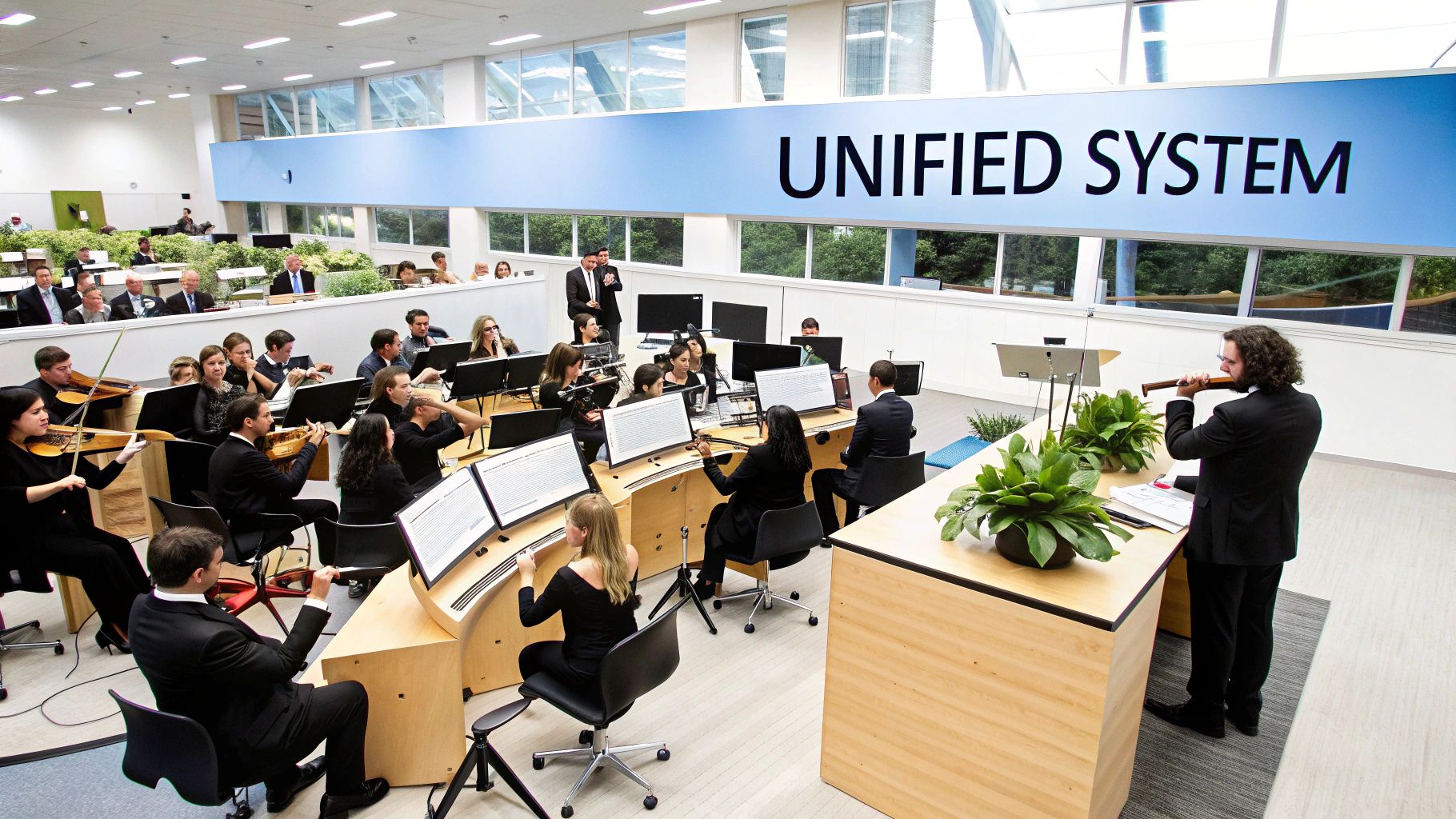
It’s a powerful software platform that replaces that messy patchwork of different tools with one elegant, unified system. Instead of fighting with separate software for your CRM, e-commerce, and project management, Odoo brings it all under one roof. This directly tackles the biggest headaches that stunt growth: scattered data, wasted time on mind-numbing tasks, and a frustrating lack of visibility.
The demand for this kind of integration is booming right here in Australia. The local ERP software market was valued at USD 930.2 million in 2024 and is tipped to hit USD 1170.6 million by 2030. In this competitive space, Odoo has carved out a serious slice of the pie, currently holding around 15% of the market share for small and medium-sized enterprises (SMEs). That figure is expected to jump to 25% by 2027. You can explore more on these market trends here.
Let’s break down how Odoo turns operational chaos into a streamlined powerhouse.
Odoo ERP At A Glance: Unifying Core Business Functions
The table below illustrates the common problems businesses face when their functions are isolated, and how Odoo brings them all together.
| Business Function | The Problem Without Odoo | How Odoo Provides The Solution |
|---|---|---|
| Sales & CRM | Customer data is scattered across emails and spreadsheets, leading to lost leads and poor follow-up. | A centralised CRM tracks every interaction, from first contact to final sale, all in one place. |
| Inventory | Stock levels are a guessing game. You either run out of popular items or overstock slow movers. | Real-time inventory tracking automatically updates stock counts across all channels (online and in-store). |
| Accounting | Manual invoicing and expense tracking is slow, tedious, and prone to human error. | Automated invoicing, bank reconciliation, and financial reporting save hours of manual work. |
| E-commerce | Your online store operates separately from your warehouse, causing sync issues and order errors. | Seamless integration means online orders instantly update inventory and flow straight into accounting. |
| Manufacturing | No clear visibility over the production line, from raw materials to finished goods. | End-to-end management of bills of materials, work orders, and supply chain logistics. |
| Marketing | It's difficult to measure campaign ROI because marketing efforts aren't linked to actual sales data. | Integrated marketing automation lets you track campaign performance and link it directly to revenue. |
As you can see, the Odoo approach isn’t just about having different tools; it’s about making them talk to each other intelligently.
Built For The Modern Australian Business
One of Odoo's biggest strengths is its modular design. You don't have to buy a massive, one-size-fits-all package. You can start with just the apps you need right now—say, Sales and Inventory—and then bolt on others as your business expands. This 'grow with you' approach is perfect for Australia’s dynamic business environment.
- Practical Case (Retail): A business running a WooCommerce store can use Odoo to automatically sync stock levels between their website and physical shops. No more manual updates after a weekend market sale.
- Practical Case (Manufacturing): A workshop in Adelaide can use Odoo to get complete visibility over its supply chain, tracking production from the moment raw materials arrive to when the finished product ships out.
- Practical Case (Services): A consulting firm in Sydney can manage projects, track billable hours for its team, and automate invoicing, all from within a single, connected system.
The real power of Odoo isn’t just in what it does, but in how it connects everything. When a sale is made on your website, inventory is updated, an invoice is generated in accounting, and the customer record is logged in your CRM—all without a single manual entry.
This level of seamless integration gives you a massive advantage. It doesn't matter if you're managing a complex Shopify implementation or need custom software development in Sydney or Adelaide; centralising your data gives you the clarity you need to make smarter, faster decisions.
Ready to see how a unified system can transform your operations? Let's discuss a tailored Odoo implementation in Sydney or Adelaide. Contact our experts for a complimentary consultation today.
Exploring The Core Odoo Modules That Power Growth
It’s easy to think of Odoo ERP as just one big piece of software, but that misses the point entirely. Its real power is in its modular design—a collection of individual, yet seamlessly connected, "apps" that cover every part of your business.
You don't have to bite off more than you can chew. You start with the essentials and bolt on new modules as your business evolves. This pick-and-mix approach is precisely what makes the Odoo ERP system so brilliantly adaptable and cost-effective.
Let’s unpack the core modules that Australian businesses consistently find invaluable, focusing not just on what they do, but the real-world results they deliver.
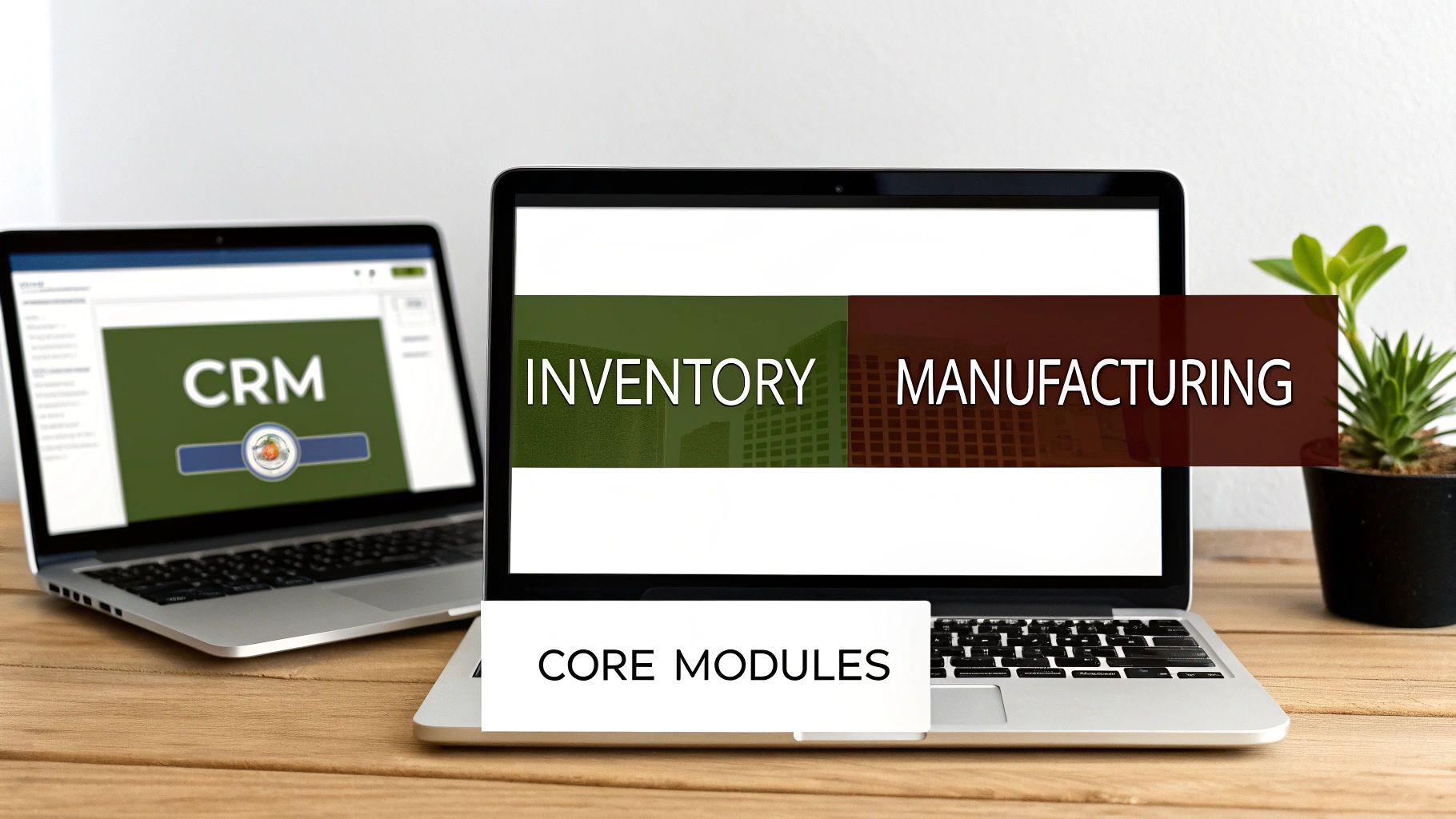
CRM And Sales For Customer Management
The heart of any successful business is the relationship it has with its customers. Odoo’s CRM and Sales modules work together like a well-oiled machine to manage this entire journey, from that first curious enquiry to the final sale and beyond.
Imagine a potential customer fills out a form on your website. Instead of that lead getting buried in someone’s inbox, it’s instantly captured in the Odoo CRM. Your sales team gets an immediate, clear view of the new opportunity. They can track every interaction, set follow-up reminders, and visually drag the deal through a sales pipeline. It completely removes the guesswork and ensures no one ever falls through the cracks.
Once you’ve won the deal, the Sales module steps in. It lets you fire off professional quotes and sales orders in just a few clicks. But here’s the clever bit: because it’s all integrated, the moment a sale is confirmed, the system can automatically tell the Inventory module to reserve the stock and nudge the Accounting module to generate an invoice. That seamless flow is what real efficiency looks like.
Inventory And E-commerce For Modern Retail
If you sell physical products, you know that managing inventory is a constant battle. This is especially true if you’re juggling a brick-and-mortar store with online platforms like Shopify or WooCommerce. The Odoo Inventory module becomes your single source of truth for every single item you stock.
Practical Case: A Sydney-based retailer using Shopify was plagued by overselling. Their website would happily sell an item that was out of stock in the warehouse, leading to cancelled orders and frustrated customers. By bringing in Odoo, they achieved real-time stock synchronisation. A sale on Shopify instantly updated the inventory count in Odoo, which was visible to staff in their physical stores. This one change eliminated stock headaches and boosted customer satisfaction overnight.
This integration is about more than just stock levels. When you look at e-commerce platform comparisons, you see platforms that handle the front end well. Odoo’s advantage is in unifying the entire back end—from the moment an online order is placed to the warehouse team picking and shipping it.
Manufacturing For Streamlined Production
For Australian producers, whether you’re making artisan foods or custom machinery, tight control over the production line is non-negotiable. The Odoo Manufacturing module gives you a complete command centre for your entire operation, from raw materials to finished goods.
You can manage complex Bills of Materials (BOMs)—the recipes for your products—and issue detailed work orders for your production floor. The module helps you plan production runs based on sales forecasts and current stock, making sure you always have the right materials on hand when you need them.
Practical Case: An industrial equipment manufacturer in Adelaide used Odoo to get total visibility over their supply chain. They could track a component from the moment it was ordered from a supplier all the way through to final assembly. This allowed them to spot production bottlenecks, slash waste, and give customers accurate lead times—a huge competitive advantage.
This level of insight ensures quality and efficiency at every single stage.
Putting It All Together
The real magic happens when these modules start talking to each other. A single customer order can set off a chain reaction across sales, inventory, accounting, and even manufacturing, all without a single person needing to re-enter data.
This is how that interconnectedness eliminates errors and frees up your team to focus on growing the business:
- Sales Module: Kicks things off by creating the order and the invoice.
- Inventory Module: Checks stock and triggers a shipping notice.
- Manufacturing Module: If stock is low, it can automatically create a production order.
- Accounting Module: Keeps an eye on the payment and updates your financial reports.
Whether you need a full Odoo implementation in Sydney to get up and running or specialised software development in Adelaide to tweak a module to your exact needs, the system is designed to grow with you.
Ready to see how these core modules can be tailored to solve your specific business challenges? Contact our expert team today for a no-obligation consultation and discover how a unified Odoo ERP can drive your business forward.
How Odoo is Making a Real Difference for Aussie Businesses
Theory is one thing, but seeing real-world results is what truly matters. It’s easy to talk about features and modules, but the real test of any system is how it solves the frustrating, day-to-day problems that Aussie businesses face.
Let's move past the brochure talk and look at how Odoo is actually delivering tangible outcomes for companies right here in Australia. These practical cases show how businesses in completely different sectors—from fast-paced online retailers to precision manufacturers—are using Odoo to work smarter, cut costs, and ultimately serve their customers better.
The Sydney Retailer Now Owning the E-commerce Game
If you're in online retail, you know that inventory is king. A great example comes from a Sydney-based retailer who was constantly fighting a losing battle with stock levels between their physical stores and their popular Shopify site.
They were facing the classic, painful scenario: a customer orders something online that shows as 'in stock', only for the warehouse team to find the shelf empty. This led to cancelled orders, unhappy customers, and a lot of lost revenue. By integrating Odoo’s Inventory and Sales modules with their Shopify implementation, they finally created a single, real-time source of truth for their stock.
The results were stunning. Within just six months, they saw a 95% drop in stock discrepancies and a 20% jump in online sales conversions.
This wasn't just about one number; it created a positive ripple effect through the entire business:
- Faster Fulfilment: With data they could finally trust, the warehouse crew could pick and pack orders with speed and accuracy. No more frantic searching for ghost products.
- Happier Customers: Shoppers could buy with confidence, which meant fewer abandoned carts and more repeat business.
- Smarter Decisions: Management finally had a clear picture of what was selling and where, allowing them to make much better calls on purchasing and marketing.
This story is a perfect illustration of how an Odoo implementation in Sydney can bridge that critical gap between online storefronts, like Shopify or WooCommerce, and the real-world operations happening in the back. Want to see more? Check out some other Odoo success stories in Australia.
Precision Manufacturing Finally Achieved in Adelaide
Now, let's head over to Adelaide and switch gears from retail to manufacturing. A mid-sized firm there was trying to run their production schedule with a messy combination of spreadsheets and disconnected software. It just wasn't working. The chaos led to constant delays, and they could never give customers a straight answer on when their order would be ready.
By bringing in Odoo’s Manufacturing, Purchase, and Inventory modules, they completely changed the game.
For the first time, they had a live dashboard view of the entire factory floor. Planners could see exactly where every single work order was, check machine capacity in real-time, and spot a potential material shortage long before it brought the production line to a halt.
This end-to-end visibility was a revelation. The purchasing team started getting automatic alerts when stock ran low, and the sales team could confidently give new clients accurate lead times. It all led to a 30% reduction in production downtime and a massive boost to their on-time delivery rate, helping them stand out in a tough market. This is the kind of granular control businesses are often looking for when they seek expert software development in Adelaide.
Getting a Service-Based Business Firing on All Cylinders
But Odoo isn't just for businesses with physical products. Think about a national consulting firm with teams spread all over the country. They were wrestling with inconsistent invoicing, patchy timesheets, and almost no real insight into which projects were actually making money.
They brought in Odoo’s Project, Timesheet, and Accounting modules to build a single, streamlined workflow.
- Clear Project Setup: Every new client job was created as a project in Odoo, with clear tasks, deadlines, and budgets from the get-go.
- Effortless Time Tracking: Consultants could easily log their hours against specific project tasks using Odoo's simple timesheet app on their phones or laptops.
- Flawless Invoicing: At the end of the month, the system would automatically generate spot-on invoices from the approved timesheets. Not a single billable hour was ever missed again.
This simple, connected process meant they got paid faster, but more importantly, the leadership team finally had a live dashboard showing project profitability and how effectively their team was being utilised. It’s a powerful reminder of how flexible the Odoo ERP platform is.
These examples are just a glimpse of what's possible, but the common thread is clear: a single, integrated system gets rid of the guesswork and the soul-crushing manual work.
Ready to write your own success story? Whether you need a sophisticated Odoo implementation in Sydney or custom software development in Adelaide, our team is here to help you build a solution that delivers real, measurable results. Contact Wistec today for a complimentary consultation, and let's start mapping out your path to a more efficient future.
The Financial And Operational Benefits Of Using Odoo ERP
Switching your core business system is a massive decision, and the first question is always the same: "What's the payoff?" With Odoo ERP, the benefits aren't just lines on a spreadsheet; they're real-world financial and operational wins that boost your bottom line and sharpen your competitive edge.
Let’s get straight into how Odoo makes this happen.
Financially, Odoo completely rewrites the cost-benefit analysis. Old-school ERP systems often demand crippling upfront licence fees, draining your capital before you've even seen a single result. Odoo turns that model on its head. Instead, you get a flexible and genuinely affordable subscription service.
This simple shift means you can pump that cash back into things that actually grow the business—marketing, R&D, or hiring your next star employee. It’s a much smarter, more sustainable way to get your hands on top-tier business tools without the financial hangover.
Boosting Your Operational Engine
But the direct cost savings are only half the story. Odoo's real magic is in how it transforms your day-to-day operations. By bringing everything under one roof, it gets rid of the friction you feel when juggling disconnected software. Clunky, manual tasks become smooth, automated workflows.
When data flows effortlessly between your sales, warehouse, and finance teams, the entire business just works better. Odoo's integrated design is perfect for achieving Straight Through Processing (STP), cutting out manual double-handling and dramatically speeding up processes. This means customer orders fly through the system, inventory levels are spot-on, and your financial reports are always up to the minute.
The result is a business that runs with less waste and greater precision. Your team spends less time wrestling with spreadsheets and re-keying information, and more time on the strategic work that actually creates value for your customers.
This kind of operational clarity is a huge confidence booster when it's time to make big decisions. With all your data in one place, you get real-time dashboards that paint a clear, honest picture of how things are going. You can spot trends early, fix bottlenecks before they become disasters, and jump on opportunities with speed and certainty.
Built For Australian Business Realities
For businesses here in Australia, Odoo isn't just a generic tool with a few local tweaks. It's built with our specific business landscape in mind, which saves a mountain of time and compliance headaches. The system comes ready to handle critical local requirements right out of the box, including:
- GST Reporting: Your financials are pre-configured for Australian Goods and Services Tax, making compliance a breeze.
- Single Touch Payroll (STP): Payroll reporting to the ATO is automated, so you can meet your obligations without even thinking about it.
- Modern Awards Tools: It helps you navigate the complexities of pay rates and conditions unique to Australian industries.
These aren't just minor conveniences; they're powerful features that free your team from hours of tedious admin. The appeal for Aussie businesses really comes down to this smart blend of cost-effectiveness and scalability. With no massive upfront licence fees and plans starting as low as $12.50 per user per month, companies can put their savings straight back into growth. We’ve seen case studies where businesses achieved a 35% reduction in administrative costs, 22% less inventory waste, and 40% faster order fulfilment. You can find more insights on Odoo's standing in the Australian market here.
So whether you need a new Shopify implementation, a smarter way to manage your WooCommerce store, or expert software development in Sydney or Adelaide, the benefits of an Odoo ERP are crystal clear. It gives you a strong, affordable, and localised platform to build your future on.
Ready to see how these benefits could look in your business? Contact Wistec for a complimentary consultation and let's explore how a tailored Odoo implementation in Sydney or Adelaide can truly transform your operations.
Your Step-By-Step Guide To A Successful Odoo Implementation
Deciding to bring a powerful Odoo ERP into your business is a fantastic first step. But now comes the real work: the implementation. Getting this right isn't about just flipping a switch; it's a carefully managed journey that turns a great idea into a practical, business-driving reality.
This isn’t just some technical checklist. Think of it as a strategic roadmap designed to get your business, your team, and your data ready for a smooth transition. By breaking the process down into clear, manageable phases, you can lead the change with confidence and sidestep the common pitfalls that can derail a project.
The ultimate goal? To unlock the core benefits shown below, starting with direct cost savings, which leads to better data, and finally, gives you back more time.
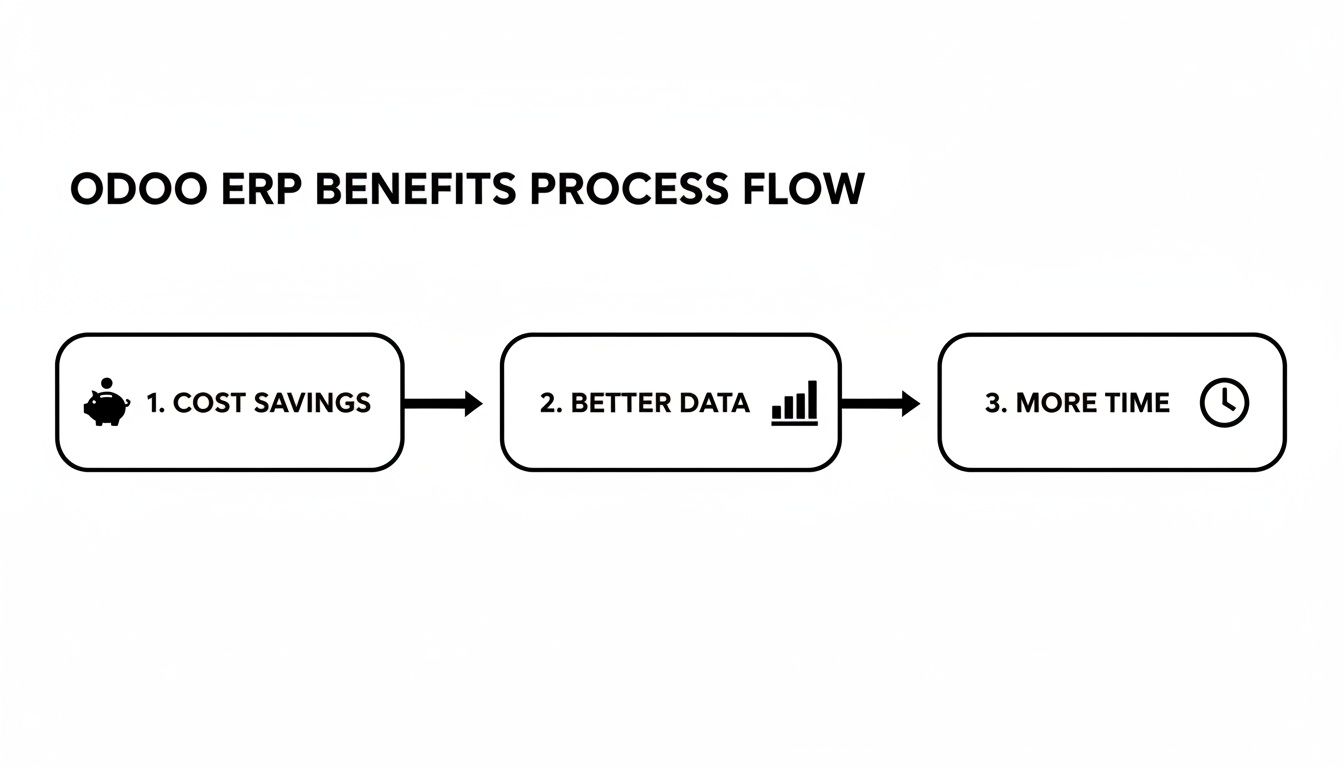
As you can see, a well-executed Odoo implementation creates a domino effect. The initial financial gains lead to operational clarity, which in turn frees up your most valuable resource—time.
Phase 1: Discovery And Planning
Before a single module is installed, any successful project starts with deep listening. The discovery phase is, without a doubt, the most critical part of the entire process. This is where your implementation partner sits down with you to understand your business inside and out. What are your biggest headaches? What do your workflows really look like? What are you hoping to achieve?
Think of it like getting an architect to draw up a blueprint before building a house. You wouldn't let a builder start pouring concrete without one, and the same principle applies here. This stage defines the project's scope, sets a realistic timeline, and establishes a clear budget.
A thorough discovery phase prevents expensive and frustrating rework down the line. It ensures the system you build is the system you actually need, perfectly aligned with your business goals.
Phase 2: Configuration And Customisation
With a solid plan in hand, it's time to shape Odoo to fit your unique operations. This isn't about twisting your business to fit the software; it's about moulding the software to support your proven processes. The goal is always to use Odoo's standard features wherever possible and only apply targeted customisations where they deliver real, tangible value.
This is where having the right partner makes all the difference. Whether it calls for specialised software development in Sydney for a unique e-commerce integration or a specific manufacturing tweak for a business in Adelaide, an experienced team knows how to make the system work for you, not against you.
Practical Case: A client had a complex commission structure that Odoo's standard sales app couldn't handle out of the box. Instead of forcing their sales team to change how they worked, their implementation partner developed a small, custom module that automated their exact commission calculations. The result? A perfect fit, no change in business process, and hours of manual work saved for the payroll team every single month.
Phase 3: Data Migration And Team Training
Your existing data—your customers, products, and sales history—is the lifeblood of your business. The data migration phase involves carefully extracting this information, cleaning it up, and importing it into your new Odoo system. This requires precision to ensure you’re starting with a clean slate.
At the same time, you need to get your team ready for the change. Good training is so much more than just showing people which buttons to press. It’s about building their confidence and demonstrating how the new system will genuinely make their jobs easier.
- Tailored Training Sessions: Focus on the specific modules and workflows that each department will actually use.
- A Safe Sandbox: Give everyone access to a test environment where they can click around and explore without fear of breaking anything.
- Internal Champions: Identify key people in your team who can become internal experts and help their colleagues long after the trainers have left.
Phase 4: Go-Live And Ongoing Support
"Go-Live" day is the moment you officially switch over to Odoo. This is a carefully orchestrated event, often planned for a weekend or a quiet period to minimise any disruption to your operations. But once you’re live, the work isn't over. Your implementation partner should provide dedicated support right after launch to quickly iron out any kinks that appear.
A strong support plan ensures your team feels confident and your business keeps humming along without a hitch. This ongoing relationship is crucial for maximising the long-term value of your Odoo ERP investment.
To keep your project on track, it helps to have a clear checklist of what needs to happen and why.
Your Odoo Implementation Success Checklist
Here’s a simple checklist outlining the essential milestones for a seamless and successful Odoo ERP implementation project. Following these steps helps ensure nothing gets missed.
| Implementation Phase | Key Action To Take | Why This Step Is Crucial |
|---|---|---|
| Discovery & Planning | Conduct deep-dive workshops with all department heads. | To ensure the final system solves real-world problems and aligns with business goals. |
| System Design | Finalise the project scope, budget, and timeline. | Creates a clear blueprint and prevents "scope creep" from derailing the project. |
| Configuration | Set up standard Odoo modules to match defined processes. | Leverages Odoo's core power and minimises the need for costly custom work. |
| Customisation | Develop specific features for unique business needs. | Fills critical gaps where standard functionality isn't enough, ensuring a perfect fit. |
| Data Migration | Cleanse, map, and import master data (customers, products, etc.). | Guarantees data integrity from day one, preventing errors and bad reports. |
| User Training | Run hands-on, role-specific training sessions for all staff. | Builds user confidence and adoption, which is essential for ROI. |
| Testing (UAT) | Have end-users test the system in a "sandbox" environment. | Catches bugs and workflow issues before they can impact live operations. |
| Go-Live | Execute the final switch-over to the new Odoo system. | The official launch, carefully planned to minimise business disruption. |
| Post-Launch Support | Provide dedicated support for the first few weeks after go-live. | Quickly resolves any unforeseen issues and ensures a smooth transition for the team. |
This checklist provides a high-level view, but it highlights the structured approach needed to move from concept to a fully operational system smoothly.
The journey to a fully integrated business system is a big undertaking, but with a clear roadmap and the right expertise, it's an achievable goal that will pay dividends for years to come.
Ready to start your implementation journey? Whether you're considering an Odoo implementation in Sydney or Adelaide, or need to connect your Shopify or WooCommerce store, we're here to help. Contact Wistec for a complimentary consultation and let's build your blueprint for success.
Ready to Build a Smarter Business?
We've walked through how Odoo ERP is so much more than just another piece of software—it's the engine for your business growth. You've seen the way it pulls everything together, breaking down the walls between departments, smoothing out clunky workflows, and giving you the clear-eyed view you need to thrive in the Australian market. The era of juggling a dozen different apps is over. A single, powerful system is what will drive your business forward.
Imagine this: no more patching together systems that don't talk to each other. Instead, you have one central hub where every single action, from a sale on your website to a pallet leaving the warehouse, is perfectly in sync. That’s the real-world advantage a well-implemented Odoo system gives you. The next move is up to you.
It's one thing to read about it, but it's another to see it applied to your unique challenges. It’s time to take that next step.
Don’t just read about efficiency—experience it. A custom-fit Odoo system is the practical step that turns operational friction into genuine momentum, giving you back the time to focus on what really matters: growing your business.
Our team at Wistec is here to help you map out a clear path. We don't deal in fluff; we build practical solutions based on real-world business needs, making sure your investment delivers results you can actually see and measure.
Take the next step today. Get in touch with Wistec for a complimentary consultation. Let's plan your Odoo implementation in Sydney, explore custom software development in Adelaide, or finally connect your Shopify or WooCommerce store to a back-end that can truly keep up.
Let’s build your smarter business, together.
Got Questions About Odoo? We’ve Got Answers.
Jumping into a new business system like an Odoo ERP always brings up a few questions. It’s a big move, and you want to be sure you're making the right one. To help you get a clearer picture, we've put together answers to the most common queries we hear from Australian business owners.
Let's cut through the noise and get straight to what you need to know about pricing, integrations, and getting started.
How Does Odoo's Pricing Stack Up Against Other ERPs?
This is where Odoo really shines. It completely flips the script on traditional ERP pricing. Forget about those eye-watering upfront licence fees that can cripple a business before it even starts. Odoo runs on a flexible, modular subscription model.
What does that mean for you? You only pay for the apps you actually need and the number of users you have. It's a "pay-as-you-grow" approach that makes powerful software accessible. You can start lean with just a few core modules and bolt on more functionality as your business expands, keeping costs completely in your control.
Can I Connect Odoo to My Shopify or WooCommerce Site?
You bet. This is a huge win for any Aussie business selling online. Odoo was built for the modern retail world and comes with fantastic, ready-to-go connectors for both Shopify and WooCommerce.
The integration creates a seamless, two-way street for your most important data:
- Products & Variants: Your product catalogue stays perfectly in sync, no matter where you make an update.
- Live Inventory: A sale on your website instantly adjusts stock levels in Odoo, putting an end to overselling.
- Customer Orders: Online orders fly straight into Odoo, automatically triggering your warehouse and accounting workflows.
- Customer Details: You get one single, unified view of every customer, whether they bought from you online or in person.
Creating this "single source of truth" is the entire point of a successful Shopify implementation, and Odoo nails it.
How Long Does it Take to Get Odoo Up and Running?
There’s no one-size-fits-all answer here—it really comes down to the complexity of your business. A smaller business looking to use a few standard modules might be live in just a few weeks. It's surprisingly quick when you keep things simple.
On the other hand, a larger company with unique workflows, custom features, and years of data to migrate could be looking at a multi-month project. The key to a smooth rollout is working with a partner who takes the time to map everything out first. A solid plan is what makes a project realistic and successful.
The projects that deliver the best results are always the ones with a rock-solid plan from the start. A clear blueprint means that whether you're in Sydney or Adelaide, and whether you need simple setup or custom software development, you get a system that works for you from day one.
Ready to see how an Odoo ERP could be fitted to your business? The team at Wistec lives and breathes this stuff. We build practical solutions that get real results, whether that means streamlining your daily tasks, connecting your e-commerce store, or creating a completely custom app.