

Picture this: your entire construction project, from the first architectural drawing and subcontractor schedule right through to the final site report, all running from a single, live command centre. That’s the reality an ERP system for the construction industry makes possible. It's the digital backbone that finally replaces those scattered spreadsheets and chaotic email chains with one, undisputed source of truth.
Why Your Construction Firm Needs a Central Command Centre
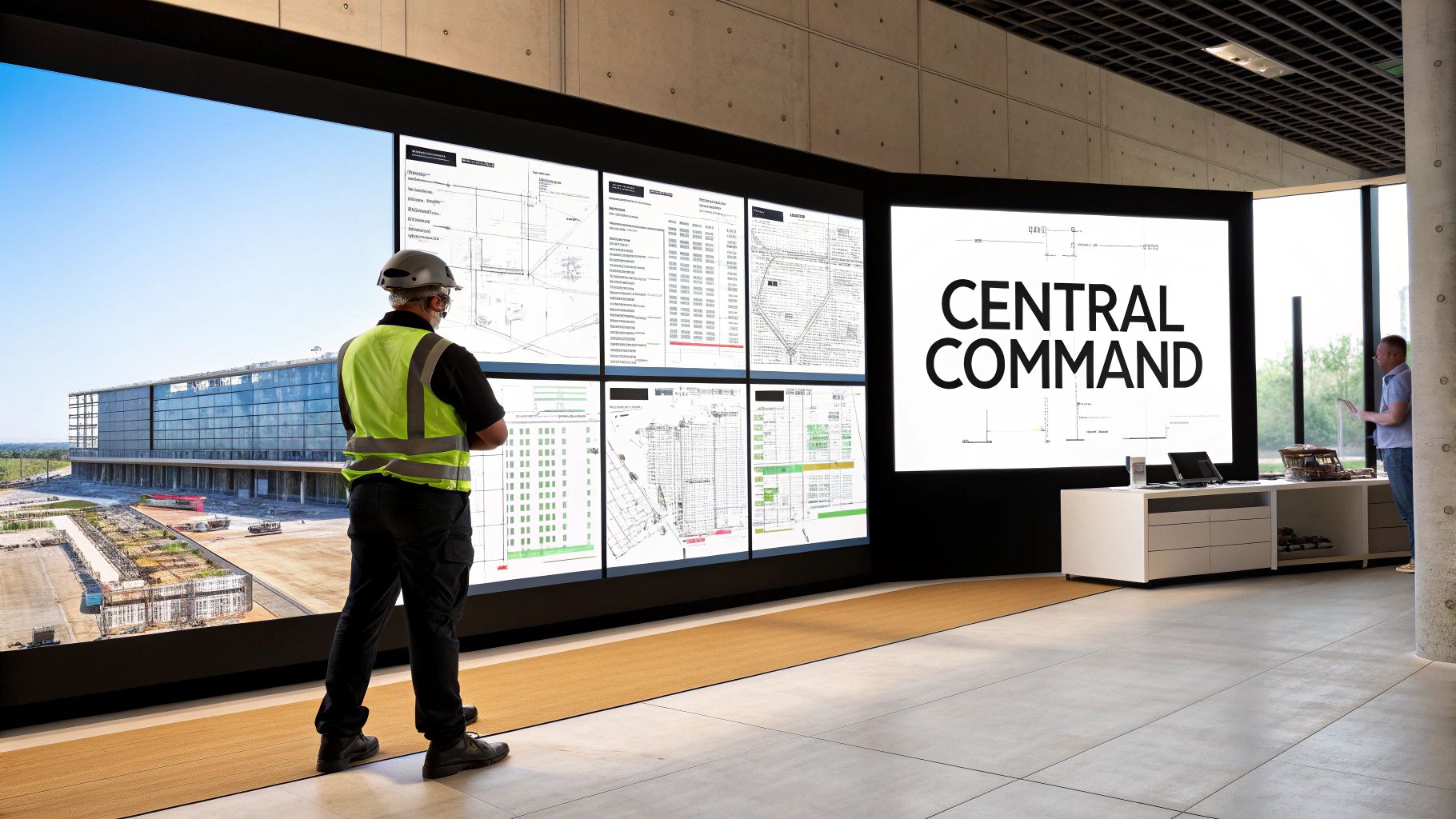
In construction, information chaos is the number one enemy of profit. We’ve all been there. Spreadsheets are out of date the minute they're saved. Critical emails get buried. The project manager in the office has a completely different picture of progress than the foreman on site. This constant disconnect is what leads to expensive mistakes, project delays, and unhappy clients.
An ERP changes the game entirely. It acts as the central nervous system for your whole operation, connecting every department, every supplier, and every project site in real-time.
Think of it like the air traffic control tower for your business. Instead of planes, you’re juggling subcontractors, material deliveries, equipment, and work schedules. Without that central system, it’s like relying on pilots talking to each other over crackly radios—a recipe for disaster. An ERP gives you that clear, unified view of everything, making sure every moving part is perfectly in sync.
Confronting the Real-World Challenges
Let's be honest, the need for this kind of control has never been more urgent. The Australian construction industry is a huge part of our economy, contributing 7-9% to GDP and employing over 1.2 million people, yet it's been plagued by productivity issues for years. A big part of the problem? Poor data management and systems that don’t talk to each other, leading to massive financial hits from rework and delays.
To see how far behind some practices are, it's worth taking a look at the latest construction technology trends and seeing what's possible. Getting an ERP in place is the foundational step to catching up and getting ahead.
An ERP system for the construction industry isn't just a fancy database. It’s about turning raw data into genuine intelligence. It gives you the foresight to spot problems before they blow up and the control to steer every project towards profitability.
The Clear Path to Modernisation
For any firm considering an Odoo implementation in Sydney or anywhere else in Australia, this is where the journey begins. It’s about building a digital core that’s solid enough to support more advanced tools and workflows down the track.
Whether you need custom software development in Sydney to handle unique processes or plan to integrate systems like Shopify or WooCommerce for a materials supply division, a powerful ERP isn't just nice to have—it's non-negotiable.
Ready to swap operational chaos for complete project control? It's time to build your business on a much stronger foundation. Contact our team for a free consultation to see how we can help.
The Blueprint for Your Construction ERP System
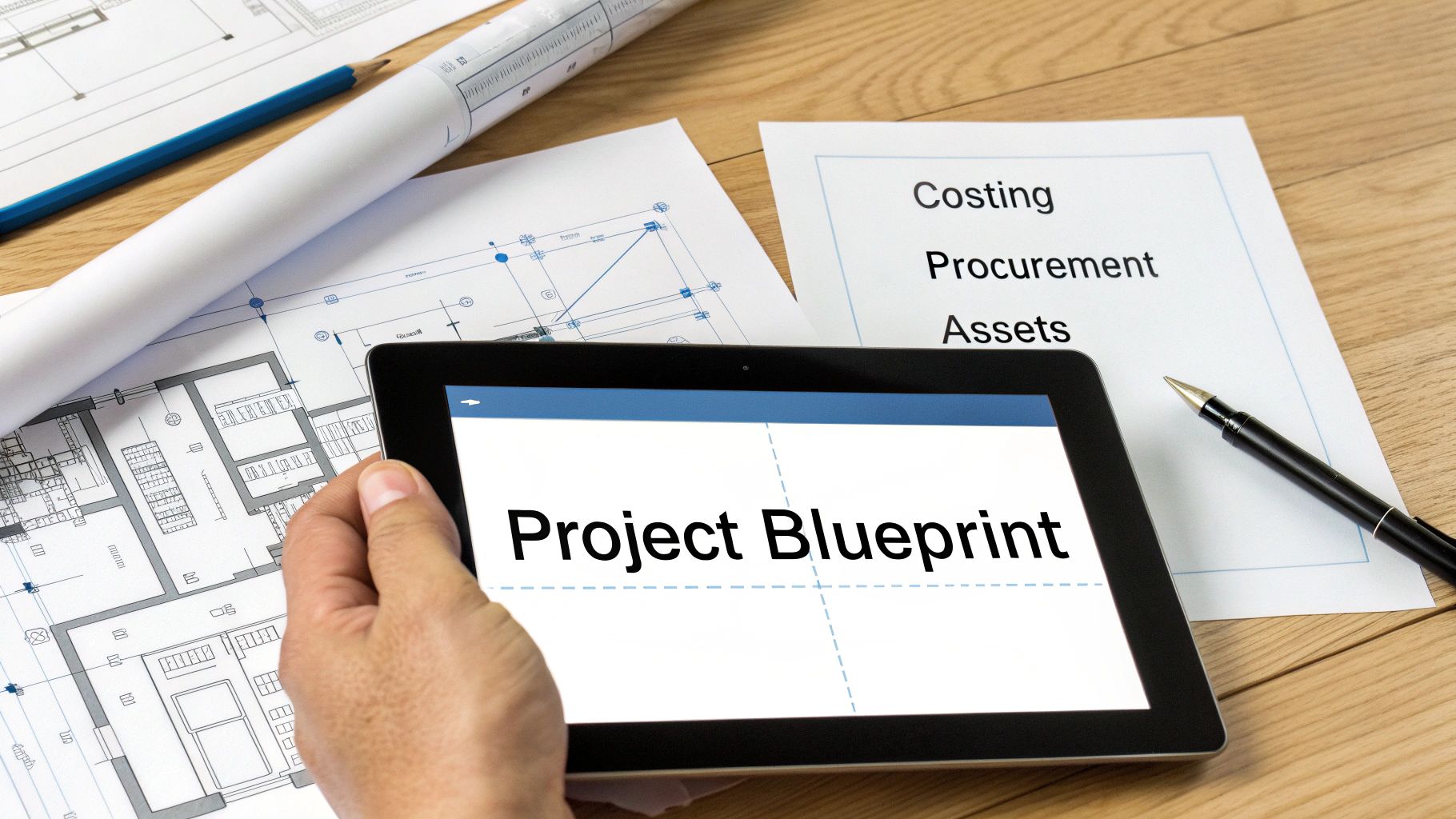
A proper ERP system for the construction industry isn't some generic software you just plug in and hope for the best. It's a purpose-built toolkit, a detailed architectural blueprint that guides every single phase of a build, from the back office to the site. Each part, or module, is designed to tackle a specific, high-stakes area of your operations, turning day-to-day chaos into predictable control.
Think of it like having all your specialist subcontractors on one digital job site. You've got the project costing expert, the procurement specialist, and the asset manager, all feeding information into one central hub in real-time. This is the secret to finally closing those costly communication gaps and eliminating the guesswork that plagues so many construction firms.
Let's walk through the essential components of this blueprint and see how each one solves a critical challenge your site crews and office teams face every day.
Project Management and Job Costing
At the very heart of any construction ERP is the module for Project Management and Job Costing. This is your project’s financial conscience, the one place where you can see every dollar spent against the budget, as it happens. Forget waiting for the end-of-month report to find out you've blown the budget; this gives you immediate, up-to-the-minute visibility.
Practical Case: A mid-sized commercial builder in Adelaide juggling a few projects at once. In the past, a sudden spike in material prices or unexpected overtime would only show up weeks later, carving a chunk out of their already slim margins. With an ERP, the site manager punches an expense into their tablet, and it instantly updates the project's overall cost report back in the office.
This instant feedback loop is a game-changer. It gives project managers the power to make proactive calls—like renegotiating with a supplier or rejigging the labour schedule—before a small variance snowballs into a full-blown financial crisis.
Ultimately, this module ensures every decision you make is backed by hard data, shifting you from constantly putting out fires to being in full control of your project's destiny.
Subcontractor and Procurement Management
Trying to manage dozens of subcontractors and suppliers with spreadsheets and emails is a recipe for disaster. The Subcontractor and Procurement Management module brings all of it into one place. Every bit of vendor data—from compliance documents and insurance certificates to performance history and negotiated rates—lives here.
Practical Case: A residential developer needs to order framing timber. Instead of the procurement manager manually ringing three different suppliers for quotes, the ERP checks real-time pricing and availability from pre-vetted vendors. They can lock in the best deal with just a few clicks. It's not just about saving time; this kind of efficiency adds up to serious material cost savings across the year.
- Centralised Vendor Database: All subcontractor and supplier info in one spot, accessible to everyone who needs it.
- Automated Purchasing: Smooth out the entire procure-to-pay process, from the initial request right through to paying the invoice.
- Compliance Tracking: Get automatic warnings when a subbie's insurance or certification is about to expire, seriously reducing your risk.
A solid construction ERP should be designed to nurture strong supplier relationships. For more on this, it's worth digging into vendor management best practices.
Asset Management and Financials
Your heavy equipment—the excavators, cranes, and trucks—are massive investments. They need to be tracked and maintained like the high-value assets they are. The Asset Management module gives you a bird's-eye view of your entire fleet, including where each machine is, its usage hours, its maintenance schedule, and its depreciation. This is all about maximising utilisation and avoiding those expensive, project-stalling breakdowns.
At the same time, the Financials module is built from the ground up for the construction industry’s unique way of billing. It handles progress claims, retentions, and variations with ease, automating complex invoicing processes that are often a manual nightmare. Linking project progress directly to billing like this does wonders for your cash flow.
Integrated HR and Mobile Timesheets
Labour can easily chew up 40% of total project costs, so getting time tracking right is non-negotiable. An integrated HR module with mobile timesheet functionality lets your crew log their hours straight from their phones on-site. That data flows instantly into payroll and job costing, killing manual data entry and making sure every hour is billed to the right project code.
For any firm looking at an Odoo implementation in Sydney, this feature alone can deliver a massive return. It cuts down on admin and gives you precise, real-time data on your single biggest operational expense. This is a crucial step in modernising your business, whether you need custom software development in Sydney or are integrating other systems like Shopify or WooCommerce into your operations.
Ready to build a digital foundation that connects every part of your operation? A well-designed ERP is the most valuable tool in your belt. Contact our team to discuss how we can tailor a blueprint for your business's success.
How an ERP Delivers Tangible Business Results
Let’s be honest: bringing in a new system like an ERP for construction isn’t about the tech itself. It's about getting real, measurable results. The true value comes from how it directly improves your business—from the accuracy of your initial bid right through to the final profit on a completed project.
Think of it as the central nervous system connecting everything you do. It links the actions happening on-site with the numbers on your balance sheet. By giving you a granular, real-time view of your costs, you can spot and plug budget leaks before they turn into major problems. This is what shifts you from constantly putting out fires to proactively managing your projects.
Smarter Decisions Powered by Real-Time Data
Picture this: your project manager is in Sydney, your site supervisor is in Adelaide, and they’re both looking at the exact same live project dashboard on their tablets. That’s the power of a single source of truth. It kills the dangerous lag time between an issue popping up on-site and head office finally hearing about it. Decisions stop being based on last week's reports or a gut feeling.
Practical Case: A dashboard suddenly shows labour costs on a specific stage are running 15% over budget. A project manager can jump on it instantly. Is it unexpected overtime? An inefficient workflow? Was the initial estimate off? An ERP helps you pinpoint the 'why' and fix it now, not weeks down the track when the margin has already vanished.
The biggest shift is moving from looking in the rearview mirror to looking at the road ahead. An ERP gives you the controls to steer your projects towards profit, instead of just documenting where the money went after it was spent.
This level of control is proving critical for Australian construction firms. Local research shows a direct link between ERP adoption and business success. A significant Australian study found that 53% of companies saw high growth after implementing an ERP. Even more telling, 27% credited the system for their survival during tough economic times. For bigger companies, the impact was even stronger, with 62% reporting high growth. You can dig deeper into these findings on the Australian enterprise resource planning market.
Boosting Operational Efficiency and Collaboration
An ERP breaks down the walls that have always separated the site from the office. When a site team updates their progress, logs materials used, or submits a timesheet through a mobile app, that information is instantly live for the whole company. This seamless flow of data is a massive driver of efficiency.
- Slash Rework Costs: With everyone—from the architect to the subcontractor—working from the latest plans and variation orders stored in one central place, costly mistakes from using old documents are dramatically cut down.
- Simplify Compliance: Need to generate a regulatory report? It becomes a simple, automated task, not a mad dash to pull together spreadsheets and paperwork from five different places.
- Genuine Teamwork: Project managers, procurement, and accounts can finally work together in the same system. This smooths out everything from approving purchase orders to paying subcontractors on time.
Measuring What Matters with Key Performance Indicators
At the end of the day, the success of your ERP system for the construction industry has to be measured against real business goals. By tracking the right Key Performance Indicators (KPIs), you can draw a straight line from your investment in the software to your bottom-line results.
You need to focus on the metrics that directly hit your profitability and project success:
- Improved Profit Margin Per Project: Keep an eye on your margins in real-time to make sure every single job is making you money.
- Reduction in Project Delays: Track your progress against key milestones to spot and fix bottlenecks before they blow out the schedule.
- Decreased Cost of Rework: Put a dollar figure on how much you're saving by cutting down on errors and miscommunication.
- Increased Asset Utilisation: Make sure your expensive machinery is earning its keep, not sitting idle in the yard.
If you’re ready to see these kinds of tangible results in your business—whether it's through a custom Odoo implementation in Sydney or specialised software development in Adelaide—it all starts with building a solid digital foundation. Let’s talk about how an ERP can deliver a clear, undeniable return on your investment. Book a free discovery call today.
Your Checklist for Choosing the Right Construction ERP
Picking an ERP system for the construction industry is a massive decision. It’s far more than just buying software; you're fundamentally shaping how your business will run and grow for years to come. If you rush it, you could be setting yourself up for a world of pain. But get it right, and you'll have a serious advantage over the competition.
I've put together this practical checklist to help you cut through the sales pitches and marketing fluff. It’s designed to get you asking the right questions and to find a real technology partner who actually gets the pressures of the Australian construction game.
Industry-Specific Features Are Non-Negotiable
Let’s get one thing straight: a generic, off-the-shelf ERP just won't work for construction. Your very first filter should be to find a system built with the unique financial and operational realities of our industry in mind. Don't let anyone convince you that workarounds are good enough.
Here’s what you absolutely must see:
- Progress Claims and Retentions: Can it handle complex progress billings and manage retentions without needing a spreadsheet on the side? This is critical for keeping your cash flow healthy.
- Subcontractor Management: Is there a dedicated place to manage subbie agreements, track compliance docs like insurance certificates, and handle their payment schedules?
- Australian Standards: Is the system built for Australia? It needs to handle GST, local building codes, and our payroll rules straight out of the box.
If a system can’t nail these three things natively, walk away. You’ll end up creating manual processes to fill the gaps, which completely defeats the point of an ERP. It’s a deal-breaker.
Can It Scale As You Grow?
The system you choose today has to be ready for where your business is heading tomorrow. What does your five-year plan look like? Are you aiming for bigger commercial jobs, moving into new states, or adding new divisions to your company?
A scalable ERP should grow right alongside you. It needs to handle more projects, more users, and a hell of a lot more data without slowing to a crawl. For any ambitious firm, this flexibility is everything. It's why many companies are turning to an Odoo implementation in Sydney or Adelaide; its modular approach means you can simply add new capabilities as you need them.
Integration Is Everything
Your ERP has to be the central nervous system of your business, not just another information silo. How well it talks to the other software you use every day is make-or-break. In our world, that means making sure it connects smoothly with:
- BIM and Estimating Software: Can it pull data directly from your estimating tools to set up the initial project budget?
- Payroll Systems: Does it link up with your payroll provider to make time tracking and labour costing a breeze?
- Accounting Software: Can it sync perfectly with programs like Xero or MYOB to give your finance team the complete picture?
For businesses with other arms, like a materials supply division, you might even need solid integrations for e-commerce platforms like Shopify or WooCommerce. This is where expert software development in Sydney can be invaluable, ensuring every system speaks the same language.
The Mobile Experience and Who’s Got Your Back
Your site team is where the rubber hits the road. The ERP has to offer a dead-simple, intuitive mobile app. Your site managers and crew need to be able to log timesheets, fire off daily reports, and pull up plans on their phone or tablet without any fuss. A clunky app simply won't get used, and you’ll be stuck with bad data.
Finally, take a hard look at the vendor themselves and their local support. Do they have a track record in the Aussie construction sector? Can you get someone on the phone—or on-site—when you really need help? Having a partner with a real presence in cities like Sydney or Adelaide means you’re not alone when things get tricky.
Ready to find a technology partner that checks all these boxes? Contact Wistec today for a no-obligation consultation to discuss your specific needs.
Your Practical ERP Implementation Roadmap
Getting a new ERP up and running is a massive project in its own right. It’s far more than just flicking a switch on some new software; you're fundamentally changing the way your business operates. A clear, phased implementation plan is non-negotiable if you want a smooth transition and a fast return on your investment.
Think of it like building a house. You wouldn't just turn up to the site with a pile of timber and start swinging a hammer. You need a detailed blueprint, a solid foundation, and a coordinated team to bring it all to life. Implementing an ERP system for the construction industry requires exactly that same level of planning and expert execution.
Phase 1: Discovery and Planning
This is where you lay the groundwork for everything that follows. Before you even think about the software itself, you have to be crystal clear on what you want it to achieve. This means defining your project goals, identifying the biggest headaches the ERP needs to solve, and setting measurable KPIs to track your progress.
A crucial step here is assembling your internal project team. This can't just be an IT job; you need champions from every corner of the business—project management, finance, procurement, and site operations. Their buy-in and real-world insights are what will make the final system genuinely useful for the people who'll be in it every day.
Phase 2: Design and Configuration
With a solid plan locked in, it's time to mould the software to your company's specific ways of working. A one-size-fits-all approach is a recipe for disaster in construction. An expert partner, like one specialising in an Odoo implementation in Sydney, will sit down with your team to map out your current processes and configure the ERP to match—or even better, improve them.
This stage usually involves:
- Workflow Mapping: Detailing exactly how things like purchase order approvals, subcontractor invoices, and variation requests move through your business.
- Customisation: Making smart adjustments to the software to handle your unique requirements without over-complicating things.
- User Role Setup: Defining permissions and access levels so every team member sees only the information they need for their job.
Phase 3: Data Migration
This is it—the most delicate and critical phase of the whole project. Data migration is the process of moving all your crucial business information—project histories, client details, supplier records, and financials—from your old systems into the new ERP. It's a job that demands military-grade planning and execution.
The single biggest pitfall here is poor data quality. If you migrate inaccurate, outdated, or messy data, you’re just polluting your shiny new system from day one. That’s why a thorough data-cleansing process before you move a single byte is absolutely essential.
Think of it like moving into a new workshop. You wouldn't just dump the entire contents of your old, messy garage into a brand-new, organised space. You'd take the time to sort through everything, chuck out the rubbish, clean your tools, and put them in their proper places.
This infographic lays out the core principles to keep in mind as you prepare for your ERP journey.
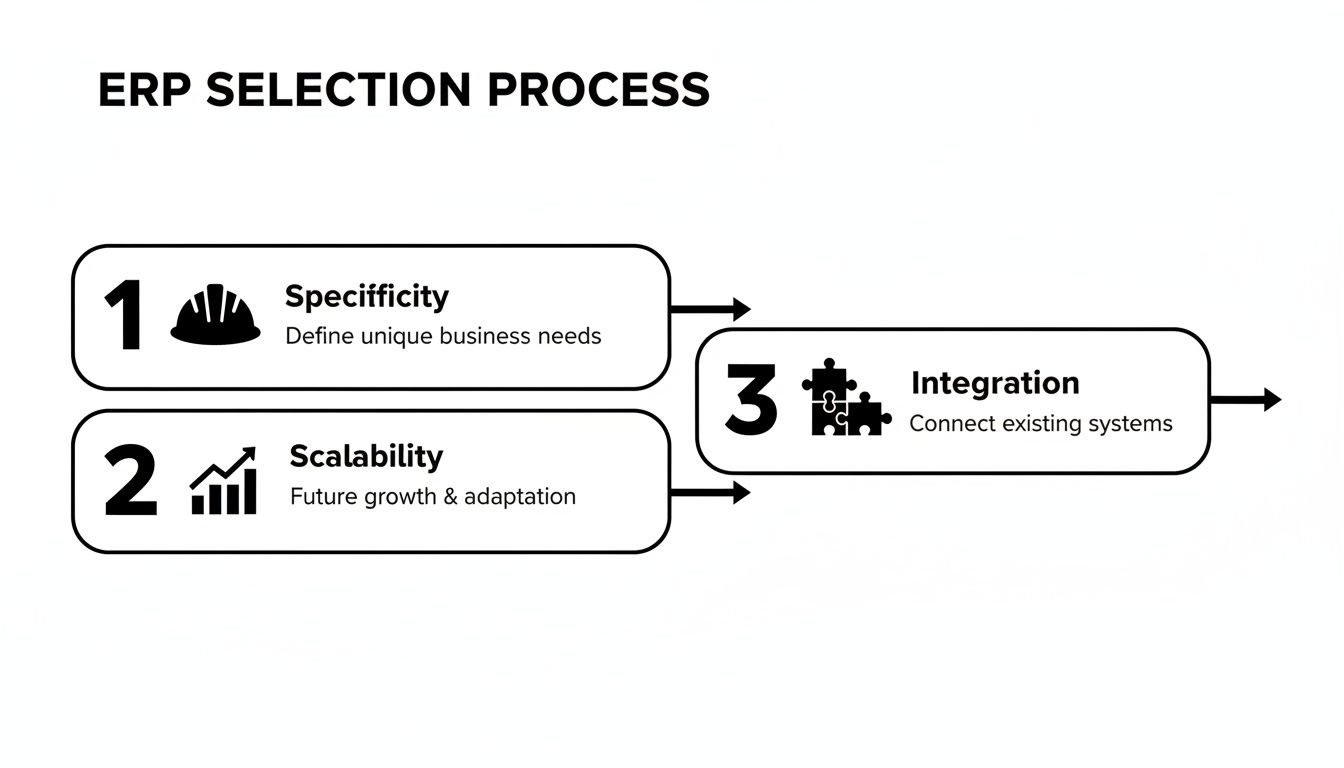
Focusing on industry-specific needs, scalability for future growth, and seamless integration right from the start ensures your implementation roadmap is built on solid ground.
Phase 4: Training and Adoption
Let's be blunt: the best software in the world is useless if your team doesn't know how to use it, or worse, doesn't want to. This final phase is all about effective training and driving genuine user adoption, and it needs to start long before you go live. Good training is tailored to different roles, focusing on the specific tasks each person will actually be doing.
Getting your team to embrace the change is the final hurdle. Highlighting the "what's in it for me"—like how mobile timesheets will kill off paperwork for site crews or how project managers get instant budget updates—can turn resistance into real enthusiasm.
This transition is becoming more critical as the sector expands. Australia's ERP market for construction is projected to hit AUD 10.37 billion by 2034, growing at a staggering 15.20% annually. This boom is driven by a real-world need to solve complex project management challenges, especially with 44,853 dwellings completed in a recent quarter. You can discover more insights about construction ERP software for Australian SMBs to see how these systems are making a difference.
A successful rollout depends on a partner with deep expertise. Whether you're after an Odoo implementation Sydney or advanced software development Adelaide, the right guide can help you navigate the complexities and ensure your new ERP delivers value from the get-go. We can even help integrate other parts of your business, like e-commerce platforms using Shopify implementation or WooCommerce.
Ready to build your roadmap to success? Contact Wistec for a consultation, and let's create a clear, actionable plan for your ERP implementation.
Finding the Right Partner to Build Your Digital Future
Picking the right ERP system for the construction industry is a massive step, but it’s really only half the job. Even the best software on the market is only as good as the team putting it in place. The right partner is what turns a piece of technology into real, tangible profit for your business.
This is exactly where a dedicated technology partner shines. You need a team that doesn’t just know the software inside and out, but also speaks your language—the language of construction. They need to get the nitty-gritty of progress claims, the headaches of subcontractor management, and the day-to-day realities on site. That’s how you get a system that solves your actual problems instead of creating a whole new set of them.
Why Wistec is Your Expert Guide
At Wistec, our bread and butter is guiding Australian construction firms through this very journey. We've found that Odoo's flexible, modular platform is a brilliant fit for the unique demands of the local industry. You can start with just the core functions you need today and then expand as your business grows, making it a seriously smart and scalable choice.
But our expertise runs deeper than just the software. We're a full-service software development firm, proudly based in Australia. This gives us the technical muscle to ensure your ERP is configured and integrated to nail your specific challenges, fuel your operational growth, and deliver a genuine return on your investment.
A great ERP implementation isn't a tech project; it's a business project. It's about sharpening your processes, giving your team better tools, and building a stronger, more profitable company from the ground up.
Your Direct Path to a Modern Operation
We’ve seen it time and time again: construction businesses stuck in the mud with outdated, fragmented systems. The endless manual data entry, the frustrating communication gaps between the site and the office, the complete lack of real-time visibility—it all chips away at your margins and adds unnecessary risk. It's time to stop letting old tech call the shots.
Whether you're looking for an Odoo implementation in Sydney or custom software development in Adelaide, our team is here to help. We also offer expert Shopify implementation and WooCommerce solutions for businesses with material supply divisions, making sure every single part of your operation is talking to each other.
Don't let another project blow its budget because of bad information. Contact Wistec today for a personalised consultation. Let's talk about how a properly implemented Odoo ERP can become the solid foundation your company's future is built on.
Frequently Asked Questions
Thinking about a new ERP system for your construction business brings up a lot of questions. We get it. Here are some straight-up answers to the things we’re asked most often by Aussie construction firms.
How Long Does It Take to Implement a Construction ERP?
There's no single answer here, as it really depends on the size of your business and how complex your current processes are. But for a typical small to medium-sized construction company in Australia, you're generally looking at a timeline of 3 to 9 months.
That window covers everything from the initial deep dive into your business, right through to planning, setup, moving your data across, and training your team properly. Working with an experienced crew for an Odoo implementation in Sydney, like us here at Wistec, is the best way to map out a realistic schedule and keep the whole project on track.
Is an ERP System Actually Affordable for a Small Construction Company?
Definitely. The old myth that ERPs are just for the big players is well and truly busted. Modern cloud-based systems like Odoo have brought this level of operational control within reach for construction businesses of all sizes.
The game-changer is the shift away from huge upfront costs. Instead of a massive capital outlay, cloud ERPs run on a subscription model. This means you have a predictable monthly expense that’s much friendlier on your cash flow. You'll find the return on investment—from better efficiency, fewer expensive mistakes, and tighter cost control—usually pays for itself very quickly.
Can a Construction ERP Connect With the Software I Already Use?
It absolutely should—this is non-negotiable. A good ERP acts as the central nervous system for your business, not just another piece of software sitting in a corner. It needs to talk to the other tools you depend on every day.
We're talking about seamless connections with:
- Accounting Software: Think Xero or MYOB.
- Payroll Systems: To make processing timesheets and wages a breeze.
- Specialised Tools: Like your BIM or estimating software.
A skilled software development Sydney or Adelaide partner can build these bridges, creating a single, unified source of truth for your entire operation. This might even extend to e-commerce platforms if you also supply materials, which would need expertise in Shopify implementation or WooCommerce.
Ready to get clear, personalised answers to your specific questions? The team at Wistec is here to help you understand how an ERP can be tailored to your exact business needs. Contact us today for a no-obligation consultation and take the first step toward a more controlled and profitable future.