

Right, so you’re trying to pin down the actual cost of developing a mobile app. Let’s get straight to it. In Australia, you could be looking at anywhere from $20,000 for a simple, focused app to well over $250,000 for a complex, feature-rich platform. The final figure really comes down to what you want to build; a basic calculator app is a world away from a custom enterprise system managing your entire operation.
Your Guide to App Development Costs in Australia
Investing in a mobile app can be a powerful move for your business, but that big question—”how much will it cost?”—is always the first hurdle. The best way to think about it is like building a house. A simple blueprint for a two-bedroom home is going to be far less complex and costly than the architectural plans for a mansion loaded with smart technology and a swimming pool. Your app is the same.
The initial budget is shaped by a handful of core factors. We’ll break these down in detail, but understanding them is the key to planning a project that doesn’t just launch, but succeeds.
The Foundations of Your App Budget
Getting a handle on what drives the price is the first step to smart financial planning. The main things that will influence your mobile app development cost are:
- App Complexity: This is the single biggest factor. An app with just a few static screens and one or two functions is relatively straightforward. But once you add things like user accounts, real-time data synchronisation, or custom animations, the complexity—and the cost—ramps up quickly.
- Design (UI/UX): A unique, custom-designed user interface creates a powerful brand experience that people remember. That said, it naturally requires more design and development hours than a clean but more conventional, template-driven approach.
- Platform Choice: Are you targeting iPhone users (iOS), the broader Android market, or both? Building two separate ‘native’ apps from the ground up for each platform will cost more than creating a single app using cross-platform technology that works on both.
Quick Estimate App Cost and Timeline in Australia
To give you a clearer picture, here’s a quick reference for what you can generally expect in the Australian market. This table breaks down costs and timelines based on the overall complexity of the project.
| App Complexity | Estimated Cost (AUD) | Estimated Timeline |
|---|---|---|
| Simple (e.g., basic info, single function) | $20,000 – $30,000 | 6 – 10 Weeks |
| Medium (e.g., user login, API feeds) | $30,000 – $60,000 | 10 – 16 Weeks |
| Complex (e.g., custom backend, real-time data) | $60,000+ | 16+ Weeks |
Of course, these are ballpark figures. The final quote will always depend on the specifics of your features and the intricacies of the mobile app development process.
Thinking Beyond the App Itself
An app on its own is useful, but its true power is unlocked when it talks to the rest of your business systems. This is where strategic software development comes into play. For instance, a retail app becomes infinitely more powerful when it’s integrated with your Shopify or WooCommerce store, keeping inventory and sales data perfectly in sync.
The same goes for industrial applications. A logistics app can revolutionise your operations when it’s directly connected to your core management system. A professional Odoo implementation, for example, can automate workflows all the way from the warehouse floor to the customer’s front door, with everything managed through the app. As an experienced Odoo partner in Sydney and Adelaide, we specialise in building these kinds of seamlessly integrated solutions.
Ready to explore your idea and get a clear estimate?
Contact Wistec for a Strategic Consultation Today
The Core Factors That Shape Your App Budget
So, you’ve got a quote in front of you, but what do those numbers actually mean? Breaking down the line items is the key to managing your investment and making smart decisions about your project’s scope. The total mobile app development cost isn’t a single figure; it’s a sum of several distinct parts, and each one pulls on the final budget in its own way.
Think of it like commissioning a custom vehicle. The base model has a set price, sure, but the final cost is all about your choices—a more powerful engine, a premium interior, advanced navigation, and that perfect custom paint job. In the same way, your app’s final price tag is shaped by a handful of core drivers that dictate the amount of time, skill, and resources needed to bring it to life.
To help you see how it all fits together, here’s a look at the main elements that will influence your app’s budget.
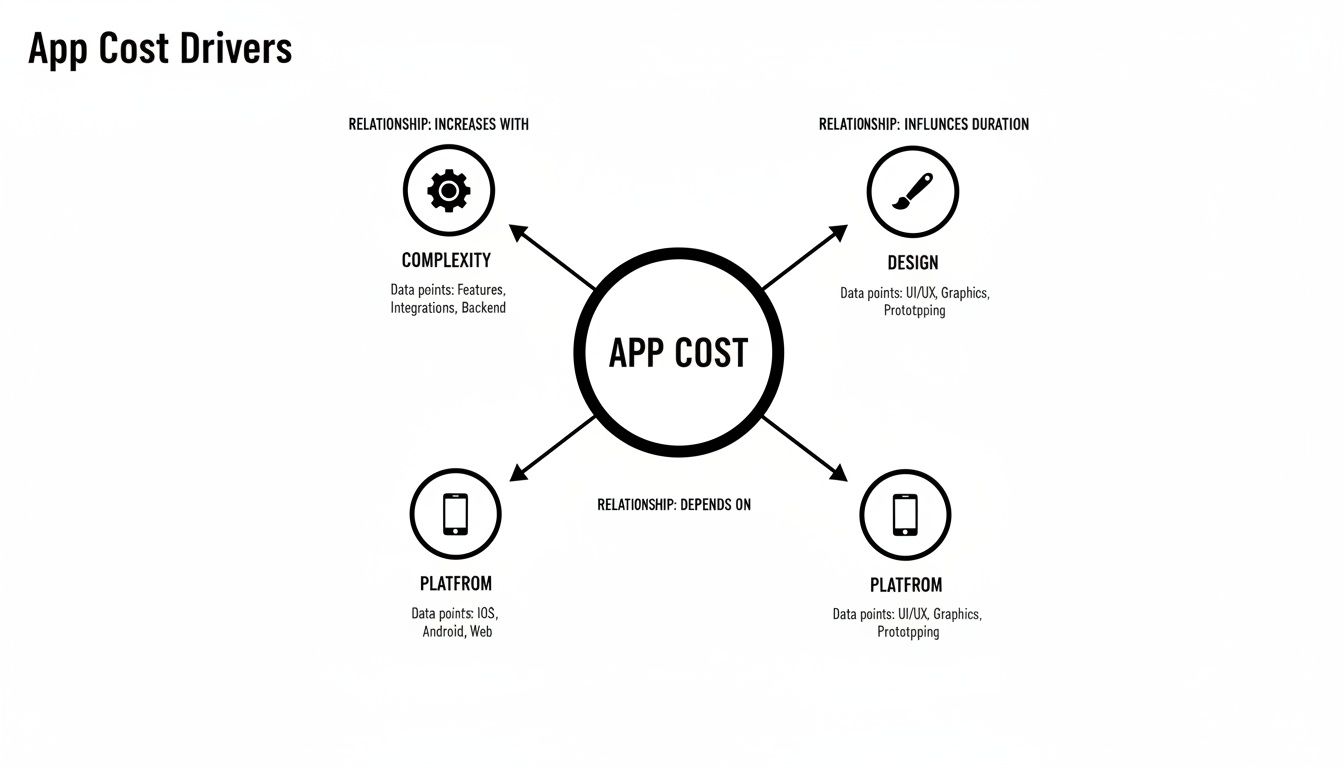
As you can see, the final cost is a direct result of key decisions you’ll make around the app’s complexity, its design, and which platforms you want to be on.
App Complexity: The Feature Equation
This is, without a doubt, the most significant cost driver. The more features you add and the more intricate your business logic gets, the more hours a development team will need to build, test, and polish your app.
- Simple Apps: These typically have a small number of screens (5-8), basic user login functions, and minimal settings. Think of a straightforward calculator app or a static information guide for a local event.
- Medium-Complexity Apps: Here, we start introducing more dynamic elements. This could include things like user profiles, push notifications, social media logins, and integrations with standard APIs to pull in data like weather forecasts or news feeds.
- Complex Apps: These are sophisticated systems with real-time data synchronisation, custom algorithms, different levels of user access, and a powerful backend. A logistics app with live GPS tracking for a fleet in Adelaide, for example, falls squarely into this category.
Platform Choice: Native vs. Cross-Platform
Your decision on where your app will live—on Apple’s iOS, Google’s Android, or both—has a massive impact on your budget. Each path comes with its own set of trade-offs.
Native Development means building a completely separate app for each operating system. One for iOS, one for Android. This approach delivers the absolute best performance and makes the most of a device’s built-in features, like the camera or GPS. The downside? It requires two separate codebases and often two specialised teams, which can effectively double a large chunk of the cost.
Cross-Platform Development, on the other hand, uses frameworks like React Native or Flutter. This allows developers to write one primary codebase that works beautifully on both iOS and Android. It’s a hugely efficient approach that can reduce development costs by 30-50%, making it a fantastic choice for businesses needing to reach the widest audience without the budget for two native builds.
A Practical Case: A Sydney-based retail business wants to launch an eCommerce app. For their initial launch (their Minimum Viable Product, or MVP), a cross-platform solution is a perfect fit. It gets them onto both the App Store and Google Play quickly and affordably, letting them test the market before committing to separate native builds for more advanced features down the track.
UI/UX Design: The User Experience Investment
Good design is so much more than just making things look pretty; it’s about crafting an intuitive, seamless, and engaging journey for your users. A brilliant user experience (UX) and an attractive user interface (UI) are absolutely critical for getting people to download—and keep using—your app. Design typically accounts for 10-20% of the total project budget.
You could opt for a template-based design, which is faster and cheaper. But a custom UI/UX, while a bigger investment upfront, creates a unique brand identity and a competitive edge that can seriously improve user engagement and drive conversions.
Backend Infrastructure: The Engine Room
The backend is the invisible powerhouse that runs your app. It’s made up of the servers, databases, and Application Programming Interfaces (APIs) that handle everything from data storage and user management to all the complex business logic. A simple app might only need a lightweight backend, but a complex one needs a robust, scalable infrastructure to handle thousands of users and process data in real time.
This is a non-negotiable for any business with plans to grow. A well-architected backend ensures your app stays fast and reliable as your user base expands.
Third-Party Integrations: Connecting Your Ecosystem
Modern apps rarely operate in a bubble. To deliver genuine value, they almost always need to connect with other services, and each one of these integrations adds another layer of complexity and cost. Common examples include:
- Payment Gateways: Integrating with services like Stripe or PayPal is essential for any e-commerce app.
- Social Media: Allowing users to log in or share content via their social media accounts.
- ERP Systems: This is where the real power of software development in Sydney and Adelaide comes into play. Integrating your app with an Odoo implementation can connect your sales, inventory, and customer data in real time, creating a single, powerful business tool. In the same way, a direct link to your Shopify or WooCommerce platform ensures your inventory and orders are always in sync.
As a dedicated Odoo partner, creating these kinds of integrated digital ecosystems is exactly what we specialise in.
Ready to see how these factors add up for your project?
Get a Personalised Quote from Wistec
Real-World App Costs for Australian Businesses
Numbers on a page are one thing, but what does an app really cost your business? Let’s move past the theory and look at what it takes to build an app in the real world, right here in Australia.
Seeing how features and requirements play out in different sectors will give you a much clearer benchmark for your own project. After all, a retail app is built for a completely different purpose than a logistics app, and a healthcare app has critical needs that a hospitality platform simply doesn’t.
Each industry has its own operational demands, customer expectations, and regulatory hoops to jump through—all of which directly shape the final price tag. These examples show how a well-planned solution from a local software partner in Sydney or Adelaide is designed to solve specific business problems.

Retail and eCommerce Apps
For any retailer today, your app is your new front door. The biggest challenge is creating a smooth, intuitive shopping experience that feels like a natural extension of your brand, whether a customer is online or in-store. This means real-time data synchronisation isn’t a “nice-to-have”—it’s absolutely essential.
The main cost driver here is the plumbing that connects your app to your eCommerce engine. A professional Shopify implementation or a solid WooCommerce connection is needed to keep your inventory, products, customer lists, and orders perfectly in sync. Even a small delay can lead to selling out-of-stock items, which is a fast way to lose a customer for good.
Here’s where the budget typically goes:
- eCommerce Platform Integration: $10,000 – $25,000+. This is for the complex API work needed to make your app and eCommerce platform talk to each other seamlessly.
- Secure Payment Gateway: $5,000 – $10,000. For integrating trusted services like Stripe or PayPal to handle transactions with bank-grade security.
- Push Notification System: $3,000 – $7,000. A must-have for marketing campaigns, order updates, and nudging customers about abandoned carts.
Logistics and Supply Chain Apps
In the world of logistics, it’s all about efficiency. An app for this industry is less about looking pretty and more about being a rock-solid operational tool that streamlines workflows, tracks assets, and gives you a bird’s-eye view of everything in real time. The costs are driven by features that can handle a constant stream of complex, live data.
Practical Case: A business managing a fleet of delivery vans in Adelaide needs real-time job tracking. GPS tracking and route optimisation aren’t just features; they’re the lifeblood of the operation. This data needs to flow directly into a central management dashboard. A custom Odoo implementation often serves as the backbone, linking the driver’s app to inventory, dispatch, and billing. As a dedicated Odoo partner, this is exactly the kind of integrated system we build.
The budget breakdown looks quite different here:
- Real-Time GPS Tracking: $8,000 – $20,000. This involves building reliable location services that won’t fail, even when a driver is in a low-connectivity area.
- ERP Integration (Odoo): $15,000 – $30,000+. This is a deep integration to sync driver locations, delivery statuses, and job sheets directly with your core business system.
- Offline Functionality: $7,000 – $15,000. This is critical. It allows drivers to keep working and logging data without an internet connection, with the app automatically syncing up once they’re back online.
Healthcare and Hospitality Apps
While they seem like different worlds, both healthcare and hospitality apps share two major cost drivers: handling highly sensitive information and managing complex scheduling. For a healthcare app, patient data security and privacy compliance (like the Australian Privacy Principles) are non-negotiable. This requires a significant investment in encryption and a bulletproof backend architecture.
For a hospitality app, the core expense is often a sophisticated booking engine that can juggle rooms, dynamic rates, availability, and special packages in real time without missing a beat.
More complex apps in these fields—especially those with AI features, payment processing, real-time chat, or the kind of ERP integrations needed by manufacturing firms—can easily exceed $150,000-$250,000+ AUD and take 16+ weeks to build. This wide range is driven by factors like custom UI/UX design ($3,000-$20,000), real-time features ($5,000-$15,000), and multiple third-party integrations ($2,000-$15,000 each). You can explore more detailed cost breakdowns for Australian businesses to see how these elements stack up.
In these high-stakes industries, the cost is a direct reflection of risk management and advanced functionality. You simply cannot cut corners on security in a healthcare app, and a clunky booking system in a hospitality app will cost you revenue from day one.
To put it all into perspective, the following table breaks down how the cost of core features can vary dramatically depending on the industry’s specific needs.
Industry-Specific App Feature Cost Breakdown
| Industry Use Case | Core Feature Example | Estimated Feature Cost (AUD) |
|---|---|---|
| Retail App | Shopify or WooCommerce Sync | $10,000 – $25,000 |
| Logistics App | Odoo ERP Integration for Job Sync | $15,000 – $30,000 |
| Healthcare App | Secure Patient Data Handling | $20,000 – $40,000+ |
| Hospitality App | Custom Real-Time Booking Engine | $25,000 – $50,000+ |
As you can see, the mobile app development cost is never a one-size-fits-all number. It’s a strategic investment that’s entirely shaped by your industry’s unique demands and your specific business goals.
Ready to see what a custom app would cost for your industry?
Talk to Our Experts and Get a Custom Quote
Budgeting for Life After Launch
Launching your app isn’t the finish line; it’s the starting block. The day your app goes live is when the real work begins, and budgeting for this next phase is what separates a genuine business asset from an expensive, short-lived project. Think of your initial mobile app development cost as the down payment on a house, but the ongoing upkeep is the mortgage and maintenance that keeps it valuable.
It’s crucial to think in terms of Total Cost of Ownership (TCO). A good rule of thumb is to budget between 15-25% of your initial development cost, every single year, just for maintenance and support. This isn’t a ‘just-in-case’ fund for emergencies; it’s a planned investment into the health and longevity of your app.

Core Maintenance and Support Costs
So, where does that money actually go? Your post-launch budget covers several critical, non-negotiable areas to ensure your app continues to provide a fantastic user experience long after the initial buzz fades.
Here are the key ongoing expenses you can’t ignore:
- Server Hosting and Backend Costs: Your app’s data needs a home. This covers the server space, database management, and cloud services that keep everything running behind the scenes.
- Performance Monitoring and Bug Fixes: Let’s be honest, no app is ever perfect. Continuous monitoring helps our team catch and squash bugs before they affect your users, ensuring your app stays stable and reliable.
- Mandatory OS Updates: Apple and Google roll out major updates to iOS and Android every year. Your app must be updated to stay compatible. If not, it risks being delisted from the app stores or simply breaking for anyone who updates their phone.
Practical Case: Imagine a retail business in Sydney launches an app with a deep Shopify implementation. A year later, a new iOS update changes how push notifications work. Without a maintenance budget, their marketing alerts could stop working overnight, crippling their ability to announce sales. Proactive support prevents this kind of disaster.
Planning for Future Growth and Features
Beyond just keeping the lights on, your budget needs to fuel growth. The market never stands still, and neither can your app. This is where you plan for adding new features, refining the user interface based on feedback, and scaling your infrastructure to handle more customers.
This is especially true for businesses with integrated systems. If your logistics app is powered by an Odoo implementation, you might decide to add a new reporting module next year. As your trusted Odoo partner in Sydney and Adelaide, we help clients plan a phased roadmap. This ensures your app evolves with your business, without needing another massive upfront investment. Whether it’s improving a WooCommerce connection or adding new functionality, a planned budget makes it all possible.
This forward-thinking approach, supported by a reliable software development team in Sydney or Adelaide, turns your app from a one-off project into a sustainable, evolving asset that delivers real, long-term value.
Ready to build a digital asset with a clear plan for the future?
Let’s Discuss a Support Plan That Works for Your Business
Smart Ways to Get Your App Built Without Breaking the Bank
Knowing what drives your mobile app development cost is one thing, but knowing how to control those costs is where the real magic happens. Making a few smart decisions early on can make a massive difference to your final bill, all without sacrificing the quality of your app. This isn’t about cutting corners; it’s about being clever with your cash.
It all comes down to focusing your budget on the things that matter most to your first users. Build a rock-solid foundation first, and you can always add the fancy bells and whistles later. With a disciplined approach, you’ll get to market faster, start getting real feedback, and make sure every dollar you spend is pulling its weight.
Let’s break down a few of the best strategies for keeping costs in check.
Start with a Minimum Viable Product
One of the most effective ways to manage your budget is by launching a Minimum Viable Product (MVP). Don’t think of an MVP as a cheap or half-baked version of your app. It’s the opposite—it’s a highly focused version that does one thing exceptionally well: solve a core problem for your ideal customer.
It’s like building the engine of a car before you worry about the leather seats or the surround-sound system. You make sure the most important part works flawlessly first. This approach has some serious benefits:
- Test Your Core Idea: You get to find out if people actually want what you’re building before you pour a fortune into features they might not even use.
- Gather User Feedback: Early users are a goldmine of information. Their feedback will guide your next steps, ensuring you build what the market truly wants.
- Get Investors on Board: A working app, even a simple one, is far more compelling to investors than just a business plan. It shows you can deliver.
For new businesses keeping a close eye on the budget, digging into guides on mobile app development for startups can offer some great, practical advice on making the MVP model work.
Embrace Cross-Platform Development
Picking your tech stack is a huge decision that directly impacts your budget. Native apps deliver incredible performance, but building and maintaining two separate codebases for iOS and Android can get expensive, fast. This is where cross-platform development really shines.
By using a single codebase, we can create one app that works beautifully on both platforms. This instantly slashes development hours, makes ongoing maintenance simpler, and brings the total project cost way down. We’ve seen our professional services clients, like accounting firms, save 30-50% by choosing a cross-platform framework like Flutter over separate native builds. You get a consistent user experience everywhere, for a fraction of the cost.
If you want to get into the nitty-gritty, read our guide on multiplatform mobile app development.
Use Existing Platforms and a Phased Rollout
You don’t always need to reinvent the wheel. A smart, phased development plan that plugs into powerful existing platforms is an incredibly effective way to manage your mobile app development cost.
Practical Case: A logistics company in Adelaide needed a driver app. Instead of spending months and a huge chunk of their budget building a custom backend, we suggested a powerful Odoo implementation. By connecting their app to a proven ERP system, they saved tens of thousands of dollars and got their solution in the hands of their drivers much faster.
This logic applies everywhere. Why build a custom sales engine from scratch when you can integrate with a Shopify implementation or a WooCommerce store? It’s all about working smarter to get the job done right and on budget.
Ready to discuss a cost-effective strategy for your app idea?
Contact Our Software Development Sydney Team for a Free Consultation
Choosing Your Ideal Australian Development Partner
The success of your app truly rests on the shoulders of the team you choose to build it. A rock-bottom price might look good on paper, but the real value comes from a partner who offers genuine strategic guidance, not just someone who writes code. The right team takes your raw idea and shapes it into a polished, powerful asset ready for the market.
When you’re weighing up potential partners, you have to look past the initial number on the quote. A professional agency will have a solid portfolio you can dig into. Ask to see case studies, especially ones that resonate with your industry, and make sure to read through their client testimonials to get a real feel for their reliability and track record.
Looking Beyond the Quote
Transparency is a massive tell. A partner you can trust will give you a crystal-clear, detailed breakdown of their process. You should know exactly what you’re paying for at every turn. This kind of clarity is what stops small misunderstandings from spiralling and keeps the project on track and on budget—a common headache when calculating the total mobile app development cost.
Look for a team that actually wants to talk to you and understand your business. They should be asking smart, probing questions about how you operate, who your customers are, and where you want to be in five years. This is the critical difference between a task-based coder and a true strategic partner in software development, whether in Sydney or Adelaide.
The ideal partner acts as a strategic extension of your own team. They should be just as invested in your app’s success as you are, offering insights and proactive solutions that align with your business objectives.
Finding a Partner with Integrated Expertise
The best partners are the ones who can see the bigger picture. A standalone app is one thing, but an app that plugs directly into the heart of your business systems? That’s a game-changer. As a solution-focused ODOO partner in Sydney and Adelaide, building these kinds of fully integrated digital ecosystems is our specialty.
We don’t just build apps; we build custom solutions that connect flawlessly with powerful platforms. This could be a deep Odoo implementation to get your backend operations running like a well-oiled machine, or a slick Shopify implementation or WooCommerce integration for your retail store. Our goal is to make sure all your technology works together as one cohesive unit. For startups where every dollar is crucial, our guide on finding an affordable app developer has more tips on making the right choice.
Ready to partner with a team that offers strategic guidance and technical excellence?
Contact Wistec for a transparent quote and a strategic consultation today.
Got Questions? We’ve Got Answers.
When it comes to figuring out app development costs, it’s natural to have a few questions. We get it. Here are some straight answers to the questions we hear most often from businesses right here in Australia.
How Long Does It Take To Get A Detailed Quote?
We can usually give you a ballpark estimate for your mobile app development cost within a few days of our first chat. Think of this as a rough guide.
For a precise, fixed-price quote that you can actually bank on, we need to go deeper. This involves a discovery phase, which typically takes between one and three weeks. It’s a crucial step where we map out every detail of the project, ensuring there are no surprises or hidden costs down the track.
Is It Cheaper To Hire A Freelancer Or An Agency?
On paper, a freelancer’s hourly rate might look more attractive. But a development agency brings an entire team to the table: project managers, UI/UX designers, developers, and QA testers, all working together.
This team-based approach almost always leads to a higher-quality product, a smoother process, and ongoing support you can rely on. It’s about value, not just cost. For a serious business project, especially complex software development in Sydney and Adelaide, relying on a single person can be a risky move.
What Is A Minimum Viable Product And Why Should I Consider One?
A Minimum Viable Product (or MVP) is a lean, first version of your app that includes only the must-have features—just enough to solve a core problem for your first users.
We’re big believers in the MVP approach. It lets you get to market faster, test your core concept with real customers, and keep your initial financial risk low. It’s the smartest way to start building momentum before you invest in a full-scale app, whether it needs to link up with a Shopify implementation or a custom Odoo implementation.
As a leading ODOO partner in Sydney and Adelaide, we specialise in planning MVPs that plug right into your existing business systems, like WooCommerce. This way, you start seeing a return on your investment right from the get-go.
Ready to move from a great idea to a clear, strategic plan? Wistec delivers technology that’s built around your business goals, not the other way around.