

Ever dreamed of building one brilliant mobile app that runs perfectly on both iPhones and Androids? That's the magic of multiplatform mobile app development. Forget the old way of building two separate apps from the ground up—this approach lets you write your code once and deploy it everywhere.
Build Once, Reach Everyone
Think of it like having a master key. Instead of juggling a heavy keychain for every single door, you have one key that unlocks them all. That’s what multiplatform development does for your business; it gives you access to the entire mobile market without doubling your effort.
This strategy is all about working smarter, not harder. It helps you maximise your audience, slash development costs, and launch your app much faster. For any Australian business, from a startup needing software development in Sydney to an established enterprise in Adelaide, this is the secret to efficient and scalable growth.
The appetite for mobile apps has never been greater. The mobile app development industry here in Australia is set to boom, projected to pull in over $2.8 billion in revenue by the end of the 2024-25 financial year. This isn't surprising when you consider that about 91% of Australians now own a smartphone.
What's more, over 70% of us use apps every single day for everything from banking and shopping to entertainment. It's clear that apps are a massive part of our digital lives. You can dive deeper into the latest app development trends in Australia on sigmasolve.com.
The Core Advantages for Your Business
Going down the multiplatform path isn't just a technical decision; it's a savvy business move that directly impacts your bottom line and how you stack up against the competition.
Here are the key benefits:
- Serious Cost Savings: Why pay to build two apps when you can build one? This approach drastically cuts down development costs. A single team can handle the entire project, whether it’s a complex Odoo implementation Sydney businesses need or a straightforward Shopify implementation.
- Speed to Market: A single codebase means you can launch on iOS and Android at the same time. This lets you grab a bigger slice of the market from day one and stay a step ahead of your rivals.
- A Consistent User Experience: Your brand's look and feel should be the same everywhere. Multiplatform development ensures your app is familiar and easy to use for everyone, whether they're on a retail site powered by WooCommerce or a corporate portal.
The real power of multiplatform development lies in its sheer efficiency. You invest your resources once to create a top-notch product that works for the entire mobile audience, giving you the best possible return on that investment.
This approach is a game-changer for businesses wanting to test a new idea, launch a Minimum Viable Product (MVP), or just scale their digital presence without breaking the bank.
Ready to see how a single app can redefine how you connect with customers on every platform?
Let's chat about building a high-performing multiplatform app that’s built for your specific goals. Contact our software development Sydney Adelaide team today!
Choosing Your Toolkit: A Comparison of Key Frameworks
Picking the right framework is easily the most important decision you'll make on your multiplatform journey. This single choice will ripple through your entire project, affecting everything from development speed and budget to the final user experience your customers get.
It’s a bit like a builder deciding between prefabricated panels and traditional bricks. Both can build a house, but the process, cost, and the final feel of the home will be worlds apart.
Let's break down the industry leaders so you can pick the right tool for the job. Remember, this isn't just a technical decision; it's a strategic one that has to line up with your business goals, whether that’s a sophisticated Odoo implementation Sydney businesses need or a slick e-commerce store built with a Shopify implementation.
React Native: The JavaScript Powerhouse
Backed by Meta, React Native is a go-to for multiplatform mobile app development, especially if your team already has web development skills. It lets developers use what they already know—JavaScript and React—to build mobile apps that feel genuinely native.
Think of it as a universal translator. You write your code in JavaScript, and React Native translates it into the native UI components for both iOS and Android. This means your app uses the same fundamental building blocks as an app built from scratch for that specific device, giving users a smooth and familiar experience.
This approach works wonders for content-heavy apps, social media platforms, and online stores, making it a brilliant contender for projects built on WooCommerce or Shopify.
The decision tree below visualises that first big choice: do you maintain two separate codebases, or do you consolidate with a single one?
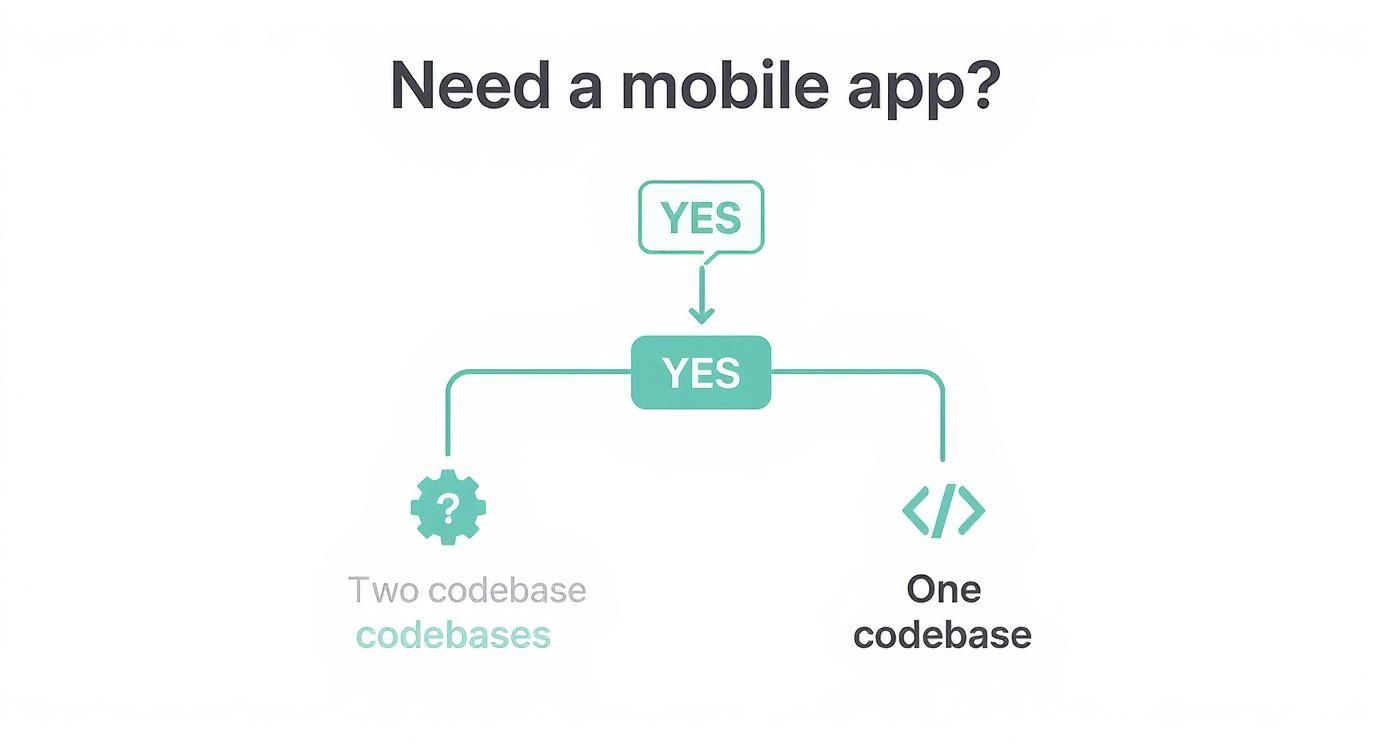
As you can see, the main draw of a single codebase is efficiency, which is exactly why these frameworks exist.
Flutter: Google's UI Specialist
Next in the ring is Flutter, Google's toolkit for crafting beautiful, high-performance interfaces from one codebase. Where React Native uses the phone's native components, Flutter does things differently. It brings its own set of high-fidelity widgets and renders them using its own powerful graphics engine, Skia.
Imagine an artist who brings their own complete set of paints and canvases to every job. This gives developers total control over every single pixel on the screen, ensuring your app's design looks identical and performs flawlessly, no matter the device. This makes Flutter an exceptional choice for apps where a strong brand identity and a highly customised, expressive UI are non-negotiable.
Flutter’s biggest strength is its ability to deliver pixel-perfect UIs and silky-smooth, 60fps animations without a performance hit. It gives you the power to build visually stunning apps that truly stand out.
The uptake of these frameworks in Australia speaks for itself. Cross-platform mobile app development frameworks like Flutter and React Native are being adopted faster than ever, completely changing how apps are built. React Native is now the top non-native framework on the Apple App Store in 2024, growing its market share from 4.73% in 2022 to 6.75%. Meanwhile, Flutter continues to dominate on Android, with its share climbing from 10.15% to 11.07% in the same period. You can find more insights about these cross-platform development trends on makeitnew.io.
Xamarin and .NET MAUI: The Microsoft Ecosystem
For businesses already deep in the Microsoft world—especially those using C#—Xamarin (which has evolved into .NET MAUI) is a seriously compelling option. It lets C# developers share code across iOS, Android, and Windows, making it a natural fit for enterprises running on .NET.
Xamarin gives you direct access to native APIs, so its performance is incredibly close to a true native app. This makes it a great fit for complex, data-heavy enterprise applications. If your business is looking at software development Sydney or Adelaide-based, and your team already lives and breathes C#, .NET MAUI is a powerful and logical choice.
To help you see how these titans stack up, here’s a quick comparison.
Comparison of Top Multiplatform Development Frameworks
This table breaks down the key differences between the top three frameworks, helping you compare them at a glance based on what matters most to your project.
| Framework | Backing Company | Core Language | Performance | Best For |
|---|---|---|---|---|
| React Native | Meta (Facebook) | JavaScript | Near-native | Teams with web dev skills, content-driven & social apps |
| Flutter | Dart | Excellent | Highly customised UIs, brand-focused apps | |
| Xamarin/.NET MAUI | Microsoft | C# | Near-native | Enterprises in the Microsoft ecosystem, complex apps |
Ultimately, choosing the right toolkit is fundamental to your project's success. Each framework has its own unique strengths designed for different project needs, team skills, and business goals.
Ready to figure out which framework is the perfect match for your app idea? Our experts in software development Sydney Adelaide can help you make the right call. Get in touch with us today for a personalised consultation!
Multiplatform vs. Native: Which Path is Right for You?
Choosing between a multiplatform and a native app isn't just a technical decision—it's a strategic one that will shape your budget, your timeline, and the very soul of your final product. It’s a bit like deciding between a bespoke, custom-tailored suit and a top-of-the-line, off-the-rack one. Both are fantastic choices, but they’re built for different needs and occasions.
There’s no single "best" answer here. The right path depends entirely on what you’re trying to achieve. Are you a startup in a mad dash to validate a concept, or are you an established brand building a flagship app where every millisecond of performance counts? Let’s break down when each approach truly shines.
The Case for Multiplatform: Speed and Smart Economics
Multiplatform development is your go-to strategy when getting to market fast and managing costs are your top priorities. It's an absolute game-changer for startups or businesses needing to test the waters with a new idea without doubling their development budget.
Practical Case: Imagine launching a new online fashion boutique. By using a multiplatform framework, your new app powered by a WooCommerce backend can be built once to work flawlessly on both iPhones and Android phones from day one. This means you can hit the entire market at once, maximising your launch buzz and gathering feedback from all potential users, not just one slice of the pie.
Here’s why this approach is so compelling:
- Launch Faster: With one codebase, your team can build, test, and release for both iOS and Android simultaneously. This can cut your time-to-market dramatically.
- Slash Development Costs: You hire one team, not separate iOS and Android specialists. This is a huge win for keeping overheads down, especially if you’re looking for cost-effective software development Sydney Adelaide partners.
- Maintain Brand Consistency: The app will look and feel the same everywhere. This reinforces your brand identity without the headache of designing and developing two different user experiences.
For a huge number of businesses, particularly in e-commerce or content-focused apps, the power to reach everyone quickly and affordably makes multiplatform mobile app development the obvious choice. The efficiency you gain is a serious competitive edge.
When Native Delivers Unbeatable Power and Polish
When it comes to raw performance and a flawless user experience, nothing beats native development. Building natively means crafting an app exclusively for a specific platform—using Swift or Objective-C for iOS, and Kotlin or Java for Android. This gives you unfettered access to every single feature the device has to offer.
Practical Case: Consider a high-end mobile game that needs to push the phone's graphics processor to its absolute limit. Or think of a complex logistics app, perhaps as part of an Odoo implementation Sydney businesses use, that relies on perfect, real-time GPS and deep Bluetooth scanner integration. For these kinds of jobs, only the raw power and direct hardware access of native will do.
Native development is the clear winner when:
- Performance is everything. For graphically intense apps, fluid animations, or heavy-duty calculations, native code simply runs faster and smoother.
- You need deep access to device hardware. If your app is all about the camera, accelerometer, or complex background tasks, native APIs offer the most stable and powerful connection.
- The user experience must feel perfectly seamless. Native apps are built to follow the specific design conventions of iOS and Android, making them feel instantly familiar and intuitive to users.
A premium user experience often leads directly to better engagement and loyalty. While the upfront investment is higher, for the right project, the payoff in performance and polish can be massive. For instance, a sophisticated Shopify implementation with augmented reality try-on features would almost certainly need a native build to feel truly magical.
Ultimately, the choice comes down to a strategic trade-off. Are you prioritising getting your app in front of the widest audience as quickly as possible, or is your goal to deliver a pixel-perfect, high-performance experience that can’t be compromised?
Ready to weigh the options for your unique project? Contact our expert software development Sydney Adelaide team to analyse your needs and map out the smartest path forward.
Architecting a Winning Multiplatform App
A truly great multiplatform app shouldn't feel like a compromise. It should feel like it was built from the ground up just for your device, whether you're swiping on an iPhone or tapping on an Android. This is the real goal of smart app architecture: to create something that isn't just functional, but genuinely intuitive and delightful to use.
Getting to this point is about more than just sharing code between platforms. It’s about laying down a clever, flexible foundation that maximises efficiency while still respecting what makes iOS and Android unique. Nail this strategic balance, and you've got the secret sauce for an app that people actually want to keep on their phones.
The whole process boils down to carefully planning out how to manage your shared business logic—the core rules and functions of your app—while knowing exactly when to tap into native modules for specific, platform-dependent features. This is the heart and soul of effective multiplatform mobile app development.
Creating an Adaptive User Interface
One of the quickest ways to disappoint users is to force a "one-size-fits-all" interface on them. A winning app needs to adapt its UI to different screen sizes, resolutions, and most importantly, the design conventions of each operating system.
Think about it: navigation patterns are fundamentally different between iOS and Android. An iPhone user expects to see bottom tabs for major sections, whereas an Android user is completely used to a navigation drawer sliding in from the side. A well-architected app understands and respects these differences, making the experience feel right at home on either device.
This thinking extends to the smaller details, too:
- Buttons and Controls: The look, feel, and placement of a simple button should align with what the platform's users expect.
- Typography: Using default system fonts and text styles instantly makes an app feel more integrated and native.
- Gestures: Common swipe and tap gestures need to behave exactly as users expect them to on their device of choice.
Managing Shared Logic and Native Integrations
The true power of going multiplatform comes from sharing your business logic. This is the engine under the hood—the code that handles data processing, user authentication, and all your core functionalities. Practical Case: For an online retailer, this could be the shared logic that processes payments from their WooCommerce or Shopify implementation, ensuring business rules are consistent on both iOS and Android.
But what happens when you need direct access to the device's hardware, like the camera, GPS, or advanced biometric sensors? This is where you build a "bridge" to a native module. This approach lets your shared codebase talk to platform-specific code, giving you the best of both worlds: the efficiency of shared logic and the peak performance of native integrations.
The art of great architecture is knowing what to share and what to separate. By centralising your core business rules and strategically using native components, you create a powerful, maintainable, and high-performing application that doesn’t cut corners.
Avoiding Common Architectural Pitfalls
So many projects run into trouble because they overlook critical architectural decisions early on. A classic mistake is to neglect performance tuning, assuming the framework will magically handle everything. While these frameworks are incredibly powerful, heavy computations or complex animations can still create lag if they aren't properly optimised.
Another huge pitfall is poor data management. You absolutely need a clear plan for how your app will store data locally, sync with a server, and handle being offline. This becomes even more critical for complex systems, like the kind needed for an Odoo implementation Sydney Adelaide businesses depend on for their daily operations.
To build a truly robust app, your plan has to cover performance, data, and platform-specific UI right from the get-go.
Ready to architect an app that performs flawlessly on every device? Our experts in software development Sydney Adelaide can help you design a winning strategy. Contact us today to discuss your vision!
Real-World Examples: Seeing Multiplatform Development in Action
It’s one thing to talk about frameworks and technical specs, but it’s another to see how it all plays out in the real world. The true power of multiplatform mobile app development becomes crystal clear when you look at the major players and local Aussie businesses who’ve used it to get ahead. These aren't just theories; they're proof of faster launches, real cost savings, and the ability to reach a much bigger audience.
You might be surprised to learn that this isn't just a strategy for startups trying to save a buck. Some of the biggest apps on your phone are built this way. Giants like Instagram and Shopify use frameworks like React Native to give hundreds of millions of people a smooth, consistent experience every single day. This lets their teams roll out updates and new features across both iOS and Android at the same time, keeping them well ahead of the competition.
From Global Giants to Local Heroes
Think about the sheer complexity of managing two separate apps for a platform as huge as Shopify. A multiplatform approach is what makes that scale manageable. It allows a single development team to work from one codebase, which is a massive win for brand consistency and just plain old operational sanity.
The same logic applies right here in Australia, delivering fantastic results for local businesses. Practical Case: A growing Sydney retail brand, for instance, can get a polished new shopping app to market so much faster by choosing a multiplatform build for their Shopify implementation. They're not just saving money by avoiding two development projects; they're reaching every single potential customer from the moment they launch.
Or picture a logistics company in Adelaide needing a custom app to manage their operations. By building a multiplatform solution as part of an Odoo implementation Sydney Adelaide businesses trust, they can get the same powerful software into the hands of every driver and warehouse worker, regardless of what device they use. This simplifies everything from training to tech support.
At its heart, the benefit is simple: you’re not just building an app, you're creating a strategic advantage. When you tear down the wall between iOS and Android, you bring your user base together, cut down on technical headaches, and clear the path for faster growth.
Smart Tech Driving Smart Business
The success of these apps is no accident. It comes from a deliberate choice to prioritise speed and market reach without ever compromising on the quality of the user experience. Whether it's a straightforward content app or a complex e-commerce platform built on WooCommerce, the aim is always the same: deliver real value to the user, quickly and reliably.
These real-world examples prove that multiplatform development isn't about taking a shortcut. It's a savvy business decision that empowers companies of all sizes to compete, innovate, and connect with their audience wherever they are.
Ready to see how a multiplatform strategy could transform your own business? Whether you're dreaming up a new app or want to overhaul an existing one, our expert software development Sydney Adelaide team is here to guide you. Contact us today to explore the possibilities and start writing your own success story!
Navigating Australian Security and Compliance

For any Aussie business, creating a brilliant app is only half the battle. The other half is making sure it’s secure, trustworthy, and plays by the local rules. Getting this wrong isn’t an option—it can seriously damage your reputation and hit your bottom line hard.
This is especially true when you consider just how much we rely on our phones. With mobile app usage expected to climb past 86% of the population by 2025, the pressure to deliver rock-solid security has never been greater. This explosion in use fuels both native and multiplatform mobile app development, but it also throws a spotlight on privacy, making compliance a top priority. You can dive deeper into Australia's mobile development landscape on codewave.com.
Sticking to the Privacy Act
The cornerstone of Australian data law is the Privacy Act 1988. If your app collects, stores, or uses any kind of personal information—even just a name and email—you absolutely must comply. This isn't just about ticking boxes; it's about earning your users' trust and shielding them from potential data breaches.
Practical Case: An e-commerce app built on WooCommerce or a Shopify implementation handles sensitive customer payments and addresses. Using a multiplatform framework, security features like end-to-end encryption can be coded once and rolled out across both iOS and Android, giving you consistent, compliant protection.
Meeting Industry-Specific Standards
If you operate in a tightly regulated industry, the compliance hurdles get even higher. To put it simply, you need an expert in your corner.
- Finance: Any app touching financial services must follow strict APRA and ASIC guidelines designed to protect consumers and keep the market stable.
- Healthcare: Apps managing patient data are bound by incredibly stringent privacy laws to protect sensitive health records.
This is exactly why teaming up with an experienced software development Sydney Adelaide team makes all the difference. A local partner gets the subtleties of these regulations and can ensure your app is both innovative and legally sound.
Building a secure and compliant app isn’t a roadblock to innovation—it's the foundation for it. When you make security a priority from day one, you create a product that people can genuinely trust, and that’s the real secret to long-term success.
Whether you're working on a complex Odoo implementation Sydney Adelaide businesses depend on or a brand-new retail app, nailing security and compliance is non-negotiable.
Ready to build an app that’s not just powerful, but fully compliant with Australian regulations? Contact our expert software development team today for a security and compliance consultation!
Time to Make Your Move
You’ve made it through the landscape of multiplatform mobile app development. You've seen the frameworks, weighed the pros and cons, and understand what it takes to build a single app for multiple devices. Now, it's about connecting that knowledge to your own business goals and making a smart, decisive move.
This all starts with a realistic look at your needs. Are you a startup racing to get your idea in front of as many users as possible, or a larger company building a complex tool for your internal team? The answer will guide your hand, pointing you toward the right framework and approach. Multiplatform development is a fantastic way to balance speed, cost, and reach, but only if the strategy is right for you.
From Idea to App Store
Think about how this plays out in the real world. Practical Case: A retailer in Sydney could roll out a brand-new e-commerce app using a powerful Shopify implementation. Imagine launching just in time for a massive sales event, hitting both iPhone and Android users from the get-go. Or picture a logistics company in Adelaide deploying an inventory management app linked to an Odoo implementation Sydney Adelaide businesses rely on, ensuring every single employee has the exact same tool on their device.
The real magic of multiplatform development isn't just about sharing code; it's about sharing opportunity. You get to connect with your entire audience on day one, building a consistent brand experience that fuels growth and streamlines everything behind the scenes.
This strategy is a solid fit for so many different kinds of apps. It’s perfect for a new online store built on WooCommerce, letting you grab sales from every segment of the mobile market. For any business looking for sharp software development Sydney Adelaide expertise, it's a cost-effective path to a premium product without the headache and expense of running two separate development teams.
The path forward is clear. By picking the right multiplatform strategy, you’re not just building an app that works—you're building a core asset that will drive your business forward. That seamless, cross-device experience you're envisioning? It's completely within reach.
If you're ready to build a high-performing app that delivers real results, the expert team at Wistec is here to help. Let's work together to turn your vision into a successful reality. Contact us today to start your development journey.