

When you’re a startup, finding the right app developer isn’t just about finding the cheapest price tag. It’s about finding the best value – a partner who can bring your vision to life without breaking the bank and who understands that every dollar counts. The real trick is to find that sweet spot between cost and quality, ensuring your app has the solid foundation it needs to launch successfully and grow from there.
Your Blueprint for Affordable Startup App Development
For Aussie startups, building a great app is a classic juggling act: you’re trying to balance cost, quality, and how fast you can get to market. Let’s get one thing straight from the start: ‘affordable’ isn’t a code word for ‘cheap and nasty’. It means making a smart, strategic investment that gets your product into the hands of users efficiently and sets you up for the long haul.
This guide will give you a clear framework for making that crucial hiring decision.
There are really three main roads you can take when it comes to development: freelancers, agencies, or going offshore. Each has its own pros and cons.
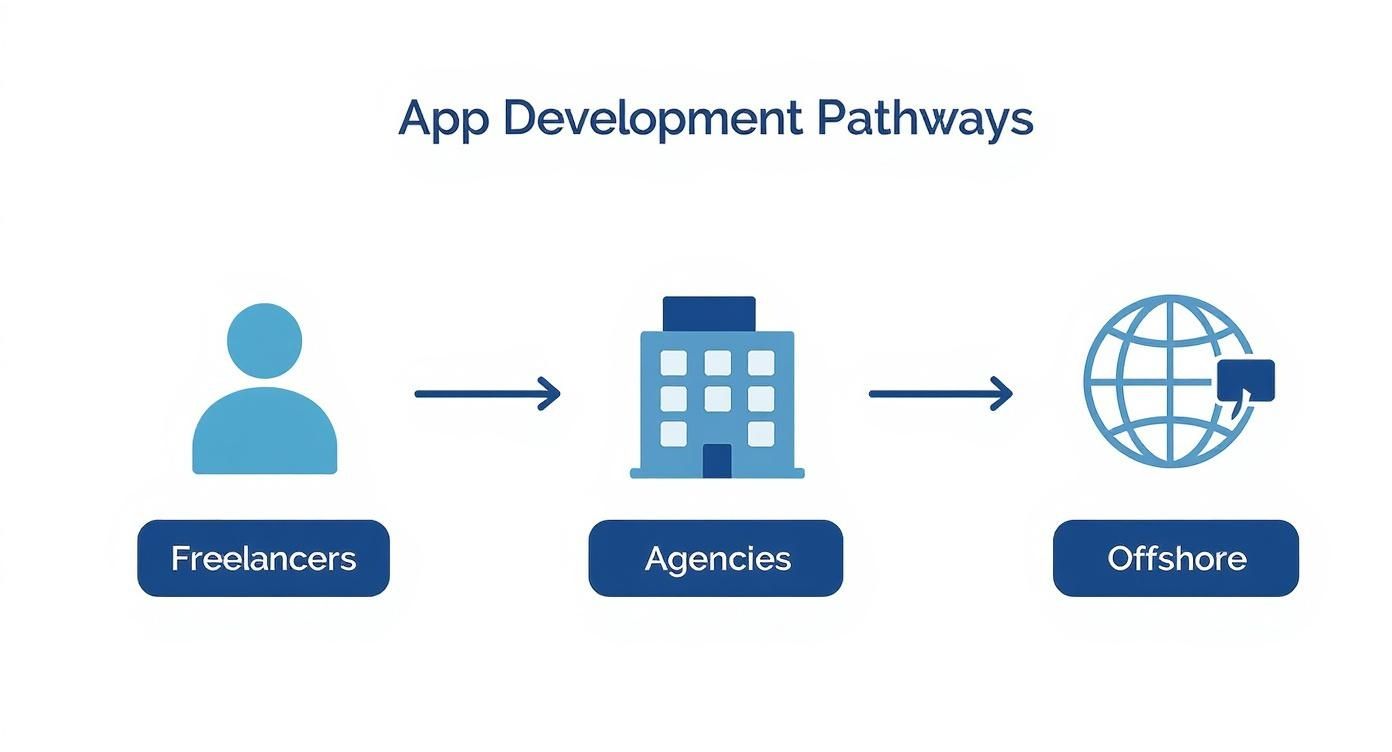
Thinking about which path is right for you depends entirely on your startup’s specific goals, your budget, and how hands-on you want to be.
The demand for custom apps in Australia is booming, with the market projected to rocket past AUD 4.5 billion by 2025. For a startup, knowing the local cost landscape is non-negotiable. A basic app will typically set you back anywhere from AUD 30,000 to 80,000. More complex, feature-rich projects can easily climb to between AUD 80,000 and 150,000 (or more), usually taking between 4 to 10 months to build.
Here in Australia, you can expect developer rates to hover between AUD 85 and 250 per hour. While that might seem steep, you’re paying for top-tier expertise and, crucially, someone who understands the local market. If you want to get granular, you can explore a deeper dive into these Australian app development costs and trends to help you budget properly.
So, How Does This Look in the Real World?
Let’s make this practical. Imagine you’re a small online retailer and you just need a straightforward WooCommerce integration for your website. Your project is small, well-defined, and calls for a specific skill. In this case, hiring a local freelancer is probably your most cost-effective move.
On the other hand, if you’re building a complex piece of custom software development in Sydney or Adelaide from scratch, the game changes. You’ll likely need a whole team—UI/UX designers, backend engineers, QA testers, and a project manager to keep it all on track. This is where a dedicated agency’s structured approach and diverse talent pool really shine.
To help you weigh your options, here’s a quick comparison of the common development models. This table breaks down the typical costs, speeds, and key trade-offs you’ll need to consider.
Startup Development Options at a Glance
| Development Model | Typical Cost Range (AUD) | Best For | Key Consideration |
|---|---|---|---|
| Freelancer | $85 – $180 / hour | Startups with small, well-defined projects and in-house technical oversight. | High risk if the developer disappears; limited scope and scalability. |
| Local Agency | $120 – $250 / hour | Startups needing a full team (design, dev, PM) for a complex, end-to-end product. | Higher initial investment, but offers reliability, expertise, and ongoing support. |
| Offshore Team | $40 – $90 / hour | Budget-conscious startups with strong project management and clear requirements. | Communication barriers and time zone differences can cause significant delays. |
Ultimately, the right choice boils down to your specific project needs, your tolerance for risk, and how much management you can handle yourself.
I’ve seen startups make one mistake over and over: underestimating the complexity of what seems like a simple project. For example, a heavily customised Odoo implementation in Sydney or Adelaide isn’t a job for a generalist. It demands a team with deep ERP experience, making an agency a much safer bet. The same goes for a unique Shopify implementation that needs custom API integrations—you need a partner who knows that ecosystem inside and out.
Ready to find the right development partner to build your app? Let’s chat about your project and find a path forward that fits your budget and your big-picture goals.
Contact Wistec today for a free consultation.
Nail Down Your App Scope to Keep Costs in Check
Before you even think about hunting for an affordable app developer for startups, you have to answer the most important question of all: what are you actually building? A vague idea is a recipe for disaster, leading to bloated quotes and a never-ending cycle of revisions.
The real secret to keeping your budget under control is to define your app’s scope with surgical precision. And that starts with embracing the Minimum Viable Product (MVP).
An MVP isn’t a cheap, buggy prototype. It’s the most distilled, focused version of your app that solves one critical problem for your ideal customer. Think of it as the solid core of your vision, polished and ready to go. Everything else is just noise that will drain your bank account and your timeline.
This focused approach is your best defence against ‘scope creep’—that sneaky process where new features get tacked on, derailing the project and blowing up the budget. By launching lean, you get to market faster, collect feedback from real users, and make smart, data-backed decisions about what comes next.
Be Ruthless: Find Your One Core Feature
Building a powerful MVP means learning to brutally separate your ‘must-haves’ from your ‘nice-to-haves’.
Let’s say you’re building a new social networking app. Your grand vision probably includes everything from live streaming and direct messaging to an intricate events calendar. But for your MVP, you need to pick just one thing.
Maybe it’s photo sharing. If so, your entire initial development effort goes into making that one feature an absolutely stellar experience. Everything else gets parked on a “future features” list.
I’ve seen so many startups fall into the trap of trying to build their ultimate dream app right out of the gate. The smarter play is to launch lean. A complex software development Sydney project for a logistics firm, for example, shouldn’t start with full-scale warehouse management. It should begin with a simple, effective package tracking feature. Prove the concept first, then expand.
When you’re this ruthless with your feature list, you end up with a crystal-clear brief for potential developers. This clarity is what allows them to give you a much more accurate—and almost always lower—quote.
Put Your Vision on Paper
Once you’ve zeroed in on that core feature, it’s time to document it. Don’t panic; this doesn’t mean writing a hundred-page technical manual. A straightforward Product Requirements Document (PRD) and some basic wireframes are all you need.
Your documentation should clearly lay out:
- The Problem: What specific pain point are you solving for your user? Be precise.
- The Core Feature: How does your app solve that problem in the simplest way possible?
- The User Flow: Sketch out the journey. What are the exact steps a user takes from opening the app to getting the job done?
- Success Metrics: How will you know if you’re winning? Is it the number of photos shared? Daily active users? Define it upfront.
This process does more than just create a brief; it forces you to think through every detail. It ensures you and your developer are perfectly aligned from day one. Honestly, this is the single most critical step in getting an accurate quote and building an app you can actually afford.
Whether you’re planning a custom Odoo implementation in Adelaide or a new Shopify storefront, a well-defined scope is your most powerful tool for budget control.
Ready to turn your focused MVP into reality? We specialise in helping startups build what truly matters.
Get in touch to discuss your app idea.
Comparing Australian App Development Hubs
Choosing where to find your development partner in Australia isn’t just about picking a spot on the map; it’s a strategic move that will directly impact your budget, the quality of your app, and its overall character. The Aussie development scene is largely a tale of two cities, with Sydney and Melbourne leading the pack, but each offers a distinctly different flavour for a startup hunting for an affordable developer.

These powerful regional hubs have their own ecosystems. Melbourne, the startup capital, is brimming with fresh ideas, and you’ll find mid-level developer rates often hovering between AUD 100 to 150 per hour. Sydney, on the other hand, is geared more towards enterprise-level clients and complex, integrated solutions.
By investing locally, you’re tapping into a developer’s innate understanding of Australian culture and regulations, which can seriously de-risk your project. You can get a deeper look into Melbourne and Sydney’s app development trends to see how this plays out in practice.
Sydney: The Powerhouse for Complex Builds
Sydney is the corporate heart of Australia, and its development community reflects that. It’s the go-to city for enterprise-grade projects, heavy-duty financial systems, and large-scale eCommerce platforms that need to be bulletproof.
If your startup requires robust software development in Sydney, especially for a project that needs deep integration with legacy systems, this is your ground zero. Think about a sophisticated Odoo implementation in Sydney; the agencies here have the runs on the board to handle that level of complexity without breaking a sweat.
Melbourne: The Hub for Startup Innovation
Melbourne has a completely different vibe. It’s the epicentre of Australia’s startup scene, buzzing with creative energy and a relentless focus on building the next big thing.
This environment is perfect for startups working on a Minimum Viable Product (MVP), a niche SaaS tool, or a one-of-a-kind mobile app. The talent pool is full of developers who aren’t just coders; they’re product-thinkers who are genuinely excited to jump in and collaborate on new ideas.
A common mistake I see is founders thinking one city is universally ‘better’ than the other. The right choice comes down to your project’s specific needs. For a complex Shopify implementation with custom APIs and tricky third-party logistics integrations, a specialised Sydney agency is a safe bet. But for a lean WooCommerce store focused on a killer user experience, a nimble Melbourne freelancer could be the perfect, affordable fit.
Case Studies: A Tale of Two Startups
Let’s look at a couple of real-world scenarios to see how this all shakes out.
-
Practical Case: FinStyle in Melbourne. This fintech startup needed to build an MVP for a niche budgeting app. They found a local freelance developer with a fantastic portfolio in consumer finance apps. The entire project was wrapped up in four months for around AUD 45,000. The freelancer’s focused expertise and lower overheads made it the ideal, affordable solution to validate their concept fast.
-
Practical Case: RetailFlow in Sydney. This eCommerce brand needed a complex Shopify implementation to connect its online store with a multi-location inventory system and a custom loyalty program. They partnered with a Sydney agency specialising in enterprise eCommerce. The project took seven months and came in at AUD 120,000. While pricier, the agency’s full-service approach—complete with a project manager, designers, and QA specialists—ensured a flawless, scalable launch that a solo freelancer simply couldn’t have handled.
Deciding between a freelancer and an agency, or even a hybrid model, often boils down to your project’s complexity and how much time you have for project management. Both paths can lead to a brilliant launch, as long as you align your choice with your specific goals.
Struggling to decide which Australian city—or which development model—is right for your app? We have deep roots in both the Sydney and Adelaide tech scenes and can help you make the smartest choice.
Book a strategy call with our experts today.
Finding a Great Developer and Getting Quotes That Don’t Bite
Okay, so you’ve got a list of potential developers. That was the easy bit. The real work starts now: figuring out who can actually deliver the goods on time and, crucially, on budget. Finding a genuinely affordable app developer for startups isn’t about picking the cheapest option; it’s about a proper vetting process. You need to look past the shiny portfolio and see how they actually think.
A slick app design is nice, but it’s useless if it doesn’t solve a real problem for your business. When you’re scrolling through a developer’s past work, don’t just look at the screenshots. Ask yourself: what was the point of this app? Did it help a retailer manage their stock better? Did it get more people to engage with a media company’s content? You’re looking for evidence of real-world results, not just a pretty interface.
This is especially true for bigger, more complex jobs. If you’re looking at a custom software development Sydney build or a tricky Odoo implementation Adelaide businesses need, you can’t afford to hire someone who just writes code. You need a partner who thinks as you do—like a business owner.
Know What to Ask
The interview is your chance to separate the genuine experts from the pretenders. Forget the generic “tell me about your experience” questions. You need to see how they handle pressure and think on their feet.
Here are a few questions I always recommend adding to your list:
- On Problem-Solving: “Tell me about a time a project went completely off the rails with a technical issue you didn’t see coming. How did you figure out what was wrong, and what did you do to fix it?”
- On Quality Control: “What’s your process for testing and quality assurance? How do you make sure the app is solid and bug-free when it’s time to launch?”
- On Communication: “What’s your preferred way to keep clients in the loop on progress? How often will I hear from you?”
Their answers here are gold. They’ll tell you everything you need to know about their process, how transparent they are, and whether they’ll crumble when things get tough.
You can learn almost everything you need to know from the ‘roadblock’ question. A vague answer is a massive red flag. A great developer’s eyes will light up. They’ll dive into the details of the problem, the things they tried that didn’t work, and the clever fix they eventually landed on. That’s the kind of passion and grit you want.
Practical Case: An Adelaide Startup’s ERP Nightmare
Let’s make this tangible. A logistics startup in Adelaide needed a custom Odoo implementation that Adelaide didn’t have the specific talent for, so they started looking further afield. Their goal was clear: an MVP to sort out their warehousing and delivery routes, and they had a firm budget.
They got in touch with three different teams: a small local agency, a massive software development firm, and a mid-sized Sydney team that specialised in ERPs.
To make sure they were comparing apples with apples, they gave each one the same Product Requirements Document (PRD) and a set of wireframes. They insisted on an itemised quote that broke down the cost for:
- Initial setup and configuration
- Custom module development
- Migrating their existing data
- Training and ongoing support
The Adelaide agency came back with the lowest price, but they’d never worked in logistics before. The big Sydney firm was impressive but way out of their price range. The mid-sized team from Sydney was the perfect fit. Their quote was competitive, and their portfolio was full of complex ERP projects they’d successfully delivered. By lining up the detailed quotes against proven experience, the startup found a partner they could afford and trust.
You can use this same approach for any project, whether it’s a Shopify implementation or a custom WooCommerce store. Nail down your scope, ask the tough questions, and make them break down the costs.
Feeling a bit overwhelmed? If you need a hand vetting developers or putting together a scope document that gets you clear, accurate quotes, we can help. Let us guide you to the right technical partner for your startup.
Contact us for a free project assessment.
Shave Months and Thousands Off Your Build with Modern Tech
In the startup game, speed is everything. It’s your single greatest advantage. Finding an affordable app developer for startups becomes a whole lot easier when you aren’t asking them to reinvent the wheel. The good news is, modern tech gives you a massive shortcut to building, testing, and getting your app out there.
This means you need to think beyond traditional, ground-up coding for your first version. No-code and low-code platforms have seriously levelled the playing field. They let founders get a working Minimum Viable Product (MVP) into the hands of real customers in a matter of weeks, not the months (or years) it used to take. You get to prove your concept works without betting the farm on a full-custom build.
The Power of Platforms and APIs
Think of these tools as sophisticated Lego blocks for your app. Instead of painstakingly crafting every single brick yourself, you’re snapping together high-quality, pre-built components to bring your vision to life.
- No-Code/Low-Code Tools: Platforms like Bubble or Adalo are incredible. They let you build surprisingly powerful applications with a visual, drag-and-drop interface. Need user accounts, databases, or complex workflows? You can often get it done without a single line of code.
- Pre-Built APIs: Seriously, why build a payment system from scratch when you can plug in Stripe in an afternoon? The same goes for user authentication with Auth0, maps with Google Maps, or even messaging with Twilio. Each API can save you hundreds of hours of development time.
This isn’t about cutting corners; it’s about being strategic. A truly great developer knows exactly when to build custom and when to integrate a proven solution to get you to market faster and for less money.
Here’s a practical case I’ve seen play out. A startup was quoted over $150,000 for a custom eCommerce platform—a huge software development Sydney project. They wisely hit the brakes and pivoted. Instead, they used a Shopify implementation for the core shop and then integrated a few specific APIs for their unique features. The result? They launched their MVP in just two months for under $40,000.
Get to Market and Grab That Share—Fast
This isn’t just about saving cash. It’s a genuine competitive weapon. It’s shocking, but around 67% of Australian businesses still don’t have a mobile app, despite apps gobbling up 90% of our time on mobile. By using app builders, startups can cut their time-to-market by a staggering 80%, launching a prototype in just a few weeks. The data backs this up: companies that launch within six months capture 33% more market share than those that drag their feet. You can find more stats on the speed of app builders in Australia.
So, whether you’re building a WooCommerce store or planning a custom Odoo implementation in Adelaide, leaning on modern tech is your clearest and fastest path to a successful launch.
Ready to build a powerful app without the enterprise-level price tag? We specialise in creating smart, efficient solutions for startups.
Let’s discuss how we can build your MVP affordably.
You’ve Hired Your Developer. Now, Let’s Get to Work.
So, you’ve found and hired your developer. That’s a huge milestone, but it’s just the starting line. The real race begins now, and how you manage the next phase is what separates a successful launch from a project that fizzles out. An affordable app developer for startups is only a good investment if you can keep the project on track and within budget after the contract is signed.
The first thing you need to do is set up a clear project management system. This isn’t about breathing down your developer’s neck; it’s about creating a single source of truth for everyone involved. Get on the same page with a tool like Jira, Trello, or Asana. When everyone can see what’s being worked on, what’s coming up, and what’s blocked, you eliminate nasty surprises.
Set Your Rhythm: Milestones and Communication
Once your tools are in place, it’s time to chop up that mountain of a project into manageable hills. Don’t just aim for a vague goal like “finish the app.” Break it down into concrete milestones, often organised into two-week “sprints.” For example, a sprint goal might be “Complete user login and password reset flow” or “Integrate Stripe payment processing.”
Just as important is establishing a steady communication rhythm. Nail this down from day one.
- Daily Stand-ups: A quick 15-minute chat each morning to cover what was done yesterday, what’s on for today, and any roadblocks. Keep it short and sharp.
- Weekly Check-ins: A more in-depth meeting to review the previous week’s progress against the milestone and plan the week.
This constant, low-friction communication is your early warning system. It helps you catch small misunderstandings before they snowball into major delays and budget blowouts.
Here’s a practical case: An Adelaide-based startup hired a gun developer for a custom Odoo implementation in Adelaide. Thanks to their mandatory weekly sprint reviews, they spotted a critical issue in the second week—a key module wasn’t talking to their CRM correctly. Catching it then saved them from a massive, expensive rebuild later on.
Whether you’re managing a software development Sydney team, rolling out a complex Shopify implementation, or building a new WooCommerce store from scratch, what you do after the hire is what truly dictates success.
Need a hand turning that new hire into a successful launch? We bring the structure and expertise to make sure your project doesn’t just start strong but finishes even stronger.
Let’s talk about building your app with confidence. Get in touch with us today!
Answering Your Burning Questions About App Development Costs
So, what does it really cost to build an app? It’s the number one question I get from startups, and it’s a fair one.
For a Minimum Viable Product (MVP) here in Australia, a realistic starting point is somewhere between AUD $30,000 and $80,000. This gets you the essential, core functionality needed to validate your concept with real users. Keep in mind, this is a baseline – the more bells and whistles you add, the more that figure will climb.
Freelancer vs. Agency: Which Is Actually Cheaper?
Another common dilemma is whether to hire a freelancer or go with an agency. On paper, a freelancer’s hourly rate might look more attractive. But an agency brings a whole team to the table – project managers, designers, and dedicated QA testers.
For a complex project, like a custom software development build in Sydney, that team structure can be a lifesaver. It prevents the kind of rookie errors that lead to costly reworks down the line, often giving you far better value for your money in the long run.
How to Keep Costs Down Without Cutting Corners
The smartest way to manage your budget is to be ruthless about defining your MVP. What is the absolute minimum you need to solve your user’s primary problem? Stick to that. Everything else can wait.
For instance, if your business needs an Odoo implementation in Sydney or Adelaide, focus on the core operational modules first. You can always add the fancy customisations in a later phase once you’re generating revenue.
You can also lean on existing platforms to speed things up and slash costs. Using battle-tested solutions like a Shopify implementation or a WooCommerce store for the e-commerce side of things can get you to market significantly faster and with a much healthier bank balance.
Ready to get a clear, no-nonsense quote for your app idea? At Wistec, we specialise in building practical, solution-focused tech that delivers real results without the eye-watering price tag. Let’s have a chat about your project.