

You walk into the store on a Monday and the numbers don't line up. The POS says a bestseller is in stock, the shelf is empty, the online store is still selling it, and the warehouse team is hunting through pallets to find one carton that should've been moved last week. That's the moment most retailers realise inventory management for retail isn't an admin task, it's the engine that decides whether cash stays trapped in stock or turns back into sales.
In Australia, that pressure is sharper because shrinkage is expensive, stock holding ties up cash, and omnichannel mistakes spread fast across stores and online. Retail theft and related shrinkage cost the sector about A$9 billion a year, and global carrying costs are commonly estimated at 20% to 30% of inventory value per year retail inventory management guide. If you run apparel, homewares, specialty retail, grocery, or a mixed channel business, the question isn't whether stock control matters. It's whether your current stack can keep up with the pace of trading.
When the Stockroom Becomes the Bottleneck
A retail operation usually doesn't collapse because of one catastrophic mistake. It bogs down because the team keeps compensating for small errors with more spreadsheets, more manual checks, and more after-hours reconciliation. One store oversells online, another hides dead stock in a back room, and the warehouse keeps receiving product that never gets matched cleanly to purchase orders.
That's where inventory starts acting like a bottleneck instead of a support function. The practical fix isn't “work harder”, it's to create one stock truth across receiving, selling, transfers, and replenishment. If your team is still patching gaps with exports and email threads, the process itself is the problem, not the staff.
The operational shift that changes everything
Retailers usually get relief from three moves. First, they stop treating the stockroom as separate from the website. Second, they make receiving a control point, not a casual handover. Third, they centralise item data so every SKU follows one rule set across locations and channels.
Practical rule: if a line can be sold online, picked in store, transferred between sites, and returned by a customer, it needs one inventory record and one owner.
That's why many retailers eventually look beyond a simple POS add-on and towards a proper systems layer. If you're mapping that transition, this guide to WMS and ERP systems is a useful companion because the warehouse process and the finance process can't stay split forever.
The promise of good stock control is simple. Less guesswork, fewer stockouts, fewer awkward customer conversations, and less time spent reconciling what the business thinks it owns versus what's on the shelf. That's the foundation for every practical decision that follows.
What Retail Inventory Management Actually Means
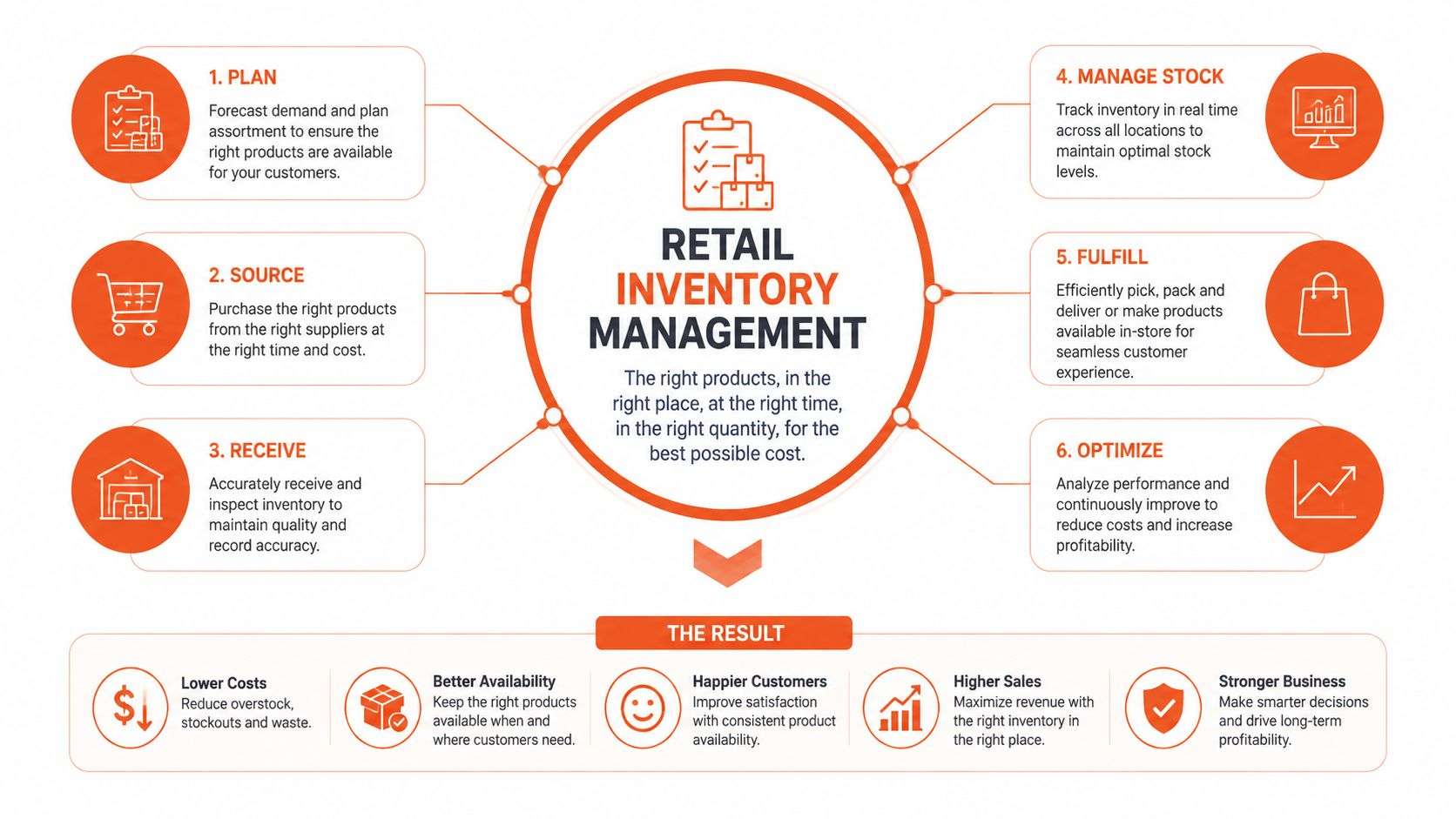
At its simplest, retail inventory management means having the right product, in the right place, at the right time, at the right cost. A café makes this easy to understand. If the barista has milk but no coffee beans, the menu fails. If the fridge is full of product nobody orders, cash is sitting idle while customers still wait.
Retail works the same way, just with more SKUs and more ways to get it wrong. The cost side matters because inventory typically costs 20% to 30% of inventory value per year to hold, including capital, storage, insurance, tax, handling, shrinkage, and obsolescence inventory management statistics. The loss side matters too, because the Australian retail sector is dealing with about A$9 billion in theft and related shrinkage each year retail inventory management guide.
The four building blocks that keep stock honest
Retailers who stay in control usually have four things in place.
- Centralised product records: SKU, supplier, cost, minimum reorder amount, case quantity, on-hand quantity, and lead time all sit in one place, not spread across folders and inboxes.
- Accurate on-hand data: counts are tied back to receiving, transfers, sales, and returns so the system matches reality.
- Disciplined replenishment: the team knows when to reorder, how much to order, and which products need tighter thresholds.
- Shrink control: the business tracks losses instead of hoping they'll disappear into “normal variance”.
NetSuite's retail guidance is blunt on the mechanics, item-master discipline and formal receiving are not optional if you want stock accuracy to hold up in a real operation NetSuite retail inventory management. Odoo ERP supports that same structure by connecting the item record, purchasing, POS, and inventory movements in one system, while Shopify and WooCommerce usually need more careful integration work to avoid splitting the truth across tools.
The goal isn't perfection. It's repeatability. Once the business can see what it has, where it is, and what it needs next, inventory stops being a guessing game and starts becoming a management discipline.
The Metrics That Reveal the Truth About Your Stock
If a retailer manages by instinct alone, the stockroom usually leaks margin in ways the team can't see until month-end. The cleaner approach is to look at a short list of KPIs every week and use them to force decisions. That's how operators move from “we feel busy” to “we know what's broken”.
The four numbers that matter most
Inventory turnover shows how often stock sells through and gets replaced. The formula is cost of goods sold divided by average inventory. A healthy signal is movement that suits the category, because apparel, grocery, and electronics behave very differently.
Days sales of inventory, or DSI, tells you how long inventory sits before it's sold. The formula is average inventory divided by cost of goods sold, then multiplied by the number of days in the period. Lower can be better, but only if stockouts aren't rising with it.
Stock-to-sales ratio compares stock on hand to sales and helps reveal whether you're overbuying for demand. GMROI, gross margin return on inventory investment, shows how much gross profit inventory is generating for each dollar invested. It's one of the clearest ways to compare categories that sell at different speeds and margins.
A practical retail dashboard should also track shrinkage percentage and stock accuracy. Benchmark studies cited by inventory analysts put retail inventory accuracy at only 63%, and 34% of retail businesses reported shipping late because they'd sold an out-of-stock product inventory KPIs for retail. Those are not abstract figures. They show how quickly bad on-hand data turns into customer-facing failure.
| KPI | What it measures | Formula | Healthy signal |
|---|---|---|---|
| Inventory turnover | How often stock moves through | Cost of goods sold divided by average inventory | Category-appropriate movement, not stagnant stock |
| Days sales of inventory | How long stock sits before sale | Average inventory divided by cost of goods sold, then multiplied by days | Lower for fast-moving lines, balanced with availability |
| Stock-to-sales ratio | Stock depth versus demand | Stock on hand divided by sales | Aligned with replenishment rhythm and season |
| GMROI | Gross profit per inventory dollar | Gross margin divided by average inventory cost | Margin justified by the capital tied up |
| Shrinkage percentage | Loss from theft, damage, errors | Shrinkage divided by stock value | Low and explained, not hidden in variance |
| Stock accuracy | System record versus physical stock | Accurate count divided by total count | Close alignment with real shelf stock |
If you want a broader lens on how to use these numbers in daily operations, tracking retail store performance metrics is a useful reference point for tying stock performance to store results without turning the dashboard into noise.
Operational truth: if turnover looks healthy but late shipments keep happening, the business probably has a stock accuracy problem, not a demand problem.
Odoo ERP can surface these KPIs without waiting for month-end spreadsheets, which matters because the lag is often where decisions go wrong. The right metric at the wrong time is still too late.
Choosing the Right Inventory Model for Your Category
One of the fastest ways to waste money is to apply one stock rule across every product. A fresh loaf of bread, a pair of sneakers, and a phone accessory do not age the same way, and they shouldn't be handled the same way either. Category fit matters more than the label on the method.
FIFO, FEFO and JIT in real retail terms
FIFO, first in, first out, suits categories where older stock should move before newer stock. Apparel and homewares are good examples because the main risk is not expiry, it's obsolescence, season change, or colour and size mix getting stuck. FIFO helps keep aged stock from hiding behind fresh deliveries.
FEFO, first expired, first out, is the right call for grocery, beauty, and pharmacy retail. If expiry matters, the system has to prioritise what needs to leave first, not just what arrived first. That's where Odoo ERP's lot and expiry tracking becomes practical rather than theoretical, because staff need a rule the system can enforce.
JIT, just-in-time, can work for electronics and seasonal goods when supplier lead times are stable and forecasting is tight. It reduces excess stock, but it also leaves less room for transport delays, regional disruption, or a supplier missing a drop. In Australian retail, that trade-off matters more outside metro centres.
Practical rule: choose the method that matches how the product spoils, ages, or becomes obsolete, not the one that sounds most modern.
Hybrid setups are common and sensible. A grocer might use FEFO for fresh items and FIFO for non-perishables. A fashion retailer might use FIFO for core lines and tighter JIT-style buying for fast-changing trend items. The mistake is not mixing methods. The mistake is pretending one rule fits everything.
In practice, Odoo ERP can apply those rules at SKU or lot level, while Shopify and WooCommerce usually need heavier plugin work and more manual oversight to achieve the same control. That's fine for small ranges. It gets messy fast when the catalogue grows.
Forecasting Demand and Replenishing Without the Firefighting
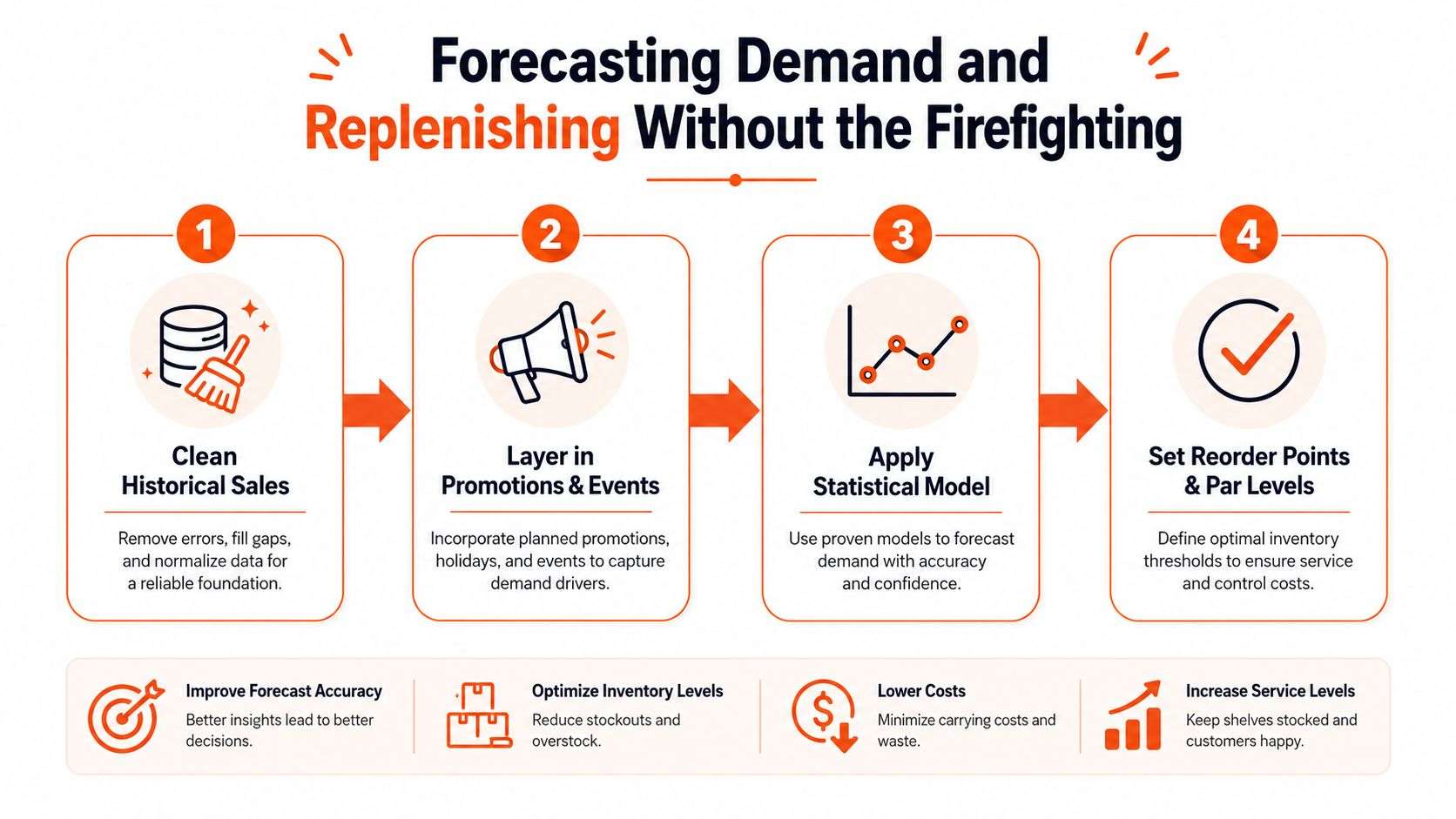
Forecasting is where most retailers either gain control or keep living in reactive mode. Reorder points are only useful if the demand signal behind them is decent, and that signal has to include more than last week's sales. Clean history, promotions, seasonality, and local events all affect what needs to be ordered next.
A practical forecasting workflow
Start with clean historical sales. Remove obvious one-off noise where you can, and make sure product codes, locations, and dates line up cleanly across channels. If the data is dirty, the forecast will be too.
Then layer in promotions and seasonal patterns. EOFY sales, Black Friday, back-to-school demand, and tourism spikes can all distort normal buying patterns in Australia. A retailer that ignores those spikes either runs short or gets stuck with excess stock after the event has passed.
The third step is modelling. It doesn't need to be fancy to be useful, but it does need to be consistent. The output should be a reorder plan with safety stock, not a pile of charts that no one uses.
For a useful external reference on forecast discipline, Online Brand Growth forecasting tips are worth reading through the lens of channel-specific demand planning, especially if your retail mix leans heavily online.
The fourth step is review. Forecasts should be checked weekly in fast-moving categories and at least regularly in slower lines. That cadence matters because the gap between forecast and reality is where stockouts and overbuying start.
Returns and disruption need their own rules
Returns are inventory, even if many retailers treat them like admin. Returned stock has to be inspected, reclassified, and either restocked, quarantined, discounted, repaired, or written off. If that decision doesn't happen quickly, the system on hand drifts away from what the business can sell.
Practical insight: returns handling is a forecasting input, not just a warehouse task. If returns are delayed or misclassified, the next replenishment decision is already compromised.
Disruption needs a separate lens too. Floods, fire, port delays, and transport issues can stretch lead times outside Sydney, Melbourne, and Adelaide. A retailer in a regional market can't assume the same replenishment rhythm as a metro store, so safety stock should be set with local logistics reality in mind, not just ideal supplier lead times.
If you're integrating POS and stock signals more tightly, this POS integration guide helps frame why the demand feed has to stay clean between checkout, warehouse, and online sales. Odoo ERP is useful here because it can pull those signals into one planning rhythm, while Shopify or WooCommerce usually need more deliberate integration work to avoid delays in the stock picture.
Why Odoo ERP Is the Backbone of Modern Retail Inventory
Spreadsheets and POS plugins can hold a small operation together for a while. They usually fail when the business adds more locations, more channels, or more complex stock rules. At that point, the problem isn't selling more, it's keeping a consistent view of what's available.
Where the different stacks fit
A pure Shopify store is strong on storefront speed and simple commerce. It's a good fit when the inventory model is straightforward and the business isn't carrying much complexity behind the scenes. The weakness shows up when the retailer needs deeper warehouse logic, more advanced purchasing control, or richer item-level workflows.
WooCommerce can be flexible, especially for retailers who already run WordPress and want control over the front end. It's often a practical option for smaller stores or businesses with custom content needs, but the plugin stack can become fragile as complexity grows. Every extra layer adds more decisions about compatibility, maintenance, and data flow.
Odoo ERP is different because it acts as the operational backbone. Inventory, Purchase, POS, eCommerce, and Manufacturing sit in one environment, so stock moves, buying decisions, and fulfilment signals stay aligned. That matters in multi-warehouse retail, and it matters even more when the business needs landed cost visibility, batch and expiry control, or a tighter link between retail and light manufacturing.
For retailers in Sydney and Adelaide, the common pattern is clear. A single-platform setup works early, then starts to strain once omnichannel complexity increases. A Wistec-led Odoo implementation can be shaped around AU tax, shipping, and reporting requirements, and one option in that mix is Wistec's own ERP stack with an inventory management module for tracking stock on hand, overstocking, stockouts, and stock moved across locations ERP for retail industry.
What Odoo handles that matters on the floor
- Inventory: on-hand visibility, transfers, replenishment, and stock valuation.
- Purchase: supplier orders, receiving, and replenishment rules.
- POS: store sales linked back to the same item record.
- eCommerce: online orders tied into stock movements.
- Manufacturing: useful when the retailer assembles, bundles, or finishes goods before sale.
Decision rule: if your team keeps reconciling three systems to answer one stock question, you've outgrown the stack.
That's where ODOO partner Sydney Adelaide support becomes practical rather than decorative. The right partner isn't selling software first, it's designing the workflow so the retailer can use it effectively. In a growing business, that usually beats trying to glue together a dozen extensions and hoping the stock ledger stays accurate.
A 90 Day Roadmap to Get Inventory Under Control
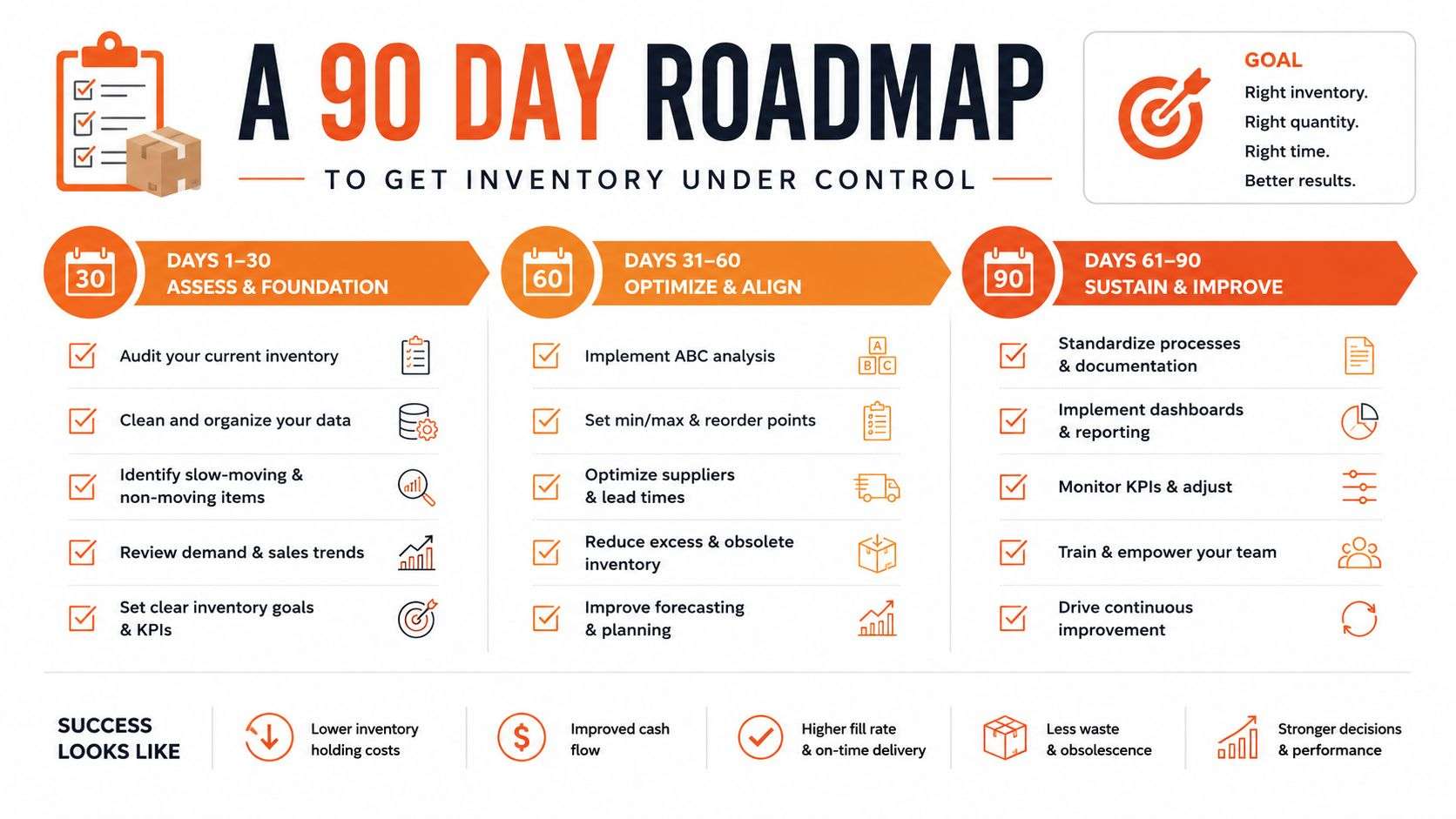
Retailers don't need another theory pack. They need a sequence that the team can start on Monday and still keep using after the first busy period hits. The fastest way to get there is to phase the work so data quality, process control, and automation land in the right order.
Days 1 to 30
Clean the SKU master, confirm supplier records, and set one naming standard across stores and channels. Introduce barcode-driven receiving against purchase orders so incoming stock is checked properly, then define your initial KPI set. ABC analysis belongs here too, because the team needs to know which lines deserve the tightest control first.
Days 31 to 60
Start cycle counting on the important lines, not everything at once. Build a simple shrinkage dashboard and turn on the first replenishment automation inside Odoo ERP. At the same time, connect Shopify or WooCommerce stock updates so the online shop and the store stop drifting apart.
Days 61 to 90
Refine forecasting, tighten returns handling, and lock in a quarterly business review. This is also the right time to document who owns exceptions, who approves adjustments, and what gets escalated when stock accuracy slips.
A practical owner-operator version of the plan looks like this.
- Operations lead: owns stock accuracy, cycle counts, and exception handling.
- Warehouse or store manager: owns receiving checks and transfer discipline.
- Finance lead: owns valuation, write-offs, and margin review.
- Systems partner: owns integration, workflow setup, and reporting.
By day 90, the business should have fewer manual corrections, clearer counts, and a more reliable ordering rhythm. That's not glamorous work, but it's exactly what stops the stockroom becoming the bottleneck again.
Your Next Move and the Questions Retailers Ask Us Most
The same three objections come up in almost every retail conversation in Sydney and Adelaide. Will it take months, what will it cost, and what happens if the team gets it wrong? Those are fair questions, and they're better answered by a phased rollout than by a big-bang promise.
A phased Odoo implementation reduces trading risk because the retailer can stabilise stock data before adding more automation. That matters more than forcing everything live at once. It also gives staff time to trust the system, which is usually the adoption hurdle.
Pricing should be judged against business complexity, not just the logo on the invoice. A simple Shopify or WooCommerce setup may be enough for a smaller retailer, but if the business needs batch tracking, multi-location stock visibility, or more advanced purchasing controls, the hidden cost of patching gaps usually rises fast. A proper planning conversation is the only honest way to compare stacks.
Practical question to ask: can the system answer a stock query without three people checking three different screens?
That's the test I use on retail projects. If the answer is no, the business is paying for software but still operating on manual effort.
For retailers comparing Shopify implementation, WooCommerce, and odoo erp, the decision usually comes down to operational complexity. Shopify wins on simplicity at the front end. WooCommerce gives flexibility. Odoo gives the broader control layer once stock, purchasing, and fulfilment need to work together. For AU retailers who also need help with software development sydney Adelaide, the true value is in matching the stack to the process, not forcing the process to fit the software.
If you want a second set of eyes on your current setup, book a free 30-minute inventory scoping session with Wistec. Bring your SKU list, your current stock pain points, and the systems you're using now, then walk away with a clear recommendation on what to fix first.
Wistec helps Australian retailers design inventory control that works across stores, warehouse, and online channels, including Odoo ERP setups, Shopify and WooCommerce integrations, and practical workflow automation. If you're ready to reduce stock confusion and tighten replenishment, visit Wistec and start with a focused inventory scoping conversation.
FAQ
What is the best inventory system for retail?
The best system is the one that matches your complexity. Smaller retailers may do well with Shopify or WooCommerce plus disciplined stock processes, while growing multi-channel retailers usually need Odoo ERP to keep purchasing, stock, POS, and reporting aligned.
Why does stock accuracy matter so much?
Because bad on-hand data affects everything after it. If the system says stock exists when it doesn't, you get stockouts, late shipments, frustrated staff, and lost sales.
Is Odoo suitable for Australian retailers?
Yes, especially when the business needs multi-location stock control, receiving discipline, and tighter integration between inventory and accounting. A local implementation partner can also shape it around Australian tax and shipping needs.
Can Shopify handle inventory management on its own?
It can handle simpler setups well, but it becomes less comfortable when the retailer needs warehouse-level control, batch rules, or more detailed replenishment logic. That's where integrations or a fuller ERP layer usually become necessary.
When should a retailer move from WooCommerce to ERP?
Usually when manual stock reconciliation starts taking too much time or when multiple channels need one trusted inventory record. If staff are constantly checking spreadsheets to answer stock questions, the business has probably outgrown the current setup.