

Your warehouse doesn't usually fall apart in one dramatic moment. It starts with a few missed cut-offs, a labour roster that never quite matches demand, and a finance manager asking why pick errors keep chewing through margin. Then a peak period hits, the floor gets louder, the ERP doesn't line up with what's on the shelf, and manual workarounds become the operating system.
That's the moment warehouse automation solutions stop being an idea and become a decision. For Australian retailers, 3PLs, and manufacturers, the right answer isn't “buy robots”. It's to build a stack that matches the site, the SKU profile, the labour market, and the systems already running the business, including Odoo ERP where it fits.
The operators who get this right don't chase gadgets. They look at throughput, labour pressure, building constraints, and integration risk, then choose the smallest automation step that pays back. That's the standard here, a practical one, not a brochure one.
The Operations Moment That Triggers Automation
The call usually comes after the pain is already obvious. A warehouse manager in Sydney or Adelaide watches the team scramble through a peak, sees picks running late, and realises the current process only works when volume behaves. The finance team then adds the part nobody wants to hear, manual handling is expensive, and every workaround has a cost.
Australia sits inside the broader Asia-Pacific automation environment, and one warehouse robotics market breakdown says the region held 51.70% of the market in 2025, while mobile robots accounted for 41.36% of warehouse automation spend and hardware held 55.12% of spending in the same period, pointing to a market where physical automation is already the centre of gravity, not a pilot experiment (warehouse automation statistics). For operators in freight-heavy sectors, that matters because the benchmark is no longer “should we automate?”, it's “what are we waiting for?”.
Practical rule: if your warehouse only works when experienced people are on shift, the process is already overextended.
The commercial case has also hardened. Analysts tracking the market say warehouse robots reached about 4.69 million installed worldwide by the end of 2026, and they project market value to move from $29.98 billion in 2026 to $59.52 billion by 2030 at a 18.7% CAGR (warehouse automation statistics). The exact base varies, the direction doesn't. Another source places the 2026 market at $27.4 billion, rising to $59.5 billion by 2030 at the same 18.7% CAGR.
For Australian operators, the takeaway is simple. Acting late means you buy automation under pressure, without enough time to redesign processes or systems. Acting early means you can choose the right layer first, whether that's software orchestration, AMRs, or storage automation. In practice, that also means choosing partners who can integrate cleanly with your WMS and Odoo ERP, and who understand site constraints, freight pressure, and labour economics in Sydney, Adelaide, and other tight Australian sites. For teams comparing options, a grounded starting point is full warehouse design solutions.
What Warehouse Automation Solutions Are
Warehouse automation solutions are a stack of connected systems, and each layer has a different job. The ERP or WMS sets the rules, the control layer coordinates the work, and the physical systems move stock with less labour and less delay.
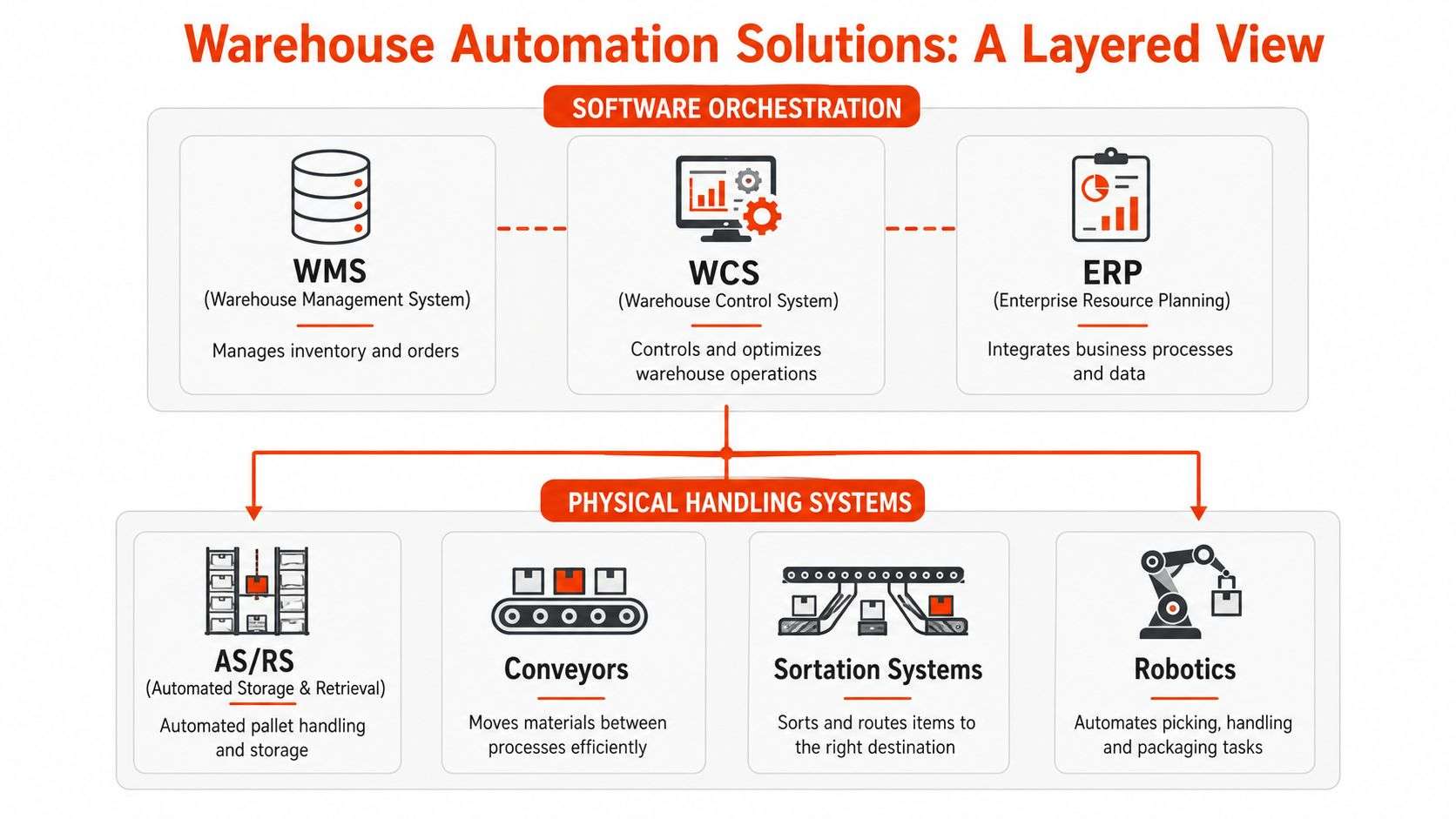
The software layer tells the warehouse what to do
Software orchestration sits at the top of the stack. A WMS manages inventory and orders, a WCS directs equipment, and an ERP holds the wider business record across purchasing, sales, and finance. That order matters, because a warehouse cannot automate cleanly if the system of record is wrong. If the ERP and WMS are out of step, the equipment just moves bad decisions faster.
The physical layer does the moving
The equipment sits underneath that software layer. AS/RS stores and retrieves stock, conveyors move cartons, sortation systems direct flow, and robotics handle picking or transport. AGVs and AMRs fill the flexible transport role, especially where routes change or layouts need reconfiguration.
Strong projects connect those layers properly. A source on automated storage systems lists storage heights of 5 to 30 m, rack levels of 3 to 15, inventory accuracy of at least 99.9%, and space utilisation improvement of 40 to 60%, but those results only land when the WMS, control layer, and material handling equipment are synchronised. Misalignment kills payback.
For teams that want a tighter technical brief on AS/RS design, full warehouse design solutions is the right benchmark to review before buying hardware.
Practical rule: software-led automation usually pays back sooner than hardware-led automation because it fixes decision flow before you spend heavily on movement systems.
For a non-technical team, the whiteboard version is simple. ERP/WMS decides, WCS coordinates, and AS/RS, AMRs, conveyors, or robotics execute. If the decision layer is weak, the hardware makes mistakes faster.
The Main Types of Automation and Where Each Pays Back
Different warehouse automation solutions solve different pain points. Mid-market Australian operators usually need to shortlist by site condition and SKU profile, not by vendor hype. A high-volume 3PL with dense storage has a different problem from a mixed-SKU retailer shipping online orders and wholesale cartons from the same floor.
Where each category earns its keep
AS/RS pays back where space is tight and stock density matters. It suits sites that need higher vertical use, cleaner inventory control, and less manual travel. The technical benchmark above, with 99.9% inventory accuracy and 40 to 60% space-use improvement, is why AS/RS keeps showing up in serious distribution centres, not because it looks futuristic.
Conveyors and sortation fit throughput-heavy lanes. They make sense when cartons or totes move the same way all day, and when order volume is high enough that manual travel becomes pure waste. If the layout is stable and the flow is repetitive, conveyors are straightforward value.
Robotic picking is for labour-heavy picking zones where staff spend too much time walking, bending, or searching. It works best when the WMS knows the slotting logic and the SKU profile is clear enough to avoid chaos. Robotic picking is not magic, it's a labour substitution tool with an integration bill.
AGVs and AMRs are the flexible option. Use them when transport paths change, when you want to avoid hard-fixed conveyor infrastructure, or when you're trying to reduce walking time before committing to a larger capital build. They're a good fit for staged adoption.
Practical rule: if your team spends most of the shift walking, transport automation deserves attention before fancy picking hardware.
| Warehouse Automation Categories at a Glance | Typical Cost Band | Complexity | Best-Fit Operator |
|---|---|---|---|
| AS/RS | High | High | High-density DCs, 3PLs, space-constrained sites |
| Conveyors and sortation | Medium to high | Medium to high | High-throughput fulfilment sites |
| Robotic picking | Medium to high | High | Labour-heavy pick zones, mixed-SKU operators |
| AGVs and AMRs | Medium | Medium | Operators needing flexible internal transport |
| WMS-led workflow automation | Low to medium | Medium | Mid-market teams needing faster payback |
The mistake is trying to buy every layer at once. The better move is to pick the first constraint that hurts most, then match the technology to that bottleneck.
WMS, ERP, and Where Odoo Fits in the Stack
Most automation projects don't fail at the robot. They fail at the handoff between warehouse logic and business logic. That's why ERP integration is the make-or-break factor, especially for Australian operators using multiple sales channels, third-party logistics, and finance systems that must stay in sync.
ERP and WMS do different jobs
A WMS runs the warehouse, receiving, putaway, pick paths, replenishment, returns, and stock accuracy. An ERP runs the business, orders, purchasing, finance, customer records, and reporting. If the ERP and WMS disagree, the warehouse ends up reconciling the gap manually, which defeats the point.
That's where Odoo ERP makes sense for mid-market operators. It's modular, so a retailer, manufacturer, or 3PL can unify inventory, purchasing, sales, and finance without taking on the overhead of enterprise licensing. For teams that need local delivery, Odoo implementation paired with custom integrations gives more control than a generic off-the-shelf setup.
One practical resource that explains the warehouse software side in more detail is Wistec's guide on WMS and ERP systems. It's useful because the integration question is usually the primary concern.
Why local integration capability matters
Australian projects get derailed when no one owns the handoff between software and operations. That's why local software development Sydney Adelaide capability matters, because it reduces the delay between a process issue and a fix. Wistec works as an ODOO partner Sydney Adelaide, and that means the warehouse design can be built around Odoo modules, custom development, and channel integrations.
That matters when the warehouse must talk to Shopify implementation workflows, WooCommerce stores, shipping platforms, or mobile apps used on the floor. A healthcare asset-management example from Evright Industrial's compliance software for healthcare shows the same principle in another sector, software only holds up when the process and compliance layer are designed together.
Wistec's warehouse tooling also includes its own WMS capability, which can support receiving, putaway, picking, returns, and replenishment when a business needs tighter control over warehouse activity. The point isn't to bolt on software for the sake of it. The point is to reduce integration risk before hardware goes live.
Benefits and ROI You Can Defend to Finance
Finance teams approve measurable change, not shiny hardware. They want to see labour saved, errors removed, throughput lifted, and floor space used better. That is the right lens for warehouse automation solutions, because the payoff comes from stripping out repeatable waste and reducing the cost of getting each order out the door.
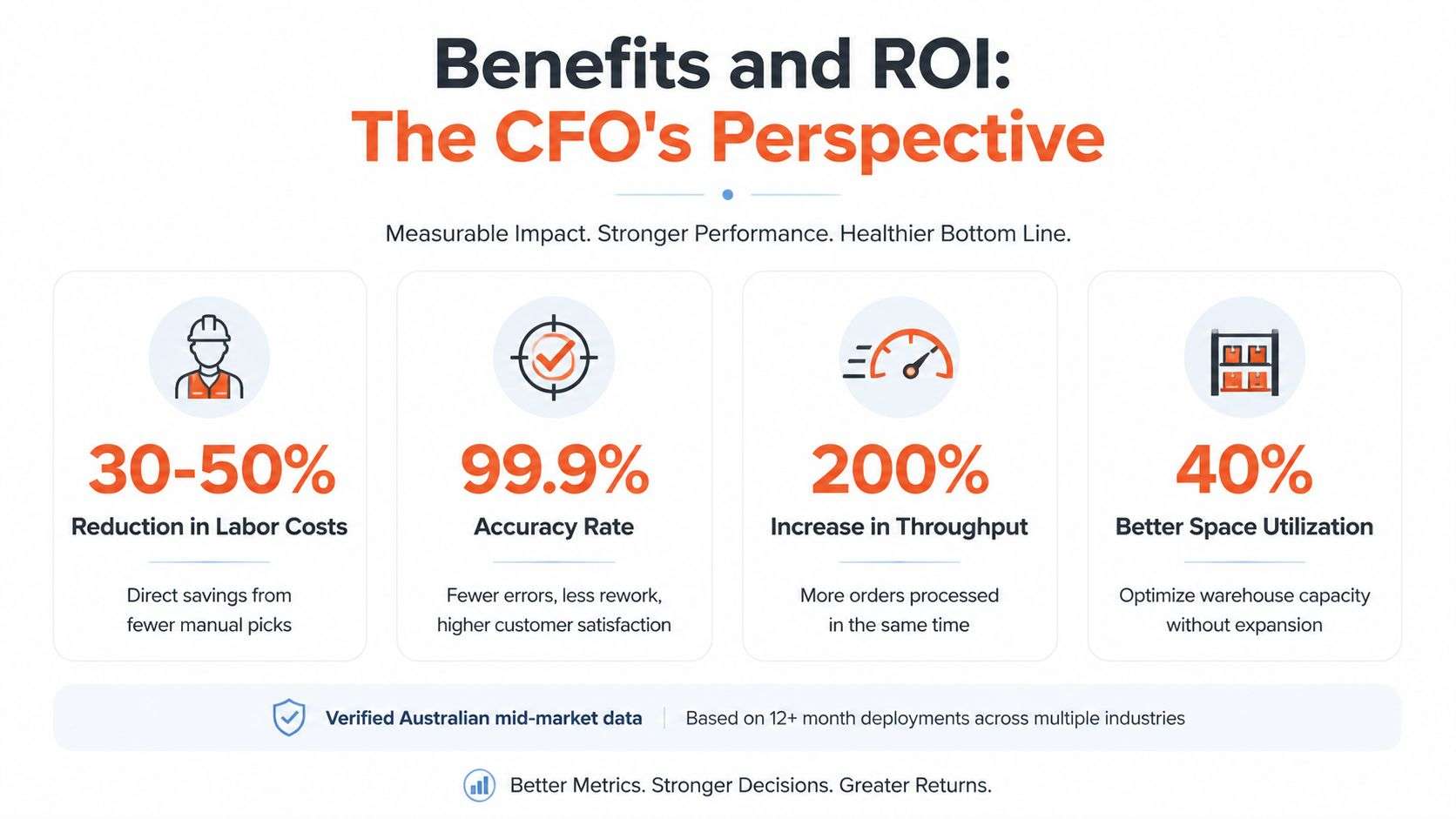
What the numbers say
A verified study reports that automation can deliver about 99% inventory accuracy, 25 to 30% labour cost reduction, 40% faster order fulfilment, and 80 to 150% productivity gains (automation performance benchmark). Those figures matter because they point to operational change, not marketing language.
Australian operators also have to deal with labour pressure. A separate market source says labour can account for 50 to 70% of total warehousing budgets, which is why every extra pick, walk, and rework step hurts margin. Wage pressure has also been rising, and that shows up quickly in fulfilment centres where throughput depends on people moving fast and making fewer mistakes. The same pressure is why warehouse automation statistics are worth reading once, then testing against your own site numbers.
How to build a defendable payback case
Start with the line items finance already trusts, labour savings, reduced error costs, and any avoided lease or expansion spend from better space use. Then include the integration cost in the model, because software, controls, and ERP or WMS work are part of the investment. If you are using Odoo or comparing it against other platforms, the integration effort should be shown clearly, not buried. Wistec's automation in business guide is useful here because the payback case falls apart fast if the software side is treated as free.
Practical rule: model payback as capex plus integration divided by annual labour and error savings, then test it against wage pressure and peak demand.
| ROI Driver | What to Measure | Why Finance Cares |
|---|---|---|
| Labour | Picking time, walking time, overtime | Biggest recurring cost |
| Accuracy | Mis-picks, stock variances, rework | Direct margin protection |
| Throughput | Orders per shift, cut-off performance | Revenue protection |
| Space use | Storage density, floor utilisation | Defers expansion |
The strongest case is usually not “we need a warehouse of the future”. It is “we need to stop losing margin every day through avoidable labour, error, and space cost.”
A Practical Roadmap From Pilot to Network Scale
A rollout that pays back starts with process audit, site constraints, and systems readiness. Mid-market Australian operators should map receiving, putaway, picking, replenishment, packing, and returns before they choose a platform, because automation only improves a process that already works cleanly.
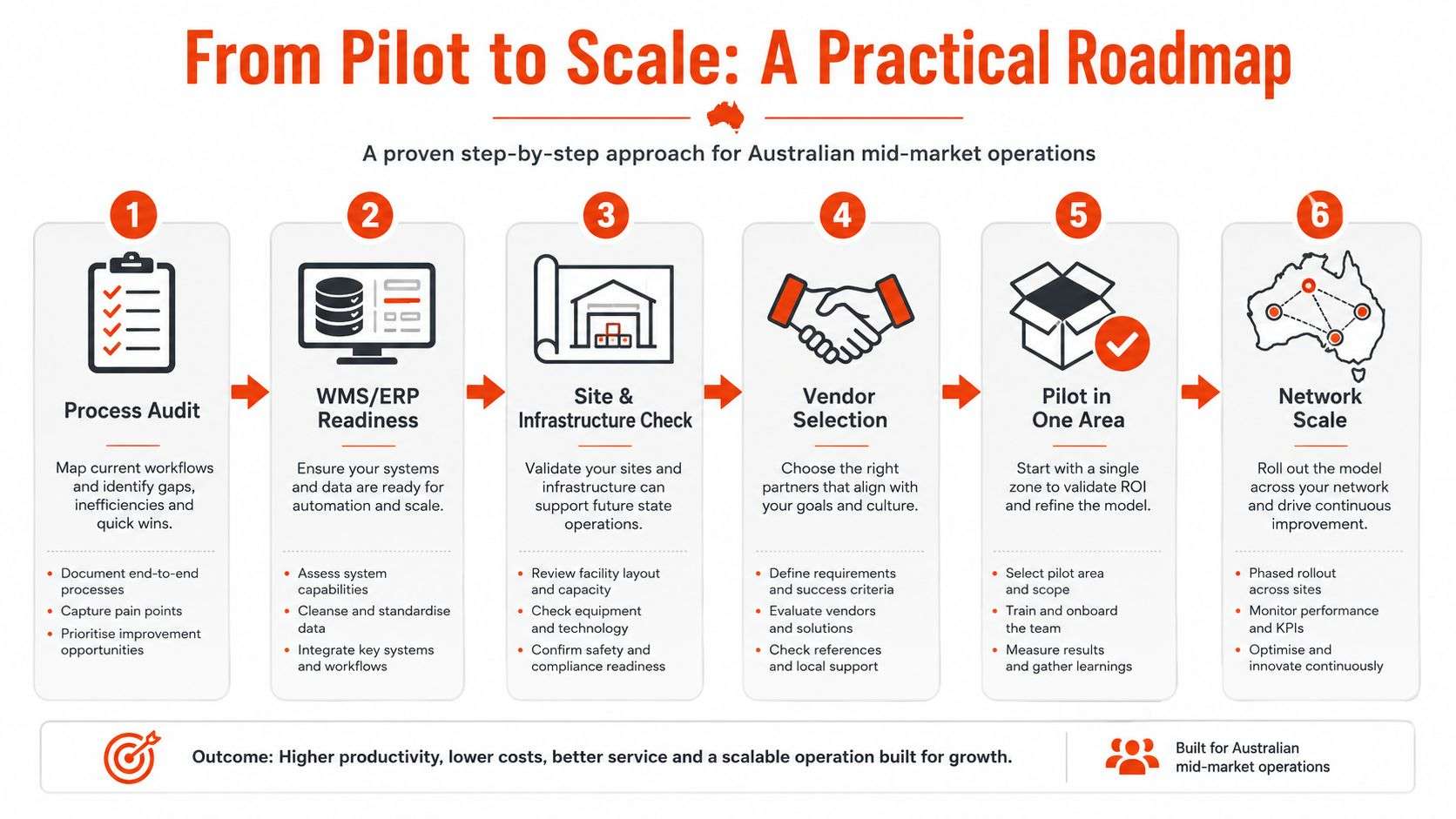
The sequence that holds up
- Process audit. Fix the flow on paper first. Broken workflows move faster once you automate them.
- WMS and ERP readiness. Check that master data, transaction logic, and reporting are clean enough for automation.
- Site and infrastructure check. Modern automated warehouses often need clear heights of 32 feet, about 9.8 m, or more, while some AS/RS setups need 40 feet, about 12.2 m, or more. AMRs need dedicated charging. AS/RS can require three-phase heavy service and transformer upgrades (warehouse automation infrastructure guide). In Sydney and Adelaide, site constraints matter just as much as the equipment list, because freight access, tenancy limits, and service capacity can decide what is realistic.
- Vendor selection. Compare systems on integration, support, and scalability. Hardware specs alone do not show whether the investment will hold up.
- Pilot in one zone. Validate one flow before you touch the whole building. That keeps the risk contained and gives finance evidence it can defend.
- Network scale. Treat the next site as part of a network plan, not a copy of the first site. Standardise the logic, then roll it out with discipline.
Use a warehouse automation strategy that treats the pilot as a test of the operating model, not a showroom. The right guidance is to use network solutions, keep governance centralised, and test SKU profiles, throughput patterns, and IT dependencies before you commit the rest of the estate (warehouse automation strategy). That stops one-site enthusiasm from becoming multi-site inconsistency.
Wistec's Odoo implementation guide matters here because ERP readiness is often the gate that slows the roadmap. If the Odoo setup, data structure, and warehouse transactions are not aligned early, the pilot becomes a software clean-up project instead of an automation project.
Practical rule: if you cannot support the pilot with clean master data and a clear process owner, you are not ready to scale.
Common Pitfalls and How to Avoid Them
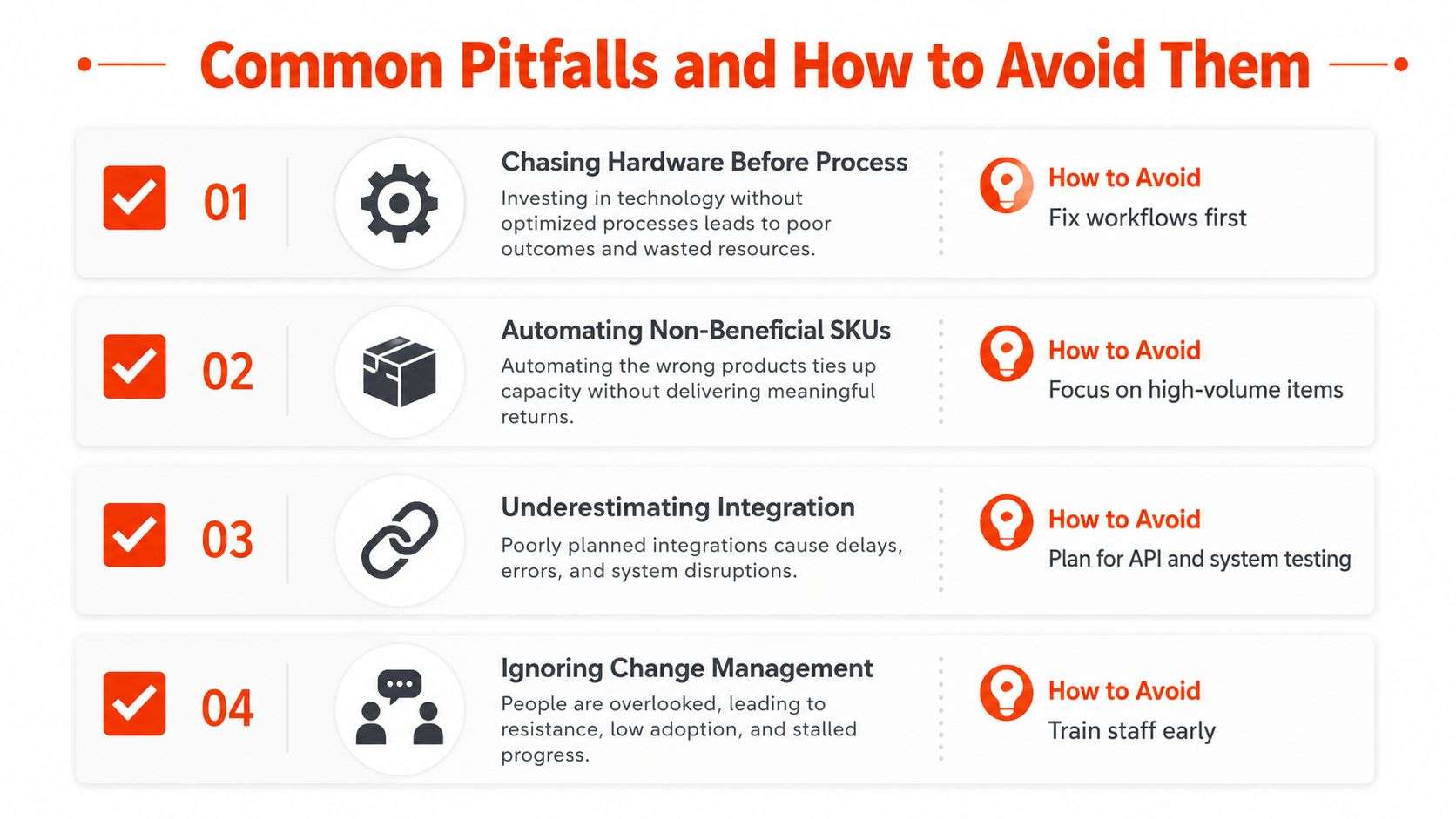
The first mistake is buying hardware before fixing the process. Teams see a conveyor or robot and assume the layout will sort itself out, but broken workflows just move faster into new failures.
The second mistake is automating the wrong SKUs. McKinsey's point is useful here, not every item benefits equally, and some medium- and low-volume SKUs gain more from reduced travel and better storage density than from brute-force automation. If the SKU profile doesn't support the equipment, the payback gets weaker immediately.
The third mistake is underestimating integration. A warehouse can have excellent machinery and still fail if the WMS, ERP, and control layer don't line up cleanly. That's why IT needs a seat at the table from the start.
The fourth mistake is ignoring change management. Operators need training, supervisors need new exception rules, and finance needs a reporting model that reflects the new operating pattern. Automation changes roles, not just equipment.
The fifth mistake is treating a pilot as proof of a network strategy. A single site can look good while the next site falls apart because its SKU mix, labour profile, or infrastructure is different.
Practical rule: automation is not a capex decision. It's a people, process, and technology decision with a capital budget attached.
The cleanest way to avoid trouble is simple. Fix the workflow, pick the right SKU segment, involve IT early, train the floor, and only then decide whether one warehouse or the whole network should go next.
Questions Australian Operators Ask Before Choosing a Partner
How does Odoo fit with warehouse automation? Odoo should sit at the business layer, keeping inventory, purchasing, sales, and finance aligned. In a warehouse setup, it works alongside the WMS and any control layer, so the operation stops relying on spreadsheets and manual reconciliations. If the data model is clean, Odoo becomes a solid base for automation and for reporting back to finance on what the warehouse is really doing.
Should I retrofit one warehouse or plan the network first? Plan the network first, even if you only automate one site now. A single site can prove the concept, but it does not prove the next site will behave the same way. Different SKU mixes, labour profiles, building constraints, and freight flows change the economics fast, so central governance keeps the investment honest.
What about Shopify and WooCommerce fulfilment? They need a reliable handoff into the warehouse stack, not manual exports. If a retailer runs Shopify implementation or WooCommerce, the store, inventory, and dispatch logic must connect cleanly or the warehouse just inherits bad data. Integration design matters more than the storefront itself, because poor order data creates avoidable labour pressure on the floor.
What should I ask an Odoo partner in Sydney or Adelaide? Ask who owns the workflow mapping, who handles the integration, how the pilot will be tested, and how exceptions will be reported. Ask how they deal with site constraints, freight pressure, and the reporting needs of finance and operations. If the partner cannot explain warehouse logic in plain language, keep looking.
Can Wistec help with the software side? Wistec supports Odoo implementation, warehouse-oriented software development, and integrations across ERP, WMS, web stores, and mobile apps. That matters because the automation decision only holds if the software layer is owned properly and the handoff between systems is tested before you spend on equipment.
The three decisions that matter are still the same. Which warehouse automation solutions should you prioritise, which ERP and WMS stack should become the standard, and which partner will own the integration without hiding behind jargon. If you are weighing an Odoo rollout, a warehouse process audit, or a Shopify or WooCommerce connection into fulfilment, Wistec can map the software and workflow side with an Australian delivery team. Visit Wistec to book a discovery call and get a practical automation plan built around your site, your SKU mix, and your ROI target.