

A project looks under control until the business sees the first real version. Then the gaps show up fast. The website brief changes halfway through build, the Odoo ERP scope expands once warehouse and finance teams test actual workflows, and a Shopify launch triggers new requests for bundles, subscriptions, local pickup, and checkout changes that were never raised in kickoff.
That pattern is common in Australian SMB projects. Requirements often sound settled in workshops, then shift once staff test a live screen against day-to-day operations. I see it regularly in ERP and eCommerce work. A purchasing flow that looked fine on paper can break down once approvers, stock controllers, and accounts teams all touch it. A storefront that passed UAT can still miss practical needs around shipping rules, promotions, or fulfilment.
Many articles on agile methodology explained stop at definitions. They cover sprints, stand-ups, and backlogs, but skip the harder question: how do you run Agile well when the business is still learning what it needs?
Agile works because it assumes change will happen and gives teams a controlled way to respond to it. The approach comes from the Agile Manifesto, written in 2001 by software practitioners who wanted a more iterative way to deliver software. For business owners, the practical takeaway is simple. You do not need every requirement locked down on day one. You need a delivery model that lets your team test ideas early, adjust scope with evidence, and keep the project commercially sensible.
Beyond Buzzwords Why Agile Matters for Your Business
The usual project failure pattern is easy to recognise. A business approves a large specification, waits months, then reviews a nearly finished system and realises key assumptions were wrong. By then, changing anything is expensive and frustrating.
Agile tackles that problem by reducing the distance between idea, build, feedback, and revision. Instead of treating change as disruption, it treats change as normal. That's why Agile fits projects where customer expectations, internal processes, or compliance requirements shift during delivery.
For Australian SMBs, that's common in:
- Retail and eCommerce: Product ranges, promotions, fulfilment rules, and customer journeys change quickly.
- Manufacturing and logistics: Inventory handling, warehouse processes, and purchasing approvals often evolve once teams start using a system.
- Healthcare and professional services: Teams need room to adapt workflows around operational and governance realities.
What this looks like in practice
In an Odoo ERP project, a finance team may think they want a straightforward purchasing workflow. Once purchasing, warehousing, and accounts staff review the first working version, they often ask for approval tiers, clearer stock moves, or reporting changes. With a rigid plan, each adjustment becomes a change request battle. With Agile, those changes become backlog decisions.
In a Shopify implementation or WooCommerce rebuild, the same pattern appears in customer experience. A merchant might begin with a clean storefront brief, then discover they also need trade pricing, shipping logic for regional delivery, or tighter integration between the store and back office.
Agile works best when the team accepts a simple truth. You won't know everything at the start, and pretending otherwise usually creates more waste.
That's why Agile matters. Not because it's fashionable, but because it gives businesses a practical way to deliver useful work while requirements are still becoming clear.
The Core Philosophy of Agile Four Values That Drive Success
Agile succeeds or fails in the day-to-day decisions a team makes under pressure. I see the gap most clearly when a business says it is "running Agile" but still waits weeks for answers, signs off documents no one uses, and treats every new insight as a disruption instead of a signal.
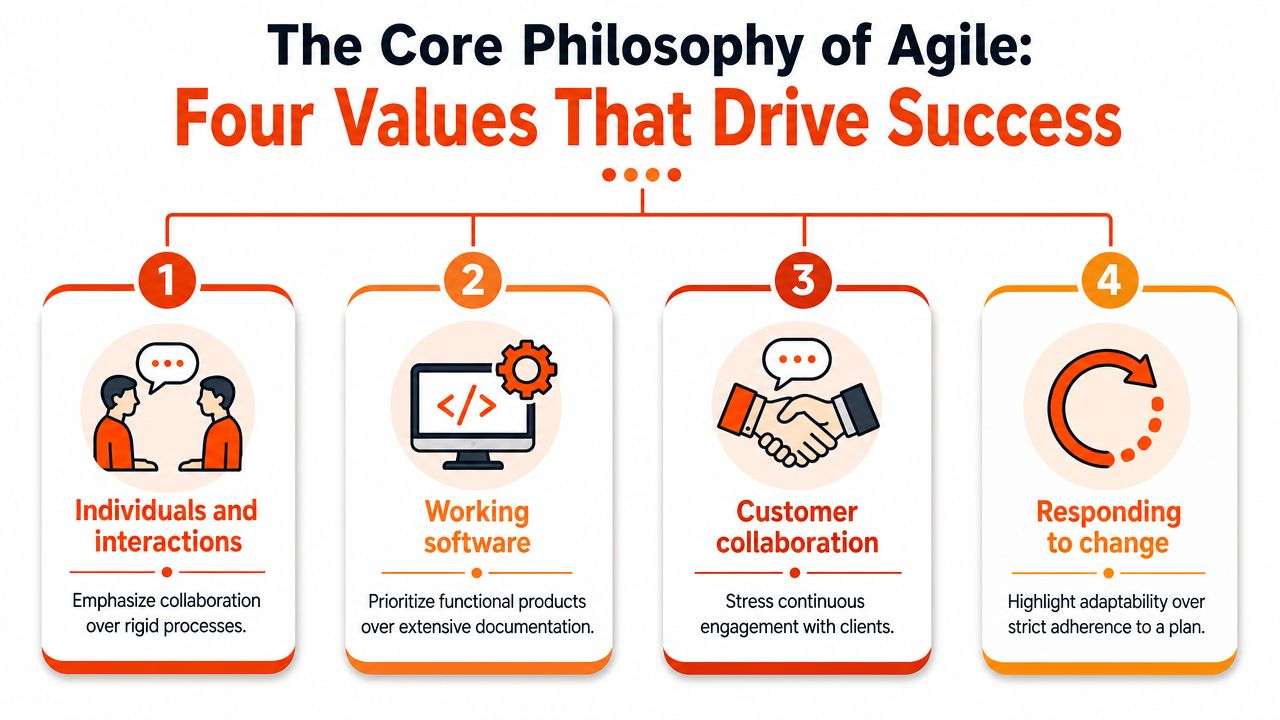
Individuals and interactions come first
Process helps. Tools help. Neither will rescue a project where the people doing the work cannot make fast, informed decisions together.
On an Odoo rollout, that often means putting a consultant, warehouse lead, and finance manager in the same room to settle how receipts, landed costs, and approvals should work. One focused workshop can remove weeks of confusion. A ticket queue usually extends it.
For Australian SMBs, this value is practical, not philosophical. Smaller teams often have overlapping roles, so delays in communication hit harder. If the operations manager is also handling purchasing and stock exceptions, every unclear handoff slows the whole business.
Working software matters more than heavy paperwork
Documentation still matters, especially in ERP and integration projects. Teams need clear process rules, acceptance criteria, and audit visibility. The problem starts when documentation becomes a substitute for delivery.
A working stock receipt flow in Odoo shows whether the warehouse team can receive goods, reconcile quantities, and pass clean data into accounts. That tells you more than a polished process diagram. In a Shopify build, a live checkout with real shipping rules will expose edge cases that a specification misses every time.
Good teams document what supports decisions and future maintenance. They do not produce fifty pages to avoid showing unfinished work. If your planning cadence needs tightening, this agile sprint planning guide is a useful companion to the values here.
Customer collaboration beats defensive scope control
Contracts set the commercial frame. Delivery still improves when clients stay close to prioritisation.
In practice, that means structured involvement. A merchant on Shopify should help decide whether the next release goes into search filtering, bundle logic, or ERP sync fixes based on margin, campaign timing, and fulfilment pressure. An Odoo client should weigh in on whether the team tackles purchase approvals before custom finance reporting. Those choices affect business outcomes, not just backlog order.
This is also where trade-offs become visible. More collaboration does not mean saying yes to every request. It means making better decisions with the people who carry the operational risk after go-live.
Responding to change beats blind plan-following
Plans are useful. Early assumptions are not sacred.
On ERP projects, teams regularly learn that the original process map does not match how the business operates. A manufacturer may discover that returns handling is more manual than expected. A wholesaler may realise customer-specific pricing rules are driving more complexity than product setup. Changing course at that point is good project control.
The alternative is worse. Teams keep delivering against an outdated plan, hit user acceptance testing, and then discover the "finished" solution does not fit the work on the ground.
The twelve principles in plain language
The manifesto's twelve principles become clearer when translated into delivery habits teams can apply every week:
- Deliver early: Put useful functionality in front of users while there is still time to adjust.
- Welcome change: Update priorities when the business learns something real.
- Work in short cycles: Smaller releases expose defects, bottlenecks, and bad assumptions sooner.
- Keep business and delivery close: Faster access to decision-makers reduces waiting and rework.
- Trust skilled people: Strong consultants, developers, and client leads solve problems better than rigid scripts.
- Use direct communication: A ten-minute call can replace days of back-and-forth.
- Measure progress by what works: Completed functionality is a better progress check than status language.
- Sustain the pace: Teams that are constantly overloaded make poorer technical and operational decisions.
- Protect technical quality: Shortcuts in integrations, testing, or data structure create expensive delays later.
- Keep it simple: Build what the business needs now, not every future possibility.
- Let teams organise the work: Delivery improves when capable teams can sequence tasks sensibly.
- Reflect and improve: Retrospectives only count when the team changes how it works.
Practical rule: If the team cannot show usable progress, explain why priorities changed, and point to feedback that shaped the next decision, they are following ceremonies, not Agile.
Choosing Your Framework Scrum vs Kanban for Your Project
Once the philosophy is clear, the next question is operational. You don't just “do Agile”. You apply it through a framework. The two dominant choices remain Scrum and Kanban.
A widely cited 2026 adoption figure says 87% of organisations use Scrum and 56% use Kanban, which is why these two frameworks dominate most modern Agile conversations according to Parabol's summary.
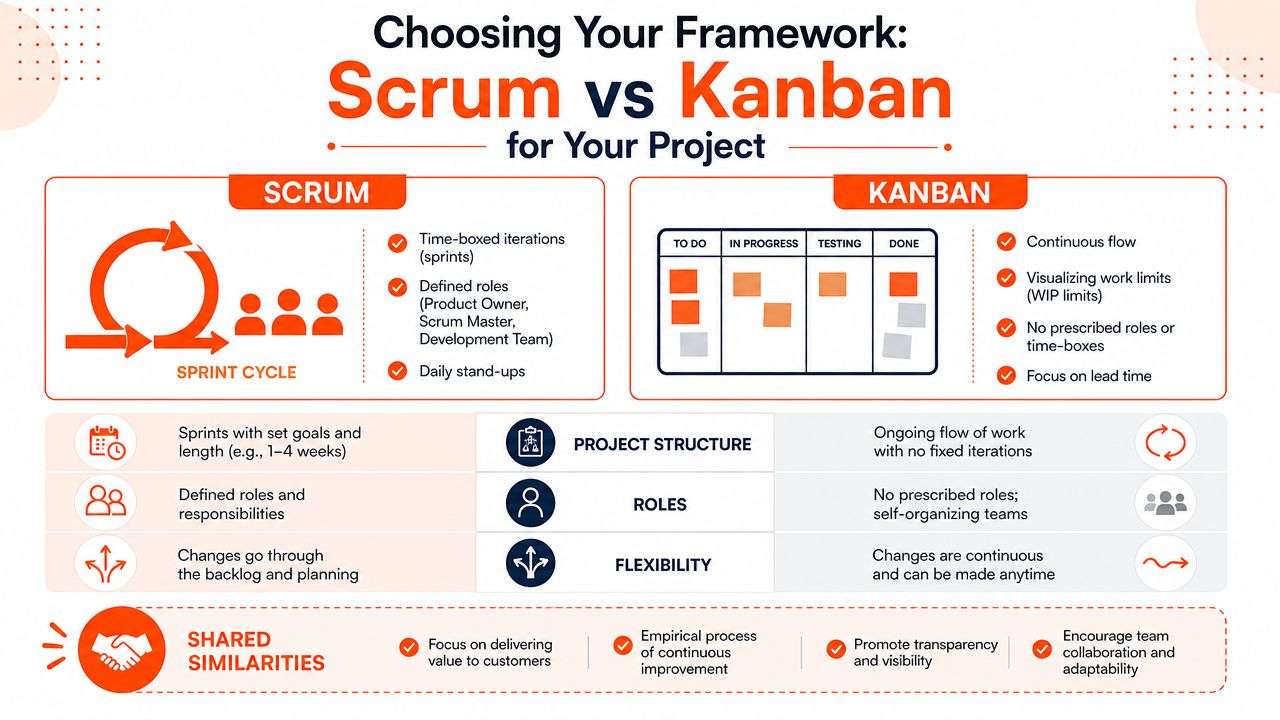
Scrum works well for structured product delivery
Scrum is best when you're building something substantial and need regular planning, review, and alignment. It's time-boxed. Work is committed into a sprint, completed, reviewed, and improved in the next cycle.
That structure is useful in an odoo implementation where multiple modules need coordination. Sales, purchasing, inventory, finance, and reporting often depend on one another. Scrum gives the project a rhythm and makes trade-offs visible.
Kanban works well for ongoing flow
Kanban is lighter. It focuses on visualising work, limiting work in progress, and improving flow over time. There are no prescribed sprints or mandatory roles.
That makes it a strong fit for post-launch support, enhancement work, and mixed-priority environments. A shopify implementation often moves into Kanban after launch because the work becomes continuous. Theme updates, app reviews, checkout refinements, SEO fixes, and campaign support don't always fit neatly into sprint boundaries.
Scrum vs Kanban at a glance
| Attribute | Scrum | Kanban |
|---|---|---|
| Cadence | Time-boxed sprints | Continuous flow |
| Planning style | Work selected at the start of each sprint | Work pulled as capacity becomes available |
| Roles | Usually defined roles such as Product Owner and Scrum Master | No prescribed roles required |
| Best fit | Complex builds with coordinated releases | Ongoing support, maintenance, and steady enhancement work |
| Change handling | Changes usually prioritised into the next sprint | Changes can enter the flow more flexibly |
| Typical use case | New Odoo ERP rollout, custom portal build | Shopify support queue, WooCommerce improvement backlog |
How to choose without overthinking it
Ask three questions:
Is the work a defined build or a continuous service?
New platform builds usually lean toward Scrum. Ongoing requests often suit Kanban.Do dependencies need tight coordination?
ERP projects often do. Website maintenance usually doesn't.Will business priorities shift every few days?
If yes, Kanban often handles that better.
Teams can also blend the two. Many Australian delivery teams run Scrum for implementation and Kanban for support. If you want a useful reference on structuring sprint work before a Scrum cycle begins, this agile sprint planning guide gives a practical breakdown of what strong preparation looks like.
Your Step by Step Guide to Agile Adoption
Agile adoption fails when businesses jump straight into ceremonies. They schedule stand-ups, buy a board tool, rename project managers, and assume they've changed the operating model. They haven't.
The shift starts with user needs, incremental delivery, and feedback. The U.S. TechFAR Hub describes agile software development as being designed around user needs, incremental delivery, and continuous improvement from user feedback, creating a direct link between stakeholder input and product changes in its agile overview.

Start with a pilot that matters
Don't roll Agile across the whole business at once. Pick one project where change is likely and stakeholder feedback is available. That could be a customer portal, a Shopify implementation, or a contained phase of an Odoo ERP rollout such as inventory and purchasing.
A good pilot should be important enough to matter, but not so politically loaded that nobody can experiment.
Define the roles properly
Scrum roles are simple on paper and frequently mishandled in practice.
- Product Owner: Owns priorities. This person decides what matters most and makes backlog trade-offs.
- Scrum Master: Protects the process, removes blockers, and helps the team improve.
- Delivery team: Designers, developers, consultants, testers, and specialists who build and configure the solution.
If nobody owns priority, the backlog turns into a wish list. If nobody protects the process, the team gets dragged into side requests and delivery quality slips.
Put the core ceremonies on the calendar
For software development Sydney Adelaide teams, consistency matters more than ceremony theatre. Keep the meetings focused and useful.
Sprint planning
Decide what the team can complete in the next cycle and why those items matter now.Daily stand-up
Keep it brief. Surface blockers. Sync dependencies.Sprint review
Show working output to stakeholders. Don't turn this into a status lecture.Retrospective
Identify what should change next sprint. Then implement it.
A practical companion for managers who want a wider operating view is this PM's guide to agile processes, which is useful when you need to align delivery mechanics with product decisions.
Build the right artefacts
Agile teams don't need heavy administration, but they do need clarity.
Product backlog
This is the ordered list of work. In an odoo erp project, backlog items might include stock rules, approval workflows, invoice layouts, and dashboard reporting.
Sprint backlog
This is the subset selected for the sprint. It should be realistic, not aspirational.
Definition of done
Agree on what complete means. Is a feature done when coded, configured, tested, approved, or deployed? If that isn't clear, reporting becomes fiction.
Measure outcomes, not just activity
The distinction between mature teams and those that only appear organised lies in their approach to metrics. Atlassian's guidance on agile metrics emphasises that metrics should support forecasting and bottleneck detection, not micromanagement, and that's the right lens for business leaders in this agile metrics guide.
Useful measures often include:
- Cycle time: How long work takes once started.
- Lead time: How long the business waits from request to delivery.
- Customer feedback quality: Whether users say the release solved the actual problem.
- Blocked work patterns: Where approvals, testing, or unclear scope repeatedly stall delivery.
Velocity can help internal planning, but it's not a business result. If your team completes points faster while users still struggle with the workflow, nothing important improved.
Use metrics to identify friction in the system, not to pressure individuals. Good Agile teams improve the flow of work. They don't turn dashboards into surveillance.
Support the rollout with process visibility
Most businesses also need a documented operating model so staff understand how discovery, delivery, review, and change control fit together. A practical reference point is a defined software development process that links business requirements to delivery steps without falling back into heavy waterfall habits.
Agile in Action Mini Case Studies
Theory is useful until the first dependency lands. Then the question becomes simple. How does this work on an actual delivery?

Odoo ERP for a manufacturing business in Adelaide
A mid-sized manufacturer needed an Odoo ERP rollout covering purchasing, stock movement, and finance handover. The original instinct was to design every workflow upfront, sign off the full process map, and then configure everything in one pass.
That would have created a long delay before users saw anything real. A Scrum approach worked better. The team prioritised the modules with the most operational impact first, reviewed working flows at the end of each sprint, and adjusted backlog items as warehouse and accounts staff identified gaps.
What helped was not the ceremony itself. It was the visibility. Staff could see where purchase receipts, stock adjustments, and invoice triggers didn't match live operations, then correct them before those issues spread through the rest of the implementation.
Shopify and WooCommerce for continuous eCommerce improvement
A retailer running both a primary Shopify implementation and a secondary WooCommerce storefront had a different problem. The business wasn't doing one large transformation. It was dealing with constant requests from marketing, customer service, and fulfilment.
Kanban suited that environment better than sprint-heavy planning. The team used a visible work queue, prioritised requests by business urgency, and managed flow across theme updates, app integrations, merchandising changes, and post-launch fixes.
The key lesson was restraint. Without work-in-progress discipline, every request looked urgent and nothing moved cleanly. Once the team limited active work and made blockers visible, decisions improved. Marketing could see when campaign changes would displace platform work, and operations could flag fulfilment logic before promotions went live.
The best Agile setup is the one that matches the shape of the work. A framework should reduce friction, not create a new layer of it.
Custom portal delivery for a professional services firm in Sydney
A professional services firm engaged a software development Sydney Adelaide team to build a client portal. They had broad requirements at the start, but many details were unclear because internal staff hadn't yet agreed on the best user journey.
An iterative approach avoided the common trap of over-specifying too early. The team released core functions first, gathered feedback from actual users, then refined workflows around document handling, approvals, and notifications.
That's where Agile is strongest. It gives stakeholders something concrete to react to. In custom software, people often don't know what they want until they interact with a working version. A rigid delivery model treats that as a problem. Agile treats it as normal project reality.
Common Agile Pitfalls and How to Avoid Them
The biggest Agile mistake is copying the language without changing the behaviour. Teams rename meetings, create backlogs, and still make every decision the old way.
A more serious mistake is choosing Agile for work that doesn't suit it. Research discussed in the South African Journal of Information Management points to agile being strongest in incremental change rather than fixed-scope delivery, which is a useful warning for regulated and tightly governed projects in this research discussion.
The common failure points
- Agile in name only: Teams run stand-ups but still lock scope too early and resist feedback.
- Weak product ownership: Nobody makes priority decisions, so the backlog becomes political.
- Too much work in parallel: Staff start everything and finish very little.
- Poor fit for the project: Some compliance-heavy or fixed-outcome work needs more upfront definition and tighter controls.
- No change support: Staff hear “new process” but don't understand what changes in their day-to-day role.
What to do instead
- Match the method to the work: Use Agile where learning, iteration, and staged delivery add value.
- Give one person priority authority: A backlog without ownership won't stay useful.
- Limit active work: Focus improves flow more than pushing for higher visible activity.
- Keep governance practical: Regulated industries can still use Agile, but they need explicit checkpoints.
- Treat adoption as change management: Internal alignment matters as much as tooling. A structured approach to change management strategies helps teams move beyond process announcements and into actual behavioural change.
Start Your Agile Journey with an Expert Partner
A typical Australian SMB project starts with good intent. The operations team wants better stock visibility in Odoo, marketing needs the Shopify storefront live before peak season, and leadership wants firm dates. A few weeks later, priorities are colliding, approvals are slow, and the team is arguing about process instead of delivery. That is usually the point where experienced guidance pays for itself.
Agile works best when it is fitted to the business, the system, and the level of change your team can absorb. An Odoo ERP rollout often needs tighter sprint planning, clearer decision rights, and regular stakeholder reviews because finance, inventory, and operations are all affected at once. A Shopify or WooCommerce project usually benefits from shorter release cycles, faster feedback from sales and customer service, and a backlog that can shift as merchandising and conversion data come in.
Good delivery leadership also means knowing where Agile is a poor fit, or where it needs stronger controls. Agile's sledgehammer approach makes that point well. In practice, the best results come from choosing the right amount of ceremony, governance, and iteration for the job in front of you.
If you are assessing Agile as part of a wider operational shift, business transformation consultancy support helps connect delivery methods with process design, system implementation, and adoption across the business.
For Sydney and Adelaide businesses planning an Odoo implementation, Shopify build, WooCommerce upgrade, or custom software project, early expert input usually prevents expensive rework. It helps set realistic scope, establish a workable backlog, and choose a delivery model your team can sustain.
If you want practical help applying Agile to ERP, eCommerce, or software delivery, talk to Wistec . Wistec works with Australian businesses on Odoo, Shopify, WooCommerce, and custom development projects, with delivery support grounded in what works on real projects, not workshop theory.