

So, what exactly is a business transformation consultancy? Think of them as more than just advisors. They are expert partners who help a company completely overhaul its operations, its culture, and its core strategy to stay ahead of the curve. This isn't about small tweaks; it's about making major structural changes to prepare your business for whatever the future holds.
What Does a Business Transformation Consultancy Do

Let’s use an analogy. Imagine your business is a solid, reliable ship built for calm waters. It gets the job done, but it’s slow and not designed for the unpredictable, fast-paced ocean of today’s market. A business transformation consultancy is the master shipbuilder you bring in, not just to patch a few leaks, but to redesign the entire vessel to navigate those stormy seas with speed and agility.
These firms are catalysts for deep, meaningful change. They don't just hand you a report and walk away. Instead, they get into the trenches with you to figure out what's really holding you back, help you imagine a better future, and then roll up their sleeves to make it happen.
More Than Just Advice
Standard management consulting often zeroes in on a single, isolated problem. A business transformation consultancy, on the other hand, looks at the whole picture. Their aim is to get every part of your organisation—from its day-to-day processes to the mindset of its people—pulling in the same new direction.
At the heart of their work, they focus on several key pillars that collectively drive real, lasting change.
Core Pillars of Business Transformation
Here's a breakdown of the primary areas a business transformation consultancy focuses on to drive holistic organisational change.
| Pillar | Description | Example Objective |
|---|---|---|
| Strategy & Vision | Defining a clear, ambitious future state and the strategic roadmap to get there. | Reposition the company from a product seller to a service provider. |
| Process Optimisation | Redesigning core workflows to be faster, leaner, and more customer-focused. | Cut the customer onboarding time by 50% through automation. |
| Technology Enablement | Integrating the right digital tools to support new ways of working and unlock value. | Implement a unified CRM system to create a single customer view. |
| People & Culture | Managing the human side of change to ensure buy-in, adoption, and new behaviours. | Foster a culture of continuous learning and data-driven decision-making. |
Ultimately, these pillars work together. You can't just install new software and expect everything to change; you also need to train your people and adjust your processes to make the most of it.
Tackling Your Biggest Challenges
Companies usually bring in a business transformation consultancy when they’re facing a challenge or an opportunity that’s too big or complex to handle internally. Their outside perspective and specialised skills become crucial when the need to adapt is urgent.
They help businesses navigate make-or-break scenarios like:
- Responding to Digital Disruption: Guiding a traditional retailer in building a powerful e-commerce platform and using AI to personalise the customer experience.
- Pivoting in Shifting Markets: Helping a company adapt its entire business model when consumer preferences dramatically change or a new competitor appears.
- Managing Mergers & Acquisitions: Bringing two different company cultures, IT systems, and operational processes together into one streamlined organisation post-merger.
- Breaking Through Growth Plateaus: Reigniting a business that has hit a wall by finding new sources of innovation and cutting out hidden inefficiencies.
In the end, a business transformation consultancy acts as a dedicated partner. They bring the fresh eyes, deep expertise, and focused execution needed to guide your company through a major evolution, ensuring you don’t just survive the disruption, but come out the other side stronger and more competitive than ever.
The Real Benefits of Partnering With Transformation Experts
Bringing in a business transformation consultancy is about more than just getting an extra set of hands. It’s about introducing a fresh, objective perspective that’s nearly impossible to find from within. Your team knows the day-to-day of your business inside and out, but that very familiarity can create blind spots to deep-seated inefficiencies.
Transformation experts walk in without the baggage of company history or internal politics. They have the freedom to ask the tough questions about "the way we've always done it" and challenge the legacy processes that everyone accepts but no one can quite justify. This unbiased viewpoint is often the first real step toward genuine change.
On top of that, they bring a wealth of experience from other industries. A problem that feels unique to your organisation might be something a consultant has tackled half a dozen times before in different sectors. This allows them to adapt proven solutions to your specific situation, saving you from reinventing the wheel.
Gaining Strategic Momentum and Mitigating Risk
One of the biggest hurdles for any internal change project is momentum. Day-to-day operational fires will always take priority, pushing big-picture initiatives to the back burner. Consultants don't have that problem. Their sole focus is driving the transformation forward, giving the project the dedicated energy it needs to succeed.
They also bring tested frameworks and methodologies that take a lot of the guesswork—and risk—out of the equation. Overhauling a major part of your organisation is complex, and plenty can go wrong, from budget blowouts to employee resistance. Consider ERP implementations, a classic transformation project: a staggering 75% of them fail to deliver what was promised without expert management.
An experienced consultancy has been down this road before. They know where the common pitfalls are and act as your guide, helping you anticipate roadblocks, manage stakeholder expectations, and keep the project on track to deliver a real return on your investment.
This structured approach turns what could be a high-stakes gamble into a well-managed strategic move. It ensures every decision is deliberate and every dollar is spent effectively, all while keeping the end goal firmly in sight.
Access to Specialised Expertise on Demand
Modern business transformations demand a wide range of specialised skills. A single project might call for deep expertise in data science, AI, change management, and specific technology platforms—all at the same time.
Trying to build a team with that breadth of talent in-house would be incredibly slow and expensive. A consultancy, however, gives you instant access to a ready-made team of specialists for exactly as long as you need them.
- Data Scientists: To translate your raw data into insights that actually guide your strategy.
- Change Management Professionals: To handle the human side of the change, ensuring your people are on board and ready for new ways of working.
- Technology Architects: To design and roll out the right digital tools, whether it’s cloud infrastructure or a new CRM system.
- Process Engineers: To completely rethink and redesign your core workflows for better efficiency and customer focus.
This on-demand access to top-tier talent is a massive advantage. It lets you tackle complex, multi-faceted projects without the long-term cost of hiring permanent staff for a temporary need. In the end, this kind of partnership isn't just about fixing today’s problems; it’s about building the skills and agility your business needs to thrive for years to come.
Your Roadmap Through the Transformation Journey
Starting a business transformation can feel a bit like planning a cross-country road trip without a map. You know where you want to go, but the path feels overwhelming and full of unknowns. This is where an experienced business transformation consultancy steps in—they’re not just a passenger, they're your expert navigator, providing a clear, structured roadmap to get you from A to B.
This isn't about them taking over the wheel. It's a true partnership. They combine their external expertise and proven methods with your team's intimate knowledge of the business. The result is a strategy that isn’t just brilliant on paper, but one that actually works in the real world of your operations.
Diagnosis and Vision Setting
The first stop is all about getting your bearings. Before you can plan the route, you need to know exactly where you're starting from and have a clear picture of the destination. This begins with a thorough diagnostic, where consultants roll up their sleeves and work alongside your people to really understand the business. They look at everything from daily workflows and tech systems to customer complaints and the underlying company culture.
This initial deep dive often uncovers issues and opportunities that internal teams, being so close to the action, might miss. Once there's an honest picture of the present, the focus shifts to the future. This is more than just setting revenue goals; it’s about creating a powerful vision for the future by asking the big questions:
- What problems will we be solving for our customers in five years?
- What kind of culture do we need to build to make that happen?
- How will we stand out and win in a market that looks different from today?
Strategic Planning and Blueprint Creation
With a clear vision locked in, the next stage is to draw the map. This is where big ideas are broken down into a concrete, actionable plan. A good consultancy brings a sharp, disciplined approach here, making sure every piece of the strategy connects and pushes in the same direction.
This phase is about mapping out the key projects, deciding who owns them, setting realistic timelines, and defining how success will be measured. It’s a process of making tough but deliberate choices—what to focus on, where to invest your money, and, crucially, what old processes or systems need to be left behind. This strategic plan becomes the single source of truth that keeps everyone on the same page.
Getting this right is vital, especially in a competitive environment. The Australia management consulting services market was valued at USD 5.25 billion in 2025 and is tipped to hit USD 7.37 billion by 2030, growing at a CAGR of 7.02%. A huge part of this is the demand for technology consulting (projected to grow at a 7.52% CAGR) and new pressures around ESG compliance. This growth shows just how many companies are turning to structured planning to stay ahead. You can explore more data on the Australian consulting market to see these trends for yourself.
The image below shows the high-level flow from the initial review to getting things done.
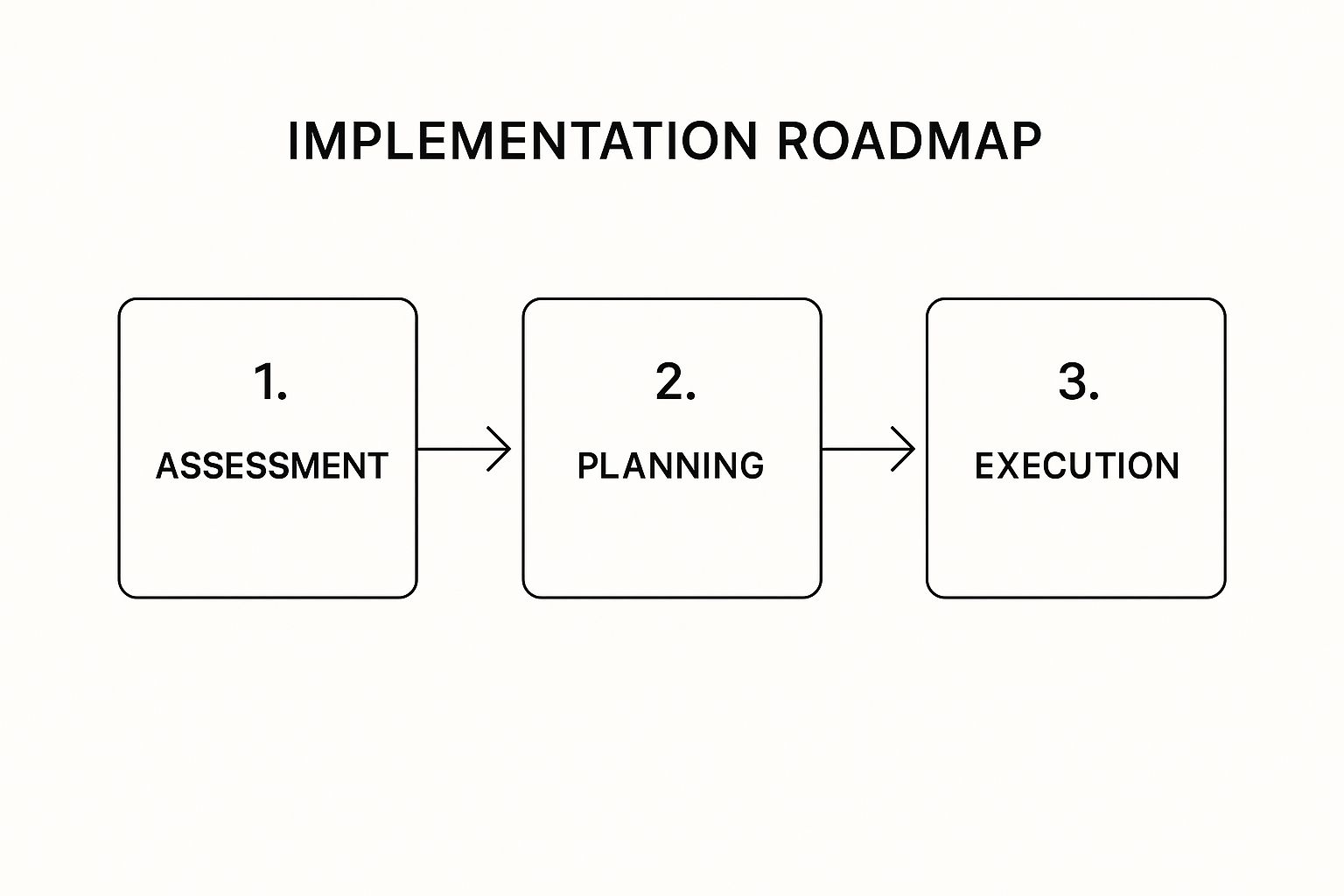
This simple flow highlights how a logical, step-by-step approach makes even a massive transformation feel manageable.
Agile Implementation and Sustaining Momentum
Finally, it’s time to hit the road. Modern transformations aren't rigid, long-haul journeys anymore. Instead, the best ones use an agile approach, breaking the project into smaller, manageable sprints. This allows the team to learn and adjust as they go, so the project can quickly pivot if the market shifts or new business needs pop up.
Throughout this stage, the consultancy wears many hats—they’re part project manager, part coach, and part change champion. They work to keep everything on track, manage risks, and ensure everyone across the business knows what’s happening and why.
The real win isn't just finishing a project. It's about embedding a new way of working and thinking right into the company's DNA. It’s about making the change stick.
Sustaining momentum is all about weaving new habits and mindsets into the company culture. It requires ongoing training, open communication, and celebrating the small wins along the way to keep everyone motivated. A top-tier consultancy ensures that by the time they leave, your team is fully empowered and equipped to keep driving the business forward on its new and improved path.
The Role of Technology as a Transformation Catalyst
In any modern business overhaul, technology isn't just a line item on a project plan—it's the engine. But let's be clear: simply buying the latest software or shifting your servers to the cloud doesn't count as a strategy. The real magic happens when you purposefully weave the right technology into the fabric of your business to unlock completely new ways of working and competing.
Think of a business transformation consultancy as your technology strategist. Their job is to make sure every tool you adopt is a direct servant to your bigger vision. They cut through the hype to focus on how technology can create a real, measurable advantage, whether that's by automating tedious workflows, creating genuinely personal customer experiences, or uncovering powerful insights that were previously buried in your data.
This strategic lens is non-negotiable. Without it, technology investments often become expensive distractions rather than powerful catalysts for change. The ultimate goal is to use technology to build a business that's more agile, more intelligent, and far more resilient.
Unlocking New Capabilities with AI and Automation
Artificial intelligence (AI) and automation are two of the biggest game-changers out there today. A good consultancy helps you look past the buzzwords to find practical ways to solve genuine business problems. This isn't about replacing your people; it's about amplifying their skills so they can focus on higher-value work.
For example, AI can sift through enormous datasets to predict what your customers will do next or spot a potential supply chain headache before it even happens. Automation can take over all those repetitive, soul-crushing tasks, freeing up your team's brainpower for innovation and creative problem-solving. A strategic partner finds these high-impact opportunities and guides you through getting them up and running successfully.
This need for tech expertise is a huge reason the consulting sector in Australia is booming. The market was valued at around USD 9.1 billion in 2024 and is projected to skyrocket to USD 18.8 billion by 2034, growing at a 7.5% CAGR. Much of that growth comes from businesses desperately needing specialised help with technologies like AI and data analytics to stay competitive. You can dig deeper into the Australian consulting services forecast on MarketResearch.com.
Building Agility with Cloud Computing
Cloud computing gives you the flexible, scalable foundation you need to adapt and grow. Instead of being locked into expensive, rigid on-site hardware, the cloud lets you ramp your resources up or down as your needs change, almost instantly.
This kind of flexibility is a massive advantage during a transformation. It means you can roll out new services and products much faster, handle unexpected surges in customer demand without your systems crashing, and give your teams secure access to the tools and data they need, no matter where they are.
A business transformation consultancy doesn't just "lift and shift" you to the cloud. They help you rethink your entire operational model to take full advantage of what cloud-native technology offers, turning agility from a buzzword into your day-to-day reality.
Gaining Unprecedented Visibility with IoT
The Internet of Things (IoT) is all about connecting physical objects—from factory machines to shipping containers—to the internet, creating a constant stream of real-time data. For industries like manufacturing, logistics, or agriculture, this opens up a whole new world of operational efficiency.
Imagine what you could do with this kind of information:
- Predictive Maintenance: IoT sensors on your factory floor could detect the subtle vibrations that signal an impending machine failure, letting you schedule repairs before a catastrophic and costly breakdown occurs.
- Supply Chain Optimisation: Smart sensors could track your goods every step of the way, giving you precise location and condition data (like temperature) to prevent spoilage and slash delivery times.
- Smarter Resource Management: In a large warehouse, IoT could monitor energy consumption, automatically adjusting lighting and climate controls to significantly reduce your operational costs.
A consultancy helps you build the infrastructure to not only gather all this data but, more importantly, to analyse it and turn it into actionable insights. This is how you start making smarter, faster decisions across the entire organisation.
Finding the Right Partner to Guide Your Transformation

Picking a business transformation consultancy is one of the biggest calls a leader can make. This isn't just about hiring a consultant; you're bringing in a partner who will be deeply embedded in your team, helping to steer the very future of your company. The right choice can be a powerful catalyst for success, while the wrong one can lead to expensive setbacks and a loss of direction.
So, how do you sort through the options? It’s about much more than just comparing fee structures and glossy proposals. You need to find a team whose expertise, work style, and overall philosophy truly sync with your organisation’s DNA and where you want to go.
Look for Proven Expertise in Your World
Your first filter should always be industry experience. A consultancy might have a stellar reputation, but do they genuinely get the nuances of your sector? The specific regulations, competitive pressures, and customer expectations that define your world are not things they can learn on the fly. A partner with deep industry knowledge is already speaking your language from the very first meeting.
Don't be shy about asking for proof. Request case studies and client stories that mirror the challenges you're facing. You want to see hard, measurable results—clear evidence they can walk the talk.
A true partner doesn't just hand you a plan; they build it with you. Their goal should be to upskill your team and transfer knowledge, making sure the changes stick long after they've gone.
This co-creation approach is what separates a genuine transformation partner from a simple vendor just looking to complete a project.
It's All About Cultural Fit
Technical skills are vital, but cultural alignment is just as important. Think about it: the consultancy's people will be working shoulder-to-shoulder with your employees at all levels. If there's a mismatch in values or working styles, you're introducing friction right when you need collaboration the most.
As you meet with potential partners, watch how they engage with your team. Are they doing more listening than talking? Do they seem genuinely curious about the nuts and bolts of your business? You’re looking for a partner who can challenge your assumptions respectfully while earning the trust of your people.
The Australian Management Consulting industry is a big pond. Projections show there will be 94,997 businesses in the space by 2025. With a market valued at a massive AUD 45.5 billion, you have a lot of choices. This makes finding that perfect fit both possible and absolutely critical. You can discover more insights about business consulting in Australia to get a better feel for this dynamic market.
Key Questions to Ask Your Shortlisted Firms
To get past the polished sales pitch, you need to ask sharp questions that reveal how a consultancy really operates. Think of it as your toolkit for digging deeper.
Here are a few powerful questions to get the conversation started:
- How will you define and measure success? A good answer will focus on tangible business outcomes, like revenue growth or cost reduction, not just ticking off project tasks.
- What's your approach to change management? This is crucial. It shows you how they’ll handle the all-important human side of the shift and get your employees on board.
- Can we speak with one of your past clients? Hearing directly from a former client is the best way to get honest, unfiltered feedback.
- How do you handle it when the project scope needs to change? Business is unpredictable. Their answer will reveal how agile and adaptable they really are.
Frequently Asked Questions
It’s natural to have questions when you’re thinking about something as significant as business transformation. Let's tackle some of the most common queries to give you a clearer picture of what the journey looks like.
How Long Does a Transformation Project Take?
There’s no one-size-fits-all answer here; the timeline really depends on the scope and complexity of what you're trying to achieve. A focused project, like revamping the workflow in a single department, might take somewhere between 6 to 12 months.
On the other hand, a full-scale, organisation-wide transformation is a much bigger undertaking. Think of a complete digital overhaul or a fundamental shift in company culture—these kinds of deep changes are often a 2 to 5-year commitment. A good consultancy will break the project into clear phases with achievable milestones, so you start seeing tangible benefits long before the final goal is reached.
Is This Only for Large Corporations?
Absolutely not. While it's true that large corporations often engage in transformation projects, the principles apply to businesses of all sizes. Small and medium-sized enterprises (SMEs) have just as much, if not more, to gain.
At its core, transformation is about improving processes, adopting the right technology, and staying agile in a changing market. Many consultancies offer services that are scaled to fit the budgets and specific challenges of smaller businesses, helping them build a solid foundation for future growth.
Management Consulting vs. Transformation Consulting
People often use these terms interchangeably, but they refer to quite different things. It helps to think of it like this:
- Management Consulting is like calling in a specialist doctor. They diagnose and treat a specific, isolated issue—maybe it's an inefficient supply chain or a problem in one particular department.
- Business Transformation Consulting is more like a team of experts creating a holistic wellness plan for your entire organisation. They look at everything—strategy, operations, technology, and culture—to bring about fundamental, interconnected change.
The key difference is the scope. Management consulting usually fixes a problem within the current business model. Business transformation aims to build a new, better model for the future.
In short, one solves a problem, while the other redesigns the entire system to prevent future problems and unlock new opportunities.
At Wistec, we believe that real, lasting change is driven by practical technology solutions. Whether you need a customised Odoo ERP system to connect your operations or a high-performance website to reach new customers, we build the tools that deliver results. Find out how we can help your business evolve at https://www.wistec.com.au.