

ChatGPT said:
1. Kotter’s 8-Step Change Model
John Kotter’s 8-Step Change Model remains one of the most enduring and effective change management strategies because it provides a clear, sequential roadmap for navigating organisational transformation. Developed by the renowned Harvard Business School professor, this framework places a strong emphasis on the human side of change, recognising that true transformation isn’t merely about updating systems or processes—it’s fundamentally about winning the hearts and minds of your people.
Furthermore, this model proves especially powerful for large-scale and complex initiatives where building and maintaining momentum are critical. Its structured, step-by-step approach helps leaders avoid common pitfalls such as under-communicating, losing focus, or declaring victory prematurely. For example, organisations undergoing significant shifts—like a comprehensive Odoo implementation in Sydney or a complete overhaul of their customer service philosophy—can rely on Kotter’s model to maintain discipline and alignment throughout the process.
In addition, it ensures that leaders establish a strong foundation of urgency, vision, and team support before attempting to alter core behaviours or systems. As a result, the organisation moves through change more cohesively, paving the way for sustained improvement and long-term success. Ultimately, Kotter’s model demonstrates that when change is guided methodically and with people at its centre, transformation becomes not only achievable but deeply impactful.
Key Steps to Implementation
The framework methodically guides an organisation from initial awareness to deeply embedded change.
- Create Urgency: The first—and arguably most crucial—step is to make the need for change feel real and immediate. Leaders must go beyond abstract data and connect the change to tangible market opportunities or potential crises that employees can clearly understand.
- Form a Powerful Coalition: No leader can drive transformation alone. This stage involves assembling a diverse group of influential leaders and team members who have the credibility, skills, and authority to champion the change throughout the organisation.
- Develop a Vision and Strategy: A clear, inspiring, and actionable vision serves as the guiding star for your entire initiative. It answers the “why” and paints a picture of the desired future state, giving everyone a sense of purpose and direction.
- Communicate the Vision: Change fails when communication stops. The vision must be shared consistently and frequently across multiple channels—and more importantly, demonstrated through leadership behaviour and everyday decision-making.
- Empower Action: Once the groundwork is set, it’s vital to remove the barriers that stand in the way. This could mean restructuring departments, redefining performance metrics, or providing additional training to equip employees with the confidence and tools they need to embrace new ways of working.
The following infographic highlights three pivotal stages in the process that are essential for building and sustaining momentum throughout your change management journey.
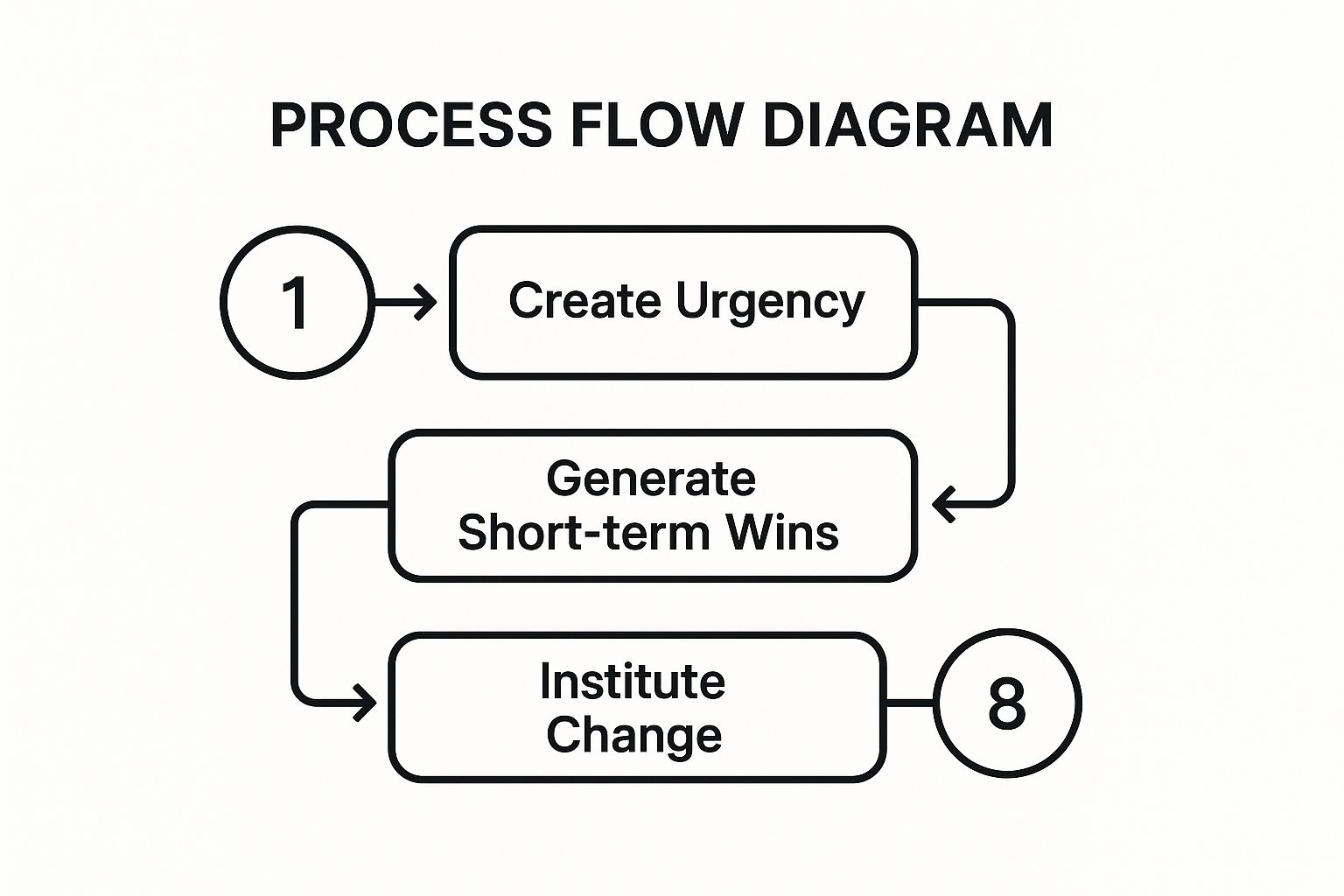
This visual flow underscores how the model strategically moves from igniting motivation (urgency) to demonstrating progress (wins) and finally to making the change permanent (instituting it in the culture).
Practical Cases
A practical case is an Adelaide-based manufacturing firm that used Kotter’s model for a Shopify implementation to launch a direct-to-consumer channel. They created urgency by showing market data on competitors’ online success. They formed a coalition of department heads from marketing, production, and IT. They communicated a clear vision of “reaching new customers directly.” By celebrating early online sales (short-term wins), they built momentum, eventually making the e-commerce division a core part of their culture. This structured approach ensured the new channel was not just a project, but a fundamental business shift.
Ready to implement a change strategy that sticks? Our experts in software development, Sydney, Adelaide, can help you navigate every step of your transformation journey. Contact Wistec today to build your roadmap for success.
2. ADKAR Model
The ADKAR Model, developed by Prosci founder Jeff Hiatt, is a people-centric change management framework that drives transformation from the ground up. Representing Awareness, Desire, Knowledge, Ability, and Reinforcement, it outlines five essential stages that every individual must experience to achieve lasting change.
Moreover, this model stands out for its ability to pinpoint and address resistance by identifying exactly where employees may be struggling in the change process. By focusing on the human journey rather than just organisational systems, ADKAR ensures that no one is left behind. It’s particularly effective for initiatives that directly impact day-to-day routines—whether it’s a healthcare clinic adopting new digital record systems or a manufacturing firm in Adelaide enhancing its safety protocols.
In addition, ADKAR proves invaluable for technology-driven transformations, such as a digital upgrade or a full-scale Odoo implementation in Sydney. By ensuring that everyone moves through each stage of change—building understanding, motivation, and capability—it creates smoother transitions, faster adoption, and, ultimately, more sustainable results across the organisation.
Key Steps to Implementation
The framework provides a clear sequence for guiding employees from initial understanding to lasting adoption.
- Awareness: The first step is to ensure everyone understands the why behind the change. This involves clearly communicating the business reasons, risks of inaction, and the nature of the change itself.
- Desire: This is often the most personal and challenging stage. It involves creating a genuine motivation for individuals to support and participate in the change, addressing their personal “What’s in it for me?” (WIIFM).
- Knowledge: Once desire is established, you must provide the necessary information and training on how to change. This includes education on new processes, systems, and required skills.
- Ability: Knowledge alone isn’t enough. This stage is about turning that knowledge into demonstrated capability. It involves hands-on practice, coaching, and support to ensure employees can perform effectively in the new environment.
- Reinforcement: The final step is to make the change stick. This is achieved by implementing mechanisms that reinforce the new behaviours, such as recognition, feedback, rewards, and performance metrics.
The following infographic highlights the five key elements that form the foundation of this individual-centric model.

This visual representation shows the logical progression required to move an individual from simple awareness to sustained, reinforced action.
Practical Cases
A Sydney-based professional services firm applied the ADKAR model during a software development project for a new client management system. They built Awareness by showing why the old system failed and inspired Desire by emphasising reduced manual work. Knowledge came through training, Ability through hands-on practice, and Reinforcement via recognition for early adopters. The result was a smooth, people-driven transition and a successful WooCommerce or system integration.
Struggling to get your team on board with a new system? Our experts in software development in Adelaide and Sydney can help you apply proven change management strategies to ensure a smooth transition. Contact Wistec today to build your roadmap for success.
3. Lewin’s Change Management Model (Unfreeze-Change-Refreeze)
Kurt Lewin’s 3-Step Model is one of the most straightforward yet powerful change management strategies, built around the simple metaphor of reshaping ice: Unfreeze, Change, and Refreeze. This framework emphasises the importance of preparing people before transformation begins, ensuring they are mentally and emotionally ready to embrace new ways of working.
In essence, the Unfreeze stage involves challenging existing mindsets and creating awareness of why change is necessary. The Change phase focuses on introducing new processes, behaviours, or systems while offering guidance and support. Finally, the Refreeze stage solidifies these new practices, embedding them into the organisation’s culture so they become the new norm.
This method works particularly well when long-standing habits or cultural norms need to shift. Whether it’s an Odoo implementation in Adelaide or a new client relationship model, Lewin’s approach provides leaders with a structured way to dismantle old behaviours, ease resistance, and ensure that new systems and values are permanently integrated. Ultimately, this model reminds us that successful change is not just about introducing something new—it’s about letting go of the old to make room for lasting transformation.
Key Steps to Implementation
The framework provides a clear psychological path from deconstruction to reconstruction.
- Unfreeze: This crucial first stage is about creating motivation for change by dismantling the current mindset. Leaders must communicate why the existing way of working is no longer viable, using data, market trends, or competitive threats to build a compelling case. The goal is to make people receptive to a new approach.
- Change: Once the organisation is “unfrozen,” the change can be implemented. This phase involves clear communication, strong support, and active involvement from employees. This is where new processes are taught, new software is rolled out, and new behaviours are modelled by leadership.
- Refreeze: To ensure the change sticks, the new ways of working must be embedded into the organisational culture. This involves updating policies, reward systems, and organisational structures to align with the new state. Without this stage, employees may quickly revert to old habits.
Practical Cases
A retail business in Adelaide used Lewin’s model for their Shopify implementation. They ‘unfroze’ the existing mindset by showing declining foot traffic and the rise of online shopping. The ‘change’ phase involved rolling out the new Shopify platform with hands-on training for staff. To ‘refreeze’ the new state, they integrated online sales targets into performance reviews and celebrated the success of the new e-commerce channel in company-wide meetings, making digital sales a permanent part of their business culture.
Ready to manage your next big shift effectively? Our experts in software development in Sydney can guide you through every stage of the process. Contact Wistec today to build your roadmap for success.
4. McKinsey 7-S Framework
The McKinsey 7-S Framework offers a balanced approach to organisational transformation. Developed in the 1970s, it examines seven interconnected elements—Strategy, Structure, Systems, Shared Values, Skills, Style, and Staff—to ensure all parts of the business align during change.
This model is especially useful for spotting misalignments that could undermine progress. For firms managing complex projects like an Odoo implementation in Adelaide or a Shopify system integration, it helps guarantee that new technology is reinforced by the right skills, leadership, and culture, leading to sustainable success.
Key Elements to Align
The framework’s strength comes from analysing and aligning all seven interdependent areas.
- Strategy: The plan devised to maintain and build a competitive advantage over the competition.
- Structure: The way the organisation is structured and who reports to whom.
- Systems: The daily activities and procedures that staff members engage in to get the job done.
- Shared Values: Called “superordinate goals” when the model was first developed, these are the core values of the company that are evidenced in the corporate culture and general work ethic.
- Style: The style of leadership adopted.
- Staff: The employees and their general capabilities.
- Skills: The actual skills and competencies of the organisation’s employees.
Practical Cases
A Sydney-based logistics company used the 7-S model for a major software development project to automate its warehouse. They didn’t just change the ‘Systems’ (the new software). They also had to alter ‘Skills’ (training staff on new tech), ‘Staff’ (hiring data analysts), and ‘Structure’ (creating a new tech support team). By aligning all seven elements, including ‘Shared Values’ around efficiency, the project succeeded where a purely technical rollout would have failed. This holistic view is vital for any major change, including a WooCommerce store overhaul.
Need to ensure your next big change is aligned for success? Our specialists in software development Adelaide can help you apply this framework to your transformation. Contact Wistec today to build a truly cohesive change strategy.
5. Bridges’ Transition Model
While most change management strategies focus on systems and structures, William Bridges’ Transition Model takes a people-first approach. It differentiates between change—the external event—and transition—the internal process of adapting.
This model is essential when the human factor determines success. It emphasises that even the best-designed change fails if people don’t emotionally let go of the old and accept the new. For organisations navigating sensitive transformations, like a professional services firm in Adelaide merging cultures or a healthcare clinic adopting a new patient care philosophy, Bridges’ model offers empathy and structure for guiding teams through the emotional side of change.
Key Phases of Transition
The model outlines three distinct psychological phases that people experience, often at different paces.
- Ending, Losing, Letting Go: Before people can accept something new, they must first acknowledge and come to terms with what is ending. This phase involves dealing with resistance and the emotional sense of loss, even if the change is positive.
- The Neutral Zone: This is the confusing, in-between period where the old way is gone but the new way isn’t fully established. Productivity may dip as people feel disoriented and anxious. Clear communication and temporary support structures are critical here.
- The New Beginning: In the final phase, people develop a new sense of identity, purpose, and energy. They have accepted the change and are starting to see its benefits, becoming more engaged and productive in the new environment.
Practical Cases
When a financial services firm in Sydney switched to a new CRM system as part of an Odoo implementation, they used Bridges’ model. They acknowledged the team’s familiarity with the old system (‘Ending’). During the confusing ‘Neutral Zone’, they assigned ‘super-users’ to provide peer support. They celebrated the ‘New Beginning’ by showcasing how the new CRM helped win a major client, thus anchoring the transition in a positive business outcome. This human-centric focus is crucial for the success of any Shopify implementation or internal software development project.
Ready to guide your team through their transition effectively? Our change management experts can help you integrate human-centric strategies into your technology roadmap. Contact Wistec today to ensure your people power your success.
6. Agile Change Management
Agile Change Management takes inspiration from software development, offering a flexible, iterative, and adaptive approach to transformation. Instead of following a rigid, top-down plan, it divides change into small, manageable “sprints.” This method relies on continuous feedback, collaborative planning, and empowering teams to learn, adjust, and improve as they progress—making it one of the most dynamic change management strategies for modern organisations.
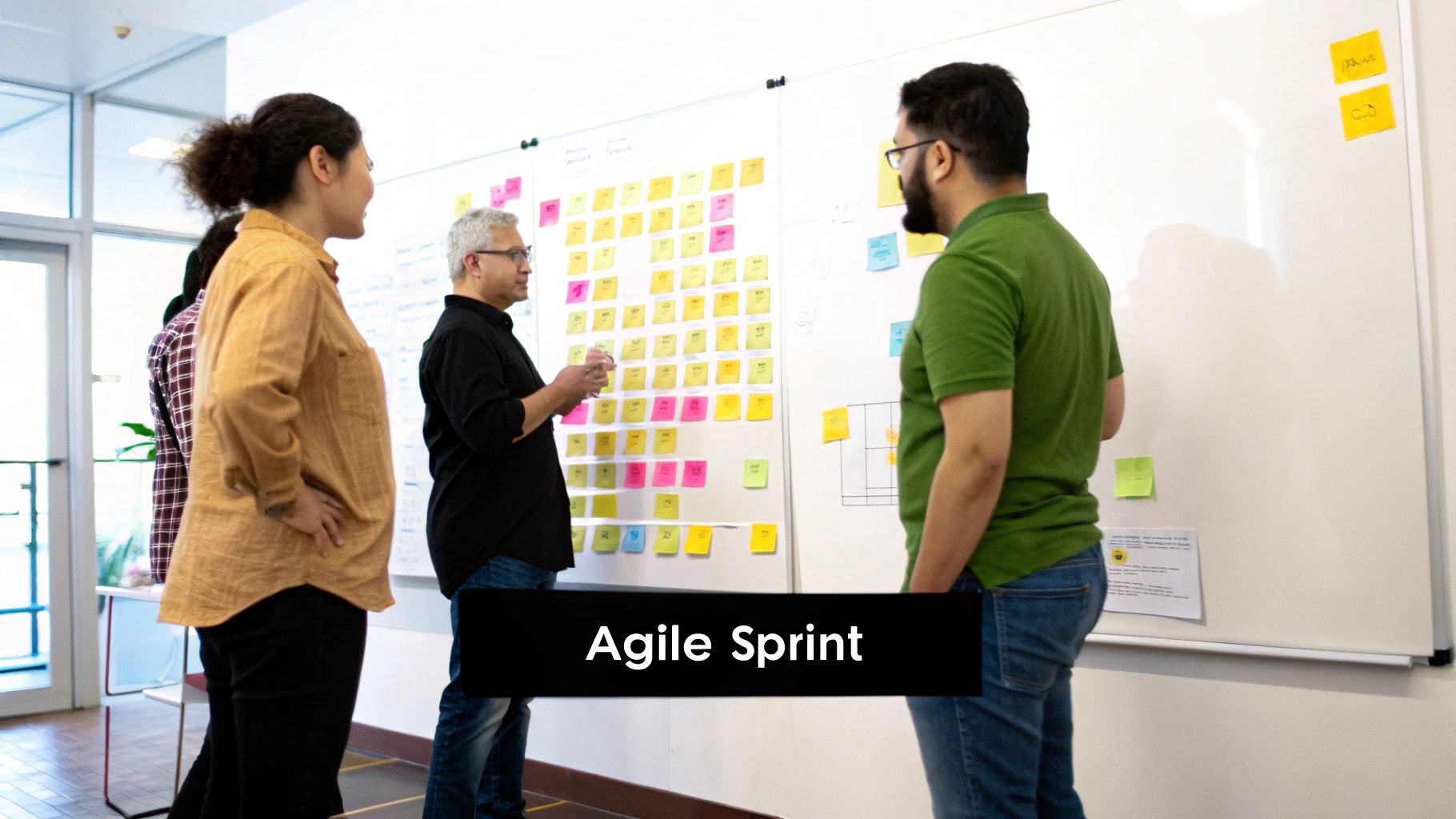
This methodology works best in fast-paced, uncertain environments where the end goal may evolve along the way. For businesses handling a complex Odoo implementation in Adelaide or adjusting their market strategy amid rapid industry changes, Agile offers the flexibility to test, learn, and refine continuously. It values progress over perfection, making it one of the most practical and effective modern change management strategies for driving digital transformation.
Key Steps to Implementation
The Agile approach focuses on iterative progress and constant engagement rather than a linear, predefined path.
- Establish a Vision, Not a Fixed Plan: Begin with a clear, overarching goal for the change, but maintain a flexible roadmap on how to get there. This vision provides direction while allowing teams the autonomy to discover the best path.
- Form Cross-Functional Change Teams: Assemble small, dedicated teams with diverse skills and the authority to make decisions. These “squads” are responsible for delivering specific pieces of the change initiative.
- Work in Sprints: Break the transformation down into short, time-boxed sprints, typically lasting two to four weeks. Each sprint should have a clear, achievable goal and result in a tangible deliverable or learning outcome.
- Implement Feedback Loops: Use daily stand-up meetings, sprint reviews, and retrospectives to foster constant communication and learning. This ensures that stakeholder feedback is continuously integrated, and the process is refined in real-time.
- Embrace Adaptive Planning: Utilise visual tools like Kanban boards to track progress and priorities. Be prepared to change course based on what is learned in each sprint, celebrating failures as valuable learning opportunities.
Practical Cases
A marketing agency in Sydney used an Agile approach for a major WooCommerce client project. Instead of a 6-month master plan, they worked in 2-week sprints, launching small features like a new checkout process or a product recommendation engine. This allowed them to gather real customer feedback and adjust priorities quickly, ensuring the final website was highly effective. This iterative method is a hallmark of modern software development and is perfect for dynamic projects.
Need to build a change strategy that can keep pace with your business? Our experts can help you implement Agile principles for your next transformation. Contact Wistec today to build your roadmap for success.
7. Kubler-Ross Change Curve (Grief Cycle)
The Kübler-Ross Change Curve, first developed to describe the stages of grief, offers a deeply insightful way to understand the emotional journey employees experience during organisational transformation. This model outlines the predictable phases people go through—from shock and denial to acceptance and integration—helping leaders manage change with empathy and foresight. It recognises that transformation often feels like losing the familiar, making emotional support essential for success.
This framework is especially useful during major disruptions such as mergers, restructurings, or technological shifts that redefine daily operations. For example, businesses managing a large-scale Odoo implementation in Adelaide or transitioning to a new patient management system in healthcare can use this curve to anticipate reactions, guide communication, and sustain morale. By addressing these human dynamics, leaders ensure their change management strategies remain both effective and compassionate.
Key Stages to Implementation
The curve guides leaders in providing the right support at the right time as employees move through distinct emotional phases.
- Shock and Denial: The initial reaction is often disbelief. Employees may ignore the change or insist it won’t affect them. Clear, repeated communication is vital here to establish the reality of the situation.
- Anger and Frustration: As reality sets in, feelings of anger, blame, and frustration emerge. Leaders must listen actively, validate these feelings without being defensive, and provide safe channels for employees to voice their concerns.
- Bargaining and Depression: In this phase, individuals may try to negotiate to avoid the change or feel a sense of low morale and apathy. It’s a turning point where support, empathy, and a focus on the future vision are essential.
- Exploration and Acceptance: Employees begin to test the new reality and explore what it means for them. This is the time to provide training, resources, and opportunities for them to experiment and build new skills.
- Integration: Finally, the change becomes the new norm. The new processes are understood, and employees have fully integrated the new way of working into their routine, often seeing its benefits.
Practical Cases
During a company merger in Adelaide, leadership used this model to guide employees. They anticipated the initial ‘Shock’. They held town halls to allow staff to voice Anger and frustration in a controlled environment. As teams moved toward ‘Acceptance’, they created cross-company projects to foster collaboration and ‘Integration’. This empathetic approach, vital for any major software development or organisational change, helped merge two distinct cultures successfully. It’s a key strategy for ensuring a smooth Shopify implementation across a newly merged team.
Need to guide your team through a challenging transition? Our experts in software development in Sydney and Adelaide are skilled in managing the human element of change. Contact Wistec today to build a supportive and successful implementation plan.
8. Stakeholder-Centric Change Management
Stakeholder-Centric Change Management is a focused approach that places people at the centre of every transformation. Rather than relying on a generic plan, it identifies all individuals and groups affected by the change, assesses their influence and concerns, and tailors communication and engagement accordingly. This ensures that every stakeholder feels seen, heard, and supported throughout the process.
This strategy is especially vital for complex initiatives involving multiple departments or conflicting priorities, such as large-scale ERP implementations or public sector reforms. By addressing each group’s unique perspective, organisations can transform resistance into active support. For example, during a major Odoo implementation in Adelaide, where finance, sales, and warehouse teams may face different challenges, this approach ensures alignment across all areas—creating smoother transitions and stronger adoption of change management strategies.
Key Steps to Implementation
The framework focuses on methodical analysis and tailored engagement to build broad support.
- Identify and Map Stakeholders: The first step is to brainstorm all parties affected by the change. Use a power/interest grid to categorise stakeholders based on their level of influence (power) and how much they are impacted (interest). This helps prioritise your engagement efforts.
- Analyse Stakeholder Needs: For each key group, dig deep to understand their motivations, potential concerns, and what they stand to gain or lose. What does the finance department need from the new system? What are the warehouse team’s biggest fears?
- Develop Tailored Engagement Plans: Create specific communication and involvement strategies for each stakeholder group. High-power, high-interest groups may need one-on-one consultations and seats on the steering committee, while low-power, low-interest groups might only require regular email updates.
- Engage and Communicate: Execute your engagement plans, ensuring communication is two-way. Actively listen to feedback, address concerns directly and respectfully, and demonstrate how stakeholder input is shaping the project.
- Monitor and Adapt: Stakeholder positions are not static; they can shift as the project progresses. Regularly revisit your stakeholder map and adjust your engagement strategies as needed to keep everyone aligned and supportive of the change.
Practical Cases
A large manufacturing firm in Sydney used this strategy for a complex Odoo implementation. They mapped stakeholders: the finance team needed robust reporting, while the warehouse team needed a simple, mobile-friendly interface. By creating tailored training and communication for each group, they addressed specific concerns and got buy-in from all departments. This targeted approach is far more effective than a generic rollout for a WooCommerce project or any large-scale software development initiative.
Need to ensure your next major project gets the buy-in it deserves? Our experts in software development in Adelaide and Sydney specialise in stakeholder-centric change. Contact Wistec today to design a strategy that unifies your team.
9. Appreciative Inquiry (AI) Approach
The Appreciative Inquiry (AI) approach redefines how organisations manage transformation by focusing on strengths rather than problems. Developed by David Cooperrider, this change management strategy centres on discovering what works well and amplifying it. The idea is simple yet powerful — organisations grow in the direction of what they focus on, so studying success naturally generates more of it.
This strengths-based model is highly effective for boosting morale, enhancing culture, and inspiring innovation. Engaging teams in conversations about their achievements it builds momentum and collaboration. For example, a professional services firm improving its client engagement process or a healthcare clinic in Adelaide enhancing patient care can use AI to drive positive, sustainable change grounded in collective success.
Key Steps to Implementation
The AI process is structured around the “4-D Cycle,” a collaborative journey from discovery to action.
- Discovery: The first step is to appreciate “what is.” Teams intentionally seek out and share stories of past and present successes, identifying the organisation’s unique strengths and core positive attributes.
- Dream: Participants envision “what might be.” In this phase, they are encouraged to think creatively and boldly about the future, imagining the organisation at its absolute best without the constraints of past problems.
- Design: The group collaboratively constructs “what should be.” This involves creating concrete proposals and “provocative propositions” that translate the dream into a tangible organisational design, including new processes, structures, or practices.
- Destiny (or Deploy): Finally, the focus shifts to “what will be.” The organisation begins to implement the co-created designs, empowering individuals and teams to take initiative and build momentum through continuous learning and improvisation.
Practical Cases
A non-profit in Adelaide used Appreciative Inquiry to guide its digital strategy. Instead of asking “what’s wrong with our website?”, they asked “tell us about a time our digital presence made a real impact.” By focusing on these success stories (‘Discovery’), they built a ‘Dream’ of a new website that amplified those strengths. This positive approach created huge buy-in for their new WooCommerce platform, a project that could have been bogged down by focusing on problems. It’s a powerful tool for any cultural or software development change.
Ready to build your future on a foundation of strength? Our experts in software development in Adelaide and Sydney can help you facilitate a change process that engages and inspires your entire team. Contact Wistec today to discover your organisation’s positive core.
10. Resistance Management Strategy
A Resistance Management Strategy transforms resistance from an obstacle into an opportunity for insight. Rather than suppressing opposition, this change management strategy—inspired by experts like Rick Maurer—focuses on identifying and understanding the reasons behind pushback. It treats resistance as valuable feedback that reveals blind spots, communication gaps, or legitimate concerns within the change process.
This approach is especially important when initiatives disrupt long-standing routines or job security. By engaging employees early and co-creating solutions, leaders turn skeptics into allies. For instance, a healthcare provider in Adelaide introducing a new electronic medical record (EMR) system or a manufacturing firm implementing new quality controls can use this strategy to uncover hidden risks, strengthen trust, and achieve smoother, more sustainable adoption.
Key Steps to Implementation
The framework focuses on transforming resistors into potential allies by addressing their underlying concerns.
- Identify and Diagnose Resistance Early: Proactively seek out resistance instead of waiting for it to derail your project. Use surveys, focus groups, and one-on-one conversations to understand not just who is resisting, but why. Is it a lack of information, a disagreement with the solution, or fear of personal impact?
- Listen Actively and Validate Concerns: Create safe channels for employees to voice their worries without fear of retribution. Acknowledge their perspective, even if you don’t agree with it. Phrases like “I understand why you’re concerned about…” can de-escalate tension and open the door for productive dialogue.
- Segment and Tailor Your Approach: Not all resistance is the same. Address rational concerns (e.g., “The new software lacks a critical feature”) with facts, data, and potential adjustments to the plan. For emotional resistance (e.g., “I’m worried this will make my job obsolete”), provide support, empathy, and a clear vision of their future role.
- Co-opt and Involve Resistors: Involve influential resistors in the change process. Inviting a sceptical team lead to join a pilot group for a new Odoo implementation in Sydney can transform them into a powerful advocate once their concerns are addressed and they see the benefits firsthand.
- Communicate, Train, and Support: Many people resist because they lack the confidence or skills to succeed in the new environment. Invest heavily in targeted training, clear communication about “what’s in it for me,” and visible support from leadership to build change readiness.
Practical Cases
During a Shopify implementation for a retail chain in Sydney, the experienced store managers were the most resistant, fearing the new system was too complex. Instead of forcing it on them, the project lead involved them in a pilot program. They listened to their feedback, which led to crucial usability improvements. By addressing their concerns and making them part of the solution, these managers became the biggest champions of the new system. This approach is critical for any major software development or system change.
Need help turning project resistance into a strategic advantage? Our specialists in software development Adelaide are experts at managing the human side of technological change. Contact Wistec today to build a more resilient implementation plan.
Change Management Strategies Comparison Table
| Model / Aspect | Implementation Complexity (🔄) | Resource Requirements (⚡) | Expected Outcomes (📊) | Ideal Use Cases (💡) | Key Advantages (⭐) |
|---|---|---|---|---|---|
| Kotter’s 8-Step Change Model | Moderate to High 🔄🔄 | Moderate, needs strong leadership ⚡⚡ | Comprehensive cultural and process change 📊📊 | Large-scale, planned transformations 💡 | Structured, people-focused, proven effectiveness ⭐⭐ |
| ADKAR Model | Low to Moderate 🔄 | Moderate, individual focus ⚡ | Improved individual transitions, reduces resistance 📊 | Individual and team-level change with resistance focus 💡 | Simple, diagnostic, measurable progress ⭐⭐ |
| Lewin’s Change Management Model | Low 🔄 | Low, simple phases ⚡ | Stable behavioral change with strong preparation 📊 | Broad organizational change needs clarity 💡 | Easy to understand, strong psychological basis ⭐ |
| McKinsey 7-S Framework | High 🔄🔄🔄 | High, in-depth analysis ⚡ | Holistic organizational alignment 📊 | Complex organization-wide change, redesign 💡 | Comprehensive, systems thinking, diagnostic ⭐⭐ |
| Bridges’ Transition Model | Low to Moderate 🔄 | Moderate, emphasis on emotional support ⚡ | Effective management of psychological transition 📊 | Change involving emotional/psychological adaptation 💡 | Deep human focus, emotional intelligence ⭐⭐ |
| Agile Change Management | High 🔄🔄 | High engagement, iterative efforts ⚡⚡ | Fast, adaptable incremental results 📊 | Fast-paced, uncertain environments; digital transformations 💡 | Highly adaptable, continuous improvement ⭐⭐⭐ |
| Kubler-Ross Change Curve | Low 🔄 | Low, mainly emotional support ⚡ | Understanding emotional stages to aid acceptance 📊 | Managing emotional reactions and resistance 💡 | Normalizes emotions, supports empathy ⭐⭐ |
| Stakeholder-Centric Change Management | Moderate to High 🔄🔄 | Moderate to High, in-depth stakeholder work ⚡ | Broad buy-in and targeted communication 📊 | Large-scale changes with diverse stakeholder groups 💡 | Early resistance detection, tailored engagement ⭐⭐ |
| Appreciative Inquiry (AI) Approach | Moderate 🔄 | High, intensive dialogue and involvement ⚡ | Positive energy, innovation, shared ownership 📊 | Strengths-based, culture change, innovation-driven 💡 | Builds enthusiasm, reduces resistance ⭐⭐ |
| Resistance Management Strategy | Moderate 🔄 | Moderate, ongoing engagement ⚡ | Reduces delays, improves trust and sustainability 📊 | Change initiatives facing strong resistance 💡 | Turns resistance into feedback, sustainable outcomes ⭐⭐ |
Putting Strategy into Action: Your Next Step
Navigating the landscape of organisational transformation can feel like charting a course through unpredictable waters. Indeed, change is rarely linear, and each organisation faces its own set of challenges and opportunities. Throughout this discussion, we’ve explored a comprehensive arsenal of ten powerful change management strategies — from the structured, top-down approach of Kotter’s 8-Step Model to the human-centric focus of Bridges’ Transition Model and the positive, strengths-based methodology of Appreciative Inquiry. Moreover, each framework, whether it’s the ADKAR model’s emphasis on individual progression or Lewin’s classic Unfreeze-Change-Refreeze concept, provides a unique lens through which to view and manage the complexities of change.
However, the true art lies not merely in knowing these models but in the skillful application and integration of their principles. In fact, true mastery is achieved when you move beyond theoretical understanding and begin to blend these strategies into a cohesive, tailored approach that aligns with your organisation’s culture, goals, and specific change initiatives. Therefore, it’s essential to remember that there is no magic formula or single “best” model that guarantees success in every scenario. Instead, success comes from adaptability, reflection, and a deep understanding of both your people and your purpose.
From Theory to Tangible Results
The critical takeaway is this: strategy without execution is merely a theoretical exercise. The most robust plan will falter if it isn’t tailored to your specific context.
Consider these practical applications:
- For a Manufacturing Company in Adelaide: Implementing a new ERP system, like an Odoo implementation Adelaide, is a monumental shift. Here, a combination of Kotter’s model to create urgency and a clear vision, alongside a detailed Resistance Management Strategy, would be crucial. The structure of Kotter’s steps provides the roadmap, while proactive resistance management addresses the inevitable operational pushback on the factory floor.
- For a Retail & eCommerce Store in Sydney: Migrating your online presence to a new platform like a Shopify implementation or WooCommerce involves more than just technology. It’s a shift in processes, customer interaction, and employee workflows. The Agile Change Management approach would allow for iterative development and quick pivots based on user feedback, while Bridges’ Transition Model is essential for guiding staff through the psychological stages of letting go of the old system and embracing the new one.
- For a Professional Services Firm: A law or accounting firm in Sydney, Adelaide, undergoing a digital transformation with new practice management software requires a different touch. The McKinsey 7-S Framework would be invaluable to ensure that the new technology (a ‘hard’ element) aligns with the firm’s culture, skills, and staff (the ‘soft’ elements). This ensures the change is integrated holistically, not just bolted on.
The Unifying Thread: A People-Centric Approach
Ultimately, the unifying thread weaving through all successful change management strategies is a profound focus on people. After all, technology, processes, and systems are merely tools; however, it is your team who must adopt, adapt, and ultimately champion the change for it to deliver its promised value. In other words, the success of any transformation hinges less on the sophistication of the tools and more on the commitment of the individuals using them. Therefore, whether you are leading a software development project or reorganising a supply chain, remembering the human element is absolutely non-negotiable.
Moving forward, your next step is to transition from passive learning to active application. First, review the strategies we’ve discussed and identify which elements speak most directly to your current or upcoming challenges. Next, begin the dialogue within your organisation, assess your readiness for change, and start building a coalition of champions who can help drive the initiative forward. Ultimately, the journey of a thousand miles begins with a single, well-planned step — and every deliberate move brings you closer to sustainable, people-centred success.
Managing complex digital transformations is our specialty. At Wistec, we provide ‘Solution Through Technology,’ but we know that successful technology adoption is built on a foundation of brilliant change management strategies. We partner with businesses across Sydney, Adelaide, and all of Australia to ensure your Odoo implementation, Shopify implementation, or custom software development project is not just technically sound but fully embraced by your team. Contact Wistec today to build a change strategy that guarantees your next project is a resounding success.