

So, what exactly is a custom software development companies? Think of them as specialist firms that design, build, and maintain software solutions from the ground up, specifically for a client’s unique needs. Unlike off-the-shelf products, custom software is created from scratch to solve very specific business challenges, giving an organisation a real competitive edge.
The Architectural Firm for Your Digital Operations
A great way to understand this is to think of them as architectural firms for your digital infrastructure. When you buy a pre-fabricated house, it’s functional and serves its purpose, but it was designed for the masses. It won’t have the exact room layout you need or the specific kitchen workflow that suits your family.
Off-the-shelf software, like Microsoft Office or Xero, works the same way—it provides a generic solution for common problems. A custom software partner, on the other hand, acts like a master architect. They don’t just sell you a pre-built structure; they collaborate with you to design and construct a digital “building” perfectly suited to your business’s unique blueprints. This process involves a lot more than just writing code.
Strategic Partners, Not Just Coders
The real value these firms bring is their strategic thinking. They kick things off by getting under the bonnet of your business, deeply analysing your operations, workflows, and pain points. Their goal is to understand how your business actually works, not how a generic software package thinks it should.
This deep dive allows them to spot opportunities for improvement that pre-made software simply can’t address. They become strategic partners who build technology that gives you a clear competitive advantage.
It’s this bespoke approach that’s fuelling rapid growth in the sector. The custom software development market in Australia is projected to hit around US$3,711.5 million by 2030, growing at a compound annual rate of about 25.1% from 2025. This surge shows just how many Australian businesses are now turning to tailored solutions to meet their operational goals. You can dig into more data on this Australian market growth in the full report from Grand View Research.
A custom software development company moves beyond the limitations of generic tools. They create solutions that don’t just fit your business but are built around its very DNA, enabling processes that are impossible with off-the-shelf alternatives.
Key Characteristics of a Custom Approach
What really separates custom development from just buying a software license? It all comes down to a few key principles:
- Problem-Specific Solutions: Custom software is built to solve a particular problem, whether it’s optimising a complex manufacturing workflow or automating a unique customer service process.
- Full Ownership: Your business owns the intellectual property. This gives you complete control over the software’s future, including any updates, changes, and integrations.
- Enhanced Scalability: The solution is designed to grow right alongside your business. As you expand, the software can be scaled to handle more users and new features without hitting a frustrating wall.
- Seamless Integration: It’s engineered to connect perfectly with your existing systems (like CRMs or ERPs), creating a unified tech ecosystem and breaking down those dreaded data silos.
Ultimately, working with a custom software development company is an investment in creating a unique asset for your business. It’s about building a tool that works precisely the way you do, rather than forcing your team to bend to the will of a one-size-fits-all product.
The Services That Actually Make a Difference
When you partner with a top-tier custom software development company, you’re getting much more than a team of coders. You’re bringing on a partner for the entire journey, from a rough idea scribbled on a napkin to a polished digital product that your customers love and your team relies on. This end-to-end approach is what separates a simple coding project from a genuine business solution.
Think of it like building a custom home. You wouldn’t just hire a crew and hope for the best. You’d start with an architect to draw up the plans, a project manager to keep everything on track, and an interior designer to make it liveable. The same logic applies to software.
Starting with Strategy and Business Analysis
Every successful project starts with a solid plan. Before a single line of code gets written, the real work begins with deep-diving into your business. This foundational stage is all about discovery and alignment.
A great development partner will take the time to:
- Get to the heart of your business goals. What does success actually look like? Are you trying to boost efficiency by 30%, or maybe break into a whole new market?
- Map out your current workflows. They’ll look at how your team works now, pinpointing the frustrations and bottlenecks that software could fix.
- Create a clear project scope. This isn’t just a feature list; it’s a detailed roadmap that lays out technical needs, key milestones, and what to expect along the way.
Getting this right is non-negotiable. It ensures the final product is a purpose-built tool that solves real problems and delivers a genuine return on your investment.
UI/UX Design: Creating the Blueprint
With a clear strategy in place, the focus shifts to how the software will look and feel. This is where the user experience (UX) and user interface (UI) designers step in to create the digital blueprint. Their job is to make sure your new tool is not only nice to look at but also incredibly simple and intuitive to use.
If the initial strategy is the foundation, then UI/UX design is the architectural plan. It’s about crafting a seamless journey for the person using the software. In fact, solid design isn’t just a “nice-to-have”; research shows a well-thought-out UI can boost a website’s conversion rate by up to 200%.
The best software is the software you don’t even notice you’re using. It just works, letting you get things done without friction. That’s the magic of brilliant UI/UX design—it puts the user first, every single time.
Engineering and Quality Assurance
Now that the blueprint is approved, it’s time for the developers to start building. Using modern approaches like Agile, they’ll tackle the project in small, manageable chunks called “sprints.” This method keeps the project flexible, allows for constant feedback, and helps avoid any major surprises down the line.
But writing code is only half the battle. Running alongside development is the all-important Quality Assurance (QA) process. A dedicated QA team acts as your first line of defence, constantly testing the software to hunt down bugs, patch security holes, and make sure everything runs smoothly. This rigorous testing is what guarantees you end up with a stable, secure, and reliable product.
Ongoing Support and Maintenance
Your relationship with a software development partner shouldn’t end the day the product launches. In many ways, that’s just the beginning. The best companies stick around to provide ongoing support and maintenance, keeping your software secure, updated, and performing at its best.
Think of it as the facility management for your new digital asset. They’ll handle security patches, fine-tune performance, and even help you add new features as your business evolves. This long-term commitment ensures your investment keeps paying off for years to come.
Custom Software vs Off-the-Shelf Solutions
Sooner or later, every business faces a crucial tech decision: do you build a bespoke software solution from scratch or buy a pre-packaged product off the shelf? This isn’t a simple question of which one is “better”. The right answer really depends on where your business is right now, what your budget looks like, and what your goals are for the future.
Let’s think about it like choosing a vehicle for your business. An off-the-shelf solution is like leasing a standard delivery van. It’s affordable, gets you on the road quickly, and handles most common jobs just fine. For many businesses, it’s the perfect place to start.
But what happens if your business has unique needs, like transporting refrigerated goods or oversized equipment? That standard van suddenly becomes a real disability. A custom software solution, on the other hand, is like getting a truck built specifically for your cargo. It’s designed from the ground up to match your exact operations, giving you an edge in efficiency that a generic van just can’t match.
Key Factors in Your Decision
The choice between building and buying comes down to a few key things that will seriously impact your budget and how you operate. A new retail shop, for example, could get online in a flash with a generic e-commerce platform. But as that business grows, its needs might become more complex—think unique inventory systems or a sophisticated customer loyalty program that simply doesn’t exist in a pre-made package.
This is precisely the point where partnering with custom software development companies becomes a smart strategic move. They help you build a tool that fits your workflow perfectly, rather than forcing you to change your workflow to fit the tool. That difference is massive when it comes to scaling your business down the track.
It’s a classic mistake to look at this decision purely from the perspective of initial cost. The real evaluation should be about long-term value, scalability, and the competitive advantage you gain from a solution that genuinely supports your unique way of doing business.
To make the right call, you need to see a clear, side-by-side comparison of what each path offers. This will help you understand the trade-offs between speed, cost, flexibility, and ownership, so you can pick the option that best aligns with where your business is heading.
A Head-to-Head Comparison
Let’s put custom-built software and its off-the-shelf counterpart side-by-side to see how they really stack up. Getting a handle on these differences is the first step toward making a confident investment in your company’s digital toolkit.
Custom Software vs Off-the-Shelf Software
| Feature | Custom Software Solution | Off-the-Shelf Software |
|---|---|---|
| Initial Cost | Higher upfront investment for development. | Lower initial cost (often a subscription fee). |
| Functionality | Built precisely to your unique specifications. | Generic features designed for a mass market. |
| Scalability | Designed to grow and adapt with your business. | Limited scalability; you may outgrow it quickly. |
| Ownership | You own the intellectual property and source code. | You are licensing the software; you never own it. |
| Implementation Speed | Longer, as it requires a full development cycle. | Fast and can often be used almost immediately. |
| Competitive Edge | High, as it supports unique business processes. | Low, as competitors can use the same software. |
| Integration | Can be built to integrate seamlessly with any system. | Integration options are often limited or costly. |
| Ongoing Costs | Primarily maintenance and support you control. | Recurring licence fees that can increase over time. |
Ultimately, what’s best for you comes down to your priorities. If you need something fast and your processes are fairly standard, an off-the-shelf product is a very sensible choice.
However, if you’re playing the long game and have specific operational needs that give you an edge, the strategic benefits of custom software often deliver a much greater return on your investment. It’s really a choice between a short-term fix and a long-term company asset.
Choosing the Right Australian Development Partner
Picking the right technology partner is one of the biggest business decisions you’ll make. This isn’t just about hiring a team to write code. It’s about finding a long-term strategic partner who can genuinely help shape your company’s future. The right team feels like an extension of your own, while the wrong one can lead to expensive delays and missed opportunities.
When you’re looking at Australian custom software development companies, you need a solid plan. It’s easy to get distracted by flashy websites and slick sales pitches, but you have to look deeper to understand a company’s real capabilities, their reliability, and whether their way of working will actually click with yours. Think of it less like a simple purchase and more like hiring a key executive for your business.
Evaluate Their Technical Expertise
First things first: you have to confirm they have the right technical chops for your project. Don’t just take their word for it. You need to dig in and make sure their skills are a perfect match for what you need built. A team that’s brilliant at making mobile apps might not be the best choice for a complex enterprise resource planning (ERP) system.
Your evaluation should really zero in on a few key areas:
- Relevant Technology Stack: Do they have a proven track record with the specific programming languages, frameworks, and databases your project requires? If you’re building a powerful eCommerce platform, for example, you’ll want to see expertise in technologies like Shopify, WooCommerce, or Magento.
- Architectural Knowledge: Can they actually design a solution that’s both secure and built to grow with you? It’s worth asking them about past projects where they’ve built systems designed to handle a big jump in users and data down the track.
- Integration Capabilities: This is a big one that often gets overlooked. You need to know if they can make your new software “talk” to the systems you already use. Check that they have solid experience with API development and connecting with platforms like your CRM or accounting software.
Scrutinise Their Portfolio and Case Studies
A company’s portfolio is its resume—it’s the hard proof of their skills and the kinds of problems they’ve solved for other businesses. But you’ve got to look past the pretty screenshots and high-level project summaries.
When you’re reviewing their past work, ask yourself a few questions:
- Do they have experience in your industry? A team that gets the unique challenges of Australian logistics, for instance, will be miles ahead of one with no relevant background.
- Are the case studies detailed? A good case study won’t just show the final product. It will walk you through the business problem, the solution they built, and the real, measurable results it delivered for the client.
- Does the complexity of their previous projects line up with what you need? Look for proof that they can handle the scale and technical depth your project is going to demand.
This kind of collaboration is definitely on the rise. In fact, around 62% of Australian companies are expected to increase their IT outsourcing in 2025. This shift is all about getting access to specialised skills and getting digital projects done faster. You can find out more about these Australian software development trends and what they could mean for your business.
Treat the selection process like you’re hiring a senior executive. This partner will have significant influence over a critical part of your your business, so the vetting process must be thorough, thoughtful, and focused on long-term alignment.
Assess Their Project Management Methodology
How a company manages its projects is just as vital as the quality of the code they write. A messy, disorganised process can sink even the most promising project. You need a partner whose approach gives you transparency, encourages collaboration, and keeps everything on track.
Most modern development firms use an Agile methodology. This approach breaks the project down into smaller, manageable chunks called “sprints.” It’s incredibly effective because it allows for constant feedback and makes it much easier to adjust to changes along the way. When you’re talking to them about their process, ask them how they handle communication, progress reports, and keeping an eye on the budget. A well-defined methodology is a great sign of a professional and reliable team.
Check References and Verify Cultural Fit
Finally, never underestimate the power of a good cultural fit and some real-world feedback. A development partnership is a close collaboration, and if your personalities and work styles clash, it can create friction that hurts the project. Your partner should feel like a true extension of your team, sharing your values and communication style.
Before you sign on the dotted line, always ask for client references—and make sure you actually call them. Ask these past clients about their experience with the company’s communication, their ability to hit deadlines, and how they handled any curveballs that came up. This kind of firsthand feedback is priceless and can give you the final piece of the puzzle, helping you choose a partner who not only has the right skills but is also the right fit for your business.
Understanding Software Development Pricing Models

Talking about the cost of custom software can feel a bit like asking, “how long is a piece of string?” There’s no single price tag. When you start discussions with custom software development companies, you’ll quickly realise they have a few different ways of billing for their work.
Each pricing model is built for different kinds of projects, budgets, and how much flexibility you need.
Think of it like building a house. For a simple, pre-designed granny flat, you’d want a single, fixed price. For a complex renovation where unexpected issues might pop up, paying by the hour makes more sense. And for a huge, multi-year construction project, you’d hire a dedicated crew full-time.
Getting your head around these models is the first step to making a smart investment, managing risk, and finding a financial arrangement that actually fits what you’re trying to build.
The Fixed Price Model
Just as the name suggests, the Fixed Price model locks in a total cost for the entire project right from the start. No surprises, no overruns—as long as nothing changes.
This approach is perfect for smaller projects where the scope is nailed down and crystal clear. If you know exactly what you need, down to the last button and feature, this model gives you complete budget predictability. It’s a great fit for building a Minimum Viable Product (MVP) or a simple internal tool where the requirements are set in stone.
- Best For: Small-scale projects, MVPs, and jobs with an airtight scope.
- Pros: You know the total cost upfront, which means minimal financial risk for you.
- Cons: There’s zero flexibility. If you need to change anything, even something small, it usually means a new quote and contract renegotiation, which can slow everything down.
The Time and Materials Model
The Time & Materials (T&M) model is all about flexibility. Instead of a single project cost, you pay for the actual time the development team spends working on your project, plus any resources they use. Billing is usually based on an agreed hourly or daily rate.
This is the go-to model for bigger, more complex projects where you expect requirements to shift and evolve. It gives you the freedom to pivot, tweak features, and adapt as you get user feedback or as market needs change. T&M is also incredibly transparent—you only ever pay for the work that’s actually done.
Here in Australia, the rates for custom software development can vary quite a bit. You might see established firms in Sydney’s Barangaroo charging around $50–$99 per hour, while more specialised boutique agencies could be in the $100–$149 per hour bracket. You can find more details on the local Australian development market to get a feel for the landscape.
The Time & Materials model trades the budget certainty of a fixed price for the invaluable asset of flexibility. It empowers you to build a better final product by allowing the project to adapt to new insights and changing market demands.
The Dedicated Team Model
For a big, long-term project that needs to feel like part of your own company, the Dedicated Team model is often the best choice. Here, you’re not just buying a block of time; you’re hiring an entire team from the software company to work exclusively on your project.
This setup gives you the highest level of control and deep collaboration, making the outsourced team a true extension of your own. You typically pay a monthly retainer that covers the team’s salaries and overheads.
This is the way to go when you have a constant stream of development work and need a consistent, dedicated team to push your goals forward, but without the hassle and cost of hiring permanent staff yourself.
What Does a Custom Software Project Actually Look Like?
Diving into a custom software project for the first time can feel a bit overwhelming. But in reality, a good custom software development company follows a surprisingly logical and collaborative process. Think of it less like a blind leap of faith and more like building a house with an expert architect – there are clear stages, constant communication, and no nasty surprises. It’s a journey from a rough sketch to a fully functional business tool.
This process, usually based on Agile principles, is all about breaking down a huge project into small, manageable chunks. This approach keeps risks low and allows you to give feedback every step of the way, ensuring the final product is exactly what you needed. Each phase builds on the last, turning your initial idea into a powerful, practical solution.
The infographic below breaks down the three main stages of this journey, from the initial brainstorming all the way to launch day.
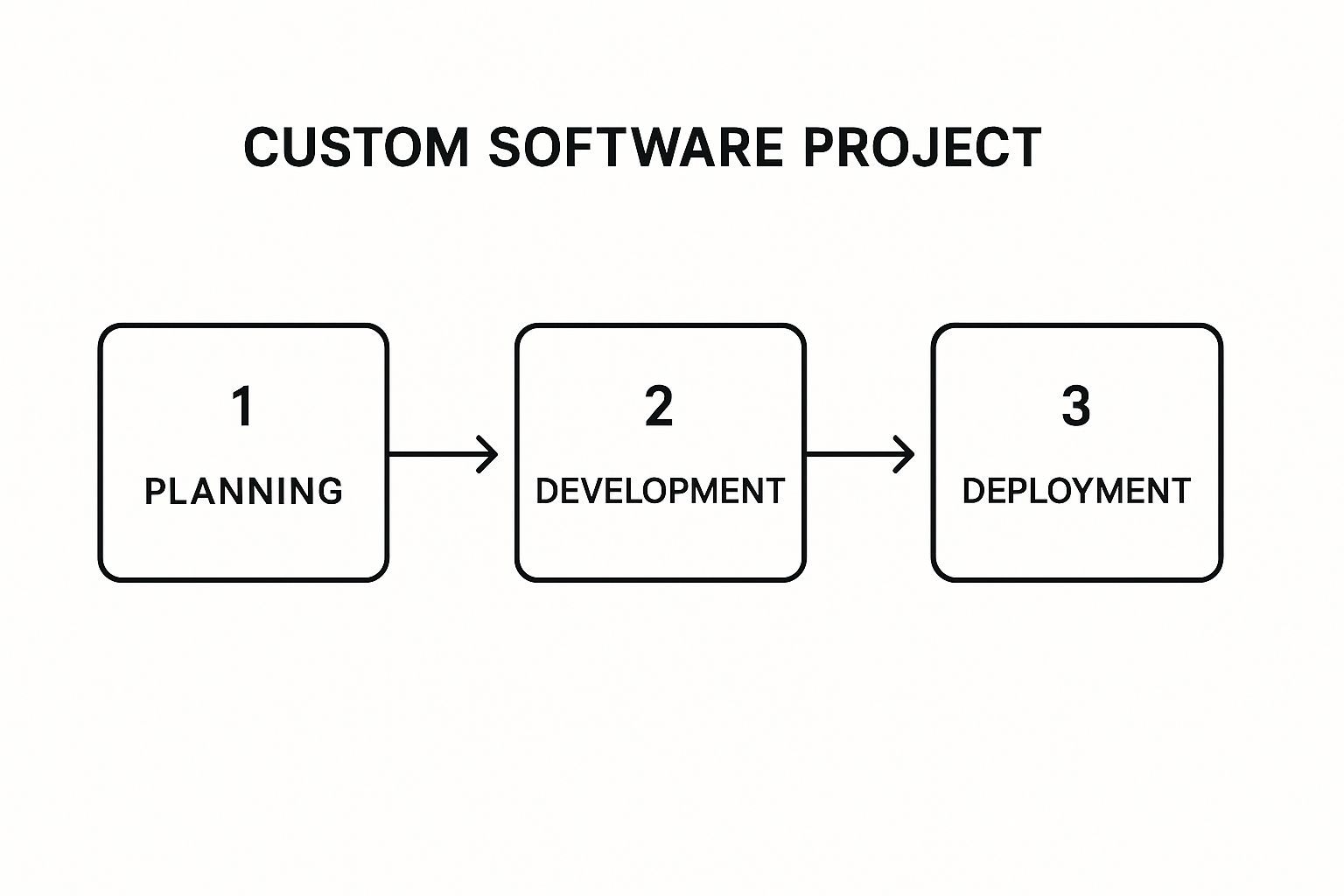
This gives you a bird’s-eye view of how a project moves from high-level strategy to the hands-on work of coding and finally, to getting it into the hands of your users.
Phase 1: Discovery and Design
Everything kicks off with the Discovery phase. Honestly, this is the most important part of the entire project. Here, your development partner acts more like a business detective than a programmer. They’ll dig deep into how your business works, chat with key people in your team, and figure out the why behind the software. The goal is to finish this stage with a crystal-clear project scope, technical specifications, and a solid roadmap.
Right after discovery comes the Design phase, where your project starts to take shape visually. This is where UI/UX (User Interface/User Experience) designers create wireframes and mockups. They map out how someone will actually use the software, making sure it’s intuitive and simple. It’s your first real glimpse of the final product, and your feedback here is absolutely crucial before a single line of code gets written.
“The initial Discovery phase isn’t just a box-ticking exercise for requirements. It’s about getting everyone on the same page about what ‘success’ actually means. A project that skimps on discovery is just setting itself up for confusion and expensive fixes later on.”
Phase 2: Agile Development and Testing
With a solid blueprint approved, the team moves into the Development phase. Most modern firms use an Agile approach, which means they work in short cycles called “sprints”—usually about two weeks long. At the end of each sprint, they’ll show you a small, working piece of the software.
This way of working is a game-changer for a few reasons:
- You’re always in the loop: You see real progress constantly and can provide feedback, making sure the project stays on the right path.
- It’s flexible: If your business needs shift halfway through, the plan can be adjusted in the next sprint without derailing everything.
- Fewer headaches: Problems are caught and squashed early, so they don’t grow into massive, costly issues down the track.
At the same time, the Testing team is hard at work. A dedicated Quality Assurance (QA) team is constantly trying to break the software, hunting for bugs and making sure every button and feature works perfectly. This non-stop testing ensures the final product is stable, reliable, and secure.
Phase 3: Deployment and Ongoing Maintenance
Once all the building and testing is done, it’s time for Deployment. This is the big moment where the software is released to your users. It can be a “big bang” launch where everyone gets it at once, or a more gradual, staged rollout. Your development partner handles all the technical heavy lifting to make sure it’s a smooth launch.
But the work isn’t over once the software is live. Maintenance and Support are vital for keeping your new tool in top shape. This is an ongoing phase that includes monitoring performance, installing security updates, fixing any little bugs that pop up, and planning for new features. It’s what ensures your investment keeps paying off for years to come.
Got Questions? We’ve Got Answers
Stepping into the world of custom software development for the first time can feel a bit daunting. It’s only natural to have a few questions pop up. Let’s tackle some of the most common ones we hear from business leaders just like you.
How Long Will It Actually Take to Build?
This is the classic “how long is a piece of string?” question, and for good reason. There’s no one-size-fits-all timeline. The project’s duration hinges completely on its complexity, the features you need, and the size of the team dedicated to it.
A streamlined Minimum Viable Product (MVP) to test a concept could be up and running in as little as 2-4 months. On the other hand, a sophisticated, enterprise-wide system with intricate integrations might be a project spanning a year or more. Any good development partner will give you a clear project roadmap with realistic timelines after they’ve properly dug into what you want to achieve.
Is Custom Software Just More Expensive?
Looking at the initial invoice, yes, custom software will cost more upfront than an off-the-shelf product. You’re funding the entire creative and construction process from scratch. But that’s only half the story.
Think of it this way: with custom software, you’re building a valuable company asset, not just renting a tool. You say goodbye to those never-ending subscription fees and create a solution that gives you a genuine edge over the competition, delivering a much stronger return over its lifetime.
Once It’s Built, Who Owns It?
When you work with a professional custom software company, the answer is simple: you own 100% of the intellectual property. This isn’t just a minor detail; it’s a fundamental benefit.
You get the keys to everything—the source code, the design files, all of it. This complete ownership means you have total freedom to evolve the software, integrate it with other systems, or take it in a new direction, without being locked into a vendor’s agenda. It becomes a core, strategic asset for your business.
Ready to build a solution that truly fits your business? At Wistec, we specialise in creating practical, results-driven technology for Australian businesses. Whether it’s a custom ERP, a powerful eCommerce website, or a high-performing mobile app, we deliver solutions that solve real problems. Learn how Wistec can help your business grow.