

The Australian retail scene has completely shifted. Today, shoppers don’t just “go online” anymore—they live there, and their expectations are higher than ever. As a result, having a mobile-friendly website is now just table stakes. A dedicated app, on the other hand, is what truly sets the leaders apart from the pack. Ultimately, it’s all about meeting your customers where they spend their time—on their phones—with an experience designed from the ground up for that device.
This isn’t just a hunch; the data tells the story loud and clear. The way we shop changed for good after the pandemic, cementing online as the go-to for millions of Aussies.
Today’s shopper wants everything fast, easy, and personal. A mobile app is the single best way to deliver on all three, forging a direct, loyal connection that’s incredibly difficult to build through a web browser alone.
If you’re not offering that seamless experience, you’re basically sending customers straight to your competitors who already have a great app.
The New Standard for Customer Experience
Picture the journey from your customer’s perspective. With an app, they can enjoy one-tap checkouts, receive instant push notifications about their orders, and unlock exclusive deals they can’t get anywhere else. As a result, it completely removes the friction between browsing and buying, creating a smoother and more engaging shopping experience.
Here’s where an app really shines:
- Next-Level Personalisation: An app can learn from a customer’s behaviour, suggesting products they’ll actually love and sending offers that feel like they were made just for them. It shows you’re paying attention.
- Building Real Loyalty: Landing a spot on someone’s home screen is prime real estate. It keeps your brand front and centre, making it effortless for customers to make repeat purchases, especially with integrated loyalty programs.
- Cutting Through the Noise: Forget crowded email inboxes. Push notifications are a powerful way to announce a flash sale, let people know a sold-out item is back in stock, or gently remind them about a cart they left behind.
The Financial Imperative
The numbers don’t lie. Not long ago, Australians spent a massive $69 billion online in a single year—that’s more than double the $28.5 billion spent back in 2019. E-commerce now makes up nearly 20% of all retail spending in Australia.
This decision to invest in mobile app development for your e-commerce business is a critical one. You can dive deeper into the Australian e-commerce statistics to grasp the full scale of the opportunity. This isn’t just about playing catch-up; it’s about staking your claim in a market that’s only getting bigger. Without an app, you’re leaving a huge and growing pile of money on the table.
Building Your App’s Strategic Blueprint
Every successful e-commerce app starts long before a single line of code is written. It begins with a smart and realistic plan. At this stage, you ground your big idea in reality by identifying your place in the market and making the critical technology decisions that will define your budget, timeline, and ultimately, the user’s experience.
In contrast, jumping straight into development without this blueprint is a recipe for disaster. It’s like trying to build a house without architectural drawings—sure, you might end up with something standing, but it almost certainly won’t be what you or your customers actually need.
Conducting Market Research That Delivers Insights
Good market research isn’t about drowning in data; instead, it’s about finding actionable insights that give you a competitive edge. Ultimately, the goal is to carve out a unique position for your app, making it an essential download for your target audience. This means looking beyond what your direct competitors are doing and truly understanding what your potential users want and need.
To get started, dig into these key areas:
- Competitor App Analysis: Download the apps from your top three competitors. Don’t just browse them – use them like a real customer. Go through the entire buying process, save an item to a wishlist, and try to contact support. Make notes on what feels slick and what’s just plain frustrating.
- Customer Pain Point Identification: Where are your competitors falling short? Dive into customer reviews on their apps, scour forums, and check social media comments. Are people constantly complaining about a clunky checkout, a useless search function, or limited payment options? Every complaint is a golden opportunity for your app to shine.
- Uncovering Your Unique Value Proposition (UVP): Based on what you’ve learned, what can your app offer that no one else does? Maybe it’s a far superior user experience, exclusive app-only deals, an advanced product visualiser, or a loyalty program that people will actually use. This UVP is the heart and soul of your app.
This infographic gives you a great snapshot of the shopping features that customers now consider standard. Think of these as the baseline for your own strategic plan.
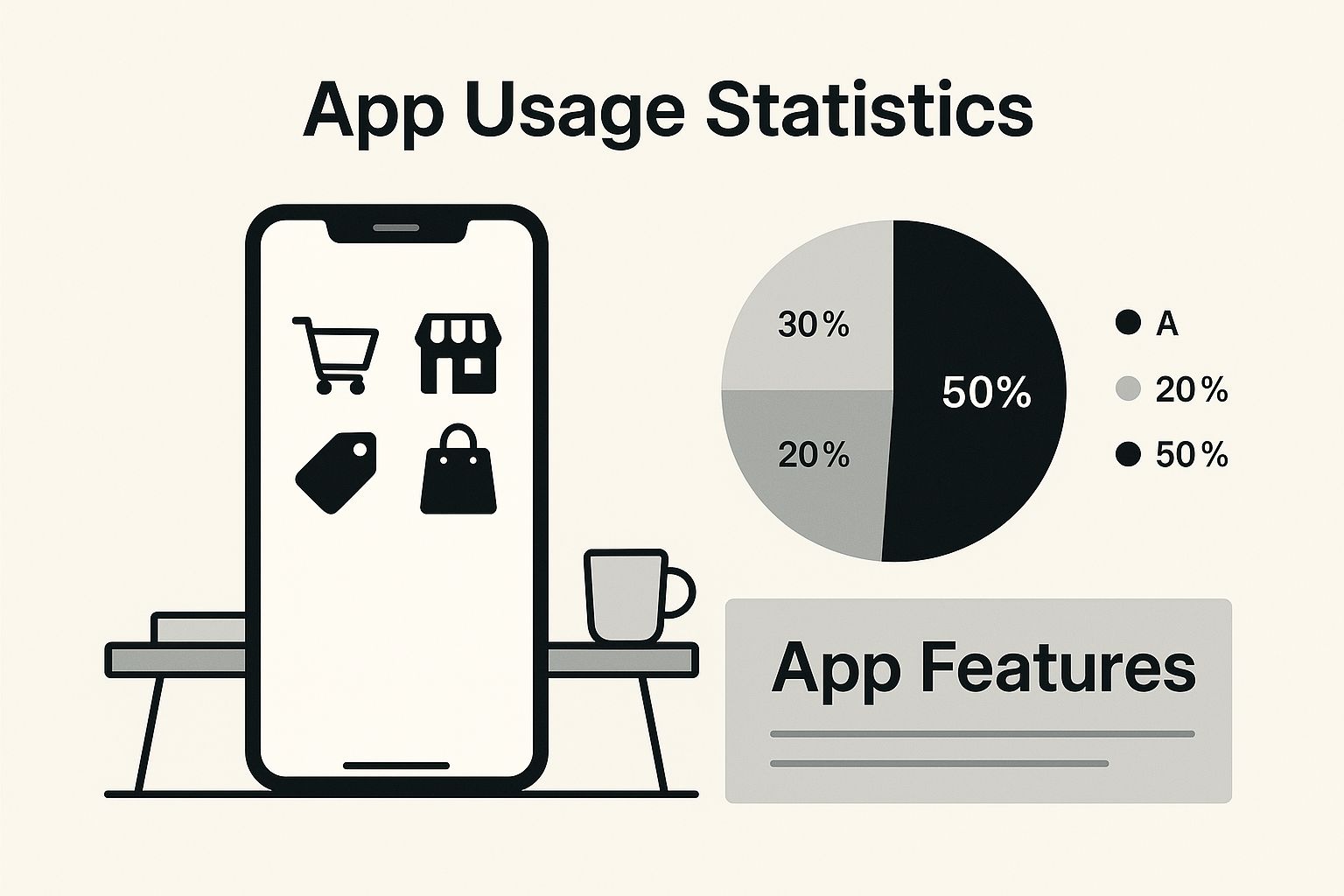
As you can see, a modern e-commerce app has to be more than just a catalogue; it needs to blend utility with genuine engagement to keep customers coming back.
Choosing Your Core Technology Stack
Once you know what you’re building, the next massive question is how. The technology you choose for your mobile app development for ecommerce isn’t just a technical detail; it has long-term consequences for performance, cost, and future maintenance. You’ve got three main paths to consider, each with its own set of pros and cons.
The right technology choice isn’t about picking the ‘best’ option on paper, but the best fit for your specific business goals, budget, and long-term vision.
It’s a strategic decision that requires balancing speed, performance, and resources. In Australia, mobile commerce is king, with an incredible 95% of Australians now shopping on their smartphones. This wave is led by Gen X (99%) and Millennials (97%), but even 79% of Boomers are on board. The total digital commerce transaction value in Australia is projected to hit a staggering US$57.65 billion in 2025. You can explore more on these Australian mobile commerce statistics to see just how big the opportunity is.
With a user base this massive, the expectation for a flawless experience is sky-high, which makes your tech choice even more important.
Choosing Your App Development Approach
Deciding on the right development approach can feel overwhelming, so let’s break down the main options. Each one presents a different trade-off between user experience, development speed, and overall cost.
| Approach | Best For | Performance | Development Cost | Key Advantage |
|---|---|---|---|---|
| Native App | Brands prioritising a premium, high-performance user experience. | Highest | High | Unmatched speed, reliability, and full access to device features like the camera and GPS. |
| Hybrid App | Startups and businesses need to launch quickly on both iOS and Android with a limited budget. | Good | Medium | A single codebase reduces development time and cost significantly. |
| Progressive Web App (PWA) | Businesses want an app-like experience without requiring users to download from an app store. | Variable | Low | Accessible via a web browser, easily shareable, and bypasses app store approval processes. |
For most serious e-commerce ventures that are aiming for deep customer engagement and high conversion rates, a Native app is usually the gold standard. The upfront investment is higher, no doubt; however, the superior performance and buttery-smooth interface often lead to better customer retention and a stronger return over the long haul.
That said, a Hybrid app is also a fantastic and practical starting point for many businesses. In fact, it offers a well-balanced solution that gets your product to market much faster while still maintaining a solid user experience.
Designing an Experience Shoppers Will Love
What’s the real difference between an app that gets used every week and one that’s deleted right after the first purchase? Ultimately, it all comes down to the experience. This isn’t just about pretty colours and slick fonts; rather, it’s about understanding how people actually behave and designing a shopping journey that feels completely natural.
From the moment a customer opens your app, their path from browsing to buying should feel intuitive—not like they’re trying to solve a puzzle. In fact, this is where great User Interface (UI) and User Experience (UX) design truly prove their worth. Consequently, a solid design foundation is what turns your mobile app development for eCommerce investment into a tool that keeps people coming back.

Crafting an Intuitive User Journey
Think of the user journey as the complete story of a customer’s interaction with your app. First, map this out meticulously: put yourself in their shoes and think through every critical action, from finding a specific item to finalising the payment.
A great journey simply feels right—it’s logical and predictable. For example, if someone is searching for “running shoes,” they instinctively look for a search bar at the top of the screen. After they search, they expect to see filters for size, brand, and colour to help them narrow things down. Ultimately, each tap should feel like a natural next step.
Here are the core elements of a journey that just works:
- Effortless Onboarding: Keep the sign-up process painfully simple. Let people use social logins or even a guest checkout to get them shopping faster. Don’t put barriers in front of a potential first-time buyer.
- Logical Navigation: Stick with what people know. A bottom navigation bar with clear icons for Home, Categories, Cart, and Account is a standard for a reason—it’s universally understood.
- Streamlined Checkout: This is where so many potential sales fall apart. Aim for a one-page checkout with as few form fields as possible. Offer saved addresses and multiple payment options to eliminate friction and dramatically cut down on abandoned carts.
Using Visual Hierarchy to Guide Attention
Visual hierarchy is simply about arranging things on the screen to show what’s most important. It’s a visual cue that tells the user’s eye where to look first, then second, then third. When done correctly, browsing becomes effortless because the key information and actions immediately stand out.
For instance, picture a product page. What’s most important? The product image, the price, and the “Add to Cart” button. These elements need to be the most prominent things a user sees. Meanwhile, the description, reviews, and shipping details are also important; however, they can appear as secondary elements—easy to find without cluttering the screen..
Good design makes the important things obvious. Your “Add to Cart” button should be the most compelling, eye-catching element on a product page, using a bold, contrasting colour that just asks to be tapped.
This same thinking applies to all your calls-to-action (CTAs). Buttons like “Buy Now” or “Explore Collection” need to pop. Use a strong brand colour that stands out against the background and pair it with clear, direct text.
Building Loyalty with Features That Matter
A fantastic user experience isn’t just about making one sale; it’s about giving customers a reason to come back. This is where you can build in features that forge a real connection and offer genuine value over time.
For Australian e-commerce businesses, this is a huge opportunity. Exclusive app-only deals and special promotions are incredibly powerful hooks. In fact, 49% of consumers say they’d be likely to download a new shopping app if it offered these kinds of incentives. This shows a clear path to using your app as a direct line for personalised offers that drive downloads and repeat business. You can dive deeper into these mobile e-commerce trends on digitalsilk.com.
Here are a few features that truly help build that loyalty:
- Personalised Push Notifications: Forget generic “Sale On Now!” spam. Send notifications that are actually helpful. Think back-in-stock alerts for a wish-listed item or early access to a new collection based on their shopping history.
- A Rewarding Loyalty Program: Build a simple, points-based system directly into the app. Let customers easily track their points and see how they can redeem rewards. A visual progress bar showing how close they are to their next perk is a simple but effective motivator.
- An Intelligent Wishlist: A wishlist shouldn’t just be a static list of items. It can be a powerful engagement tool. Use it to trigger notifications when an item’s price drops or when stock is running low, creating a sense of urgency while providing real value.
When you focus on these principles—a seamless journey, a clear visual hierarchy, and features that build loyalty—you create more than just a place to shop. You create a helpful companion that your customers will genuinely enjoy using, again and again.
Bringing Your App to Life: Core Development and Testing
This is where the rubber really hits the road. All the strategy sessions, wireframes, and design mock-ups are about to become a real, functional product that people can actually use. It’s an intensive process; however, breaking it down into the backend build, feature integration, and rigorous testing makes it far more approachable.
To begin with, we’ll start with the engine room of your app—the backend—and see how it talks to the frontend, which is everything your customers will see and touch. Next, we’ll cover the absolute must-have e-commerce features you can’t afford to skip. Finally, we’ll explain why treating testing as an afterthought is one of the biggest mistakes you can make.

Building the Backend Infrastructure
Think of the backend as the entire “back-of-house” operation for a retail store. It’s the stockroom, the manager’s office, and the point-of-sale system all rolled into one. Customers never see it, but without a powerful and reliable backend, the beautiful storefront you’ve designed would be completely useless.
In essence, this server-side infrastructure handles all the heavy lifting. For example, when a shopper adds a product to their cart, the backend checks inventory levels. Then, when they go to pay, it securely processes the transaction and updates their order status. Moreover, all this communication happens through APIs (Application Programming Interfaces), which are basically messengers running between the app on a customer’s phone and your servers.
Integrating Must-Have E-commerce Features
A great e-commerce app is built on a set of core features that modern shoppers simply expect. Getting these right is fundamental to building trust and creating a smooth, frustration-free path to purchase. If you stumble here, you’ll see your cart abandonment rates soar.
Here are the non-negotiables you need to prioritise:
- Secure Payment Gateways: This is paramount. You need to integrate trusted, PCI-compliant gateways like Stripe or Braintree to protect sensitive customer data. Offering a variety of options, especially digital wallets like Apple Pay and Google Pay, is a proven way to lift conversion rates by making checkout a one-tap process.
- Real-Time Inventory Sync: There’s almost nothing more frustrating for a customer than buying an item, only to get an email later saying it’s out of stock. Your app must synchronise with your inventory management system in real time, ensuring product availability is always accurate.
- Reliable Order Tracking: Post-purchase anxiety is real. Customers want to know exactly where their order is. By providing clear, up-to-the-minute tracking information right inside the app, you reduce “Where is my order?” support tickets and keep customers happy.
The Make-or-Break Testing Phase
So many teams treat testing like the final box to tick before launch. That’s a massive, and potentially fatal, mistake. Rigorous, ongoing testing needs to be baked into the development process from day one, not just bolted on at the end. It’s the only way to catch the bugs and performance issues that will otherwise kill your user experience and tarnish your brand.
A single show-stopping bug, like a checkout that crashes, doesn’t just lose you one sale—it can lose you a customer for life. Think of thorough testing as your insurance policy against a terrible first impression.
The point of testing isn’t just to find what’s broken. It’s about proactively guaranteeing a fast, secure, and intuitive experience for every single user, no matter what device they’re on. This means running a whole battery of different tests, each designed to check a different aspect of the app.
Types of Essential App Testing
To launch your app with confidence, you need to put it through its paces. Each type of testing shines a light on different potential points of failure; skipping one can leave you with a critical blind spot.
Your testing plan should always include:
- Functionality Testing: Does everything actually work? This is the nuts and bolts of testing—clicking every button, testing every form, and trying every user flow to make sure the app behaves exactly as it should.
- Performance Testing: How does the app hold up under pressure? We’re talking about testing load times, responsiveness, and battery drain, especially under heavy traffic conditions like a Black Friday sale. A slow app is one of the top reasons people hit uninstall.
- Security Testing: Is my customers’ data safe? This involves trying to actively break into your own app to find vulnerabilities. You need to ensure all sensitive data is encrypted and shielded from threats.
- Usability Testing: Is the app actually easy and enjoyable to use? This is where you put the app in the hands of real people and watch them use it. It’s the best way to uncover confusing navigation or awkward design choices that the development team might be blind to.
By adopting this disciplined approach, you’re not just coding an application; instead, you’re engineering a reliable and delightful shopping platform. Ultimately, this groundwork is what sets you up for long-term success in the world of mobile app development for eCommerce.
Now, you’ve built a brilliant app. However, let’s be honest—that’s only half the job done. Once the final line of code is committed and you’ve squashed the last bug, the real challenge begins: getting people to actually use it. In fact, a powerful launch is all about creating momentum from day one, making sure your app doesn’t just quietly appear in the app stores, but arrives with a bang.
At this stage, this is where you shift from a developer mindset to a marketing one. Without question, without a solid plan to get the word out, even the most perfectly designed app will just sit there, lost among millions of others. Therefore, the goal is to make your app easy for the right people to find and irresistible to download.
Get Your App Store Foundations Right
Before a single marketing email goes out, you need to make your app discoverable. This is all about App Store Optimisation (ASO). Think of it as SEO, but specifically for the Apple App Store and Google Play. Nailing your ASO is the secret to driving a steady stream of organic downloads from people already looking for what you sell.
A strong ASO strategy has a few moving parts that need to work together:
- A Smart App Title: This isn’t just for your brand name. Pop in one or two of your most important keywords here. For example, if you sell boutique homewares, something like “BrandName – Homewares & Décor” immediately captures relevant searches.
- Keyword-Rich Descriptions: Both the short and long descriptions matter. Don’t just list features; talk about the problems you solve and the products you offer. Weave in the search terms your ideal customers are typing into the app store, but keep it sounding natural and compelling.
- Show, Don’t Just Tell: Visuals are everything. Your app store page needs crisp, clean screenshots that highlight the best parts of your app’s experience. Even better, a short preview video showing the app in action can dramatically increase downloads.
Get these elements sorted, and you’ll be putting your app directly in the path of potential customers, ready to make a killer first impression.
Build the Hype Before You Launch
Launch day shouldn’t be the first time anyone hears about your new app. You need to build anticipation and get people excited before it’s even available. The weeks leading up to your release are the perfect time to prime your existing audience.
Start teasing the app on your social media channels and in your email newsletters. You could offer an exclusive “early bird” discount or a special in-app gift for anyone who signs up to be notified the second it goes live. This does two things: it builds a list of guaranteed first-day downloads and makes your most loyal customers feel like VIPs.
A successful launch isn’t a single event; it’s the peak of a well-executed build-up. The goal is to have a crowd of excited customers waiting at the digital door the moment you open for business.
This pre-launch buzz turns a cold launch into a warm welcome from the people who already love your brand.
Go Live with a Multi-Channel Push
Okay, the app is live. Now it’s time to shout about it from the rooftops—or at least, from the right digital channels. A coordinated marketing push ensures you’re reaching different parts of your audience where they spend their time. It’s not about being everywhere at once, but being in the right places with a message that resonates.
Here are a few powerful channels to hit hard during your launch week:
- Email Marketing: Send a dedicated launch announcement to your entire email list. Don’t make them hunt for it—include big, obvious buttons linking directly to the Apple App Store and Google Play.
- Social Media Campaigns: Go beyond a simple “we’ve launched” post. Create eye-catching videos, run targeted ads aimed at people who’ve visited your website, and make your app the star of your Instagram Stories for a few days.
- Influencer Collaborations: Find some local Australian influencers whose followers are your kind of people. A genuine recommendation or even a simple “first look” at the app experience can send a huge wave of engaged, trusting customers your way.
- Website Promotion: Your website is your most valuable marketing asset. Use prominent banners and pop-ups to guide your existing web traffic to the app stores. Make sure you sell the benefits of the app experience—is it faster, easier, or more exclusive?
By weaving these tactics together, you create a launch campaign that gets you seen and drives that all-important first wave of downloads. This initial momentum is what helps you climb the app store charts and sets you up for long-term success.
Got Questions? We’ve Got Answers
Stepping into e-commerce app development is a big move for any Australian business. It’s a serious investment, so naturally, you’ll have plenty of questions before you commit. We get it.
Let’s tackle some of the most common queries we hear from businesses just like yours, giving you the straightforward, practical answers you need to make smart decisions.
What’s the Real Cost of Building an E-commerce App in Australia?
This is always the first question, and the honest-to-goodness answer is: it really depends. The price tag is directly linked to how complex your app needs to be, the features you’re set on, and the development path you take.
For a simple app with core shopping functionality, you might be looking at a starting point of around $30,000.
But if you’re dreaming bigger—think custom features like AI-powered product suggestions, sophisticated inventory systems, or even augmented reality try-on tools—that investment can easily climb past $200,000.
Here’s what really influences the final cost:
- Platform Choices: Building for both iOS and Android from the get-go will cost more than focusing on a single platform first.
- Design Complexity: A unique, custom-designed user experience takes more time and specialised skill than working from a pre-existing template.
- System Integrations: Does your app need to talk to your inventory management system, CRM, or a specific Aussie shipping carrier? Each of these API connections adds development time.
My best piece of advice? Lock down a crystal-clear project scope before you get a quote. This is the single most effective way to manage your budget, prevent surprise costs, and keep the project on track.
How Long Until My App is Ready to Launch?
Building a high-quality app isn’t an overnight job—good things take time. From the first sketch on a whiteboard to launching on the App Store, a typical e-commerce app project takes anywhere from 4 to 9 months. This timeline ensures no corners are cut, especially when it comes to crucial stages like planning and testing.
Here’s a rough breakdown of how that time is spent:
- Strategy & Planning: This is where we map everything out. It usually takes a solid 4-6 weeks.
- UI/UX Design: Creating an intuitive and beautiful user interface is a detailed process that often takes 6-8 weeks.
- Development: The actual coding is the heaviest lift, typically lasting 12-20 weeks.
- Testing & QA: We spend another 4-6 weeks hunting down and squashing every last bug.
The project’s complexity and the size of your development team are the biggest variables here. If you need to get to market faster, launching a Minimum Viable Product (MVP) is a brilliant strategy. You start with just the essential features, launch it, and then add the bells and whistles later based on what your actual customers are telling you they want.
Should I Go for a Native or Hybrid App?
This is a biggie. It’s a strategic call that boils down to a classic trade-off: performance versus budget. There’s no single right answer here—it all comes down to what matters most for your business right now.
Native apps are built from the ground up for a specific operating system, like iOS or Android. They deliver the absolute best performance, speed, and user experience because they can tap directly into the phone’s hardware. If you’re an established brand where a flawless, premium customer experience is non-negotiable, native is the way to go.
Hybrid apps, on the other hand, are built with a single codebase that works on both platforms. This approach is much faster and more budget-friendly. For start-ups or businesses where getting to market quickly and efficiently is the top priority, a hybrid app is a fantastic and very practical choice.
Ultimately, if a slick user experience is your number one priority, lean towards native. If launching fast on a tighter budget is more important, hybrid is a powerful contender.
Ready to turn your e-commerce vision into a reality? At Wistec, we specialise in creating high-performing mobile apps that drive sales and build customer loyalty. Let’s build a practical solution that delivers real results for your business. https://www.wistec.com.au