

Think of a software development firm as a strategic partner, not just a vendor. They’re the team you bring in to design, build, and maintain custom digital solutions for your business. It’s about much more than just coding; these firms blend deep technical expertise with sharp business strategy to turn a brilliant idea into something real and functional, like a mobile app or a new internal platform.
What Do Software Development Firms Actually Do?

Let’s use an analogy. Imagine you want to build a custom, high-tech factory. You wouldn’t just hire a team of bricklayers and hope for the best. You’d partner with a specialised construction company that brings everyone to the table—architects, engineers, project managers, and builders—to see the project through from blueprint to the final switch-on.
A software development firm is the digital version of that company. They are the architects and engineers for your digital world, responsible for turning a business vision into a tangible, reliable software product that actually works.
Don’t mistake them for a simple collection of programmers for hire. A good firm is a cohesive unit of professionals, each with distinct, complementary skills that come together to create something great.
More Than Just Writing Code
One of the biggest misconceptions is that software firms just write code. While programming is obviously a huge part of what they do, it’s only one piece of a much larger, more strategic puzzle. A true partnership is a blend of different experts working in sync.
Your team will typically include:
- Business Analysts: The translators who turn your business goals into clear technical requirements.
- UI/UX Designers: The artists and psychologists who make sure your software is a joy to use.
- Software Architects: The master planners who design the application’s foundational structure.
- Developers (Coders): The builders who write the clean, efficient code that brings the designs to life.
- Quality Assurance (QA) Engineers: The detectives who hunt down bugs and issues before your users do.
- Project Managers: The conductors who keep the entire orchestra on schedule and within budget.
A great software development firm doesn’t just build what you ask for; they help you figure out what you truly need. They act as strategic advisors, guiding your technical decisions to ensure the final product delivers real business value and a strong return on investment.
A Growing Industry in Australia
The appetite for these specialised services is only getting bigger. The Australian software development market has seen massive growth recently, fuelled by rising IT spending and a serious demand for custom digital tools. In fact, by 2025, Australian IT spending is tipped to hit A$146.85 billion, with a huge chunk of that going towards software. This growth really underscores the critical role these firms play in helping businesses modernise across all sectors, from finance and healthcare to logistics. You can discover more about tech industry trends in Australia to get a deeper insight.
This surge gives businesses more choice than ever. You’ve got everything from small, agile boutique agencies that specialise in specific technologies to large-scale enterprise partners ready to tackle enormous, complex projects. Understanding this landscape is the first step toward finding the perfect fit for what you need to achieve.
Diving Into What Software Development Firms Actually Do

To really get what a software development firm brings to the table, you need to see their services as more than just a list on a website. It’s better to think of them as a specialist’s toolkit. Each tool is designed to solve a very specific business problem, connecting the technical nitty-gritty to a real-world result that helps you grow.
For instance, a logistics company doesn’t just need someone to write “code.” What they really need is a reliable system to track their inventory in real time, so they can slash delivery delays. Similarly, a retail brand isn’t just after an “app.” They want a seamless mobile shopping experience that turns casual buyers into loyal fans.
Every service these firms offer is a direct response to a business challenge. Let’s break down the most common ones and see how they translate into tangible business wins.
Custom Software Development
This is the bread and butter of most software development firms. It’s all about building a digital solution from scratch, tailored perfectly to your unique way of doing things. Off-the-shelf software often forces you to bend your processes to fit its limitations, which can be a real headache. Custom development flips that idea on its head.
Here, the software is crafted to match your workflow, not the other way around. Picture a manufacturing plant with a complex, multi-stage production line. A custom-built system could monitor every single step, automate quality control, and spit out data that no generic software could ever hope to capture. The end result? Greater efficiency, fewer mistakes, and a serious competitive edge.
Web and Mobile Application Development
These days, having a solid presence on the web and on mobile phones is non-negotiable. Software firms build the very platforms that connect you to your customers, no matter where they are. This goes way beyond creating a simple digital brochure; it’s about building engaging, functional experiences.
A well-designed web application could be a sophisticated e-commerce site or a private portal for managing customer relationships (a CRM). In the same vein, mobile apps give you a direct channel to your audience, unlocking powerful features like:
- Push notifications for flash sales and special offers
- Loyalty programs and in-app rewards
- Super convenient on-the-go booking or ordering
The whole point is to create intuitive, secure, and reliable applications that people genuinely enjoy using. A great digital experience is one of the most powerful tools you have for building brand loyalty and encouraging repeat business.
UI and UX Design
How a piece of software looks (User Interface or UI) and how it feels to use (User Experience or UX) are just as crucial as the code running behind the scenes. You can have the most powerful application in the world, but if the interface is a confusing mess, people will simply give up on it. This is where designers are worth their weight in gold.
UI/UX specialists live and breathe this stuff. They focus on creating a user journey that is not only easy on the eyes but also incredibly simple to navigate. Their process involves user research, creating blueprints (wireframes), and testing prototypes to make sure the final product just makes sense. A great design reduces frustration, cuts down on customer support tickets, and massively increases adoption rates for your new software.
Quality Assurance and Testing
Let’s be honest: no software is perfect right out of the gate. That’s why rigorous quality assurance (QA) is a non-negotiable service from any reputable firm. QA engineers are the detectives of the development world; their entire job is to hunt down bugs, find security holes, and identify performance issues before your customers ever see the product.
This process is a mix of manual and automated testing across a whole range of devices and situations. By catching these problems early, QA protects your brand’s reputation, ensures a smooth launch, and saves you the huge cost and stress of fixing a major issue after it’s already gone live. Think of it as the essential final inspection that guarantees you’re shipping a professional, reliable product.
Ongoing Support and Maintenance
Getting your software launched is really just the beginning. Technology moves fast, operating systems get updated, and new security threats pop up all the time. Ongoing support and maintenance are what keep your application secure, functional, and relevant long after the initial build is done.
This can include everything from fixing minor bugs and monitoring performance to adding new features and conducting regular security checks. Having a firm on board for long-term support gives you peace of mind, making sure your investment continues to deliver value and can adapt to whatever comes next. It transforms a one-time project into a lasting digital asset for your business.
To help you see how these pieces fit together, here’s a quick summary of the core services and what they aim to achieve for your business.
Overview of Core Software Development Services
| Service Area | Description | Typical Business Goal |
|---|---|---|
| Custom Software Development | Building a unique software solution from the ground up to fit specific business processes and workflows. | Improve operational efficiency, solve a unique problem, or gain a competitive advantage. |
| Web & Mobile Apps | Creating applications for browsers and mobile devices (iOS/Android) to engage with customers and provide services. | Increase customer engagement, open new sales channels, or improve service accessibility. |
| UI/UX Design | Focusing on the visual design (UI) and the overall feel and usability (UX) to create an intuitive and enjoyable product. | Boost user adoption, increase customer satisfaction, and reduce the need for support. |
| Quality Assurance & Testing | Systematically testing the software to find and fix bugs, security flaws, and performance issues before it goes live. | Protect brand reputation, ensure a stable product, and provide a seamless user experience. |
| Support & Maintenance | Providing ongoing technical support, updates, and security patches after the software has been launched. | Ensure long-term reliability and security, and adapt the software to future business needs. |
Ultimately, a good software development partner uses this range of services to build a solution that doesn’t just work, but works specifically for you.
Why Partnering With a Firm Is a Strategic Move
So, you need to build software. The classic dilemma is whether to hire your own team or bring in an external partner. While building an in-house team feels like you’re in the driver’s seat, partnering with an established software development firm is often the smarter play. Think of it less like outsourcing a task and more like gaining a powerful ally.
Let me put it another way. Imagine you decide to build a championship-winning sports team from scratch. You’d need to scout, recruit, and train a whole roster of specialists—players, coaches, strategists—and pay them top dollar. It’s a slow, expensive process, and there’s no guarantee they’ll gel as a team.
Partnering with a firm is like hiring a professional team that’s already trained, cohesive, and ready to win from day one.
Instantly Access a Pool of Specialised Talent
Assembling a truly great in-house software team is a massive undertaking. You don’t just need a few coders. You need UI/UX designers, project managers, quality assurance testers, and business analysts. Finding, vetting, and hiring each of these roles can take months, and that’s before you factor in the hefty price tag for salaries, benefits, and ongoing training.
A software development firm gives you immediate access to this entire ecosystem of talent. Their teams are pre-built, they’ve worked together before, and they have a proven system for collaboration. This completely sidesteps the long and costly recruitment cycle, meaning your project can get off the ground much, much faster.
The real value of a firm isn’t just the code they write; it’s the integrated expertise they bring. You’re not just hiring developers; you’re gaining a strategic partner with a deep bench of specialists dedicated to your project’s success.
Having this ready-made expertise is becoming more critical by the day. The demand for application development in Australia is climbing as businesses across the board digitise their operations, particularly in e-commerce. With IT spending projected to grow by 7.8% in 2025, the need for expert teams to build these solutions is only going to intensify. You can discover more about Australia’s software market trends to get a clearer picture of why having a team on standby is such a huge advantage.
This decision tree gives you a simple way to think about choosing between an in-house team and a firm, based on your project’s key constraints.
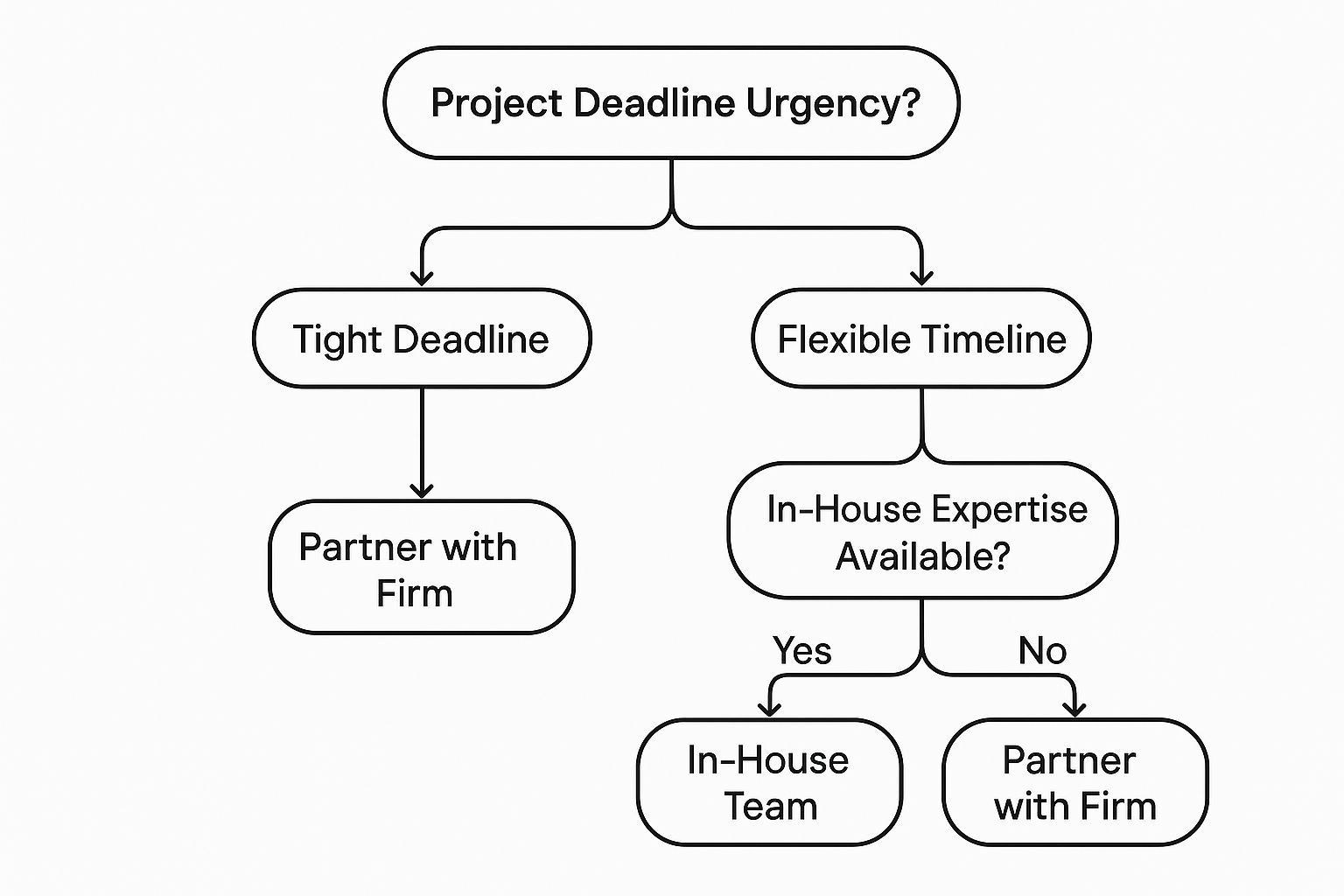
As you can see, things like tight deadlines and not having the right skills internally are strong signals that partnering with a specialist firm is the right call.
Accelerate Your Time to Market
In business, speed is everything. The faster you can get your product out there, the sooner you can get real user feedback, start making money, and secure your spot in the market. Trying to build a team from the ground up just slows the whole process down.
On the other hand, experienced software development firms are built for speed and efficiency. They hit the ground running because they already have:
- Proven Methodologies: They rely on established frameworks like Agile or Scrum to keep projects moving forward and adapt to changes on the fly.
- Ready-Made Infrastructure: All the necessary tools, processes, and communication channels are already in place.
- Focused Expertise: Their team is 100% dedicated to your project, without the daily distractions of other internal company business.
This powerful combination means they can often deliver a top-quality product in a fraction of the time it would take a newly assembled internal team to even get started.
Mitigate Project Risks Effectively
Let’s be honest—software projects are complex beasts. They come packed with risks, from budgets blowing out and deadlines being missed to serious quality control issues. One of the biggest, often overlooked, benefits of working with a professional firm is their knack for risk management. They’ve seen it all before and know how to navigate the common pitfalls that can completely derail a project.
A good firm takes ownership of managing the timeline, controlling the costs, and making sure the final product is stable and secure. This accountability takes a massive weight off your shoulders, freeing you up to concentrate on what you do best: running your business. By entrusting the technical side to the experts, you turn a potential headache into a predictable and well-managed investment.
How to Choose the Right Development Partner

Choosing a software development partner is a big decision. In many ways, it’s one of the most critical you’ll make for your project. The company you pick isn’t just a vendor; they become a genuine extension of your team, entrusted with bringing your vision to life. To get it right, you need to look past the slick sales pitches and have a solid evaluation process.
Think of it like hiring a master builder to construct your dream home. You wouldn’t just go with the cheapest quote. You’d want to see their previous work, understand their process, and know they can handle the inevitable challenges. Applying that same level of diligence when vetting software development firms is what separates a successful project from a frustrating one.
Let’s walk through a practical roadmap to help you make a confident, well-informed choice.
Scrutinise Their Portfolio and Case Studies
A company’s track record is the best crystal ball you have. Don’t just scroll through their portfolio of finished products; you need to dig into the case studies. Look for projects with similarities to yours, whether it’s the industry, the technical complexity, or the business problem they were trying to solve.
A portfolio shows you the what, but a good case study tells you the why and how. It should lay out the client’s initial problem, the steps the firm took to solve it, and—most importantly—the tangible results. Did their software actually increase revenue? Did it make the client’s team more efficient?
These details are gold. They prove the firm can deliver real business value, not just lines of code.
Assess Their Technical Expertise and Technology Stack
You don’t need to be a software engineer to make a good decision, but you do need to understand their technical toolkit. Ask them about the programming languages, frameworks, and platforms they use.
A professional firm will be completely open about their technology stack and, more importantly, will be able to explain why they’re recommending specific tools for your project. Their reasoning should always tie back to your business goals.
They should be thinking about things like:
- Scalability: Can this technology handle our growth in a year? Five years?
- Security: How is our data—and our customers’ data—being protected?
- Maintainability: How easy will it be to update and support this thing down the road?
When a team can clearly justify their technical choices, it’s a great sign they’re thinking strategically about your project’s long-term health.
Understand Their Project Management Methodology
How a company organises its work directly impacts everything from timelines to your own sanity. Most modern development teams use an Agile methodology, often a framework like Scrum. The core idea is simple: break the massive project down into small, manageable chunks of work called “sprints.”
This approach is a game-changer. It allows for constant feedback and adjustments along the way, which is far better than the old “waterfall” method where you’d wait months for a big reveal, only to find it wasn’t what you wanted.
Ask potential partners to walk you through a typical project from kickoff to launch. Look for transparency, clear communication channels, and regular check-ins. It’s a huge green flag when a firm treats you like a collaborator, not just another name on an invoice.
This partnership style is what keeps your project on track and ensures the final product truly meets your needs.
Verify Client Testimonials and References
Reviews on a website are a nice start, but nothing beats a real conversation. A confident firm will have no problem connecting you with a few past or current clients for a reference check. This is your chance to get the unvarnished truth.
Don’t be shy about asking direct questions. You can learn so much about their communication style, problem-solving skills, and what it’s really like to work with them day-to-day. This is how you discover a firm’s true character.
To help you get started, here’s a simple checklist of questions to ask during your evaluation.
Vendor Evaluation Checklist
This table provides a framework for your conversations, ensuring you cover all the critical bases before making a final decision.
| Evaluation Area | Key Questions to Ask | What to Look For (Green Flags) |
|---|---|---|
| Communication | How often will we meet? Who is my main point of contact? | Proactive updates, clear communication channels, and a dedicated project manager. |
| Process | Can you describe your development and testing process? How do you handle scope changes? | A well-defined Agile or Scrum methodology, transparent change management, and regular demos. |
| Cultural Fit | How do you approach collaboration and feedback? What are your core company values? | A collaborative spirit, openness to feedback, and values that align with your own. |
| Post-Launch Support | What kind of support and maintenance do you offer after the project goes live? | Clear service-level agreements (SLAs) and different tiers of ongoing support packages. |
Ultimately, your goal is to find a partner who is not just technically skilled but also a great cultural fit. The best business relationships are built on trust, clear communication, and a shared passion for getting the job done right. Following this structured approach will put you in the best position to find a firm that will help you succeed.
A Look at Software Development Costs
For any business diving into custom software, the first question is almost always: “What’s this going to cost me?” It’s a fair question, and getting a handle on the budget is key to starting your project on the right foot. The final price tag isn’t just a number pulled out of thin air; it’s a direct reflection of the time, skill, and resources needed to bring a quality product to life.
In Australia, the cost and complexity of a software project can swing wildly depending on its scope, the features you need, and any ongoing maintenance. The local market is booming, with forecasts predicting it will hit USD 17.15 billion by 2033. This surge shows just how much demand there is for skilled software development firms that deliver real value. If you’re keen to dig deeper, you can explore detailed insights into Australian software development costs.
So, let’s break down how these costs are actually calculated by looking at the most common pricing models.
Common Pricing Models Explained
Most software development firms stick to one of three main pricing models. Each has its own strengths and is a better fit for different kinds of projects. Knowing the difference helps you match your budget to what you’re trying to achieve.
-
Fixed Price: Just as it sounds, you agree on a single, all-in price for the entire project. This works brilliantly for projects with a crystal-clear set of requirements and a scope that isn’t likely to change. The big win here is budget certainty, but it doesn’t offer much wiggle room if you need to make changes mid-stream.
-
Time and Materials (T&M): With a T&M model, you pay for the actual hours and resources the team puts into your project. It’s incredibly flexible, making it the perfect choice for complex projects where the requirements might shift or evolve. You have more control, but the final cost is less predictable from the start.
-
Dedicated Team: This model is like hiring an entire team from the firm to work exclusively on your project for a flat monthly fee. It gives you the benefits of an in-house team without the hassle of recruitment, offering deep collaboration and adaptability for big, long-term projects.
Key Factors That Influence the Final Cost
Beyond the pricing model, a few key things will directly push your project’s final cost up or down. At the end of the day, the more complex or feature-packed your software is, the more time and expertise it will need—and that naturally drives up the budget.
Here are the main cost drivers to keep in mind:
- Project Complexity: A simple app with a few basic functions will be far cheaper than a large-scale enterprise system with lots of integrations.
- Feature Scope: The number and sophistication of features are huge cost factors. Every new piece of functionality adds more development and testing time to the clock.
- Design Intricacy: A highly polished, custom UI/UX design takes a lot more specialised work than a simple design built from a template.
- Technology Stack: The specific programming languages, frameworks, and platforms you choose can affect the cost, depending on developer availability and any licensing fees.
It’s tempting to jump at the lowest quote, but this is often a dangerous trap. An unusually low price can be a red flag for compromises on quality, experience, or post-launch support, which could lead to a failed project and much bigger costs in the long run.
Choosing the right firm isn’t just about price; it’s about finding a partner who is transparent about their costs and can show you exactly how your investment will turn into a high-quality, lasting product. By understanding these cost structures and the factors that shape them, you can budget smarter and make a much better choice for your business.
What to Do Next to Ensure Your Project Succeeds
You’ve made it through the guide, which means you now have a solid game plan for finding and working with a top-notch software development firm. Taking a brilliant idea and turning it into a real, market-ready product is never a simple A-to-B journey. It’s filled with twists and turns, but the right partner makes all the difference, turning a potential headache into a clear, strategic roadmap.
Think of them as less of a contractor and more of an extension of your own crew—your dedicated tech team, ready to go from day one.
The real magic of partnering with one of the best software development firms is that you’re not just hiring coders. You’re plugging into a ready-made, high-performing team of specialists. Strategists, designers, and engineers who are all pointing in the same direction: making your project a success. This kind of collaboration doesn’t just speed things up; it dramatically lowers the risks that come with building something new from scratch.
Your Project Launch Checklist
Before you start firing off emails and booking calls, a little prep work goes a long way. Walking into those initial conversations with a clear plan helps you stay in control and gives potential partners a real sense of your vision.
Get these four things sorted out first:
- Define Your Goals (Clearly!): What specific business pain point are you trying to solve? Seriously, what does a “win” look like in six months? And in a year? Be specific.
- Sketch Out a Project Brief: Pull together a short, sharp document that covers the core idea, who it’s for, and the absolute must-have features. It doesn’t need to be a novel, just a solid starting point for a conversation.
- Set a Realistic Budget Range: You’ve read the guide, so you have a better idea of the costs involved. Work out a practical budget range you can live with. Having a range gives you room to move and shows firms you’re serious.
- Get Ready for Those First Chats: Write down your questions beforehand. You’ll want to ask about their relevant experience, how they work, and what their team culture is like. Remember, you’re interviewing them just as much as they’re assessing you.
At the end of the day, you’re looking for a partner, not just a vendor who takes orders. The right firm will be just as invested in your long-term success as you are, acting as a genuine part of your team and guiding you with skill and commitment.
Frequently Asked Questions
Jumping into a partnership with a software development firm for the first time naturally brings up a lot of questions. Getting straight answers from the get-go is the best way to set clear expectations and build a solid foundation for a great project. Let’s tackle some of the most common queries we hear from businesses.
How Long Will My Project Take to Build?
This is the big one, and the only honest answer is: it really depends on the size and complexity of what you want to build. A straightforward website might only take a few weeks. A complex, custom enterprise platform? That could easily be six months or more.
Any decent firm will break the project down into stages. They’ll start with a discovery phase to get a deep understanding of your goals, and from there, they can give you a much more accurate timeline with clear milestones. If they use an agile approach, you’ll see tangible progress in short cycles (often called “sprints”), usually every two to four weeks.
Who Owns the Intellectual Property?
This is a make-or-break question that needs to be crystal clear before you sign anything. In any standard professional agreement, the intellectual property (IP) – that’s all the source code, designs, and everything in between – should be transferred completely to you once the final bill is paid.
It’s standard practice that the client retains 100% ownership of the finished product. Double-check your contract for a clause that explicitly states all IP rights belong to your business after the project is completed and paid for.
This is non-negotiable. It protects your investment and gives you the total freedom to change, grow, or even sell your software down the track without being tied to the original developers.
How Do We Handle Changes During the Project?
Things change. It’s just a reality of building software. You might get some eye-opening user feedback or a new business need might pop up halfway through. A good software development firm expects this and will have a proper change management process in place.
It usually looks something like this:
- You submit a change request: A formal note outlining what you need to adjust.
- They assess the impact: The firm will figure out how the change affects the timeline, budget, and overall scope.
- You give the green light: You review their assessment and approve the new plan before any work starts.
This kind of transparent process means no nasty surprises. It keeps the project flexible enough to adapt while making sure the budget and timeline don’t get out of hand, keeping everyone on the same page.
Ready to turn your vision into reality with a technology partner you can trust? At Wistec, we specialise in creating practical, solution-driven software, websites, and mobile apps that deliver real business results. Let’s build your solution together.