

If you’re running a growing business in Australia, there’s a good chance your team is still stitching together core work with spreadsheets, email threads, accounting software, an e-commerce site, and a few manual workarounds no one has documented properly. Orders come in through one system. Stock gets updated in another. Quotes are built manually. Customer history lives in someone’s inbox. Meanwhile, the website looks fine, but it doesn’t connect cleanly to operations.
At first, that setup works. However, as growth picks up, the cracks start to show.
For example, a retail business begins overselling products because online and in-store inventory don’t match. Similarly, a professional services firm in Sydney loses time re-entering client details across CRM, invoicing, and project tools. In another case, a wholesaler in Adelaide can’t get a reliable view of purchasing, delivery status, and cash flow without asking three different staff members. As a result, none of these problems are unusual. Instead, they’re clear signs that the business has outgrown disconnected tools.
Ultimately, the essence of what Business Technology is becomes clearer. It isn’t just a fancy label for software. Rather, it’s the practical capability to connect how your business sells, operates, reports, and scales—so the business runs as one system instead of a collection of workarounds.
Beyond the Spreadsheet The Modern Business Dilemma
A typical example looks like this. A business owner has a website, accounting package, payroll tool, shared drive, and a few spreadsheets that handle the “important bits” no system quite covers. On the surface, it feels manageable. Staff know which file to open. They know who to ask. They know the manual process. However, this only holds together while nothing changes. Once someone goes on leave, the business gets busy, or demand suddenly shifts, the gaps start to show.
Then, inevitably, the friction becomes expensive.
For instance, quotes are delayed because pricing isn’t centralised. At the same time, inventory becomes inaccurate because the ecommerce store isn’t properly tied to the back office. In addition, customer service suffers because staff can’t see order history in one place. As a result, management meetings turn into debates over whose numbers are correct instead of focusing on what actions to take next.
What the chaos usually means
Most businesses in this position don’t have a people problem. Instead, they have a systems problem.
In reality, the issue isn’t that staff aren’t working hard. Rather, it’s that the business has no reliable operational backbone. Information gets duplicated, processes depend heavily on memory, and reporting often arrives too late to support good decisions.
Because of this, businesses rarely stall simply because they lack software. Instead, they stall because the software they already have doesn’t work together.
In practice, business technology becomes the answer to this operational mess. It provides a structured way of connecting front-end channels like websites, Shopify stores, and customer forms with back-end systems such as ERP, CRM, finance, inventory, and workflow automation.
What that looks like in real terms
For an Australian SME, that often means replacing patchwork admin with a connected stack such as:
- ERP for operations: Odoo implementation can bring inventory, purchasing, sales, invoicing, and reporting into one environment.
- eCommerce for revenue: Shopify implementation or WooCommerce development can improve online sales while feeding orders into fulfilment and finance.
- Custom platforms where needed: Software development in Sydney and Adelaide often comes into play when an off-the-shelf process doesn’t reflect how the business operates.
- Cloud delivery: Teams can access systems from multiple locations without managing physical servers.
The point isn’t to buy more tools. It’s to build a system that reduces rework and makes growth more predictable.
What Business Technology Really Means for Your Company
Business technology isn’t just the collection of tools you own. It’s the way you organise, govern, and use technology across the business so it supports commercial goals, daily operations, and risk management.
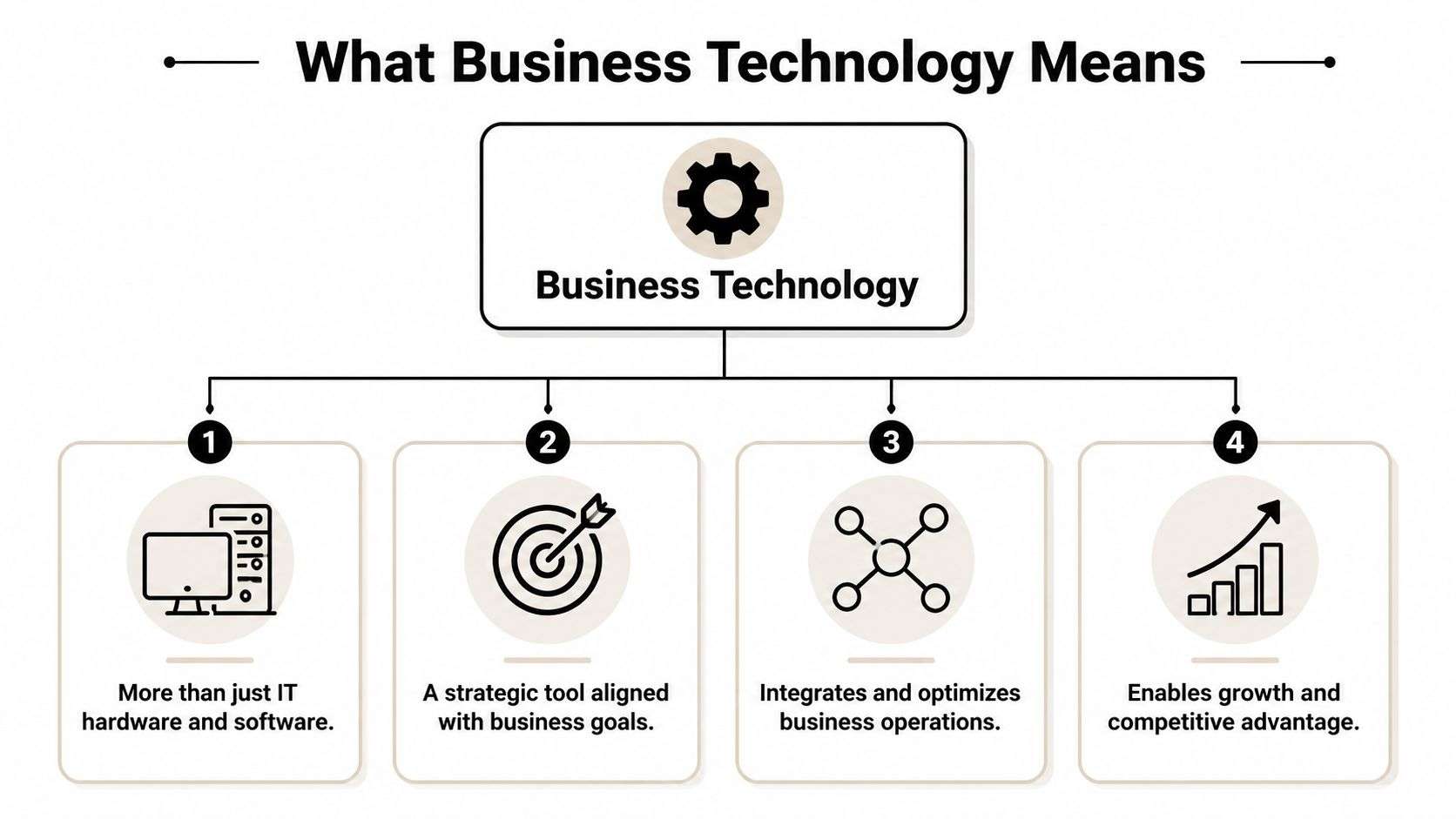
A lot of business owners still think of technology as “IT”. That usually means laptops, internet access, printers, support tickets, and someone to call when email breaks. Those things matter, but they don’t define business technology.
The better definition
The stronger definition is operational and strategic at the same time. As noted in this introduction to business technology, “Business technology” is not just software tools; it is also a governance and management discipline that coordinates technology across the enterprise. That distinction matters in Australia because the same source notes the 2024 Australian Cyber Security Centre Annual Cyber Threat Report recorded 76,000 cybercrime reports, which is a reminder that operational resilience belongs inside technology decisions, not outside them.
Think of your business like a vehicle. The engine is the operating system that powers sales, fulfilment, finance, and service delivery. The dashboard shows what’s happening. The GPS helps you choose the route. If those parts aren’t connected, the driver can’t make reliable decisions. Business technology is the discipline that makes those parts work together.
Business technology versus basic IT support
A simple comparison makes the difference clearer.
| Focus | Basic IT support | Business technology |
|---|---|---|
| Primary role | Keep systems running | Help the business operate and grow |
| Typical work | Devices, email, troubleshooting | Process design, integration, automation, reporting |
| Success measure | Fewer outages | Better workflow, visibility, control, and customer experience |
| Decision lens | Technical issue resolution | Business value plus governance |
Practical rule: If a technology decision doesn't clearly connect to revenue, service delivery, efficiency, control, or risk reduction, it probably isn't mature business technology management yet.
Why this matters to owners
When owners ask what Business Technology means, they're often really asking a more practical question. How do I stop my systems from slowing down the business?
The answer is to manage technology as a capability. That means choosing systems deliberately, defining ownership, setting rules for data and access, and making sure tools support the way the business works. That's why a proper Odoo implementation, a well-scoped Shopify implementation, or targeted software development in Sydney or Adelaide should never start with features alone. It should start with business model, process, and governance.
The Core Components of a Modern Business Technology Stack
A modern stack isn't one product. It's a connected set of capabilities. Each part does a different job, and the value comes from how they interact.

The systems most SMEs actually need
For many Australian businesses, the core stack includes these building blocks:
- ERP
Operations become organised with ERP. ERP handles functions like sales orders, purchasing, stock, invoicing, manufacturing workflows, and management reporting. For SMEs, Odoo implementation is often a practical route because it can cover multiple departments in one platform instead of forcing staff across disconnected tools.
-
CRM
CRM keeps track of leads, follow-ups, customer interactions, and pipeline activity. When CRM connects to quoting, invoicing, and service delivery, sales stops operating in a silo.
-
Website and ecommerce
Your website isn't just a brochure anymore. It's often the front door to the business. For product-based businesses, Shopify implementation or WooCommerce development can support online sales, promotions, catalogue management, and customer self-service.
-
Cloud infrastructure
Cloud is now the normal operating model for many SMEs. According to CC Tech Group's business technology overview, the ABS reported that 88% of businesses used cloud-based computing in 2022–23. In practical terms, that means faster rollouts of integrated workflows like ERP and CRM with less server administration overhead.
What ties the stack together
Buying platforms isn't the hard part. Making them behave like one business system is the hard part.
Integration matters because the customer doesn't care which internal system owns the data. They care that pricing is accurate, stock is available, delivery updates are clear, and service staff know what's going on.
A useful way to think about the architecture is this:
| Component | Business job | Common failure when isolated |
|---|---|---|
| ERP | Runs operations | Finance, stock, and orders drift apart |
| CRM | Manages relationships | Leads don't convert cleanly into jobs or invoices |
| Shopify or WooCommerce | Drives online sales | Orders need manual re-entry |
| Mobile app or portal | Improves access and service | Users get partial or outdated information |
| Analytics | Supports decisions | Reports arrive late or conflict |
If you're planning cloud-first systems, CloudCops' guide to cloud native design is a useful reference for understanding how modern architectures are structured when flexibility and scalability matter.
The foundation most businesses underestimate
Data and reporting sit underneath all of this. If product records, customer information, pricing logic, or workflow states are inconsistent, no dashboard will fix the problem. Good reporting depends on clean process design first.
That's one reason cloud adoption has changed the economics of implementation for Australian firms. Core systems are more accessible, but they also need stronger planning around integration, ownership, and process. Businesses exploring hosted platforms and connected operations can also review cloud computing options for small businesses to understand the operational trade-offs before committing.
A modern stack should remove handoffs, not create new ones.
Measuring the ROI The True Benefits of Smart Tech Adoption
The return on technology doesn't come from having newer software. It comes from changing how work moves through the business.
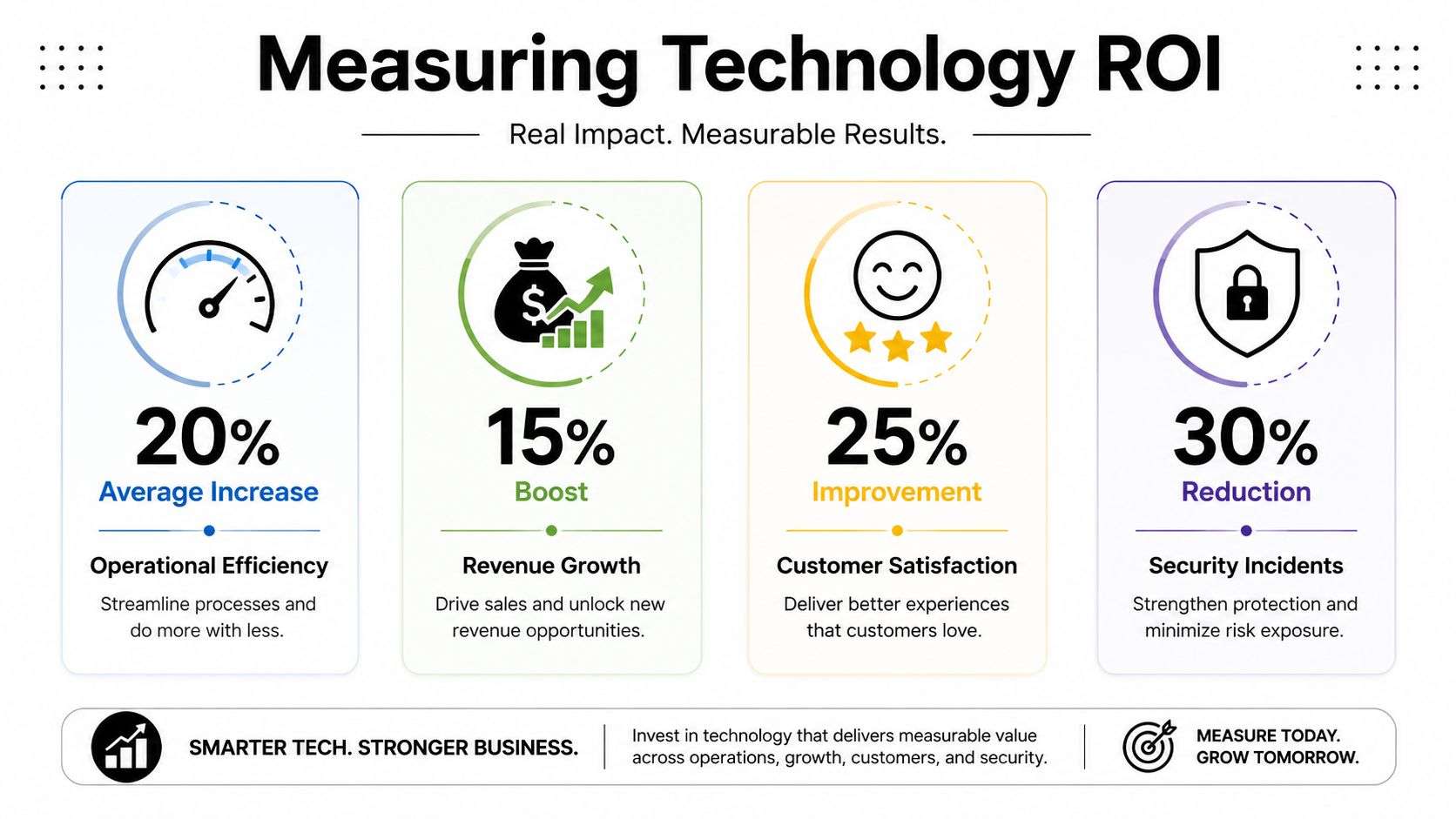
When systems are integrated properly, staff stop doing low-value admin that software should already be handling. Data entry reduces. Approvals become clearer. Customer information stays consistent. Reporting improves because the business is working from one source of truth rather than trying to reconcile several.
Where owners usually feel the gains first
The first benefits are usually operational, not glamorous.
- Less manual handling: Teams spend less time copying data from one system to another.
- Cleaner decision-making: Managers can review sales, purchasing, and service data without waiting for someone to compile spreadsheets.
- Better customer experience: Customers get more consistent communication, faster fulfilment, and fewer avoidable mistakes.
- Scalability: The business can add products, staff, locations, or channels without rebuilding everything from scratch.
According to Electro IQ's summary of technology in business statistics, Australia set a goal to become a top-10 digital economy and society by 2030, and 94% of Australian businesses used the internet in 2021–22. The practical takeaway isn't just that digital adoption is widespread. It's that core systems have become foundational infrastructure for operating at scale.
ROI isn't only financial
Owners often ask for a direct payback calculation. That's reasonable, but it can be too narrow.
Some returns show up as reduced friction rather than a neat line item. A salesperson can quote faster. A warehouse team trusts the stock figure. A clinic can manage workflows more consistently. A services firm can onboard clients without chasing missing details across email and accounting software.
The strongest ROI often appears when the business can finally make decisions without arguing about the data.
That matters because delays, duplicated effort, and poor visibility don't stay operational for long. They become commercial problems. They affect margin, customer retention, and management confidence.
A good Odoo implementation, a properly scoped Shopify implementation, or a custom integration project should be judged on whether it removes friction from core business processes. If it doesn't change daily execution, it won't deliver much value.
Business Technology in Action Across Australian Industries
The concept becomes clearer when you look at how different industries use it day to day.

Retail and ecommerce
An Australian retailer selling through a physical store and online channel often struggles with product, pricing, and fulfilment consistency. A connected setup might use Shopify implementation for ecommerce, linked to ERP for stock, purchasing, and invoicing. The result is simple but important. Online sales don't sit outside operations. They become part of them.
WooCommerce can suit businesses that want flexibility inside a WordPress-based site, especially when content, SEO, and custom buying journeys matter. The key isn't the platform name. It's whether orders, stock movements, and customer records flow properly into the rest of the business.
Manufacturing and logistics
Manufacturing firms need more than a sales system. They need visibility across raw materials, work orders, production steps, purchasing, and dispatch. That's where ERP becomes operational infrastructure rather than admin software.
Logistics businesses face a similar issue. Their service quality depends on coordination, not just communication.
For Australian businesses, especially in healthcare and logistics, process digitisation expands the attack surface. As noted in Sofigate's explanation of business technology, the ACSC's Annual Cyber Threat Report recorded 876,000 cybercrime reports in 2022–23, which is why secure architecture has to be treated as a core functional requirement rather than an add-on.
Professional services, healthcare, and education
A law firm, accounting practice, or consulting business in Sydney or Adelaide usually doesn't need a heavy manufacturing stack. It needs strong client intake, document control, project visibility, billing discipline, and reliable reporting. In those environments, CRM, workflow automation, and customized portals often matter as much as finance software.
Healthcare providers need tighter controls around access, workflows, and resilience because staff are handling sensitive information while trying to keep service delivery moving. Education and training organisations need enrolment processes, communications, portals, and reporting that don't force staff into duplicate administration.
A practical pattern shows up across sectors:
- Retail: connect catalogue, payments, stock, and fulfilment
- Manufacturing: connect supply, production, dispatch, and costing
- Professional services: connect leads, projects, time, invoicing, and documents
- Healthcare and education: connect service workflows with stronger governance and access control
Different industries need different platforms, but they all need the same discipline. Systems have to reflect real operating conditions.
How to Implement Your Technology Strategy Successfully
Most technology projects fail long before go-live. They fail when the business chooses software before defining the problem properly.
Start with process, not demos
A slick product demo can hide a poor fit. The right starting point is a needs analysis that looks at sales flow, fulfilment, approvals, reporting, customer touchpoints, and the handoffs that slow work down.
That analysis should answer questions like:
- Where does manual re-entry happen?
- Which reports are hard to trust?
- What delays quoting, ordering, delivery, or billing?
- Which process breaks when a key staff member is away?
- What needs to be standardised before it can be automated?
Without that level of clarity, businesses often buy a platform and then discover they were really paying for a set of assumptions about how they should operate.
Sequence the rollout properly
According to the University of Advancing Technology's discussion of business technology, business technology decisions increasingly depend on workforce capability, not only purchase price. That's the right lens for Australian SMEs. Skills shortages, security pressure, and fast-moving AI adoption mean you can't implement everything at once and expect staff to absorb it cleanly.
A sensible sequence usually looks like this:
- First, stabilise the core: finance, sales flow, inventory, service delivery, or customer records
- Then connect channels: website, ecommerce, mobile, portals, field access
- Then automate selectively: approvals, recurring admin, notifications, routine reporting
- Then extend: analytics, advanced workflows, AI-supported features where governance is clear
For businesses planning this journey, a structured digital transformation roadmap helps make sequencing more realistic.
Choose the next system your team can absorb and use well. Not the one with the longest feature list.
Partner selection matters more than many owners expect
Many SMEs make an expensive mistake. They compare quotes without comparing implementation thinking.
If you're evaluating an ODOO partner in Sydney or Adelaide, ask how they map workflows, handle data migration, define user roles, manage exceptions, and support change inside the business. If you're assessing software development in Sydney or Adelaide, ask how much of the project can be solved with configuration and integration before custom code is introduced.
Useful signs of a good implementation partner include:
- They challenge vague requirements: They won't accept "we need a better system" as a brief.
- They focus on adoption: Training, ownership, and change management are part of the project.
- They understand trade-offs: They know when to configure Odoo, when to use Shopify, when WooCommerce is enough, and when custom software is justified.
- They don't force the business into unnecessary complexity: Simpler is often stronger.
One local option businesses consider for ERP, web, and app projects is Wistec, which provides Odoo ERP implementation, website development, and mobile application work in the Australian market.
Your Next Steps Choosing the Right Path and Partner
If you're still asking what Business Technology is, the practical answer is this. It's the set of connected systems and operating decisions that let your business run with less friction, more visibility, and better control.
The next move depends on where your biggest bottleneck sits.
Match the tool to the business problem
If you're dealing with inventory complexity, multi-department workflows, purchasing issues, or fragmented reporting, an Odoo implementation is often the right place to start. If your biggest issue is online sales, conversion, and ecommerce operations, Shopify implementation or WooCommerce development may be the more immediate priority.
If your process is unique and off-the-shelf tools only solve part of it, custom software development in Sydney and Adelaide can fill the gaps. That might include customer portals, mobile apps, internal workflow tools, or integrations between platforms you already use.
A simple decision view helps:
| Business need | Likely starting point |
|---|---|
| Complex operations across teams | Odoo implementation |
| Fast ecommerce growth | Shopify implementation |
| Content-rich ecommerce with WordPress | WooCommerce |
| Unique workflow or integration need | Custom software development |
| Broader strategic review | Business technology assessment |
Choose the partner with implementation discipline
The right platform can still fail with weak delivery. A good partner won't just install software. They'll translate your workflow into a practical system, identify where standardisation is needed, and help your staff adopt the change.
If you want a clearer path for ERP, ecommerce, cloud, or custom systems, review business technology solutions for Australian organisations and compare them against your current bottlenecks before making the next investment.
If your business is relying on spreadsheets, disconnected tools, or manual workarounds to hold core operations together, it's time for a better structure. Wistec helps Australian businesses plan and implement practical technology across Odoo ERP, Shopify and WooCommerce websites, cloud systems, and custom software. If you want to map the right next step, get in touch for a consultation.