

In Australia, ecommerce website development cost can start under $10,000 for a template-based store and climb well beyond $100,000 for a custom build. The primary cost usually comes from complexity, integrations, and operational requirements, not just whether you choose Shopify, WooCommerce, or a custom platform.
If you're planning your first serious online store, you've probably already seen the problem. One provider quotes a few thousand dollars. Another quotes the price of a small fit-out. Both call it an “ecommerce website”, but they're talking about very different projects.
That gap confuses business owners because most quotes bundle unlike things together. A basic storefront with standard checkout is one job. A store that connects to accounting, inventory, shipping rules, customer-specific pricing, and an Odoo ERP is a different category entirely. That's why smart budgeting starts with total cost of ownership, not headline build price.
Decoding Your eCommerce Website Development Cost
Ecommerce pricing in Australia often surprises businesses. Two agencies can quote the same brief and land in completely different ranges because they are pricing different levels of risk, integration, and post-launch responsibility.
I see this regularly with first-time projects. A business asks for a Shopify store, then later mentions ERP sync, warehouse rules, trade pricing, gift cards, abandoned cart flows, and a migration from spreadsheets or an old POS. The platform did not change. The operating scope did.
That is why headline build price is only a starting point. The pertinent question is what the store needs to handle once customers start ordering. A simple WooCommerce or Shopify setup with standard checkout and basic shipping is one category of project. A store that must connect cleanly with accounting, freight carriers, inventory tools, and an Odoo ERP is a different category, with more discovery, more testing, and more failure points to manage.
For a broader external perspective, this realistic guide for e-commerce businesses is useful because it reflects the same budgeting gap many owners run into when comparing options.
A clearer way to frame the cost is this:
- The website is part of a sales system, not a standalone design job.
- Your platform choice affects how the business will operate, who maintains it, and how easily it connects to other systems.
- The budget needs to cover launch, support, app subscriptions, upgrades, and integration maintenance after go-live.
Many budgets often falter. The initial build quote might cover theme setup, product import, and checkout configuration, but leave out API work, middleware, custom shipping logic, data cleanup, and support during the first few trading weeks. Those items often decide whether the project stays profitable.
For businesses comparing local providers, it helps to assess the work through a full delivery lens rather than visual design alone. A proper web and eCommerce development partner should separate platform fees, implementation effort, integration work, and ongoing support so you can see where the money really goes.
Practical rule: If one quote is much cheaper, ask what happens when stock fails to sync, orders need manual correction, or your Odoo workflow does not match the website checkout. Hidden cost usually shows up in those gaps.
The Core Factors Driving Your eCommerce Cost
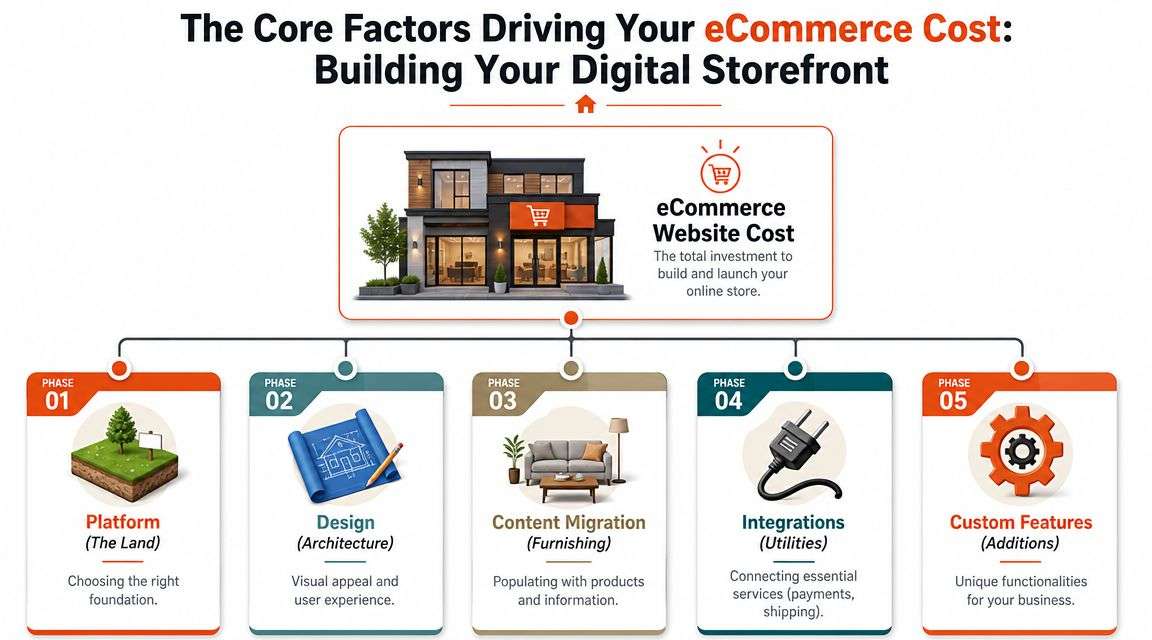
A useful analogy is commercial construction. The platform is the land. The design is the architecture. The product catalogue is the fit-out. The integrations are the utilities. You can open a basic shop without complex infrastructure, but the moment you need power, water, security, loading docks, and warehouse systems, the build changes.
Platform choice sets the foundation
A Shopify implementation is usually faster to launch because hosting and core commerce functions are already packaged. WooCommerce gives more flexibility, but someone still has to manage hosting, plugin compatibility, security, and performance. An Odoo implementation changes the conversation again because the website may only be one part of a wider system covering inventory, CRM, purchasing, and finance.
That's why platform debates are often misleading. The platform affects cost, but it rarely determines it on its own.
Integrations usually move the budget fastest
For Australian eCommerce projects, the strongest cost driver is usually integration density, not the storefront theme itself. When checkout, inventory, payments, loyalty, and marketing automation are bundled into one build, costs move from a low-thousands template store into a mid-to-high five-figure custom implementation because each API workflow adds configuration, testing, and ongoing maintenance overhead, as explained in this ecommerce cost analysis.
That matters in real projects because “just connect it” sounds simple to a buyer but rarely is for the delivery team.
Consider how complexity stacks up:
- Payment workflows: A standard card gateway is straightforward. Split payments, account terms, deposits, or B2B approval flows are not.
- Shipping logic: Flat-rate shipping is simple. Multi-location fulfilment, regional rules, bulky-item logic, or third-party carriers add development and testing work.
- Inventory sync: Manual stock updates are cheap. Real-time stock sync across warehouse, ERP, and website is where projects become technically sensitive.
- Customer pricing: Public retail pricing is easy. Contract pricing, trade portals, wholesale tiers, and account-based ordering push the build into custom territory.
Real-time sync is where risk starts to rise. Every connected system adds another failure point, another testing cycle, and another support dependency.
Design matters, but it's rarely the main cost
Business owners often overestimate theme design and underestimate workflow design. A polished homepage matters, but not as much as checkout behaviour, order routing, returns handling, and back-office automation.
A store with a standard theme and strong operational logic usually performs better for the business than a beautiful custom front end sitting on manual processes. This is especially true for manufacturers, wholesalers, and logistics-heavy businesses where the store must work closely with an Odoo ERP or another operational system.
Comparing eCommerce Platforms and Their True Costs
Most platform comparisons stop too early. They compare monthly subscriptions or licence costs, then ignore the build work, extensions, support burden, and integration overhead that show up after launch. That's where total cost of ownership becomes more useful than sticker price.
Shopify
Shopify is often the cleanest route for a first launch. The hosting is handled, the admin is approachable, and a standard shopify implementation can move quickly if your product catalogue and fulfilment rules are simple.
But low entry pricing doesn't equal low total cost. One source places Shopify plans at $29 to $299 per month, while also noting that custom or enterprise implementations commonly reach $10,000+ upfront and can exceed $30,000 when custom integrations are needed, as covered in this platform cost breakdown.
Where Shopify becomes expensive isn't usually the base plan. It's the layer of apps, custom middleware, specialised shipping logic, and back-office automation needed once the business grows.
WooCommerce
WooCommerce appeals to businesses that want more control over content, design flexibility, and the WordPress ecosystem. It can be an excellent fit for content-heavy brands, service-led businesses adding commerce, or stores that need custom merchandising without committing to a tightly managed SaaS stack.
The trade-off is operational ownership. With WooCommerce, someone has to take responsibility for hosting, plugin conflicts, updates, security, and performance tuning. If the site runs several paid plugins plus custom code, the “open source is cheaper” argument can unravel quickly.
Buyers should compare platforms by management burden, not ideology.
Odoo eCommerce
Odoo eCommerce is a different proposition. It makes the most sense when the online store is part of a bigger operational transformation. If the business needs website sales tied directly to inventory, purchasing, CRM, accounting, service workflows, or manufacturing, an odoo implementation can make far more sense than bolting separate apps together.
The upfront work is often broader because you're not just launching a storefront. You're aligning customer-facing sales with the internal system that runs the business. For wholesalers, distributors, manufacturers, and multi-channel operators, that can reduce duplication and manual handling over time.
The best platform isn't the one with the lowest monthly fee. It's the one that creates the least operational friction for your team.
Platform cost comparison
| Cost Factor | Shopify | WooCommerce | Odoo eCommerce |
|---|---|---|---|
| Entry point | Low apparent entry cost through SaaS plans | Software is flexible, but hosting and setup sit with you | Usually part of a broader business system decision |
| Best fit | Fast retail launch, simpler catalogues, standard checkout | Content-led stores, flexible customisation, WordPress users | Businesses needing integrated commerce and ERP workflows |
| Customisation model | Apps plus custom development | Plugins plus custom development | Native modules plus business process configuration |
| Ongoing management | Lower infrastructure burden, more app dependence | Higher technical ownership for hosting, updates, and plugin stability | More centralised if commerce and operations live in one system |
| Integration profile | Can become expensive as app stack grows | Flexible, but integration quality depends heavily on implementation | Strong fit when store must connect deeply with operations |
| Who should look closely | Retailers wanting speed | Businesses wanting control | Firms needing odoo erp alignment |
For a more direct platform-by-platform decision lens, this Shopify vs WooCommerce comparison is worth reviewing before you finalise scope.
One-Time Build Costs vs Ongoing Recurring Fees
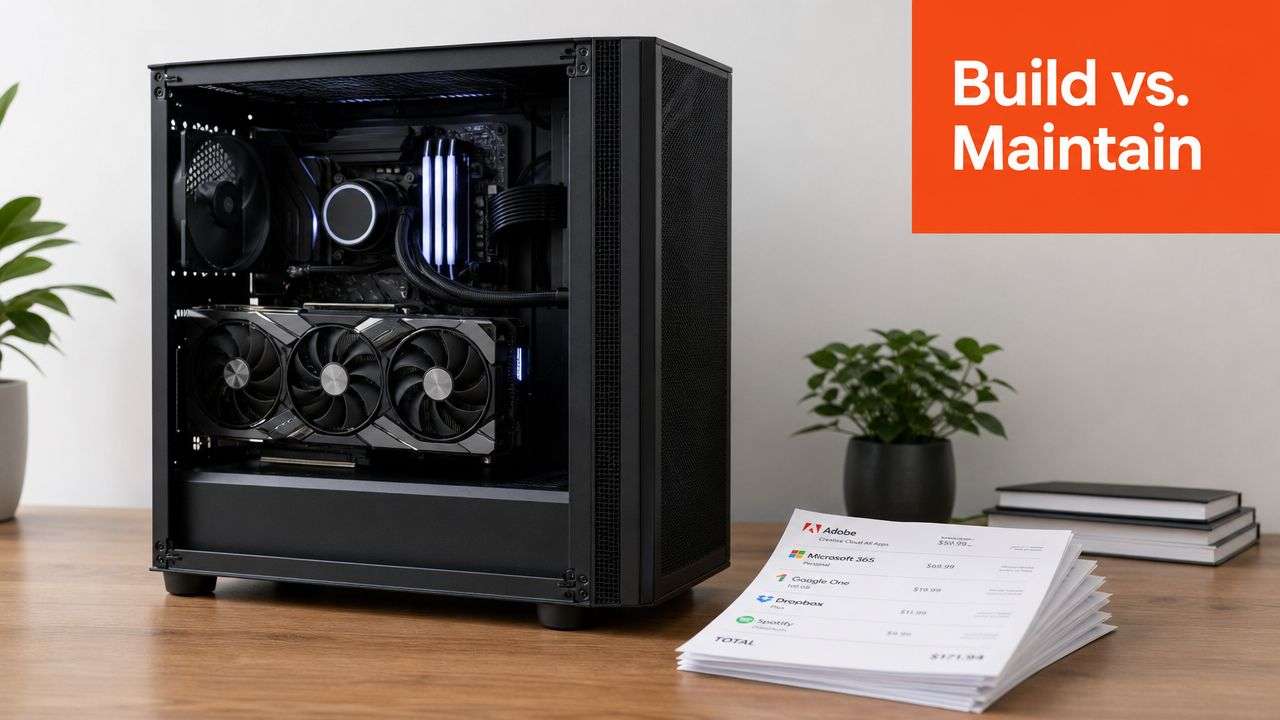
Many Australian businesses budget for launch and under-budget for operation. That's usually where cost overruns begin. The store goes live, then the monthly app bills, support requests, gateway charges, maintenance tasks, and integration issues start to appear.
What belongs in one-time build cost
One-time project spend usually includes the parts needed to get the store live in a production-ready state.
That often covers:
- Discovery and scoping: requirements workshops, solution design, and technical planning
- Design and build: theme work, page templates, navigation, product structure, and checkout setup
- Migration: product data, customer records, page content, and redirects
- Initial integrations: payment gateway, shipping tools, CRM, accounting, or Odoo ERP connections
- Testing and launch: browser testing, device checks, checkout validation, and deployment
This is the number most agencies lead with. It's important, but incomplete on its own.
What keeps costing money after launch
A frequently missed angle is ongoing operating cost after launch. Maintenance alone can be $15,000 to $30,000 a year for a mid-sized store, with some estimates reaching $3,000 to $60,000 per year depending on complexity, according to this ongoing ecommerce maintenance guide.
Those recurring costs don't all behave the same way.
| Recurring cost type | How it behaves |
|---|---|
| Platform or hosting fees | Usually fixed monthly or annual cost |
| App and plugin subscriptions | Fixed at first, then grow as features are added |
| Support and maintenance | Can be retainer-based or ad hoc |
| Payment processing | Scales with order volume |
| Integration support | Often rises as workflows become more interconnected |
The budgeting mistake to avoid
Some owners compare a low build quote against a higher one without asking what the next year looks like. That's the wrong comparison. A better question is which stack gives you the best operating model over time.
A lean launch is often sensible. A false economy isn't. If your store will need constant manual exports, double entry, plugin patching, or custom fixes to keep stock and orders in line, your recurring cost won't stay lean for long.
Sample eCommerce Budgets for Australian Businesses
A Brisbane retailer launches on Shopify for a modest upfront cost. Twelve months later, staff are still rekeying orders into accounting, fixing stock mismatches, and chasing freight exceptions by hand. The store was affordable to build. It was expensive to run.
That is the budgeting lens Australian businesses should use. Budget by total cost of ownership, not just the initial build. Catalogue size matters, but the bigger cost driver is operational complexity: pricing rules, fulfilment, product data, GST treatment, wholesale workflows, and whether systems such as Odoo need to stay in sync.
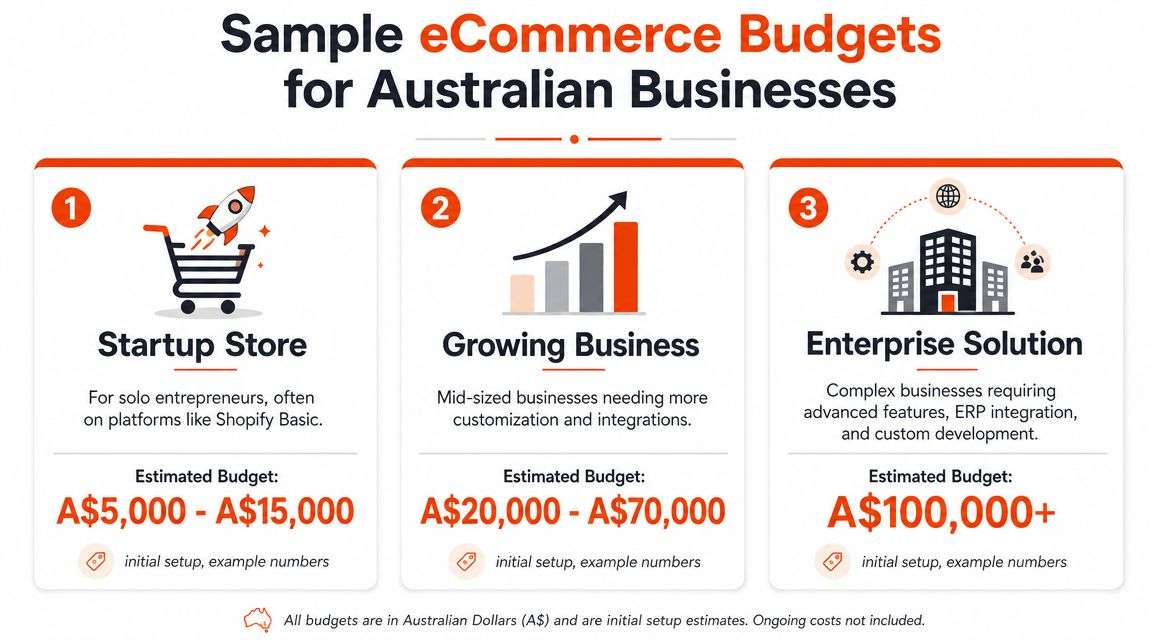
For planning purposes, I'd split most projects into three practical brackets. The build cost increases as the storefront stops being a standalone website and starts acting as part of a wider sales and operations system. If you are still weighing platform fit and scope, our eCommerce website design services page outlines the delivery considerations we typically assess before pricing.
Startup store
This suits a business selling direct to consumers with a small to mid-sized catalogue, standard shipping rules, and limited back-office integration. Shopify is often the fastest path here. WooCommerce can also work well if the business already runs on WordPress and wants more control over content and plugin choice.
Typical characteristics:
- Simple catalogue
- Standard retail checkout
- Manual fulfilment or light app-based automation
- No ERP connection at launch
The right budget focus is not “how cheap can we build it?” It is “what can we launch cleanly without creating admin debt in month three?” Product setup, payments, shipping configuration, basic SEO, and clear reporting usually deserve budget before custom features do.
Growing SME
This bracket covers established retailers, wholesalers adding online ordering, and multi-location businesses that have moved past a basic cart. Costs rise here because the store now affects stock accuracy, customer service, finance processes, and marketing operations at the same time.
A semi-custom Shopify or WooCommerce build is common, but the hidden costs usually sit behind the storefront. Examples include trade pricing, customer group rules, ERP or accounting sync, freight logic, returns handling, and cleaning up years of poor product data before migration. That work often decides whether the project stays controlled or blows out.
I see many Australian SMEs underestimate integration effort at this stage. Connecting a store to Odoo, Cin7, MYOB, Xero, StarShipIT, or a 3PL sounds straightforward until edge cases appear. Partial shipments, backorders, bundled products, GST edge cases, and customer-specific price lists all need rules. Each rule takes discovery, configuration, testing, and support after go-live.
This is also a sensible point to review whether technology spend may qualify under the small business technology boost with your adviser.
Integrated enterprise
Manufacturers, distributors, and larger B2B operators usually belong here. The website is only one part of the system. The main project is the connection between commerce, inventory, pricing, warehousing, finance, and customer account workflows.
In this bracket, an odoo implementation can make commercial sense because it reduces the number of disconnected tools the business has to maintain. But the upfront budget is higher for a reason. You are paying for process design, ERP configuration, product and customer data structure, role permissions, testing across multiple business scenarios, and often change management for the internal team.
A low entry quote can be misleading at this level. A cheaper storefront paired with custom plugins and manual workarounds often produces a higher TCO than a properly scoped integrated build. That trade-off matters more in Australia, where labour cost, freight complexity, GST handling, and multi-channel operations can turn “good enough for now” into an expensive operating model quite quickly.
Choosing a Partner and Maximising Your ROI
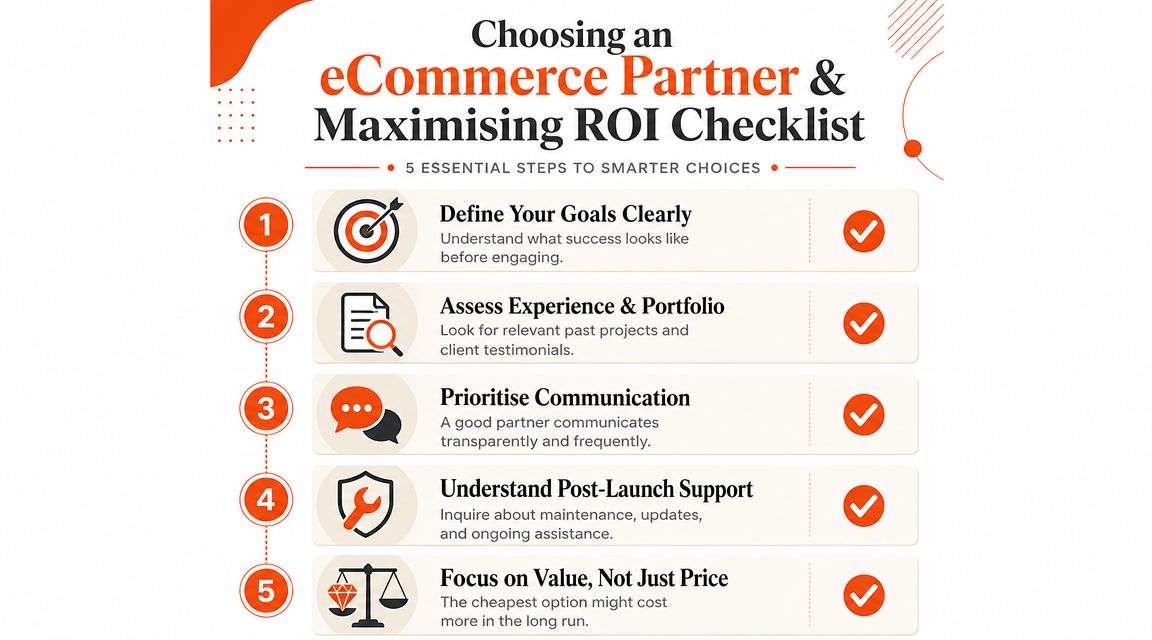
A quote is only useful if it reflects the job accurately. The cheapest proposal can still become the most expensive outcome if it omits integration work, underestimates migration, or leaves you with weak post-launch support.
A practical AU benchmark puts template-based eCommerce builds at around $3,000 to $10,000, semi-custom projects at $10,000 to $30,000, and fully custom builds at $40,000 to $150,000+. The same guidance notes that each added integration can materially increase the budget, with some estimates placing add-on integrations at roughly $1,000 to $10,000 each, according to this eCommerce build cost benchmark.
What to look for in a delivery partner
If you're evaluating agencies or a software development Sydney Adelaide team, ask them to show how they think, not just what they charge.
Use this checklist:
- Scope clarity: Can they separate design, development, apps, integrations, migration, and support?
- Platform fit: Do they explain why Shopify, WooCommerce, or Odoo ERP suits your business model?
- Integration experience: Have they handled operational systems, not just brochure-style online stores?
- Post-launch support: Is there a realistic plan for maintenance, fixes, and change requests?
- Commercial honesty: Do they explain trade-offs, or just agree to everything in the brief?
Local understanding matters
For Australian businesses, local context changes implementation decisions. GST handling, shipping geography, warehouse arrangements, payment preferences, and local support expectations all affect scope. That's one reason businesses often prefer a local Odoo partner Sydney Adelaide or an experienced software development Sydney Adelaide provider when the project has operational complexity.
The strongest partner will challenge assumptions early. They'll tell you when a custom workflow is justified and when a standard process is better. That's how ROI is protected.
For owners trying to frame return on investment more rigorously, this guide to optimizing your Shopify brand's ROI offers a useful commercial lens. If you're assessing implementation options in more detail, reviewing these eCommerce website design services can also help clarify what should be included in a serious proposal.
Frequently Asked Questions About eCommerce Costs
How long does an eCommerce website take to build
It depends on complexity more than platform. A simple template-based launch can move relatively quickly because the team is configuring known components. A custom build with migration, approval flows, or Odoo ERP integration takes longer because each workflow must be specified, tested, and signed off properly.
If a provider gives you a timeline before understanding products, checkout rules, integrations, and content readiness, treat that estimate cautiously.
Can I start small and add features later
Yes, and in many cases you should. A phased launch is often the smartest way to control ecommerce website development cost. Start with the features needed to sell reliably, then add automation or custom workflows once real operational pain points are visible.
The catch is architectural planning. If you know an odoo implementation or deeper ERP integration is coming, the initial build should account for that direction. Otherwise you can end up paying twice.
What should I ask before signing with an agency
Ask questions that expose assumptions:
- What exactly is included in the quoted scope?
- Which features rely on third-party apps or plugins?
- What happens if integration requirements change mid-project?
- Who handles data migration and content loading?
- What support do we get after launch?
A good agency will answer plainly. A weak one will stay vague around support, integrations, and change control.
Is Shopify always cheaper than WooCommerce or Odoo
No. Shopify often has a lower barrier to launch, but not always a lower total cost of ownership. WooCommerce can be more flexible but needs stronger technical stewardship. Odoo can look heavier upfront, yet make more commercial sense when the website must connect tightly with operations.
The right answer depends on whether your store is primarily a sales channel, a content-and-commerce platform, or part of a broader business system.
What usually blows out the budget
Three things do it most often in practice:
- Unclear requirements: especially around shipping, pricing, and customer account logic
- Late integration decisions: adding ERP, warehouse, or marketing automation too late in the process
- Underestimated content work: product cleanup, image preparation, category structure, and redirect planning
That's why budgeting needs business input from operations, finance, fulfilment, and sales, not just marketing.
If you're planning a Shopify implementation, WooCommerce rebuild, or a fully integrated Odoo ERP commerce project, Wistec can help you scope it properly before cost surprises appear. Speak with the team to map actual requirements, compare platform options, and get a build plan that reflects both launch needs and long-term operating cost.