

You know the point where the business is still selling, still shipping, still growing, but every week feels more fragile than the last. Purchasing is in one system, production notes are in spreadsheets, warehouse staff are checking dates by hand, and finance is trying to close the month with data nobody fully trusts.
That's where most food businesses start looking seriously at food ERP software.
It usually isn't because someone suddenly wants “digital transformation”. It's because a buyer asks for tighter batch records, a quality issue exposes gaps in traceability, expiry losses keep appearing in margin reports, or online orders from Shopify and WooCommerce are creating more admin than revenue. At that point, a generic ERP or basic accounting package stops being a platform and starts becoming a workaround.
The Tipping Point for Food Businesses
A common pattern shows up in food operations. The business starts with sensible tools. Accounting software handles finance. A stock app tracks quantities. Production relies on whiteboards, spreadsheets, and the experience of the team on the floor. For a while, that works.
Then complexity emerges. One product becomes ten. One warehouse becomes two. Retailers ask for tighter documentation. Batch questions take too long to answer. Stock on hand looks acceptable in the system, but the wrong lot is sitting in the pick face, or the expiry window is too short for a customer order.
Where the pressure usually shows up first
The first warning signs are operational, not technical:
- Expiry waste starts climbing: stock exists, but not the right stock with the right remaining shelf life.
- Recall confidence drops: staff can identify the product, but not every affected batch movement forward and backward.
- Production planning gets reactive: buyers, planners, and warehouse staff are working from different versions of the truth.
- Admin grows faster than sales: each new customer, SKU, and channel adds another manual process.
Food businesses dealing with transport delays and supplier variability often hit this wall sooner. If you're already working through broader logistics disruption, this guide to fixing supply chain issues is useful context because software problems and supply-chain bottlenecks usually feed each other.
Australia is also in a practical position to adopt connected systems. In 2022–23, 91% of businesses had internet access, 77% had a web presence, and 41% used cloud computing, according to the ABS data cited by Wherefour's overview of food and beverage manufacturing ERP software. That matters because food ERP software works best when purchasing, production, inventory, and traceability data move through one connected environment rather than disconnected files and departmental tools.
Practical rule: If your team needs to “double-check the spreadsheet” before making a stock, production, or recall decision, your current system isn't controlling the process.
The tipping point isn't about software fashion. It's about operational risk. Once traceability, shelf life, quality, and fulfilment all depend on disconnected tools, the business is one mistake away from a costly week.
What Is Food ERP Software Exactly
A generic ERP helps manage business functions. Food ERP software manages business functions in an environment where products expire, ingredients vary, labels matter, and every batch may need to be traced.
That difference sounds small until you try to run a food business on a standard manufacturing setup.
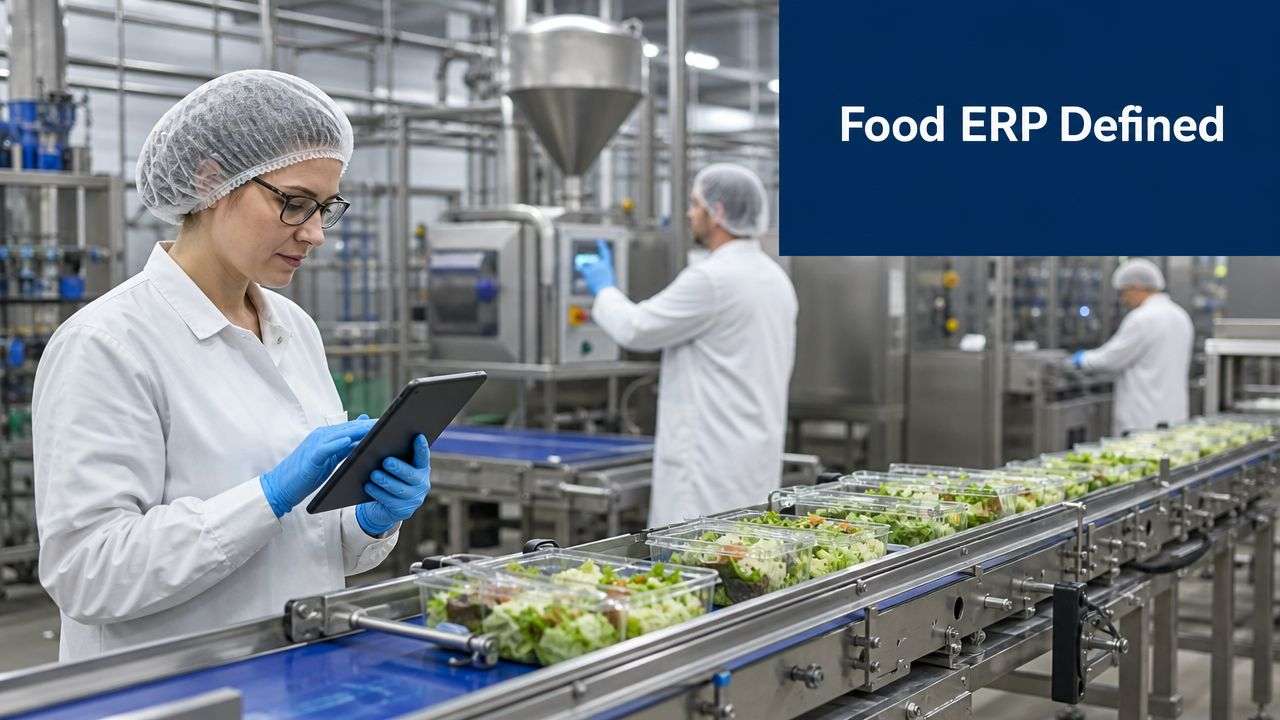
Generic ERP versus food ERP
The simplest comparison is this. A generic ERP is like a standard delivery van. It can carry goods from one place to another. A food ERP is a refrigerated vehicle with temperature controls, route constraints, and handling rules built into the design.
Both are “vehicles”. Only one is built for perishables.
In practice, the core difference is that a generic ERP revolves around the item. A food ERP revolves around the lot or batch. That changes everything:
- purchasing records which supplier lot came in
- production records which raw lots went into which finished batch
- inventory records not just quantity, but age, status, and expiry logic
- dispatch records which customer received which batch
If your software only knows that you have 500 units of a SKU, it can't properly support food operations. The critical question is which 500 units, from which batch, with what shelf life, under what quality status, and sent to whom.
Why add-ons often fail
Many businesses try to stretch a generic ERP with custom fields, notes, spreadsheets, and bolt-on apps. That can work for a while, but food operations usually expose the weak points.
Typical failure points include:
Traceability lives outside transactions
Staff record critical batch detail manually after the fact. That weakens audit confidence.Shelf-life logic is too basic
The system can show a date, but it doesn't drive practical picking and allocation decisions.Quality is disconnected from stock movement
Goods can move before hold, release, or inspection status is properly enforced.
A food ERP shouldn't just store compliance data. It should control operations with that data.
That's why food-specific capability matters. When software is designed around batch movement, recipe control, expiry rules, and compliance records from the start, teams stop building parallel processes just to keep the plant running.
Essential Features for Food and Beverage Businesses
The fastest way to judge food ERP software is to ignore the broad brochure language and look for the functions that protect the operation. Plenty of platforms claim inventory, purchasing, and reporting. That's not enough.
The essential features are the ones that support traceability, product integrity, and day-to-day execution.
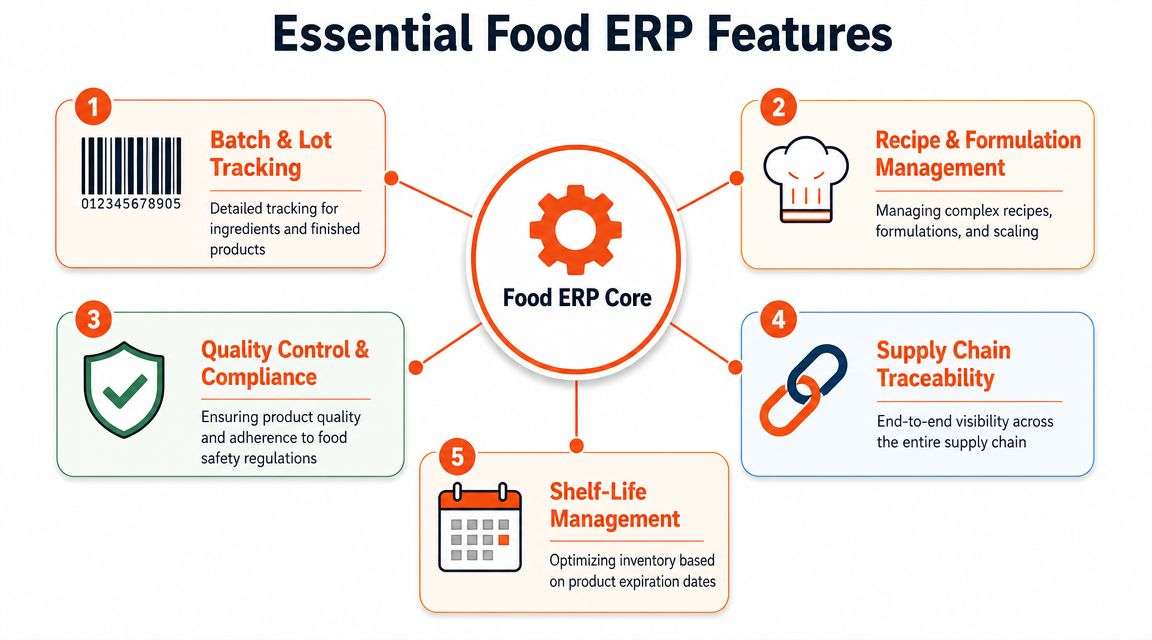
Lot traceability is the centre of the system
The single most important technical differentiator in food ERP is end-to-end lot traceability. As explained in Inecta's food ERP guidance, it allows a business to narrow recall scope from an entire product line to a specific batch. Operationally, that means less quarantine, less customer disruption, and a more defensible compliance response.
This isn't a nice feature for the quality team. It affects purchasing, production, warehousing, customer service, and management.
What good traceability looks like in practice:
- Backward tracing: finished goods can be traced to ingredient lots and suppliers.
- Forward tracing: raw material lots can be traced into every affected finished batch and shipment.
- Transaction-level capture: data is recorded when goods are received, consumed, moved, packed, and dispatched.
- Audit-ready history: the business can reconstruct events without relying on memory or side files.
A useful benchmark for evaluating systems is whether they can support the processes described in this guide to ERP for food manufacturing, especially where compliance, traceability, and waste control intersect.
The features that separate food systems from standard systems
Lot tracking alone won't run the plant. The surrounding controls matter just as much.
FEFO shelf-life control
First-expired, first-out logic helps the warehouse pick the right stock, not just the oldest receipt by assumption. That reduces spoilage and customer rejections caused by short-dated stock.Recipe and formula management
The system needs to control versions, yields, substitutions, and costing. In food, a recipe change is not just a production change. It can affect allergens, labels, margins, and quality outcomes.Allergen controls
Allergen flags should travel through products, ingredients, and production processes. If that information sits in PDFs or separate QA records, mistakes become more likely.Catch-weight handling
This matters in categories where units don't weigh exactly the same. Selling, costing, and stock valuation need to reflect actual variable weight, not a rough standard.
Quality and the physical environment
Food businesses often focus on software features and forget that operational control also depends on plant design and hygiene discipline. For example, facilities looking at higher-care production areas can learn from Wilcox Door's hygienic door solutions, because physical movement control and digital traceability often need to improve together.
The strongest food ERP projects treat quality, stock movement, and production recording as one process, not three separate departments.
If a vendor shows beautiful dashboards but can't explain lot genealogy, FEFO logic, allergen handling, and recipe version control in operational terms, it's probably not a true food system.
The Real ROI of a Specialised Food ERP
Most ROI discussions around ERP get reduced to labour savings and “better visibility”. Those matter, but food businesses usually see the strongest return somewhere else. Risk control, waste reduction, and decision speed.
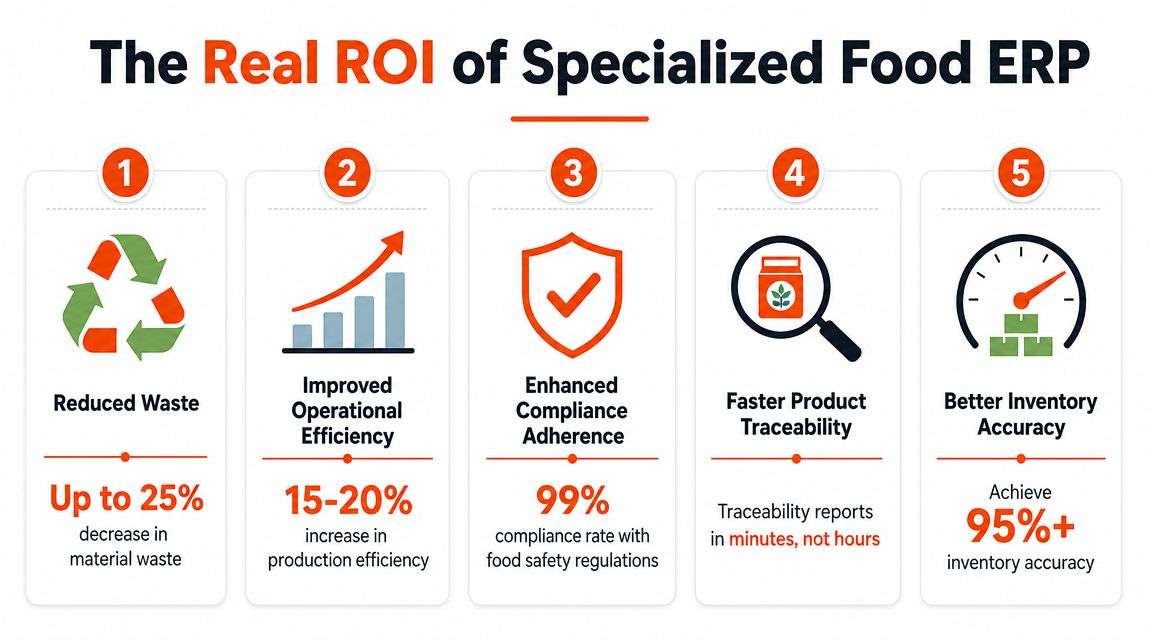
Australia's food and beverage manufacturing base is large enough that operational improvements don't stay small for long. ABS figures cited by FoodReady's discussion of ERP relevance show food product manufacturing employed 228,400 people, beverage and tobacco product manufacturing employed 35,300 people, and generated $70.1 billion and $21.6 billion in sales and service income respectively in 2022–23. In a sector of that size, even modest gains in stock visibility, reporting speed, and production control can have meaningful impact.
Where the return usually appears
The first return often comes from fewer avoidable mistakes.
A specialised system helps the business answer questions faster:
- Which batches are affected?
- What can still be shipped safely?
- What stock should be picked first?
- Which ingredients are driving variance?
- Where is waste appearing in the process?
Those answers reduce delays, over-reactions, and manual investigation time.
Waste and margin protection
This is the ROI area many buyers underestimate. Businesses often start the ERP search because of compliance pressure, but the ongoing value frequently comes from waste visibility and better planning discipline.
Advanced forecasting and inventory optimisation are often positioned as sustainability benefits, but they are also margin controls. If the business buys better, produces closer to demand, and allocates stock based on shelf life, it wastes less product and protects contribution.
Better forecasting doesn't just improve planning. It prevents good stock from turning into write-offs.
That matters in Australia because waste is not an abstract policy issue. The ABS reported 263.7 million tonnes of waste generated in Australia in 2022–23, as cited in Aptean's discussion of food ERP features and waste reduction. For food operators, that creates a practical commercial argument for systems that improve inventory control and decision-making.
Compliance has financial value even when nothing goes wrong
The best food ERP projects don't “pay off” only during a crisis. They pay off because the business can run with more confidence every day. Audits are easier to support. Customer documentation is cleaner. Month-end reporting is less painful. Production, warehouse, and finance teams spend less time reconciling facts after the event.
That's the fundamental shift. A specialised food ERP is not just software that records activity. It becomes the operating system for safer, tighter, more profitable execution.
Your Vendor and Software Selection Checklist
Choosing food ERP software is partly a product decision and partly a partner decision. Businesses often spend too much time comparing feature checklists and not enough time testing whether the vendor understands how the operation works.
A polished demo can hide a poor fit. What matters is whether the system can handle your product, process, and commercial model without forcing the team into awkward workarounds.
Questions worth asking in every vendor meeting
The sustainability angle should be part of this discussion, not an afterthought. As noted in the earlier source on waste and optimisation, forecasting and inventory discipline can be central to ROI, not just compliance. That changes what good software looks like.
| Category | Question to Ask | Why It Matters |
|---|---|---|
| Process fit | Can you show receiving, batch consumption, production, QC hold, and dispatch using our actual workflow? | Food businesses need operational fit, not generic manufacturing screens. |
| Traceability | How do you trace one ingredient lot forward and one finished lot backward? | If this is clumsy in the demo, it will be worse in production. |
| Shelf life | How does the system enforce FEFO and customer-specific shelf-life rules? | Date tracking alone isn't enough. The system must guide decisions. |
| Recipe control | How are formula changes versioned and approved? | Recipe changes affect cost, labelling, allergens, and consistency. |
| Integration | Can it connect cleanly to eCommerce, accounting, scanners, and freight workflows? | Most failures happen between systems, not inside one screen. |
| Implementation | Who maps processes, migrates data, trains users, and supports go-live? | Software rarely fails on features alone. Rollouts fail on execution. |
| Local support | Do you have a team that can support businesses in Sydney or Adelaide? | Local context matters when workshops, training, and issue resolution are needed. |
| Flexibility | What is configured versus custom-built? | Too much custom code can become expensive to maintain. |
Why Odoo comes up in shortlist discussions
Odoo ERP is often considered because it is modular and flexible. For food businesses, that matters when finance, purchasing, manufacturing, inventory, CRM, and eCommerce need to connect without buying a stack of unrelated systems.
Still, Odoo is only as effective as the implementation design. A poor Odoo implementation can reproduce the same mess in a new interface. A sound one maps batch control, approvals, reporting, and integrations properly from the start.
If you're comparing implementers, this guide on choosing Odoo implementers is a sensible checkpoint because it focuses on selection criteria rather than marketing language.
What to look for in an Odoo partner
For Australian buyers searching terms like ODOO partner Sydney Adelaide, the important issue isn't the geography in the keyword. It's whether the partner can translate food operations into a workable system design.
Look for a partner that can speak clearly about:
- plant-floor data capture
- lot and expiry handling
- finance and operations integration
- Shopify implementation and WooCommerce order flow
- training across office and warehouse users
- software development Sydney Adelaide support when a process needs extension
One option in that category is Wistec, which provides Odoo Open ERP implementation and broader software development services for Australian businesses. The relevant question is not whether a partner says “food ERP” on a webpage. It's whether they can design the operating model inside the software.
A Practical Guide to Odoo Implementation
Most owners worry that implementation will disrupt production, frustrate staff, and swallow management time. That fear is reasonable. ERP projects go wrong when teams treat them like an IT install instead of an operational change program.
The core lesson is simple. Odoo implementation succeeds when the project is built around process decisions, user adoption, and disciplined scope.

Start with process mapping, not screens
Before anyone configures Odoo ERP, the team needs a practical map of how the business runs today and how it should run after go-live.
That means documenting:
- supplier receipt and batch creation
- QC hold and release decisions
- recipe consumption and production recording
- warehouse moves and FEFO picking
- dispatch, returns, and customer traceability
- finance handoffs for valuation, invoicing, and reporting
A structured ERP system implementation approach helps here because it forces the project to deal with real workflows, not just software menus.
Use phases that the business can absorb
Big-bang rollouts sound efficient and often create avoidable stress. Food businesses usually do better with phased delivery.
A practical rollout often looks like this:
Discovery and design
Workshops define process rules, data structures, reports, and integration needs.Configuration and targeted customisation
Standard Odoo modules are configured first. Custom development only happens where the process genuinely requires it.Data migration and testing
Master data, products, suppliers, customers, recipes, and opening stock are cleaned before import. Testing uses real scenarios, not ideal ones.Training by role
Buyers, warehouse staff, production supervisors, QA users, and finance all need different training.Go-live and stabilisation
The first weeks focus on issue triage, user support, and small adjustments. Not new major scope.
The human side decides the outcome
Independent ERP guidance for food manufacturing points to organisational resistance as the biggest hurdle, not software features. The same guidance cited by Panorama Consulting's article on managing ERP resistance in food manufacturing notes the importance of assessing resistance early and using frontline change champions. That matters in Australia because the Food and Beverage Manufacturing industry employed 286,000 people in February 2024.
What works on the ground:
- Train with actual jobs: warehouse users should scan and move stock in realistic scenarios, not sit through abstract demos.
- Appoint floor champions: supervisors and trusted operators help convert resistance faster than project emails.
- Fix reporting early: managers accept change faster when the new system answers daily questions better than the old one.
- Avoid over-customising: every unnecessary custom feature makes training, support, and upgrades harder.
If plant-floor users feel the system was imposed on them, they'll create side processes. Once that starts, data quality drops fast.
Don't ignore integrations
Many food businesses now sell and fulfil across multiple channels. If online sales matter, Shopify implementation or WooCommerce integration should be designed as part of the core project, not left as a “phase two maybe”. Orders, stock availability, pricing, and fulfilment status need one source of truth.
The same applies to barcode scanning, freight workflows, and finance connections. Good implementation reduces handoffs. Bad implementation digitises them without removing them.
Conclusion and Your Next Steps
Food businesses rarely outgrow generic systems all at once. They outgrow them through daily friction. A batch question that takes too long to answer. Short-dated stock that keeps getting missed. Quality records that don't connect cleanly to inventory or dispatch. That's when specialised food ERP software starts making commercial sense.
The right system gives you tighter traceability, stronger compliance control, better waste visibility, and a platform that can support growth across production, warehousing, finance, and eCommerce. A well-run Odoo implementation can do that, but only if the design matches the reality of your operation and the rollout deals properly with training, process discipline, and change on the floor.
If you're evaluating options now, start with your workflows, not a feature brochure. Then choose the partner who can turn that operational reality into a working system.
If you're planning a food ERP project and want a practical discussion about Odoo ERP, implementation scope, integrations such as Shopify or WooCommerce, and local support from an ODOO partner Sydney Adelaide, speak with Wistec. They work with Australian businesses on customized ERP and software development outcomes built around real operations, not generic demos.