

Choosing to implement a new ERP system is one of the biggest strategic decisions a business can make. But too often, it’s treated as a purely technical project, and that’s where things start to go wrong. Real success comes from seeing it for what it truly is: a fundamental shift in how your entire business operates, bringing siloed departments together into a single, cohesive unit.
Why So Many ERP Implementations Miss the Mark

Let's be blunt: diving into an ERP project can feel like a massive, high-stakes gamble. This guide isn't filled with vague theories; it’s a practical playbook drawn from years of experience in the trenches, navigating both successes and failures. We're here to show you why a strategic, business-first approach is the one thing that will separate a successful rollout from a costly headache.
The real frustration for most companies boils down to disconnected data. Your inventory system doesn’t talk to your sales platform, leading to surprise stockouts during a big promotion, or worse, capital tied up in overstocked items that aren't moving. A well-planned ERP turns that chaos into clarity.
It’s about creating a central nervous system for your business, whether you're considering an Odoo implementation in Sydney or a completely custom software development project in Adelaide.
The Hidden Costs of Your Disconnected Systems
There's a good reason ERP adoption is on the rise across Australia. The local market, valued at roughly USD 930 million in 2024, is expected to surge to USD 1.17 billion by 2030. This isn't just about keeping up with technology; it's a direct response to a massive, hidden problem.
Did you know that businesses can lose up to 40% in productivity simply because staff are constantly toggling between different, unintegrated apps? You can explore more data on the Australian ERP market to see the full picture.
Practical Case: A warehousing company in Adelaide was losing hours daily as staff manually cross-referenced orders from their WooCommerce site with a separate inventory spreadsheet. After their Odoo implementation, order processing became automated. This single change reduced shipping errors by 60% and freed up two staff members to focus on customer service instead of data entry. That’s the real-world impact of a successful implementation—it transforms fragmented daily tasks into a smooth, efficient operation.
Moving From a Tech Task to a Business Overhaul
The single biggest mistake we see is when the ERP project is handed off to the IT department and forgotten. When key teams from finance, sales, and operations aren't deeply involved from day one, the final system inevitably fails to solve their day-to-day problems. The whole point is to build a unified platform that works for everyone.
A successful ERP implementation is less about the software itself and more about fundamentally redefining how your business works. It forces you to standardise processes, root out long-standing inefficiencies, and establish a single source of truth everyone can rely on.
This principle holds true whether you're managing a complex Shopify implementation or a rapidly growing WooCommerce store. Integrating these e-commerce platforms with a central ERP is the only way to build a foundation for genuine, scalable growth.
An ERP's value is realised when it stops being just software and becomes the backbone of your operations. The table below highlights just how transformative this can be across different departments.
Core Business Functions Transformed by ERP
| Business Function | Common Pre-ERP Challenge | How ERP Implementation Resolves It |
|---|---|---|
| Finance & Accounting | Manual data entry, slow month-end closing, and error-prone reporting from multiple spreadsheets. | Automates financial workflows, provides real-time financial visibility, and generates accurate reports instantly. |
| Sales & CRM | Inconsistent customer data, lack of visibility into the sales pipeline, and difficulty tracking interactions. | Centralises all customer information, tracks leads and opportunities, and provides a 360-degree view of the customer. |
| Inventory & Supply Chain | Inaccurate stock levels leading to stockouts or overstocking, and inefficient warehouse management. | Offers real-time inventory tracking, optimises stock levels with demand forecasting, and streamlines order fulfilment. |
| Human Resources | Disjointed employee records, cumbersome payroll processes, and manual time-off tracking. | Unifies employee data, automates payroll and benefits administration, and simplifies HR management tasks. |
By breaking down these silos, a unified ERP gives every team the data and tools they need to perform at their best, driving the entire business forward.
Ready to build a solid foundation for your ERP project? Contact Wistec today for a strategic consultation and learn how our expertise in Odoo and custom software can drive your business forward.
Building Your Blueprint for Success

The success of your ERP system implementation is decided long before a single dollar is spent on software. Victory is won right here, in the planning phase—the deep, often gruelling, discovery work where you define what this project is really about.
Rushing this stage is a classic mistake. It's the fastest way to end up with a system that looks impressive in a demo but solves none of your real-world business problems. Think of this as your project's DNA, the non-negotiable guide for everything that follows. It's not just a technical document; it’s your strategic blueprint.
Assemble Your Internal Champions
Your first move isn't to look at software; it's to look at your people. You need to assemble a dedicated internal project team, and I can't stress this enough: it cannot just be the IT department. An ERP touches every single corner of your business, and your team needs to reflect that reality.
These project champions have to come from the front lines. I’m talking about the finance manager who feels the pain of a manual month-end close, the operations lead who sees every bottleneck in the supply chain, and the sales team leader who knows the frustration of a CRM that doesn't talk to the inventory system.
These are the people with invaluable, ground-level insight. They're the ones who will actually use the new system every day, and getting their buy-in and expertise from the get-go is the only way to define requirements that truly matter.
Ruthlessly Map Your Current Processes
With your team in place, the real work begins. You need to map out your current business processes—warts and all. This isn’t a time to document how things should work in an ideal world; it’s about capturing the messy reality of today.
How does an order actually get from your Shopify implementation to the warehouse floor? What clumsy manual workarounds are your staff using to generate invoices when the system gets stuck?
Practical Case: A manufacturing client of ours in Adelaide was gearing up for an Odoo implementation and discovered their inventory receiving process involved three separate spreadsheet entries. This created a 48-hour lag in stock visibility. That single discovery immediately defined a core requirement for their new ERP: real-time inventory updates the moment a delivery arrives. Uncovering these hidden inefficiencies pinpoints the exact bottlenecks secretly costing you time and money.
Documenting your existing workflows isn't about criticising the past. It's about creating a clear "before" picture so you can design a measurably better "after."
Define What Success Actually Looks Like
Once you have an honest picture of your current state, you can finally define your future state with absolute clarity. This is where you move beyond vague goals like "improving efficiency" and start setting specific, measurable Key Performance Indicators (KPIs). Clear objectives are what turn a hopeful expense into a strategic, high-return investment.
Your goals should be tied directly to tangible business outcomes. A few real-world examples might look like this:
- Slash order fulfilment time from 72 hours down to 24 hours.
- Achieve a 99% inventory accuracy rate across all warehouse locations.
- Cut the monthly financial closing process from 10 days to just 2 days.
- Increase sales team productivity by fully automating quote generation.
These concrete targets become your north star. Every decision from here on out can be measured against them. Does this proposed feature help us reduce fulfilment time? Will this customisation genuinely support a faster financial close? If the answer is no, you can confidently push back on scope creep and keep the project on track.
This detailed blueprint is vital, whether you're integrating with an existing WooCommerce site or engaging a partner for custom software development in Sydney. A well-defined plan ensures every dollar spent and every hour invested is actively driving you toward your strategic goals.
This meticulous planning can feel like a mountain of work, but it’s the most critical investment you will make in your project's success. If you're ready to build a powerful blueprint for your Odoo implementation in Sydney or Adelaide, our expert team can guide you through every step.
Contact Wistec for a strategic consultation to start your project the right way.
Picking Your Tech and Your Team
Let's be blunt: choosing your ERP software and the team that will implement it is the single most important decision you'll make in this entire process. This isn’t a simple purchase. It’s a long-term strategic partnership that will define your business's operational backbone for the next decade. If you get this wrong, even the most perfect plan will fall flat.
The ERP market can feel overwhelming. You’ve got the titans like SAP and Oracle, which are incredibly powerful but often come with a hefty price tag and a steep learning curve. Then you have more agile, customisable platforms like Odoo, which are often a brilliant fit for small and medium-sized Australian businesses. The right choice hinges entirely on your company's size, your industry, and the specific goals you mapped out earlier.
Finding the Right Implementation Partner
The software itself is only half the story. The real make-or-break factor is the partner you choose to bring it all to life. A great partner does far more than just install the software. They’ll challenge your assumptions, help refine your strategy, and make absolutely sure the final system solves your actual business problems.
This is especially true here in Australia, where local knowledge is non-negotiable. When you’re looking at an Odoo implementation in Sydney, for example, you need a team that gets local compliance rules, understands the nuances of Australian supply chains, and has seen the specific challenges your industry faces before. A generic approach from an overseas firm just won’t deliver.
Your search should zero in on teams with a proven track record. Look for a firm that offers expert software development in Sydney or Adelaide and can show you concrete examples of successful projects just like yours.
Your Partner Vetting Checklist
Don't let a slick sales pitch distract you. You need a structured way to evaluate who you're about to get into business with. Here’s a checklist I’ve seen work time and time again:
- Real Industry Experience: Have they actually worked with businesses in your sector? A partner who’s navigated the complexities of manufacturing will get your shop-floor headaches in a way a retail-only specialist never could.
- Deep Technical Chops: Can they handle the tricky integrations? Ask them specifically about connecting the ERP to your other critical systems, like a Shopify implementation or your existing WooCommerce store.
- Local Presence and Support: When things go sideways after launch (and they sometimes do), you need a responsive local team. A partner in Adelaide can provide hands-on support that’s simply impossible for a remote team in another time zone.
- A Clear Project Methodology: How do they run their projects? Insist on seeing a clear outline of their process, their communication plan, and how they manage scope changes to prevent nasty budget surprises.
- Good Chemistry and Shared Vision: Does it feel like they’re genuinely invested in your success? The best partnerships are built on collaboration, where the implementation team feels like a natural extension of your own.
Choosing an implementation partner is like hiring a key executive. You're not just buying a service; you're entrusting them with the central nervous system of your business. Vet them with the same rigour.
On-Premise, Cloud, or a Bit of Both?
Before you lock in a specific platform, it’s crucial to decide on the deployment model. Will you host the ERP on your own servers (On-Premise), access it via the internet (Cloud), or use a combination of both (Hybrid)? Each has its own set of trade-offs.
Here’s a quick rundown to help you weigh the options.
ERP Solution Comparison: On-Premise vs Cloud vs Hybrid
| Deployment Model | Key Advantages | Primary Considerations | Ideal For |
|---|---|---|---|
| On-Premise | Complete control over data, security, and customisation. No ongoing subscription fees. | Higher upfront investment in hardware and IT staff. You're responsible for all maintenance and updates. | Businesses in highly regulated industries or those with very specific security protocols and existing IT infrastructure. |
| Cloud (SaaS) | Lower initial cost, faster implementation. Scalability is simple, and updates are handled by the provider. | Can have less flexibility for deep customisation. Ongoing subscription costs. Data is stored on third-party servers. | Most SMEs and startups looking for agility, scalability, and predictable monthly costs without a large IT overhead. |
| Hybrid | Balances control and flexibility. Keep sensitive data on-premise while using the cloud for other functions. | Can be complex to manage and integrate the two environments. Potential for higher overall costs. | Larger enterprises that need to retain control over critical data while wanting the flexibility of cloud applications. |
Deciding on the right deployment model is a foundational step that influences everything from cost and security to scalability and maintenance. Think carefully about your long-term strategy and what makes the most sense for your operational reality.
Making the right choices now on your tools and partners will set the entire project up for success.
Ready to find a partner who understands your vision? Contact Wistec today to discuss your Odoo implementation in Sydney or Adelaide and see how our expertise can fuel your growth.
Executing the Plan: From Data Migration to Go-Live
Right, you’ve done the hard yards with planning and you’ve picked your partners. Now comes the exciting (and slightly terrifying) part: bringing your new ERP to life. This is where the blueprint becomes your business’s new central nervous system. It’s a journey with a few critical stages, and each one needs your full attention.
Let's start with what I believe is the most make-or-break stage of any implementation: data migration.
Honestly, the old saying 'garbage in, garbage out' has never been more true. The power of your shiny new system is completely at the mercy of the data you feed it. Before you even think about moving a single customer record, you have to get your hands dirty with a serious data cleanse.
This means hunting down and merging duplicate customer files, updating ancient supplier details, and standardising all your product codes. It’s tedious, painstaking work, but I’ve seen projects stumble and fail because teams tried to cut this corner. Skipping it will hamstring your ERP from day one.
This infographic lays out the foundational thinking—Discovery, Evaluation, and Partnership—that absolutely must happen before you get to this point.
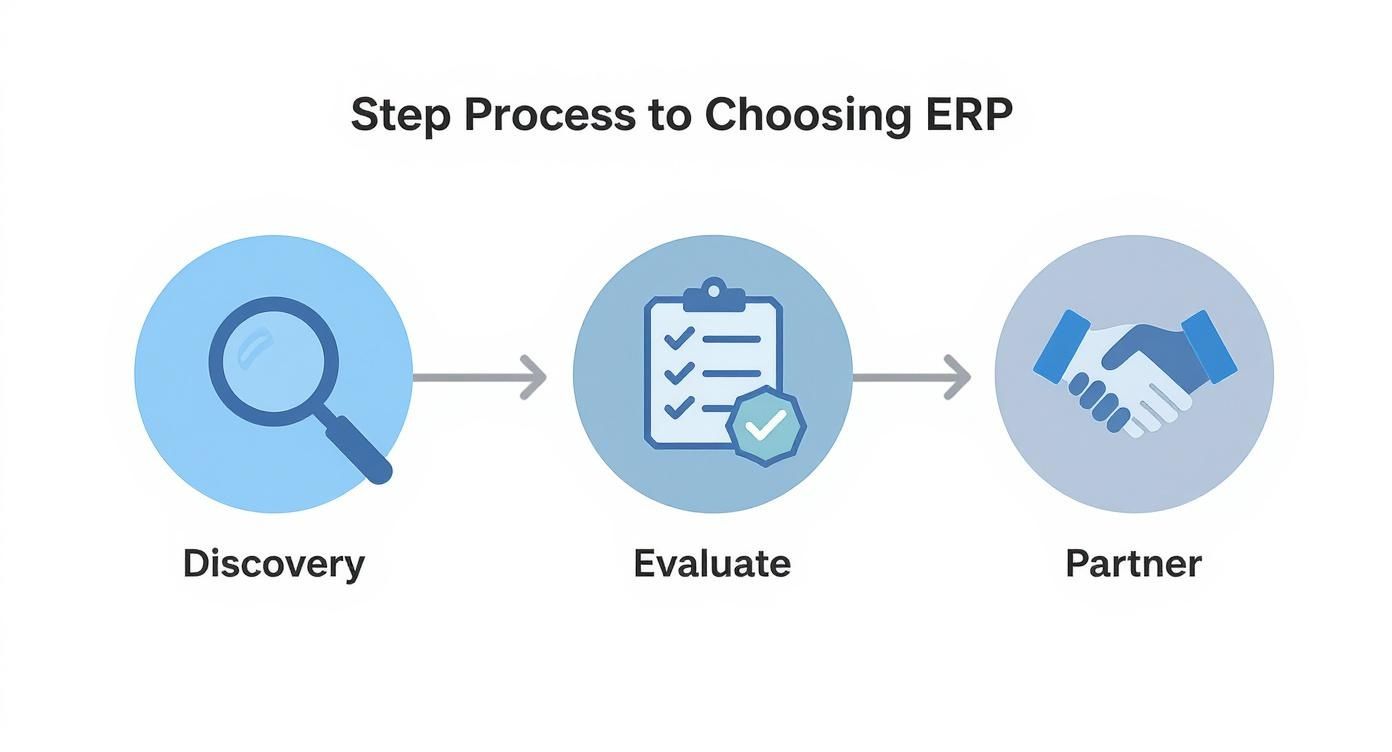
It’s a great reminder that a smooth implementation is built on a solid strategy and the right people in your corner long before the first line of code is touched.
Configuration vs. Customisation: Know the Difference
With your data sparkling clean, your focus can shift to moulding the ERP to your business. Most modern systems, like Odoo, are incredibly flexible straight out of the box. The aim should always be to tweak your processes to fit the ERP's standard way of doing things, not the other way around. This approach is quicker, cheaper, and makes future system upgrades a whole lot less painful.
But sometimes, standard just doesn’t cut it. That’s when you have to talk about customisation—actually changing the ERP's source code to do something unique. Tread very, very carefully here. True customisation should be a last resort, saved only for those unique processes that give you a genuine, hard-to-copy competitive advantage.
This is where a good partner with deep experience in software development in Sydney or Adelaide is worth their weight in gold. They can be the voice of reason, helping you decide if a customisation is a smart strategic move or just an expensive detour.
Real-World Testing That Doesn't Cut Corners
Okay, the system is configured. Now you have to break it. This is User Acceptance Testing (UAT), and it's your last line of defence before you go live. So many businesses get this wrong. They hand out generic test scripts that have zero connection to the chaos of a normal workday. That's a waste of everyone's time.
Effective UAT is all about real-world scenarios. Don't just tell your warehouse manager to "test receiving goods." Give them a real task: "Here's the purchase order from Supplier XYZ. It's got three items on backorder and two that are damaged. Process it exactly like you would at 11 a.m. on a frantic Tuesday."
That level of detail forces people to use the system how they actually would, which is how you find the weird glitches and workflow snags that a simple checklist will always miss.
UAT isn't about ticking boxes. It's about throwing the messy reality of your business at the system to see if it flinches. You need to know it can handle the pressure before your customers and your revenue are on the line.
Of course, the price tag for all this is a major consideration. In Australia, ERP implementation costs can start around AUD 150,000 for smaller businesses and soar past AUD 10 million for large enterprises. The biggest hurdles are often that initial investment, getting staff on board, and making the new system talk to your old ones. It's telling that 89% of companies pull the trigger on an ERP because they desperately need better finance and accounting tools. You can discover more insights about Australian ERP implementation trends to get a fuller picture.
Practical Case: A Retailer’s Pre-Christmas Stress Test
A mid-sized Sydney retailer was integrating their new ERP with their Shopify implementation. Their UAT was brilliant—they planned it around the mayhem of their pre-Christmas sales rush.
- Order Fulfilment: They simulated a massive flash sale, hammering the system with hundreds of fake orders in just a few minutes to see if the inventory sync between Shopify and the ERP would crack under pressure.
- Complex Returns: They tested nightmare return scenarios, like a customer trying to return part of an online order in-store that was originally paid for with a gift card. This is exactly how they found a nasty bug in the refund calculation logic.
- Multi-Platform Sync: The business also ran a small wholesale site on WooCommerce. Their testing made sure stock levels updated perfectly across Shopify, WooCommerce, and their physical stores all at the same time.
By stress-testing with these true-to-life situations, they caught several critical bugs that would have created absolute chaos during their busiest trading period.
The Go-Live Decision: Big Bang or Phased Rollout?
At last, you’re standing at the final hurdle: the go-live decision. You’ve really only got two ways to play this.
- The Big Bang: This is the all-or-nothing approach. On a set day, you turn the old system off and the new one on for everyone, everywhere. It’s fast and can be cheaper, but if something goes wrong, the whole business grinds to a halt. High risk, high reward.
- The Phased Rollout: This is the more cautious path. You introduce the new ERP piece by piece—maybe one department or one location at a time. It’s slower and can be more complicated to manage, but it keeps the risk contained. For example, a national company might launch their Odoo implementation in Sydney first, learn the lessons, and then roll it out to their Adelaide team three months later.
There’s no single right answer; it all comes down to your company's appetite for risk, its complexity, and the resources you have. But no matter which path you take, a smooth go-live is always the direct result of the discipline you put into data migration, configuration, and testing.
Ready to navigate your implementation with an expert partner? Contact Wistec today to ensure your project is a success from start to finish.
Winning Over Your Team for Lasting Change

Let’s be honest. The most powerful ERP system implementation on the planet will crash and burn if your team won’t use it. The human element isn’t a soft skill here; it’s the most critical variable for success. It’s time to move change management from a corporate buzzword to a practical, actionable plan that delivers a real return on your investment.
This part of the journey is all about turning deep-seated scepticism into genuine enthusiasm. The secret? Stop talking about system features and start showing how this new tool will make everyone’s job easier, less frustrating, and far more impactful.
Communicating the ‘Why’ from Day One
The first whisper of a new ERP often triggers fear and resistance. Employees immediately picture a complicated, clunky system being forced on them, adding more stress to their already full plates. You have to get out in front of this narrative, and fast.
Start by clearly and passionately articulating the "why" behind the change. This isn't a top-down mandate; it's a solution to the shared frustrations everyone feels. Frame the conversation around benefits, not just for the company, but for the individual. For example, explain how the new system will kill off tedious manual data entry for the finance team. Show the sales team how they'll finally have real-time inventory levels so they can stop apologising for selling out-of-stock items.
Practical Case: A Perth-based manufacturing company completing an Odoo implementation used their new ERP to slash their month-end financial close from 10 days down to just three. You can read more about these ERP adoption statistics. That’s the kind of tangible, relatable benefit that gets people on board and transforms resistance into advocacy.
Go Beyond One-Size-Fits-All Training
Forget those stuffy boardroom sessions with a generic, 100-page manual. Effective training needs to be hands-on, role-specific, and directly mirror the actual tasks your team performs every single day.
A warehouse manager doesn't need to know the fine details of the accounting module. What they do need is to become an absolute master at processing returns through a Shopify implementation. Structure your training to simulate a "day in the life" for each role. This practical approach builds muscle memory and real confidence, proving to your team that the new system isn't an obstacle—it's their most powerful ally.
The goal of training isn't just to teach people which buttons to click. It's to build their confidence to the point where they see the new ERP as their tool for getting the job done better and faster.
Build a Network of Internal Champions
One of the smartest things you can do is implement a "train-the-trainer" model. Instead of relying solely on your implementation partner or IT department, find those enthusiastic, tech-savvy people in different departments and give them advanced training.
These people become your internal champions. They are the go-to experts, the friendly faces who can provide immediate, peer-to-peer support long after the official project team has packed up.
- Boosts Credibility: When a colleague from their own team endorses the system and helps them out, it carries far more weight than advice from an external consultant.
- Scales Knowledge: You can't be everywhere at once. A network of champions ensures knowledge is spread throughout the organisation, preventing bottlenecks and frustration.
- Fosters Ownership: By empowering key users, you give them a genuine sense of ownership over the system, turning them into passionate advocates for its success.
This strategy is especially powerful for projects like an Odoo implementation in Sydney, where localised, on-the-ground support can make a world of difference. By building this internal support network, you ensure the ERP system implementation doesn't just launch successfully—it thrives for years to come. Whether you're working with Odoo or planning custom software development in Adelaide, we're here to help you build a change management plan that truly sticks.
Ready to ensure your team embraces your new ERP? Contact Wistec for a consultation and let's build a change management plan that drives real adoption.
Turning Your ERP Into a Growth Engine
Flicking the switch on your new ERP isn't the finish line. It's really just the starting gun for a smarter, more connected way of working. Too many businesses treat their ERP system implementation as a one-and-done project, and that’s a mindset that puts a hard ceiling on your return on investment. The real magic happens when you stop thinking about project management and start focusing on continuous value creation.
Your first job after launch is to have a responsive support system ready to go. You can bet there will be user issues in the early days, but resolving them quickly builds confidence and stops bad habits from taking root. This immediate support shows your team the system is there to help them, not get in their way.
Fostering a Culture of Improvement
Once things have settled down and the system is stable, your focus can shift to optimisation. This is where you really prove the ROI and build a compelling case for future enhancements. An ERP should never be a static piece of software; it has to evolve right alongside your business.
To make this happen, you need a solid feedback loop that actively pulls insights from your team. They’re the ones using it every day, and their experiences are a goldmine for spotting workflow improvements and uncovering new opportunities.
Here are a few practical ways to keep the momentum going:
- Schedule Regular Health Checks: At least twice a year, take a deep dive into system performance, user adoption rates, and overall satisfaction. Are people actually using the features you thought they would?
- Actively Track Your KPIs: Go back to those Key Performance Indicators you defined way back in the planning phase. Are you seeing those reduced order fulfilment times or a faster month-end close?
- Create a User Feedback Forum: Set up a simple, dedicated channel where your team can drop ideas for improvements. This not only empowers them but helps you prioritise what to work on next based on genuine, real-world needs.
Think of your ERP as a living asset. When you nurture it with consistent attention, user feedback, and data-driven tweaks, it transforms from a simple operational tool into a genuine engine for business growth.
This ongoing process ensures your technology keeps pace with your strategic goals. That could mean refining your Odoo implementation in Sydney or integrating a brand new WooCommerce sales channel. As your business scales and the market shifts, the system has to adapt.
For businesses looking for a long-term partner to get the most out of their technology investment, our expertise goes far beyond the initial launch. We specialise in ongoing ERP optimisation and strategic software development in Sydney and Adelaide. We make sure your platform—whether it's Odoo, or a custom build integrated with a Shopify implementation—delivers more and more value, year after year.
Ready to turn your ERP into a lasting competitive advantage? Connect with Wistec today for a strategic consultation.
Your ERP Implementation Questions Answered
We get it. Kicking off an ERP project brings up a lot of questions. Over the years, we've seen the same concerns pop up time and again, so let's tackle the big ones head-on. Getting clear answers is the first step to turning uncertainty into a solid action plan.
How Long Does a Typical ERP Implementation Take?
Look, there's no magic number, but for a small to mid-sized Australian business, you should realistically budget for 6 to 12 months. It all hinges on a few key things: how complex your current processes are, how much customisation you need, and frankly, the state of your existing data.
A fairly standard cloud-based Odoo implementation in Sydney might land on the shorter end of that scale. On the other hand, a complex, multi-site project in Adelaide that requires significant bespoke work can easily push past the one-year mark.
What Is the Biggest Reason ERP Implementations Fail?
It’s almost never the software’s fault. After all these years in the game, I can tell you the number one reason projects go off the rails is a failure to manage the people side of the change.
It comes down to a few classic mistakes: leadership goes quiet, user training is treated as an afterthought, and there’s no real effort to get buy-in from the team who will actually be using the system day in and day out.
A DIY approach is just asking for trouble. Bringing in specialists for software development in Sydney or Adelaide isn’t a cost; it’s an investment. It’s what stops you from making expensive blunders and ensures you actually see a return on platforms like Shopify, WooCommerce, or Odoo.
You absolutely need a partner who has been down this road before and knows how to navigate the inevitable bumps.
Ready to get started on your own successful implementation? The team at Wistec has the expertise to guide you through every stage, from planning to post-launch optimisation. Visit us at https://www.wistec.com.au to book your strategic consultation today.