

A professionally built ecommerce site in Australia usually takes 1 to 4 months, but the actual timeframe depends on complexity. A simple Shopify store can launch in 3 to 7 days, while a custom enterprise platform can take 3 to 6 months.
If you're reading this, you're probably trying to pin down one very practical question. How long will this take, and what is likely to slow it down? That's the right question to ask before design starts, before product data gets imported, and definitely before anyone promises a launch date tied to a campaign.
Most ecommerce projects don't go off track because developers can't build. They go off track because the timeline was treated like a rough guess instead of an operating plan. Platform choice matters. So do approvals, content prep, payment setup, and whether your store needs to sync with tools like Odoo ERP, courier platforms, CRMs, or accounting systems. A lean shopify implementation has a very different path from a custom WooCommerce build or a larger odoo implementation tied to stock, fulfilment, and finance workflows.
Mapping Your Journey from Concept to Customer
A typical ecommerce brief starts like this. Marketing wants a launch date, operations wants stock accuracy, finance wants clean order data, and the product team is still finalising categories, shipping rules, or customer account requirements. The timeline usually looks clear until those dependencies surface.
A realistic ecommerce website development timeline starts with business readiness, not design files alone. Agency production time matters, but it is only one part of the schedule. Content, product data, payment setup, tax rules, fulfilment logic, and internal approvals often decide whether a project moves cleanly or stalls halfway through.

What the timeline depends on
Three variables usually have the biggest effect on delivery:
- Platform choice: A fast shopify implementation can suit a startup or a straightforward catalogue. A custom WooCommerce build can make more sense when design flexibility, custom checkout behaviour, or specific extensions matter.
- Operational complexity: If the store needs to connect with Odoo, a CRM, inventory software, courier platforms, or finance tools, the website timeline becomes a systems timeline as well.
- Decision speed: Delays rarely come from code alone. They come from waiting on product uploads, homepage copy, legal sign-off, shipping settings, or feedback spread across too many stakeholders.
The practical question is not only how long it takes to build pages and features. It is how long it takes to get the business ready to trade with confidence on day one, and to keep trading once real orders start coming through.
That last point is often missed. Launch is not the finish line. In well-run ecommerce projects, the plan also protects time after go-live for fixing edge cases, tuning conversion paths, checking order flow, and confirming that integrations behave properly under live conditions. That post-launch optimisation gap, usually the first two to four weeks after release, is where rushed projects often show their weaknesses.
If you want a simple planning reference before speaking with an agency or an internal team, these 8 website design process steps are useful because they show how strategy, design, development, testing, and launch depend on each other.
For businesses comparing software development options in Sydney and Adelaide, the key is to get a schedule built around your business inputs, not just agency production time.
The Six Stages of an Ecommerce Project
Ecommerce projects run more smoothly when everyone understands the sequence. Skipping ahead feels faster, but it usually creates rework. The simplest way to think about it is like building a house. You need the brief before the plans, the plans before the build, and inspection before handover.
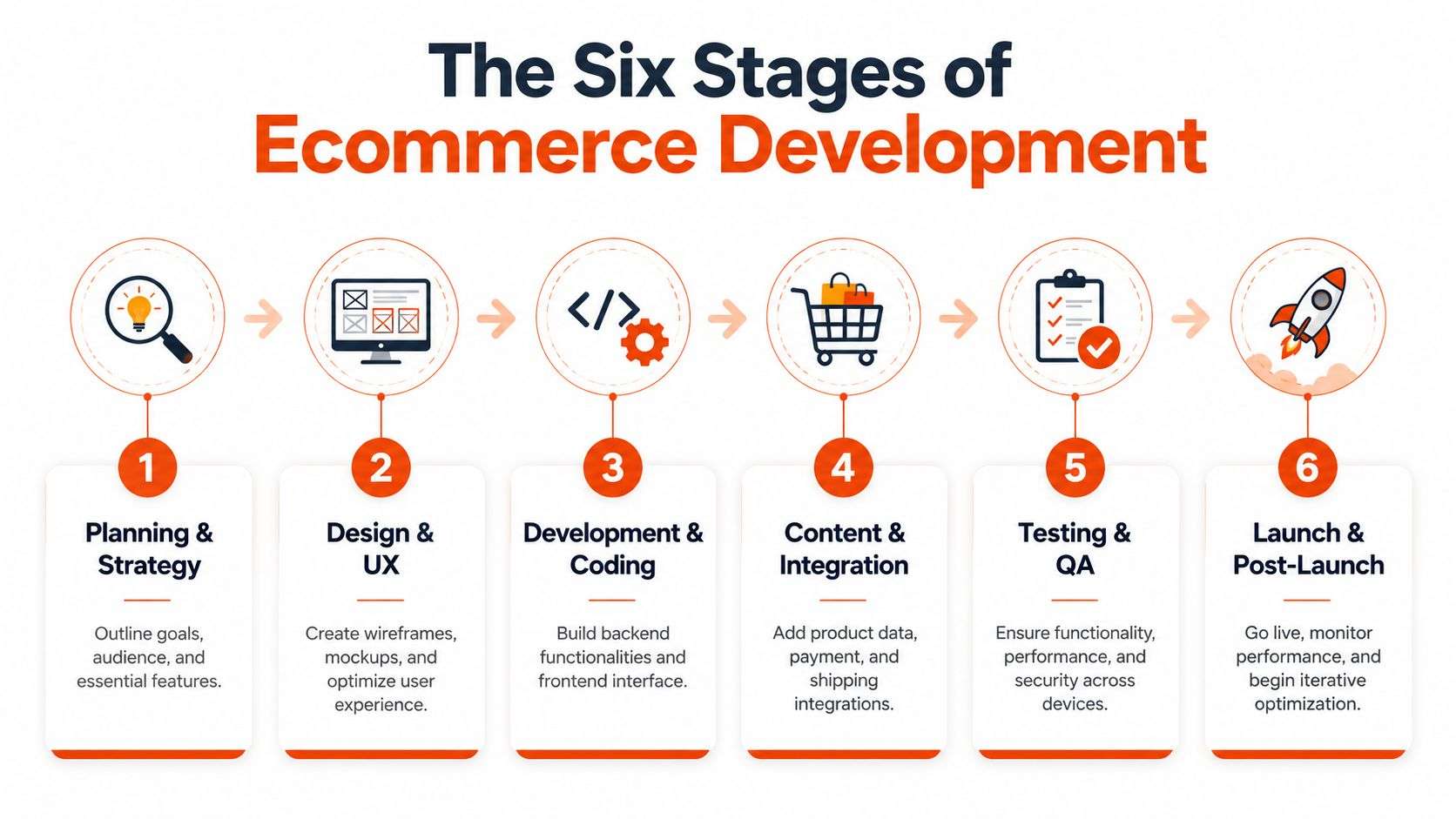
A useful benchmark for a custom build in Australia comes from Synapse Worldwide. It states that a custom Australian ecommerce website development timeline typically spans 14 to 26 weeks, split into four weeks for strategic discovery, 10 weeks for bespoke design and development, and four weeks for rigorous user acceptance testing in its strategic buying guide.
Stage 1 Planning and strategy
At this stage, the brief stops being vague. The team defines business goals, target users, product structure, required integrations, platform choice, and launch constraints.
The most common mistake here is under-specifying the project. If you discover halfway through that you need wholesale pricing, multiple warehouse logic, or ERP sync, the timeline expands because the architecture changes.
Stage 2 UX and UI design
Design isn't just colours and banners. It defines how customers browse, filter, compare, add to cart, and check out.
For a WooCommerce or Shopify implementation, this stage often includes:
- Wireframes: Page layout and conversion flow before visuals are finalised.
- Mobile-first review: Navigation, product cards, and checkout behaviour on phones.
- Approval gates: One consolidated client response is far better than scattered comments from five stakeholders.
The design phase should answer operational questions too. For example, where will trade customers log in, how will stock status appear, and what content needs to support SEO from day one?
Stage 3 Development and coding
During this phase, the front end and back end are constructed. This includes theme work, custom components, product templates, account flows, search behaviour, and checkout logic.
On a lighter store, this stage can move quickly. On a custom build, developers also handle environment setup, feature logic, and performance work.
Stage 4 Content and integrations
This stage is often underestimated. Product titles, images, descriptions, pricing rules, categories, shipping settings, tax settings, and SEO content all need to be loaded and checked.
For retailers and manufacturers, this is also where integration work lands. That might include:
- Payment gateways
- Shipping services
- CRM tools
- Marketing platforms
- Odoo ERP or other back-office systems
Stage 5 Testing and UAT
Testing should cover more than whether a page loads. It needs to validate checkout, shipping logic, payment behaviour, account creation, mobile display, emails, and error handling.
User acceptance testing matters because clients often spot operational gaps that aren't visible in code review alone.
Stage 6 Launch and post-launch
Launch is a controlled handover into live trading. It should include monitoring, issue triage, and a short optimisation phase after go-live.
That last part is the one many timelines ignore. The store is live, but the project isn't finished.
How Long Will Your Build Actually Take
A client signs off on design expecting to launch in six weeks. By week four, the actual timetable starts to show itself. Product data is half-complete, payment setup is still in progress, and one integration decision changes the checkout flow. That is normal. Ecommerce timelines are shaped less by the homepage and more by the operational detail behind it.
The quickest way to estimate your build is to look at how much business logic sits behind the storefront. A startup testing a focused product range can move fast with a standard setup. A wholesaler syncing orders, stock, pricing rules, and customer accounts with Odoo needs more time because the website depends on other systems, approvals, and data quality.
Ecommerce build timeline by business size
| Business Size | Example Platform | Key Features | Typical Timeline |
|---|---|---|---|
| Small business or startup | Shopify | Template-based design, core payments, standard shipping, smaller catalogue | A basic build can launch in days if content and settings are ready |
| Growing mid-sized business | WooCommerce | Custom design, user accounts, inventory tracking, mobile optimisation, third-party apps | Often measured in weeks, and can extend into a few months |
| Enterprise or multi-system business | Headless platform or custom build with Odoo ERP | Advanced workflows, deeper integrations, high-traffic performance, complex operations | Commonly several months, especially where multiple systems are involved |
Case 1 Small and fast with Shopify
A straightforward Shopify build works well when the catalogue is controlled, product content is ready, and the business can stay close to default platform behaviour. That usually suits a new direct-to-consumer brand, a retailer trialling online sales, or a business that needs to start trading before it invests in custom workflow.
The trade-off is flexibility. Fast projects stay fast because the team uses a proven theme, limits custom features, and keeps version one focused on selling. Add bespoke account logic, unusual fulfilment rules, or a long list of app dependencies, and the timeline stops behaving like a simple template rollout.
Case 2 Mid-range and tailored with WooCommerce
WooCommerce suits businesses that need more control over content structure, checkout behaviour, or plugin selection. It is often a good fit for established retailers, service-plus-product businesses, and operators with specific account or pricing requirements.
These projects tend to slow down at the decision points, not only in development. Plugin selection, data migration, feature priority, and QA all need tighter coordination. Teams that apply clear project management fundamentals usually keep this stage under control because ownership, approvals, and change requests are defined early.
Case 3 Enterprise and integration-heavy
At the enterprise end, the website is one part of a larger operating system. Manufacturers, distributors, and larger retailers often need customer-specific pricing, stock synchronisation, order routing, approval flows, and reporting connected to Odoo or other back-office platforms.
That changes the delivery plan. Integration work adds dependency mapping, API handling, data validation, exception testing, and coordination across internal teams or third-party vendors. In practice, the launch date depends on how quickly those systems can be aligned, not just how quickly pages can be built.
Budget and timeline usually rise together. If you are weighing platform choice against delivery effort, Cart Whisper's website cost guide is a useful companion read. It helps frame why a cheaper starting point can become more expensive if the platform cannot support the business model cleanly.
One more point clients appreciate once the project is underway. Go-live is not the finish line. A realistic timetable leaves room for the post-launch optimisation gap in the first two to four weeks, when real customer behaviour, search data, order patterns, and support issues show the adjustments that could not be fully predicted in staging.
Hidden Delays and How to Avoid Them
Most missed launch dates don't come from dramatic technical failures. They come from ordinary project habits that seem harmless in the moment. Late feedback. Unfinished product data. A stakeholder who joins in week five and asks for a new account flow. A payment gateway setup that no one started early enough.
The biggest hidden delay is often content readiness. Butterfly reports that content readiness and stakeholder approval speed are the most significant variables causing delays, with 30–50% of a project's duration often lost while clients gather product images, descriptions, and settings in its website development timelines article.
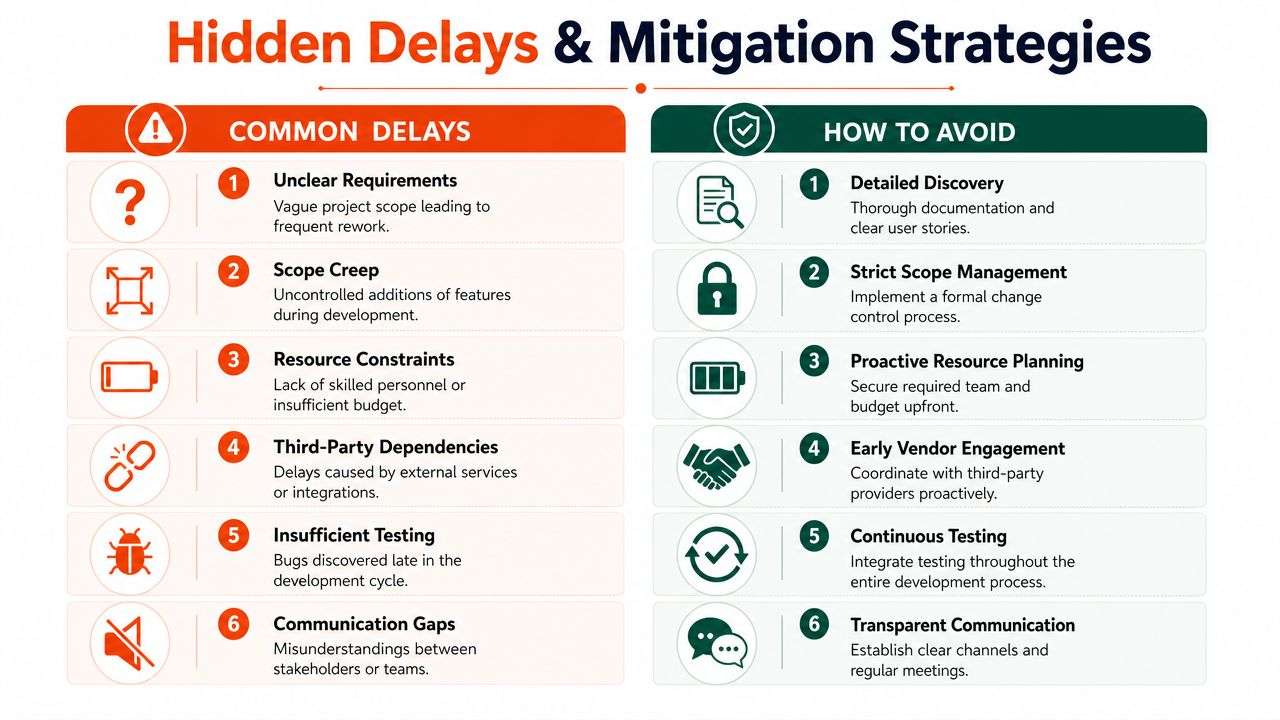
The delays that catch teams by surprise
A few problems show up again and again.
- Content bottlenecks: Product imagery, copy, variations, shipping settings, tax rules, and category structure arrive late or in inconsistent formats.
- Approval drag: Feedback comes in waves from different people, often contradicting earlier decisions.
- Scope creep: The team adds “small” requests during build, but each one affects design, development, QA, or all three.
- Third-party waiting time: Payment providers, app vendors, or ERP owners respond on their own timeline.
What to do before the build starts
Strong projects reduce delay before anyone opens a design file.
| Risk area | What good teams do early |
|---|---|
| Content | Prepare product data, images, SKU structure, and policy pages before development finishes |
| Decisions | Nominate one approver for design and one for operational setup |
| Scope | Freeze launch requirements and place new ideas into a later enhancement list |
| Integrations | Confirm every external system, required access, and responsible contact at kickoff |
Operational advice: If your catalogue, pricing rules, or stock data live inside multiple spreadsheets, your website timeline is already at risk.
A practical case
Consider a wholesaler moving from manual phone orders to online ordering. The website build itself may be straightforward, but the delay appears when the business tries to standardise product names, units of measure, customer-specific terms, and freight rules. The code can be ready before the business data is.
That's why internal readiness matters as much as agency capacity. Teams that map ownership clearly tend to move better. Marketing owns imagery and copy. Sales confirms pricing logic. Operations confirms shipping rules. Finance signs off tax treatment. Without that split, “the client” becomes a vague bottleneck.
If you're looking at ecommerce delivery through a commercial growth lens rather than a pure design lens, these strategies for online retail growth are useful because they connect project decisions to trading performance, not just launch checklists.
Connecting Your Store to Odoo ERP and Other Tools
An ecommerce store on its own can process orders. A connected store can run a business. That difference matters once order volume grows, product ranges expand, or the business has to manage purchasing, warehousing, invoicing, and customer service in one flow.
For many Australian businesses, that's where Odoo ERP enters the picture. An odoo implementation connects website activity to operational reality. Orders can feed into fulfilment. Stock levels can stay in sync. Customer data can move between sales, service, and finance teams without manual re-entry.
A typical Odoo ERP implementation in Australia takes 6–16 weeks, with Phase 1 analysis lasting 1–2 weeks, Phase 2 customisation taking 2–4 weeks, and Phase 3 data migration requiring 2–6 weeks, according to this Odoo implementation timeline article.
Where ecommerce and Odoo overlap
The website and ERP timelines don't always run one after the other. They often overlap, especially when the build needs:
- Inventory sync between ecommerce and warehouse records
- Order transfer into fulfilment or invoicing workflows
- Customer account mapping for trade and wholesale users
- Pricing logic that reflects business rules already sitting inside Odoo
For a manufacturer selling spare parts online, a common practical case is a WooCommerce front end paired with Odoo for stock, order processing, and invoicing. Customers get an easier buying experience. Internal staff avoid double entry.
What works in Odoo implementation
The projects that stay stable usually do three things early:
- Map processes first: Don't start by asking what module to install. Start with how quotes, orders, stock, and invoices should move.
- Clean the data: Product records, customer records, and units of measure need consistency before migration.
- Separate launch-critical from ideal-state: Not every automation needs to be live on day one.
Australian businesses looking for an ODOO partner Sydney Adelaide or broader software development Sydney Adelaide support should treat ERP integration as part of delivery planning, not an add-on after the site is already designed. For a closer view of how odoo erp fits into broader business operations, review this page on Odoo ERP solutions.
Beyond Go-Live The Often-Missed Optimisation Window
Most project plans treat launch day like the finish line. In practice, it's the start of the first live trading cycle. Real customers use different devices, different payment methods, and different browsing patterns from the ones tested internally.
That's why the post-launch window matters. The useful planning assumption is that you'll need 2 to 4 weeks after go-live for monitoring, bug fixes, and early optimisation. During this period, mobile edge cases, payment issues, and friction in the checkout flow show up under real usage.
Recent data from Australian agencies indicates that 15% of ecommerce projects require a post-launch revision cycle due to unforeseen mobile compatibility issues or payment gateway failures, as noted in this planning guide for ecommerce website development.
What should happen after launch
The immediate post-launch period should include:
- Checkout monitoring: Confirm payments, shipping selections, and notifications are behaving correctly.
- Mobile review: Watch how actual users move through product, cart, and checkout pages.
- Content adjustment: Tighten product copy, banners, FAQs, and category labels where friction appears.
- Search and SEO checks: Make sure pages are crawlable, relevant, and structurally sound for ongoing visibility.
Launch day proves the site is live. The next few weeks prove the site is working.
This is also the right time to refine page content, technical performance, and discoverability through ongoing website SEO optimisation support. Teams that budget time for this window usually get a cleaner commercial start than teams that declare victory too early.
Partnering for a Successful and Timely Launch
A realistic ecommerce website development timeline isn't built from optimism. It's built from scope clarity, disciplined approvals, content readiness, and a partner who understands both delivery and operations.
That matters whether you're planning a quick shopify implementation, a custom WooCommerce store, or a broader odoo implementation tied to internal systems. Retailers need reliable checkout and merchandising. Manufacturers need stock and order control. Logistics-focused businesses need process accuracy. Each one needs a different level of technical planning.
The strongest delivery relationships do a few things consistently. They push for clear discovery. They name risks early. They challenge vague requirements. They build room for testing and post-launch optimisation instead of pretending launch day ends the work.
If you're comparing agencies or development partners, ask direct questions. Who owns content readiness? When are integrations confirmed? What is the UAT process? What happens in the first weeks after launch? Good answers to those questions tell you more than a flashy proposal ever will.
If you're planning an ecommerce build, replatform, Odoo ERP rollout, or need an experienced ODOO partner Sydney Adelaide team for software development Sydney Adelaide, talk to Wistec . Wistec helps Australian businesses deliver practical ecommerce, WooCommerce, Shopify implementation, and odoo implementation projects with clear timelines, strong project control, and post-launch support that doesn't stop at go-live.