

Ever felt like you're forcing a square peg into a round hole with your current software? If you're wrestling with generic, one-size-fits-all tools that dictate how your business should run, you're not alone. Custom software development in Australia is the answer, offering a way to build digital solutions designed from the ground up to fit your unique operations. It’s the difference between buying a suit off the rack and having one perfectly tailored to you.
Why Australian Businesses are Shifting to Custom Software
Think about off-the-shelf software as a standard rental car. Sure, it gets the job done, but it’s never quite right. You end up paying for features you'll never use while missing the specialised tools you actually need. You’re constantly creating workarounds and fighting a system that simply wasn't built with your business in mind.
Custom software flips that script entirely. It's like commissioning a vehicle built to your exact specifications, where every control, feature, and workflow is crafted around how your team actually works. This isn't just a fleeting trend; it’s a powerful strategy for carving out a genuine competitive advantage in the Australian market.
From Bottlenecks to Breakthroughs
So many businesses in retail, manufacturing, and logistics hit the same walls with generic software. Inventory systems refuse to sync, production workflows are clunky and inefficient, and delivery management is a constant headache. This is precisely where custom software steps in to turn those operational pain points into pathways for growth.
- Solving Integration Nightmares: Forget juggling a dozen disconnected systems. A custom solution can unify your entire operation. A single Odoo implementation, for instance, can seamlessly connect your sales, inventory, accounting, and HR, giving you one central source of truth.
- Boosting Operational Efficiency: By automating the mundane, repetitive tasks and designing digital workflows that mirror your real-world processes, you empower your team to focus on what truly matters. The result is a direct, measurable lift in productivity.
- Creating a Scalable Foundation: Your business is built to grow, and your software should be ready to grow with it. A custom platform is engineered for your future, not just your present, helping you avoid the enormous cost and disruption of migrating systems later on.
The numbers tell the story. The Australian market for custom software is exploding, projected to hit USD 3,711.5 million by 2030. Companies making the switch are seeing incredible returns, with reports of 40% gains in productivity and 35% improvements in operational efficiency. It's a clear signal that this is an investment that pays off. You can dive deeper into the data by reading the full report on Australia's software transformation.
A custom solution transforms technology from a necessary expense into your greatest asset. It’s about building a tool that works for you, not forcing your team to work for the tool.
Whether it’s a custom Shopify implementation for a growing eCommerce brand, a unique feature for a WooCommerce site, or a full-scale ERP system from an Odoo partner in Sydney or Adelaide, the objective is always the same: to achieve a perfect fit.
If you're tired of fighting with your software and ready to build a real, sustainable competitive edge, it's time to see what custom development can do for you.
Ready to see how a tailored solution can solve your biggest challenges? Contact Wistec today for a no-obligation consultation and discover the power of custom software development in Sydney and Adelaide.
Seeing Custom Software in Action Across Australia
It’s one thing to talk about the benefits of custom software in theory, but it’s another thing entirely to see it solve real, everyday headaches for Australian businesses. Off-the-shelf software often forces you to bend your processes to fit its limitations. Custom solutions do the opposite—they’re built around the way you actually work, delivering massive gains in efficiency, saving money, and keeping your customers happy.
Let's look at some practical cases where tailored technology has genuinely made a difference. These aren’t just feel-good stories; they're practical examples of how targeted software can untangle industry-specific knots, from the chaos of eCommerce inventory to the complexities of a factory floor.
Each case study zeroes in on a common pain point and shows how a purpose-built solution delivered a clear, measurable return.
Practical Case 1: Taming eCommerce Inventory Chaos
A booming online retail store in Adelaide was becoming a victim of its own success. Their inventory management was a messy patchwork of spreadsheets and basic plugins that couldn’t handle the daily avalanche of orders. This meant they were constantly overselling popular products, leaving customers frustrated and staff spending countless hours just trying to figure out what was actually in stock.
The fix was a custom Shopify implementation. Instead of trying to cobble together a dozen different apps that only did half the job, we built a unique integration that linked their Shopify store directly to their supplier's live inventory feed.
- Live Stock Syncing: The moment an item sold, the count updated everywhere. No more overselling.
- Automated Reordering: When stock for an item dropped to a set level, the system automatically fired off a new purchase order to the supplier.
- Smarter Insights: With clean data, the business could finally track sales trends accurately, helping them make better buying decisions and stop tying up cash in slow-moving items.
The result? A huge 40% reduction in time wasted on manual inventory chores and a steep decline in customer complaints. It freed them up to focus on growing the business instead of just keeping it afloat.
Practical Case 2: Unblocking a Manufacturing Workflow
A mid-sized manufacturer in Sydney was hitting serious bottlenecks on its production floor. Communication was a broken chain of emails and paper notes passed between the sales team, production managers, and the warehouse. This mess led to expensive delays, incorrect material orders, and zero visibility into where any given job was at.
They decided to work with an expert Odoo partner in Sydney to create a custom module for their Odoo ERP. The standard Odoo Manufacturing app was a great start, but it didn't cater to their very specific, multi-stage quality control process.
The idea wasn't to throw out their whole system, but to enhance it. We built a custom module that digitised their unique quality assurance checklists and tied them directly to each stage of production.
This Odoo implementation created a single source of truth. The sales team could check production status in real-time, managers could schedule jobs based on what materials were actually on hand, and the warehouse received automatic shipping alerts. It's a perfect example of how targeted software development in Sydney can sharpen an already powerful tool like Odoo to fit a business perfectly. For those in specialised fields, you can learn more about how we create custom software solutions for trades.
Practical Case 3: Streamlining a Service-Based Business with WooCommerce
A home services company offering plumbing and electrical work across Australia was struggling to manage job bookings and payments. Their old system relied on phone calls and a clunky, outdated booking plugin on their WordPress site. It led to double bookings, missed appointments, and a lot of administrative overhead chasing invoices.
The solution was a custom WooCommerce integration designed specifically for booking services, not selling products.
- Real-Time Calendar Booking: Customers could see real-time availability for technicians in their area and book a specific time slot directly on the website.
- Automated Invoicing & Deposits: The system automatically generated and sent an invoice for the deposit upon booking, and a final invoice once the job was marked complete by the technician via a mobile app.
- Technician Dispatch & Management: The custom backend allowed the office to assign jobs to the nearest available technician and track job status from start to finish.
The impact was immediate. The company reduced administrative time by 30% and improved their on-time arrival rate significantly, boosting customer satisfaction.
Ready to see how custom software can solve your specific business challenges? Contact Wistec for a complimentary consultation and let's build your solution.
Your Guide to the Development Lifecycle
Stepping into a custom software project can feel a lot like building a house. You have a clear picture of the finished product in your mind, but turning that vision into a tangible, functional reality involves a whole series of steps—from laying the foundation to framing, wiring, and finishing. A well-defined development lifecycle is your architectural blueprint, ensuring everyone involved knows exactly what’s happening, when, and why.
It’s the roadmap that transforms your great idea into a powerful digital asset.
To really get a handle on how custom software is built, it helps to understand the various software development cycle stages that take a project from a simple concept to a full-blown launch. This isn't about getting bogged down in technical jargon; it's about making the entire process transparent and collaborative.
The diagram below gives you a feel for how these core development principles apply to the unique operational flows of major Australian industries.
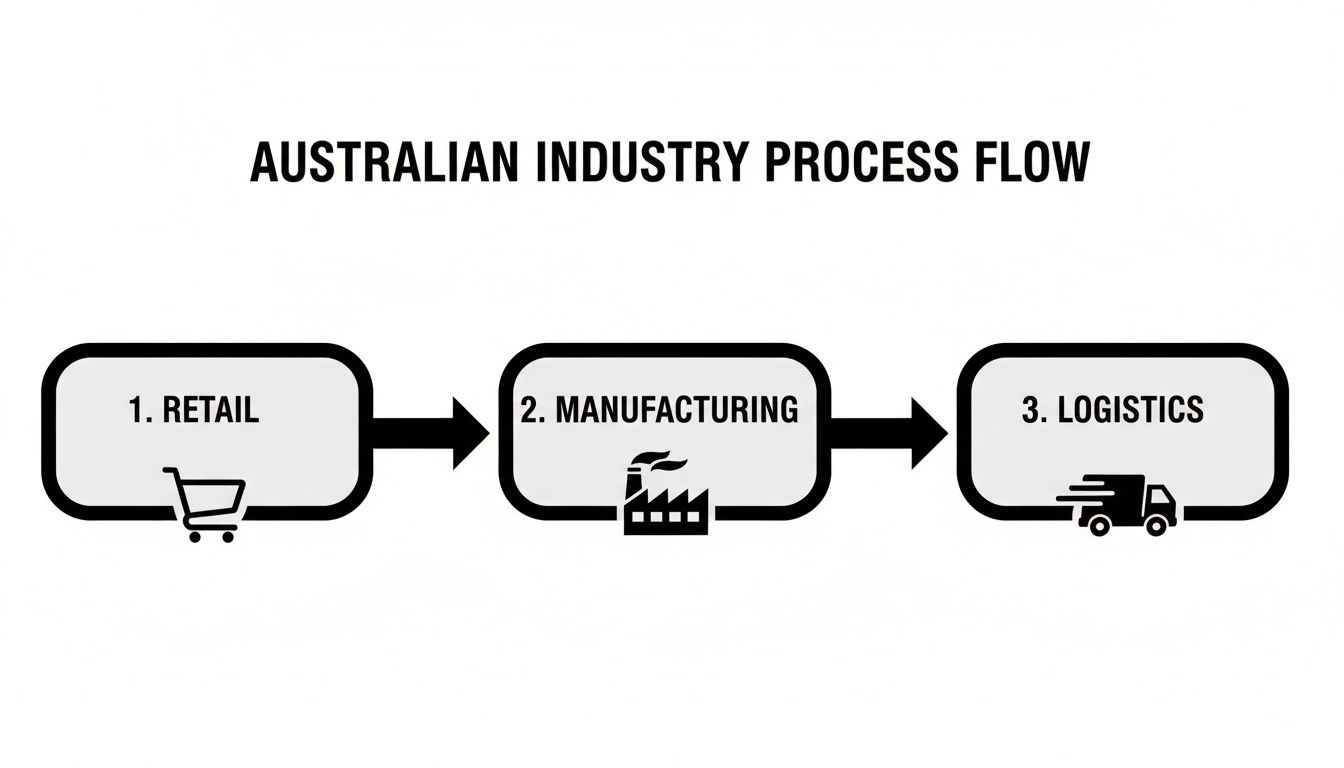
As you can see, whether it's managing inventory in retail or optimising a supply chain in logistics, the underlying need for smart, tailored software is a constant.
Agile vs. Waterfall: Two Competing Philosophies
For a long time, the software world ran on the Waterfall methodology. Think of it like a classic car assembly line: each step has to be perfectly completed before the next one can begin. You’d define all the requirements, finalise the entire design, build the whole thing, test it, and then—finally—deploy it. It’s a very rigid, linear process that doesn't handle change well.
Today, most modern teams use an Agile approach, which is much more like building with LEGOs. The entire project is broken down into small, manageable chunks called “sprints,” which usually last a couple of weeks. At the end of each sprint, the team delivers a small but working piece of the software. This cycle of building and getting feedback allows for incredible flexibility.
For most custom software development in Australia, an Agile approach is just a smarter way to work. It lets your business react to market feedback, refine ideas as you go, and start seeing a return on your investment much, much sooner.
The Six Core Stages of Development
No matter the project—whether it's a complex Odoo implementation or a specialised Shopify app—it will move through these essential phases. Knowing what they are helps you stay in the driver's seat.
- Discovery & Strategy: This is where it all begins. We sit down and get to the heart of your business, your goals, and the specific problems you’re trying to solve. It’s all about asking "why" before we even touch the "what" or "how."
- Design (UI/UX): Now we start drawing up the blueprints. This is where we map out how users will interact with the software (UX, or User Experience) and craft the visual look and feel (UI, or User Interface). The aim is simple: create something that’s not just powerful, but also genuinely easy and enjoyable to use.
- Development: This is where the magic happens and the code gets written. Our developers, with expertise spanning from software development in Sydney to Adelaide, get to work turning the designs and strategy into a real, functioning product.
- Testing & Quality Assurance (QA): Before anything goes live, it has to be put through its paces. Our QA specialists are relentless, hunting for bugs, testing for performance issues, and ensuring every single feature works exactly as it should.
- Deployment: This is go-time. We move the finished, tested software to a live environment where your team and your customers can start using it.
- Maintenance & Support: The journey isn’t over at launch. We stick around to provide ongoing support, fix any issues that pop up, perform necessary updates, and help you plan for new features as your business grows.
This structured, yet flexible, process is the key to making sure your investment pays off with a high-quality tool that solves real problems. From a custom WooCommerce plugin to a company-wide ERP system, this lifecycle ensures success.
How to Budget for Custom Software Costs
Let’s get straight to the question every business owner asks: "So, what's this actually going to cost?" Budgeting for custom software in Australia might seem like a bit of a dark art, but it's more straightforward than you think. The final price tag simply reflects the complexity and value you’re building into a genuine business asset.
Think of it like building a custom vehicle for your business. A straightforward delivery van has a very different price tag than a specialised, refrigerated long-haul truck with GPS tracking and automated inventory management. In the same way, your software's cost is shaped by what it needs to do, the features it requires, and the technology needed to bring it to life. The trick is to stop seeing it as an expense and start seeing it as a strategic investment in your company’s future.
Key Drivers That Shape Your Investment
A few core factors really drive the overall cost of a project. Getting your head around these from the start makes the whole budgeting process transparent and realistic, so there are no nasty surprises down the line. You'll know exactly where your money is going and why.
- Project Complexity and Scope: This is, by far, the biggest piece of the puzzle. A simple inventory plugin for a WooCommerce store is a world away from a full-scale Odoo implementation designed to run manufacturing, accounting, and HR across multiple warehouses. The more features, user roles, and unique business rules you need, the more development hours it will take.
- Third-Party Integrations: Does your new platform need to talk to other systems you already rely on, like Xero, Salesforce, or specialised industry software? Every connection point adds a layer of complexity. These integrations have to be carefully planned and built, which naturally influences the final cost.
- UI/UX Design: If people don't find your software easy and intuitive to use, they simply won't use it. The level of polish you want for the user interface (UI) and the depth of research that goes into the user experience (UX) will impact the budget. A clean, functional design is faster to create than a highly customised, slick user journey built from the ground up.
- Ongoing Support and Maintenance: Your software isn't a "set and forget" purchase. It's a living asset that needs looking after. It’s smart to budget for post-launch support, security updates, and regular tune-ups to ensure your investment stays secure and effective for years to come.
Realistic Cost Scenarios
To give you a real-world idea, let's compare two typical projects. A custom Shopify implementation, perhaps with a unique theme and a couple of specific app integrations, will likely fall into one price bracket. On the other hand, a comprehensive ERP system built by an Odoo partner in Sydney or Adelaide is a much bigger undertaking. That kind of project involves deep business analysis and multiple custom-built modules, placing it in a significantly higher investment tier.
The real value isn't just in the code; it's in what the code does for your business. A smart upfront investment can eliminate thousands in recurring subscription fees for multiple apps, drastically cut down on manual labour, and give you operational insights you never had before.
Australian-Specific Considerations
When you choose to do your software development in Sydney or Adelaide, you're also accounting for local factors. Making sure your software complies with the Australian Privacy Act and handles data residency correctly is non-negotiable. Working with a local partner who gets these legal requirements from day one saves you from facing expensive compliance headaches later.
On top of that, Australian businesses should look into government incentives that can make a custom solution even more affordable. For example, the Small Business Technology Investment Boost can help offset development costs. If you want a more detailed look at what a collaborative project looks like, check out our guide on the Wistec software development process.
Ready to get a clear, transparent quote for your project? Contact Wistec today for a no-obligation consultation and let's build a budget that delivers real ROI.
Choosing the Right Australian Development Partner

Of all the steps in building custom software, picking your development partner is arguably the most crucial. This isn’t just about finding a team that can write code; it’s about finding a strategic ally who gets your business, buys into your vision, and has the experience to turn your ideas into a real, value-driving asset.
Think of them as an extension of your own team. The right partner will guide you through the tricky parts and ensure the final product is a perfect fit. Get it wrong, however, and you could be looking at budget blowouts, missed deadlines, and a piece of software that just doesn't hit the mark. That’s why you absolutely must look beyond a simple price tag.
Beyond the Quote: What Truly Matters
It’s tempting to let the initial cost drive your decision, but that can be a real trap. The cheapest quote often means corners are being cut—corners you’ll inevitably pay for later through bug fixes, poor performance, or even needing a complete rebuild down the track.
True value lies in finding a team that can deliver a robust, scalable, and secure solution that actually generates a return.
Here’s what you should really be focusing on:
- Real Technical Expertise: Do they have a proven history with the specific technologies your project requires? Whether it's a complex Odoo implementation or a custom Shopify build, they need to show you their skills, not just talk about them.
- Local Experience: A partner with a solid track record in cities like Sydney and Adelaide understands the Australian market. They get the local compliance rules and business culture, which is a massive advantage.
- Clear, Open Communication: How will they keep you in the loop? Look for a firm commitment to regular updates and a project management style that feels collaborative and open, not like a black box.
Essential Questions to Ask Potential Partners
To make a confident choice, you need to ask the right questions. This isn't an interrogation; it's a conversation designed to uncover how they think, work, and solve problems.
A great development partner doesn't just build what you ask for. They challenge your assumptions and offer insights to make the final product even better. They act as a true consultant, not just a coder for hire.
Before signing on the dotted line, make sure you get clear, confident answers to these questions:
- Can you show us case studies from our industry? Seeing their work with businesses like yours is the best proof of their capability.
- How do you manage projects and keep us updated on progress? This tells you everything about their commitment to transparency.
- Who will be our main point of contact? A dedicated project manager is non-negotiable for clear, consistent communication.
- What does your support and maintenance look like after launch? Your software is a long-term asset; you need a partner who will be there to support it.
- How do you handle scope changes or unexpected roadblocks? Their answer reveals a lot about their flexibility and problem-solving skills.
It's no surprise that small and medium enterprises are the engine room of Australia's software market, holding a commanding 54% share of the industry. This is driven by their need for nimble, affordable solutions—like a custom WooCommerce site or an Odoo ERP system—that help them compete without the bloat of enterprise software. The proof is in the results: Australian firms that invest in custom builds report impressive 40% productivity boosts and 26% cost savings.
Finding the right team is the key to unlocking these benefits, and we've put together a guide to help you evaluate top software development firms in Australia.
Ready to find a partner who truly understands your goals? Contact Wistec for a no-obligation consultation. Let's talk about how our expert software development in Sydney and Adelaide can bring your vision to life.
Ready to Build Your Competitive Edge?
You've seen how custom software can tackle those nagging operational headaches and turn a brilliant idea into a genuine business asset. The next step? Let's talk about how that potential can be unlocked for your business. We’re not just a team of developers; we're your Australian technology partners, committed to building your competitive advantage from the ground up.
Our focus is squarely on delivering real-world results where they count. Whether that means a seamless Odoo implementation to get your entire operation humming from the same song sheet, or a custom Shopify implementation that turns website visitors into loyal customers, the objective is always the same: we build solutions that get the job done.
Your Local Technology Partner
As a seasoned Odoo partner in Sydney and Adelaide, we get the local market. Our approach to software development in Sydney and Adelaide is built on genuine partnership, complete transparency, and a real understanding of the challenges Australian businesses face every day. We don't just write code; we build the tools you need to grow.
"Working with Wistec was a game-changer. They didn't just deliver a WooCommerce site; they gave us a platform that automated our inventory and saved us 20 hours a week. Their team in Sydney understood our vision perfectly."
– Local Retail Business Owner
From fine-tuning WooCommerce for a unique retail experience to developing complex mobile apps, our track record is built on helping businesses just like yours achieve results you can actually measure. We believe technology should be your greatest asset, not another problem to solve.
Ready to turn your challenges into opportunities? Your next big advantage could be just one conversation away.
Contact Wistec today for a no-obligation consultation to explore how custom software development in Australia can become your most powerful tool for success.
Your Questions, Answered
Deciding to build custom software for your business is a huge move, and it’s completely normal to have a lot of questions. This isn't just another purchase; it's a major investment in your future. We get it. That's why we've put together some straight-talking answers to the most common questions we hear from business owners across Australia.
Let's clear up the uncertainties so you can feel confident about the path ahead.
How Long Does a Typical Custom Project Take?
Honestly, this is a bit like asking "how long is a piece of string?". The timeline really hinges on what we're building. A targeted Shopify implementation or a slick WooCommerce integration could be up and running in a few months. But if we're talking about a full-scale Odoo implementation to run your entire operation, that's a more involved, phased project.
The good news? We use an Agile development process. This isn't about making you wait for a "big reveal" at the end. We break the project down into smaller, bite-sized pieces, delivering working software at each stage. This way, you start seeing a real return on your investment almost immediately.
Is Custom Software Really More Expensive?
The initial outlay for a custom build is higher than buying something off the shelf—there's no getting around that. But it's crucial to look at the total cost of ownership over the long run. Think of it like buying your business premises instead of renting. You're building a valuable asset that belongs entirely to you.
With a custom solution, you say goodbye to those never-ending per-user licence fees that can quietly cripple a growing business. More importantly, the automation you gain slashes manual labour costs, and you end up with a platform that scales with you, not against you. This avoids the eye-watering expense and disruption of having to migrate systems down the track.
What Kind of Ongoing Support Will We Need?
Great software isn't a "set and forget" item; it's a living, breathing part of your business. That’s why we offer comprehensive maintenance and support plans that go far beyond just fixing the occasional bug. We see it as an ongoing partnership.
We'll handle all the critical security patches and performance updates, but we also work with you to evolve the software as your business changes. Whether you're in Sydney or Adelaide, we're not just a vendor; we're your long-term Odoo partner and tech advisor. We make sure your investment keeps paying dividends by staying secure, up-to-date, and perfectly in sync with your goals.
Ready to get answers that are specific to your business and your project? The team at Wistec is here to map out a clear path forward for your software needs. Let's have a chat about how a custom solution can become your most powerful tool for growth.