

Your analytics are flat, the phone's not ringing the way it should, and the dashboard keeps telling the same story. You've published a few blogs, boosted a couple of posts, maybe even spent on ads, yet the visitors you're getting aren't the buyers you want. For an Australian business, that usually means the problem isn't “more traffic”, it's better traffic.
The right question is how to increase website traffic that reaches a real buyer in Sydney, Adelaide, Melbourne or a defined service area, and does it without wasting budget on the wrong clicks. In Australia, organic search is still the largest traffic source for most websites, and the most durable gains come from SEO fundamentals, faster mobile experiences, relevant local pages and links from credible sites (Matomo's Australian traffic guidance). That matters for retailers, clinics, manufacturers, hospitality operators and professional services firms alike, because the traffic that compounds is the traffic you keep earning after the work is done.
Why Most Traffic Advice Falls Flat for Australian Businesses
Much traffic advice sounds good until you compare it with how Australian buyers search. A Sydney retailer doesn't need more generic impressions from everywhere. They need people who are already looking for the product, the suburb, the city, the service area, or the implementation help that leads to a sale.
The mistake is treating every visit as equal. It isn't. A visit from someone searching for Odoo implementation in Adelaide has a very different value from a casual browser reading broad brand content. The same goes for a manufacturer looking for odoo erp support, or a clinic comparing providers in a specific state.
Use four lenses before you spend
Before you chase any channel, judge it on four things, intent match, time-to-impact, cost per visit, and compounding potential. That simple filter stops founders from pouring money into activity that looks busy but doesn't move revenue. It also keeps the team honest about what belongs in this week's sprint and what belongs in next quarter's plan.
Practical rule: if a channel brings traffic but not the right buyer, it's a visibility exercise, not a growth channel.
For Wistec-style clients, the best traffic work usually starts with search visibility, then gets reinforced with local pages, email, social distribution and partnerships. That mix is especially useful for businesses using Shopify implementation, WooCommerce, or custom builds, because each property can attract traffic differently depending on whether the buyer is searching, comparing, or returning later.
What good traffic looks like in 2026
Good traffic is qualified, locally relevant, and tied to an obvious next step. That might be a quote request, a booking, a demo enquiry, a catalogue download, or a contact form from the right suburb or region. Raw sessions matter far less than whether the session matches buyer intent.
Australian SMEs also need to think in terms of owned and compounding channels. Organic search remains the anchor, local search catches ready-to-buy customers, and email or social can bring people back after the first visit. The smartest programs don't try to “do everything”, they line up the channel with the buyer's stage and geography.
Building an SEO Foundation That Compounds
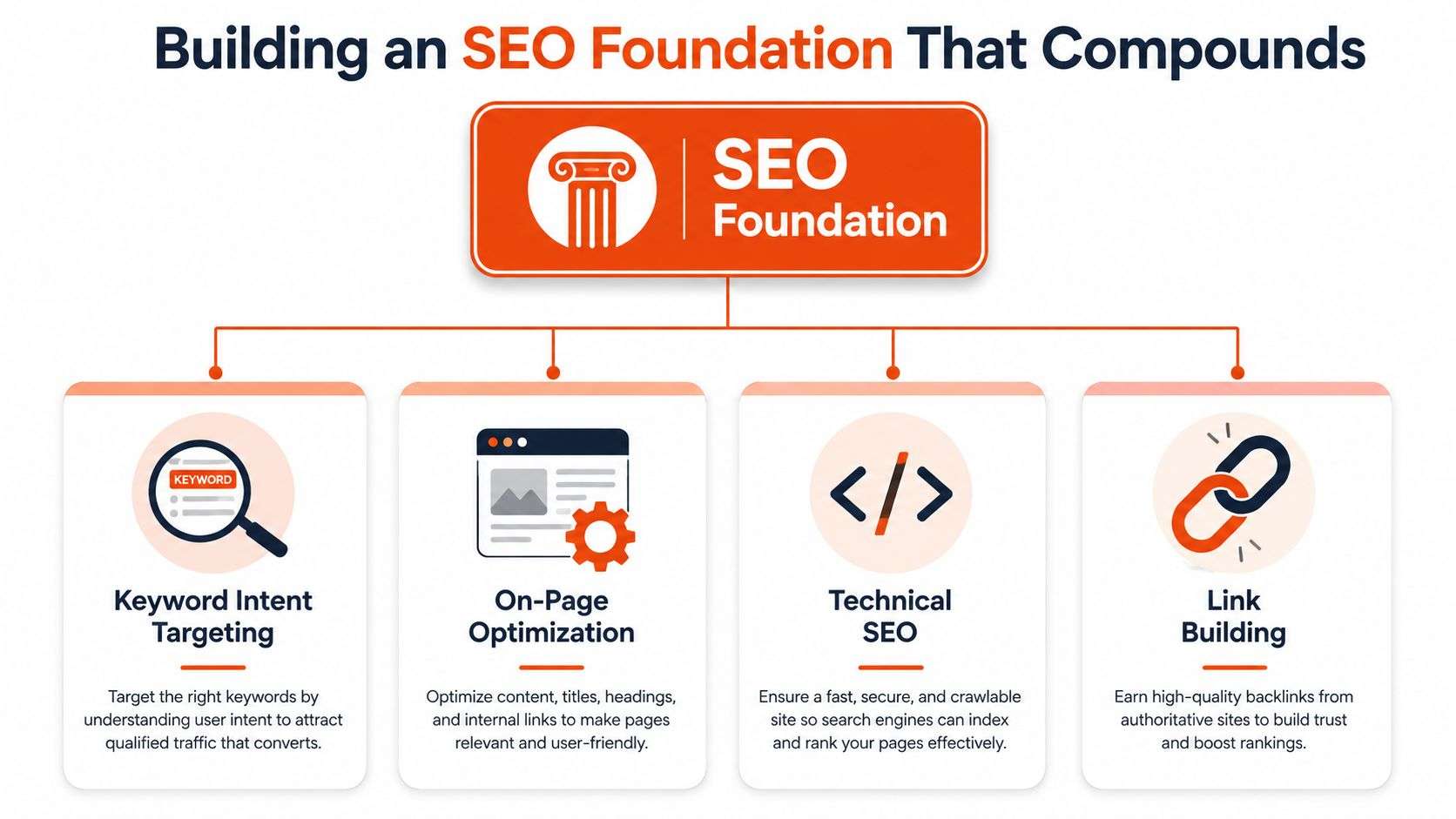
Organic search is still the most durable traffic engine for Australian websites, but only when the foundations are tight. The four pillars that matter are keyword intent targeting, on-page structure, internal linking, and backlink acquisition. If any one of those is weak, the page struggles to rank, or it ranks for the wrong query.
A useful way to think about this is by buyer intent, not just keywords. A page targeting “family lawyer Parramatta” should read like it was written for a person ready to compare firms, while “warehousing Adelaide” should serve a logistics buyer looking for local capacity, trust signals and next-step contact details. A Shopify merchant searching for “eco packaging suppliers Australia” needs a page that answers supplier quality, minimum order realities, and delivery expectations, not generic brand copy.
Start with the page before you start with the site
The first 30 days of SEO should focus on the pages that can realistically convert. Build pages around one clear intent, then write the title tag, meta description and first screen so they match what the searcher wants. Search visibility improves when the page is easy for both humans and crawlers to classify.
Internal links are the simplest authority signal most sites underuse. They help search engines understand which pages matter most, and they help buyers move from a general guide into a service page or product page. If you want a practical reference on that part of the work, Wistec's own guide on building domain authority is a useful companion to the technical side of link strategy.
Build topical depth, not scattered posts
A strong topic cluster is better than a pile of disconnected articles. For an Odoo partner Sydney Adelaide, that might mean one core implementation page, a comparison page, a migration page, and a handful of industry-specific support pages for manufacturing, retail or services. That structure tells search engines there's real depth behind the offer.
For ecommerce sites, the content architecture matters just as much. A helpful external reference on SEO for ecommerce sites shows why product, category and support pages need to work together instead of living in isolation.
Earn links the Australian way
Backlinks still matter, but the best ones usually come from realistic business relationships. Supplier mentions, partner pages, industry associations, local chambers, trade publications and digital PR all work better than random outreach. A link from a relevant Australian source is often more valuable than a stack of irrelevant mentions.
A practical SEO foundation also includes technical performance. Faster load times, mobile-friendly layouts, descriptive metadata and authoritative links are the durable combination that keeps paying over time. That's the reason SEO remains the most compounding traffic channel for Australian businesses, especially when the business serves a defined geography or a specific industry.
Winning Local Search Across Sydney, Adelaide and Beyond
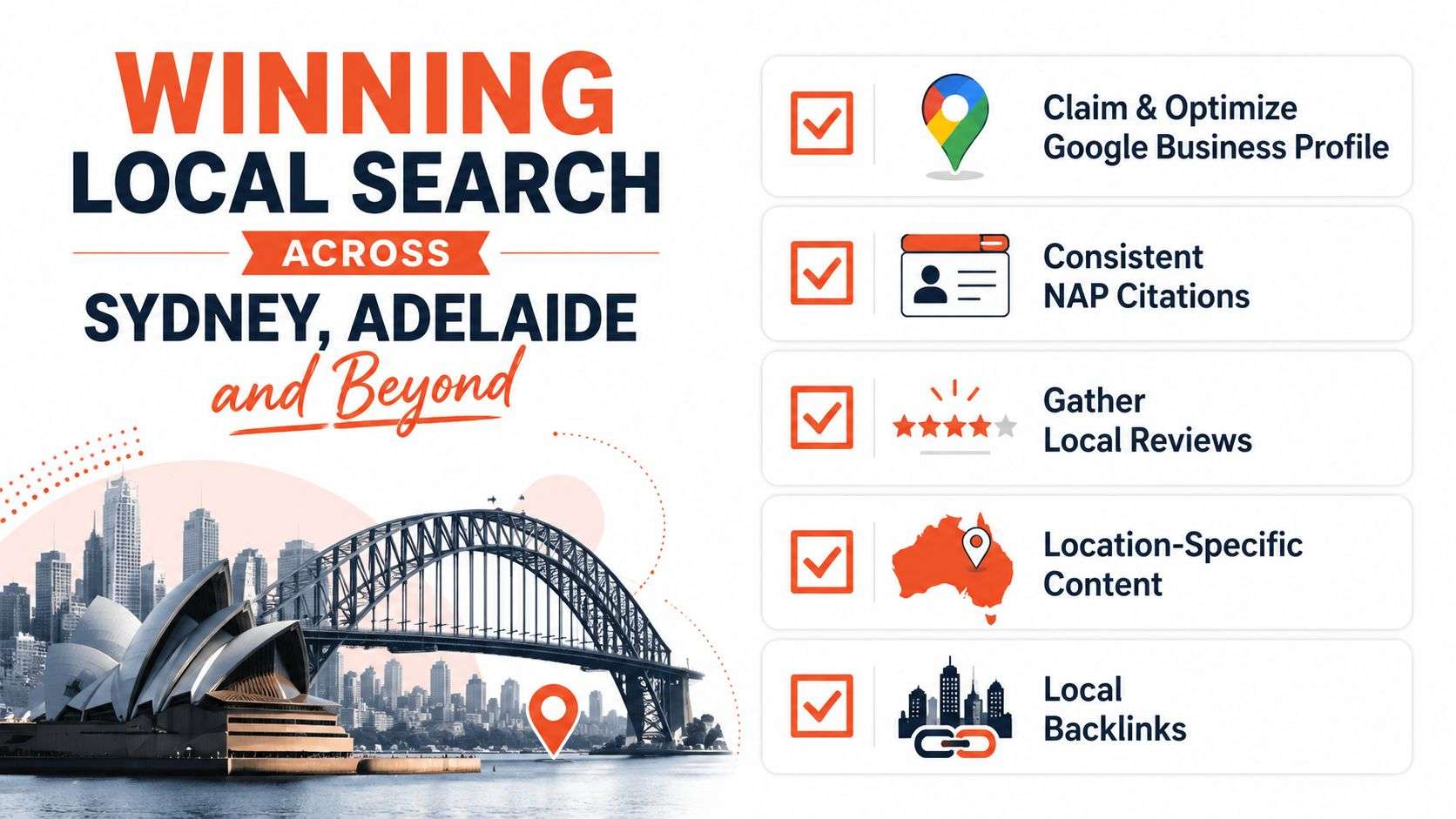
Local traffic presents a significant opportunity that many Australian SMEs overlook. If your buyers are in a specific city, state, or service area, your site needs to articulate that clearly in the places search engines and buyers check. The goal is not to rank everywhere. It is to appear where the buying decision happens, then make it obvious that you serve that area well.
The first asset to get right is your Google Business Profile. Claim it, complete every field, add services, opening hours, service areas and category details, then keep it active with regular updates. For clinics, trades, hospitality and professional services, that profile is often the first trust check before anyone lands on the website.
Build local pages that deserve to rank
A single generic services page is rarely enough for a service-area business. A clinic, accounting firm, logistics provider or hospitality operator usually needs city-specific or region-specific landing pages that match local search intent. Each page should spell out the local offer, the service promise, the contact path and the proof that the business serves that area.
NAP consistency matters here too. Your name, address and phone number should match across your site, directory listings and profile listings. The cleaner those references are, the easier it is for search engines to connect the business to the location, and for buyers to trust what they see.
Structured data helps with that matching. LocalBusiness schema gives search engines clearer context about who you are, where you serve and what type of business you run. It does not replace good content, it helps the content get classified correctly.
A practical example, an Odoo ERP consultant in Adelaide can turn one generic services page into a cluster with a city page, an industry page for manufacturing, a support page for implementation, and a FAQ page for common migration questions. That approach gives search engines more signals, and it gives the buyer more confidence before they enquire. For teams planning that sort of site structure, website development in Sydney Australia is often part of getting the local architecture right from the start.
Treat local trust as part of traffic strategy
Australian buyers are cautious. The Australian Community Attitudes to Privacy Survey shows how sensitive people are about personal information and misuse concerns. That makes clear contact details, HTTPS, privacy cues and visible business information part of traffic performance, not just compliance.
Buyers do not just click the page with the best keyword match, they click the page that looks safe, local and real.
Local SEO, nearby directory citations, and region-specific content work together. A business that keeps its development house in order can turn those search moments into actual leads instead of bounce-backs. For one practical example of that kind of setup, the website development in Sydney Australia resource fits naturally alongside location pages, service pages and contact information that reassure local buyers.
Where to spend your first afternoon
If you only have a few hours, start with the profile, then the location pages, then the directory consistency. After that, clean up the trust signals on the contact and service pages. That sequence gives you the fastest path to relevance without needing a full rebuild. For retailers, clinics and service firms, it usually produces the first meaningful lift in local enquiries before broader SEO work has time to compound.
Creating Content That Earns Clicks, Shares and Rankings
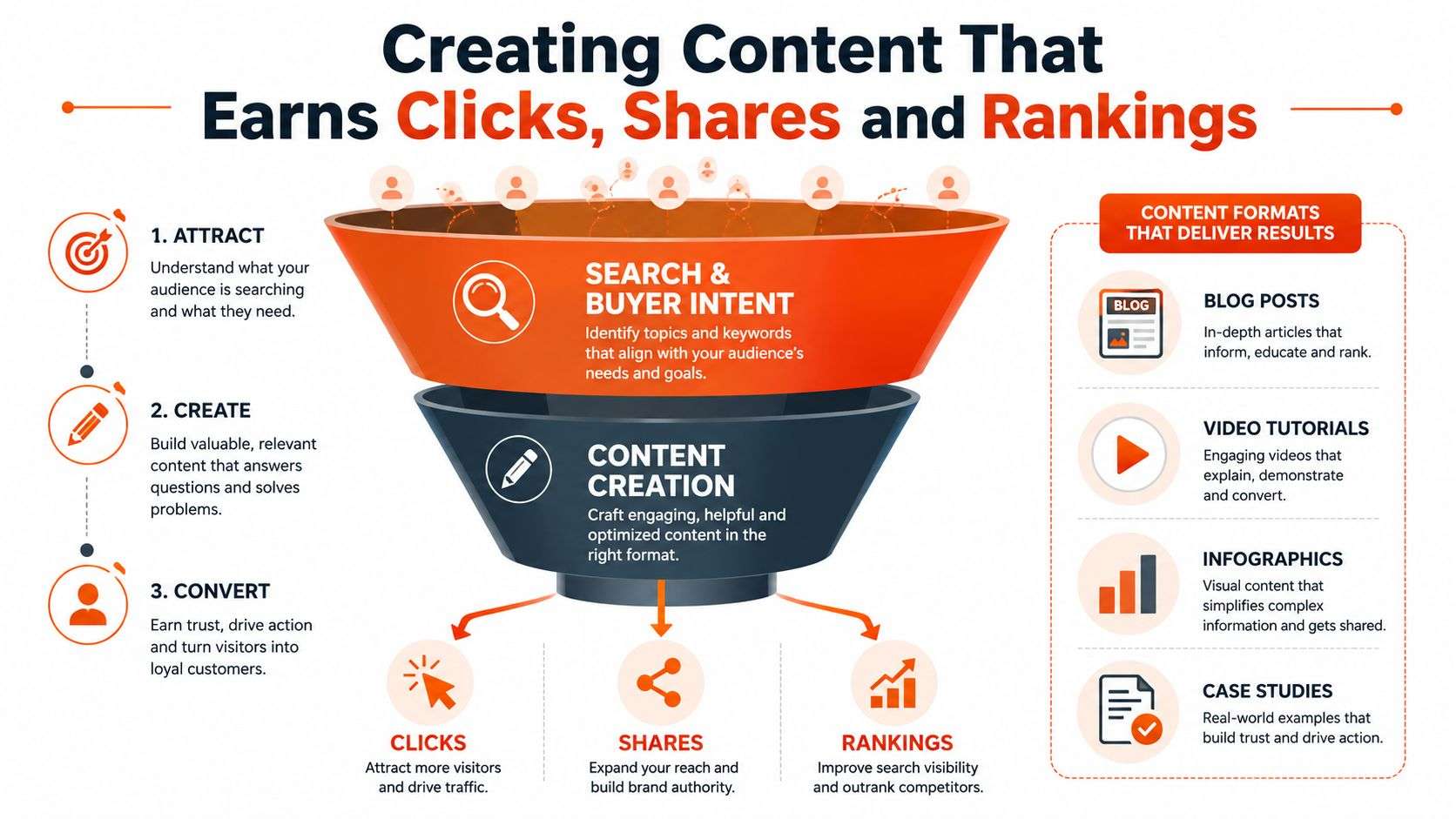
Content earns traffic when it answers a buyer's problem and still has a clear path in search. Generic brand copy usually misses both jobs. People rarely arrive because they want “more about the company”. They arrive looking for an answer, a comparison, a checklist or the next step.
The formats that usually perform best for Australian SMEs are comparison guides, implementation how-tos, case studies and location-specific pages. A manufacturer comparing Odoo vs SAP needs decision support. A retailer using WooCommerce needs implementation guidance. A healthcare operator reviewing systems needs a page that makes the next choice easier, not harder.
Use a brief that forces intent
A strong content brief should define five things, intent, audience, format, call to action and success metric. Leave one out and the piece often turns into content for content's sake. For lean teams, that is a poor use of time and budget.
One useful cadence is to publish the high-intent piece first, then distribute it through email, LinkedIn, Facebook and any niche channel where the audience already pays attention. That does not mean posting the same copy everywhere. It means reshaping the same idea so it fits the channel and the buyer's expectations.
Refresh what's fading before writing something new
Traffic growth does not always come from publishing more. Sometimes the faster move is updating a post that is already slipping. Traffic guidance from WebTonic notes that rewriting titles on pages already ranking in positions 5 to 20 can affect traffic in 2 to 4 weeks, adding internal links can take 2 to 6 weeks, refreshing decaying posts can take 4 to 8 weeks, and building a topic cluster of 8 to 12 pages can take 3 to 6 months. Those ranges are useful because they show what each lever is likely to deliver.
Practical rule: if a page already has search visibility, improve it before you chase a brand-new topic.
For a Shopify merchant, that might mean rewriting a category page and tightening the FAQ content before commissioning five fresh blog posts. For an Odoo user in healthcare, it might mean turning one service explainer into a more useful implementation guide with links to related pages and a clear enquiry path.
Repurpose with intent, not laziness
A single strong piece can become an email, a LinkedIn post, a short video script, a sales enablement asset and a FAQ expansion. That is not recycling for the sake of it. It gives one useful idea more chances to reach the right buyer.
The content programs that work best I've seen do not rely on a huge volume of posts. They produce a few pages that attract searchers, get shared by the team, and keep working across channels long after publication.
The Technical Checklist That Unlocks Hidden Traffic
Technical SEO is where good content gets rescued from preventable problems. Slow pages, clumsy mobile layouts, broken redirects and weak schema can all suppress traffic even when the writing is solid. The fix is usually not a redesign. It's a focused clean-up.
Start with Core Web Vitals, mobile responsiveness and HTTPS. Then check URL structure, image weight, structured data, internal link paths, redirect hygiene, sitemap health and robots.txt. Those are the basics that help search engines crawl the site properly and help buyers trust what they're seeing.
Audit the pages that matter most first
There's no value in auditing the whole site if the pages that generate leads are still slow or messy. Focus on service pages, category pages, local landing pages and high-traffic articles first. That gives you the highest payoff for the least time.
The privacy angle matters too. Since many Australians are wary of fraud and identity theft, visible trust cues like clear contact details, HTTPS and a proper privacy page help reduce hesitation before a click or form fill. That trust work is part of the traffic funnel, because people are less likely to ignore or abandon a page that looks safe.
Good technical SEO doesn't create demand on its own, it removes friction from demand that already exists.
A clean audit script is straightforward. Check page speed on the mobile view, test key templates for broken links, verify your structured data, and confirm that the sitemap reflects only live pages. Then review whether the most important landing pages are linked from navigation, supporting content and relevant internal anchors.
Don't ignore the visual side of speed
Images often carry more weight than owners realise. Compressing them, using the right format and avoiding oversized uploads can make the site feel sharper on mobile. On Australian service pages, that matters because many first visits happen on a phone, not a desktop.
This is also where implementation quality becomes visible. A well-built site from a developer, an Odoo implementation partner, or a software development Sydney Adelaide team should make performance and crawlability part of the build, not an afterthought. The same principle applies whether the site runs on Shopify, WooCommerce or a custom stack.
Measuring What Matters and Prioritising Your Next Move
Traffic programs fall apart when every channel is judged by a different yardstick. A better approach is to tie each source to one or two metrics that reflect buyer intent, then review those numbers on the same cadence. Organic pages need landing page performance, local pages need profile actions and map visibility, email needs click-through behaviour, and paid campaigns need cost and conversion quality.
GA4 helps once it has been set up properly, but the raw reports still need interpretation. A single source of truth in Looker Studio makes monthly reporting easier because the team is looking at the same figures in the same place. That cuts down the usual argument about which channel deserves the credit, and it keeps the focus on traffic that reaches the right buyer in retail, manufacturing, healthcare, hospitality or professional services.
Score ideas before you fund them
A simple ICE model, Impact, Confidence and Ease, is enough for most SMEs. Score each possible action, then choose the top two instead of trying to push everything at once. That keeps the team moving and stops low-value work from swallowing the calendar.
For example, an Adelaide accounting firm might weigh SEO title rewrites, a local landing page, a partner backlink campaign and a retargeting test. The highest-confidence move is usually the one that improves the best-performing page or closes the biggest local gap. The goal is not to chase a perfect answer, it is to avoid funding work that looks promising but will not shift the next metric.
If you need a quick way to gather internal feedback before prioritising, a free online survey tool can help you collect what sales, support or service staff are hearing from customers.
Track the signals by channel
Use organic landing pages to see which topics attract the right searchers. Watch local pack impressions and clicks for location-based pages. Track email click-to-open behaviour, not just opens, because opens can make performance look better without creating traffic. For social, look at assisted conversions, because many visits do not arrive on the first touch.
Wistec's website analytics guidance gives your team a practical way to read the numbers without getting lost in vanity metrics. The point is straightforward. Do not optimise for activity. Optimise for evidence that the traffic lands in the right place and does the right thing.
Review weekly, then decide quarterly
Weekly reviews keep execution honest. Quarterly reviews help you decide whether the current mix of SEO, content, local search, partnerships and paid promotion still suits the business. That rhythm matters for Australian SMEs because priorities shift quickly between service demand, stock, hiring and seasonal buying.
Start by checking whether the traffic is converting, then ask which channels are sending the right visitors rather than just more visitors. If a channel brings volume but weak intent, it needs tighter targeting, better landing pages or a smaller role in the plan. If a channel brings fewer visits but stronger leads, it deserves more attention even if it looks less exciting in the report.
The practical test is simple. Keep the channels that send qualified traffic into the pipeline, cut the ones that only create noise, and set the next quarter around the gaps that are most likely to close. That gives founders a cleaner path from data to action, and it keeps the work tied to buyers who are likely to enquire, book or buy.
Frequently Asked Questions About Growing Website Traffic
How long does it usually take to see traffic growth in Australia?
It depends on the channel. Local and on-page fixes can move quickly, while deeper SEO and topic cluster work takes longer. WebTonic's ranges suggest title rewrites can affect traffic in 2 to 4 weeks, internal links in 2 to 6 weeks, refreshing decaying posts in 4 to 8 weeks, and a topic cluster in 3 to 6 months (WebTonic). For most Australian SMEs, the first meaningful lift comes from fixing pages that already have intent and visibility.
Should a small business start with paid ads or SEO?
If the budget is tight, start with SEO fundamentals and local search, then use paid ads selectively for immediate demand or retargeting. Organic search is still the most durable source of traffic for most websites in Australia, and it compounds over time (Matomo's Australian guidance). Paid ads are useful, but they shouldn't be the only engine if you want traffic that keeps arriving after the spend stops.
What should a business fix first, content or technical SEO?
Fix the technical blockers on your most important pages first, then improve the content that already has demand. A fast, mobile-friendly page with clear metadata and internal links will usually outperform a slower page with prettier writing. For an Australian buyer, trust signals matter too, especially on service pages where the user is deciding whether to enquire.
How do Shopify and WooCommerce stores stand out against overseas competitors?
They usually win by being more locally relevant, more specific and easier to trust. That means better local intent pages, clearer shipping and service information, stronger reviews, and content that answers Australian buyer questions instead of generic global ones. If the store is targeting local demand, local SEO and location-specific content often matter more than broad brand messaging.
Does Odoo traffic growth work differently from ecommerce traffic growth?
Yes, because the buyer journey is usually longer and more technical. An Odoo partner Sydney Adelaide or an implementation consultant usually needs comparison pages, industry pages and service pages that match different decision stages. A Shopify or WooCommerce store leans more heavily on category, product and buyer guide content.
If you want traffic that reaches the right Australian buyer, Wistec can help with Odoo implementation, Shopify implementation, WooCommerce builds and software development Sydney Adelaide projects that are set up for search from day one. Visit Wistec to talk through a traffic plan that fits your market, your geography and the way your customers search.