

Australian businesses logged 87,400 cybercrime reports in FY2023–24, about one every 6 minutes, and the average self-reported cost for a small business rose 8% year-on-year to A$49,600 (ACSC reporting cycle summary). That's not a background statistic, it's a board-level warning. If your Odoo ERP, Shopify store, or customer booking system goes dark, you're not just losing files, you're losing sales, service continuity, and trust.
That's why disaster recovery solutions have moved from “nice-to-have backup” to a practical resilience control. The right plan protects revenue, restores data cleanly, and gives owners confidence that a regional outage, ransomware hit, or accidental deletion won't turn into a long, expensive shutdown. For Australian SMEs, especially retail, healthcare, logistics, and professional services, the question isn't whether disruption will happen, it's whether the business can recover without improvising under pressure.
Why Disaster Recovery Solutions Matter Now
The national threat picture is already bad enough on its own, but the core problem is operational. The ACSC cycle also noted that cyber-enabled incidents increasingly disrupt operations, which is exactly where recovery planning earns its keep. When staff can't access orders, clinicians can't confirm bookings, or a warehouse can't see dispatch data, the cost isn't abstract. It lands in missed shipments, delayed service, refund requests, compliance exposure, and damaged customer confidence.
A lot of owners still hear “disaster recovery” and think of a backup drive sitting somewhere safe. That's too narrow. Disaster recovery solutions are the controls that help a business restore systems, data, and work processes after an outage so the operation keeps moving. Backup matters, but backup alone doesn't answer the hard questions, like how quickly your platform returns, who authorises the failover, or how your team keeps trading while the primary environment is offline.
What the user-obssessed buyer actually needs
For a business owner, the right framing is simple. Recovery isn't an IT vanity project, it's a way to reduce the blast radius of a disruption. A retail team needs to keep selling. A healthcare clinic needs to keep receiving patients. A logistics operator needs visibility across fulfilment and dispatch. An Odoo ERP rollout needs finance, inventory, and order data to come back in a way the business can use.
That's where a local practitioner's view matters. In Wistec engagements, the best recovery discussions start with business pain, not tooling. The conversation begins with what breaks first, what can wait, and what must never be lost. That's also why our guide to modernising legacy IT systems in 2026 belongs in the same strategic conversation as disaster recovery, because old systems tend to fail in clusters, not neatly one by one.
Practical rule: if the person running the business can't explain what happens in the first hour after an outage, the recovery design isn't finished.
The point is not to buy the most complex platform. The point is to get back to work with the least confusion, the least data loss, and the least governance chaos. If you want a recovery check built for your Odoo ERP, Shopify, or WooCommerce stack, book a free recovery assessment with Wistec and map the weak spots before an incident does it for you.
What Disaster Recovery Solutions Really Mean
Backup and recovery are often spoken about as if they're the same thing. They're not. Backup is the copy of data, the drill in the car park, the inventory of what you might need. Recovery is the rebuilt office with people back at their desks, the systems online, the approvals working, and the business trading again.
That difference is where many public explainers fall short. A small business can keep clean backups and still fail badly at recovery if nobody knows who decides, who pays, or which service comes back first. The World Bank recovery framework makes that governance point clearly, because it ties recovery success to institutional roles, lead agency coordination, funding tracking, funding-gap analysis, and audit controls (World Bank disaster recovery framework). In practice, the cheapest DR plan can become the most expensive one once weak governance is exposed.
The user-obsessed buyer needs a recovery plan that works in real operations
For Australian retail, healthcare, logistics, and professional services, a real recovery design needs answers in plain English. Who declares the incident? Who approves spend? Which vendor gets called first? Which environment becomes the temporary home for the workload? Those questions carry as much weight as replication speed. If they are unanswered, the team burns time making decisions during the outage, when time is exactly what you do not have.
That is why we treat Odoo implementation, ERP recovery, and eCommerce continuity as one operational system. Finance depends on order flow. Inventory depends on sales data. Booking systems depend on identity, notifications, and customer communications. If the recovery plan only restores a database, it has not restored the business.
For a useful examination of planning mechanics, browse our DRP technical guide alongside your internal risk review. The main takeaway is straightforward, recovery has to be designed before the outage, not improvised after it. A governance-ready template is worth having on hand before pressure hits.
A sensible DR plan does more than confirm data exists. It checks whether the business can keep making decisions, paying suppliers, serving customers, and meeting obligations while systems are being brought back. That is the point where recovery becomes a resilience capability instead of a storage exercise.
Understanding RTO RPO and Recovery Testing
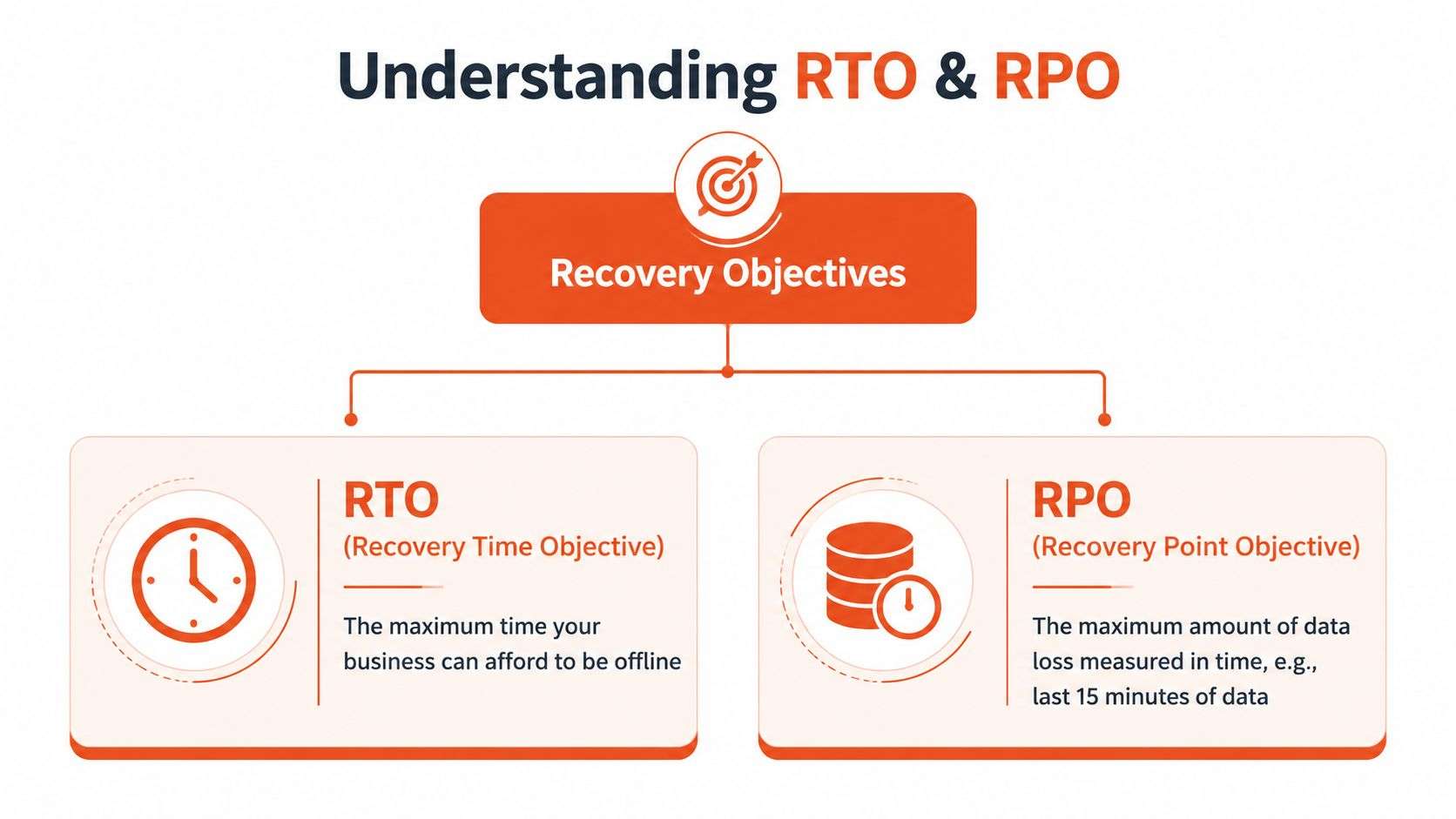
RTO and RPO are the two numbers every serious recovery conversation has to face. RTO is the maximum acceptable downtime before a service has to be restored. RPO is the maximum acceptable data loss measured in time. If the shop can't trade for three hours, that's an RTO problem. If you can only afford to lose the last fifteen minutes of sales records, that's an RPO problem.
Make the objectives workload-specific
AWS best practice is explicit about this, define an RTO and RPO for each application, not one generic company-wide number (AWS disaster recovery best practices). That matters because different systems carry different business risk. Your Odoo ERP may need tighter recovery than a marketing site. Your Shopify store may need a different failover profile from your staff intranet. A clinic booking platform has different tolerances again, especially when customer communication and appointment continuity are involved.
Low-latency replication and redundant infrastructure help when those thresholds are tight. The reason is practical, not theoretical. Faster replication reduces the window of data exposure. Redundant infrastructure gives you a live place to land when the primary environment fails. But none of that helps if the runbook is stale or the team has never rehearsed the sequence.
Recovery testing is the difference between a plan on paper and a plan that works under pressure.
Testing has to be regular because infrastructure changes, staff change, and dependencies drift. A restore that worked six months ago can fail today because a password expired, a script moved, or a firewall rule changed. In a Shopify implementation or WooCommerce store, that failure shows up as lost orders and support calls, not as an abstract technical defect. In an ERP, it shows up as stalled fulfilment, delayed invoicing, and confused users.
What to validate during a recovery test
- Data restore points, confirm the system can reach the last clean point you need.
- Application sequence, make sure services come up in the right order, not just individually.
- User access, verify staff can log in with the right permissions after failover.
- Communications, test the customer and internal notification path, because silence creates extra load.
- Operational handover, check who declares success and who signs off on re-entry to normal service.
A testing regime doesn't need to be theatrical, it needs to be honest. If the test exposes that the business can't meet its target, that's good news. It means you've found the problem before an outage did.
If you want a practical RTO/RPO workshop for Odoo, Shopify, or WooCommerce, Wistec can map the numbers to the stack you run and show what will hold up under a real outage.
Comparing On-Prem Cloud and DRaaS Models
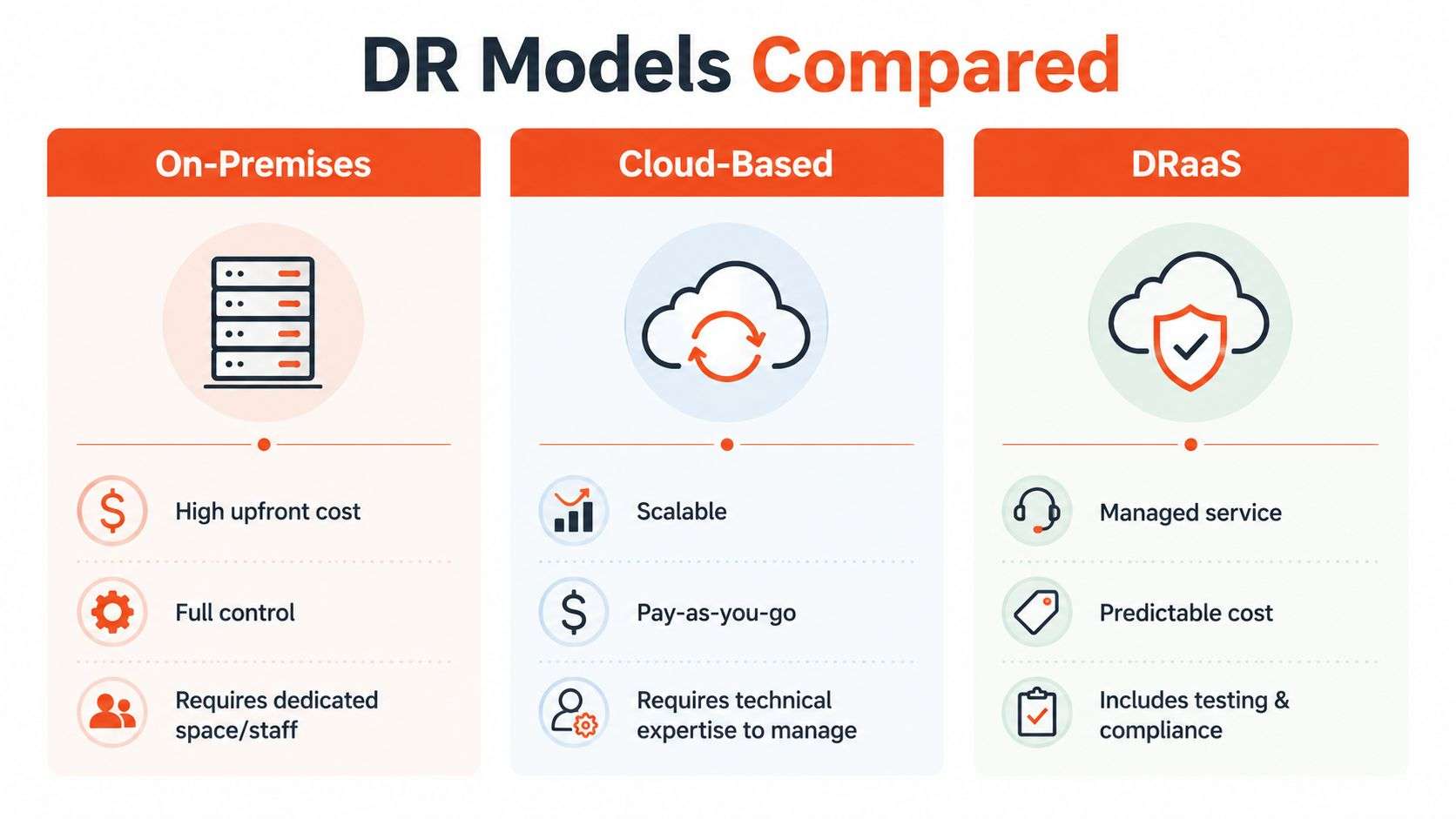
Recovery architecture shapes the business outcome. On-premises recovery gives you control, but it also asks you to maintain space, hardware, staff time, and discipline. Cloud-based recovery reduces some of that burden, yet it still needs the right design and someone who understands the dependencies. DRaaS sits differently again, because the service model shifts much of the operational work to a managed platform.
The biggest mistake is treating backups as if they were a complete architecture. Microsoft's Azure guidance recommends predeploying a secondary region, duplicating networking, IAM, monitoring, and recovery runbooks, and using warm active/passive workloads for the critical parts of the stack (Azure disaster recovery guidance). That means a recovery site isn't just storage, it's a usable environment with the pieces needed to run the workload.
What changes across the three models
| Model | What it gives you | What it costs you in practice |
|---|---|---|
| On-Premises | Full control over hardware and recovery process | More capital, more maintenance, more local dependency on staff and facilities |
| Cloud-Based | Elastic capacity and regional separation | You still need architecture skill, runbooks, and test discipline |
| DRaaS | Managed recovery process and more predictable operations | Less direct control, more reliance on the provider's delivery model |
For a user-obsessed buyer, the trade-off is usually speed versus control. On-prem can feel reassuring until you price the hidden work of keeping it ready. Cloud can scale well, but if nobody owns the recovery runbooks, the design is fragile. DRaaS often suits SMEs because it reduces operational drag, but it still has to be aligned to business priorities, not bought as a checkbox.
The skill gap is where software development Sydney Adelaide support becomes relevant. Many teams can describe their app stack, but not all can translate that stack into a live recovery environment with sensible sequencing, dependencies, and access controls. That's the part Wistec helps rationalise, especially when Odoo ERP and eCommerce systems sit alongside payment, booking, or logistics integrations.
If you're comparing your current setup with a cloud path, our cloud computing overview for small businesses is a useful starting point before you ask for a DR quote. The right question is not “Which model sounds modern?” It's “Which model gets my business back online with the least disruption and the most confidence?”
If you want a cloud DRaaS comparison against your current recovery posture, Wistec can price the trade-offs in plain English and help you choose without overbuying.
Building Your DR Plan and Selection Criteria
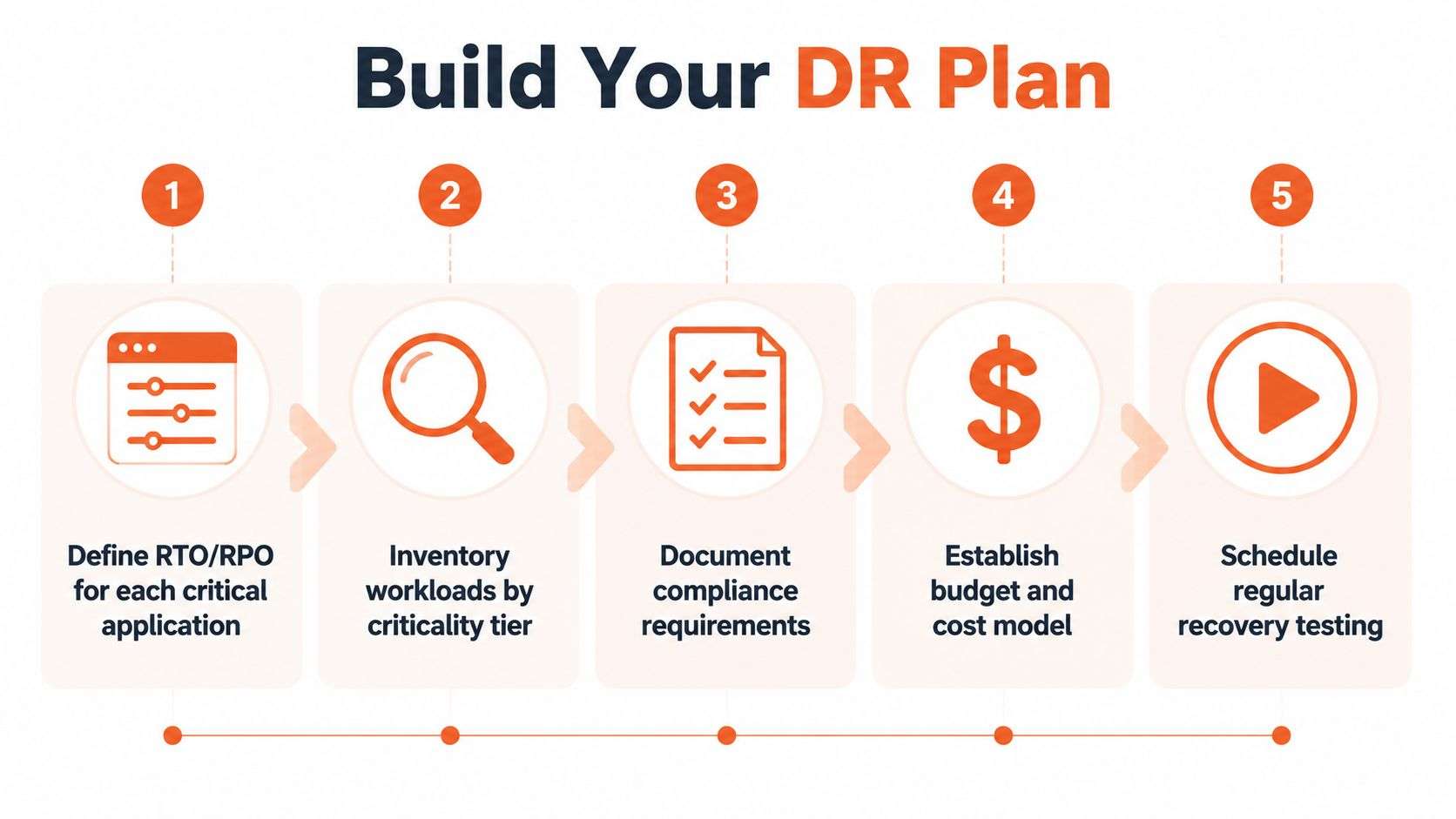
A recovery plan works best when it starts with the systems that keep revenue, service, and compliance moving, then works back from the business impact. For Australian SMEs, that usually means setting RTO and RPO for each application, then deciding how quickly each one has to return and how much data loss the business can tolerate. A single company-wide target usually hides the difference between payroll, customer orders, internal reporting, and customer-facing platforms.
What to assess before choosing a model
- Workload criticality, decide which systems stop the business and which ones can wait.
- Compliance needs, map healthcare, financial, privacy, and record-keeping obligations.
- Budget reality, include setup, testing, management, and staff time, not just software.
- In-house skill, be honest about whether your team can maintain and rehearse the plan.
- Dependency risk, identify what the app needs to function, including identity, databases, and integrations.
That checklist becomes more useful once you apply it to the systems people rely on every day. An Odoo implementation often sits at the centre of finance, inventory, procurement, and fulfilment, so the ERP may need a tighter recovery path than the website. A shopify implementation usually sits at the customer-facing edge, so order capture and payment continuity matter straight away. WooCommerce stores often depend on hosting, plugin health, and integration quality, which means the weak point is sometimes not the storefront but the service behind it.
A practical recovery checklist for SME stacks
- Odoo ERP, confirm database replication, module dependencies, and access control recovery.
- Shopify implementation, test customer-facing continuity, order visibility, and staff admin access.
- WooCommerce, review hosting, plugin compatibility, and the ability to restore the site cleanly.
- Mobile apps, check how the app behaves when APIs, auth, or inventory services are unavailable.
- Integrations, document payment, shipping, email, and identity services that must come back together.
A good ODOO partner Sydney Adelaide team earns its keep by mapping those dependencies before a crisis exposes them. A business impact analysis makes the hidden links visible, and that is where recovery design becomes practical rather than theoretical. Skip that step, and businesses often overprotect low-value systems while underprotecting the ones that keep revenue moving.
Use the checklist to decide whether you need full DRaaS, a hybrid setup, or a narrower recovery design tied to a particular workload. If you are building this for Odoo, start with an Odoo-ready DR checklist with Wistec and anchor the plan in the systems your team uses every day.
Disaster Recovery Cases for Key Industries
A retailer running Shopify usually cares about one thing first, can the store keep taking orders when something breaks. In one engagement pattern I've seen repeatedly, a ransomware event forced the team off the primary environment, and the recovery path was built around a managed failover design rather than a manual restore scramble. The important part wasn't the tech label, it was the fact that customers could still buy while the clean environment was brought back under control.
Retail and eCommerce
When a Shopify implementation is under pressure, every minute of hesitation creates a queue of customer complaints and support tickets. The store owner needs the storefront live, payments working, and order data trustworthy enough for fulfilment. That's why disaster recovery for retail has to protect the transaction path first, not just the image library or theme files.
Manufacturing and Odoo ERP
An Odoo ERP site in manufacturing faces a different problem. If supply orders stop moving, production plans and dispatch sequences stall as well. In those cases, secondary-region failover is valuable because it preserves the operational core, not just the database copy. That's where an ODOO partner Sydney Adelaide team with recovery experience helps, because ERP continuity depends on getting modules, users, and dependencies back in the right order.
Logistics and connected storefronts
A logistics operator with a WooCommerce-linked fleet portal needs visibility more than glamour. Customers want to know where orders are, dispatch teams need current information, and support staff need a live system to answer questions. In that kind of environment, software development Sydney Adelaide expertise matters because the recovery plan usually has to cover integrations, not just the storefront itself.
Healthcare and governance-led continuity
Healthcare recovery is the toughest mix of technology and governance. A clinic can't treat system restoration as a purely technical event because patient communication, appointment continuity, and role clarity are part of the service. The strongest plans I've seen for clinics were governance-led first, technical second, which means the right people were named, the escalation path was clear, and the recovery sequence supported patient access.
Practical takeaway: if the recovery plan doesn't preserve the service people came for, it's too narrow.
Each of these cases points to the same lesson. The business outcome matters more than the tool name. Odoo, Shopify, and WooCommerce all need recovery designs that match how the organisation works, not how a brochure describes a platform.
If you want a similar recovery blueprint for your sector, request one from Wistec and anchor it to the systems that would hurt most if they went offline.
Frequently Asked Questions on DR Solutions
How often should a small business test disaster recovery?
Test it regularly enough to prove the plan still works after system changes. The practical benchmark is to validate the recovery path, the clean point, and the team's execution, not just the backup job.
What compliance issues matter most in healthcare recovery?
Healthcare plans need clear roles, documented communication paths, patient access continuity, and recovery controls that support accountability. The governance side matters as much as the infrastructure side because service interruption affects people directly.
Can Odoo and Shopify share one recovery plan?
Yes, but only if the plan treats them as connected workloads with different priorities. The ERP may need deeper internal continuity, while Shopify may need storefront and order intake continuity first.
Is DRaaS always more expensive than on-premises recovery?
Not always in practice, because on-premises recovery carries hardware, space, maintenance, and staff overhead. DRaaS changes the cost model, so the comparison should include ongoing management and test effort, not just the initial quote.
What should I ask before buying a recovery service?
Ask how the provider handles testing, who owns the runbooks, how dependencies are mapped, and how quickly you can prove the right data is restorable. Those answers tell you whether the service is operationally ready or just technically impressive.
If you want a straight answer on your own stack, ask Wistec your specific question live and compare the answer against your current recovery assumptions.
Next Steps with Wistec Disaster Recovery
Disaster recovery stops being theoretical once you connect the risk data, the governance model, the recovery objectives, and the architecture choice. The ACSC numbers show why the pressure is real. The governance framework shows why backups alone aren't enough. RTO and RPO turn intent into operational targets. Then architecture and testing decide whether the plan is usable when the business needs it.
That's where Wistec fits as an ODOO partner Sydney Adelaide and software development Sydney Adelaide specialist. We work with Australian businesses that need recovery to fit Odoo ERP, Shopify, WooCommerce, mobile apps, and the integrations around them. The practical path is straightforward, book an assessment, map your RTO/RPO by application, and pilot the recovery model that matches your real operational risk.
If you already have cloud infrastructure, our cloud managed services can be a sensible place to align ongoing operations with recovery readiness. If you don't, start smaller, with the systems that would cause the biggest business interruption if they failed tomorrow. Either way, the goal is the same, reduce uncertainty before an outage turns it into a crisis.
Wistec designs and manages practical disaster recovery solutions for Odoo, Shopify, WooCommerce, and the systems that sit around them, with recovery planning that accounts for governance, continuity, and real-world trade-offs. If you want a local team to review your stack and turn recovery assumptions into a working plan, visit Wistec and start the conversation today.