

Australia's online shopping market reached $64.9 billion in 2026 source, and that single figure changes the way Sydney businesses should think about ecommerce website development Sydney. This is no longer a side project or a prettier catalogue. It's a revenue system that has to handle search, checkout, payments, logistics, compliance, and the operational plumbing behind the scenes.
The strongest Sydney stores are built on the assumption that customers already know how to buy online. 52.8% of Australians shop online weekly, and 23.1% buy groceries or fresh produce online source. That means your site isn't just competing on design, it's competing on speed, trust, and whether the whole buying journey feels effortless.
Why Sydney Ecommerce Development Is a Systems Project
A Sydney ecommerce build fails when it's treated like a storefront with a cart attached. The work sits underneath the pages, in the way product data, payments, shipping, tax, support, and reporting move together. If those parts don't align, the site may look polished and still break down the moment orders start flowing.
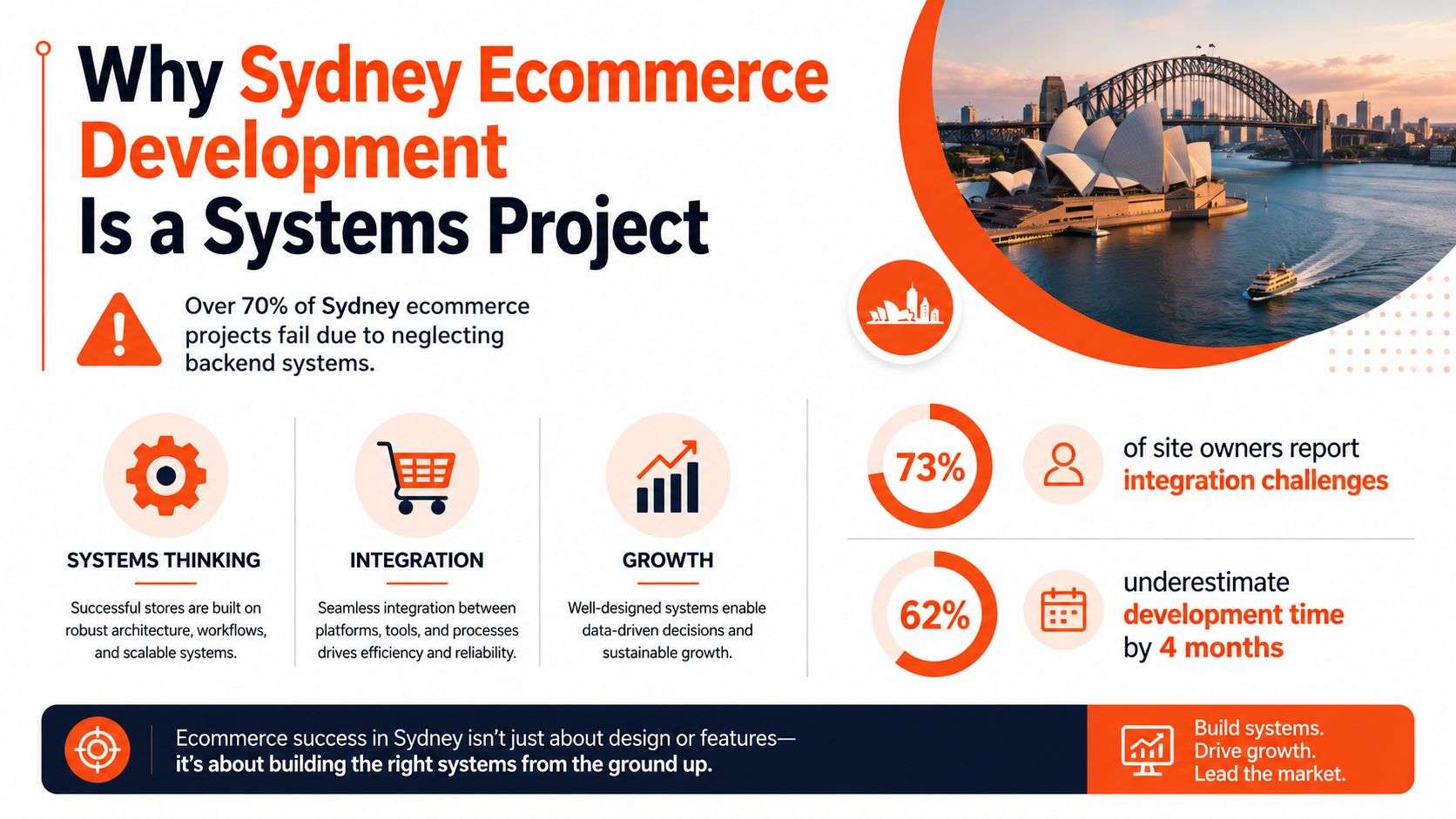
A better starting point is the way Australian shoppers already move across payment methods. As of March 2024, 80% had used PayPal, 48% BPAY, 39% Apple Pay, 38% AfterPay, and 27% Google Pay source. If your build only supports one or two payment paths, you're asking customers to adapt to your setup instead of matching the way they already buy.
What systems thinking changes
Systems thinking changes the brief before the first mock-up is drawn. You stop asking only what the homepage should look like and start asking where stock lives, how orders sync, what happens when a courier label fails, and who fixes a refund mismatch. That difference shows up fast, because a launch that feels fine in testing can still create support tickets the moment orders begin flowing in production.
Sydney teams also need to think beyond the visible build. The hidden layer includes compliance, logistics integrations, analytics, and the handover between sales and operations. For a plain-English explanation of how these pieces fit together, the overview of system integration is a useful reference point.
Practical rule: if an agency talks mostly about colours, templates, and homepage sections in the first meeting, they're probably not scoping the operational load properly.
The strongest ecommerce website development Sydney projects start with business flow, not visual polish. That matters even more once a store begins to grow, because a site that handles twenty orders a week can behave very differently when inventory checks, support queries, and fulfilment tasks become part of the daily load.
That shift also changes the cost base. ERP connections, tax rules, warehouse handoffs, and duplicate customer records often sit outside the first design quote, then appear later as rework. Businesses that want to reduce surprises should read the AUSFF cost reduction guide before they lock the scope, because the biggest overruns usually come from system gaps, not from the homepage design.
Choosing the Right Platform for Your Sydney Store
Platform choice is where Sydney retailers make expensive mistakes. The platform itself is not the strategy, but it does determine how much flexibility you have when the business model changes. A DTC brand, a wholesaler, and a multi-location retailer all need different things from the stack, even if they all sell online.
The shortlist usually comes down to Shopify, WooCommerce, and Odoo. Shopify implementation works well when speed to launch, predictable hosting, and a clean checkout matter most. WooCommerce is better when the business wants WordPress flexibility and is prepared to manage hosting, plugins, and maintenance more actively. Odoo becomes more compelling when ecommerce is tied closely to ERP, inventory, accounting, or dealer workflows.
| Criteria | Shopify | WooCommerce | Odoo |
|---|---|---|---|
| Launch speed | Fast for standard store builds | Moderate, depends on setup | Slower if ERP scope is broad |
| Operational control | Good for retail-first teams | High, but self-managed | Strong for unified operations |
| Trade pricing and portals | Usually needs apps or custom work | Flexible with custom development | Well suited to complex workflows |
| Hosting responsibility | Platform-managed | Client or agency-managed | Usually part of broader system planning |
| Best fit | DTC and fast-moving retail | Content-rich stores and flexible builds | Businesses needing commerce plus ERP |
For deeper comparison, this Shopify vs WooCommerce guide is a useful companion when you're weighing practical trade-offs.
How each platform behaves in production
Shopify implementation is often the right answer for a brand that needs a dependable checkout and doesn't want to carry infrastructure risk. It's less ideal when the business wants deep back-office logic inside the same environment. WooCommerce gives more control, but that control comes with responsibility, because plugin quality, updates, and hosting performance become part of your ongoing workload.
Odoo is different again. It's not just an ecommerce layer, it becomes part of the operating model, especially where stock, sales, fulfilment, and finance need to stay synchronised. That's why Odoo implementation, Odoo ERP, and ecommerce are often discussed together in larger projects rather than as separate decisions.
A store outgrows a templated build when operational rules start shaping the sale itself, not just the warehouse after the sale.
For businesses searching ecommerce website development Sydney, the right question is rarely “Which platform is best?” It's “Which platform will still work when order volume, channels, and internal processes become more complicated?” That's the decision that protects you from replatforming too early.
Realistic Timelines and Budgets for Sydney Builds
Sydney ecommerce projects fail most often at the planning stage. Teams budget for the storefront, then discover the work sits in ERP connections, shipping rules, tax settings, product data cleanup, and post-launch fixes. A realistic build separates those tasks into phases, because discovery, design, build, testing, and launch each expose different risks and cost drivers.
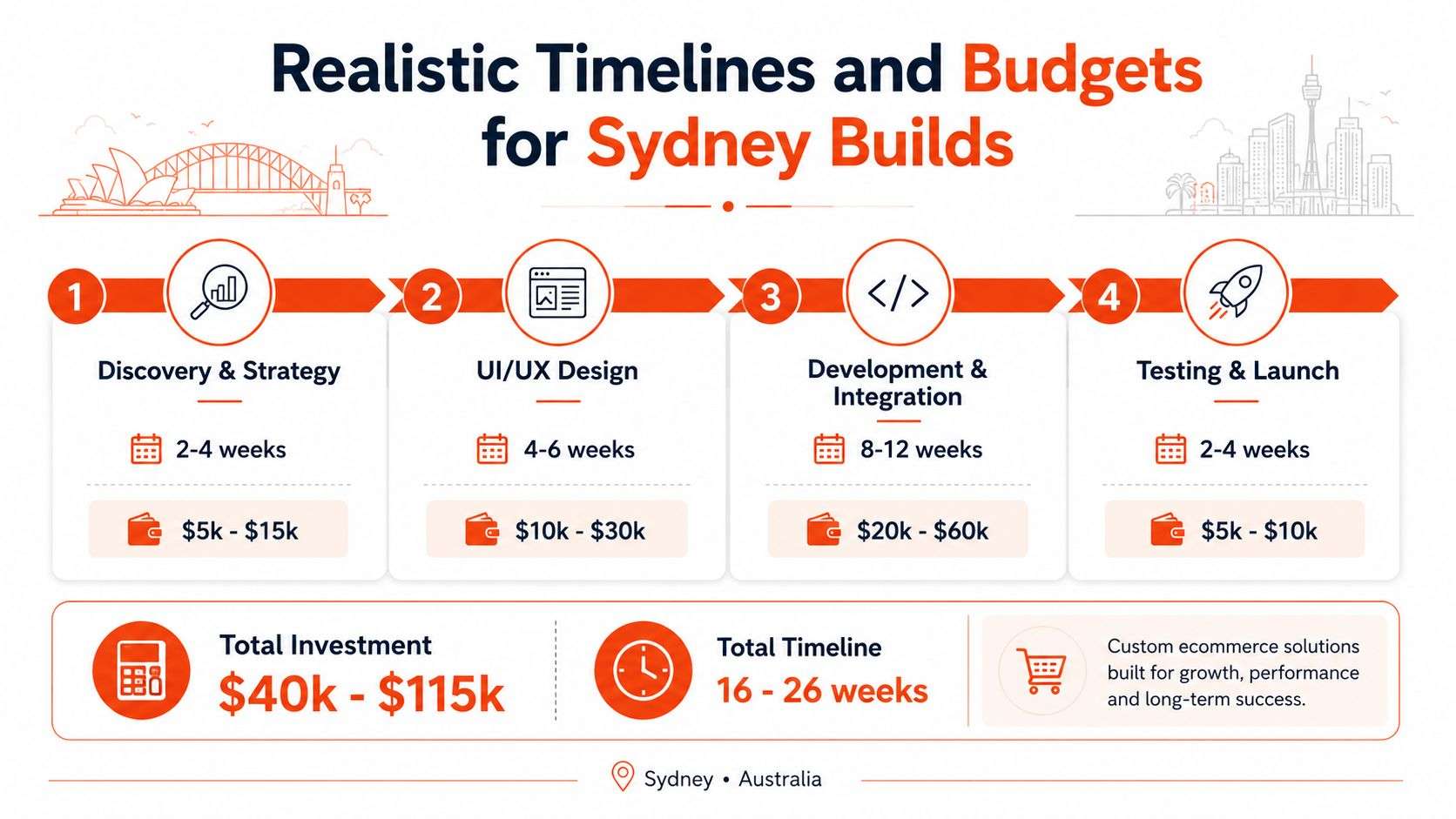
Australian industry sources place the average cost of eCommerce website development at AUD 20,000 to AUD 50,000+, with basic builds around AUD 8,000 to AUD 20,000 and high-end custom platforms exceeding AUD 50,000 source. Another Australia-focused benchmark places a basic MVP at about AUD $10,000 to $25,000, while complex builds with integrations and scalability requirements can reach AUD $50,000 to $250,000+ source. Those ranges widen fast once the project has to connect to accounting, fulfilment, or warehouse systems.
Where the time actually goes
A Sydney ecommerce build usually takes 8 to 16 weeks from kickoff to launch source. A more detailed Sydney benchmark breaks that into 2 to 3 weeks for discovery and planning, 3 to 4 weeks for design, 4 to 6 weeks for build, and 2 to 3 weeks for testing and refinement source. That sequence matters because a mismatch in product data, shipping logic, or checkout rules is much cheaper to fix early than during UAT.
A practical delivery model separates the work into discovery and strategy, UI/UX, development and integration, UAT, then launch and optimisation source. That structure stops the project being treated as a design job alone. It also forces buyers to price the integration work that sits under the storefront.
Budget rule: if an agency can't explain what's included in discovery, integration, testing, and post-launch support, the quote is not detailed enough to trust.
For businesses trying to reduce waste, the AUSFF cost reduction guide is a useful reminder that cost control comes from process discipline, not from cutting corners in the middle of a build. The same logic applies here. Cheap launches often turn into expensive rebuilds when the hidden systems work is left out.
Why hidden scope changes the quote
The visible part of the site, pages, menus, and design, is only one part of the budget. Operational scope includes ERP connections, shipping configuration, payment setup, analytics, and ongoing management, which is why Sydney project costs often look higher than a simple brochure-site estimate. If you want a clearer sense of sequencing, the ecommerce development timeline resource is the right place to start.
The cleanest budgets separate storefront costs from systems costs. Once that split is clear, quote comparisons become easier, and you can tell whether a proposal is lean or just incomplete.
Technical Requirements and Integration Essentials
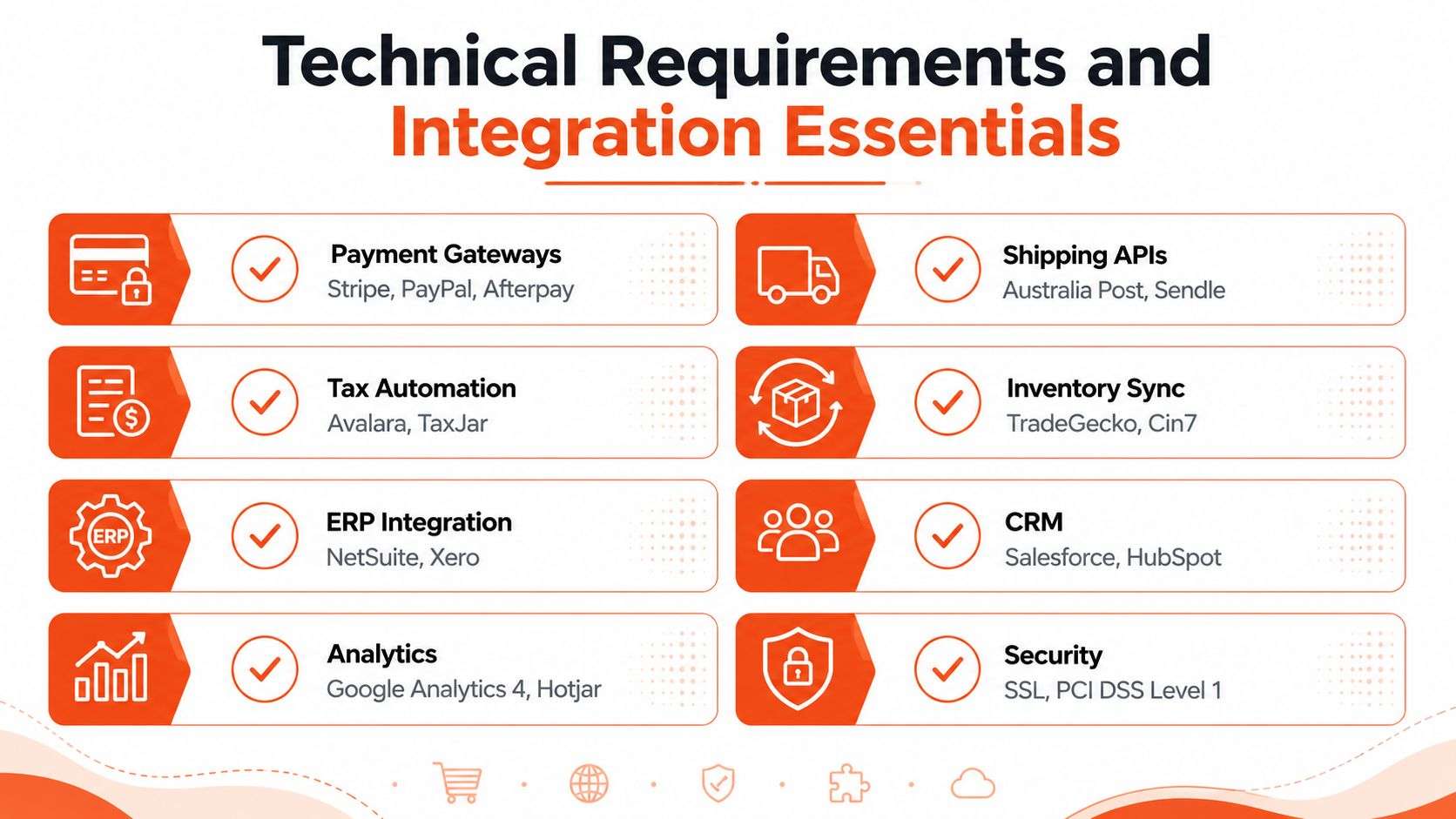
A Sydney ecommerce store works when the technical checklist is treated as essential. The job is not only to make products visible, it's to make every order flow correctly through payment, stock, fulfilment, and reporting without creating manual cleanup work.
Australian consumer-law guidance says ecommerce sites should display pricing inclusive of GST, publish a clear returns and refund policy, and ensure products match their descriptions source. The same guidance recommends targeting mobile page load time under 3 seconds and placing security cues such as SSL and payment badges near purchase decisions source. These aren't cosmetic details. They affect trust, conversion, and how often customer service has to intervene after checkout.
The checklist that saves rework
Start with payments. A Sydney store should support the options customers already trust, which in practice means payment flexibility aligned with the Australian market data cited earlier. Then add shipping logic, because inventory, postcode rules, and courier handoff are where many launches slow down.
For the operational side, Odoo implementation becomes valuable when product, order, and customer data need to stay in sync. That's why businesses looking at Odoo ERP should scope it early rather than bolting it on later. The same logic applies to CRM, reporting, tax handling, and fulfilment rules, because each connection adds testing burden.
One practical resource worth reviewing when you're comparing technical choices is WearView. It's a reminder that platform decisions are only useful when they support the entire customer journey, not just the front-end look.
Security and search need to be planned together
Security is not separate from conversion. The Australian Signals Directorate continues to emphasise controls like MFA, backups, and secure configuration for businesses operating online source. That makes the site architecture, admin access, and deployment process part of the ecommerce brief, not an afterthought for launch week.
SEO architecture also belongs in the technical scope. Clean URLs, crawlable category structure, and properly mapped product content should be designed from the beginning, because retrofitting SEO into a finished store usually means extra cost and duplicated effort. In practice, that's why a serious ecommerce website development Sydney project looks more like software delivery than graphic design.
If the agency's technical checklist doesn't mention security, shipping, analytics, tax, and search, the quote is missing the parts that usually cause the most pain.
Software development Sydney Adelaide conversations become relevant too, especially for businesses operating across more than one location or state. The same backend standards that support Sydney buyers also keep the rest of the operation consistent.
Practical Case Examples From Sydney Retailers
A fashion retailer in Sydney wanted a cleaner online storefront, but the core problem was stock visibility. The business used Shopify implementation for the customer-facing store and connected it to Odoo ERP so warehouse staff, online orders, and product availability could stay aligned. That setup reduced the mismatch between what shoppers saw and what the warehouse could fulfill.
A wholesale supplier with dealer pricing
A B2B industrial supplier needed something different. It wasn't a brand-led retail site, it was a portal with trade pricing, account-based access, and dealer login. WooCommerce was the right fit because the business wanted flexibility around customer roles and catalogue presentation, while the back-office team kept control over fulfilment rules and pricing tiers.
The challenge wasn't the front end. It was the logic behind who could see what, when pricing should appear, and how orders should move into operations without manual intervention. That's where experienced software development Sydney Adelaide support matters, because the site has to reflect how the company sells, not how a generic theme assumes selling works.
A hospitality group with multiple locations
A multi-location hospitality operator needed online ordering that didn't create stock confusion across venues. The winning approach was to integrate ordering with the existing inventory system, then keep menus, availability, and fulfilment aligned by location. That avoided the common problem of one store showing items that a nearby venue had already run out of.
The strongest ecommerce projects I've seen in Sydney are the ones where the online store behaves like part of the business, not a separate marketing asset.
An experienced ODOO partner Sydney Adelaide approach helps in situations like this because the conversation starts with workflows, not templates. That's also where odoo erp becomes a practical fit for businesses that need a single source of truth across ecommerce and operations.
These examples show why a standard build is enough for some stores and not enough for others. If your business needs trade pricing, multi-location inventory, or back-office automation, the platform choice and integration scope matter more than the theme pack.
How to Evaluate and Select Your Development Agency
Portfolio screenshots don't tell you whether an agency can deliver a live store that survives launch week. The better test is whether they can explain how they scope integrations, test edge cases, and support the business once orders start moving through the system. That's especially true for ecommerce website development Sydney projects, where the primary risk usually sits in operations rather than design.
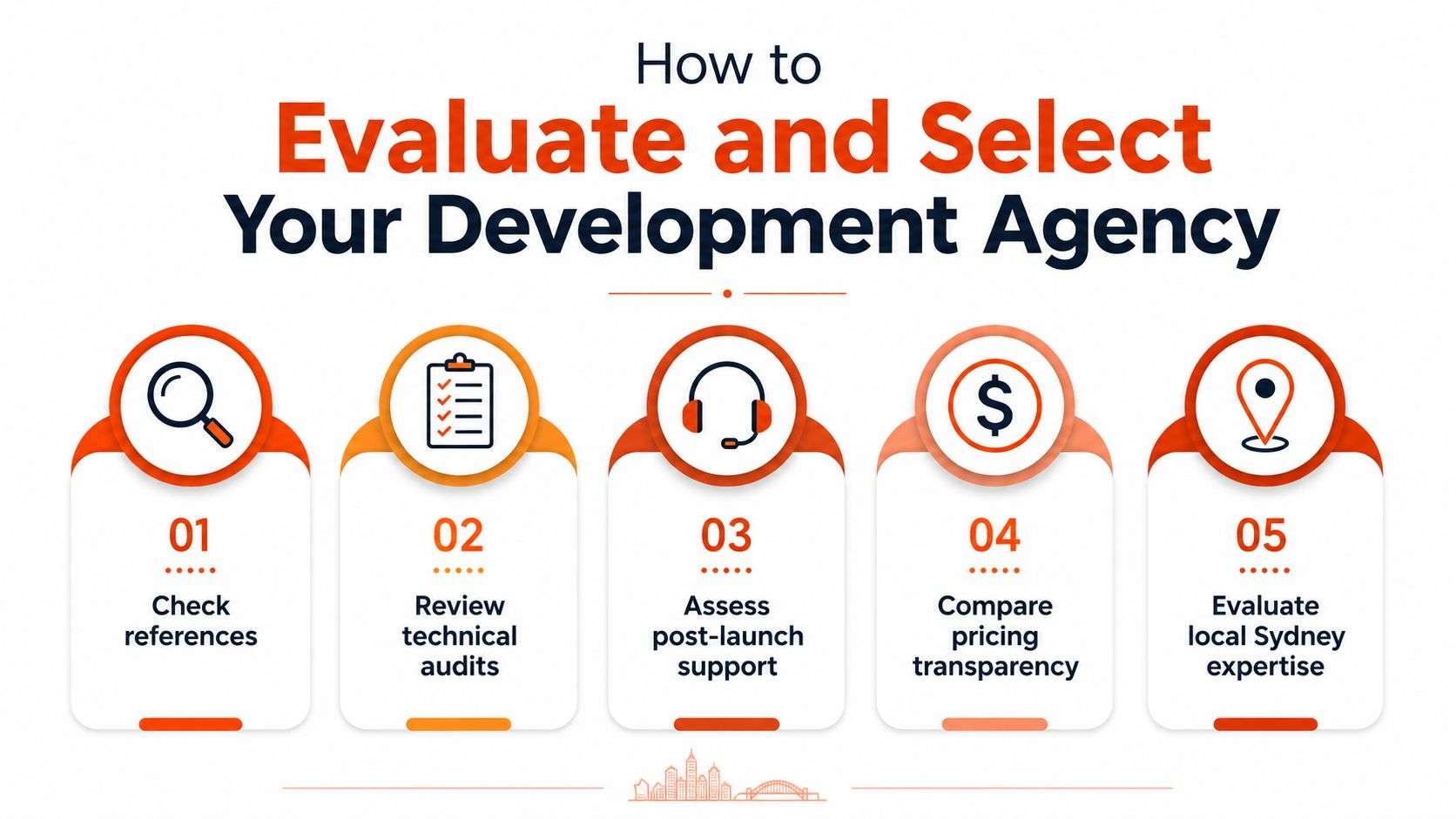
A practical way to assess agencies is to ask for evidence in five areas. First, check references that describe delivery quality, not just friendliness. Second, review technical audits or discovery outputs. Third, ask how they handle support after launch. Fourth, compare pricing transparency. Fifth, confirm they understand local Sydney retail conditions, including GST handling and shipping realities.
Questions that separate capability from presentation
Ask direct questions about Odoo implementation experience if ERP is part of the project. If the agency says they “can integrate anything” but can't describe the QA process for stock, orders, and refunds, keep looking. The same applies to Shopify implementation and WooCommerce work. Platform familiarity is useful only if the team can explain how they test real scenarios before launch.
The best agencies also distinguish between design approval and systems acceptance. That matters because a pretty mock-up can still hide a weak fulfilment workflow. If an agency can't explain how they validate payment paths, inventory sync, and post-launch support, their process is too shallow for a serious retail build.
Where a comparison resource helps
When you're shortlisting vendors, a structured guide like choose an ecommerce agency can help you compare beyond surface-level claims. Use it as a checklist, not as a substitute for asking hard questions in the sales call.
Red flag: if the proposal is heavy on homepage ideas and light on integration detail, the project will probably cost more later.
A good partner should sound comfortable talking about ecommerce as a production environment. That includes performance, support windows, release management, and the trade-offs between fast launch and long-term flexibility. It's the difference between an agency that sells a site and a team that can support a business.
Frequently Asked Questions About Sydney Ecommerce Development
Can I migrate platforms later without losing SEO rankings?
Yes, but only if the migration is handled carefully. Preserve key URLs where possible, map redirects properly, and keep product and category structure consistent so search equity doesn't disappear during the move.
What does Australian consumer law mean for an online store?
Your site should show GST-inclusive pricing, publish a clear returns and refund policy, and ensure the product matches its description source. Those basics reduce disputes and keep the store trustworthy.
What ongoing costs should I budget for after launch?
Plan for maintenance, support, security updates, plugin or app management, and changes to fulfilment or integrations. If your store uses Odoo ERP, Shopify implementation, or WooCommerce, ongoing care matters because the site is part of a live operating system, not a one-off asset.
When does headless commerce make sense?
Usually when a business has outgrown a standard monolithic build because channels, content, and operations need more independence. If the store is still relatively straightforward, a simpler architecture is often easier to maintain and faster to support.
Your Next Steps for Building a Sydney Ecommerce Store
If you're still exploring, start by mapping the business problem rather than asking for a generic quote. Decide whether the main challenge is checkout friction, stock visibility, trade pricing, or a back-office workflow that keeps breaking. That answer shapes the platform and the budget.
If you're ready to brief agencies, prepare a short document with catalogue size, integrations, fulfilment rules, payment preferences, and any ERP connection requirements. Include your growth expectations too, because the right build for today might be too small six months from now. That's especially true for projects involving Odoo implementation, Shopify implementation, or WooCommerce development.
If you already have proposals, compare them on scope clarity, testing depth, and post-launch support, not just price. The cheapest quote often leaves out the exact work that makes a store reliable in production. A strong partner should be able to explain the build as a system, from front-end experience through to operations.
Wistec builds ecommerce stores as working systems, including Odoo implementation, Shopify implementation, WooCommerce development, and end-to-end software development for Sydney and Adelaide businesses. If you're planning ecommerce website development Sydney and want a practical conversation about scope, integrations, and launch readiness, visit Wistec and start the discussion with a team that understands retail operations as well as platform delivery.