

Let’s be honest, "workflow automation" sounds a bit like corporate jargon. But strip away the buzzwords, and you're left with a brilliantly simple idea: creating a smart assembly line for your digital work.
Instead of your team manually pushing tasks from one person to the next, you build a system where technology does the heavy lifting. It follows a set of rules you define, handling the entire sequence without needing anyone to press a button. Think of it as teaching your software how to do the repetitive parts of your job for you.
So, What Is Workflow Automation, Really?
Imagine your business is a bustling café on a Monday morning. Without any systems, your staff are shouting orders, bumping into each other, and manually scribbling notes. It’s pure chaos, and mistakes are bound to happen.
Now, let's introduce workflow automation. It's like installing a slick conveyor belt that zips orders from the counter to the barista and then to the kitchen, all in perfect sequence. No dropped dockets, no forgotten flat whites. Just smooth, efficient service.
This digital conveyor belt runs on two core ideas: triggers and actions.
- A trigger is the starting pistol. It's the event that says, "Go!"
- An action is the job that gets done as soon as that pistol fires.
This simple cause-and-effect logic is the powerhouse behind every automated workflow you can think of.
This visual really brings to life how triggers kick off a series of actions to create a seamless, hands-off process.

As you can see, it all starts with that initial trigger, which sets the entire chain of events in motion, creating a reliable and predictable outcome every single time.
The Building Blocks of Workflow Automation
To make this crystal clear, let's break down the essential components that make any automated workflow tick. These are the fundamental parts you'll mix and match to build your own systems.
| Component | What It Is | Practical Case |
|---|---|---|
| Trigger | The event that starts the workflow. | A new lead fills out a contact form on your website. |
| Action | The task performed automatically in response. | The system sends an automated "Thanks for your enquiry!" email. |
| Condition | A rule that guides the workflow. | If the lead selected "Sales Enquiry" on the form… |
| Logic | The path the workflow takes based on the rule. | …then assign the lead to the sales team in the CRM. |
These building blocks are the foundation of everything from simple email alerts to complex, multi-step business processes. Once you understand how they fit together, you can start seeing automation opportunities everywhere.
Putting It All Together: Real-World Scenarios
Let's see how this plays out in the real world. Say your business has a Shopify store. When a customer completes a purchase, that's your trigger. The automated actions could instantly follow:
- Send a branded order confirmation email.
- Create a shipping label in your logistics software.
- Add the customer to your "Recent Buyers" email list for future marketing.
Or maybe your warehouse runs on Odoo. You could set a trigger for when a product's inventory drops below 50 units. The system’s action? It automatically generates and sends a purchase order to your supplier, preventing stockouts before they happen. No one even has to think about it.
The real win here isn't just about speed. It's about building an airtight system that executes perfectly every time. This frees up your team from mind-numbing repetition so they can focus on what actually matters: talking to customers, solving complex problems, and growing the business.
This same principle works everywhere. Whether it's a service desk in Adelaide, a team working on software development in Sydney, or an e-commerce store built on WooCommerce, the key is to spot those simple trigger-action opportunities. Finding and automating them is the first step to winning back countless hours of valuable time.
Ready to see how a smart automation strategy could reshape your operations? Contact Wistec today for a free consultation and let's uncover the potential waiting in your business.
The Real-World Impact of Automating Your Processes

It’s one thing to understand what workflow automation is, but it’s another thing entirely to see what it can do. Bringing automation into your business isn’t just about installing new software; it's about fundamentally rethinking how your business works, for the better. The results aren't just theoretical—they're real, they’re measurable, and they often show up sooner than you'd think.
One of the first things you’ll notice is the almost complete disappearance of human error from routine tasks. A tiny keyboard slip during data entry or a forgotten follow-up email can easily spiral into costly mistakes and frustrated customers. Automation is your safeguard, carrying out processes with perfect consistency, time and time again.
This newfound precision is what fuels huge leaps in efficiency. When your team isn't chained to manual, repetitive work, they get countless hours back. This isn't just about saving time; it's a golden opportunity to point your most valuable asset—your people's expertise—towards innovation, strategy, and building genuine customer relationships.
Boosting Productivity and Morale
When you automate the mundane, you do more than just help your bottom line; you improve your company culture. Let's be honest, tedious tasks are a fast track to burnout and disengagement. By taking them off your team's plate, you empower them to dive into the more fulfilling, strategic work that actually requires their unique skills.
This shift is profound. When people feel their work is meaningful, their job satisfaction and productivity skyrocket. They stop being process-followers and become problem-solvers, driving growth from within.
Australian businesses are already seeing this in action. Companies using AI-powered workflow automation are reportedly saving around 15 hours per week just by cutting out repetitive tasks. This translates into operational cost reductions of roughly 30% and far greater accuracy across the board. You can dive deeper into these findings on how AI is impacting Australian businesses.
Practical Cases in Action
So, what does this look like day-to-day for businesses here in Australia?
-
Retail & eCommerce: A practical case is a store on Shopify or WooCommerce where inventory alerts are automated. This simple step prevents stockouts and lost sales. In the same way, an automated abandoned cart email sequence can claw back revenue without anyone lifting a finger.
-
Professional Services: An accounting firm in Adelaide can set up automated invoice reminders, slashing the time it takes to get paid. A law firm can automate client intake forms, ensuring every crucial piece of information is captured correctly right from the start.
-
Manufacturing & Logistics: A business using an Odoo implementation in Sydney can trigger automatic purchase orders the moment stock levels dip. The production line keeps moving because it never runs out of a critical component.
These examples all point to the same truth: workflow automation delivers a serious competitive edge. Whether you're thinking about custom software development in Adelaide or just connecting the systems you already have, the goal is clear—to build a smarter, more resilient, and more efficient business.
Ready to see how automation can directly benefit your operations and free up your team to do what they do best? Reach out to Wistec for a personalised consultation, and let’s map out your path to greater efficiency.
How Smart Businesses Use Automation Every Day
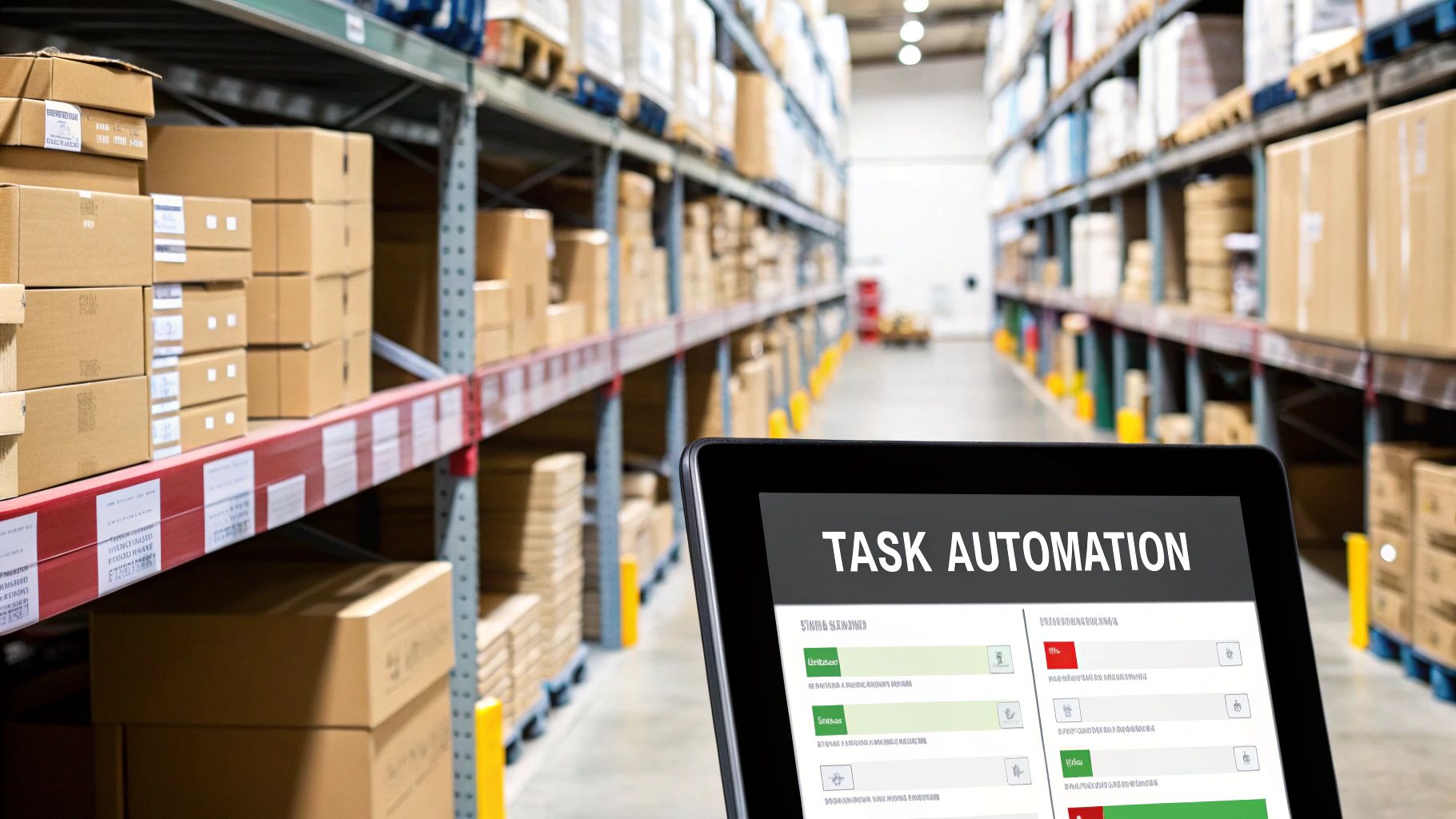
The real magic of workflow automation isn't in the theory; it's seeing how it solves messy, everyday business problems. This isn't about buzzwords. It’s about making tangible changes that save you time, cut your costs, and eliminate those constant headaches.
Let’s dive into how businesses in different sectors are putting these ideas into practice right now.
From bustling online stores to specialised professional services, automation has become the secret weapon for getting ahead. It gives small teams the muscle to operate like much larger companies and helps established players stay agile and responsive.
Powering Australian E-Commerce
For any retailer, an abandoned cart is lost money and a stockout is a customer you might never see again. This is precisely where a savvy Shopify implementation or a well-configured WooCommerce setup becomes a game-changer. Automation transforms these platforms from simple shopfronts into intelligent sales machines that work around the clock.
Think about these practical cases:
-
Abandoned Cart Recovery: A shopper is browsing, adds a few items to their cart, but gets distracted and leaves. That's the trigger. An automated workflow immediately kicks in, sending a sequence of friendly reminder emails over the next few days. It might even offer a small discount code to sweeten the deal. This one automation alone can recover a huge chunk of otherwise lost sales.
-
Smart Inventory Alerts: That bestselling product is flying off the shelves. When stock drops below a preset level (say, 10 units), an automated alert instantly pings the purchasing manager. More advanced setups can even auto-generate a draft purchase order, ensuring you never miss a sale because an item was out of stock.
These systems quietly tick away in the background, closing sales and stamping out problems before they even start.
Streamlining Professional Services Firms
Firms that live and breathe by their client relationships—accountants, lawyers, consultants—thrive on efficiency. The problem? They often get swamped by administrative work that eats into valuable billable hours. Workflow automation tackles this head-on.
A practical case is an accounting firm in Adelaide signing on a new client. Instead of a chaotic flurry of emails and paperwork, a slick onboarding sequence begins the moment the contract is signed.
The system automatically sends out a welcome pack, provides a link to schedule the kick-off meeting, and sets up a new client folder in the document management system. It's a flawless, professional first impression, every single time.
Invoice management is another massive win. An automated workflow can send invoices on a set schedule and then follow up with polite, persistent reminders for any that are overdue. This does wonders for cash flow and spares your team from the awkward job of chasing payments.
Accelerating Software Development Cycles
In the tech world, speed and precision are everything. Teams deep in software development in Sydney and Adelaide use automation to build, test, and ship code faster and more reliably than ever. This whole process is known as CI/CD (Continuous Integration/Continuous Deployment), and it's a non-negotiable part of modern development.
Here’s how it works. A developer commits new code, and that single action triggers an entire automated pipeline:
- Automated Builds: The system instantly compiles the new code.
- Rigorous Testing: It then runs a whole suite of pre-written tests to catch any bugs early.
- Deployment: If all the tests pass, the code is automatically pushed live.
This means developers can stay focused on what they do best: writing brilliant code, not getting bogged down in complex deployment logistics. It cuts down on human error and allows for incredibly fast iteration, which is a huge competitive advantage.
Orchestrating Entire Operations with Odoo
For businesses that want to connect every single part of their operation, an Odoo implementation in Sydney or Adelaide acts as a powerful central nervous system. Odoo brings everything—sales, CRM, manufacturing, inventory, accounting—under one roof. This total integration is the perfect playground for creating truly sophisticated, end-to-end automations.
Imagine a practical case where a sales rep closes a deal in the CRM. That one click can set off a chain reaction: the finance team gets an alert to generate an invoice, the warehouse receives the order to start packing, and inventory levels are updated across the board in real-time. This is what a truly seamless business looks like.
These real-world examples prove that workflow automation isn't some far-off concept. It's a practical, powerful tool that smart businesses are using right now to solve their biggest challenges.
Ready to find out how these strategies can be applied to your specific business needs? Get in touch with the experts at Wistec for a no-obligation chat about building your automation roadmap.
Building Your First Automation Strategy
Jumping headfirst into workflow automation without a clear plan is a classic mistake. It’s like starting a road trip without a map – you’ll definitely be moving, but you’ll have no idea if you're heading in the right direction. Real success isn't about the software you pick; it's about the thinking you do before you spend a single dollar. This is your game plan for getting it right from the get-go.
Your journey doesn't start with tech. It starts with a simple, honest question: "Where are our biggest holdups?" The best place to start is with tasks that are high-volume, mind-numbingly repetitive, and strictly follow a set of rules. This is the low-hanging fruit, the stuff that gives you the biggest, fastest wins right out of the gate.
Identifying the Perfect Processes to Automate
Before you can fix a problem, you have to know exactly what it is. Start looking for the friction in your daily operations. Where do things slow down? What tasks are notorious for human error? What work simply drains your team's morale and energy? A great place to start is to just ask them what parts of their job they wish they could ditch forever.
You're hunting for processes with a few key tells:
- Manual Data Entry: Think of all the copying and pasting. Maybe it's moving customer details from a web form into your CRM or manually updating a spreadsheet.
- Routine Approvals: Simple, everyday sign-offs for things like leave requests or small expense claims that always follow the same predictable path.
- Standardised Reporting: Those weekly or monthly reports that someone has to painstakingly pull together from three different places.
- Repetitive Notifications: Sending the same update emails or alerts over and over, like order confirmations or appointment reminders.
The real secret is to find a process where the rules are black and white. If you can map it out with simple "if this, then that" logic, you've found a golden ticket for automation. That clarity is what makes for a smooth and successful rollout.
Once you’ve got a shortlist, pick the one that will deliver a quick, visible win. This builds momentum and gets everyone on board and excited about what's coming next.
Choosing the Right Tools for the Job
The tool you choose has to fit the job you need it to do. For simple tasks that just need to connect two apps, something like Zapier can be a brilliant choice. It’s perfect for linking cloud-based tools, like automatically creating a Trello card whenever a specific email lands in your inbox.
But as your ambitions grow, so will your need for more powerful solutions. A strategic Shopify implementation or a well-configured WooCommerce setup can run your entire e-commerce backend, from stock levels to customer follow-ups. For businesses needing a single source of truth, a full Odoo implementation in Sydney can connect every department, from sales and inventory to manufacturing. And sometimes, you'll hit a unique challenge that calls for custom software development in Adelaide to build a solution that fits your business like a glove.
Getting Your Team on Board
Honestly, this is the most critical step of all. Automation can be an incredible ally, but if your team views it as a threat, your project is dead on arrival. The key is to frame automation for what it actually is: a tool to get rid of the boring, soul-crushing parts of their job so they can focus on the interesting, high-value work they were actually hired to do.
Bring your team into the conversation from day one. Ask for their input on which processes are the most frustrating and ripe for automation. When you launch that first workflow, make a big deal of it. Celebrate the time saved and the errors that have vanished. Make it crystal clear that the goal is to make them better at their jobs, not to replace them.
By focusing on high-impact tasks, picking the right tools, and leading the change with your team, you're not just automating tasks—you're building a smarter, more resilient business.
Ready to map out your own automation strategy? Contact Wistec for an expert consultation and let's find the opportunities that will make the biggest difference for your business.
The Next Wave: AI in Workflow Automation

Traditional workflow automation is brilliant at following a script. Think of it as a loyal assistant who perfectly executes a checklist you’ve laid out. But what happens when a task demands a bit of judgement, some interpretation, or the ability to learn from what happened last time?
This is precisely where Artificial Intelligence (AI) comes in, taking automation from a simple rule-follower to an intelligent decision-maker.
AI gives automation a brain. While standard automation is built on rigid "if this, then that" logic, AI-powered systems can handle the shades of grey. They understand context, spot patterns in massive amounts of data, and actually adapt their actions over time. This isn't just a minor upgrade; it’s the difference between a basic calculator and a data scientist.
From Following Rules to Making Decisions
The leap from standard automation to AI-powered automation is huge.
A practical case is a standard workflow filing incoming invoices based purely on a vendor's name. It works, but it's limited. An AI-powered workflow, on the other hand, can read the entire invoice—line items, dates, and amounts—and then decide which department budget to code it to, all without needing a specific rule for every single supplier.
This intelligent capability opens up a whole new world of possibilities for your business:
- Intelligent Chatbots: Instead of just spitting out pre-written answers, AI chatbots can understand what a customer is really asking for, pull up their order history, and provide genuinely helpful, personalised solutions to complex problems.
- Predictive Analytics: An AI system can analyse sales data to not just report on last month's numbers, but to accurately forecast future demand. This helps a WooCommerce store owner make much smarter inventory decisions.
- Automated Document Processing: AI can read and understand unstructured documents like contracts or resumes, pulling out key information and feeding it into the right systems—a job that was once strictly manual.
This shift moves automation from simply handling the tasks of your business to truly understanding the data of your business. It’s a powerful change that unlocks deeper insights and creates more robust, adaptable processes.
AI Automation in Action Across Australia
This isn't just some far-off concept; it’s happening right now. A sophisticated Odoo implementation in Sydney, for example, could use AI to analyse production line data, predicting when a machine needs maintenance before it breaks down. This proactive approach stops costly downtime in its tracks.
Even government bodies are proving the incredible scale and reliability of this technology. By late 2024, Services Australia had put over 600 automated processes to work. These systems range from Optical Character Recognition (OCR) that reads digital forms to AI-powered tools like the myGov Digital Assistant, which successfully handles millions of citizen enquiries every year. You can read more about the full scope in Services Australia's automation strategy.
Whether it’s a Shopify implementation using AI to personalise customer shopping experiences or a custom software development in Adelaide creating predictive models, AI is making workflow automation smarter, faster, and more valuable than ever before. It's the engine that will power the next generation of business efficiency.
Are you ready to explore how intelligent automation can transform your operations? Connect with Wistec today for a free consultation, and let's discuss how AI-powered solutions can give your business a decisive competitive advantage.
Your Game Plan for Getting Started
So, you're ready to get automation working for your business? That's great. The secret is to forget about boiling the ocean and instead focus on a clear plan that gets you some early wins. It's all about building momentum, one smart step at a time.
The best place to kick things off is with a single, low-risk process. Have a think about the daily grind—what are the little tasks that constantly create bottlenecks or just suck the life out of your team? Maybe it's the mind-numbing data entry for new leads, the endless cycle of chasing up invoices, or answering the same customer questions over and over.
Pick one of those repetitive, rules-based tasks. Automating it will give you a quick, tangible result and, just as importantly, show everyone on your team what’s possible.
Finding the Right Partner for the Big Picture
Once you’ve had a taste of what automation can do, you'll naturally start thinking bigger. For those more ambitious projects, bringing in the right technology partner is absolutely crucial. The kind of expertise you need really depends on what you're trying to achieve.
-
Mastering E-commerce: If you’re running an online store, a partner who lives and breathes Shopify implementation or WooCommerce can build incredible workflows for your inventory, order processing, and customer messages.
-
All-in-One Business Management: For businesses wanting to connect every single department—from the accounts team to the factory floor—an expert in Odoo implementation in Sydney can create one unified system that handles it all.
-
Truly Custom Solutions: Sometimes, off-the-shelf software just doesn’t fit. That’s when you need a team that’s brilliant at custom software development in Sydney or Adelaide to build a solution that’s a perfect match for how you actually operate.
Here’s the most important part: define your goals before you do anything else. You need to know exactly what success looks like. Is it slashing invoice processing time by 50%? Or maybe it's boosting your lead follow-up speed? Whatever it is, set clear benchmarks to measure your progress.
Getting this clarity from the start means every dollar you invest is tied directly to a real business result. It turns automation from a fuzzy concept into a laser-focused strategy for making your business more efficient and profitable. Start small, get that first win, and then scale up intelligently with the right people by your side.
The path to a smarter, more automated business starts with that first move. Whether you need to get your Shopify and WooCommerce stores running like clockwork, are considering a full Odoo implementation in Adelaide, or need something built from scratch, having the right expertise in your corner changes everything.
Ready to transform how you operate? Contact Wistec today for an expert chat about your specific automation goals.
Got Questions About Workflow Automation? We've Got Answers
Thinking about what workflow automation could do for your business will naturally bring up a few questions. To help you feel confident about taking the next step, we’ve answered some of the most common queries we hear from business leaders just like you.
Let's cut through the noise and get you the clear, straightforward information you need to make smart decisions.
Is Workflow Automation Just Another Name for Business Process Management?
It's a great question, and while they're definitely related, they aren't the same thing. The easiest way to think about it is like this: workflow automation is the powerful tool you use for a specific job, like automatically approving an expense claim or getting a new team member set up. It’s the engine that gets the task done.
Business Process Management (BPM), on the other hand, is the much bigger picture. BPM is the entire strategy of looking at your business from end to end, then analysing and improving your core processes to make everything run better. Automation is a massive part of a modern BPM strategy, but BPM itself is the overall game plan.
What's the Real Cost of Putting Workflow Automation in Place?
The investment can really vary. It could be as simple as a small monthly fee for a basic tool that connects two of your apps, or it might be a more involved project like a custom software development in Sydney or a full Odoo implementation in Adelaide.
But honestly, the best way to look at it isn't the cost, but the return you get on that investment. A properly planned automation project should always pay for itself—and then some—by saving time, slashing costly errors, and boosting productivity across the board.
Try this: calculate the actual cost of just one repetitive manual task in your business. Once you add up the staff hours and the risk of human error, the value of automating it usually becomes crystal clear.
Can My Small Business Actually Benefit from This?
Absolutely. In fact, small businesses often feel the biggest and most immediate impact. When you're running a lean team, every single hour you can win back from repetitive admin is an hour you can pour directly into what really matters—making sales, delighting customers, or developing new ideas.
Automating a few key tasks can completely level the playing field, letting you operate with the kind of efficiency and polish you'd expect from a much bigger company. Just think about the difference automating tasks like these could make:
- Order Fulfilment: If you're running a Shopify implementation or a WooCommerce store, automating order processing and shipping updates is a total game-changer for your customers and your sanity.
- Client Onboarding: Service-based businesses can automate welcome emails, contract signing, and info gathering to create a seamless and professional first impression.
- Invoice Reminders: Automatically chasing up unpaid invoices means better cash flow without having to make those awkward follow-up calls.
These aren't massive, complex changes. They're simple automations that free up your most important asset—your people—to focus on growing the business.
Ready to see how a smart automation strategy can deliver real results for your business? Wistec delivers solution-driven technology that simply works. Whether you need a powerful Odoo ERP, a high-converting website, or custom software, we build practical solutions that help you succeed.
Start your journey to greater efficiency by contacting Wistec for a free consultation today.