

At its heart, an eCommerce platform is the engine that powers your online store. It's the essential software that lets you build, manage, and grow your business on the internet without needing to code everything from scratch.
Think of it as your digital headquarters. It's where you list your products, process customer orders, and handle payments, all from one central dashboard. For any business, from a startup to a large enterprise, choosing the right platform is a critical first step.
What Is an eCommerce Platform Explained

If you were opening a physical shop, you wouldn't start by manufacturing your own bricks and mortar. You'd rent a space that already has walls, electricity, and plumbing. An eCommerce platform does the exact same thing for you in the digital world.
It’s so much more than a simple website. It’s a complete, commerce-focused system that brings together all the different tools you need to run a successful online retail operation.
The Tools That Build Your Digital Store
To really get what an eCommerce platform does, it helps to see how its core components work together. Each piece of the puzzle acts like a part of a traditional brick-and-mortar store, giving your customers a familiar and seamless shopping experience.
Here’s a quick look at the essential tools that come built-in, and what they do for your business.
Core Components of an eCommerce Platform
| Component | Function (What It Does) | Business Analogy |
|---|---|---|
| Website Builder | Lets you design your store's appearance, pages, and navigation. | Your store's layout, paint colours, and window displays. |
| Product Management | Allows you to add products, descriptions, images, and prices. | The shelves and racks where you display your merchandise. |
| Shopping Cart | Enables customers to select and hold items before purchasing. | A customer's shopping trolley or basket. |
| Checkout & Payments | Securely processes customer payments via credit cards, PayPal, etc. | The cash register or point-of-sale (POS) terminal. |
| Order Management | Tracks orders from purchase through to fulfilment and shipping. | Your back-office system for managing sales and stock. |
Essentially, these tools work in concert to create a smooth journey for your customer, from the moment they land on your site to the second their order is confirmed.
A great platform doesn’t just sell products—it builds trust, tells a story, and makes shopping feel effortless. It’s the engine that powers your entire online business, from the first click to the final checkout.
Practical Case: A small startup looking to launch quickly might choose a Shopify implementation for its ease of use. In contrast, a growing wholesaler in Adelaide needing a custom WooCommerce solution would need a platform that can handle complex B2B features. For larger businesses, integrating these platforms with an ERP through an Odoo Partner in Sydney or engaging in custom software development in Sydney or Adelaide can create a powerful, unified system that scales.
Ready to find the perfect foundation for your online business? Contact us today for a consultation and let's discuss your next project.
What's Really Powering Your Online Store?
Think of your eCommerce platform as less of a website and more of a central hub for your entire retail business. While a great-looking storefront is what your customers see, the real work—the heavy lifting—happens behind the curtain. This is the engine that drives sales, keeps your operations smooth, and ultimately, fuels your growth.
To really get your head around what an eCommerce platform is, you need to look beyond the surface. It’s the collection of core functions that transforms a simple digital shop into a serious sales machine, taking care of tedious tasks so you can focus on the bigger picture.
The Features That Actually Matter
A solid platform isn't just a blank slate; it comes packed with tools designed to manage every corner of your business. These aren't just nice-to-haves; they are absolutely fundamental to running a modern online store.
Take inventory management, for example. A robust system will automatically track your stock levels in real-time. When you sell a product on your site, on a marketplace, or in-store, the count updates everywhere. This simple feature is what stops you from accidentally selling the same item twice and having to disappoint a customer.
And then there's payments. A modern platform must connect smoothly with trusted gateways like Stripe or PayPal. Offering secure, familiar payment options is non-negotiable—it builds trust at the most critical moment and is one of the easiest ways to reduce abandoned carts.
You can judge a platform's real worth by how well it simplifies your day-to-day operations. Every feature, from marketing tools to customer service integrations, should work together to create a seamless experience for you and your customers.
How It Works for Aussie Businesses
Let’s bring this down to earth with a couple of real-world examples. Picture a fashion boutique in Adelaide. They use their platform's built-in customer relationship management (CRM) features to see who their best customers are and what they like to buy. This allows them to send out targeted emails with special offers, building a loyal community around their brand.
Or, think about a parts manufacturer based in Sydney. By using the platform's search engine optimisation (SEO) tools, they can make sure their product pages rank high on Google. Suddenly, their website isn't just an online catalogue—it's actively generating high-quality B2B leads.
Seeing these examples in action makes it clear that a platform is a powerful strategic asset. If you want to dive deeper, checking out real-world eCommerce platform case studies is a great way to see the tangible results they deliver.
Whether it’s a Shopify implementation for a fast-growing retail brand or a custom WooCommerce solution for a B2B operation with complex needs, the power of the right engine is undeniable. For businesses aiming for ultimate efficiency, an Odoo implementation from an Odoo Partner in Sydney can link your online store directly to your core business systems.
Ready to find the right engine for your business? Our experts in software development in Sydney and Adelaide are here to help you navigate your options and build a solution that works. Contact Wistec today for a free consultation and let's get started.
Choosing Your Digital Storefront: SaaS vs Open-Source
One of the very first, and most important, decisions you'll make is the type of eCommerce platform you build on. This is a real fork in the road. You’re essentially choosing between two distinct philosophies: Software-as-a-Service (SaaS) and open-source.
Think of it like setting up a physical shop. You could rent a ready-made retail space in a bustling shopping centre, or you could buy a block of land and build your store from the ground up. Each path has its own massive advantages and trade-offs.
A SaaS platform like Shopify is your fully-furnished apartment or turnkey retail space. For a predictable monthly fee, you get everything you need to start selling almost immediately. The hosting, security, updates, and technical support are all handled for you. It’s built for speed and convenience, making it a fantastic choice for businesses that want to get online fast without a team of developers.
On the flip side, an open-source platform like WooCommerce (which runs on WordPress) is like being handed the architectural blueprints to your dream home. The core software itself is free, but that's just the starting point. You are in the driver's seat for everything else—sourcing the land (hosting), managing the construction (development and design), and handling the ongoing maintenance (security patches and updates).
This approach gives you complete freedom to build exactly what you want, tailored perfectly to your business's unique quirks and processes.
The Trade-Off Between Convenience and Control
Let's be clear: one isn't inherently "better" than the other. The right choice comes down to what you value most for your business right now.
Is your priority speed-to-market and simplicity? Or is it total control and long-term, deep customisation? It’s a classic balancing act between ease of use and ultimate flexibility.
To help you visualise this, here’s a quick comparison of the two models.
SaaS (Shopify) vs Open-Source (WooCommerce) At a Glance
This table breaks down the core differences to help you see which model aligns with your business needs, technical comfort, and budget.
| Feature | SaaS (e.g., Shopify) | Open-Source (e.g., WooCommerce) |
|---|---|---|
| Upfront Cost | Low; starts with a monthly subscription. | Potentially low for the software, but high for development. |
| Ongoing Cost | Predictable monthly fees plus transaction fees. | Variable; includes hosting, maintenance, and developer costs. |
| Ease of Use | Very high. User-friendly interface designed for non-tech users. | Steeper learning curve; requires technical knowledge. |
| Speed to Launch | Fast. Can be set up in days. | Slower. Custom development takes weeks or months. |
| Customisation | Limited to themes and available apps. | Virtually limitless. You can modify anything. |
| Maintenance | Handled by the platform provider. | Your responsibility. You manage all updates and security. |
| Support | Included via 24/7 support channels. | Community forums or paid support from developers/agencies. |
Ultimately, SaaS gets you selling faster with less technical headache, while open-source offers a path to a truly bespoke solution, provided you have the resources to build and maintain it.
What This Looks Like in the Real World
Let's make this practical. Imagine a new fashion startup in Sydney. Their main goal is to launch their brand, test the market, and start generating buzz. For them, a Shopify implementation is a no-brainer. The platform’s all-in-one nature lets them go from an idea to their first sale in a week, allowing them to focus on what they do best: marketing and design. While there are some Shopify limitations and solutions, the incredible speed is a game-changer for a new venture.
Now, consider a growing B2B wholesaler in Adelaide with a complex inventory system and unique freight rules. A standard SaaS platform would feel like a straightjacket. They need their online store to talk directly to their specialised logistics software and internal systems.
By choosing a custom WooCommerce solution, they gain total control. This investment allows them to build a powerful, one-of-a-kind platform that works precisely the way their business operates. It’s also the ideal foundation for a deep Odoo implementation, as an open-source site can be perfectly moulded to sync with their ERP—a complex task best handled by an Odoo partner in Sydney or an expert in software development in Adelaide.
Your choice here will set the entire tone for your online strategy. SaaS prioritises simplicity and speed, while open-source is an investment in unparalleled flexibility and business-specific functionality.
Not sure which path is right for your business? It can be a tough call. Our team is here to help you weigh the pros and cons for your specific situation.
Contact Wistec today for a personalised consultation and let's map out the perfect digital storefront for your goals.
Capturing the Australian eCommerce Opportunity
The way Australians shop has fundamentally changed, and there’s no turning back. This isn't just a minor trend; it’s a seismic shift that presents a massive opportunity for your business—whether you’re in retail, manufacturing, or even professional services. To stake your claim in this booming market, an eCommerce platform isn't just an option; it's essential.
This change is all about consumer behaviour. Aussie shoppers have moved online for good, setting a new benchmark for how businesses need to operate to stay relevant. A solid digital storefront is no longer a 'nice-to-have'—it's the very foundation of a modern, resilient business.
Think of it like choosing a physical location. You could rent a spot in a busy shopping centre that’s ready to go, or you could build your own flagship store from the ground up. The infographic below perfectly illustrates this classic choice, comparing a ready-made solution like Shopify to a custom-built home with WooCommerce.
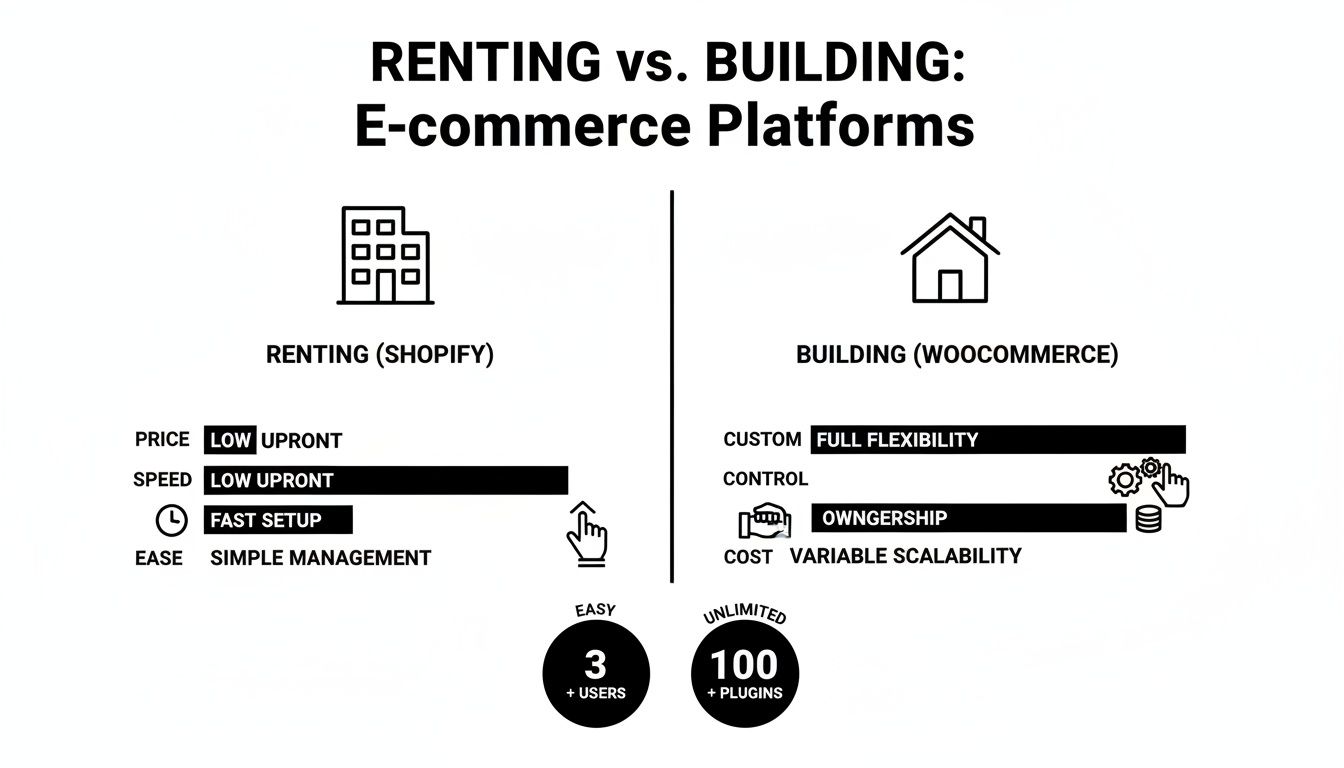
As you can see, it’s a trade-off. Shopify gets you up and running quickly, while WooCommerce offers deep customisation and control for businesses with more complex or unique requirements.
Tapping Into Australia's Digital Gold Rush
The numbers speak for themselves. In 2023, Australia's eCommerce market exploded to an incredible $63.6 billion in spending. That accounts for 16.8% of all retail sales—a huge leap from pre-pandemic figures that proves online shopping is now a permanent part of our culture.
And this growth isn't just a big city phenomenon. Regional areas are actually outpacing the metros, with online purchasing growing by a staggering 18% since 2019. For businesses in Adelaide or those serving rural communities, this opens a direct line to customers who were once out of reach. An effective eCommerce platform closes that distance instantly.
Strategic Platform Choices for Growth
This is where understanding what an eCommerce platform really is becomes critical. Practical Case: A small retail startup might get off the ground fast with a Shopify implementation to start generating sales immediately. On the other hand, a larger Adelaide-based manufacturer might require the power and flexibility of WooCommerce to handle complex inventory and integrate with its existing ERP system.
For Australian businesses, the question is no longer if you should sell online, but how you can do it most effectively. The right platform is the engine that turns market statistics into real, tangible revenue.
This is where having an experienced guide makes all the difference. Whether you need an agile Shopify store or a completely bespoke build with custom software development in Sydney or Adelaide, the end goal is the same: creating a powerful sales channel that works for you.
For ultimate efficiency, a specialist Odoo Partner in Sydney can even perform an Odoo implementation that seamlessly connects your new eCommerce front-end with your back-end operations.
Ready to claim your piece of the Australian market? Our expertise in web and eCommerce development can help you build the perfect solution to drive your business forward. Contact us today for a strategic consultation.
Integrating eCommerce with Your Core Business Systems
Running an online store that’s cut off from the rest of your business is a surefire way to create headaches and lose money. The real magic happens when you realise what an eCommerce platform is at its core: not just a digital shopfront, but a connected hub for your entire operation. Its value truly skyrockets when it talks flawlessly with your other critical business software.
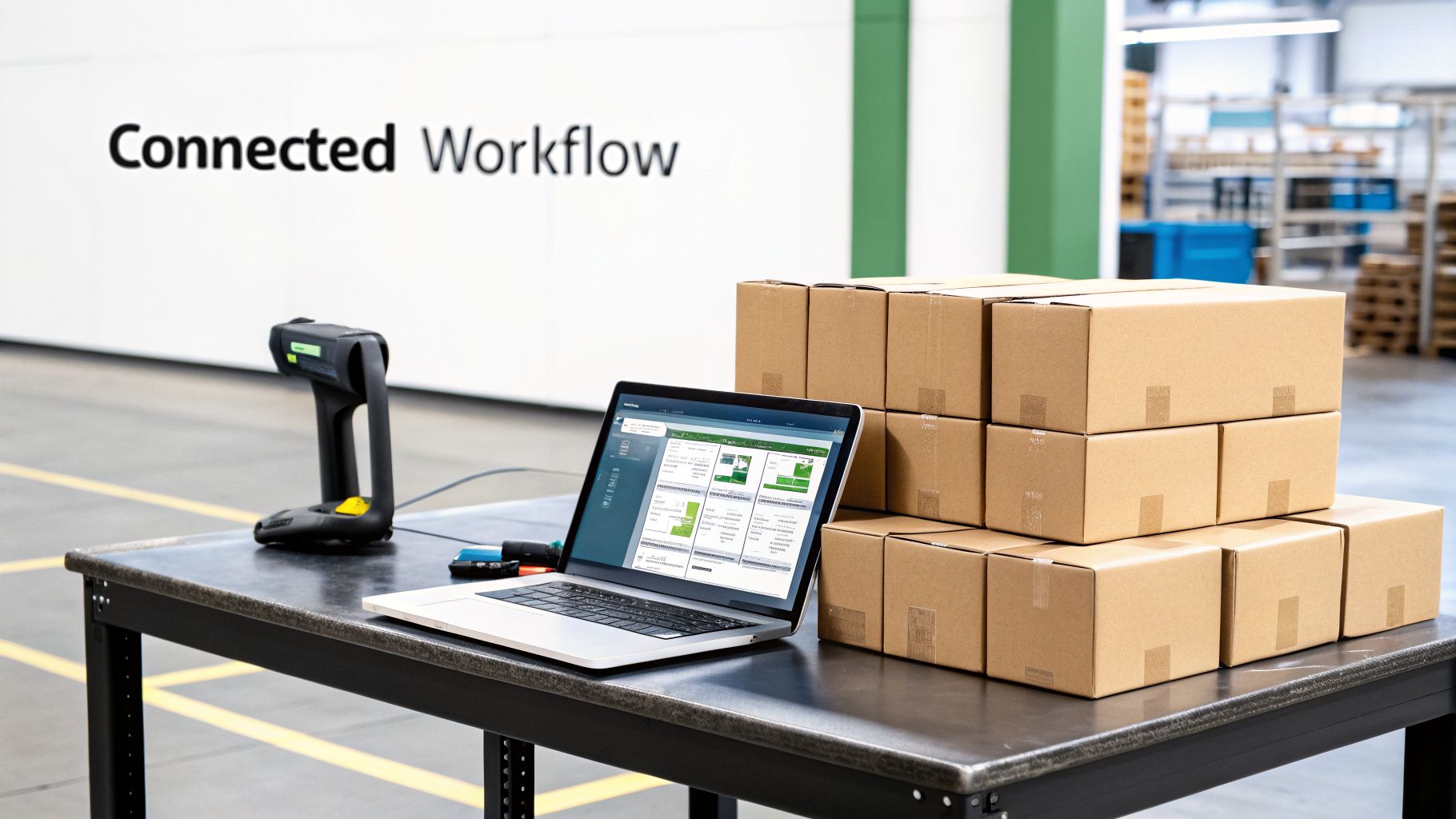
Think of your eCommerce site as your hardest-working salesperson. For that salesperson to do their job properly, they need instant access to information from the warehouse (what's in stock?), accounting (who has paid?), and production (when will more be ready?). Without that live connection, you're stuck manually punching in data, which always leads to costly mistakes, overselling stock, and frustrating shipping delays.
The Strategic Power of an Odoo Implementation
This is where linking your store to an Enterprise Resource Planning (ERP) system gives you a massive advantage. An ERP like Odoo acts as the central nervous system for your business, and a well-executed Odoo implementation ensures every department is working from the same script.
When your eCommerce platform and ERP are perfectly in sync, you unlock a whole new level of control. An online order can automatically update inventory levels, trigger a shipping label to be printed, alert the warehouse team, and generate an invoice—all without a single person lifting a finger.
This automation transforms a simple online store into a lean, self-managing machine. It’s the key difference between just selling online and building a scalable business that's ready for serious growth. With Australian online spending hitting AU$56.07 billion in 2024, you need this kind of efficiency just to keep pace, let alone get ahead. For a deep dive into these numbers, check out the latest Australian eCommerce market research on researchandmarkets.com.
How Integration Works in the Real World
Let's look at a practical example. Imagine a manufacturing business in Sydney that sells custom parts through its WooCommerce store. Before they integrated their systems, their workflow was a chaotic mess of spreadsheets and back-and-forth emails between the sales and production teams.
By working with an Odoo Partner in Sydney, they connected their WooCommerce site directly into their Odoo ERP. Now, the moment a customer places an order, the system automatically kicks off a perfect chain reaction:
- It first checks the real-time stock of raw materials in Odoo.
- Then, it creates a new production order for the factory floor.
- It even schedules the job based on current machine availability.
- Finally, it syncs the shipping details back to the customer's account in WooCommerce.
This strategic software development in Sydney completely overhauled their operations. It wiped out human error, dramatically shortened order fulfilment times, and gave management a crystal-clear, live view of the entire business from one dashboard. Our software development team in Adelaide is equipped to deliver these same powerful, business-changing results.
Connecting your platform isn't just a tech upgrade; it's a fundamental business strategy. You can learn more about POS software integration in our detailed guide.
Ready to build a connected, automated, and highly efficient eCommerce business? Contact Wistec today for a free consultation.
It's Time to Build Your eCommerce Future
You’ve seen what an eCommerce platform can do, from the basics of SaaS and open-source to the incredible power of integration. The theory is one thing, but turning that knowledge into action is what will define the future of your business. This next step isn’t just about technology; it’s a strategic move.
The Australian market isn't standing still. With online shopping projected to hit a staggering $64.9 billion by 2026, the opportunity is massive. To claim your piece of that pie, you need more than a simple website—you need a smart game plan. A modern ecommerce content marketing strategy is crucial for standing out and winning over customers in this crowded space. You can dig deeper into these growth figures in IBISWorld's industry report.
Your Partner in Digital Growth
Whether you need to get to market quickly with an expert Shopify implementation or require the deep customisation that WooCommerce development in Adelaide offers, the right partner changes everything. For businesses looking to truly unify their operations, a powerful Odoo implementation from an official Odoo Partner in Sydney can connect your sales front-end directly to your core business processes.
This is exactly where our expertise in software development in Sydney and Adelaide shines. We don’t just build websites; we engineer growth engines specifically designed for the unique challenges and opportunities here in Australia.
Don’t let analysis paralysis stall your progress. Every day you wait is another day your competitors are engaging with your potential customers. The most successful businesses are the ones that act decisively.
The time for waiting is over. Let's start building. You have business goals, and we have the technical skill to make them a reality.
Contact Wistec today for a no-obligation chat. Let's explore how we can build the perfect eCommerce solution to hit your specific targets.
Your eCommerce Platform Questions, Answered
Alright, we’ve covered a lot of ground. It's completely normal if you still have a few questions swirling around. Let's tackle some of the big ones we hear all the time from Aussie business owners just like you.
How Much Will an eCommerce Platform Actually Cost?
That's the million-dollar question, isn't it? The honest answer is: it depends entirely on the path you take and how unique you need your store to be.
With a SaaS platform like Shopify, you get a nice, predictable monthly bill. Think somewhere between $40 and $400 a month, plus a small cut of each sale. It's a fantastic way to keep your initial outlay in check and manage your budget.
On the other hand, you've got open-source options like WooCommerce. The software itself won't cost you a cent to download. But don't let that 'free' tag fool you—the real costs are in the implementation. You're paying for hosting, essential plugins, and the expertise of a software development team in Sydney or Adelaide to piece it all together. This could be a few thousand for a simple store or climb into the tens of thousands for something truly bespoke.
Can I Change Platforms Later On?
Yes, you absolutely can, but it’s not a task to take lightly. Think of it like physically relocating your entire retail store overnight—every product, every customer file, and every single sales record has to be packed up and moved to a new building.
A platform migration involves a meticulous transfer of product data, customer accounts, and order histories. It’s a technical minefield where one wrong move could lose critical data or tank your search engine rankings. While we always aim to get it right the first time, a seasoned development partner can help you navigate a move if your business simply outgrows its current home.
What's the Best eCommerce Platform for a Small Aussie Business?
There's no magic "best" platform—only the one that’s best for your business, right now and in the future.
For many startups and smaller businesses, the all-in-one simplicity of a Shopify implementation is hard to beat. It’s easy to get started and covers all the basics beautifully.
But if your business has complex inventory, unique workflows, or big ambitions for growth, a custom WooCommerce site offers unmatched flexibility. It’s the perfect launchpad for a business that knows it will eventually need to integrate with an ERP system through an Odoo implementation, giving you total command over your entire operation.
For a growing business, the real question isn't just "How do I sell online?" It's "How do I build a system that supports me in two, five, or ten years?" The right platform is an investment in that future.
If you’re considering an ERP, working with a certified Odoo partner in Sydney or Adelaide is non-negotiable. While off-the-shelf connectors exist, a proper Odoo implementation ensures that your orders, stock levels, and customer data flow seamlessly between your website and your back-end systems. A partner tailors the integration to your specific processes, preventing costly headaches and making sure you get every bit of value from your investment.
Ready to stop wondering and start building? The team at Wistec lives and breathes this stuff. Whether you need a powerful Shopify store, a flexible WooCommerce build, or a game-changing Odoo integration, we create solutions that deliver real-world results.