

API integration enables your software applications to communicate and work together effortlessly. It acts as the invisible link that lets them share information automatically through their APIs (Application Programming Interfaces).
For example, every time you check the weather on your phone, book a flight online, or view a map in a real estate app, you’re seeing API integration in action. In business, connecting your e-commerce platform with your accounting software through API integration creates a seamless data flow, saving hours of manual work and reducing the risk of human error.
How Does API Integration Actually Work?
At its core, API integration bridges separate software systems, enabling them to communicate seamlessly without manual data transfers. For example, if your business uses one app for sales, another for marketing, and a third for inventory management, your team would otherwise spend hours exporting and importing spreadsheets — a slow, tedious, and error-prone process.
With API integration, these workflows are fully automated. It creates a secure, standardised channel for applications to exchange data effortlessly. As a result, when a new customer signs up in your sales CRM, that information instantly updates your marketing platform and other connected software. Everything works together seamlessly.
The Restaurant Analogy: A Deeper Dive
To really grasp the concept, let’s go back to the restaurant analogy. It’s a simple but powerful way to understand what’s happening behind the scenes.
- You (The Application): You’re a program that needs something specific, like the latest customer data or a product’s current stock level. You know what you want, but you have no idea how the other system—the “kitchen”—is set up to handle it.
- The Waiter (The API): The API is your go-between. It takes your request (your order) in a very specific, structured format that it can understand.
- The Kitchen (The Other Application): This is the system that has the data or function you’re after. It gets the order from the API, does the necessary work, and gets the result ready (preps your meal).
- The Delivery (The Response): Finally, the API brings the result back to you in a format you can easily use. You get exactly what you asked for without ever needing to know the complex inner workings of the kitchen.
This smooth, behind-the-scenes conversation is what makes so many modern business tools so powerful. For instance, a well-executed Shopify implementation depends on API integrations to connect with payment gateways like Stripe, shipping carriers like Australia Post, and various marketing tools. In the same way, a WooCommerce store might use APIs to keep its product listings perfectly in sync with an external inventory management system.
For a clearer picture of these moving parts, here’s a quick breakdown of the core concepts.
API Integration Core Concepts at a Glance
| Component | Analogy (The Restaurant Waiter) | Technical Function |
|---|---|---|
| API Endpoint | The specific waiter you call over to your table. | The specific URL or address where an API can be accessed to perform a task. |
| API Request | Your food order, given to the waiter. | The message is sent from one application to another to ask for data or an action. |
| API Response | The meal is delivered to your table by the waiter. | The data or confirmation message sent back from the target application. |
| Data Format (JSON/XML) | The language you and the waiter agree to speak. | The structured format is used to send and receive data so both systems can understand it. |
| Authentication | Proving you have a reservation or can pay. | The security keys or tokens are used to verify that the requesting application is authorised. |
Understanding these pieces is the first step to seeing how you can connect your own systems.
When the needs get more complex, businesses often turn to experts. A custom software development project in Sydney or a major Odoo implementation in Adelaide relies heavily on APIs to create truly unified systems, breaking down data silos and paving the way for serious growth.
Ready to connect your business systems and unlock new efficiencies? Contact the Wistec team today for a consultation on your integration needs.
How Does API Integration Actually Work?
We’ve covered what an API does, but how does it work? Think of it as a highly structured digital handshake. When one application needs information from another, it sends a precise message — an API call — to a specific address on the other system’s server.
The exchange happens instantly and follows strict rules. The requesting application must format its query correctly, provide valid credentials, and send the request to the exact entry point. This structured process allows APIs to operate quickly, securely, and reliably every time.
The Anatomy of an API Call
Let’s trace the journey of a single API request to see how it all fits together. Picture this: you’re on a travel booking site, searching for flights from Sydney to Adelaide. The moment you hit “Search,” you kick off an API integration that needs to pull live data from an airline, say, Qantas.
Here’s a simplified look at how your simple click translates into a technical back-and-forth.
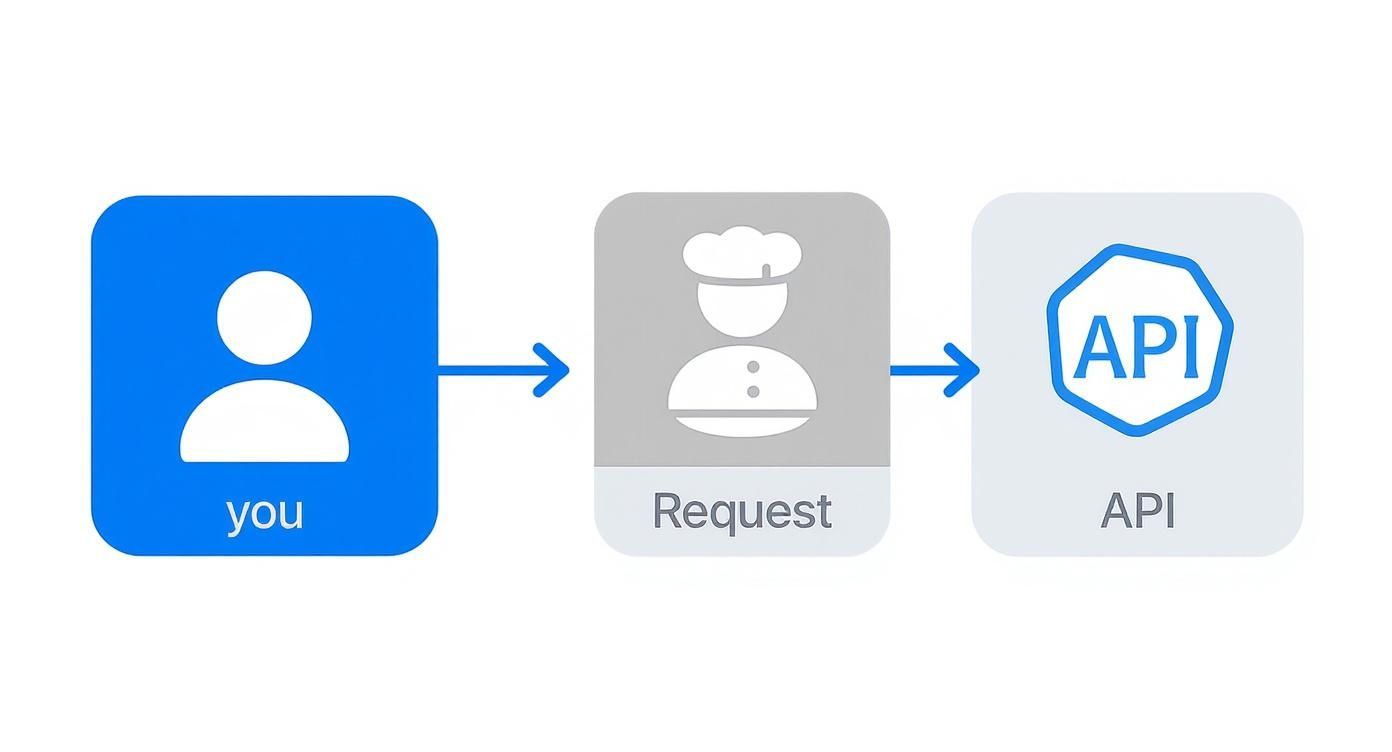
As you can see, your action creates a request, which is sent off to the API. The API does its job and sends back a response. Let’s unpack the key pieces that make this trip possible.
-
The Request and Endpoint: Your search action creates an API request. This isn’t just fired off to the airline’s homepage; it’s sent to a specific endpoint. An endpoint is just a unique URL built for a particular job, like
.../api/flights/search. -
Authentication: The travel site has to prove who it is. Tucked inside the request is an authentication key or token—basically a digital passport—verifying that it has permission to access the Qantas flight data. This is a non-negotiable security step.
-
The Payload and Data Format: Your search details (Sydney, Adelaide, dates) are bundled up into the request’s payload. This information is organised in a common language that computers easily understand, usually JSON (JavaScript Object Notation). It’s lightweight and incredibly easy for different systems to read.
What is JSON?
Think of JSON as a universal translator for software. It organises data into simple key-value pairs (e.g.,"origin": "Sydney", "destination": "Adelaide") that both the requesting and receiving systems can instantly interpret. It just gets rid of any potential for miscommunication.
The Response From the Server
Once the airline’s server receives the authorised request at the correct endpoint, it searches its database for all flights matching your criteria and compiles the details — including flight times, prices, and seat availability — into a JSON payload.
The server sends this package back to the travel website, which quickly interprets the data and displays it in a clear, user-friendly list. From your perspective, you simply see the flight options, unaware of the complex, high-speed data exchange happening behind the scenes.
This same request-and-response cycle is the engine behind countless business operations. For example, a successful Shopify implementation leans heavily on APIs to talk to payment gateways. In the same way, connecting WooCommerce to an inventory system uses APIs to make sure stock levels are always spot-on.
For more complex setups, such as a custom Odoo implementation in Sydney, businesses often require expert software development in Adelaide to build robust API integrations. These custom solutions connect all the disparate parts of their operations, from the front office to the factory floor.
Getting your head around this technical flow is the first step toward building a more connected and efficient business. If your systems aren’t talking to each other effectively, you’re leaving huge opportunities for automation on the table.
Ready to explore how API integration can solve your specific business challenges? Speak with our integration experts today to get a personalised consultation.
Why Bother With API Integration? The Business Case
Understanding how API integration works is one thing, but the real question is: what can it do for your business? Beyond technical jargon, it boosts operational efficiency, enhances customer experiences, and drives meaningful growth. In today’s competitive landscape, a smart API strategy isn’t just a “nice-to-have” for large corporations — it’s essential for any business that wants to stay competitive.
At its core, API integration lets your software systems communicate and function as a single, well-oiled machine. Instead of isolating applications in separate silos, integration enables automatic information sharing. This eliminates tedious, error-prone manual data entry and frees your team to focus on what truly matters — growing and improving the business.

Driving Serious Efficiency and Automation
- eCommerce Fulfilment: A well-executed Shopify implementation uses API integration to link the online store directly to an inventory management system. When an item sells, stock levels update everywhere instantly. No more overselling, no more disappointed customers.
- Streamlined Operations: For a manufacturer, a custom Odoo implementation in Sydney can use APIs to connect the production floor with sales and procurement. A new order can automatically kick off material requests and schedule production, creating a seamless journey from sale to delivery.
- A Unified View of Your Customer: Integrating your CRM with a marketing automation tool enables some seriously sophisticated lead nurturing. When a lead’s status changes in the CRM, an API call can instantly slot them into a targeted email campaign, ensuring your communication is always timely and relevant.
By connecting your separate systems, API integration creates a single source of truth. This means you’re making decisions based on live, accurate data straight from the source—not on outdated spreadsheets or guesswork.
Fuelling Innovation and Responding to the Market Faster
Moreover, the numbers clearly reflect this growing trend. The Australian system integration market reached USD 9.31 billion in 2025 and is projected to nearly double to USD 18.07 billion by 2030. This rapid growth is being fuelled by businesses recognising that an API-first approach gives them a crucial competitive edge. For example, Woolworths successfully launched its MILKRUN service in just four months by leveraging a modern integration strategy — a perfect example of how smart connectivity drives innovation and speed to market. You can find more insights on the Australian system integration market on Mordor Intelligence.
For a growing business, this agility means you can:
- Quickly add a new payment gateway to your WooCommerce store.
- Integrate a powerful analytics tool to get a deeper understanding of customer behaviour.
- Connect with a new logistics partner to offer faster, better shipping options.
Not all APIs are the same. Just as you wouldn’t use a sledgehammer to hang a picture frame, you need the right API for the task. Ultimately, answering “what is API integration?” comes down to one question: who can use it?
APIs are classified by their level of accessibility. This choice goes beyond technical concerns — it shapes your integration strategy, influencing security and business objectives. Understanding the differences between Private, Partner, and Public APIs is the crucial first step to building an efficient, secure integration.
Private APIs: Your Internal Powerhouse
Let’s start with Private APIs. Think of them as your company’s internal nervous system. They connect your own applications and systems to keep operations running smoothly. Since they aren’t public, they are inherently secure.
A practical case is a large retailer using a custom Odoo implementation in Adelaide. They could use a private API to link their warehouse management system directly to the sales team’s dashboard. Suddenly, executives can see live inventory figures without logging into three different systems or waiting for someone to email a spreadsheet. It’s all about efficiency.
Here’s what makes them tick:
- Restricted Access: Only your internal developers and systems can touch them.
- High Security: They live safely behind your company’s firewall, shielded from the outside world.
- Built for Purpose: They are custom-designed to solve your specific internal challenges.
This kind of internal connectivity is the backbone of modern software development in Sydney, letting businesses create a single, responsive operational machine.
Partner APIs: Building Strategic Alliances
A classic practical case is a Shopify implementation that needs to sync up with a third-party logistics (3PL) company. The store uses a partner API to securely send order details to the 3PL. The 3PL then uses that same secure channel to send back tracking numbers once the package is on its way. Both businesses get exactly what they need, without ever having to expose their entire system.
Partner APIs are the digital handshakes that make modern B2B collaborations possible. They allow companies to share specific data sets securely, creating value that neither could achieve alone.
It’s the perfect middle ground—you get the security of a private API with the collaborative power of a more open system. It’s all about sharing just enough to make the partnership thrive.
Public APIs: Fuelling Open Innovation
Now, “public” doesn’t mean it’s a free-for-all. Developers usually need to register for an API key, and there are often usage limits to stop servers from getting overwhelmed. The main goal here is to spark innovation by letting others build cool things using your data or services. A practical case for this is a WooCommerce plugin that uses Australia Post’s public API to calculate live shipping rates at checkout.
These APIs are designed to be easy to find and simple to use, creating a whole community of developers who can dream up new and exciting applications you might never have thought of.
Choosing the right API type isn’t just a technical detail; it’s a strategic business decision. To make it clearer, here’s a quick breakdown of how they stack up against each other.
Comparing API Types: Private vs. Partner vs. Public
| API Type | Primary Use Case | Example Scenario | Key Advantage |
|---|---|---|---|
| Private | Streamlining internal operations and connecting internal systems. | Connecting a CRM to an internal inventory management system. | Maximum security and control. |
| Partner | Securely sharing data with specific business partners (B2B). | An e-commerce site shares order data with a shipping provider. | Controlled collaboration and new revenue streams. |
| Public | Encouraging third-party innovation and building a developer ecosystem. | A mapping service allowing other apps to embed its maps. | Broad reach and rapid innovation. |
Need a hand figuring out the right API strategy for your business? Contact our expert team at Wistec to talk through your integration goals and find the perfect fit.
API Integration Use Cases for Australian Businesses
The real power of API integration isn’t just technical — it solves everyday business challenges in Australia. By connecting your software systems, API integration automates tedious tasks, enhances customer experiences, and helps you build a smarter, more connected operation.
Across the country, from fast-growing online stores to large financial institutions, APIs act as the invisible engines driving progress. They also transform separate applications into one powerful, unified business ecosystem.
Unifying E-commerce and Operations
-
Automated Sales Sync: A business with a Shopify implementation can use an API to instantly send every sale straight into their accounting software, like Xero or MYOB. No more manual data entry. This keeps financial records perfectly accurate and makes tax time a whole lot simpler.
-
Real-Time Inventory Management: If you’re running a WooCommerce store, an API can link your website directly to your warehouse management system. When an item sells online, the stock level is updated in the warehouse immediately. This simple connection prevents overselling and ensures your customers are always looking at an accurate product catalogue.
The finance sector in Australia has been transformed by APIs, largely driven by government initiatives like the Consumer Data Right (CDR). As a result, banks and financial institutions have built secure APIs that let consumers safely share data with trusted third parties, helping them access better deals and services.
This regulatory push has accelerated API adoption across the industry. It follows a global trend in the banking, financial services, and insurance (BFSI) sector, where APIs modernise legacy systems and deliver the real-time digital experiences customers expect. By 2025, an estimated 90% of Australian banks had adopted APIs for data sharing — a clear sign of the sector’s transformation.
To see the full impact, explore the growing role of APIs in financial services and how this technology is reshaping the industry.
For Australian financial firms, API integration is no longer a “nice-to-have.” It’s a regulatory requirement and a sharp competitive edge. It’s the only way to deliver the secure, instant services modern consumers expect.
Streamlining Logistics and Supply Chains
An API can connect an e-commerce platform directly with shipping carriers like Australia Post or Sendle. When a customer clicks “buy,” the integration can kick into gear and automatically:
- Calculate real-time shipping costs based on the package size and destination.
- Generate and print a shipping label without anyone lifting a finger.
- Send tracking information back to the store, which then pings an update to the customer.
This kind of automation is a game-changer for growing businesses. For example, a smart Odoo implementation in Adelaide can use APIs to seamlessly connect manufacturing, inventory, and shipping into one system. Every step — from production to delivery — is tracked and managed efficiently, resulting in fewer delays and happier customers.
These examples show that API integration is a powerful tool for solving real-world business challenges. It makes your technology work for you, not the other way around.
If your business systems feel disconnected and create extra work, it’s time to act. Contact Wistec today to discover how a tailored API integration strategy can automate processes, streamline operations, and drive real growth.
Building Your API Integration Strategy
Feeling inspired by the possibilities? That’s great, but moving from understanding API integration to building a strategy is the most important step. Don’t let disconnected systems limit your business’s potential. It’s time to explore how a smart API strategy can solve your biggest operational challenges and unlock new growth opportunities.
A winning strategy begins with an honest assessment of your current operations. Where are the bottlenecks? Which manual, repetitive tasks drain your team’s time and energy? Identifying these pain points is the first step toward a more automated, efficient future.
Identifying Your Most Pressing Needs
Get granular and map out your workflows. Do you really spend hours every week manually copying sales data from your Shopify implementation into your accounting software? Or maybe your WooCommerce inventory levels are constantly out of sync with what’s actually in your warehouse, leading to overselling and frustrated customers.
Once you know what needs connecting, the next question is how to do it. You’ve really got two paths here: use an existing integration platform (like Zapier or Make) or go for custom software development in Sydney. Off-the-shelf tools are fantastic for simple, point-A-to-point-B connections, but they often can’t handle the more complex or unique processes that make your business special.
For those deeper, mission-critical integrations—like a full-scale Odoo implementation in Adelaide that needs to link manufacturing, sales, and logistics—a custom solution is almost always the way to go. It’s built precisely for your workflows, so it fits your needs perfectly, with no compromises.
Partnering with a professional development team is crucial for success, especially for complex projects. They bring the expertise to build secure, scalable, and reliable integrations that align perfectly with your long-term business goals.
Planning for the Future
A solid API strategy isn’t a one-time fix — it’s a foundation you continuously build. From the start, you must consider scalability and security. A well-designed integration can handle growing data volumes and includes strong measures to protect sensitive information.
Across Australia, the demand for better connectivity is accelerating. API integration plays a key role in industries like healthcare and retail. For example, e-commerce businesses rely on live inventory feeds powered by APIs to drive online sales. Additionally, the rapid rise of AI adoption has increased the need for robust strategies that ensure systems work seamlessly together.
Don’t let an integration gap slow your business. Now is the time to build a more connected, efficient, and resilient operation.
Ready to take the first step? Contact our team for a consultation, and we’ll explore your integration needs to create a strategy that delivers measurable results.
Frequently Asked Questions About API Integration
Diving into API integration often raises practical questions. Understanding the concept is one thing; applying it to your business is another. That’s why it’s important to break things down clearly before you begin.
With this in mind, let’s address some of the most common questions from business owners and managers. These real-world concerns arise when exploring system connections, and we’ll answer them clearly and simply.
What’s the Difference Between an API and API Integration?
ChatGPT said:
How Much Does a Typical API Integration Project Cost?
This is the classic “how long is a piece of string?” question. The cost of an API integration project depends entirely on its complexity. A simple connection using a pre-built tool for a basic task can be surprisingly affordable and quick to implement.
By contrast, a fully custom solution naturally requires a larger investment. For example, a bespoke Odoo implementation in Sydney that pulls data from multiple legacy systems into a new ERP demands deep technical expertise and careful planning.
The final price also depends on factors like API documentation quality, data volume, and the complexity of business rules. The most reliable way to determine cost is to consult an expert who can provide a quote tailored to your specific goals and requirements.
Is API Integration Secure?
Absolutely — but only when done right. Today, developers build security directly into modern APIs rather than treating it as an afterthought. Good APIs follow proven security standards such as authentication (verifying identity), authorisation (confirming permissions), and encryption, protecting data as it moves across systems.
The security of your integration depends on implementing these protocols correctly and consistently following industry best practices. That’s why working with an experienced software development team in Adelaide is essential. Skilled professionals configure every security protocol precisely, ensuring your business and customer data remain protected.
If you’re ready to connect your systems and boost efficiency, Wistec can help. We deliver practical technology solutions that produce measurable results. Whether you need a complex WooCommerce integration or a custom ERP setup, we ensure your systems work seamlessly and securely together.
Contact our integration experts today for a personalised consultation.