

For any consultancy, law firm, or professional services firm, your website isn’t just a digital brochure—it’s your most hardworking business development tool. It’s out there, 24/7, building your credibility, showing off your expertise, and turning curious visitors into high-value clients. A dated or cookie-cutter site doesn’t just look unprofessional; it actively damages your authority.
Why Your Website Is Your Most Valuable Asset
In the world of professional services, trust is everything. Potential clients aren’t just buying a service; they’re investing in your knowledge, your reliability, and your unique approach. More often than not, your website is where they first meet you and where they’ll make a snap judgment about what you’re capable of. A well-thought-out website design takes control of that first impression, transforming a passive online placeholder into an active lead-generation engine.
This isn’t just a hunch; the market backs it up. The Australian web design services industry saw a 6.9% jump in 2022, hitting a market value of $1.3 billion. This surge highlights just how critical a strong digital presence has become as businesses fight for attention online. You can dive deeper into the Australian web design market’s growth to see the trends for yourself.
To truly understand what separates a basic website from a powerful business asset, let’s break down the core components that drive results. These are the pillars that support a high-converting digital presence for any service-based firm.
Core Pillars of a High-Converting Services Website
| Pillar | Key Objective | Practical Example |
|---|---|---|
| Expertise & Authority | Prove you’re the best at what you do. | An accounting firm publishes a detailed guide on navigating recent changes to Australian tax law for small businesses, complete with a downloadable checklist. |
| Lead Qualification | Attract the right clients and politely deter the wrong ones. | A marketing agency clearly outlines its project minimums and ideal client profile (e.g., “We partner with B2B SaaS companies with over $2M ARR”). |
| Seamless User Journey | Guide visitors from discovery to contact without any friction or confusion. | A law firm’s “Family Law” page has a clear, prominent button that says “Book a Confidential Consultation” which leads directly to a simple contact form. |
| Client-Centric Content | Address your ideal client’s specific pain points and questions. | A management consultant’s blog features articles like “5 Signs Your Operations Are Holding Back Growth,” directly speaking to the problems their clients face. |
Ultimately, these pillars work together to build a website that does more than just sit there. It actively works for your business, building trust and generating opportunities.
Moving Beyond the Digital Brochure
A simple website just lists what you do and how to get in touch. A high-performance website, on the other hand, is built with purpose. Every single element, from the headline on your homepage to the footer at the bottom, is designed to achieve a specific business goal.
- It establishes authority. Through genuinely helpful blog posts, in-depth case studies, and glowing client testimonials, your site proves you know your stuff.
- It qualifies your leads. When you’re clear about the services you offer and the process you follow, you naturally attract the right kind of clients and filter out those who aren’t a good fit.
- It creates a smooth client experience. With intuitive navigation and obvious calls-to-action, you make it easy for visitors to go from “just browsing” to “I need to talk to them.”
Your website shouldn’t just tell people what you do. It needs to show them how well you do it, giving prospective clients the confidence they need to pick up the phone or fill out that form.
Putting It Into Practice
Let’s look at a firm that offers software development in Sydney. A generic site might just have a bullet point saying “custom software solutions.” A strategic website, however, would feature a detailed case study explaining how they solved a complex logistics problem for a local manufacturing company, complete with real metrics and a quote from the happy client.
Likewise, a business consultant specialising in Odoo implementation in Adelaide could use their website to publish guides on common ERP migration headaches. This positions them as the go-to expert before a potential client even makes contact. A practical case would be a firm that used Shopify implementation to build an online store for a client, resulting in a 40% increase in online sales within three months. This tangible result is far more powerful than just listing a service. For e-commerce firms, platforms like Shopify or WooCommerce are more than just sales tools; they’re brand-building platforms. Every piece of content and every design choice should work together to attract, engage, and convert your ideal customer.
Ready to turn your website into a powerful business development tool? Contact Wistec today for a consultation, and let’s build a digital presence that drives real growth.
Mapping the Client Journey Before You Build
Let’s be honest, a beautiful website that doesn’t connect with your ideal client is just an expensive digital brochure. Before a single line of code is written or a pixel is pushed, the most crucial part of any effective website design for professional services is understanding the journey your prospects will take. This is where we stop guessing and start getting a real, practical handle on who your audience is.
I’m not talking about surface-level demographics. You need to get right inside their heads. What’s keeping them up at night professionally? What result are they desperately trying to achieve? And, most importantly, what do they need to see and read on your site to trust you enough to pick up the phone?
Getting this right ensures every single element on your website has a clear purpose: to guide visitors, step-by-step, from their first click to becoming a genuine lead.
Building Your Ideal Client Personas
The first move is to create detailed client personas. Think of these as semi-fictional profiles of your perfect clients, but built on real data and insights from your experience. A solid persona is so much more than a job title; it captures their real-world motivations, their biggest headaches, and their ultimate goals.
Let’s make this tangible. Here are a couple of examples I’ve seen play out:
- A firm that offers Odoo implementation in Sydney or Adelaide: You’re likely targeting someone we’ll call “Operations Manager Olivia.” She’s drowning in clunky, separate systems and is actively looking for an all-in-one ERP solution. Her goal? To kill off manual data entry and finally get accurate reports. Her core pain point is operational chaos.
- A software development company in Sydney or Adelaide: Your ideal client might be “Startup Founder Sam.” He’s got a game-changing app idea but no in-house tech team to make it happen. He’s searching for a reliable partner who not only gets his vision but can deliver a polished, market-ready product without blowing his budget.
Once you’ve defined these personas, you can stop talking to everyone and start talking to someone. Your messaging, your case studies, and your user pathways can now address their specific needs head-on, making them feel like you truly get it.
Architecting a Path to Conversion
Now that you know exactly who you’re talking to, you can start mapping out the path they’ll take. A user journey map isn’t some rigid, straight line. It’s more like a network of possible routes that all point towards your conversion goal. This map is your best friend for visualising how someone finds you, what content they interact with, and what finally convinces them to act.
This flow chart breaks down the simple, three-stage journey from attracting a visitor to turning them into a paying client.
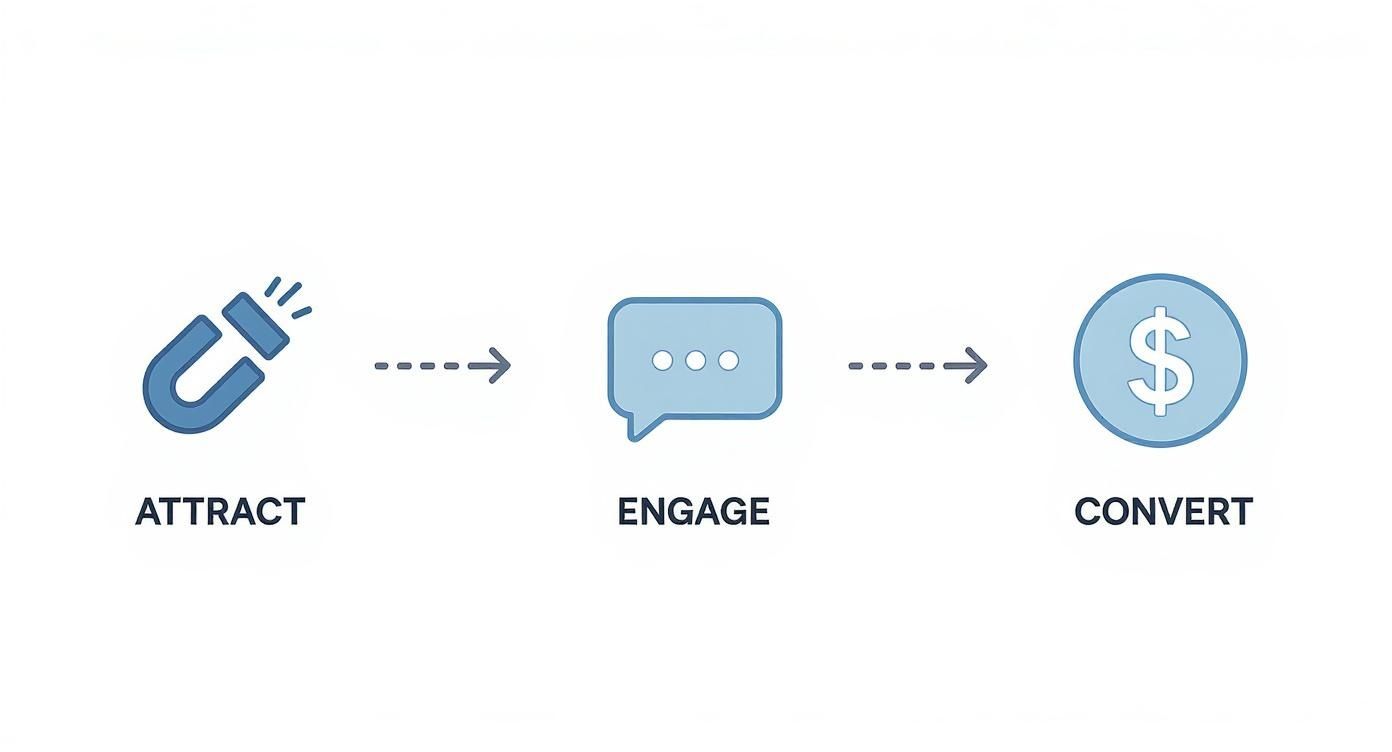
As you can see, each stage demands a different mindset. It starts with creating genuinely useful content to draw people in, then shifts to designing a user experience that makes it incredibly easy for them to take the next step.
A practical case: think about a consulting service that uses Shopify implementation for a retail business. The client journey might begin with a blog post on “Boosting Holiday Sales,” lead to a service page on e-commerce optimisation, and culminate in a call-to-action to book a “Free E-commerce Audit.” For a law firm, a similar journey could involve selling legal document templates via WooCommerce. A potential customer might land on a blog post about “Common E-commerce Mistakes,” get curious and click through to a detailed service page, and then effortlessly add a “Website Audit Package” to their cart. Every step is deliberately designed to build confidence and remove any hesitation.
When you meticulously map this journey, your website transforms from a static collection of pages into a well-oiled machine for attracting, educating, and converting high-value clients.
Ready to build a website that clicks with your clients? Contact Wistec for a strategic consultation, and let’s start mapping out your success.
Designing a Website That Radiates Credibility

When you’re in professional services, your website has a heavy lift. It has to do more than just look good; it needs to project authority and trustworthiness from the very first click. Think about it – you’re selling expertise, something intangible. Your site’s job is to make that expertise feel real and reliable, turning abstract concepts into visual cues that give a potential client the confidence to pick up the phone.
Every single element plays a role in this, from your colour scheme to your font choice. This is where the real craft of website design for professional services comes into play. You’re building a digital front door that should feel just as professional as your actual office. My advice? Ditch the cheesy, generic stock photos of people in boardrooms. Nothing builds a connection faster than high-quality, authentic photos of your real team and your own workspace. It’s a small tweak that makes a massive difference in building genuine trust.
Crafting a Visual Identity of Trust
I’ve found that a sophisticated, minimal colour palette usually hits the mark. It conveys professionalism without screaming for attention. Think about a base of muted blues, greys, and clean whites, then punctuate it with a single, strong brand colour for impact. This clean approach lets your most important assets—your case studies, service details, and team bios—take centre stage.
Typography is another piece of the puzzle you can’t afford to get wrong. You need fonts that are clean, legible, and professional. Choices like Lato, Open Sans, or Montserrat are always a safe bet. They’re incredibly easy to read on any device and project an air of clarity and precision, which subtly reinforces the quality of your work.
A potential client forms an opinion about your website in just 0.05 seconds. Your design doesn’t get a second chance to make a first impression; it has to signal credibility instantly.
Content That Proves Your Value
A great design sets the stage, but it’s your content that closes the deal. Don’t just list what you do; show the results you deliver. It’s a simple shift in perspective that changes everything.
For instance, a firm offering software development in Sydney or Adelaide shouldn’t just say, “We build apps.” They’ll win more business by showcasing a case study that explains how they built a custom logistics app that saved a client 20% in operational costs. That’s tangible value. A practical case for Odoo implementation in Sydney would be showcasing how a manufacturing client in Adelaide reduced their inventory management costs by 15% after a successful ERP integration. This benefit-first approach works whether you’re using Shopify implementation for productised consulting packages or WooCommerce to sell downloadable legal templates.
Placing Strategic Calls to Action
Once you’ve earned that initial trust with sharp design and compelling content, you have to tell visitors what to do next. Make it ridiculously easy for them. Every single page needs a clear, persuasive call-to-action (CTA).
- On a service page: Try a button like “Book a No-Obligation Consultation.”
- On a case study: Add a link that says, “See How We Can Achieve Similar Results for You.”
- On a blog post: Offer a valuable takeaway, like “Download Our Free Project Scoping Checklist.”
These aren’t just buttons. They are signposts guiding your ideal clients down the path from being a curious reader to becoming a qualified lead. When you nail this combination of thoughtful design, value-driven content, and clear next steps, your website stops being a brochure and starts being your best salesperson.
Ready to build a website that radiates credibility and converts visitors into clients? Let’s talk about your project today.
Choosing the Right Technology for Your Firm
While the visual design is what pulls new clients in, it’s the technology humming away in the background that truly makes a website work. For anyone who isn’t a developer, the world of platforms, code, and tech stacks can feel a bit like a foreign language. But getting this decision right is one of the most important steps in effective website design for professional services. It influences everything from how easy it is to update your blog to whether your site can grow with you over the next five years.
Think of it like choosing a vehicle. A solo consultant might just need a reliable sedan to get from A to B. But a national logistics company? They’ll need a whole fleet of heavy-duty trucks. The right website platform works the same way—it has to be a perfect fit for your firm’s specific needs and where you plan on going.
Platforms for Every Professional Service
For most professional service firms, a platform built around content is the smartest place to start. There’s a good reason WordPress powers over 43% of all websites on the internet. It’s incredibly flexible, backed by a huge global community, and it’s brilliant for showcasing your expertise through articles, case studies, and detailed service pages.
But the real magic of WordPress is in how you can extend it. For example, a law firm could add a WooCommerce integration to sell standardised legal document templates. Just like that, their website transforms from a simple brochure into a revenue-generating asset.
On the other hand, what if you’re a business consultancy selling pre-defined service packages? You might find a dedicated e-commerce platform like Shopify is a much better fit. It gives you a slick, ready-to-go system for selling fixed-price offerings—think discovery audits, strategy sessions, or monthly retainers. Shopify handles all the tricky payment and client management stuff, freeing you up to focus on delivering amazing work.
To help you weigh up your options, here’s a quick comparison of some popular platforms.
Platform Comparison for Professional Service Firms
Choosing the right foundation for your website is crucial. This table breaks down some of the most common platforms to help you see which one aligns best with your firm’s goals, technical comfort level, and budget.
| Platform | Best For | Key Advantage | Consideration |
|---|---|---|---|
| WordPress | Firms focused on content, thought leadership, and lead generation. | Unmatched flexibility with plugins for almost any function imaginable. | Requires ongoing maintenance and security updates. Can be complex. |
| Shopify | Consultants and firms selling productised, fixed-price services. | A seamless, all-in-one e-commerce experience that’s easy to manage. | Less focus on content marketing features compared to WordPress. |
| Webflow | Design-led firms that want total creative control without writing code. | Visually stunning, high-performance websites with a powerful CMS. | Has a steeper learning curve and can be more expensive. |
| Custom Build | Firms with unique operational needs, like custom client portals. | Built precisely to your specifications for maximum efficiency. | Higher upfront cost and longer development timeline. |
Ultimately, there’s no single “best” platform—only the one that’s best for you. A great development partner can help you navigate this decision based on a deep understanding of your business.
When Custom Solutions Are Non-Negotiable
Sometimes, an off-the-shelf platform just won’t do the job. This is especially true for firms with highly specific internal workflows or client-facing features that simply don’t exist in a pre-built theme or plugin.
A bespoke website isn’t an expense; it’s an investment in operational efficiency and a superior client experience. It solves problems that pre-built platforms were never designed to handle.
Take a firm that specialises in software development in Sydney or Adelaide. They’ll almost certainly need a sophisticated client portal that plugs directly into their project management and invoicing systems. This custom feature would let clients log in, track project progress, sign off on milestones, and pay invoices, all from one central hub. You just can’t get that level of deep integration from a standard template.
Similarly, a practical case is a business scaling up its Odoo implementation in Sydney or Adelaide. They might need a completely custom website front-end that talks seamlessly with their powerful backend ERP. This gives them a unique, branded user experience on the outside while maintaining all the operational muscle Odoo provides on the inside.
How to Evaluate a Development Partner
Choosing the right technology is really about choosing the right partner to build and manage it. When you’re talking to potential developers or agencies, you need to ask questions that dig deeper than just their coding skills.
- Can you show me examples of websites you’ve built for other professional service firms? This proves they get the nuances of marketing expertise, which is very different from selling a physical product.
- How do you approach scalability? You need a website that can grow alongside your business, not one that will hold you back in two years.
- What’s your process for integrating with third-party tools like our CRM or scheduling software? Smooth integrations are the key to automating your workflows and making your firm more efficient.
The best partners don’t just build what you ask for. They ask the right questions to make sure the final website is a powerful tool that actually helps you achieve your business goals.
Ready to find the perfect technology solution for your firm? Contact Wistec today for a technical consultation and let’s build a platform that powers your growth.
Building a Website That Ranks and Lasts
Getting your new website live is a huge moment, but it’s really just the starting line. For your site to deliver real, long-term value, it has to be easily found by clients who are actively looking for the exact solutions you offer. A brilliant website design for professional services is useless if no one sees it, which is why building it on a solid foundation of search engine optimisation (SEO) is so critical.
This isn’t something you tack on at the end. It starts way back in the planning stages, by figuring out what your ideal clients are actually typing into Google when they have a problem.
For example, a practical case for a firm offering Odoo implementation in Sydney would be targeting specific, high-intent phrases. Instead of just “Odoo implementation,” they should target “manufacturing ERP upgrade Adelaide” or “inventory management software for SMEs Sydney.” These queries capture prospects who aren’t just browsing—they have a real issue they need to solve, right now.
Getting Specific with Keyword Research
Good keyword research is really an exercise in empathy. It’s about putting yourself in your client’s shoes and speaking their language.
Here’s what that looks like in practice:
- A financial advisory firm doesn’t just chase “financial advice.” They’re much better off targeting “SMSF setup advice for doctors” or “business succession planning for family businesses.”
- A software development company in Sydney might aim for “custom CRM development for real estate” or “mobile app developers for logistics companies.”
These longer, more descriptive phrases (often called long-tail keywords) might have less search volume, but the people searching for them are far more likely to convert. By building out your service pages and blog content around these niche topics, you signal to both Google and potential clients that you’re the specialist they need.
Building an Asset for the Future
A website that stands the test of time is one built with the future in mind. This means a relentless focus on technical excellence from day one.
Interestingly, Australia is a little behind the curve on some modern tools. For instance, fewer than 25% of Australian SMEs have adopted AI tools, even though globally, 93% of web designers use them. For a professional services firm, staying ahead of these key website design trends Australian businesses should embrace in 2025 isn’t just about looking modern—it’s about securing a genuine competitive advantage.
A fast, secure, and mobile-friendly website isn’t a bonus feature anymore—it’s the absolute baseline. Search engines reward sites that deliver a great user experience, and your clients simply expect it.
To make sure your investment keeps paying dividends, you need to nail these technical fundamentals:
- Mobile-First Design: It’s non-negotiable. Your site has to look and work perfectly on a smartphone.
- Blazing-Fast Load Times: Slow pages don’t just annoy users; they actively harm your rankings. Every image and line of code should be optimised for speed.
- Rock-Solid Security: A secure site (using HTTPS) protects visitor data and is a massive trust signal for both people and search engines.
Whether you’re wrangling a complex Shopify implementation or a content-rich site built on WooCommerce, these principles are the bedrock of a successful online presence.
Ready to build a powerful website that attracts the right clients and is built to last? Contact Wistec for an SEO and technical consultation today.
So, you’ve launched your new website. It’s a huge milestone, but it’s definitely not the finish line. Honestly, the real power of a great website design for professional services isn’t just in how it looks on day one, but in its ability to grow and adapt. Your new site is a living, breathing asset—one you need to constantly monitor, test, and tweak to turn clicks into genuine, qualified leads.
This post-launch phase is where the real magic happens, because data becomes your best friend. Instead of just guessing what’s working, you can start making smart decisions based on how real people are actually using your site. Tools like heatmaps, for example, are brilliant for this. They’ll show you exactly where visitors are clicking, how far they’re scrolling, and where they’re getting stuck. This kind of insight is gold for figuring out which parts of your message are hitting the mark and which are falling flat.
Grow and Refine with Smart Testing
Once you have this user data in hand, you can start a cycle of systematic improvement. This is where A/B testing becomes invaluable, letting you test small changes to see what moves the needle. You can pit different headlines against each other, try out new button colours, or even test completely different page layouts to see which version actually drives more enquiries.
Let’s say you’re a professional services firm. You could easily test two different calls-to-action on your contact page:
- Version A: “Contact Us Today”
- Version B: “Book a Confidential Consultation”
It might seem like a tiny change, but wording like this can have a massive impact on both the quality and quantity of leads you get. Over time, these small, data-backed adjustments really add up, creating a website that performs better and better each month.
A high-performing website is never really ‘finished.’ It’s a dynamic tool that adapts to what your audience needs and what your firm wants to achieve, making sure it remains your most valuable business asset.
Keep Your Funnel Full with Great Content
Beyond the technical tweaks, a solid content plan is what will keep your audience coming back and boost your SEO authority for the long haul. A consistent content calendar is your chance to really show off your expertise and pull in potential clients who are out there right now, searching for the solutions you offer.
For a firm offering software development in Sydney or Adelaide, this could mean publishing quarterly reports on emerging tech trends. A consultant who specialises in Odoo implementation in Sydney or Adelaide might create a series of short video tutorials walking through specific modules. Likewise, businesses that handle Shopify implementation or build sites with WooCommerce could write deep-dive articles on e-commerce best practices.
This kind of ongoing effort does more than just fill a blog. It proves your firm is active, knowledgeable, and an authority in its field. It builds trust and ensures your website doesn’t just launch with a bang but continues to be a reliable lead-generating machine for years to come.
Ready to transform your online presence from a static brochure into your most powerful business development tool? Let’s discuss how a strategic website can become your firm’s most valuable asset.
Frequently Asked Questions
Building a new website for your firm is a big step, and naturally, it comes with a lot of questions. Let’s tackle some of the most common ones we hear from professional service firms just like yours, so you can move forward with clarity and confidence.
How Much Should a Website Cost?
This is the big question, isn’t it? The honest answer is: it depends. There’s no one-size-fits-all price because every firm has unique goals. A streamlined site for a solo practitioner will have a very different price point than a complex, custom-built platform for a national firm with specialised integrations.
To give you a ballpark, projects can start from a few thousand dollars and go up from there. For example, a firm needing custom software development in Sydney that plugs into existing client portals is a different beast entirely from a straightforward Shopify implementation for selling packaged services.
The most important shift in mindset is to see this as an investment, not just a cost. A great website is a lead-generating, credibility-building machine that pays for itself many times over. The real cost is a cheap or outdated site that actively drives potential clients away.
What Is a Realistic Timeline for a New Website?
Again, this varies, but most projects land somewhere between a few weeks and several months. The single biggest factor influencing the timeline? How prepared are you. If you have your content, branding, and a clear vision locked down from the start, things move much, much faster.
A project with deep technical requirements, like integrating a new site with an Odoo implementation in Sydney, will naturally need more time for discovery and development. In contrast, customising a WooCommerce theme for a well-established brand can be a much quicker affair. We’ll always map out a detailed project plan so there are no surprises.
How Do I Maintain My Website After Launch?
Your website isn’t a “set and forget” asset. Think of it like a car; it needs regular tune-ups to keep running smoothly and securely. Post-launch maintenance is about protecting your investment. This means consistent software updates, security scans, and performance checks are non-negotiable.
Ongoing support ensures everything stays secure and works as it should, whether that involves simple content updates or digging into a technical glitch. For firms in fast-moving industries like software development in Adelaide or those offering services like Odoo implementation in Adelaide, keeping your content fresh isn’t just maintenance—it’s a vital part of showcasing your expertise and driving your SEO.
Ready to build a website that actually moves the needle for your firm? Wistec delivers strategic, solution-driven technology built around your specific business goals.