

Let’s be honest, a great website design for manufacturing isn’t just about looking good. It needs to be your hardest-working salesperson, a dynamic engine that pulls in leads, builds rock-solid credibility, and makes life easier for the engineers and B2B buyers who spend most of their time researching online.
Your Website Is So Much More Than a Digital Brochure
In the industrial world, your website is almost always the first handshake with a potential client. Yet, so many manufacturing sites feel like dusty, outdated pamphlets. That’s a huge problem when you realise that modern buyers—from procurement managers to design engineers—do nearly 70% of their research online before they even think about picking up the phone.
An old, clunky site isn’t just a missed opportunity. It’s an active liability. It chips away at your credibility and sends perfectly good leads straight to your competitors.
This guide is about turning that around. We’ll walk you through how to transform your online presence from a passive placeholder into a powerful asset that actively works for you, day in and day out.
From Brochure to Sales Tool: Making the Shift
What’s the real difference between a brochure-style site and a proper sales tool? It all comes down to function. A brochure is static; it just sits there. A modern manufacturing website, on the other hand, is an interactive platform built to engage visitors and guide them toward a conversion.
It has a job to do, and that job includes:
- Building Trust Instantly: A clean, professional design signals expertise and reliability before a visitor even reads a single word. First impressions count for a lot.
- Showcasing Complex Capabilities: Don’t just tell them what you do—show them. Use high-resolution images, videos of your machines in action, and detailed case studies to prove you can deliver.
- Simplifying the Buyer’s Journey: Make it incredibly easy for visitors to find what they need. Technical specs, downloadable CAD files, and a clear path to request a quote should be front and centre.
A website isn’t a “set and forget” project. Think of it as a core business function, one that needs to evolve with your customers and the market. Getting that mindset right is the first step toward building a true digital asset.
Integrating Systems for Real Efficiency and Growth
The most effective websites don’t exist in a silo. They plug directly into your core business systems, creating a seamless flow of information that saves time and money.
Practical Case: A Sydney-based fabrication company integrated its website’s quote form directly with its ERP system. The result? Quote turnaround times dropped by 40%, and they could handle 25% more inquiries without hiring extra staff. This is the power of smart integration.
A smart Odoo implementation in Sydney can link your website’s contact forms directly to your ERP. When a lead comes in, it automatically kicks off a sales workflow, ensuring no opportunity ever falls through the cracks. If you sell standard parts, a clean Shopify implementation can turn your site into a 24/7 sales channel. For more complex, configurable products, a custom WooCommerce setup offers the flexibility you need. Pulling this all together often requires expert software development in Sydney or Adelaide to make sure every system talks to each other perfectly, creating a single, powerful platform that drives real growth.
Ready to turn your website into a lead-generating machine that works around the clock? Contact Wistec today to discuss how our expert website design and development services can transform your online presence.
Building a Strategic Foundation for Your Site
Before you even think about design mockups or lines of code, you need a blueprint. A high-performance manufacturing website isn’t born from a cool colour scheme; it’s built on a rock-solid strategic foundation. Jumping straight into the visual design is a rookie mistake, a bit like building a factory on a shaky foundation—it might look impressive at first, but it won’t stand the test of time. This initial discovery phase is where we make sure every single element of your new site is tied directly to a business goal.
First things first, let’s get crystal clear on who you’re actually trying to reach. It’s not enough to say “we sell to engineers.” You need to dig deeper and create detailed customer personas. Are you talking to a senior procurement manager in Adelaide who lives and breathes cost-efficiency? Or is it a young design engineer in Sydney who just wants to find and download a CAD file as quickly as possible? They have completely different needs, and your website has to serve both masterfully.
This is all about moving from big-picture thinking to a concrete, actionable plan for your website.
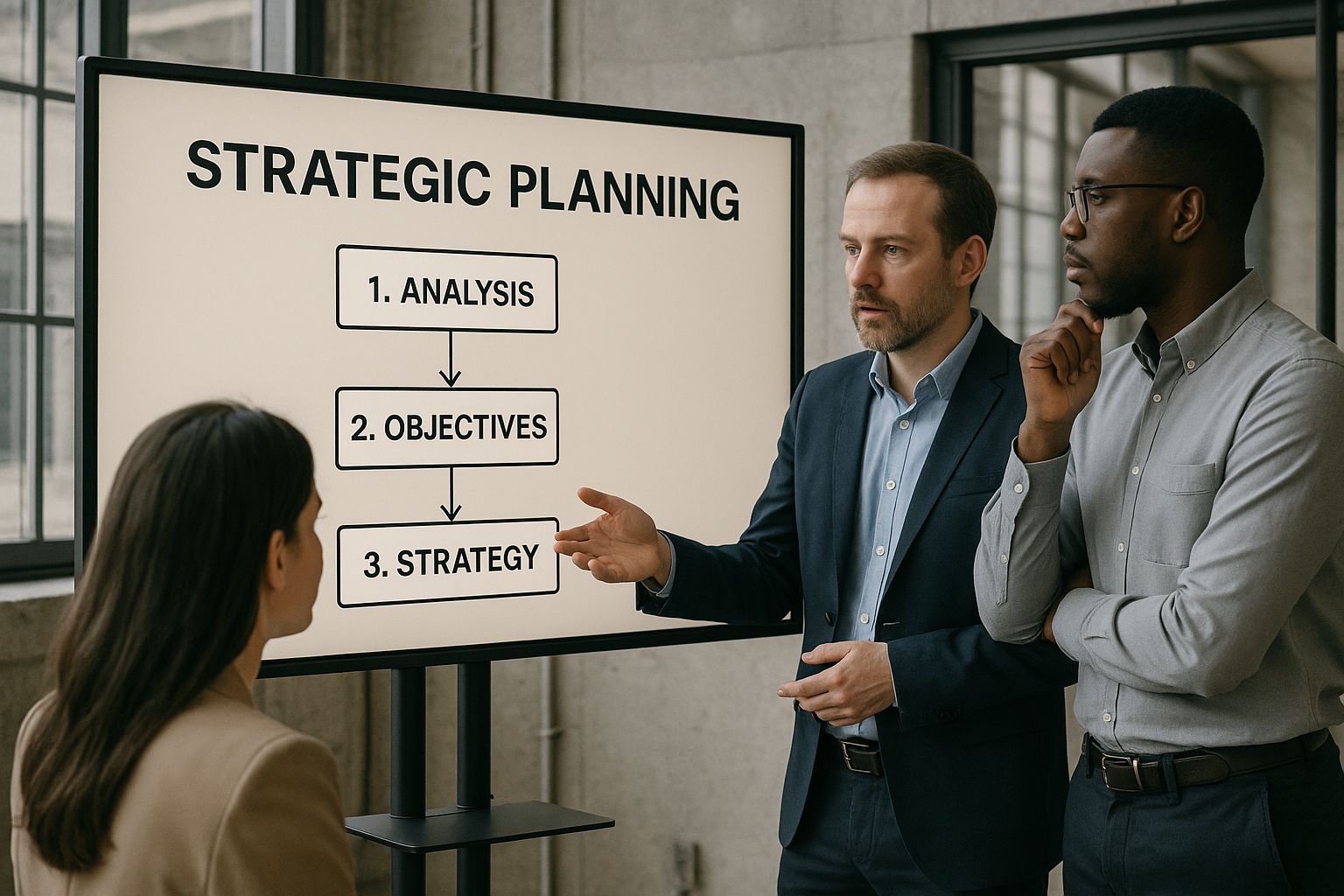
Taking this structured approach from the start means every design decision has a purpose, saving you from expensive and frustrating do-overs down the track.
Mapping the Buyer Journey and Sizing Up the Competition
Once you know who you’re talking to, the next step is to map out their journey. What are the key questions they ask at each stage? What piece of information—be it a spec sheet, a case study, or a video—is the one that finally pushes them from just browsing to actually requesting a quote? Getting this right is the absolute heart of effective website design for manufacturing.
With that mapped out, it’s time to put your competitors under the microscope. A proper competitor analysis isn’t about simply copying their layout. It’s a hunt for their weaknesses. Maybe their site loads at a snail’s pace. Perhaps their technical data is buried three clicks deep, or their case studies are vague and unconvincing. Every one of their shortcomings is a golden opportunity for you to create a far better experience for your customers.
Don’t be vague with your goals. “Get more leads” is a wish, not a plan. A proper goal sounds like this: “Increase qualified RFQs from the mining sector by 25% within six months.” Now you have a clear target to aim for and a benchmark for success.
Aligning Your Tech Stack with Business Goals
Strategic planning isn’t just about marketing—you have to think about the technology right from the start. A crucial question to ask is: how will this new website plug into the systems you already use to run your business? For Australian manufacturers, getting this integration right is often the difference between success and failure.
Practical Case: An industrial parts supplier in Adelaide wanted to sell online. For their standard components, a streamlined Shopify implementation worked perfectly. But for custom-machined parts, they needed a more robust solution. Expert software development in Adelaide allowed them to build a custom quoting tool that integrated seamlessly with their existing systems.
For instance, if you’re planning an Odoo implementation in Sydney, we need to ensure your website’s contact and quote forms feed new leads directly into your ERP. No more manual data entry. This creates one seamless system for managing customer info and tracking your sales pipeline, making your whole operation more efficient.
The same logic applies if you’re selling products online:
- Shopify implementation: This is often the best choice for selling standardised parts and components. It’s fast, reliable, and gives customers a smooth checkout experience.
- WooCommerce: If you offer products that are customisable or have complex configurations, WooCommerce offers the flexibility you need for a more tailored setup.
Often, these decisions require specialised software development in Sydney to build those bulletproof connections between your website and your internal systems. Nailing this technical foundation is every bit as important as the visual design.
Ready to build a strategic foundation that delivers real business results? Speak with a Wistec expert today to map out your digital strategy.
Key Design Principles for Industrial Buyers
Designing a website for the manufacturing sector is a whole different ball game. Your audience isn’t chasing flashy trends; they demand clarity, precision, and trust. Let’s be honest, the people visiting your site—engineers, project managers, and procurement specialists—are on a mission. They need technical information, and they need it yesterday.
A clean, professional interface is your opening argument. It instantly tells them you’re a serious, credible partner. This is the bedrock of effective website design for manufacturing.
Forget cluttered layouts and confusing menus. The single most important design principle I can share is intuitive navigation. A visitor should be able to land on your homepage and find detailed technical specs, material data sheets, or a contact for your engineering team in three clicks or less. If they have to hunt for information, you’ve already lost them to a competitor whose site is better organised. Simple as that.
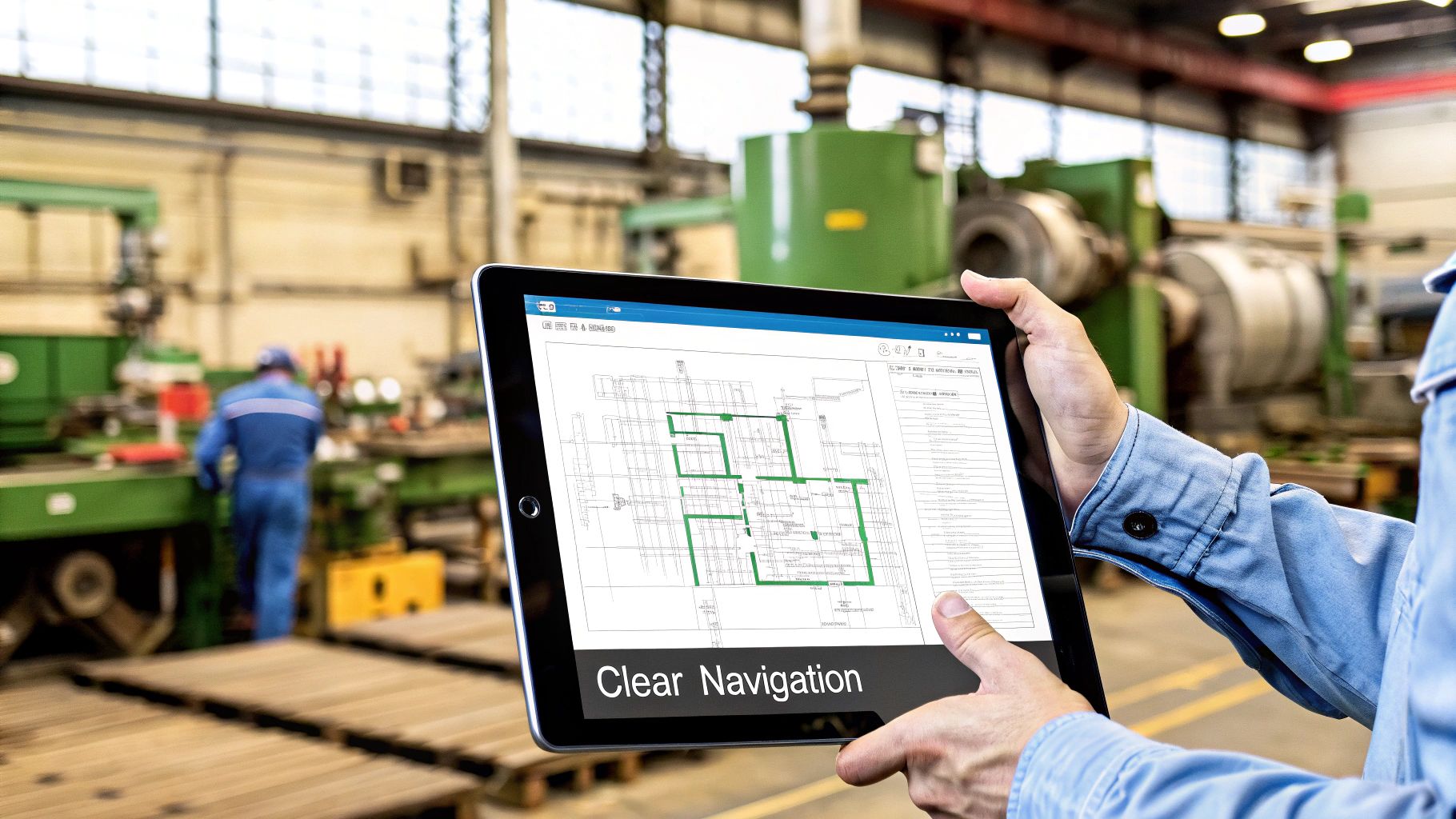
This relentless focus on user experience has a direct, measurable impact on your bottom line. A well-designed website can actually increase conversion rates by up to 200% compared to a poorly designed one. That’s a staggering figure from these website design statistics and their impact, highlighting just how much value professional design brings to manufacturers trying to win over industrial buyers.
Credibility Through Clean and Professional Aesthetics
Make no mistake: your website’s visual design is a direct reflection of your company’s standards. A messy, outdated site subtly suggests messy, outdated operations. On the flip side, a clean, modern aesthetic builds immediate trust.
So, what should you prioritise?
- High-Quality Imagery: Use professional photos and videos of your facility, your machinery in action, and your finished products. Stock photos scream “inauthentic” and do more harm than good.
- Consistent Branding: Your colours, fonts, and logo must be applied consistently across every single page. This creates a cohesive, polished experience that reinforces your brand identity.
- Ample White Space: Please, don’t cram every inch of the page with text and images. White space is your friend. It makes your content more readable and helps guide the user’s eye to what’s truly important.
“A great manufacturing website doesn’t just present information; it builds confidence. Every design choice, from the font to the page structure, should reinforce the message that you are a precise, reliable, and expert partner.”
Function Over Frills Responsive Design
Industrial buyers aren’t always sitting at a desk. They could be on a tablet out on the factory floor or checking specs on their phone during a site visit. This means a fully responsive design isn’t a “nice-to-have”; it’s an absolute necessity.
Your website has to provide a seamless, fully functional experience on any device, from a huge desktop monitor right down to the smallest smartphone screen.
This practical approach extends to your choice of technology. For companies with a huge catalogue of standard parts, a streamlined Shopify implementation can provide a robust e-commerce solution. For those offering more customisable products, a flexible build on WooCommerce might be the better fit.
In more complex scenarios, you might need custom software development in Sydney or Adelaide to integrate complex quoting tools or secure client portals. These systems must be backed by solid infrastructure, like a well-executed Odoo implementation in Sydney, to seamlessly connect the front-end user experience with your back-end operations.
Ready to build a website that speaks directly to industrial buyers and drives real growth? Get in touch with Wistec to create a design that builds trust and delivers results.
A solid design is the bedrock of your site, but the features you build on top of it are what will actually get you leads. I’ve seen too many manufacturing websites that look good but don’t do anything. A truly effective website design for manufacturing needs to be more than a digital brochure; it has to be a practical tool that helps engineers, buyers, and procurement managers solve their problems.
These are the features that will make that happen.
Essential Features Every Manufacturing Website Needs
The absolute heart of your website is your product or services section. This is where your highly technical audience will spend their time, so it needs to deliver value, fast. Forget just listing product names with a single photo. We’re talking about building a rich, interactive resource hub for every single thing you make or do.
Giving them the granular detail they need is how you build instant credibility and make their job easier.
Building the Ultimate Product and Capabilities Showcase
Think of your product pages as a one-stop shop for technical information. Your mission is to anticipate and answer every question a potential customer might have before they even have a chance to ask it.
A world-class product showcase needs to include:
- High-Resolution Imagery and Video: Get up close. Show your products from every possible angle. Even better, include videos of your machinery in action to really drive home the precision and quality of your work.
- Downloadable CAD Files and Spec Sheets: This is a massive win for engineers. Letting them pull your files directly into their own designs removes a major roadblock and makes you an invaluable partner.
- Interactive 3D Models: Let users spin, zoom, and inspect your products right from their browser. It provides a tangible feel and level of detail that a static image just can’t compete with.
Beyond just what you make, you need a dedicated ‘Capabilities’ section. This is where you pull back the curtain on your processes, list your key machinery, and flaunt your certifications (like ISO 9001). It’s your proof that you have the right gear and the right expertise to get the job done.
Essential Website Features for Manufacturers
This table breaks down the key features, why they matter to your audience, and how to get them right.
| Feature | Primary Goal | Implementation Focus |
|---|---|---|
| Detailed Product Catalog | Provide technical data to engineers and buyers. | Use high-res images, 3D models, and filterable specs. Make it easy to search by part number or attribute. |
| Downloadable Assets | Integrate your products into the customer’s workflow. | Offer CAD files (e.g., STEP, DWG), spec sheets (PDF), and installation guides. Ensure files are easy to find. |
| Capabilities Section | Build trust in your processes and quality control. | List key machinery, materials you work with, and display certifications (ISO, AS9100). |
| Case Studies | Demonstrate real-world problem-solving ability. | Structure as a story: problem, your solution, and quantifiable results. Use client quotes where possible. |
| B2B E-commerce | Streamline the quoting and purchasing process. | Choose a platform based on product complexity—simple for standard parts, configurable for custom orders. |
| Resource Centre | Establish authority and capture top-of-funnel traffic. | Publish technical articles, white papers, and guides that answer common industry questions. |
| Clear Contact/RFQ Forms | Make it incredibly easy to start a conversation. | Keep forms simple. Allow file uploads for drawings and provide clear contact details for key personnel. |
Getting these features in place transforms your site from a simple online presence into a hard-working part of your sales and engineering teams.
Crafting Compelling Case Studies and B2B E-commerce Solutions
While specs and data are king, your audience still needs to see your solutions in the wild. This is where compelling case studies become your secret weapon for building trust. Don’t just list a client’s name; tell their story. Lay out the specific challenge they were up against, detail the solution you engineered, and—most importantly—present the measurable results you delivered.
Practical Case: A manufacturer of custom gaskets used a detailed case study to show how they solved a complex sealing problem for a major aerospace client. They included photos, technical drawings, and a direct quote from the client’s lead engineer. This single page became their most powerful sales tool, directly leading to three new high-value contracts.
The right e-commerce approach depends entirely on your business model. For a business in Adelaide selling standard bearings, a clean Shopify implementation offers a fast, secure, and straightforward path to purchase. But for a Sydney-based firm offering highly configurable parts, a flexible WooCommerce setup provides the deep customisation needed for complex orders.
Integrating these systems often requires expert software development in Sydney to ensure they talk seamlessly to your inventory and order management systems. For a truly unified operation, a backend system like an Odoo implementation in Sydney can connect your e-commerce storefront directly to your ERP, creating a single source of truth for the entire business.
Ready to equip your website with the features that turn visitors into long-term customers? Contact Wistec to explore how we can build a powerful digital platform tailored to your manufacturing business.
Getting Found: Traffic, SEO, and Smart Tech Integration
So, you’ve built a brilliant website. That’s a massive step, but it’s only half the battle. If your ideal customers—the engineers, procurement managers, and decision-makers—can’t find it, it might as well not exist. A truly effective website design for manufacturing isn’t just a digital brochure; it’s an active, lead-generating machine.
This is where a smart traffic strategy comes in, and for manufacturers, that strategy lives and dies by Search Engine Optimisation (SEO).
But let’s be clear. This isn’t about chasing generic keywords like “manufacturing services.” That’s a waste of time and money. Your SEO game has to be one of precision. You need to get inside the heads of your buyers and target the exact technical phrases they’re typing into Google when they have a problem to solve.
Think terms like “CNC machining tight tolerances” or “AS9100 certified metal fabrication.” By building your website’s content around these highly specific, niche terms, you cut through the noise. You stop attracting random visitors and start drawing in qualified professionals who are actively looking for the solutions you provide. Suddenly, your website isn’t just a site; it’s an authoritative resource.
Gain a Competitive Edge with Smarter Tech
Beyond getting found, the real game-changer is how you handle visitors once they arrive. This is where forward-thinking manufacturers are pulling away from the pack by integrating more advanced technology right into their websites.
Imagine an AI-powered chatbot on your site. It’s not just there to say hello. It could provide instant quotes for standard parts based on user inputs or guide a specifier directly to the right technical data sheet in seconds. This does more than just impress a visitor; it frees up your skilled sales and engineering teams from repetitive queries, letting them focus on complex, high-value opportunities.
A website is no longer a static, one-time project; it’s a living business function. Integrating smart technology is essential to making sure that function delivers maximum ROI and keeps pace with evolving buyer expectations.
The opportunity here in Australia is enormous. Believe it or not, fewer than 25% of Australian SMEs—manufacturers included—have adopted AI tools. This is your opening. By offering a more responsive, intelligent, and personalised online experience, you immediately stand out and meet the modern expectations of industrial buyers. You can explore more about these Australian business web design trends on Enterprise Monkey.
Connecting Your Website to Your Core Operations
Making this work requires more than just installing a few plugins and hoping for the best. For technology to be truly effective, it has to talk to your core business systems. This is where expert software development in Adelaide or Sydney becomes crucial, building robust connections between your website and your Customer Relationship Management (CRM) or Enterprise Resource Planning (ERP) systems.
When everything is connected, the magic happens:
- No More Lost Leads: A potential customer fills out a quote request on your site. Instantly, their details are funnelled into your CRM, and a follow-up task is automatically assigned to your sales team. Nothing falls through the cracks.
- A Single Source of Truth: A custom Odoo implementation in Adelaide can synchronise your website’s inventory levels with what’s actually happening on your factory floor. The data customers see is always accurate and up-to-date.
- Effortless E-commerce: If you’re selling parts through a Shopify implementation or a custom WooCommerce store, this backend integration can automate the entire order processing and fulfilment workflow, slashing manual data entry and eliminating costly errors.
This is how you transform your website from a simple online presence into the central nervous system of your entire sales and marketing operation.
Ready to future-proof your digital operations and drive more qualified leads? Contact Wistec today to discuss how a custom technology integration can maximise your website’s performance.
Let’s Tackle Your Big Website Questions
When I sit down with manufacturing leaders about a new website, the same three questions almost always come up. It’s all about the money, the time, and the results. Getting straight answers to these is the only way to plan properly and make sure the project is a success right from the get-go.
So, let’s break them down.
How Much Does a Manufacturing Website Cost?
There’s no one-size-fits-all answer here, and any agency that gives you one without asking questions isn’t being honest. A simple, professional “digital brochure” site could be a relatively modest investment, starting in the low five figures.
But if you’re looking for a real workhorse—a platform with custom quoting engines, B2B e-commerce through a Shopify implementation, or a deep integration with your ERP, like a full Odoo implementation in Sydney—you’re talking about a more significant project. The final number really comes down to what you need the site to do for your business.
How Long is This Going to Take?
You should plan for a timeline of around 12 to 20 weeks. That’s a realistic window to get from our initial strategy session and design concepts all the way through development, rigorous testing, and a smooth launch.
Of course, that timeline can stretch. If we’re building something truly unique, like custom software development in Adelaide, or untangling complex integrations with your existing operational systems, we’ll need to factor in more time to get it right.
The one non-negotiable? An incredibly detailed and easy-to-use product or capabilities section. Your technical buyers live here. It has to be packed with value—think high-res images, downloadable spec sheets, and clear calls to action on every page.
How Do We Know if It’s Actually Working?
Measuring success comes back to the goals we set at the very beginning. For most manufacturers I work with, the proof is in the numbers. We look at key performance indicators (KPIs) like:
- The number of qualified leads coming through your contact forms.
- A steady increase in RFQ submissions and quote requests.
- Direct revenue from your WooCommerce or Shopify store.
On top of that, we’re constantly tracking how well you’re ranking in search engines for the keywords that matter and whether the right kind of traffic is finding your site. It’s about attracting your ideal customers, not just anyone.
At Wistec, we don’t just build websites. We create digital platforms that connect directly to your operations and deliver real, measurable growth for manufacturers across Australia. We build technology that works as hard as you do.
Ready to see what’s possible? Get in touch with a Wistec expert today.