

A great website for a manufacturing company isn’t just a digital brochure—it’s a 24/7 sales engine firing on all cylinders. It’s designed from the ground up to attract, educate, and ultimately convert highly specific B2B buyers, from detail-oriented engineers to bottom-line-focused procurement managers. The goal is to build a strategic asset that showcases technical prowess, builds unshakeable trust, and keeps your lead pipeline full.
Why Your Website Is Your Hardest Working Sales Tool

Manufacturing sales cycles are notoriously long and complex. Multiple decision-makers are involved, each with their own set of questions and priorities. Your website is the only tool in your arsenal that works tirelessly, around the clock, to cater to every single one of them. It’s there for the engineer downloading CAD files late at night and for the purchasing agent comparing spec sheets first thing in the morning.
Long before a salesperson ever picks up the phone, your website has already made the first impression. It’s where potential clients go to validate your capabilities, check your quality certifications, and decide whether you’re even worth a conversation. A weak digital presence means you’re essentially invisible to a massive chunk of your target market.
Establishing Digital Credibility and Trust
In manufacturing, trust is everything. A modern, professional, and easy-to-use website sends a powerful signal: your company is credible, organised, and up-to-date with current technology. On the flip side, an outdated or clunky site plants seeds of doubt. If your digital shopfront is a mess, what does that say about your factory floor?
Think of it this way: you wouldn’t let your physical facility look disorganised and inefficient, so why would you settle for a subpar digital presence? This is where strategic website design comes in, focusing on building that crucial trust from the very first click.
A website isn’t just a project; it’s a core business function. It should evolve continuously with your business, serving prospects, customers, and even potential employees with the information they need, when they need it.
To create a website that truly performs, we need to focus on its foundational elements. These core pillars work together to build credibility, engage users, and drive conversions.
Core Pillars of a High-Performing Manufacturing Website
| Pillar | Primary Goal | Key Features |
|---|---|---|
| User Experience (UX) | Make it easy for visitors to find what they need, fast. | Intuitive navigation, mobile-responsive design, clear calls-to-action. |
| Technical Content | Prove your expertise and answer detailed questions. | Downloadable spec sheets, CAD files, case studies, material guides. |
| Lead Generation | Convert visitor interest into actionable sales enquiries. | Prominent RFQ forms, contact details, live chat functionality. |
| Trust Signals | Build confidence in your quality and reliability. | ISO certifications, client testimonials, industry accreditations. |
| Brand Storytelling | Show the people and values behind the machinery. | “About Us” page, team bios, company history, facility photos/videos. |
Each of these pillars is essential. Neglecting one can undermine the effectiveness of the others, resulting in a site that looks good but fails to generate business.
It’s More Than Just a Digital Brochure Anymore
The role of a manufacturing website has fundamentally changed. It’s no longer a static online catalogue; it’s an active, dynamic participant in the entire sales process.
Today, its primary jobs are to:
- Generate Leads: Capture enquiries with strategically placed Request for Quote (RFQ) forms and crystal-clear calls-to-action.
- Educate Your Audience: Provide a deep well of resources—technical data sheets, detailed case studies, and white papers—that solve real problems for your buyers.
- Build Brand Authority: Demonstrate your expertise and position your company as an industry leader through high-quality, insightful content.
- Support the Sales Team: Give your sales reps a powerful tool they can use to guide conversations and showcase company capabilities during meetings.
This shift isn’t just a trend; it’s a reflection of a broader economic reality. In Australia, the web design services industry has grown into a $1.4 billion market, a steady climb fuelled by businesses across all sectors needing to strengthen their digital footprint. If you want to learn more, you can read the full research about Australian web design trends and their impact. For any manufacturer looking to grow, a professional online presence is no longer a “nice-to-have”—it’s a non-negotiable requirement for staying relevant and competitive.
Building Your Strategic Website Blueprint
https://www.youtube.com/embed/VQraviuwbzU
It’s tempting to jump straight into the visual design of a new website. But diving in without a solid plan is a classic mistake—you end up with a site that looks polished but does nothing for your bottom line. Your strategic blueprint is the single most important part of the process. It’s what transforms a website from a simple digital brochure into a hard-working tool that actually fuels your sales pipeline.
The whole process kicks off by setting clear, measurable goals. What, exactly, do you need this website to do? Is its main job to generate qualified leads through RFQ forms? Or is it more about supporting your existing distributors with easy access to technical data? Maybe you’re trying to attract top-tier engineering talent. Without that clarity, your design efforts will be unfocused and ineffective.
Identifying Your Core Audiences
One of the most common pitfalls I see with manufacturing websites is trying to talk to everyone at once. In reality, you have several distinct groups of people visiting your site, and each one has a completely different set of needs. You’re not selling to a faceless “company”; you’re communicating with real people doing specific jobs.
Think about the different people involved in any B2B buying decision:
- The Design Engineer: This person is looking for the nitty-gritty details. They need technical specs, downloadable CAD files, and data on material compatibility. For them, precision and accuracy are everything.
- The Purchasing Agent: Their world revolves around logistics, pricing, lead times, and supplier reliability. They’re on the hunt for certifications, solid case studies, and a clear way to get in touch.
- The Operations Manager: They’re concerned with the bigger picture. How will your product integrate with their existing systems? How will it improve their production line? Videos of your equipment in action or detailed process documents are gold to them.
If you don’t create clear paths for each of these visitors, they’ll get frustrated and leave. A good blueprint maps out exactly how each person will find what they need, with as few clicks as possible.
Analysing the Competitive Landscape
Before you start building, you need to know what you’re up against. A thorough competitive analysis isn’t about blindly copying what others are doing. It’s about finding opportunities to do things better. Take a hard look at the websites of your top 3-5 competitors and start asking some tough questions.
What are they getting right? Maybe their product filtering system is incredibly intuitive, or their case studies are really compelling. Even more importantly, where are they dropping the ball? Perhaps their site is a nightmare on mobile, their technical data is buried five clicks deep, or their core message is vague and confusing. These gaps are your strategic openings.
By figuring out where your competitors fall short, you can deliberately position your website to fill those voids. This is how you carve out a unique space for your brand and capture the market share they’re ignoring.
For example, if a major competitor’s site is just a product catalogue, you have a massive opportunity. You could build out a comprehensive resource hub filled with industry guides, technical white papers, and process tutorials. This move positions you not just as another supplier, but as an indispensable industry authority—a powerful advantage in the complex manufacturing space.
Translating Value into a Messaging Hierarchy
Once you’ve got your goals, audience, and competitive intel sorted, it’s time to nail down your messaging. Your unique value proposition (UVP)—the fundamental reason customers should choose you over anyone else—needs to be front and centre. It should be the first thing a visitor understands within seconds of landing on your homepage.
From there, you can build out a clear messaging hierarchy. Think of it as a pyramid of information:
- Primary Message (Your UVP): This is the single most important takeaway. Something like, “Precision Machining for Aerospace Components with AS9100 Certification.” It’s clear, specific, and speaks directly to a need.
- Supporting Points: These are the key benefits that back up your UVP. Think superior materials, guaranteed rapid turnaround times, or dedicated in-house engineering support.
- Proof Points: This is the evidence that makes your claims believable. We’re talking testimonials, detailed case studies, quality certifications (AS9100, ISO 9001, etc.), and the logos of well-known clients.
This structured approach makes sure your most important messages get seen first, naturally guiding visitors from initial interest to a deeper dive into your capabilities. Your blueprint pulls all of this together—objectives, audience profiles, competitive insights, and messaging—into a single, coherent strategy. With that foundation in place, every design choice you make will be deliberate, purposeful, and squarely aimed at driving real business growth.
Designing for Technical Clarity and Credibility
In the world of manufacturing, credibility is your currency. It’s built on precision, quality, and expertise. Your website is often the very first place a potential buyer, engineer, or procurement manager will go to see if you have what it takes. It needs to immediately project professionalism and technical authority.
This audience isn’t after flashy animations or vague marketing promises. They’re looking for hard facts: specifications, certifications, and capabilities. Effective website design for manufacturing companies is all about striking a balance between a professional look and no-nonsense functionality.
The goal is to make it dead simple for visitors to find exactly what they need, whether that’s a detailed product spec sheet or proof of your ISO 9001 certification. A cluttered, confusing website creates friction, and that friction erodes trust before you’ve even had a chance to build it.
Crafting a Clean and Organised Layout
The foundation of a trustworthy manufacturing website is a logical, intuitive structure. Your visitors are busy people on a mission. They don’t have time to decipher a confusing menu or navigate a maze of pages to find critical information.
A clean layout isn’t just about looks; it’s about creating a frictionless experience. That means using plenty of white space to let the content breathe, establishing a clear visual hierarchy with distinct headings, and making sure the navigation is completely straightforward. Think of your website less like a sales brochure and more like a well-organised technical library, guiding users precisely where they need to go.
For example, a potential client looking for your range of stainless steel fasteners should be able to land on the main product category, filter by grade and size, and download a technical data sheet in just a few clicks. If that process is a pain, they’ll probably assume working with you will be, too.
The ultimate test of your site’s design is speed. How quickly can a technical user find a specific piece of data? If an engineer can’t locate a CAD file or a spec sheet within a minute, the design has failed, no matter how good it looks.
Showcasing Excellence with High-Quality Visuals
While your audience is technically focused, they’re still human. High-quality images and videos are incredibly powerful tools for proving your credibility and showing off the scale of your operations. Let’s be blunt: generic stock photos of people in hard hats are a waste of space. They feel inauthentic and cheapen your brand instantly.
You need to invest in professional photography and videography that captures your actual facilities, your machinery, and your team at work. These visuals aren’t just decoration; they are tangible proof of your capabilities.
Consider adding elements like these:
- Facility Tours: A short video walkthrough of your clean, organised workshop can say more about your commitment to quality than a whole page of text.
- Process in Action: Show off your advanced CNC machines, robotic welding cells, or meticulous quality control processes. This builds real confidence in your technical skills.
- Detailed Product Shots: Use high-resolution photos from multiple angles to highlight the quality of your workmanship and the materials you use.
These visuals turn abstract claims like “commitment to excellence” into concrete, believable evidence. You’re not just telling them you’re good; you’re showing them.
The Non-Negotiable Need for Mobile Responsiveness
The idea that B2B decision-makers are chained to their desks is a myth. Engineers are on the factory floor, project managers are at a job site, and executives are travelling. They’re all using phones and tablets to get information, and your website has to work perfectly on every single one. A site that’s clunky on mobile doesn’t just feel inconvenient; it screams that your company is behind the times.
This isn’t just a feeling; the numbers prove it. With mobile internet usage in Australia soaring, over 65% of website visits are now expected to come from mobile devices. What’s more, user data shows that 84.6% of Australians prefer clean and simple websites, a preference that directly builds trust. You can learn more about Australian website trends and user behaviour to see just how critical this is.
A mobile-responsive design means your navigation, text, and images automatically adjust to fit any screen. It guarantees your site looks professional and works perfectly, whether it’s on a giant monitor or a small smartphone. In today’s market, this isn’t an optional extra—it’s a fundamental requirement for any credible B2B company.
Turning Your Website into a Lead-Generation Engine
A great-looking website is just the starting point. For a manufacturer, the real workhorse is its functionality—the specific features that turn a casual visitor into a genuine, qualified lead. These tools are what transform your site from a static online brochure into a dynamic sales machine that works for you 24/7.
This is where smart website design for manufacturing companies goes beyond aesthetics. Every single element needs to have a purpose, guiding engineers, procurement managers, and designers to the information they need and making it dead simple for them to take the next step.
The performance gap between a modern, responsive website and an older, clunky one is massive. The data doesn’t lie—it directly affects how users engage and, ultimately, whether they convert.
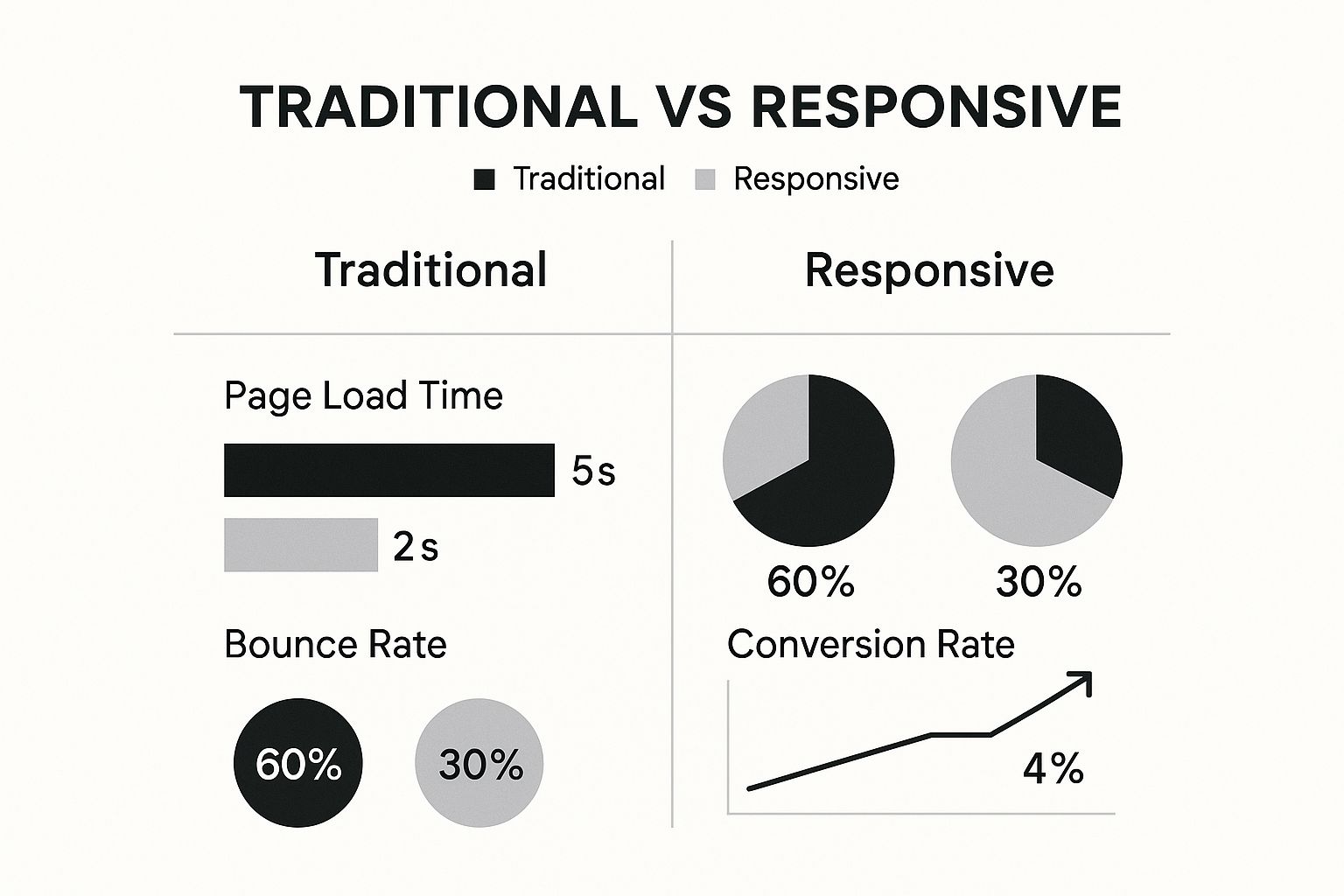
As you can see, a responsive site doesn’t just load faster and keep people on the page longer. It can literally double the conversion rate. For a business built on leads, that’s a game-changer.
Build a Product Catalogue That Thinks Like an Engineer
Your product or capabilities catalogue is the heart of your website. It can’t just be a list of parts. To be truly effective, it needs to function as a powerful, searchable database that lets technical buyers pinpoint exactly what they need with precision. A generic, hard-to-navigate catalogue is a surefire way to lose a potential customer.
The key is advanced filtering. You have to let people search based on the criteria they actually use in their day-to-day work. Forget just searching by product name; give them options like:
- Industry or Application: Let them find solutions for aerospace, medical, or automotive.
- Material Specifications: Allow filtering by steel grade, polymer type, or specific alloys.
- Performance Metrics: Let them sort by load capacity, temperature resistance, or other critical data points.
- Certifications: Give them a way to find products that meet standards like ISO 9001 or AS9100.
This kind of intuitive navigation shows you understand their world and respect their time, guiding them straight to the solution.
Design RFQ Forms That Actually Get Filled Out
The Request for Quote (RFQ) form is your money-maker. It’s where interest becomes a tangible lead. Yet so many manufacturers get this wrong, using generic contact forms that are either too vague to be useful or so long and complicated they scare people away.
The sweet spot is a form that’s simple on the surface but powerful underneath. You start with the basics—name, company, email—but then give users the option to add the real details your sales team needs. Think fields for part numbers, material specs, and, crucially, a file uploader for technical drawings or CAD models.
A well-designed RFQ form does more than just collect contact info; it pre-qualifies the lead. It gives your sales team the critical data they need upfront, saving everyone time and enabling them to respond with a detailed, relevant quote that moves the deal forward.
Every detail matters here. Well-optimised websites can see a conversion rate increase of up to 200%. Even small tweaks, like using red call-to-action buttons, have been shown to boost conversions by 34%. You can explore more website design statistics to see just how much these choices impact your bottom line. It proves why every element, especially your RFQ form, needs to be meticulously planned.
Prioritising Your Website’s Features
When planning your website, it’s easy to get overwhelmed by all the possible features. A good approach is to separate the “must-haves” from the “nice-to-haves.” The essentials form a solid foundation for lead generation, while the advanced features can provide a significant competitive advantage if your budget and strategy allow for them.
Here’s a breakdown to help you prioritise:
Essential vs. Advanced Website Features for Manufacturers
| Feature | Description | Impact on Business |
|---|---|---|
| Responsive Design | Ensures the website displays perfectly on all devices, from desktops to mobiles. | Essential: Crucial for user experience and SEO. Google prioritises mobile-friendly sites. |
| Advanced Product Catalogue | A searchable database with detailed filters for specs, materials, and applications. | Essential: Allows technical buyers to find products quickly, reducing friction and increasing leads. |
| Optimised RFQ Forms | Forms designed for ease of use, including file uploads for CAD/technical drawings. | Essential: The primary mechanism for capturing high-quality, pre-qualified leads. |
| Technical Resource Library | A hub for downloadable spec sheets, case studies, and industry guides. | Essential: Builds trust and establishes your company as an industry authority. |
| CAD File Downloads | Providing 2D/3D models of your products directly on the website. | Advanced: A major value-add for engineers, getting your products specified into their designs early. |
| Product Configurator | An interactive tool allowing users to build and customise a product to their exact needs. | Advanced: Creates a highly engaging user experience and provides detailed lead data. |
| ERP/CRM Integration | Connecting your website directly to your internal business systems for streamlined workflows. | Advanced: Automates lead entry and quote generation, significantly improving sales efficiency. |
Focus on mastering the essentials first. Once that solid foundation is in place, you can strategically invest in advanced features that will truly set you apart from the competition.
Become an Indispensable Technical Resource
One of the most powerful ways to generate high-quality leads is to position your company as an industry expert. You do this by creating a resource library filled with genuinely useful content for your technical audience—no marketing fluff allowed.
Think of your resource centre as a go-to destination for engineers and designers who need answers. It should be packed with practical tools and deep-dive information.
Here’s what every great manufacturing resource library should include:
- Detailed Case Studies: Don’t just post a testimonial. Walk through a client’s problem, explain your solution, and show the measurable results. This is powerful social proof.
- Technical Data Sheets: Every single product needs a comprehensive, easy-to-download PDF with all the relevant specs, performance data, and material info.
- CAD File Downloads: For engineers, this is gold. Offering downloadable 2D and 3D models lets them drop your components directly into their designs.
- Industry Guides & White Papers: Write content that solves common industry problems. This positions you as a helpful expert, not just another supplier.
When you provide this level of value, you become a trusted partner in your customer’s workflow long before they’re ready to make a purchase. That’s how you build a website that doesn’t just look good—it consistently delivers results.
Getting Found by Search Engines and B2B Buyers
Let’s be honest: you can have the most impressive website in the industry, but if your ideal customers can’t find it, it’s just a digital business card. The people you want to reach—engineers, procurement managers, and technical buyers—aren’t just browsing. They’re on a mission, actively searching for solutions to very specific problems.
This is where a solid search engine optimisation (SEO) strategy comes in. And for manufacturers, this isn’t about generic marketing fluff. It’s about making sure you show up precisely when a buyer with a real need is looking for your specific capabilities.
Learning to Speak Your Buyer’s Language
First things first, you need to get inside the heads of your technical audience. They don’t search like the average person. Their search queries are loaded with technical jargon, part numbers, material specs, or process names. Your keyword research has to reflect that reality.
Forget about broad terms like “manufacturing services.” You need to dig much, much deeper. The real gold is in the long-tail keywords—those longer, more specific phrases that signal a user knows exactly what they’re looking for.
Think along these lines:
- Product-specific searches: “AS9100 certified CNC machining” or “high-temp PEEK injection moulding.”
- Problem-solving queries: “how to reduce corrosion in 316 stainless steel parts” or “best material for high-wear industrial components.”
- Looking for alternatives: “[Competitor Name] alternative for custom metal fabrication.”
Sure, these phrases get less search traffic, but the people who use them are infinitely more qualified. They’re much further down the buying journey, meaning your marketing effort is focused on leads that actually have the potential to become customers.
Nailing On-Page SEO for Your Technical Pages
Once you’ve mapped out what your audience is searching for, it’s time to infuse that language into your website, especially your product and service pages. This is what we call on-page SEO—fine-tuning individual pages so they rank higher. For a manufacturer, this is about more than just sprinkling in a few keywords.
Treat every single product page as a standalone sales tool, armed with all the technical details a buyer needs to make an informed decision.
Every product page on your site has a job to do: prove your technical competence and answer a buyer’s questions before they even have to ask. If a page fails to do that, it fails to build the trust needed to generate a lead.
Structure your pages with clear, descriptive headings that naturally include your target keywords. It makes the page easier to scan for a busy engineer and signals relevance to Google.
A Practical Look at On-Page SEO for a “Custom Metal Stamping” Page
| Element | What It Does | A Real-World Example |
|---|---|---|
| Title Tag | This is your page’s title in the Google search results. It’s your first impression. | Custom Metal Stamping Services | ISO 9001 Certified | Wistec |
| Meta Description | The short blurb under the title in search results. Its job is to earn the click. | Precision metal stamping for automotive & aerospace. We handle complex geometries & high-volume runs. Get a fast quote. |
| H1 Heading | The main on-page title. It confirms for the visitor they’ve landed in the right place. | High-Precision Custom Metal Stamping Solutions |
| H2/H3 Subheadings | These break up your content and target related topics. | Materials We Work With; Our Stamping Capabilities; Quality Assurance & Certifications |
This kind of logical structure makes your content digestible for people and search engines alike, establishing your expertise right away.
Earning Trust and Authority with Expert Content
The final piece of this puzzle is building your site’s authority. In the SEO world, authority is largely built through backlinks—that is, links from other credible websites pointing to yours. The single best way for a manufacturer to earn these is by creating genuinely helpful, expert-led content.
We’re not talking about a fluffy blog here. We’re talking about building a resource centre filled with high-value technical information that cements your position as a thought leader.
- Deep-Dive Technical Articles: Go beyond the basics. Write an in-depth article on a complex topic, like “A Guide to Selecting the Right Finish for Industrial Components.”
- Comprehensive Industry Guides: Create a ‘pillar’ piece of content that your audience will want to bookmark and reference, such as “The Manufacturer’s Handbook to Lean Production.”
- Original Research & Data: Conduct a small survey on an industry trend and publish your findings. This kind of unique content is a natural magnet for links from trade publications and news sites.
When you consistently publish content that solves real-world problems for your audience, others in your industry will start to notice. They’ll link to it as a valuable resource, which tells search engines that you’re a trusted authority. This boosts your rankings across the board, ensuring a steady stream of qualified B2B buyers find their way to you.
Your Pre-Launch Checklist for a Flawless Go-Live

The final sprint before your new manufacturing website goes live is every bit as crucial as the design phase. I’ve seen it happen too many times: a rushed launch undoes months of fantastic work, resulting in broken links, a clunky user experience, and a nosedive in SEO rankings. A methodical pre-launch process is your insurance policy for making a strong first impression.
This stage is all about obsessive quality assurance and getting your measurement tools ready. It’s your last chance to hunt down and fix every little glitch before your customers and prospects lay eyes on it.
Finalise Technical and Functional Testing
First things first, you need to put the site through its paces. Don’t just check it on your own computer in Chrome. You need to be sure it works flawlessly for every visitor, regardless of how they access it.
Your testing should cover a few key areas:
- Cross-Browser Compatibility: Make sure the site looks and functions perfectly on all the big players: Chrome, Firefox, Safari, and Edge. Things can look surprisingly different from one to the other.
- Device Responsiveness: This is non-negotiable. Test it on desktops with different monitor sizes, tablets, and a range of smartphones to ensure your responsive design holds up in the real world.
- Functionality Checks: Click everything. Seriously. Submit every form, press every button, and test every download link. Assume nothing works until you’ve proven it does.
A single broken “Request a Quote” form could cost you thousands in lost revenue. This isn’t just a technical box-ticking exercise; it’s a vital business activity that protects your investment and ensures your lead generation engine is firing on all cylinders.
Secure Your SEO Foundations
If you’re redesigning an existing website, protecting your hard-won search engine rankings is paramount. A sloppy migration can wipe out years of SEO effort in a single afternoon. The most critical task here is setting up a solid 301 redirect plan.
This means mapping every single old URL to its new counterpart. It’s how you tell search engines “this page has moved permanently,” which passes along most of your link authority and stops users from hitting dead-end “404 Not Found” pages. While you’re at it, double-check that your analytics tools, like Google Analytics 4, are installed and configured correctly to start tracking performance from day one.
Plan Your Post-Launch Promotion
The job isn’t done when you flick the switch. You need a game plan to announce your new and improved digital home and start driving traffic to it.
A simple promotional plan could look like this:
- Email Announcement: Write an email for your existing customers, suppliers, and mailing list. Show off the new features and explain how the site makes their life easier.
- Social Media Campaign: Announce the launch on platforms like LinkedIn. You could share sneak peeks of key pages or highlight new resources, like an upgraded product catalogue or technical library.
- Update Business Listings: Make sure your new website URL is updated everywhere online, from your Google Business Profile to all your industry directory listings.
Running through this checklist helps you dodge the common tripwires, ensuring your new website is an asset that starts delivering results from the moment it’s live.
Common Questions We Hear
One of the first things people ask is about the bottom line. It’s a fair question, and the answer is… it depends.
How Much Should We Budget for a Manufacturing Website?
The investment for a new manufacturing website in Australia can swing from a few thousand dollars right up to and beyond $50,000. If you just need a simple, brochure-style site using a pre-made template, you’ll land on the lower end of that scale.
But let’s be realistic—most industrial businesses need more than that. A more typical investment covers a custom design that reflects your brand, a detailed product catalogue, and the essential SEO work to get you found online. If you’re looking at more advanced features, like a custom-built product configurator or integration with your ERP system, the budget will naturally climb.
Think of it this way: your website is a long-term business asset, a virtual salesperson working 24/7. It’s not just a line item expense.
How Long Does It Actually Take to Build?
Patience is key here. A well-built, professional manufacturing website typically takes somewhere between 12 to 20 weeks from start to finish. This gives everyone enough time to get the strategy, design, development, and testing right the first time.
A rough breakdown of the timeline usually looks something like this:
- Strategy & Discovery: 2-4 weeks
- Design & UX/UI: 4-6 weeks
- Development & Content Population: 5-8 weeks
- Testing & Launch: 1-2 weeks
Trying to rush this process is a recipe for disaster. You often end up with a site that misses the mark and needs expensive fixes down the track.
It’s far better to invest the time upfront to build a solid strategic foundation than to launch a site quickly that fails to generate leads. That initial planning phase is honestly the most critical part of the entire project.
What About After It Goes Live? Is Maintenance Necessary?
Absolutely. Your website isn’t a “set and forget” tool. To keep it secure, functional, and effective, it needs consistent attention after launch. You should plan for regular maintenance tasks like software updates, security scans, and performance checks.
Beyond the technical upkeep, it’s also smart to budget for ongoing content creation and SEO. This is what keeps your site attracting the right kind of traffic and ensures you stay visible in search engine results long after launch day.
Ready to build a website that becomes your hardest-working sales tool? At Wistec, we specialise in creating strategic, high-performing websites for Australian manufacturing companies. Explore our web design and development services today.