

Trying to pin down the cost of a new website in Australia can feel a bit like asking, “How long is a piece of string?” But to give you a straight answer, a simple, professional site usually starts around the $5,000 mark. For something more complex, like a bustling online store or a custom-built web application, you could be looking at $20,000 or more.
Ultimately, the final price tag comes down to what you need it to do—the size, the features, and the tech behind it all.
Your Quick Guide to Australian Website Costs
Before we get into the weeds, let’s set some clear expectations. I always tell my clients to think of it like building a house. A granny flat has a very different budget and timeline than a custom-designed, multi-storey home. The same logic applies to your digital storefront.
A basic “brochure” website is your digital business card—it looks great and tells people who you are. A full-blown eCommerce platform, on the other hand, is an entire online department store, complete with stockrooms and payment gateways. Each serves a different purpose, and the investment reflects that.
Australian Website Design Cost at a Glance
To give you a realistic idea of where your project might fit, here’s a quick-reference table breaking down the typical investment levels.
| Website Type | Typical Price Range (AUD) | Best For | Core Features Included |
|---|---|---|---|
| Basic Brochure Site | $3,000 – $8,000 | Startups, sole traders, or businesses needing a simple, professional online presence. | 5-10 pages, contact form, mobile responsive design, basic on-page SEO. |
| SME Business Site | $8,000 – $20,000 | Established small-to-medium enterprises that need more functionality. | Custom design, CMS (e.g., WordPress), blog, advanced forms, basic integrations. |
| eCommerce Store | $15,000 – $40,000+ | Businesses selling products online, from small boutiques to large retailers. | Product catalogues, shopping cart, payment gateways, inventory management, secure checkout. |
| Custom Web Application | $25,000+ | Companies with unique operational needs requiring a bespoke software solution. | Custom-built functionality, database integration, user accounts, complex workflows. |
This table should help you match your business goals to a realistic budget. Remember, these are ballpark figures—the final cost will always depend on your specific needs.
Typical Investment Tiers
To break it down further, here’s how the costs generally line up with different project scopes:
- Entry-Level Sites ($3,000 – $8,000): This is the sweet spot for startups, sole traders, and small businesses. It’s all about getting a professional online presence up and running to build credibility and start generating leads.
- Business Growth Sites ($8,000 – $20,000): This is for established SMEs ready to level up. We’re talking more advanced functionality, like deep integrations with your other business systems, sophisticated forms, and a powerful content management system.
- eCommerce & Custom Solutions ($20,000+): Welcome to the big leagues. This tier covers comprehensive online stores and tailor-made web applications built from the ground up to solve complex business problems.
Naturally, a custom Shopify implementation or a high-performance WooCommerce store will fall into these higher brackets. The same goes for larger-scale projects involving specialised software development in Sydney or Adelaide. The trick is to align your investment with your business goals.
It’s not just an expense; it’s a strategic investment. We’ve seen firsthand how a professionally built website can lead to a 25% increase in growth and 59% more enquiries for Australian businesses. Feel free to read up on these Australian website cost benchmarks to see how a smart investment pays for itself.
Whether you’re looking at an Odoo implementation in Sydney or simply need a powerful new website to drive growth, understanding these price points is the first step toward creating a budget that makes sense.
Ready to get a precise quote for your project? Contact Wistec today, and let’s have a chat about building a high-performing website that fits your budget and delivers real, measurable results.
What Really Drives Your Website Budget?
Ever wondered why one quote for a new website lands at $5,000 while another soars past $50,000? It’s a lot like building a house. You can go with a pre-designed plan that’s quick and affordable, or you can hire an architect for a custom design that costs more for a very good reason. The final price tag for a website in Australia is shaped by a few very specific, tangible factors.
Getting your head around these core drivers is the secret to setting a realistic budget. It lets you make smart decisions, putting your money where it will deliver the best bang for your buck.
Let’s pull back the curtain and see what really shapes your final investment.
Custom Design vs. A Template
The first big decision you’ll face is whether to use a pre-built template or commission a fully custom design. Think of a template as buying a suit off the rack—it’s fast, relatively cheap, and looks pretty sharp for most occasions. We take a pre-existing layout and tailor it with your brand colours, logo, and content.
A custom design, on the other hand, is the bespoke equivalent. It’s a suit measured and cut just for you. This process involves creating a unique user interface (UI) and user experience (UX) from the ground up, built specifically around your customers and business goals. Naturally, this costs more because of the deep strategic thinking, design hours, and development time involved, but the result is a one-of-a-kind digital presence that truly stands out.
While a template gets you in the game quickly, a custom design is what gives you a real competitive advantage. It’s engineered to solve your unique problems, not just to fill a pre-made box.
Scope and Functionality: The Biggest Price Shapers
The sheer size and complexity of your website—what we call the scope—is easily the biggest factor influencing your budget. A simple five-page “brochure” site with a contact form is a relatively straightforward job. But a 50-page corporate website with detailed service sections, a blog, and a library of downloadable resources? That’s a much bigger beast.
Functionality then adds another layer of complexity and cost. Every single feature you add, from a simple photo gallery to a sophisticated online booking system, requires real development hours to build, test, and launch.
You can think of features in a few different tiers:
- The Basics: This includes things like standard contact forms, image galleries, and embedded Google Maps.
- A Step Up: Here we’re talking about features like customer login areas, integration with third-party booking software, or advanced search filters for a catalogue.
- Complex Systems: This is where projects like a full Shopify implementation or a custom WooCommerce online store fit. These need secure payment gateways, inventory management, and shipping integrations, which seriously expand the scope and, in turn, the budget.
The Tech and The Content
The technology platform you choose also plays a massive part. A standard WordPress website is typically more budget-friendly than a project that demands complex software development in Sydney or Adelaide. Custom builds require specialists to create unique features, database structures, and API integrations from scratch.
Don’t forget about content, either. High-quality copywriting, professional photography, and well-produced videos are what actually connect with your visitors and persuade them to act. You can definitely supply your own to keep costs down, but investing in professional content creation ensures your message is sharp, compelling, and properly optimised for search engines.
When you’re mapping out your budget, don’t overlook core branding assets like your logo. For startups or businesses on a tight budget, using a tool like an AI logo generator can be a smart, cost-effective starting point.
Ultimately, whether you need a sophisticated Odoo implementation in Adelaide to run your entire back-office or a simple, elegant website to showcase your services, these are the factors that will determine your final investment. Understanding them will help you have a much more productive chat with any web design agency.
Ready to see how these factors line up for your project? Reach out to the Wistec team for a clear, detailed quote that’s built around your specific business goals and budget. Let’s build a website that works as hard as you do.
Putting a Price on Your Digital Front Door: What to Expect
It’s one thing to talk about cost drivers in theory, but seeing real-world examples is where it all clicks. Let’s move from the abstract to the concrete and break down the most common types of website projects in Australia. This will give you a much clearer picture of where your business fits and what a realistic budget looks like.
At the heart of it, almost every quote you get will boil down to three things: how complex the design is, how big the website needs to be, and what you need it to do.
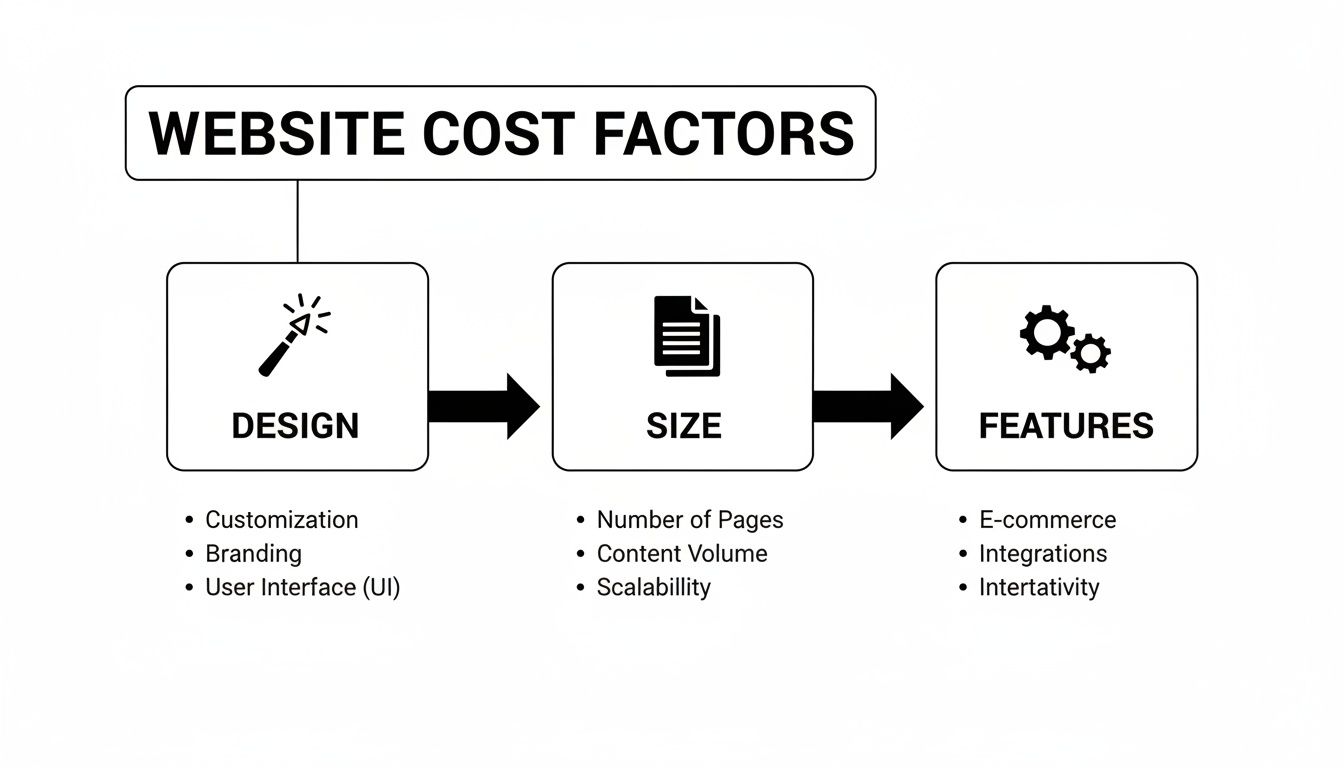
As you can see, each of these elements adds another layer, turning a simple project into a much more significant undertaking.
To give you a clearer idea of how these factors play out, let’s compare the most common project types side-by-side.
Website Project Cost and Timeline Comparison
This table gives a comparative overview of different website projects, outlining their typical costs, development timelines, and core functionalities. It’s designed to help you quickly identify which solution best aligns with your business goals and budget.
| Project Type | Estimated Cost (AUD) | Typical Timeline | Core Functionalities & Use Case |
|---|---|---|---|
| Small Business Brochure Site | $3,000 – $8,000 | 2-4 weeks | Establishes a professional online presence. Perfect for lead generation and providing essential business information (e.g., services, contact details). |
| Robust Corporate Website | $5,000 – $25,000 | 4-10 weeks | Designed for established businesses. Includes deeper content like blogs, case studies, career portals, and often integrates with CRMs or marketing tools. |
| Standard eCommerce Store | $8,000 – $15,000 | 6-8 weeks | A fully functional online shop for businesses with a small-to-medium product catalogue. Includes product management, payment gateways, and shipping setup. |
| Custom eCommerce or Web App | $20,000 – $50,000+ | 10-16+ weeks | Built for scale. Features advanced integrations, custom functionalities (like loyalty programs or complex inventory), and often connects with ERP systems. |
This comparison should help you benchmark your own project. Now, let’s dig into the specifics of what each of these really entails.
The Small Business Brochure Site
Think of this as your digital handshake. It’s a clean, professional, and straight-to-the-point website designed to build credibility, spell out what you do, and give potential customers an easy way to get in touch. For new businesses or those who don’t need all the bells and whistles, it’s the perfect launchpad.
- A Real-World Example: An accounting firm in Adelaide needs to look the part online. They’re after a home page, an ‘About Us’ section, a page detailing their services (tax, bookkeeping), and a contact page with a simple form and a map.
- What to Budget: $3,000 – $8,000 AUD
- How Long it Takes: 2–4 weeks
This price typically gets you a sharp, mobile-friendly design, a basic on-page SEO setup to get you found on Google, and a user-friendly Content Management System (CMS) like WordPress so you can make your own updates. It’s all about maximum impact for a sensible investment.
The Robust Corporate Website
This is a serious step up, built for established businesses that need more than just a digital business card. A corporate site is a workhorse. It dives deep into your services, showcases your expertise, and often connects with other business systems to serve clients, partners, and even potential new hires.
The scope here is much larger. We’re not talking five pages anymore; think twenty or more. You’ll likely have detailed case studies, a regularly updated blog, career pages, or even secure portals for clients to log in. The design is rarely a template; it’s a bespoke creation that reflects a strong, established brand.
A project of this scale is a genuine investment. It’s common for Australian SMEs to spend between $5,000–$25,000 on their websites. Why? Because the payoff is real, with many reporting 25% revenue growth and 59% more customer enquiries. The price tag reflects the need for more senior developer expertise and strategic planning. You can learn more about how these website costs break down in Australia.
This kind of project might also call for specialised software development in Sydney to build out unique features that streamline how the business operates.
The Dynamic eCommerce Store
An eCommerce site isn’t just a website; it’s a 24/7 retail machine. The cost and complexity shoot up because you’re managing products, taking secure payments, tracking inventory, and handling customer accounts. The platform you choose here is absolutely critical.
Let’s look at two very different scenarios:
Case 1: A Straightforward WooCommerce Store
- The Business: A local Adelaide boutique with a curated range of 50-100 products.
- The Goal: An elegant, easy-to-manage store built into their existing WordPress site. They just need standard payment options like Stripe and PayPal, plus simple shipping rules.
- Estimated Cost: $8,000 – $15,000 AUD
- Timeline: 6–8 weeks
Case 2: A High-Growth Shopify Implementation
- The Business: A national fashion brand based in Sydney with hundreds of products and ambitions to sell overseas.
- The Goal: A high-performance Shopify implementation that can handle serious traffic. They need custom apps for their loyalty program, advanced inventory management across multiple warehouses, and deep integration with their marketing software.
- Estimated Cost: $20,000 – $50,000+ AUD
- Timeline: 10–16+ weeks
As you can see, what the store needs to do completely dictates the price. A simple WooCommerce setup is perfect for smaller catalogues, while a complex Shopify build is an investment in future growth. For larger operations, you might even need an Odoo implementation in Sydney or Adelaide to seamlessly connect the online storefront with your back-end accounting and warehouse systems.
Hopefully, these real-world examples help demystify the website design cost in Australia. Your final price tag is directly tied to the value and results you need your website to deliver.
Ready to find out where your project fits? Contact Wistec for a no-obligation quote and our team will give you a clear, detailed cost breakdown based on your unique goals.
The Hidden Costs You Cannot Afford to Ignore
Your initial quote for a new website is really just the beginning of the story. Think of it like buying a car; the sticker price gets you the vehicle, but you still have to budget for insurance, rego, and fuel to actually get it on the road. A website is no different. It needs ongoing investment to keep it secure, visible, and performing at its best.
The upfront website design cost in Australia gets your digital property built and looking sharp, but ignoring the running costs is a surefire way to watch that investment stall. These aren’t optional extras; they’re the essential utilities that keep your digital doors open for business.
Let’s break down what you absolutely need to budget for after your site goes live.
Essential Technical Upkeep
First up, the non-negotiables—the technical costs that keep your site online, secure, and functioning properly. These are the recurring expenses that form the very foundation of your online presence.
- Web Hosting: This is the rent you pay for your website’s home on the internet. You can expect to pay anywhere from $20 to over $100 per month. It all depends on how much traffic you get and the power your site needs. Cheap shared hosting might look good on paper, but a busy eCommerce site built with WooCommerce needs something far more robust to handle transactions without frustrating customers.
- Domain Name Renewal: Your website’s address (like yourbusiness.com.au) needs to be renewed every year. This is usually a small fee, around $20-$30 annually, but letting it lapse can be catastrophic for your brand.
- SSL Certificate: This is what puts the little padlock in the browser bar, encrypting data between your users and your site. It’s absolutely essential for security and building trust, especially if you’re selling online. While some hosting packages include one, a standalone certificate can set you back $70-$300 a year.
- Security and Maintenance: Just like your computer, your website’s software (like WordPress and all its plugins) needs regular updates to patch security holes and fix bugs. A solid maintenance plan can cost $50-$500 per month and will cover updates, regular backups, and security monitoring. Neglecting this is like leaving your shop’s front door unlocked overnight.
The Growth Engine: Marketing and SEO
Building a beautiful website without a plan to attract visitors is like opening a stunning retail store in the middle of the desert. No one will ever find it. This is where your marketing and search engine optimisation (SEO) budget becomes mission-critical.
A classic mistake we see is businesses pouring 100% of their budget into the initial build, leaving nothing in the tank for marketing. A good rule of thumb is to set aside a marketing budget that’s at least 25-50% of the initial development cost for the first year. That’s what it takes to get real traction.
A Tale of Two Sydney Businesses
Imagine two local companies.
- Business A, a law firm, invests $15,000 in a slick new website but allocates zero budget for marketing. Six months later, their traffic is flatlining because they aren’t ranking for crucial legal search terms. They have a fantastic-looking site that no one ever sees.
- Business B, an accounting practice, also spends $15,000. But they’re smarter. They budget an additional $1,000 per month for an ongoing SEO strategy. After six months, they’re on the first page of Google for “accountant services Sydney,” bringing in a steady flow of high-quality leads.
This shows that the website itself is just the starting line. It’s the continuous effort in creating content, building authority, and refining technical SEO that transforms it from a digital brochure into a lead-generating machine.
Long-Term Strategic Partnerships
For businesses with more complex systems, the relationship with a technology partner rarely ends at launch. Your systems need to evolve as your business grows—this is especially true for custom-built solutions.
For example, a manufacturing company might invest in an Odoo implementation in Adelaide. The initial setup is a massive project, but they’ll need ongoing support for staff training, custom module updates, and system optimisation to get the full value. The same goes for a rapidly growing online store that needs a custom Shopify implementation or ongoing software development in Sydney to add new features or integrate with different logistics partners.
These ongoing partnerships ensure your technology continues to solve real business problems, delivering a return on your investment long after the initial project is signed off.
Ready to plan for a website that delivers long-term success? Contact Wistec today. We don’t just build powerful websites; we provide the ongoing support and strategy you need to see real, measurable growth.
How to Get an Accurate Quote and Maximise Your ROI
Vague ideas get you vague quotes and, almost always, frustrating results. If you want a clear, accurate, and comparable proposal from any web design agency, you need to start with a powerful project brief. This isn’t just about shopping for the cheapest price; it’s about finding the right partner and making sure your investment actually pays off.
Think of it this way: you wouldn’t ask an architect to quote a build based on a sketch on a napkin. You’d give them a detailed blueprint. The more detail you provide upfront, the more precise the quote, the smoother the project, and the better the final outcome will be. A great brief eliminates guesswork and sets everyone up for success right from the start.
Crafting a Powerful Project Brief
Your brief is the single most important document you’ll create for this project. It’s your vision, your goals, and your non-negotiables all rolled into one. When you send the same detailed brief to multiple agencies, you ensure everyone is quoting on the exact same work, which means you can finally compare their proposals like-for-like.
Here’s a practical checklist to get you started:
- Your Business Goals: Why do you need this website? Is it to generate leads, sell products, or build your brand’s reputation? Get specific. “Increase online sales by 20% within the first year” is much better than “sell more stuff.”
- Target Audience: Who are you trying to connect with? Describe your ideal customer—what they do, what problems they have, and where they spend their time online.
- Scope & Must-Have Features: Make a list of everything the site must do. This could be anything from a simple contact form to a full-blown WooCommerce store or a custom Shopify implementation that talks to your other business software.
- Competitors & Inspiration: Send over links to 3-5 competitor websites. Point out what you like and, just as importantly, what you don’t. It’s also incredibly helpful to include links to sites you admire, even if they’re from completely different industries.
- Budget & Timeline: Don’t be shy. Being upfront about your budget range and your ideal launch date helps agencies propose realistic solutions that actually work for you.
Looking Beyond the Price Tag
Let’s be honest: the lowest quote is rarely the best value. When you get proposals back, you need to look past the final number and really dig into what you’re getting for your money. This is how you spot the difference between a quick-fix vendor and a genuine long-term partner.
Pay close attention to these critical factors:
- Proven Experience: Have they done this before? Look for a strong portfolio with projects similar to yours. An agency that excels in software development in Sydney for large corporates will have a very different skillset to one building e-commerce sites for Adelaide boutiques.
- The Team: Who is actually going to be building your website? You want an agency with in-house designers, developers, and project managers who know the local market inside and out.
- Ongoing Support: What happens after launch day? Ask about their maintenance plans, support hours, and what’s included in their ongoing retainers. The last thing you want is a website you can’t get help with.
- Process & Communication: How do they run their projects? A clear, transparent process with regular check-ins is the hallmark of a team that has its act together.
A cheap website that doesn’t bring in leads or sales isn’t a bargain—it’s a liability. You’re investing in a tangible return, not just a digital business card.
To really get the most out of your website, it’s essential to understand what Return on Investment (ROI) is and how it applies here. This simple shift in thinking moves the conversation from “cost” to “value.”
For instance, a complex Odoo implementation in Adelaide might feel like a huge expense upfront. But if it saves your team 20 hours of manual admin work every single week, the ROI is massive and pays for itself in no time. The same logic applies to your website. If it starts generating an extra $10,000 in sales each month, that initial investment suddenly looks like a brilliant move.
This is the mindset of a successful business owner. You’re not just buying a website; you’re investing in a powerful business tool designed to generate a measurable return.
Ready to have a conversation about real results? Contact Wistec today. We’ll help you build a brief that gets you the clarity you need and provide a transparent quote focused on delivering maximum ROI for your business.
Your Website Cost Questions, Answered
Alright, let’s get straight to the questions we hear all the time from business owners trying to get a handle on website pricing in Australia. No jargon, no fluff—just direct answers to help you feel confident about your next move.
How Much Should a Small Business Website Cost in Australia?
For a solid, professional website for a typical Aussie small business, you’re generally looking at a budget somewhere in the $3,000 to $8,000 range.
This gets you a beautifully designed, mobile-friendly site with about 5-10 pages. Think of it as your digital shopfront, covering all the essentials like your services, who you are, and an easy way for customers to get in touch. It’s the perfect starting point to build credibility and start bringing in new leads.
Of course, if your needs are a bit more complex—say, you want to sell a handful of products with a WooCommerce setup or need sophisticated booking forms—you’ll want to budget closer to the $8,000 to $15,000 mark. The final price really comes down to what features you need to kick your business goals.
Why Are Web Design Quotes So Wildly Different?
This is easily the most confusing part for most people, but there’s a simple way to think about it. It’s a bit like getting quotes for a new kitchen. You wouldn’t expect a flat-pack from Bunnings to cost the same as a custom-built job from a master cabinet maker, would you?
The same principle applies to building a website. Here’s what’s behind those price swings:
- Experience & Expertise: A seasoned agency with a dedicated team of designers, developers, and SEO strategists will naturally have a higher price tag than a freelancer working out of their garage. You’re paying for their collective experience and a tried-and-tested process that gets results.
- The Process Itself: A cheap quote is often for a basic template with a few colours changed. A higher quote, on the other hand, likely covers a much deeper process: strategy workshops, custom user experience (UX) design, professional copywriting, and thorough testing. It’s the difference between a pretty brochure and a high-performance sales tool.
- The Tech Behind It: The technology used also plays a huge role. A standard WordPress site is a different beast entirely from a custom software development Sydney project. Or consider an Odoo implementation Adelaide businesses might need; that involves connecting the website to the very core of their business operations, which is a far more complex undertaking.
Can I Just Build It Myself with a DIY Tool to Save Money?
Look, you can absolutely save some cash upfront by using a DIY website builder like Squarespace or Wix. For a sole trader just starting out or a micro-business with a tiny budget, it’s a legitimate way to get an online presence off the ground.
But it’s vital to go in with your eyes open. That initial saving often comes at a hidden cost: your time, your sanity, and, most importantly, your site’s long-term performance. DIY sites often lack the proper SEO foundations, unique branding, and strategic design needed to actually compete and win customers in a busy market.
A professionally built website isn’t an expense; it’s an asset engineered to grow your business. DIY might feel cheap to start, but it rarely delivers a real return on your time and effort.
What Other Costs Should I Budget for After the Site Is Live?
This is the big one that catches so many people out. The initial build cost gets you in the game, but the ongoing costs are what keep you winning. It’s crucial to factor these into your annual budget to make sure your investment keeps working for you.
Here are the non-negotiables you need to plan for:
- Web Hosting: Think of this as the rent for your little corner of the internet. Good, secure hosting will set you back $20 – $100+ per month.
- Domain Name Renewal: This is your website’s address. It’s an annual fee, usually around $20 – $30.
- Maintenance & Security: This is not optional. Regular software updates, security scans, and backups are what protect your site from getting hacked. A professional plan can run from $50 – $500 per month.
- SEO & Marketing: A website with no marketing is like a billboard in the desert. You need an ongoing budget for SEO, content creation, and maybe some digital ads to actually drive traffic and find new customers.
Whether you’re after a simple site, a powerful Shopify implementation, or need ongoing software development in Adelaide to add new features, these recurring costs are simply part of owning a successful digital asset.
At Wistec, we’re all about total transparency. We don’t just build websites—we build partnerships designed to deliver real, measurable results for your business.
Ready to talk to a team that puts your goals first? Contact us today for a detailed, no-obligation quote and let’s build a website that works as hard as you do.