

Your website isn’t just a digital pamphlet; it’s your hardest-working employee. Think about it – this thing works 24/7, never calls in sick, and is your primary tool for pulling in customers, drumming up leads, and closing sales. Getting the web development right is how you build that powerful digital foundation from the ground up.
Why Smart Web Development is Your Greatest Asset
At its most basic, web development is the craft of building and maintaining websites. But if you see it as just a technical chore, you’re missing the point entirely. It’s the engine that powers your whole online world, directly shaping how people see your brand and, ultimately, whether they decide to spend money with you. A well-built website isn’t an expense; it’s an investment that pays for itself over and over again.
To really get it, you need to understand the two sides of the coin that work together to create a seamless experience. Knowing the difference is the first step to making smart decisions for your business.
Front-End: The Customer Showroom
The front-end is everything your customers see, touch, and click. Imagine it as the showroom for your business—the colours, the layout, the menus, and the buttons. The whole point is to create an experience that feels natural and easy, guiding people where you want them to go, whether that’s hitting “buy now” or filling out a contact form. If it’s slow, confusing, or just plain broken, you’ll lose them in a heartbeat.
A practical case is a business investing in a Shopify implementation or a custom WooCommerce site. They need a front-end that not only looks sharp but makes the entire shopping process ridiculously simple. Every single click needs to feel right, from adding an item to the cart to entering payment details.
Back-End: The Operational Engine
The back-end is all the heavy machinery humming away behind the scenes. This is your server, your database, and the application itself—the stuff that makes the front-end actually do things. When someone submits a form or buys a product, the back-end is what processes that information, securely handles the payment, and updates your records. It’s the operational core of your digital business.
This is why a company seeking expert software development in Sydney or Adelaide knows a rock-solid back-end is non-negotiable. A practical case for this is a complex Odoo implementation in Sydney or Adelaide, where the website must communicate flawlessly with inventory, accounting, and sales systems in real-time.
Let’s break these core components down into a simple table to make it even clearer.
Core Web Development Components Explained
| Component | Its Role in Your Business | Simple Analogy |
|---|---|---|
| Front-End | This is your digital storefront. It’s what shapes the customer’s first impression and makes it easy for them to shop, learn, or get in touch. | The stylish, well-organised shop floor and friendly staff in a retail store. |
| Back-End | This is your operational hub. It manages customer data, processes orders, and connects all your business systems together securely. | The stockroom, point-of-sale system, and manager’s office that keep the store running. |
| Database | The secure storage for all your critical information, from customer accounts and product details to order histories. | The store’s filing cabinet, where all customer records and inventory lists are kept safe. |
At the end of the day, these pieces aren’t separate tasks; they’re parts of a single, powerful machine designed to help you grow.
A great website experience is born when a beautiful, user-friendly front-end is powered by a fast, secure, and reliable back-end. One simply can’t succeed without the other.
Ultimately, smart web development is all about making sure these two sides are perfectly aligned with what your business needs to achieve. The goal isn’t just to have a website that looks good, but to build a genuine asset that actively contributes to your bottom line.
Ready to build a website that works as hard as you do? Contact our team for a complimentary strategy session to discuss your vision.
The Blueprint for a Successful Website Build
Building a high-performance website isn’t a shot in the dark; it’s a carefully structured journey. Every truly successful project follows a proven roadmap, a step-by-step process that turns a business idea into a powerful digital asset. This isn’t just about building something that looks good—it’s about ensuring every decision, from the first conversation to the final launch, is deliberate and purposeful.
Think of it like building a custom home. You wouldn’t just start laying bricks without a detailed architectural plan. In the same way, a top-tier software development Sydney agency kicks off every project with a clear, phased approach. It’s the only way to guarantee success from day one.
Phase 1: Discovery and Strategy
This is, without a doubt, the most important part of the entire process. Before a single line of code is written, we need to get to the heart of your business. The discovery phase is all about deep-diving into your objectives, figuring out who your target audience really is, and understanding the competitive space you operate in.
A practical case: an e-commerce brand wants to lift online sales by 30%. For a service business in Adelaide, it could be about generating 50% more qualified leads through the website’s contact form. This strategic foundation shapes everything that follows and ensures the final product delivers a measurable return on investment.
Phase 2: Design and User Experience
With a solid strategy locked in, the focus shifts to crafting a user journey that feels both intuitive and engaging. This is where UX (User Experience) and UI (User Interface) design take centre stage.
UX architects start by mapping out user flows, creating wireframes that serve as the website’s blueprint. Then, the UI designers step in to apply the visual magic—the colours, typography, and branding elements that make the interface beautiful and instantly recognisable as yours.
A website’s success isn’t just about looking good; it’s about feeling right. The goal is to make it so effortless for a visitor to find what they need that they don’t even have to think about it.
It’s also crucial to remember that great design is an ongoing process. Continuous user experience optimization (UXO) ensures the site doesn’t just launch well, but keeps getting better, adapting to how real people actually use it.
This diagram offers a simple look at how all the pieces fit together.
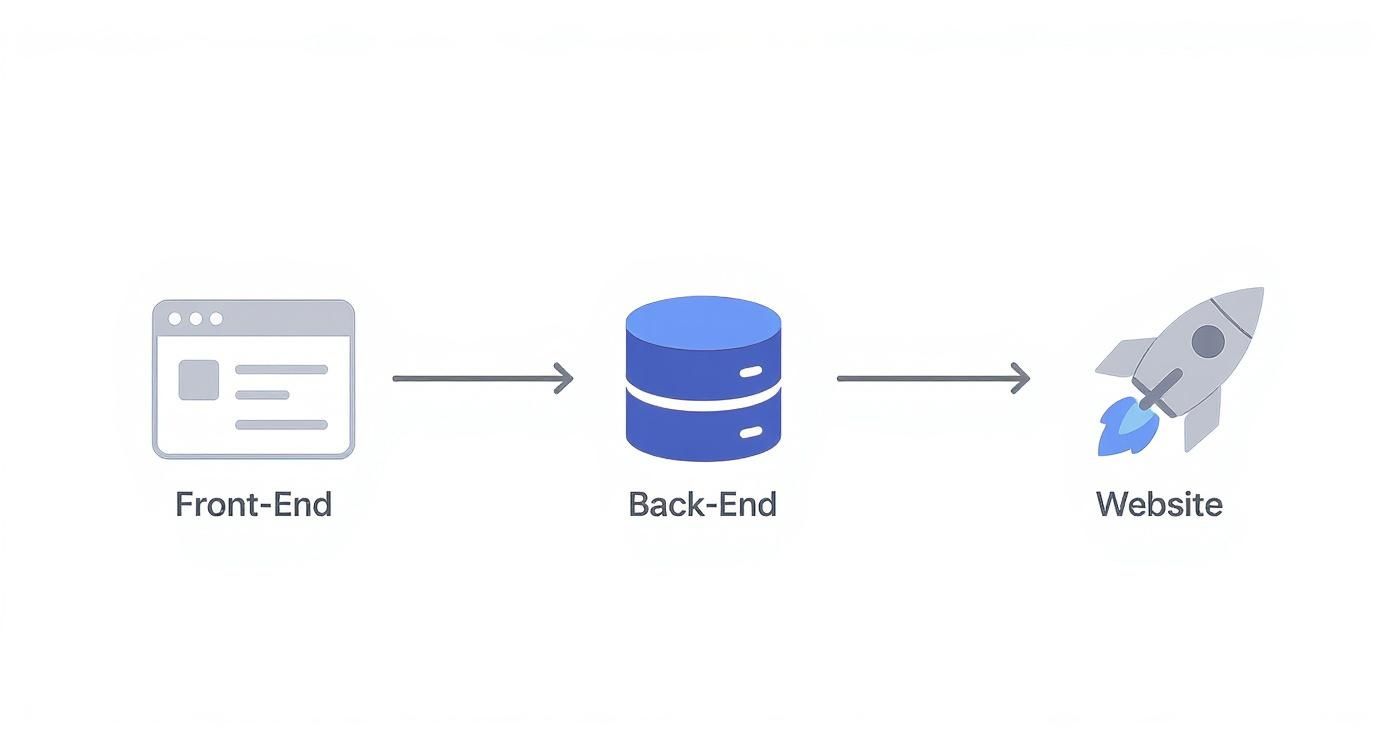
You can see how the front-end (what users see) and the back-end (the engine room) have to be perfectly synced to create a functioning website.
Phase 3: Development and Implementation
Now we get to the fun part: turning the vision into a living, breathing reality. Developers get to work writing the code that brings the designs to life. They build both the front-end that your customers will interact with and the powerful back-end that makes everything tick.
Here are some practical cases for technology choices:
- For Retailers: The project might centre on a Shopify implementation or a custom WooCommerce build, with a laser focus on product displays, secure checkouts, and seamless payment integrations.
- For Complex Operations: A business might need an Odoo implementation Sydney, integrating its website directly with core ERP systems to manage inventory and customer data in one place.
This is the phase where precision and technical expertise are paramount. The end goal is a digital platform that’s secure, scalable, and built for speed.
Phase 4: Testing and Quality Assurance
Before a website is introduced to the world, it has to go through boot camp. Our Quality Assurance (QA) team meticulously hunts for bugs, tests every feature across different browsers and devices (from desktops to tablets and mobiles), and stress-tests the site to make sure it can handle a rush of traffic.
The checklist is extensive and non-negotiable:
- Functionality Testing: Does every single button, link, and form work exactly as it should?
- Compatibility Testing: Does the site look and work perfectly on Chrome, Safari, Firefox, and all the popular mobile devices?
- Performance Testing: How fast do the pages load? Is the site snappy and responsive?
- Security Testing: Have we sealed any potential vulnerabilities that could put user data at risk?
Only when it passes with flying colours can we move on.
Phase 5: Launch and Ongoing Maintenance
After clearing every test, it’s time for launch day. We deploy the website to a live server, making it accessible to the public. But our job isn’t done. Think of your website as a living asset, not a one-off project.
Ongoing maintenance is absolutely essential. This includes security updates, performance monitoring, and adding new features to keep pace with your business as it grows. A great website evolves with you. Don’t let your investment become outdated. Reach out to discuss a maintenance plan that protects your digital asset.
Choosing the Right Technology for Your Business Goals
The technology stack powering your website is its operational DNA. It determines everything from how fast your pages load to how secure you are against threats. Most importantly, it dictates how easily your digital presence can grow with your business.
This isn’t about chasing the latest trend. It’s about being incredibly deliberate and matching the right tools to your specific business goals. Getting this wrong is like building a house on a shaky foundation—it might look good for a while, but it won’t handle the pressure of growth or changing customer demands.
The right stack, on the other hand, becomes a serious asset that powers your ambitions.
E-commerce Platforms Built for Growth
For any business selling products online, the choice usually boils down to a few powerful, specialised platforms. Each one offers a different path to success, and the best fit really depends on your business model and how hands-on you want to be.
To help you navigate this, here’s a quick comparison of the platforms we see delivering the best results for Australian businesses.
Comparing Web Platforms for Australian Businesses
A clear comparison of leading platforms to help you decide which is best for your specific business needs.
| Platform | Ideal Business Type | Cost & Scalability | Key Strategic Advantage |
|---|---|---|---|
| Shopify | Retailers and direct-to-consumer brands looking for rapid setup and ease of use. | Monthly subscription model. Scales easily with tiered plans but transaction fees can add up. | Speed to market. It’s a fully managed solution, letting you focus on selling, not server maintenance. |
| WooCommerce | Businesses with a strong content focus, like bloggers or informational sites that also sell products. | Free to install (WordPress plugin), but costs for hosting and premium extensions are variable. Highly scalable with the right hosting. | Unmatched flexibility. You have total creative control and can deeply integrate your store with your content. |
| Odoo | Established businesses needing to connect their online store with inventory, accounting, and CRM. | Subscription-based (per user/app). Highly scalable and designed for complex operations. | Total business integration. Connects every department into a single, automated system. |
| Custom Build | Companies with unique business models or highly specific functional needs that off-the-shelf platforms can’t meet. | Higher initial investment but can offer lower long-term costs. Built to your exact scaling requirements. | A true competitive edge. Your technology is built precisely for your process, creating efficiencies no competitor can copy. |
Each of these platforms represents a different strategic approach. Choosing the right one sets the stage for everything that follows.
Integrating Your Operations With Odoo
For many Australian businesses, a website is just one piece of a much bigger puzzle. When your online store needs to talk seamlessly with your inventory, accounting, and customer relationship management (CRM) systems, you need something more connected. This is where an Enterprise Resource Planning (ERP) system really shines.
A strategic Odoo implementation Sydney or Adelaide businesses invest in can be a genuine game-changer. Odoo is an all-in-one suite of business apps that can integrate your website directly with every other part of your operation.
Practical case: a customer places an order on your site. Instantly, an Odoo implementation updates your stock levels, alerts the warehouse to ship, creates an invoice in accounts, and updates that customer’s record in your CRM. That’s the power of a fully integrated system.
This level of automation gets rid of tedious manual data entry, cuts down on human error, and gives you a single, reliable source of truth for your entire business. It turns your website from a simple sales channel into the central hub of a seriously efficient operation.
Custom Solutions for Unique Challenges
But what if an off-the-shelf platform just won’t cut it? Sometimes, a business has a one-of-a-kind model or needs functionality that platforms like Shopify or WooCommerce simply can’t deliver.
In these cases, custom software development Sydney or Adelaide is the answer. This approach means building a web application from the ground up, designed precisely around your unique processes. It’s a bigger upfront investment, but a custom solution gives you maximum scalability and a powerful competitive advantage. It ensures your technology works for you, not the other way around.
Ready to find the perfect technology stack to fuel your growth? Contact us today for a complimentary consultation and let’s build a solution that drives real results.
Web Development in Action: Real Australian Success Stories
Theory is all well and good, but what really matters is seeing how smart web development delivers tangible results. Let’s move past the concepts and look at real-life Australian businesses that have completely changed their game and fuelled their growth through savvy digital investments. These stories show what’s possible when the right tech is matched with a clear business vision.

From bustling Sydney retail floors to specialised service providers in Adelaide, these case studies highlight the power of a well-executed digital strategy. Each one breaks down a common business challenge and shows how targeted development provided a powerful, practical solution.
Sydney Retailer Boosts Sales With Shopify
Practical Case: A popular Sydney-based fashion brand was wrestling with an outdated, clunky e-commerce site. The user experience was awful, the checkout process was a maze, and the site performed terribly on mobile phones. Frankly, they were losing customers and leaving a lot of money on the table.
The fix? A complete overhaul with a new Shopify implementation. The project was laser-focused on creating a visually stunning, mobile-first design that made browsing and buying an absolute breeze. Key features included a streamlined one-page checkout, much faster page load speeds, and seamless integration with their social media sales channels.
The results were immediate and impressive. Within just three months of launching the new site, the brand saw a 45% increase in online sales and a massive 60% jump in mobile conversions. By focusing on a smooth customer journey, they turned their website from a liability into their most powerful sales tool.
Adelaide Service Provider Transforms Efficiency With Odoo
Practical Case: An Adelaide-based logistics company was drowning in paperwork and manual processes. They were juggling separate, disconnected systems for client bookings, vehicle dispatch, and invoicing. This chaos led to constant data entry errors, wasted admin hours, and frustrating delays for their customers.
They needed a single source of truth. The answer was a custom Odoo implementation Adelaide businesses are increasingly turning to for this very reason. We built an integrated solution that connected a new customer-facing booking portal directly with their back-end dispatch and accounting modules.
This project wasn’t just about building a website; it was about re-engineering their entire workflow. The goal was to automate every possible step, freeing up the team to focus on high-value client work instead of paperwork.
The operational improvements were profound. The company managed to slash its administrative workload by over 20 hours per week and cut invoicing errors to virtually zero. This strategic web development project delivered a powerful return on investment by directly boosting their bottom-line efficiency.
Scaling Rapidly With Custom Software Development
Practical Case: A tech startup was facing a unique challenge that no off-the-shelf software like WooCommerce could solve. To get their idea off the ground, they needed a custom platform that could handle incredibly complex data processing and provide a one-of-a-kind service to their users. To secure funding and capture the market, they had to build a scalable and reliable application from the ground up.
By partnering with a software development Sydney team, they built a bespoke web application tailored to their exact specifications. A critical part of the strategy was building a mobile-responsive platform from day one. After all, web traffic in Australia is overwhelmingly mobile—with approximately 70% of visits coming from mobile devices, a mobile-first design is essential for keeping users around and boosting conversion rates. You can learn more about Australian web design trends and statistics on dotsquares.com.
This custom build gave them a true competitive edge. The platform performed flawlessly, handled rapid user growth without a hitch, and provided the unique functionality that truly set them apart. That initial investment in quality software development Adelaide and Sydney businesses rely on was instrumental in securing their next round of funding and establishing them as a market leader.
These real-world examples prove that strategic web development is a powerful driver of business success. Ready to write your own success story?
How to Budget for a Website That Actually Makes You Money
Putting money into a new website shouldn’t feel like you’re just throwing cash into the wind and hoping for the best. When you get the budgeting right, it stops being an expense and starts becoming a predictable, high-return investment for your business. The trick is to understand what actually drives the cost and what you should expect for your money here in Australia.
The price tag on a website isn’t some arbitrary number; it’s a direct reflection of its complexity and the job you’re hiring it to do. A simple five-page brochure site will, of course, cost a lot less than a sophisticated e-commerce platform with all the bells and whistles. It’s absolutely critical to match your budget to your business goals right from the get-go.
Breaking Down the Core Costs
A few key things will shape the final quote you receive. The biggest factors are always the scope of the project, the specific features you need, and the technology used to bring it all to life. For instance, a practical case of a project needing a deep Odoo implementation Sydney businesses use to sync their website with inventory and accounting will look very different, cost-wise, from a straightforward Shopify implementation.
Here are the main cost drivers you’ll want to think about:
- Project Complexity: This covers everything from the number of unique pages and custom design elements to how a user will move through the site.
- Custom Features: Need a booking system, a private customer portal, or integration with another piece of software? These special functions will influence the budget.
- Technology Stack: The platform you choose is a major factor. This could be anything from WooCommerce or Shopify to a completely custom software development Sydney build from the ground up.
To really get a handle on your budget, it helps to understand how agencies structure their fees. You can explore web development pricing models to get a clearer picture of the different ways projects are quoted.
What to Expect to Invest in Australia
So, what’s a realistic number? For a professionally built website in 2025, Australian small businesses are typically looking at an investment between AUD 5,000 and AUD 25,000. That said, this often climbs to AUD 8,000 to AUD 35,000 or more in the first year once you add hosting, maintenance, and other integrations.
A big reason for this is Australia’s higher cost of living, which translates to developer rates. You can expect mid-level developers to charge between AUD 75 to AUD 120 per hour, while senior developers in major cities like Sydney or Adelaide will often be AUD 120 to AUD 180 or more. For a deeper dive, you can check out more insights about Australian website costs and developer rates on rockingweb.com.au.
Think of your website not as a one-off purchase but as a living business asset. A smart budget accounts for the initial build and the ongoing care it needs to stay secure, fast, and effective.
Planning for Ongoing Success
Your website going live is just the beginning, not the finish line. To make sure your investment keeps delivering value, you have to plan for the ongoing costs. These aren’t optional extras; they’re essential for keeping your online presence professional and secure.
These recurring costs usually fall into four main buckets:
- Website Hosting: The service that literally keeps your site online.
- Domain Name Renewal: The small annual fee to keep your www address.
- Maintenance & Support: This is for regular software updates, security checks, and having an expert on hand when you need them.
- Marketing & SEO: The work needed to actually get people to your site and move up in search rankings.
Factoring in these long-term costs from day one helps you create a realistic financial plan. It’s how you ensure your new digital asset continues to be a powerful engine for your business’s growth.
Ready to invest in a website that delivers a clear return?
Contact our team for a transparent quote and a complimentary strategy session.
Ready to Build Your Digital Future? Here’s What to Do Next
You’ve journeyed through the fundamentals of web development, from the core technologies to the workflows that bring a project to life. Now you’re equipped with the knowledge to make smart, strategic decisions for your business’s online presence.
The final piece of the puzzle isn’t more theory—it’s taking action. It’s about channelling this understanding into a tangible asset that drives real growth for your business.
Maybe you’re eyeing a powerful Odoo implementation in Adelaide to get all your business systems talking to each other. Perhaps it’s custom software development in Sydney that will give you that killer competitive edge. Or you might be ready to launch a high-converting online store with a slick Shopify implementation or a flexible site built on WooCommerce.
Whatever the path, the secret to success is settled long before a single line of code is written. It all starts with preparation.
Your Pre-Consultation Checklist
To hit the ground running and make your first chat with a development agency incredibly productive, it pays to do a little homework. Getting these details sorted beforehand will speed everything up and ensure everyone is on the same page from day one.
- Pinpoint Your Main Goal: What’s the number one thing this project needs to achieve? Is it boosting online sales by 30%? Or generating 50 qualified leads every month? Be specific.
- Know Your Audience: Who are you actually trying to connect with? Jot down a quick profile of your ideal customer.
- List Your “Must-Haves”: What features are absolutely non-negotiable? Think about the core functions your site needs to deliver on its goal.
- Find Your Inspiration: Gather links to 2-3 websites you genuinely like. Make a few notes on what you admire about their design, feel, and how they work.
It’s also helpful to have a realistic grasp of the investment involved. The Australian web app development market is booming, and costs can vary widely. A simpler application might start around AUD 60,000, while more complex platforms can climb north of AUD 450,000, with projects taking anywhere from three to twelve months. For a deeper dive, Appinventiv has a great breakdown of the costs of web app development in Australia.
Having a clear vision and a well-defined plan isn’t just a nice-to-have; it’s the single most critical factor in guaranteeing a great result and a healthy return on your investment.
You’ve got the insights. You know what’s possible. The next step is finding the right partner to help you build it.
Let’s talk. We invite you to book a no-obligation strategy session with our team. We’d love to hear about your vision and map out a practical plan to build what could become your most valuable business asset.
Book Your Free Strategy Session Today
Got Questions About Web Development? We’ve Got Answers.
Diving into a web development project can feel a bit like navigating uncharted waters. It’s completely normal to have questions. To help clear things up, we’ve put together some straightforward answers to the queries we hear most often from Australian business owners.
How Long Does It Take to Build a Website?
This is probably the number one question we get, and the honest answer is: it depends. A basic website might take 4-6 weeks from start to finish. A more involved Shopify implementation with custom features could be 8-12 weeks. For bigger projects, like custom software development in Sydney or a full Odoo implementation Adelaide businesses rely on, the timeline can easily stretch into several months. The key factors are always the project’s size, its complexity, and how quickly we can collaborate on feedback.
Do I Need to Supply My Own Content and Images?
While we have fantastic copywriters and photographers we can bring in, the project will always run smoother and faster if you have your core content ready to go. After all, nobody knows your business like you do.
Having your text, key images, and brand guidelines locked in from the beginning is a massive advantage. It means we can build a site that truly captures the heart of your brand right from day one.
What Is a Responsive Website and Why Does It Matter So Much?
Ever tried to browse a website on your phone and had to pinch and zoom just to read the text? That’s a non-responsive site. A responsive website, on the other hand, automatically adapts its layout to look great and work perfectly on any screen, whether it’s a giant desktop monitor, a tablet, or a smartphone.
In Australia, a huge chunk of web traffic comes from mobile devices. If your site isn’t responsive, you’re essentially making it difficult for more than half of your potential customers to use it. It’s not just a nice-to-have feature anymore; it’s absolutely essential.
A non-responsive website in today’s market is like a shop with a locked door for over half of its potential customers. It’s a fundamental requirement for online success.
How Much Ongoing Maintenance Will My Website Need?
Your website isn’t a “set and forget” asset; it’s more like a car. It needs regular servicing to keep it running smoothly, securely, and at peak performance. This ongoing care typically involves a few key things:
- Software Updates: Keeping platforms like WooCommerce and all their plugins current is vital for patching security vulnerabilities.
- Regular Backups: We’ll need to save a complete copy of your site regularly, so if the worst happens, we can restore it quickly.
- Security Scans: We proactively scan for malware and block threats to keep your site and your customers’ data safe.
A little bit of consistent maintenance goes a long way in preventing major, costly headaches down the track.
Ready to get your project off the ground, or still have a few more questions? The team at Wistec is here to give you clear, practical advice and build a solution that genuinely helps your business grow.
Contact us today for a complimentary, no-obligation consultation.