

Ever thought about your business’s most powerful tool? It might just be that application running 24/7 in a simple web browser—no downloads, no installations, just pure accessibility. That’s the magic of a web application. It’s not just a website that displays information; it’s a dynamic, interactive system. Think about the online banking portal you use daily, the project management tool your team can’t live without, or the e-commerce store that keeps your business running.
Beyond the Website: A Guide to Web Applications
A standard website is a bit like a digital brochure. It looks great and tells people who you are, but it doesn’t really do anything. Web-based application development is something else entirely. It’s about creating powerful tools that solve real-world problems, automate tedious tasks, and genuinely push your business forward. These applications live on the web but feel and act like robust software, ready to go on any device with an internet connection.
This “access anywhere” approach is a massive advantage. It doesn’t matter if your team is in the same office or spread across the country; everyone is working from the same centralised hub. It’s a game-changer for collaboration, keeping data consistent and finally getting rid of the chaos of scattered spreadsheets and out-of-date files.
Why Every Business Needs a Web Application Strategy
Building your own custom software isn’t just a nice-to-have anymore; for many businesses, it’s a critical part of staying competitive. The right application can take repetitive tasks off your team’s plate, give you incredible insights into your operations, and deliver a frictionless experience for your customers. In fact, investment in IT and software is booming across Australia, with total IT spending projected to climb by 7.8% in 2025. It’s a clear sign that organisations are serious about digital growth, as highlighted in this report on Australian software development trends.
Let’s look at a few practical cases of how web applications create serious value:
- Practical Case (Manufacturing): A manufacturing firm running its entire operation—inventory, production schedules, and supplier orders—from one dashboard thanks to a custom Odoo implementation in Sydney.
- Practical Case (E-commerce): An e-commerce brand leveraging a tailor-made Shopify implementation or a flexible WooCommerce setup to manage thousands of orders without a hitch.
- Practical Case (Professional Services): A professional services firm in Adelaide building a secure client portal where customers can book appointments, check project progress, and download documents, a common goal of software development in Adelaide.
The real power of a web application is its ability to be precisely built for your unique business processes. Instead of forcing your workflow into an off-the-shelf product, you create a tool that works exactly how you need it to.
Ultimately, investing in strategic software development in Sydney or Adelaide is about sharpening your competitive edge. It’s about creating a business that runs more efficiently, serves its customers better, and is ready to scale without being held back by its own systems.
Ready to build a powerful tool that drives your business forward? Contact Wistec today to talk about your project and see what a custom web application can do for you.
The Blueprint for Building Your Web Application
Building a powerful web application isn’t magic; it’s a disciplined process. Think of it as a roadmap that takes a simple business idea and transforms it into a living, breathing asset that solves real problems. Understanding this journey puts you in the driver’s seat, ensuring the final product isn’t just functional, but genuinely aligned with your vision.
Let’s walk through the essential phases that make up successful web based application development. This isn’t a coding masterclass, but a high-level look at how great digital products are born.
At its core, the process is about connecting a business need to a user-friendly digital tool that your customers will love to use.
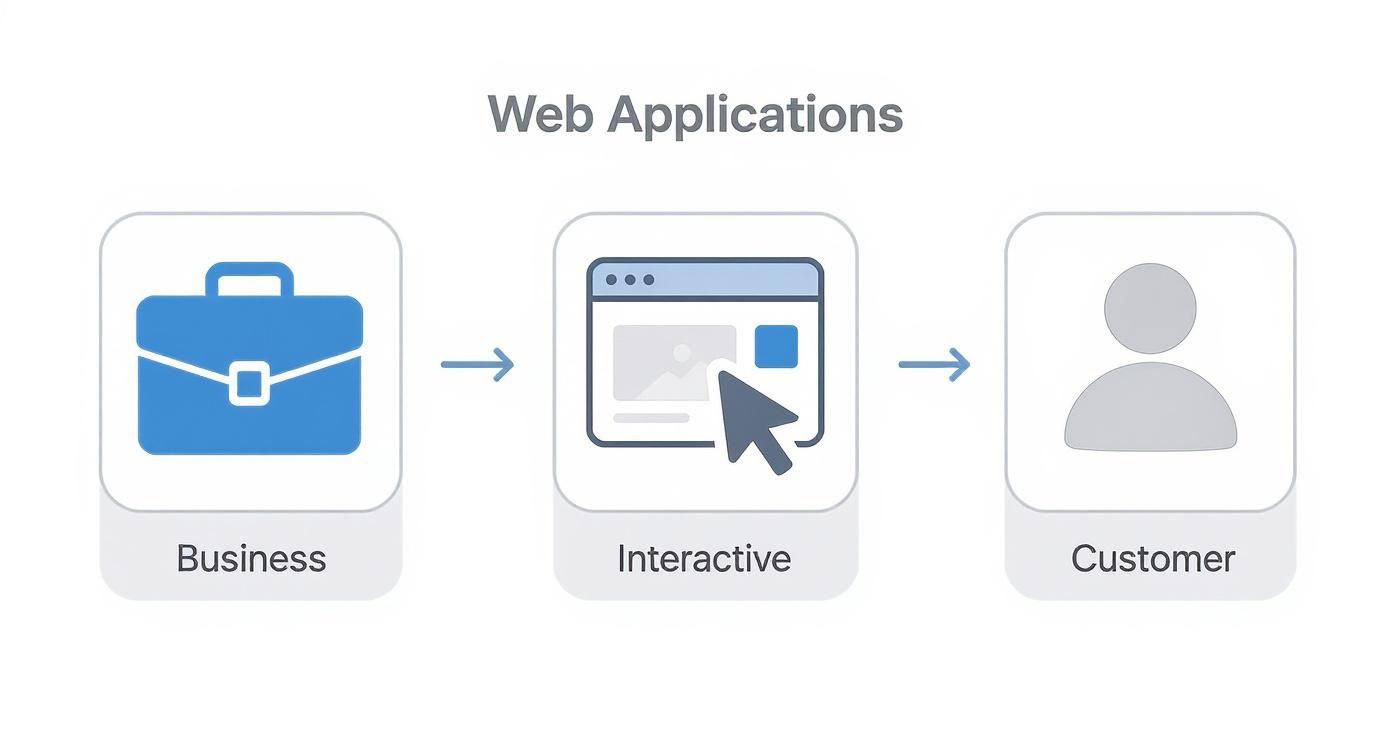
This simple flow from concept to customer is the guiding principle. Every decision we make is designed to create an intuitive and valuable experience for that end-user.
Phase 1: Discovery and Strategy
Before anyone writes a single line of code, we talk. A lot. This discovery phase is all about getting to the heart of your project. We’ll map out your business objectives, pinpoint the exact problem you’re trying to solve, and get a crystal-clear picture of the people who will be using the application.
This strategic foundation is everything. Building an app without it is like setting sail without a destination—you might build something technically impressive, but it won’t get you where you need to go. A solid strategy ensures every feature and design choice has a purpose.
Phase 2: UI and UX Design
Once the ‘why’ is clear, we move on to the ‘how’. This is where User Experience (UX) and User Interface (UI) design come into play. Think of UX as the architecture of the app—the logical flow that makes it easy and enjoyable to use. UI, on the other hand, is the interior design—the colours, buttons, and visual elements that bring that architecture to life.
A well-designed application just makes sense. It guides users from one step to the next without them even thinking about it, making complicated tasks feel effortless. This is where you either hook a user or lose them for good.
Our aim is to create an experience that feels completely natural. We build wireframes and interactive prototypes so you can click around and get a real feel for the application long before the heavy-lifting of development begins. It’s a crucial step that saves a massive amount of time and money later on.
Phase 3: Development and Implementation
This is where the blueprints become a reality. Our developers take the approved designs and strategic plans and start building. We almost always use an agile methodology for this, which means we work in short, focused cycles called “sprints.”
This approach keeps the project nimble and transparent. It gives us regular opportunities for you to provide feedback, allowing us to make adjustments on the fly. Whether we’re tackling a large-scale Odoo implementation Sydney businesses depend on or crafting a custom Shopify implementation, working in sprints ensures everyone is on the same page and the project never veers off course.
Phase 4: Testing and Quality Assurance
Testing is non-negotiable. Before an application sees the light of day, it goes through a rigorous quality assurance (QA) process. We push it, pull it, and try to break it to make sure it’s secure, bug-free, and performs perfectly on any device. This includes:
- Functionality Testing: Does every button, form, and link do exactly what it’s supposed to?
- Performance Testing: What happens when hundreds of users log on at once? We find out.
- Security Testing: Is your data and your users’ data locked down tight against threats?
This meticulous QA process is our promise that on launch day, your application is solid, reliable, and ready to deliver a flawless user experience.
Phase 5: Deployment and Maintenance
Launch day is just the beginning. The final step is getting the application live, but the work doesn’t stop there. Great applications evolve. We provide ongoing maintenance and support to keep things running smoothly, apply critical security updates, and add new features as your business grows and your needs change.
A dedicated partner in software development Sydney or Adelaide won’t just build your app and disappear. They’ll be there to ensure it remains a powerful asset for your business for years to come.
Ready to turn your vision into a powerful web application? Let’s discuss the blueprint for your project today.
Choosing the Right Technology for Your Project
Picking the right technology for your web application is a lot like choosing the engine for a car. It’s the heart of the machine, dictating its performance, speed, and what it’ll be capable of down the track. This decision isn’t just a technical footnote; it directly shapes how your app performs, how easily it can grow, and how much it will cost to keep it running smoothly.
Let’s break this down. Every web application has two sides: the front-end and the back-end. Getting your head around the difference is the first crucial step to making a smart choice.
Think of the front-end as everything your user sees and touches—the buttons, menus, forms, and the overall layout. It’s the car’s interior: the steering wheel, the dashboard, the seats. The entire goal here is to craft an experience that feels seamless, intuitive, and looks great.
The back-end, on the other hand, is the engine room. It’s the server, the database, and all the application logic working silently behind the scenes. This is what processes data, handles user accounts, and makes sure everything a person does on the front-end actually works.
Front-End Technologies That Power the User Experience
The front-end is all about that first impression and making the user’s journey a breeze. Modern web based application development leans on powerful frameworks to build these slick, dynamic interfaces. Some of the most popular choices include:
- React: Built by Facebook, it’s known for being incredibly fast and flexible. It’s a brilliant choice for single-page applications where data is constantly changing on the screen.
- Angular: This is Google’s comprehensive, all-in-one framework. It’s often the go-to for large, complex enterprise-level applications because of its structured and opinionated approach.
- Vue.js: Often praised for its simplicity and gentle learning curve, Vue is a fantastic option for startups and projects that need to get off the ground quickly without a massive overhead.
The right choice really boils down to your project’s specific needs. A simple marketing website has completely different demands than a complex data analytics dashboard.
The ultimate goal of the front-end is to make the user’s interaction with your application effortless. A great front-end is one that users don’t even notice because everything just works as they expect it to.
Back-End Technologies: The Engine Room
This is where the real heavy lifting happens. The back-end is the unseen force that makes your application functional, reliable, and secure. It’s where your core business logic lives, whether that’s processing an e-commerce order or managing intricate workflows in an enterprise system.
Choosing the right back-end technology is a balancing act between performance, scalability, and the development resources you have available. Common languages and frameworks include:
- Python (with Django/Flask): Incredibly versatile and used for everything from web apps to AI. It’s a solid choice for projects that need to crunch complex data.
- PHP (with Laravel): A true workhorse of the web. PHP still powers a huge portion of the internet and is known for its massive community and robust frameworks like Laravel.
- Node.js: This one is a game-changer because it lets developers use JavaScript on the back-end. This can seriously simplify the development stack and is excellent for building fast, real-time applications like chat apps.
To help clarify the roles these technologies play, here’s a quick comparison of the two sides.
Comparing Front-End vs Back-End Technologies
| Technology Type | Popular Frameworks/Languages | Primary Function | Best For |
|---|---|---|---|
| Front-End | React, Angular, Vue.js | Building the user interface (UI) and user experience (UX) | Interactive web pages, single-page applications, and dynamic user interfaces. |
| Back-End | Python, PHP, Node.js | Server-side logic, database management, and API development | Data processing, user authentication, and powering the core application logic. |
This table gives you a bird’s-eye view, but the real magic happens when you pair the right front-end with the right back-end to match your project’s goals.
Practical Cases: How Technology Choices Shape Projects
Let’s look at how these choices play out in the real world. A fast-moving startup might pair Vue.js on the front-end with Node.js on the back-end to quickly build a Minimum Viable Product (MVP). This tech stack allows for rapid iteration and a speedy launch to test their idea in the market.
On the other end of the spectrum, a large manufacturing company needing an all-in-one system might look to a robust Odoo implementation in Sydney or Adelaide. Odoo is built on Python and provides a rock-solid, scalable foundation for managing everything from inventory to accounting. Its pre-built modules accelerate development time, while its customisability ensures it can be moulded to fit the business perfectly.
For e-commerce, the decision often comes down to specialised platforms. A growing retail brand might opt for a custom Shopify implementation to tap into its powerful sales tools and massive app ecosystem. A business with more unique product requirements might choose WooCommerce for its sheer flexibility, allowing them to build a completely bespoke online store. These platforms handle much of the tricky back-end work, letting businesses focus on what they do best: selling. The right partner for software development in Sydney or Adelaide can help you navigate these choices to find the perfect fit.
Making the right technology decision is absolutely foundational to your project’s success. It ensures your application is not only powerful today but is also built to handle the challenges of tomorrow.
Feeling unsure about which technology is right for your vision? Book a free consultation with our experts, and let’s build a plan together.
Real-World Examples of Web Application Success
It’s one thing to talk theory, but seeing how web based application development actually solves real-world problems for Australian businesses is when the lightbulb really goes on. These aren’t just minor tech upgrades; they’re fundamental business transformations, all driven by smart, targeted software. Let’s dive into some practical cases that show the direct impact of building the right tool for the job.

Time and again, we see custom applications turn a messy tangle of spreadsheets into a perfectly synchronised operation, bringing clarity and control where there was once chaos.
Case Study: Odoo Implementation in Adelaide
Picture a local manufacturer in Adelaide. Their entire operation—inventory, production runs, sales orders—was being juggled across a complex web of spreadsheets. It was a system stretched to its absolute breaking point. Information was constantly out of date, which led to costly stock errors and infuriating production delays. What they desperately needed was a single source of truth.
The answer was a tailored Odoo implementation in Adelaide. Instead of relying on a patchwork of disconnected files, they moved to a unified platform where every part of the business could finally talk to each other.
- The Problem: Disjointed data scattered across multiple spreadsheets, causing inventory nightmares and operational bottlenecks.
- The Solution: A custom Odoo ERP application that brought inventory, manufacturing, sales, and accounting together under one centralised dashboard.
- The Result: Within the first year, the manufacturer saw a 30% reduction in stock discrepancies and a 20% improvement in production efficiency. Decisions were no longer based on guesswork but on real-time, accurate data.
This project is a perfect example of how a well-executed web application doesn’t just organise information—it builds a smarter, more responsive business.
Case Study: Shopify Implementation in Sydney
Now, let’s head over to a Sydney-based retailer. They had an online store, but it was basic and struggled to deliver the modern, personalised shopping experience their customers craved. The platform felt clunky, was a pain to update, and simply couldn’t keep up with their growing product catalogue.
They decided to invest in a custom Shopify implementation. This wasn’t just about slapping on a new theme; it was a ground-up rebuild of their digital storefront, with a laser focus on user experience and powerful sales features.
A great e-commerce site is more than a catalogue; it’s a conversation with your customer. The right platform allows you to guide that conversation, making it personal, engaging, and incredibly simple to make a purchase.
The development team built a custom Shopify app to handle unique product bundles and seamlessly integrated a sophisticated loyalty program. They streamlined the checkout process and optimised the entire site for lightning-fast performance on mobile. The impact was immediate and substantial, proving the immense value of expert software development in Sydney.
The results spoke for themselves: a 45% increase in online sales and a massive 60% rise in repeat customer purchases, which they could directly attribute to the new loyalty features and vastly improved shopping journey.
Case Study: WooCommerce for a Growing Business
Not every business needs a massive, enterprise-level system to succeed. Take a smaller specialty goods supplier, for example. They wanted a powerful e-commerce presence without the eye-watering price tag. Crucially, they needed the flexibility to sell unique, customisable products—something many off-the-shelf platforms really struggle with.
The perfect fit for them was WooCommerce. Built on the incredibly flexible foundation of WordPress, it gave them the power to create a completely bespoke online store that perfectly reflected their brand and product needs. This approach offered immense capability on a more accessible budget. Because WooCommerce is open-source, they could easily add specific plugins for product customisation and connect to local Australian payment gateways and shipping providers without any fuss.
This project shows that strategic web based application development is all about choosing the right scale of technology. For this supplier, WooCommerce delivered the ideal balance of control, customisation, and cost-effectiveness, allowing them to punch well above their weight and compete with much larger players in their niche.
These stories all highlight a clear pattern: successful web applications are born from a deep understanding of a specific business problem, followed by building a precise, targeted solution to solve it.
Ready to write your own success story? Get in touch with Wistec today, and let’s talk about how a custom web application can solve your biggest challenges.
Budgeting for Your Web Application in Australia
Alright, let’s talk about the big question: what’s it actually going to cost to bring your web app idea to life? It’s what everyone wants to know, but pinning down a single number without a detailed blueprint is almost impossible. The final investment is always a reflection of your project’s unique ambitions and technical needs.
I like to use the house-building analogy. You wouldn’t expect a simple, single-story home to cost the same as a multi-level architectural marvel with custom fittings and a fully integrated smart system. Web applications work the same way. The budget is a direct result of how complex it is, what features you need, and the technology we use to put it all together.
Key Factors That Shape Your Budget
A few core elements will always steer the final cost. Once you get your head around these, you’ll have a much better idea of where your money is going and why. Unsurprisingly, the biggest drivers are nearly always the complexity and uniqueness of the features you’re after.
Here’s a breakdown of what really moves the needle on price:
- Feature Complexity: There’s a world of difference between a simple informational site with a contact form and an e-commerce platform with real-time inventory tracking and a customer loyalty program. The more intricate the logic, the more development hours it takes.
- Third-Party Integrations: Does your app need to connect with other systems? Think payment gateways, accounting software like Xero, or shipping providers. Each of these integrations adds another layer of work to the project.
- UI/UX Design: A completely bespoke, animated user interface will naturally require more design and front-end development time than a clean, functional design built from a standard framework.
- Technology Stack: The programming languages and frameworks we choose can influence the cost, as can the need for specialised expertise in certain areas of software development in Sydney or Adelaide.
The scope of your project is the single biggest factor in determining cost. A focused Minimum Viable Product (MVP) designed to test a core idea will always be more affordable than a feature-packed application built to serve thousands of users from day one.
The Australian market for web based application development is absolutely buzzing, with huge demand coming from e-commerce, healthcare, and finance. Looking at current figures for 2025, project costs can swing from around AUD 60,000 for simpler applications to well over AUD 450,000 for complex, enterprise-level platforms. Timelines follow suit, ranging from three months to over a year. If you want to dive deeper, you can explore some of these Australian web app development cost breakdowns to see how different factors come into play.
Realistic Cost and Timeline Estimates
To put this into perspective, let’s look at a couple of real-world scenarios. A small business, for example, might invest in a powerful WooCommerce store or a streamlined Shopify implementation. These are fantastic ways to get online and start selling quickly, often delivering a brilliant return on a more modest initial outlay.
On the other end of the spectrum, a large manufacturing or logistics company might need a comprehensive Odoo implementation in Sydney or Adelaide. This is a much heavier lift. It’s not just an app; it’s about mapping and automating core business processes across multiple departments, from inventory and manufacturing right through to accounting.
Ultimately, budgeting for a web application is a balancing act between your vision and your resources. The smartest way to start is by getting crystal clear on your “must-have” features versus the “nice-to-haves.” This focus will keep your project on track and ensure you’re putting your money into a tool that delivers real, measurable value to your business.
Ready to get a clear and transparent quote for your project? Contact Wistec for a free consultation and let’s discuss how we can build a powerful web application that fits your budget and your goals.
Ready to Build Your Competitive Edge?
Standing still in business is the same as moving backwards. To get ahead, you have to build for where the world is going, not just where it is today. User expectations are always on the move, shaped by everything from AI integration to the simple fact that everyone uses their phone for everything. A smart approach to web based application development isn’t just a nice-to-have anymore; it’s about building a solid foundation for your business’s future.
Investing in a custom web application gives you a powerful, flexible asset that scales with you. It’s your chance to break free from generic, one-size-fits-all software and craft something that perfectly matches your unique workflow, giving you a real advantage over the competition.
Riding the Wave of Modern Web Tech
The biggest change in recent years? The undeniable shift to mobile-first thinking. It has completely reshaped how we build modern web applications. This has paved the way for technologies like Progressive Web Apps (PWAs), which offer a slick, app-like experience right inside a web browser. In fact, a well-built PWA can load up to 15 times faster than a standard mobile site, making for a much happier user. This isn’t just a fleeting trend; it’s a global move towards more accessible and engaging digital experiences, and you can discover more insights on Australian app development services here.
By embracing these modern technologies, you’re not just polishing your current digital presence. You’re building a foundation that’s faster, more reliable, and ready for whatever your customers demand next.
This forward-thinking mindset is crucial, whether you’re looking at a comprehensive Odoo implementation Sydney businesses are adopting or a flexible WooCommerce storefront. The aim is always the same: create a better, more efficient experience for your team and your customers. The right partner in software development Sydney or Adelaide can help you navigate the tech choices to get you there.
So, are you ready to sharpen your operations and deliver an exceptional customer experience? Whether you need a bespoke web application, a powerful Shopify implementation, or a fully integrated ERP system, our team is here to help you build the tools that will drive your success.
Let’s talk about how we can build your competitive edge. Contact Wistec for a no-obligation consultation today.
Frequently Asked Questions
Diving into the world of web-based application development often brings up a few common questions. We hear these all the time from business owners across Australia, so let’s clear them up with some straightforward answers.
What’s the Real Difference Between a Website and a Web App?
It’s all about interaction. Think of a standard website as a digital brochure—it’s fantastic for presenting information like your services, contact details, or a portfolio. It’s mostly a one-way street; you publish, they read.
A web application, on the other hand, is a tool. It’s a two-way street where users can do things. They can book appointments, manage their accounts, design a product, or track an order. While a website tells, a web application acts.
How Long Does It Take to Build a Web Application?
That’s the million-dollar question, and the honest answer is: it completely depends on what you’re building. A streamlined application with a clear set of core features, often called a Minimum Viable Product (MVP), could be up and running in 3 to 4 months.
For something more complex, like a full Odoo implementation in Sydney with custom modules and third-party integrations, you’re looking at a timeline of 6 to 12 months, sometimes longer. A good software development Sydney team will always start with a discovery phase to give you a realistic timeline.
The smartest way to approach it is often to launch with the essentials first. Get your application into the hands of real users, gather their feedback, and then build out more features. It’s a faster and more effective way to create something people actually want to use.
Should I Just Use an Off-the-Shelf Solution Instead?
You absolutely can, and for many businesses, it’s the right call—at least to start with. Platforms like Shopify and WooCommerce are brilliant for getting a business off the ground quickly. But eventually, you might find your unique way of doing things clashes with the platform’s limitations.
- Shopify Implementation: A powerhouse for e-commerce businesses that need a robust, ready-to-go solution with a huge ecosystem of apps.
- WooCommerce: Gives you more control and flexibility, especially if your business is built on WordPress or you have unique product requirements.
Custom development becomes the logical next step when you’re tired of trying to fit your business into a box. It’s about creating a tool that’s moulded perfectly to your operations, not forcing your operations to fit the tool.
What Should I Budget for Ongoing Maintenance?
Think of it like servicing a car; you need to keep it running smoothly and securely. A good rule of thumb is to budget around 15-20% of the initial development cost per year for ongoing maintenance.
This isn’t just a “just in case” fund. It actively covers security patches, server costs, squashing any bugs that pop up, and making sure your app keeps up as technology changes. It’s a crucial investment in protecting the asset you’ve just built.
A reliable partner for software development in Adelaide will lay out transparent maintenance plans, ensuring your application performs just as well on day 1,000 as it did on day one.
Ready to turn your idea into a web application that solves real problems and drives results? The team at Wistec is here to guide you every step of the way, creating practical solutions built for your business.
Book your free consultation with Wistec today and let’s build something great together.