

Web and application development go beyond writing code; instead, it focuses on crafting the digital tools your business relies on every day. In essence, it serves as the engine room of your entire online operation, powering everything from your public-facing website to the complex internal systems your team uses. Ultimately, the goal is not just to create something that looks good, but to actively solve real business problems and drive measurable growth.
Why Web and Application Development Is Your Digital Engine for Growth
Too many business leaders see a website or an app as a necessary cost—essentially a digital brochure you simply need to have. However, that mindset completely misses the point. When you do it right, web and application development create active, high-performing assets that generate revenue, cut inefficiencies, and build stronger connections with your customers.
In other words, it’s the difference between a static flyer and a tireless sales and operations team working for you 24/7.
For example, a basic website might list your opening hours, and that’s fine. However, a thoughtfully developed application goes much further. It allows customers to book appointments, purchase products, and track orders from their phone in real time. While the first approach delivers passive information, the second actively drives revenue and business growth.
From Problem to Powerful Solution
Every great digital project starts with a simple question: “What business problem are we actually trying to solve?” The technology comes later. It’s just the tool we use to get the job done. When you put the problem first, development stops being a technical chore and becomes a smart business investment.
Let’s look at some practical cases:
- Retail Growth: A Sydney-based retailer was constantly battling inventory headaches across multiple stores. A targeted Shopify implementation got their online and in-store stock levels in sync, putting an end to overselling and giving customers a much smoother experience.
- Manufacturing Efficiency: An Adelaide manufacturing firm was drowning in clunky, disconnected production schedules. A custom Odoo implementation in Sydney, Adelaide, automated their entire workflow—from ordering raw materials to shipping finished goods—cutting waste and boosting output.
- Service Delivery: A professional services firm needed a more secure and efficient way to manage projects. Custom software development in Sydney and Adelaide gave them a private client portal for sharing documents and updates, which dramatically improved transparency and kept their clients happy.
At its core, development is about building a direct bridge between a business challenge and a digital solution that delivers a clear return on investment.
Creating a Competitive Advantage
In a market this crowded, a seamless digital experience truly sets you apart. When your website loads instantly, your app feels effortless to use, and your internal systems simply work, you create a powerful competitive advantage. More importantly, this goes beyond looking professional—it delivers operational excellence that both your customers and your team can genuinely feel.
Whether you run a high-volume WooCommerce store or require a bespoke mobile app, investing in quality development directly strengthens your business performance. As a result, your systems work harder, your processes run smoother, and your growth becomes more sustainable.
So, are you ready to turn everyday business challenges into real growth opportunities? Contact us today to explore how a custom digital solution can become the engine that drives your business forward.
Your Blueprint From Idea to a Live Digital Asset
Bringing a new digital project to life can feel overwhelming at first. However, behind every successful website or application sits a clear, structured process. Much like building a house, you would never pour the foundation without detailed architectural plans and a well-defined construction timeline.
The same principle applies in the digital world. A well-built digital asset moves through six distinct stages, with each phase deliberately building on the one before it. As a result, this methodical approach ensures the final product remains stable, user-friendly, and closely aligned with your real business goals. When teams try to rush or skip steps, they almost always face costly rework and frustrating delays later on.
Ultimately, this visual illustrates how we move from a clear business problem to a digital solution that genuinely drives growth.
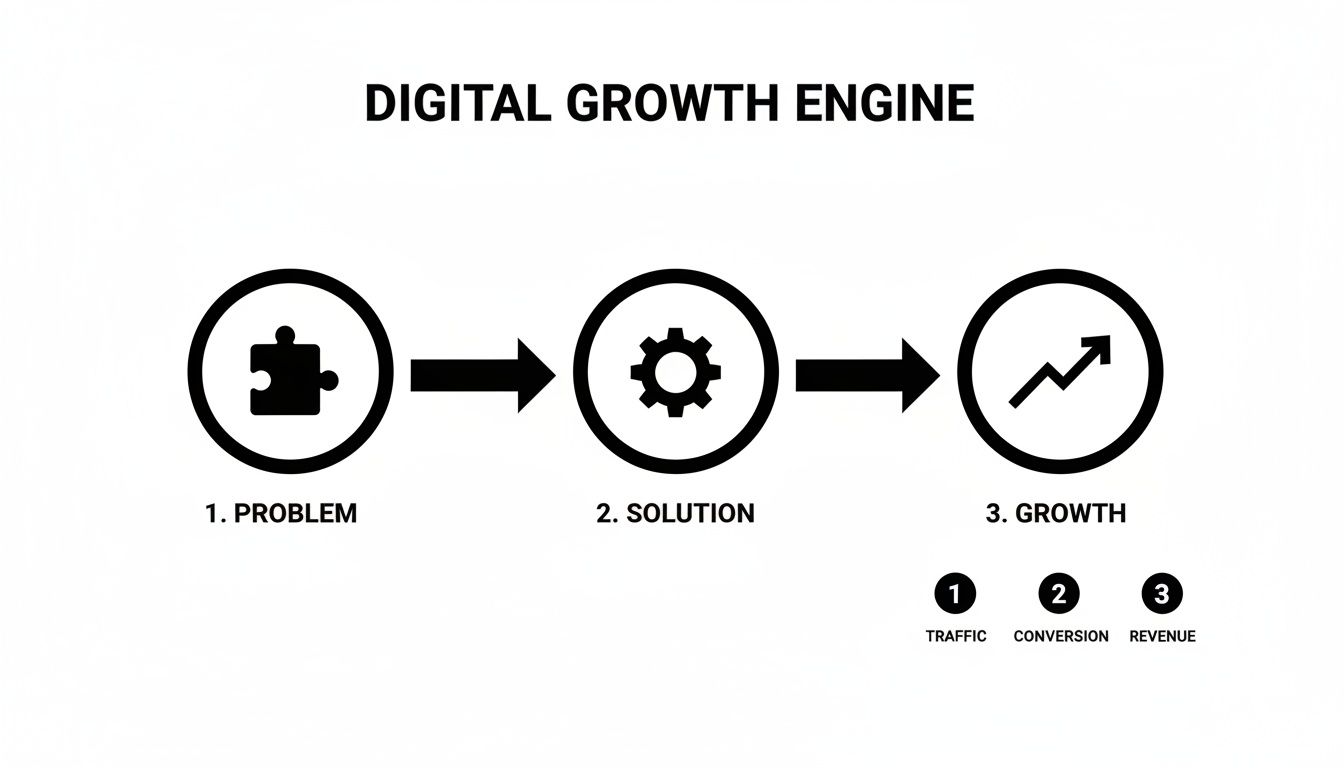
As you can see, it all starts with defining the real problem, so we can build a targeted digital solution that delivers measurable results.
Stage 1: Discovery and Planning
This is easily the most critical phase, because it’s where we build the entire foundation of the project through careful listening and detailed planning. First, we sit down with you to identify the core business challenge. Then, we define clear objectives, understand your users, and map out every feature the solution truly needs.
To illustrate this, consider a real-world example. An Adelaide-based logistics company approached us to improve its delivery tracking. However, during our discovery sessions, we uncovered that the real issue wasn’t tracking at all—it was inefficient driver routing. As a result, this insight shifted the project’s focus toward a far more valuable solution, ultimately saving the business thousands of dollars in fuel costs. Without a thorough discovery process, that opportunity would have been completely missed.
Stage 2: Design and Prototyping
With a rock-solid plan in place, we move into the visual phase. At this stage, we create wireframes—the basic skeletal layouts—and mockups, which add detailed visual design. Together, these elements come to life in an interactive prototype. Importantly, this step goes beyond making things look good; it focuses on designing an intuitive User Experience (UX) and an engaging User Interface (UI).
The prototype allows you to see, feel, and click through your application before we write a single line of code. As a result, it becomes the most effective way to gather feedback and make adjustments while changes remain quick and cost-effective.
This is also where we refine the entire user journey. We ensure every click feels natural and every screen serves a clear purpose. Ultimately, this phase plays a critical role in every project, whether you’re building a WooCommerce store or a complex internal platform.
Stage 3: Development
Now, our developers get to work, turning the approved designs into a living, breathing digital product. Following the best practices for software development in Sydney and Adelaide, our team writes clean, efficient, and secure code. We typically break the project into smaller, manageable “sprints,” which allows us to show you regular progress and stay flexible enough to adapt if needed.
The structural foundation of any great digital asset is its architecture. To see how a well-planned structure supports long-term performance and scalability, it’s worth understanding modern web application architecture.
Stage 4: Quality Assurance
Before anything goes live, our Quality Assurance (QA) team puts it to the test. Acting as your first—and toughest—users, they actively hunt for bugs, test features across multiple devices and browsers, and push the application to its limits to confirm it can handle real-world demands.
To illustrate this, consider a practical example. During a major Shopify implementation, our QA team simulated a high-traffic flash sale. Through this stress test, they uncovered a hidden bottleneck in the payment gateway that would have caused the site to crash at launch. As a result, that single test saved the client from lost sales and serious brand damage.
Stage 5: Deployment and Launch
Once the application passes every QA check and you give the final thumbs-up, it’s go-time. At this point, we migrate the code to the live server, configure the databases, and run final checks to ensure everything transitions smoothly. Throughout this stage, our team manages the entire process, ensuring a seamless launch experience for both you and your users.
Stage 6: Maintenance and Support
The journey doesn’t stop at launch. Technology is always moving, so ongoing maintenance is essential for security, performance, and long-term stability. This includes applying security patches, updating software, and providing support to make sure your digital asset keeps performing at its peak. This holds for any system we build, including a custom Odoo implementation in Sydney and Adelaide.
Ready to build your digital asset the right way? Get in touch to start your project blueprint.
Choosing Your Tech: Platforms vs Custom Solutions
Once your project blueprint is clear, you reach a critical decision point: do you choose a ready-made platform, or do you build a fully custom solution from the ground up? This choice goes far beyond a technical preference. Instead, it’s a strategic business decision that directly influences your budget, your timeline, and your ability to adapt as your business evolves.
To put it into perspective, think about setting up a physical business. On one hand, you could lease a pre-built shop in a busy retail centre, which gets you operational quickly but comes with fixed layouts and rules. On the other hand, you could purchase land and build a purpose-designed facility, giving you complete control while requiring more time and upfront investment.
Ultimately, neither option is automatically better. The right path depends entirely on your commercial objectives, operational requirements, and long-term vision.
The Power Of Platforms For Speed And Simplicity
Platforms like Shopify, WooCommerce, or even some modules within an Odoo ERP are the pre-built retail spaces of the digital world. They give you a solid foundation with all the essential features ready to go, making them ideal for businesses that need to get to market quickly and have fairly standard requirements.
Let’s look at a practical case. A startup fashion boutique in Sydney needs an online store. Their main goals are to list products, process payments securely, and manage orders. A professional Shopify implementation is a perfect fit. It offers a fast, reliable, and cost-effective way to launch, allowing them to start making money in weeks, not months. The platform handles all the tricky backend stuff, so they can focus on what they do best: marketing and selling.
Similarly, a small services business might use WooCommerce to sell digital products or book appointments, getting them online without a huge initial investment.
When Custom Solutions Deliver Unmatched Value
While platforms are fantastic for many, they do have their limits. When your business processes are truly unique, when you need to connect with specialised legacy systems, or when your competitive edge comes from a one-of-a-kind user experience, a custom solution is the only way to go. This is building your facility to your exact specifications.
This is where expert software development in Sydney and Adelaide becomes a game-changer. Using powerful frameworks and languages, developers can build a digital asset that maps perfectly to your workflows, creating a competitive advantage that can’t be easily copied.
A custom solution is built for how your business actually works, not how a platform thinks it should work. It’s an investment in operational perfection and unlimited scalability.
Here’s another practical case. An established logistics firm in Adelaide has a highly specialised process for managing freight, involving custom routing algorithms and integration with proprietary warehouse hardware. No off-the-shelf platform can do that. A custom web application is the only way to automate their unique workflow, delivering massive efficiency gains and a clear return on investment. The same logic applies to a complex Odoo implementation in Sydney and Adelaide, where standard modules are tailored and extended to fit precise manufacturing or supply chain needs.
Making the right choice here is vital. To help clarify the trade-offs, here’s a quick comparison from a business perspective.
Platform vs Custom Development: A Business-Focused Comparison
| Consideration | Platform-Based (e.g., Shopify, WooCommerce) | Custom Development (e.g., Python, .NET) |
|---|---|---|
| Speed to Market | Very Fast. Can launch in weeks. Ideal for getting a minimum viable product (MVP) out quickly. | Slower. Takes months, depending on complexity. Requires a full development cycle. |
| Initial Cost | Lower. Involves setup fees, theme costs, and monthly subscriptions. More predictable budget. | Higher. Significant upfront investment in development, design, and project management. |
| Flexibility & Customisation | Limited. You work within the platform’s constraints. Customisation is possible but has boundaries. | Unlimited. Built from the ground up to match your exact business processes and vision. |
| Scalability | Good, but with limits. The platform manages scaling, but you may hit a ceiling with complex needs. | Infinite. Architected for your specific growth trajectory. You control the entire infrastructure. |
| Ownership & Control | Leased. You operate on their system and are subject to their terms, fees, and feature changes. | Full Ownership. You own the code and the intellectual property. It’s a company asset. |
Ultimately, choosing between a platform and a custom build comes down to one question: are you aiming for a quick launch with standard features, or do you need a powerful, bespoke tool that gives you a unique market advantage?
Understanding your true operational needs is the first step. If you’re unsure which path best aligns with your business goals, our team can help you analyse the trade-offs and make a strategic decision.
Contact us today for a consultation to explore whether a platform or custom solution is right for you.
Understanding the True Cost of Your Digital Project
When it comes to web and application development, the first question we always hear is, “So, how much is this going to cost?” It’s a fair question, but there’s no simple price tag. The real cost is a direct reflection of the value, complexity, and long-term capability you’re building into your business.
It’s helpful to shift your mindset from seeing this as just another expense. Think of it as an investment in a powerful, revenue-generating asset—one that should grow with you, not hold you back.
The Key Drivers Behind Your Project’s Budget
The final number on any quote, whether for a Shopify implementation or a custom internal tool, boils down to two things: time and expertise. A simple project takes less time than a complex one. The secret to budgeting effectively is understanding exactly where that time is spent.
Let’s break down the main factors that shape the final investment:
-
Project Complexity & Feature Count: This is the big one. A basic five-page marketing website is worlds away from a multi-vendor eCommerce marketplace with real-time bidding. Every single feature—user logins, payment processing, analytics dashboards, third-party connections—adds another layer of development and testing.
-
UI/UX Design Intricacy: A clean, functional design based on a proven template is always going to be faster to build than a completely bespoke, highly animated user interface. While a unique design can create an incredible brand experience, it demands significantly more hours from skilled designers and front-end developers to bring it to life.
-
Third-Party Integrations: Does your new system need to talk to your existing software? Connecting with payment gateways like Stripe, shipping carriers, accounting software, or a powerful ERP like in an Odoo implementation in Sydney, Adelaide, requires specialised work to make sure data flows securely and without a hitch.
What to Expect at Different Budget Levels
To put this into perspective, project costs here in Australia can vary wildly. Recent research shows that web app development typically ranges from AU$60,000 to AU$450,000, depending on the scope.
A fairly basic app with a simple feature set might fall into the AU$60,000 to AU$90,000 range and take about 3-6 months. On the other hand, an advanced platform with complex business logic and multiple integrations will easily push past AU$135,000 and can take a year or more to complete.
The goal isn’t to find the cheapest quote. It’s to find the partner who delivers the most value for your budget. A low upfront cost often hides future expenses in the form of rework, missed deadlines, and a poorly performing final product.
Beyond the Build: Looking at Total Cost of Ownership
Smart businesses look beyond the initial development invoice. To get a true picture of the investment, you need to consider all the associated factors, including the true costs involved in building and managing a website.
This is what we call the Total Cost of Ownership (TCO), and it includes:
- Initial Development: The core build of your website or application.
- Ongoing Maintenance: Absolutely vital for security updates, bug fixes, and performance tuning.
- Hosting & Infrastructure: The servers and cloud services that keep your application online.
- Third-Party Subscriptions: Ongoing fees for any integrated services, like payment gateways or marketing automation tools.
Any potential partner, especially a software development Sydney or Adelaide, should be willing to have a transparent conversation about these ongoing costs. A good partner will help you map out every expense, giving you a complete financial picture from day one, with no nasty surprises down the road.
Ready for a transparent cost breakdown for your project? Let’s talk about your goals and how we can deliver the best possible value for your investment.
How Different Australian Industries Win with Custom Tech
Let’s be honest, off-the-shelf digital solutions rarely create market leaders. The most successful businesses know that real power comes from technology that’s been precision-engineered to solve their specific industry challenges. After all, a feature that’s a game-changer for a retailer might be totally useless to a manufacturer.
This is why finding a development partner who genuinely understands your industry isn’t just a nice-to-have; it’s a deal-breaker. Let’s move past the theory and look at practical cases of how custom tech delivers real-world wins across key Australian sectors.
Retail and eCommerce: It’s All About the Customer Experience
In retail, the battle is won or lost on the customer’s screen. A clunky checkout, a slow-loading page, or inaccurate stock levels will send shoppers straight to your competitors in a heartbeat. Modern retail demands a seamless, fluid connection between the online and offline worlds—something a generic template simply can’t deliver.
A Practical Case: A national fashion brand, headquartered in Sydney, was wrestling with a classic problem: managing inventory across its physical stores and its booming online shop. They needed to create a true omnichannel experience. The answer was a custom Shopify implementation that integrated their point-of-sale (POS) systems directly with their eCommerce platform. This unlocked crucial features like click-and-collect and real-time stock visibility. The project didn’t just fix a problem; it dramatically reduced overselling, improved customer satisfaction, and boosted online sales by over 30% in the first year alone.
Manufacturing and Logistics: Squeezing Out Every Drop of Efficiency
For manufacturers and logistics companies, efficiency is the name of the game. Every minute wasted on manual data entry, every miscommunication, every scheduling hiccup—it all eats directly into the bottom line. These industries need rock-solid systems that can handle complex workflows, track physical goods flawlessly, and automate repetitive tasks without fail.
A Practical Case: An Adelaide-based manufacturer was being disabled by a patchwork of disconnected systems. They had one for inventory, another for production scheduling, and a chaotic mess of spreadsheets holding everything else together. This was a recipe for constant delays and costly errors. A specialised Odoo ERP implementation brought their entire operation under one roof. We configured modules for manufacturing resource planning (MRP), inventory management, and supply chain logistics, giving them a single, reliable source of truth. The result? A 25% reduction in production lead times and a massive drop in material waste.
The right technology doesn’t just support your business processes; it actively refines and improves them, turning operational friction into a competitive advantage.
Professional Services: Building Digital Trust
If you’re an accountant, lawyer, or consultant, your business is built on trust, confidentiality, and crystal-clear communication. You need secure, reliable digital tools to manage sensitive client data, streamline projects, and deliver a professional, transparent experience. Standard, off-the-shelf software often falls dangerously short of the strict compliance and security standards this sector demands.
A Practical Case: A Sydney law firm needed a secure portal to share case files and communicate with clients, but generic cloud storage was a non-starter due to security concerns. A custom software development Sydney Adelaide project delivered a bespoke client portal with end-to-end encryption, document version control, and secure messaging. This didn’t just tick their compliance boxes; it massively improved client confidence and made their internal workflows far more efficient. For businesses with less stringent but equally important needs, a well-configured WooCommerce site can be the perfect tool for securely managing client retainers and service package payments.
This push towards specialised digital solutions is a huge reason for Australia’s booming tech infrastructure. The cloud hosting and data processing services industry, for instance, has grown at an impressive compound annual rate of 8.1% over the past five years. This surge is expected to push industry revenue to an estimated AU$3.9 billion in 2025, largely thanks to the widespread adoption of e-commerce and custom web applications. You can explore more about this growth and what it means for Australian businesses.
No matter what industry you’re in, the message is clear: a one-size-fits-all approach to technology will always deliver one-size-fits-all results. To truly get ahead, you need a digital solution built by people who understand your unique operational world.
Ready to build a tech solution that’s perfectly aligned with your industry’s demands? Contact Wistec today for a free consultation, and let’s talk about how we can solve your biggest business challenges.
Finding the Right Partner to Build Your Vision

Choosing a development agency isn’t like picking a supplier based on the lowest quote. It’s about finding a long-term strategic partner, a team that’s genuinely invested in seeing your business succeed. The best agencies don’t just build what you ask for; they dig deeper, asking the tough questions to ensure the final product actually delivers tangible business value.
Ultimately, your project’s success rests on finding a partner with the right mix of technical skill, real-world industry insight, and open, honest communication.
Your Essential Partner Vetting Checklist
Before you sign on the dotted line, it’s crucial to do your homework. A great partner will welcome your questions and be completely transparent about how they work.
Here’s a practical checklist to help you evaluate potential agencies:
- Dig into their portfolio: Look for case studies and past work that mirror what you need. Have they successfully delivered a complex Shopify implementation for another retailer? Do they have a proven track record with Odoo implementation in Sydney and Adelaide for clients in the manufacturing space?
- Assess their technical chops: Don’t just take their word for it. Ask about the specific technologies they favour and, more importantly, why. A quality agency can clearly explain their approach to software development in Sydney and Adelaide and justify their technical choices for your project.
- Check their communication style: How do they run their projects? Ask about their communication rhythm, who your main contact will be, and what tools they use to keep you in the loop. Clear, consistent communication isn’t a “nice-to-have”; it’s a must.
- Confirm post-launch support: What happens after the project goes live? A reliable partner will have clear, structured maintenance and support plans to keep your new website or app secure, up-to-date, and running smoothly.
This need for skilled, reliable partners is only growing. The Australian IT services market is projected to climb from AU$57.17 billion in 2025 to over AU$70.26 billion by 2030, a surge driven by the demand for quality web and application development. You can discover more about these IT market trends to see how local businesses are gearing up.
Why Wistec Is Your Ideal Technology Partner
Here at Wistec, we blend proven technical expertise with a genuine understanding of what it takes to grow a business. We’re more than just developers—we’re strategic problem-solvers focused on building solutions that deliver a real, measurable return on your investment.
We believe the best digital solutions are born from a true partnership, where your industry knowledge and our technical skill come together to build something exceptional.
Our team has a wealth of experience delivering successful projects, from custom builds to platform-based solutions. Whether you need a high-performing WooCommerce store, a powerful mobile app, or a complete operational overhaul with Odoo, we have the skills and the passion to bring your vision to life.
If you’re ready to build a robust, scalable digital solution with a partner who is committed to your success from day one, it’s time to start a conversation.
Contact Wistec today for a no-obligation consultation, and let’s explore how we can build your vision together.
Answering Your Top Questions
We get it. Diving into a new web or app project brings up a lot of questions. Let’s tackle some of the most common ones we hear from businesses just like yours, so you can move forward with confidence.
How Long Will My Project Actually Take?
This is the classic “how long is a piece of string?” question, and the honest answer is: it completely depends on what we’re building. A straightforward, beautiful marketing website might be ready to launch in 4-8 weeks.
But if we’re talking about a sophisticated custom web application, say a comprehensive Odoo implementation Sydney Adelaide, with deep integrations and unique workflows, you’re looking at a timeline closer to 4 to 9 months, and sometimes longer. The only way to get a timeline you can count on is by starting with a detailed discovery phase where we map out every single requirement.
What’s the Real Difference Between a Website and a Web App?
It’s a great question, and the distinction is all about interaction.
Think of a basic website as a digital brochure. It looks great and gives people information, but it’s mostly a one-way street. A web application, however, is a two-way conversation—it’s a tool designed for users to do something.
A practical case is an online store. Whether it’s a Shopify implementation or built on WooCommerce, it’s a web application because customers actively browse products, manage a cart, and make payments. The same goes for the custom software development Sydney Adelaide we build for internal teams; it’s designed for active, dynamic use, not just passive viewing.
Do I Really Need to Pay for Maintenance After Launch?
In a word, yes. Think of your new web application like a brand-new company car. You wouldn’t drive it for years without servicing it, right? Your digital platform is no different.
Ongoing maintenance is crucial for protecting your investment. It covers essential security patches to fend off new threats, performance tweaks to keep things running fast, and bug fixes that pop up over time. It’s what keeps your application secure, reliable, and ready to handle your business growth. That’s why we offer dedicated maintenance plans for every solution we build.
Ready to build a powerful digital solution that drives real business results? The team at Wistec has the expertise to bring your vision to life. Contact us today for a no-obligation consultation.