

When you hear “custom website development,” what comes to mind? It’s essentially the process of building a website from the ground up, designed specifically for your business and its unique goals. This is a world away from template-based sites, offering unlimited flexibility, better performance, and a brand identity that’s truly one-of-a-kind.
What Exactly Is Custom Website Development?
Think about it like building a house. You could go for a pre-fabricated home. It’s fast, generally more affordable, and gets the job done. But it’ll look a lot like every other house on the block. This is your template website, built on platforms like Squarespace or Shopify. It serves its purpose, but it might not be the perfect long-term fit for your specific needs.
The other option? Hire an architect. They’ll design a home meticulously planned around your family’s lifestyle, your taste, and your plans for the future. Every single element, from the layout to the materials, is chosen for a reason. That, right there, is the heart of custom website development services.
Moving Beyond a Cookie-Cutter Template
Custom development isn’t just about changing colours and fonts on a pre-made design. It’s about constructing the entire digital experience from scratch—the code, the features, the user flow. It’s about building a digital headquarters that works exactly the way your business does.
This approach is a strategic investment, and it comes with some serious advantages over off-the-shelf solutions.
- Tailor-Made Functionality: Need a special feature that templates just don’t have? Think custom-built calculators, secure client portals, or intricate booking systems. A custom build makes it possible.
- Ready to Scale: A website built from the ground up is designed to grow as you do. It’s ready to handle more traffic and new features down the line without needing a complete do-over.
- SEO From the Ground Up: The code is clean and optimised for search engines from day one. This gives you a leg up in search rankings right out of the gate.
- A Truly Unique Brand Experience: Your website will look and feel like no other. It’s the perfect way to express your brand and stand out from competitors relying on common templates.
A custom website is an engine built for your specific business objectives. It’s not just a digital brochure; it’s a high-performance tool crafted to attract visitors, turn them into loyal customers, and drive a real return on your investment.
Ultimately, choosing custom website development means you’re not trying to squeeze your business into a box it was never meant for. Instead, you’re creating a powerful digital asset that perfectly matches your vision, giving you a competitive edge that generic solutions simply can’t provide.
The Business Case for a Custom-Built Website
Choosing to invest in custom website development services is the moment you decide to turn your online presence from a simple digital brochure into a hard-working business asset. While off-the-shelf templates are great for getting started quickly, a website built from the ground up delivers tangible returns that grow over time and directly feed your bottom line.
This isn’t just about looks. It’s a strategic move built on three core pillars: scalability, search engine performance, and user experience. These aren’t just fluffy industry terms; they are the real-world advantages that give you a serious edge over the competition.
Built for Future Growth
Think of scalability as future-proofing your business. Imagine you launch a killer marketing campaign and your website traffic explodes overnight, going from a few hundred visitors a day to tens of thousands. A template-based site, bogged down by its own limitations, might buckle under the pressure and crash. That means lost sales and a damaged reputation.
A custom website, on the other hand, is built for that kind of success from day one. Its very architecture is engineered to handle massive spikes in traffic or the addition of complex new features without needing a painful and expensive overhaul. Your website can grow right alongside your business, adapting to whatever comes next.
Gaining an SEO Advantage from Day One
With custom development, Search Engine Optimisation (SEO) isn’t something you bolt on at the end; it’s baked right into the website’s DNA. Template sites can certainly be optimised, but they often carry a lot of clunky, inefficient code that slows them down. This makes it much harder for search engines to crawl and understand what your site is about.
When your site is custom-built, every line of code is clean and has a purpose. It’s structured for optimal search engine visibility, which means faster loading times and a rock-solid technical foundation that Google absolutely loves. This gives you a head start in climbing the rankings for the keywords that matter to your business.
Ultimately, this clean code and performance focus makes it much easier for potential customers to find you online.
Crafting a Superior User Experience
A truly great user experience (UX) is perhaps the strongest argument for going custom. It’s all about creating a customer journey that feels so intuitive and effortless that it naturally guides people toward becoming a customer. This is so much more than just a pretty design; it’s the science behind making a website both easy and enjoyable to use.
This intense focus on the user has a real, measurable impact. In Australia, the web design industry hit a massive AUD 1.3 billion in 2022 as more businesses realised the value of great UX. We’ve seen that well-designed websites can achieve conversion rate improvements of up to 200% compared to poorly designed ones.
Even tiny changes can make a huge difference. For example, simply using red call-to-action buttons has been shown to boost conversions by 34%. These numbers prove that a custom, user-focused website isn’t an expense—it’s one of the best investments you can make in your company’s future. You can see more about how website design impacts business metrics on mycodelesswebsite.com.
A Look Inside the Custom Web Development Process
So, what does it actually look like to build a custom website from the ground up? It can seem like a huge, complicated undertaking, but any good development team follows a clear, structured path. It’s a journey we take together, broken down into logical stages.
Think of it like building a custom home. You wouldn’t just start pouring concrete without a detailed blueprint. The same principle applies here; we move step-by-step to bring your digital vision to life, ensuring nothing gets missed.
Phase 1: Discovery and Strategy
This is arguably the most important part of the entire project. Before a single line of code is written or a design element is chosen, we need to understand the ‘why’. This is our blueprinting phase.
We’ll sit down with you to get to the heart of your business. We’ll talk about your goals, who your customers are, what your competitors are doing, and what success looks like for you. Your input here is everything; you’re the expert on your business, and we’re here to translate that expertise into a digital strategy. The result is a detailed project brief that acts as our north star for the whole build.
The infographic below shows how this foundational planning sets the stage for everything that follows.
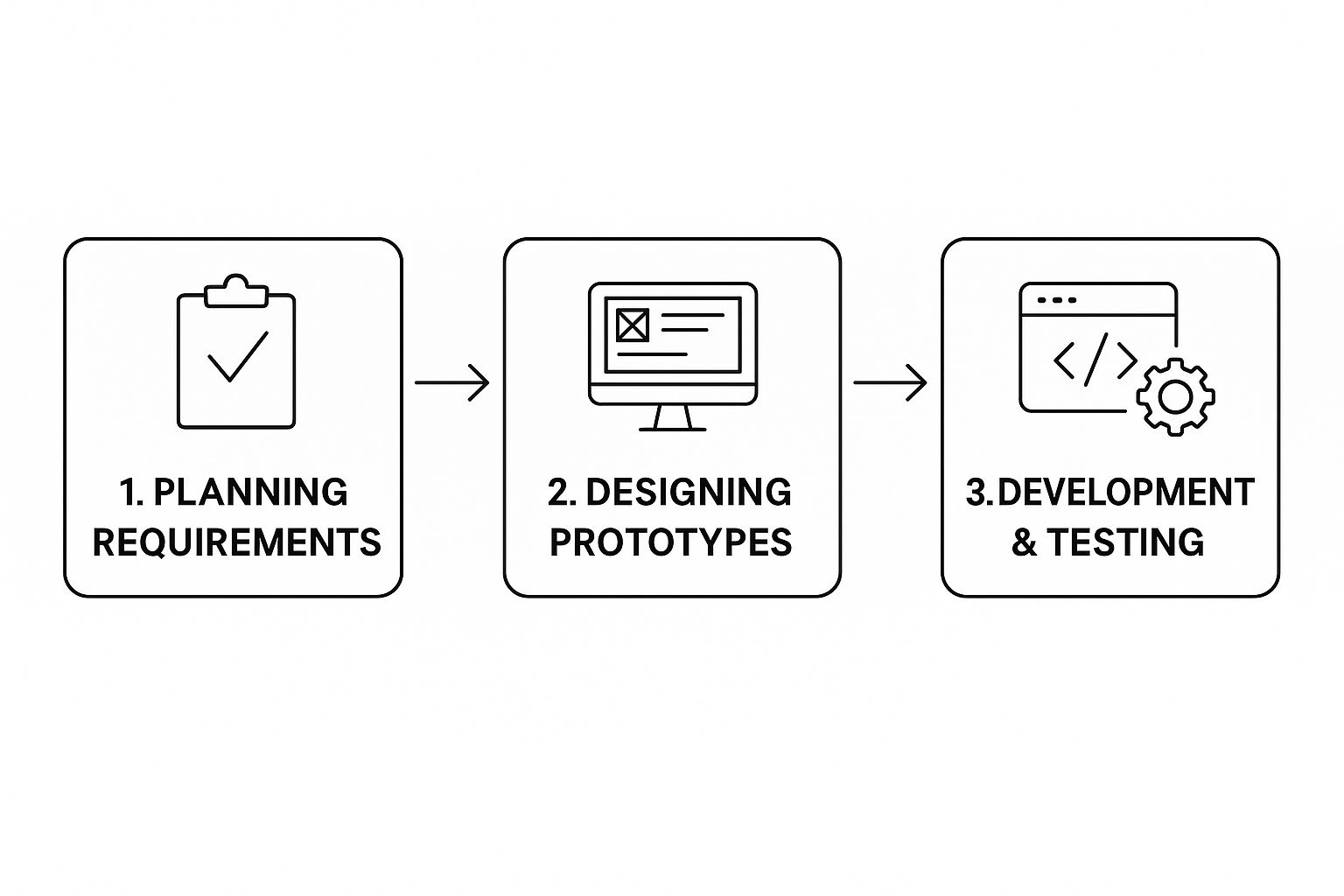
As you can see, a solid plan is the bedrock of a successful project.
Phase 2: UI and UX Design
With our strategy locked in, we can start visualising the website. This is where we figure out how it will look, feel, and function for your visitors. It’s a two-part process focused on creating a site that’s both beautiful and easy to use.
- User Experience (UX) Design: First, we map out the skeleton of the site. This means creating wireframes and prototypes – simple, black-and-white layouts. The goal is to perfect the site’s structure, navigation, and user flow without getting distracted by colours or fonts. We want to make sure the journey for your visitors is completely intuitive.
- User Interface (UI) Design: Once we’re happy with the structure, our designers bring it to life. They apply your brand’s colours, typography, and imagery to create a polished, high-fidelity mockup. This is the first time you’ll see exactly how your new website will look.
Throughout this stage, your feedback is essential. We’ll work together to refine the design until it perfectly captures your brand and connects with your audience.
Phase 3: Development and Coding
Now it’s time to build. Our developers take the approved designs and turn them into a real, working website. This is where the magic happens, and it’s typically split into two key areas happening at the same time:
- Front-End Development: This is all the stuff your visitors can see and interact with. Our developers use languages like HTML, CSS, and JavaScript to build the visual side of the website, making sure it looks great and works flawlessly on every device, from a giant desktop monitor to a small smartphone.
- Back-End Development: This is the powerful engine running behind the scenes. It’s the server, database, and application logic that makes everything work. If you have a contact form, an online store, or customer logins, that’s all powered by the back-end.
This is the phase where designs and plans on paper become a tangible thing you can click on and interact with. It’s where the technical skill of our team transforms a creative vision into a high-performing digital asset.
Phase 4: Testing and Launch
We’re almost there! Before we pop the champagne, the website goes through rigorous testing. Just like a new car is put through its paces before leaving the factory, our quality assurance (QA) team meticulously inspects every part of your site.
They hunt for bugs, test every feature, and check the site on a wide range of web browsers and devices. We do everything we can to ensure it’s perfect.
Once it passes our internal checks and you give the final green light, it’s launch day. We deploy the website to a live server, making it visible to the world. It’s a huge milestone, but our partnership doesn’t end there. We’re on hand to provide ongoing support and maintenance to keep your new website running smoothly.
Decoding Custom Website Costs in Australia
Trying to pin down a price for a custom-built website can feel a bit like asking, “How long is a piece of string?” There’s no single, off-the-shelf price tag, and that’s because a custom website is exactly that—custom. It’s crafted from the ground up to meet your specific business goals, not pulled from a template.
So, instead of looking for a flat fee, it’s more productive to understand the ingredients that go into the final price. These are the core elements that shape the size, scope, and complexity of your project.
Key Factors Influencing Your Investment
The final cost really boils down to the time, skill, and resources needed to bring your vision to life. A few key things will always have the biggest impact on the budget.
- Design Complexity: A clean, simple brochure-style site is one thing. A highly interactive site with custom animations, sophisticated layouts, and unique graphical elements is another entirely. The more intricate the design, the more time it takes.
- Number of Unique Pages: Think about page templates. Your homepage will have a unique layout. Your services page will have another, and your blog post template a third. Each one of these needs to be designed and developed individually.
- Specialised Functionality: This is often the biggest variable. Do you need an online store with secure payment processing? A customer portal for members to log in? Or maybe an integrated booking system that syncs with your calendar? These features require serious backend development to make them secure, reliable, and user-friendly.
It helps to think of it like building a house. A standard project home has a predictable cost. But once you start adding an architect-designed kitchen, a custom pool, and smart home automation, the investment naturally grows. Your website follows the same principle.
Typical Price Ranges in the Australian Market
As more Australian businesses get serious about their online presence, the local web development market has matured, and we’ve seen some clear investment brackets emerge.
For a basic “online brochure” website, a small business might start in the AUD 3,000 to AUD 8,000 range. But for genuine custom website development services—where you’re getting a unique design and purpose-built features—businesses should expect to budget anywhere from AUD 12,000 to over AUD 30,000.
For bigger, more complex builds like large e-commerce platforms or web applications with deep integrations, the investment typically starts around AUD 22,000 and can easily climb higher depending on the feature set. For a more detailed breakdown, you can explore this overview of the web design cost landscape in Australia.
To give you a clearer picture, here’s a look at some common project types and their estimated costs here in Australia.
Estimated Custom Website Development Costs in Australia
| Website Type | Typical Features | Estimated Cost Range (AUD) |
|---|---|---|
| Small Business Website | 5-10 pages, custom design, contact form, blog | $8,000 – $15,000 |
| Corporate Website | 10-25 pages, advanced design, CMS, team profiles, resource centre | $15,000 – $30,000 |
| E-commerce Store | Product catalogue, shopping cart, payment gateways, customer accounts | $22,000 – $50,000+ |
| Web Application | User portals, interactive dashboards, API integrations, custom databases | $40,000 – $100,000+ |
Of course, these are just ballpark figures. The final quote will always depend on your specific requirements, but this table should give you a realistic starting point for your budget discussions.
Ultimately, it’s crucial to see this as a strategic investment rather than a business expense. You’re not just buying a website; you’re acquiring a powerful asset designed to attract customers, streamline your operations, and deliver a tangible return for years to come. Understanding these cost factors helps you make an informed decision that perfectly aligns your budget with your long-term business goals.
Must-Have Features of a Modern Business Website
Let’s be clear: a modern business website is much more than a digital business card. It’s an active, hard-working tool designed for the way people actually use the internet today. When you invest in custom website development services, you’re building an asset that’s packed with features that don’t just look good, but actively drive results.
Today’s users are always on the move and have zero patience for slow or clunky experiences. This reality means your website absolutely must be fast and look perfect on any screen, from a tiny phone to a huge desktop monitor. These aren’t optional extras anymore; they’re the price of entry.
Mobile-First Design and Blazing Speed
A mobile-first approach is simply non-negotiable in this day and age. It means we design for the smallest screen first, then adapt the design for larger devices. This approach forces us to prioritise what’s truly important, ensuring the core experience is perfectly optimised for the vast majority of visitors who find you on their phones.
Speed goes hand-in-hand with mobile design. If your page takes more than a couple of seconds to load, people are gone. A custom site is built with clean, efficient code, meaning your pages load in a flash. This doesn’t just keep visitors happy; it’s a huge positive signal to search engines like Google.
A website that loads in one second has a conversion rate almost three times higher than a site that loads in five seconds. Speed isn’t just a feature; it’s a direct driver of revenue.
Progressive Web Apps and Robust Security
To really level up the mobile experience, many modern sites are now built as Progressive Web Apps (PWAs). Think of a PWA as a hybrid between a website and a native app. It gives you an app-like feel right in the browser—complete with offline access and push notifications—without anyone needing to visit an app store.
Here in Australia, where 70% of web traffic comes from mobile devices, PWAs are becoming a game-changer. One Melbourne retailer, for example, saw a 20% increase in mobile conversions after implementing a PWA. It’s a powerful demonstration of how the right tech can deliver real business growth. This is a big part of where things are heading, and you can get more insights on Australian web design trends on dotsquares.com.
Of course, none of these fancy features matter if your site isn’t secure. Building from scratch allows us to bake in advanced security protocols from the very beginning, protecting your business and your customers from online threats.
Accessibility for All Users
Finally, a great website is one that everyone can use, including people with disabilities. Following the Web Content Accessibility Guidelines (WCAG) isn’t just about ticking a compliance box; it’s about being inclusive and reaching the widest possible audience. It’s just good business.
Making a site accessible involves things like:
- Alt Text for Images: Writing descriptions so screen readers can explain visuals to users.
- Keyboard Navigation: Making sure every part of the site works without a mouse.
- High-Contrast Text: Using colour combinations that are easy to read for people with visual impairments.
When you build an inclusive website, you’re sending a clear message that you value every single customer. These features all work together to create a site that’s fast, secure, user-friendly, and truly ready for a modern audience.
How to Choose the Right Development Partner
Picking a partner for your custom website development services is a massive decision for your business. It’s not just about hiring someone to write code. The right team becomes a genuine extension of your own, someone who’s truly in your corner and invested in seeing you succeed.
On the flip side, the wrong choice can be a nightmare. We’re talking about blown budgets, missed deadlines, and a website that just doesn’t deliver on what you needed it to do.
This whole process is about finding a team whose technical chops are perfectly matched by a deep understanding of what you’re trying to achieve with your business. It’s a partnership, and like any good one, it needs clear communication, a solid track record, and shared values to work. You’ve got to look past the fancy sales pitch and get to the real substance.
Vetting Potential Agencies
To make a smart decision, you need a solid plan for checking out potential partners. The first thing you should do is look for hard evidence that they can actually deliver. That starts with a deep dive into their portfolio.
Don’t just skim through the pretty designs. Really get into their past projects. Do they have a history in your industry? Have they tackled websites with the kind of functionality you need? If you run an e-commerce store, a portfolio filled with simple one-page sites should be a red flag.
A great development partner shows their value through the success of their previous clients. Look for case studies that detail the business problem, the solution they built, and the measurable results they achieved.
Beyond their finished work, you need to get a feel for their process. How an agency manages a project and communicates with you is just as critical as the quality of their code. This is what a successful collaboration is built on.
Key Questions to Ask
When you start meeting with agencies, come prepared. You need specific questions that get to the core of their expertise and how they operate. This is your best chance to see if their approach fits with how you like to work.
Here are a few essential questions to get the conversation started:
- Project Management: What project management software do you rely on, like Jira or Asana? How often will we connect for updates, and what should I expect from those meetings?
- Communication: Who will be my day-to-day contact? How do you normally handle feedback and changes during the design and development stages?
- Technical Expertise: What technologies are you recommending for this project, and why do you believe they’re the best choice for our business goals?
- Post-Launch Support: What happens after the site goes live? What kind of ongoing maintenance and support plans do you offer?
Their answers will tell you everything you need to know about their professionalism, how transparent they are, and whether they’re genuinely interested in a long-term partnership. Choosing the right team at Wistec means finding a group with the technical skill to build your vision and the collaborative spirit to make the entire process a success.
Got a Few Questions?
Thinking about a custom website usually sparks a few questions. It’s a big decision, and getting the right information is key to feeling confident about the path you choose for your business. Let’s tackle some of the most common ones we hear.
So, How Long Does This Actually Take?
The timeline for a custom website really depends on what we’re building. For a fairly standard business website – think custom design, unique features, and all the usual pages – you’re generally looking at about 12 to 16 weeks from our first chat to launch day.
But if we’re talking about something more complex, like a massive e-commerce store with lots of moving parts or a web application built from the ground up, the timeline will naturally stretch out. These bigger projects can easily take six months or more to get just right.
Is a Custom Site Really Better Than a WordPress Theme?
This is the big one, isn’t it? A pre-made WordPress theme is a bit like buying a suit off the rack. It’s quick, it looks pretty good, but it was made for everyone, not specifically for you. You’re stuck with its limitations, and making it truly your own can be a real struggle.
A custom website, on the other hand, is like getting that same suit tailored. It’s built from scratch to fit your business perfectly—your brand, your customers, and your goals. You get a unique design, much better performance, and the freedom to add new features as your business grows.
What Happens After We Launch?
Hitting the “go live” button is just the beginning. Your website is a living asset, not a one-and-done project. Any good development partner will stick around to offer ongoing support and maintenance to make sure your investment keeps paying off.
This is a really important piece of the puzzle. It typically includes things like:
- Keeping all the software and security patches up-to-date to fend off any nasty surprises.
- Watching over performance to make sure the site stays quick and reliable.
- Having a team on standby to jump in and fix any technical glitches that pop up.
Think of it as the support crew that keeps your website running smoothly, securely, and looking great for your visitors long after launch day.
Ready to build a website that’s as unique as your business? The expert team at Wistec specialises in creating high-performance, custom websites designed to drive growth. Start your project with us today.