

In today’s fast-paced market, business as usual is a recipe for stagnation. The difference between market leaders and those left behind often comes down to one critical factor: operational efficiency. The constant pressure to do more with less, deliver faster, and provide exceptional customer experiences means that clunky, inefficient workflows are no longer just a minor inconvenience-they’re a major liability. Streamlining business processes isn’t a one-off project; it’s a strategic imperative that unlocks growth, reduces costs, and empowers your team to focus on what truly matters.
This article moves beyond generic advice to provide a comprehensive roundup of 10 powerful, battle-tested methodologies for transforming your operations. Whether you’re a manufacturer in Adelaide grappling with production bottlenecks or a service firm in Sydney looking to enhance client delivery, these strategies offer a clear roadmap to a more agile, productive, and profitable future. We will explore practical cases and demonstrate how tailored technology, from a custom Odoo implementation in Sydney to bespoke software development in Adelaide, can be the key to unlocking your organisation’s full potential. Prepare to discover actionable insights that will reshape how your business operates from the ground up.
1. Lean Management
Originating from the Toyota Production System, Lean Management is a powerhouse methodology for streamlining business processes. Its core principle is simple yet transformative: maximise customer value by systematically identifying and eliminating waste, or ‘Muda’. This isn’t about cutting corners; it’s a sophisticated approach to creating more value with fewer resources by focusing on activities your customer truly values.
By adopting Lean, organisations shift from a ‘push’ system to a ‘pull’ system, where work is initiated only in response to customer demand. This minimises overproduction, reduces inventory, and shortens lead times dramatically. A practical case is a manufacturing firm in Adelaide that implemented Lean principles, reducing its assembly line changeover times by 40% and increasing throughput without additional capital expenditure. This was achieved by mapping the value stream and eliminating non-essential steps.
Getting Started with Lean
- Map Your Value Stream: Begin by visually mapping your entire process from start to finish. This exercise is crucial for pinpointing non-value-adding activities and bottlenecks that are ripe for improvement.
- Empower Your Team: Engage frontline employees from the outset. They possess invaluable, hands-on knowledge of daily operations and are best positioned to identify waste.
- Implement 5S: Use the 5S methodology (Sort, Set in order, Shine, Standardise, Sustain) to create a clean, organised, and efficient workspace. This foundational step reduces wasted time searching for tools or information.
The following infographic provides a high-level overview of Lean’s core components.
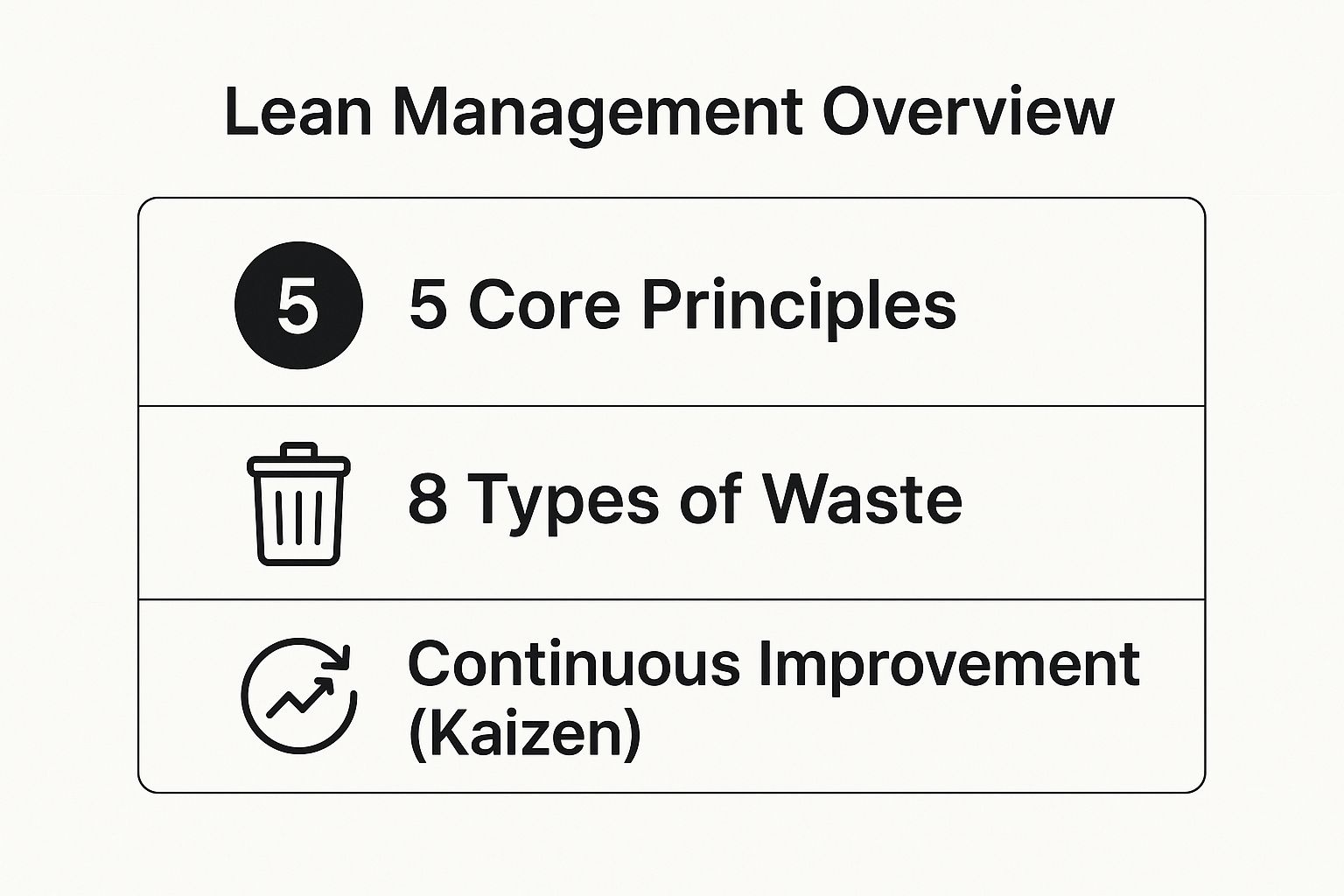
This quick reference highlights how Lean is built on core principles, a sharp focus on waste elimination, and a commitment to continuous improvement (Kaizen). To effectively implement these ideas, consider integrating them into your core systems. An Odoo implementation in Sydney or Adelaide, for example, can provide the digital tools needed to visualise workflows, track performance, and sustain your Lean transformation. Contact us to explore software development options in Sydney and Adelaide that can support your Lean journey.
2. Six Sigma
Developed by Motorola in 1986, Six Sigma is a disciplined, data-driven methodology for streamlining business processes. Its primary objective is to eliminate defects and minimise variability, aiming for a statistically near-perfect level of quality: 3.4 defects per million opportunities. This is not just a quality control system; it’s a rigorous framework that uses statistical analysis to pinpoint inefficiencies and drive tangible financial results.
By adopting Six Sigma, organisations can systematically improve performance and enhance customer satisfaction. A practical case is a Sydney-based financial services company that used Six Sigma to analyse its loan application process. By identifying key areas of variation and error, they reduced processing defects by 70%, leading to faster approvals and a significant boost in customer trust. This approach turns process improvement into a science, replacing guesswork with quantifiable data.
Getting Started with Six Sigma
- Secure Executive Sponsorship: Six Sigma projects require resources and authority. Ensure you have strong backing from leadership to overcome obstacles and drive change effectively.
- Invest in Training: Equip your team with the necessary skills by investing in training for certified roles like Green Belts and Black Belts, who will lead your improvement projects.
- Start with High-Impact Projects: Select initial projects that are both highly visible and have a strong potential for a significant return on investment. A quick win will build momentum and secure organisational buy-in.
To properly manage the vast amounts of data required for a Six Sigma initiative, robust software is essential. An Odoo implementation in Sydney or Adelaide, for example, can provide the analytics and process control tools needed to measure performance and sustain improvements. Contact us to discuss software development options in Sydney and Adelaide that can anchor your quality-focused initiatives.
3. Business Process Reengineering (BPR)
Coined by Michael Hammer and James Champy, Business Process Reengineering (BPR) is a radical approach to streamlining business processes. It challenges organisations to fundamentally rethink and dramatically redesign core processes to achieve breakthrough improvements in critical measures like cost, quality, service, and speed. Unlike gentle, incremental changes, BPR is about starting with a blank slate and asking, “If we were starting this company today, how would we design this process?”
This “clean sheet” methodology drives transformative results. A practical case is a national logistics company that reengineered its entire delivery dispatch system. Instead of incremental tweaks, they used custom software development in Sydney to create a new, algorithm-based routing system, reducing fuel costs by 20% and improving on-time delivery rates from 85% to 98% within six months. This radical overhaul transformed their competitive standing.
Getting Started with BPR
- Secure Leadership Buy-In: BPR is a top-down initiative that requires absolute commitment from senior leadership to overcome organisational inertia and fund the transformation.
- Target Broken Processes: Focus your initial efforts on processes that are fundamentally broken, create a competitive disadvantage, or are crucial to customer value.
- Set Stretch Goals: Define clear, ambitious, and measurable objectives from the outset. Aim for dramatic improvements (e.g., 80% cost reduction) rather than minor gains.
BPR is a high-risk, high-reward strategy best suited for organisations facing significant competitive pressure or seeking a fundamental operational overhaul. To manage such a large-scale transformation, robust digital tools are essential. A custom software development project in Sydney or Adelaide can digitise and automate your newly designed workflows, ensuring the changes are embedded effectively. Contact us to discuss how a bespoke solution or an Odoo implementation can support your BPR initiatives.
4. Process Automation and RPA (Robotic Process Automation)
Process Automation stands as a critical strategy for streamlining business processes, utilising technology to execute repetitive, rule-based tasks with minimal human input. A key component of this is Robotic Process Automation (RPA), which deploys software ‘bots’ to mimic human actions on digital interfaces. Unlike traditional automation that demands deep system integration, RPA operates on the user-interface level, making it a faster and more cost-effective way to modernise workflows.
This approach allows organisations to offload high-volume tasks, freeing up valuable human capital for more strategic, creative, and customer-facing activities. A practical case involves an e-commerce business using a Shopify implementation that integrated RPA bots to automate order processing and customer service responses for common queries. This reduced manual data entry by 90% and allowed the customer service team to focus on complex issues, improving overall satisfaction.
Getting Started with RPA
- Target Quick Wins: Begin with high-volume, rules-based processes like data entry or invoice processing. Automating these areas delivers a rapid and measurable return on investment.
- Optimise Before You Automate: Map and refine your existing workflow first. Automating an inefficient process only makes it faster, not better.
- Establish Strong Governance: Create a clear framework for managing your bots, including security protocols, performance monitoring, and update schedules to ensure long-term success.
Integrating automation tools is key to realising these benefits. A custom Odoo implementation in Sydney or Adelaide can provide a centralised platform to manage these automated workflows, linking them seamlessly with your core business operations. Contact us to discuss software development options in Sydney and Adelaide that can power your automation strategy.
5. Agile Methodology
Originating from the world of software development, Agile is an iterative methodology ideal for streamlining business processes in dynamic environments. Its core philosophy revolves around flexibility, collaboration, and rapid response to change, breaking down large projects into short, manageable cycles called ‘sprints’. This approach moves away from rigid, long-term planning towards a more adaptive model where continuous feedback shapes the final outcome.
By embracing Agile, organisations can significantly improve their speed to market and responsiveness. A practical case is a marketing agency in Adelaide that adopted Agile for campaign management. Instead of month-long planning cycles, they used two-week sprints to test, launch, and refine digital ads, allowing them to reallocate budget to the best-performing channels in near real-time and improving client ROI by over 25%.
Getting Started with Agile
- Start with a Pilot Team: Begin with one dedicated team to pilot the Agile process. This allows you to learn, adapt, and demonstrate success before a wider, organisation-wide rollout.
- Invest in Training: Proper training for both team members and leadership is crucial. Everyone needs to understand the principles of sprints, daily stand-ups, and retrospectives to make the transition effective.
- Prioritise a Working Solution: Agile focuses on delivering functional increments over comprehensive, upfront documentation. The goal is to produce a tangible outcome at the end of each sprint that can be tested and iterated upon.
To effectively manage sprints and track progress, modern digital tools are essential. Integrating Agile workflows into your core systems, such as with a custom software development in Sydney or an Odoo implementation in Adelaide, can provide the structure and visibility needed for success. Contact us to explore how we can tailor a solution to support your Agile transformation.
6. Value Stream Mapping (VSM)
As a cornerstone of Lean methodology, Value Stream Mapping (VSM) is a powerful visual tool for streamlining business processes. In essence, it involves creating a detailed flowchart that documents every step required to deliver a product or service — from raw materials to the end customer. Through this process, the goal is to clearly distinguish between value-adding activities and non-value-adding waste, thereby providing a clear roadmap for targeted improvement.
Furthermore, VSM goes beyond a simple process map by incorporating critical data such as cycle time, lead time, and inventory levels. For example, a healthcare clinic in Adelaide used VSM to map the patient journey from check-in to check-out. As a result, the map revealed that 60% of a patient’s time was spent waiting. Consequently, by redesigning patient flow and improving information handoffs, the clinic successfully reduced average visit times by 30%, thereby enabling them to serve more patients using the same resources.
Getting Started with VSM
- Walk the Gemba: Physically walk through the process from start to finish. Observing the actual workflow provides insights that cannot be gained from a conference room.
- Assemble a Cross-Functional Team: Involve representatives from every department touching the value stream. This ensures a holistic view and encourages collective ownership of the improvement plan.
- Map the Current, Design the Future: Start by mapping the “current state” to identify waste. Then, design an ideal “future state” based on Lean principles, creating a clear vision to work towards.
7. Business Process Management (BPM)
Business Process Management (BPM) is a holistic and disciplined approach to streamlining business processes on an ongoing basis. Unlike one-off optimisation projects, BPM establishes a continuous cycle of analysing, designing, executing, monitoring, and optimising how work gets done. At its core, it treats processes as strategic assets — ones that can be systematically managed and improved to drive organisational success and sustainability.
By embracing BPM, organisations gain end-to-end visibility and control over their operations. For example, a national retailer using a WooCommerce platform implemented BPM to standardise its online order fulfilment process across multiple warehouses. As a result, the company ensured consistent packing standards, optimised shipping routes, and enabled real-time customer tracking — thereby reducing “where is my order?” support tickets and significantly improving delivery times. Ultimately, BPM transforms operations from reactive management to proactive excellence.
Getting Started with BPM
- Target High-Impact Processes: Begin with processes that directly affect customer experience or revenue generation. These early wins will demonstrate BPM’s value and build momentum for broader adoption.
- Establish a Centre of Excellence (CoE): Create a dedicated team to develop BPM standards, tools, and expertise. A CoE acts as an internal consultancy, guiding and supporting process improvement initiatives across the organisation.
- Model and Monitor: Use standardised notation like BPMN 2.0 to map processes clearly. Implement key performance indicators (KPIs) and dashboards to monitor process health and identify areas for continuous optimisation.
Developed by Dr. Eliyahu Goldratt, the Theory of Constraints (TOC) presents a powerful methodology for streamlining business processes. At its core, it operates on a simple yet transformative premise: every complex system — including a business — has at least one constraint that limits it from achieving greater results. By identifying, managing, and improving this single bottleneck, an organisation can unlock substantial gains in overall performance and efficiency.
Unlike other methods, TOC shifts the focus from optimising every individual part of a process to strengthening the system’s weakest link. For example, a custom joinery workshop in Adelaide discovered that its finishing and painting station was the primary bottleneck. By strategically reorganising the schedule to ensure the station was never idle and assigning a part-time assistant solely for prep work, the workshop successfully increased its total weekly output by 15% — and all without investing in new machinery. Ultimately, TOC demonstrates that targeted improvements at the constraint can deliver exponential results across the entire operation.
Getting Started with TOC
- Identify the Constraint: Your first step is to pinpoint the one resource or policy that dictates the output of the entire system. This is often not the busiest resource but the one with the least capacity relative to the demand placed upon it.
- Exploit the Constraint: Maximise the utilisation of the identified constraint. Ensure it is only working on value-adding activities and is protected from downtime or interruptions.
- Subordinate Everything Else: Align all other processes to support the constraint’s performance. Non-constraint resources should operate at the pace of the bottleneck, preventing overproduction that creates excess inventory and complicates workflows.
The beauty of TOC lies in its focused approach, which can be applied to any process, from manufacturing floors to service delivery. To effectively manage and subordinate processes, robust systems are key. An Odoo implementation in Sydney or Adelaide, for example, can provide the real-time data visibility needed to identify bottlenecks and synchronise operations. Contact us to explore software development options in Sydney and Adelaide that can support your TOC journey.
9. Standard Operating Procedures (SOPs) and Process Documentation
Standard Operating Procedures (SOPs) are the unsung heroes of streamlining business processes. At their essence, this methodology involves creating detailed, step-by-step instructions that document how to perform specific tasks consistently and correctly. In doing so, it eliminates ambiguity and variability, ensuring that critical functions are executed uniformly every time — regardless of who performs them. Rather than being a symbol of rigid bureaucracy, SOPs serve as a strategic framework for quality control, efficiency, and scalability.
Moreover, by implementing comprehensive SOPs, organisations establish a single source of truth for all operations. For instance, a fast-growing digital agency documented its client onboarding process in meticulous detail. As a result, they were able to train new account managers in half the time and deliver a consistent, high-quality kickoff for every client, thereby reducing early-stage miscommunication and scope creep. Ultimately, this documentation became the blueprint for their successful Odoo implementation in Sydney, demonstrating how structure and technology together drive operational excellence.
Getting Started with SOPs
- Involve Your Team: Collaborate with frontline staff who perform the tasks daily. Their direct involvement ensures the SOPs are accurate, practical, and more likely to be adopted.
- Use Visuals: Enhance clarity and comprehension by incorporating flowcharts, screenshots, and photos. A visual guide is often far more effective than text-only instructions.
- Keep it Simple and Accessible: Write in clear, action-oriented language. Store your SOPs in a centralised, easily accessible digital location, such as a company intranet or within your ERP system.
Popularised by the Japanese manufacturing industry, Kaizen is a powerful philosophy centred on continuous, incremental improvement. At its core, it is a cornerstone for streamlining business processes by engaging every employee — from the executive suite to the frontline — in the collective pursuit of perfection. Rather than focusing on dramatic, disruptive overhauls, Kaizen fosters a culture where small, ongoing positive changes are consistently implemented, ultimately leading to significant long-term results.
As a result, this approach transforms the workplace into an environment of constant evolution and collaboration. For instance, consider a retail store that introduced a weekly “Kaizen huddle.” During one session, an employee suggested moving high-demand items closer to the checkout during peak season. Consequently, this seemingly minor change reduced average transaction time by 15 seconds — a small improvement that, over time, shortened queues, boosted customer satisfaction, and noticeably increased daily sales.
Getting Started with Kaizen
- Go to the Gemba: The principle of ‘gemba’ means going to the actual place where work happens. Managers should regularly visit the factory floor or service desk to observe processes and understand challenges firsthand.
- Encourage All Suggestions: Create a system where employees can easily submit improvement ideas, no matter how small. Acknowledge and act on these suggestions promptly to maintain momentum and show that every contribution is valued.
- Standardise Improvements: Once a better way of working is found, it must be documented and standardised across the relevant teams. This prevents backsliding into old, inefficient habits and locks in the gains.
The following infographic illustrates the cyclical nature of Kaizen.
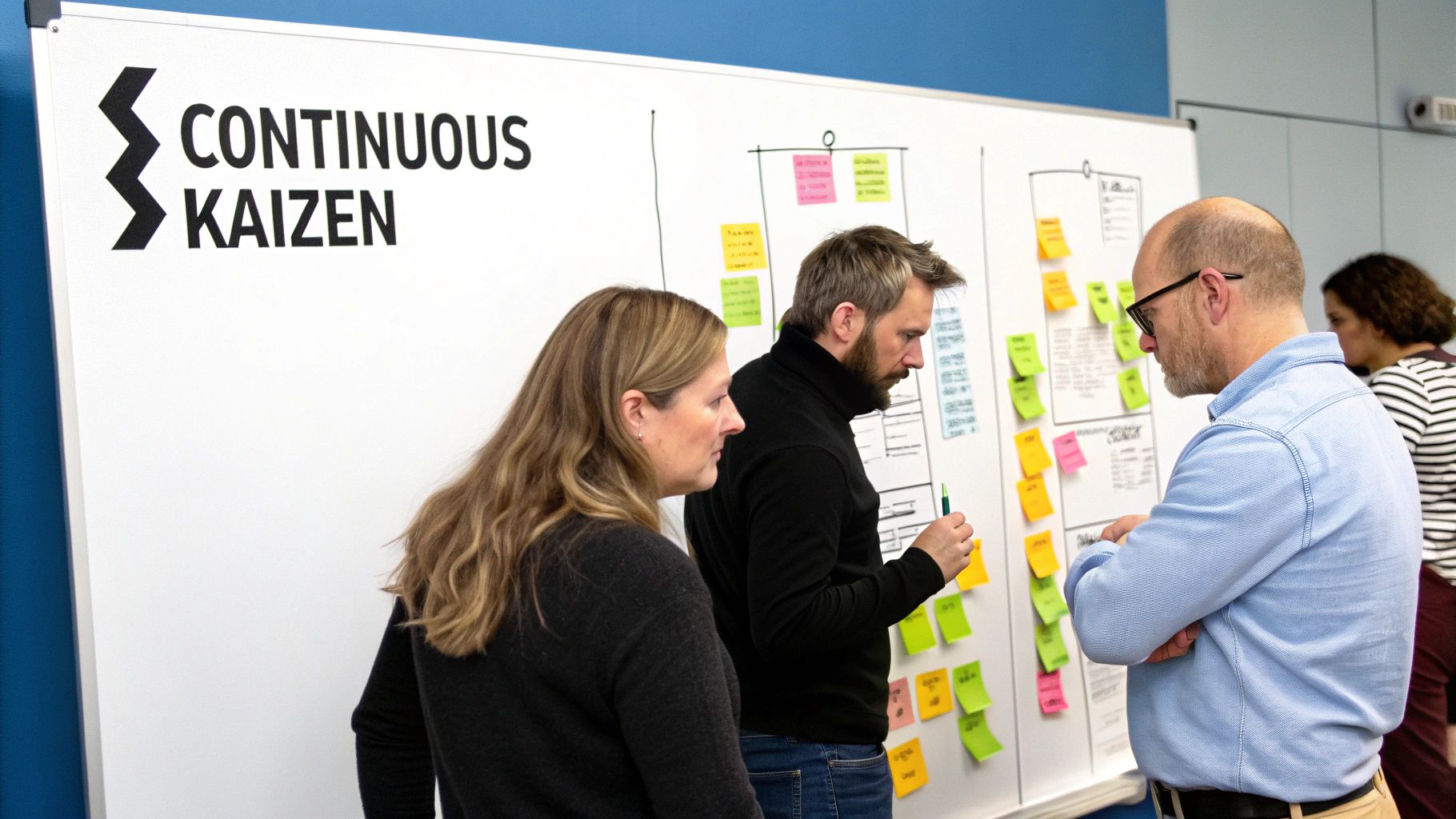
This cycle of Plan-Do-Check-Act is fundamental to sustainable improvement. To embed this philosophy, your systems must support it. A custom Odoo implementation in Adelaide or Sydney can provide the framework to track suggestions, monitor process changes, and measure performance improvements. Contact us to discuss software development in Sydney and Adelaide that can anchor your continuous improvement culture.
Streamlining Business Process Methods Comparison
| Methodology / Approach | Implementation Complexity 🔄 | Resource Requirements ⚡ | Expected Outcomes 📊 | Ideal Use Cases 💡 | Key Advantages ⭐ |
|---|---|---|---|---|---|
| Lean Management | Medium – requires cultural change and training | Moderate – ongoing training and engagement | Waste reduction, product quality, shorter lead times | Manufacturing, healthcare, logistics, repetitive processes | Cost reduction, continuous improvement, employee buy-in |
| Six Sigma | High-intensity training and data analysis | Highly certified specialists needed | Defect reduction, process consistency, measurable ROI | Large orgs with complex, quality-critical processes | Data-driven, structured problem-solving, quality focus |
| Business Process Reengineering | Very High – radical redesign, high disruption | Very High – major resources and commitment | Dramatic performance improvement, process overhaul | Organizations in crisis or needing transformational change | Breakthrough results, innovation, and silo removal |
| Process Automation & RPA | Low to Medium – faster deployment than traditional | Moderate – IT and bot management | Error reduction, faster processing, cost savings | High-volume transactional tasks in finance, HR, and operations | Rapid ROI, scalability, error-free, and employee freeing |
| Agile Methodology | Medium – requires cultural shift and discipline | Moderate – training and leadership support | Flexibility, customer satisfaction, and early value delivery | Projects with evolving requirements and innovation | Adaptability, collaboration, transparency |
| Value Stream Mapping (VSM) | Low to Medium – data collection and mapping effort | Low – mainly workshop and analysis effort | Waste visibility, bottleneck identification, and quick insights | End-to-end processes with multiple handoffs | Visual clarity, shared understanding, quick execution |
| Business Process Management (BPM) | High – software, governance, ongoing maintenance | High – software investment and training | Continuous optimization, agility, and real-time monitoring | Enterprise-wide process excellence | Process transparency, standardization, compliance |
| Theory of Constraints (TOC) | Medium – mindset shift needed | Low to Moderate – focused on constraint management | Throughput increase, reduced WIP, alignment | Operations with clear bottlenecks and sequential flows | Focused improvement, rapid impact, throughput optimization |
| SOPs and Process Documentation | Low to Medium – time-intensive documentation | Low to Moderate – effort in creation & review | Consistency, compliance, reduced errors | Regulated industries, quality control | Standardization, training aid, baseline for improvement |
| Kaizen (Continuous Improvement) | Low to Medium – ongoing incremental changes | Low to Moderate – training and employee involvement | Continuous culture improvement, employee engagement | Organizations seeking sustainable improvement | Employee empowerment, quick wins, low investment |
From Theory to Transformation: Your Next Step Towards a Streamlined Business
We have journeyed through ten powerful and distinct methodologies for streamlining business processes. From the waste-elimination focus of Lean Management and the quality control precision of Six Sigma to the incremental, continuous improvements championed by Kaizen, it is clear there is no single “correct” path. The ideal strategy for your organisation is a tailored blend, adapted to your specific industry, scale, and challenges.
The core takeaway is that sustainable improvement is not a one-off project but a cultural shift. It requires moving from a reactive, firefighting mentality to a proactive, strategic one. Whether you are identifying bottlenecks with the Theory of Constraints or mapping out workflows with Value Stream Mapping, the ultimate goal remains the same: to create a leaner, more agile, and more profitable operation. This transformation is about empowering your team, delighting your customers, and building a resilient foundation for future growth.
Bridging the Gap Between Strategy and Reality
While understanding these frameworks is a critical first step, true transformation is realised only when these brilliant theories are put into practice. A documented process is a great start, but a digitally enabled and automated process is a competitive advantage. This is where a robust technological foundation becomes not just helpful, but essential.
Consider a professional services firm in Adelaide struggling with inconsistent client onboarding. Documenting SOPs is a solid start, but implementing a custom Odoo solution can automate task assignments, client communication, and document collection, ensuring a flawless experience every time. Similarly, a Sydney retailer can use a strategic Shopify implementation or WooCommerce setup to apply Agile principles to their marketing and inventory management, responding rapidly to market trends.
The most significant barrier to successful process improvement is not the lack of ideas, but the friction in implementation. The right technology removes that friction, turning ambitious plans into measurable results.
Streamlining business processes is an active, ongoing commitment. It requires the right knowledge, the right team, and crucially, the right tools. Without a technology partner capable of translating your vision into functional, efficient systems, even the best-laid plans can fall short. The key is to find a partner who understands both the methodologies and the technology required to bring them to life. By investing in software development in Sydney or Adelaide, you are not just optimising a workflow; you are future-proofing your entire organisation.
Ready to turn your process improvement goals into a tangible reality? Wistec specialises in custom software development and platform implementation designed to bring efficiency and clarity to your operations. Whether you need a sophisticated Odoo implementation in Sydney or Adelaide, or a finely tuned Shopify implementation or WooCommerce solution, we build the technological bridge from theory to transformation. Contact Wistec today for a no-obligation consultation, and let’s start building your more efficient future.