

Feeling like you’re trying to run your business with a tangled mess of different apps for sales, inventory, and accounting? You’re not alone. So many businesses get stuck juggling separate tools that just don’t talk to each other, creating endless manual work and confusion.
Odoo cuts through this chaos. Think of it as your company’s central nervous system—a single, powerful platform that brings every part of your operation together in one place.
What Is Odoo and Why Is It Such a Game-Changer?
Let’s use an analogy. Imagine your business is an orchestra. Right now, your sales team, your warehouse, and your finance department are all playing from different sheets of music. It’s messy, inefficient, and the final result is never quite right. Odoo is the conductor, getting everyone to work in perfect harmony from a single, unified score. It completely eliminates the need to juggle dozens of software subscriptions and pray that the data matches up.
At its heart, Odoo is an Enterprise Resource Planning (ERP) system, but it’s built with a clever twist. It has a modular design, a bit like your smartphone. You start with the core system and then add “apps”—or modules—for the specific functions you need, when you need them. This means you aren’t forced to pay for a whole bunch of complicated features you won’t use today, but you have a clear path to grow into them tomorrow.
A Platform That Grows with You
This flexibility is exactly why Odoo is fast becoming the go-to choice for businesses across Australia. Instead of being boxed in by a rigid, one-size-fits-all system, you can build a solution that mirrors your unique workflow.
- Start Small, Scale Big: A practical case is an Adelaide-based startup that can begin with just the CRM and Invoicing modules. As they expand into e-commerce, they can seamlessly add a Shopify implementation or WooCommerce integration, and later the full Manufacturing app once they bring production in-house.
- Wipe Out Data Silos: When your sales team closes a deal in the CRM, the inventory and accounting modules are updated instantly. No more double-handling data or chasing costly errors.
- A Single Source of Truth: Get a complete, real-time picture of your entire business from one dashboard. This allows for smarter, faster decision-making based on what’s actually happening, not what you think is happening.
The numbers speak for themselves. There are currently 1,218 live Odoo-powered online stores in Australia, a figure that shot up by a massive 51% year-over-year. This incredible growth shows just how many small and medium-sized businesses are ditching their disconnected tools for a unified approach. You can discover more insights about Odoo’s impressive growth in the Australian market and see how it’s shaping local eCommerce.
Odoo gives you a fundamental advantage by swapping operational complexity for streamlined simplicity. It lets you focus on growing your business and looking after your customers, instead of constantly fighting with your software.
Whether you’re running a retail store with a Shopify or WooCommerce front-end, managing a manufacturing plant, or operating a service-based company, getting the setup right is crucial. A professional Odoo implementation ensures the platform is perfectly aligned with your business goals right from the start.
Ready to see how a unified platform can simplify your world? The expert team at Wistec specialises in Odoo implementation Sydney Adelaide. We offer custom software development Sydney Adelaide to fine-tune the system to your exact needs, guaranteeing a smooth transition and long-term success. Contact us today for a personalised consultation.
Exploring the Odoo Ecosystem of Essential Modules
Viewing Odoo as a single piece of software completely misses the point. It’s far better to think of it as a living, breathing ecosystem of interconnected business tools—or modules—that all speak the same language. This isn’t just about a long list of features; it’s about how these individual tools solve real-world problems by sharing information instantly and accurately.
Let’s put that into perspective with a real-world example. Imagine a retail business in Adelaide. A customer places an order on their WooCommerce store. That single click sets off a chain reaction within Odoo. The inventory module immediately deducts the item from stock, the accounting module logs the sale and revenue, and the CRM updates the customer’s purchase history for future marketing. That’s the magic of a truly integrated system.
This diagram shows just how seamlessly Odoo’s core modules for sales, inventory, and accounting work together as a central hub for your business operations.
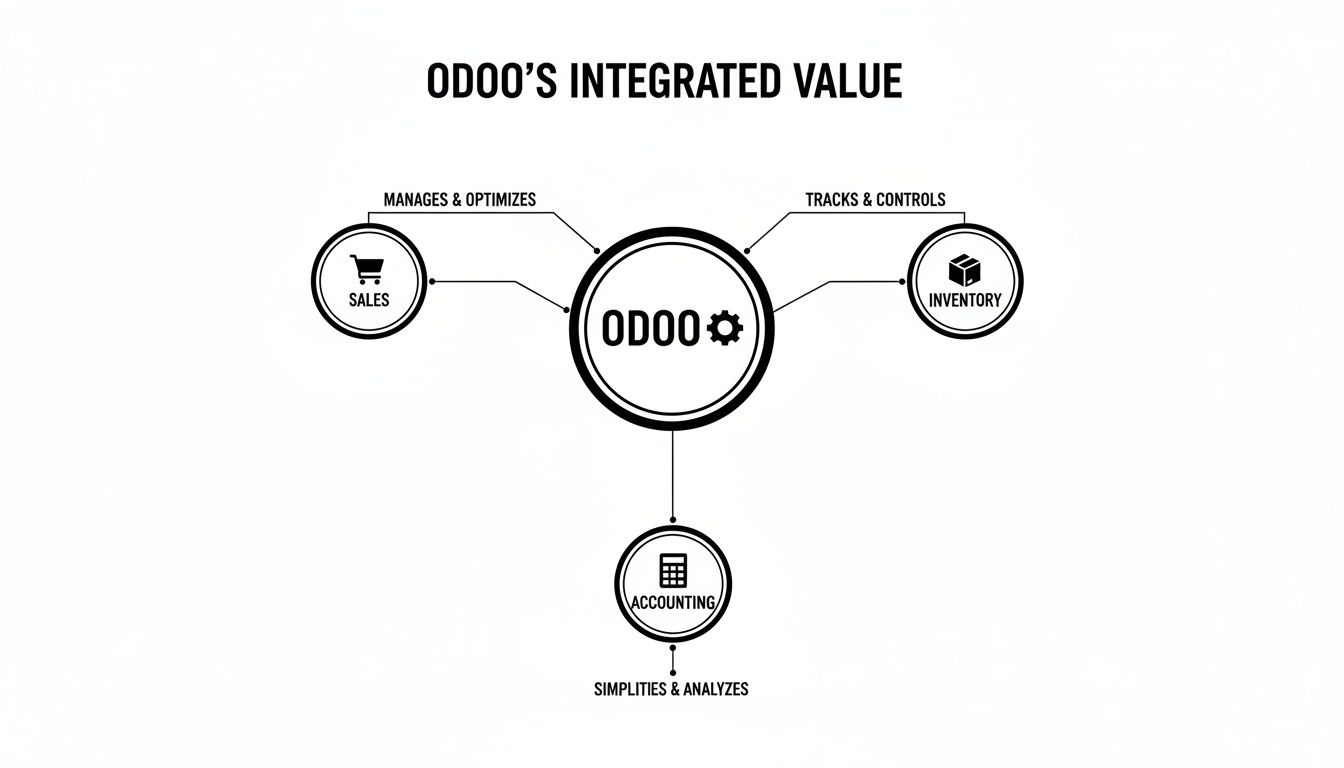
The key takeaway is that no department is an island. An action in one area creates an automatic and precise reaction somewhere else, which gets rid of soul-destroying manual data entry and the costly errors that come with it. Let’s break down some of the most critical modules.
Supercharge Your Pipeline with CRM and Sales
At the heart of any growing business is its ability to find, win, and keep customers. Odoo’s CRM module gives you a crystal-clear, visual pipeline of all your leads and opportunities, tracking everything from the first “hello” to the final handshake.
A practical case is a sales team in Sydney that can use the CRM to follow a lead from a website enquiry. Every email, phone call, and meeting is automatically logged, creating a complete history. This ensures that even if the primary salesperson is away, another team member can step in, see the entire conversation history, and provide a seamless customer experience.
The Sales module then picks up right where the CRM leaves off. As soon as a deal is won, you can generate a professional quote directly from the opportunity, convert it into a sales order with a single click, and send it straight to the customer for an electronic signature. This kind of efficiency slashes the sales cycle and gets cash in the bank faster.
Master Your Stock with Inventory and Warehouse Management
For any business that holds physical products, managing stock is a constant balancing act. Too much inventory ties up precious capital, but too little leads to lost sales and frustrated customers. Odoo’s Inventory module gives you the control you need to get that balance just right.
It can automate your replenishment rules, so when stock for a popular item dips below a certain level, a purchase order is automatically created. It’s a proactive approach that prevents stockouts before they happen and keeps your entire supply chain running smoothly.
Getting your head around how a proper enterprise system manages stock is crucial for growth. You can dive deeper with a guide on ERP for Inventory Management to see just how powerful these tools can be. Odoo pushes this even further with advanced features like barcode scanning, double-entry inventory tracking, and direct integrations with major shipping carriers.
Automate and Simplify Your Finances
Let’s be honest, financial management is often the most complex and tedious part of running a business. Odoo’s Accounting module is designed to bring remarkable clarity to your numbers by automating the tasks that typically chew up hours of manual work.
Here are a few ways it makes life easier:
- Bank Synchronisation: It automatically pulls in your bank statements, making reconciliation a breeze.
- GST and BAS Reporting: The system is localised for Australia, so meeting your tax obligations is no longer a headache.
- Integrated Invoicing: You can create and send invoices directly from sales orders or timesheets and track payments in real time.
Because the accounting module is plugged into every other part of the system, your financial reports are always live and accurate. When an invoice is paid or a supplier bill is entered, the general ledger reflects it instantly. You get a precise, up-to-the-minute view of your financial health, anytime you need it.
Build Your Online Storefront with eCommerce
For businesses ready to sell online, Odoo provides a fully integrated eCommerce module that’s so much more than a simple shopping cart. It lets you build a beautiful, modern online store that is directly connected to your inventory and sales data from day one.
This is a complete game-changer, especially for businesses that also use platforms like Shopify or WooCommerce. While they are excellent standalone storefronts, trying to manage them alongside a separate inventory or accounting system creates disconnected data silos. An Odoo implementation can bring these platforms under one roof, or you can use its own powerful eCommerce module to create a truly unified omnichannel experience.
Odoo in Action: Real Stories from Australian Businesses
Theory is great, but seeing how a platform solves real-world problems is where the rubber meets the road. Odoo isn’t just a collection of apps; it’s a flexible toolkit that can be shaped to fit the unique rhythm of just about any industry. Let’s look at a few practical cases of how Australian businesses are using it to get real, tangible results.

These aren’t just hypotheticals. They’re based on the everyday headaches that companies face and show how a smart Odoo implementation can completely change the game. From retail shops to service firms, the impact of having everything in one place is massive.
Case Study 1: The Omnichannel Retailer
Picture a popular Sydney boutique. They have a bustling storefront and a successful online shop powered by Shopify. For years, they wrestled with the classic retail nightmare: disconnected systems. Their in-store point-of-sale (POS) was an island, completely separate from their eCommerce site. Inventory was a mess of guesswork and endless manual counts.
This created all sorts of frustrating problems. An item sold in the shop could still show as “in stock” online, leading to overselling and apologetic phone calls to disappointed customers. They had no single view of who their customers were, making it impossible to run a decent loyalty program or send out targeted marketing emails.
The solution? A strategic Odoo implementation designed to create one seamless, omnichannel experience. By plugging their Shopify store and in-store POS directly into Odoo’s Inventory, Sales, and CRM modules, they finally got a single source of truth. A professional Shopify implementation team ensured the data flow was flawless.
Now, a sale on their website instantly updates the stock levels the cashier sees in the Sydney store, and vice versa. It’s a simple change, but it completely wiped out their stock discrepancies and made for much happier customers.
On top of that, they now have a unified customer database. They can see someone’s entire purchase history, whether they bought online or in-person. This lets them create personalised promotions and truly understand who they’re selling to.
Case Study 2: The Sydney Software Development Firm
Now, let’s shift gears to a software development Sydney firm building custom apps for clients. Their biggest blind spot was project profitability. They were juggling a whole suite of different tools—one for project tracking, another for timesheets, and a completely separate system for invoicing. This siloed approach made it nearly impossible to see if a project was actually making money or losing it.
Developers would log hours in one system, but that data then had to be manually keyed into the accounting software to create an invoice. The process was slow, riddled with errors, and offered zero real-time insight into project budgets.
Their Odoo implementation was built around the Project, Timesheets, and Accounting modules, creating a single, connected workflow from start to finish.
- Project Management: Every client project was set up in Odoo with clear tasks, deadlines, and budgets.
- Integrated Timesheets: Developers could log their hours directly against specific project tasks right inside Odoo.
- Automated Invoicing: With just a few clicks, the system turned all those billable hours from timesheets into accurate client invoices. No more manual entry.
The result was a total transformation in their operational visibility. Managers could now pull up a live dashboard showing exactly how many hours were burned on a project compared to the budget. This insight allowed them to quote new projects with confidence and spot potential budget blowouts before they spiralled out of control.
Case Study 3: The Adelaide Manufacturing Business
Our final example comes from an Adelaide-based manufacturer of high-quality industrial parts. Their supply chain was being run on a chaotic mix of spreadsheets and outdated, clunky software. Ordering raw materials was manual, production scheduling was a constant juggling act, and tracking finished goods was a shot in the dark.
This lack of integration was costing them dearly. A critical raw material would unexpectedly run out, grinding the entire production line to a halt. Other times, they’d over-order materials, tying up precious cash in inventory that was just sitting there. They needed to see everything, end-to-end.
By implementing Odoo’s Manufacturing, Purchase, and Inventory modules, they built a fully connected supply chain.
- Automated Procurement: They set up reordering rules. When the stock of a certain raw material hit a minimum level, Odoo automatically generated a purchase order to the supplier. No more forgetting.
- Streamlined Production: Manufacturing orders were created directly from sales orders, which meant they only produced what was actually needed to meet customer demand.
- Real-Time Tracking: They brought in barcode scanning for every step—from raw materials arriving at the dock to finished goods being shipped out—giving them complete traceability.
This Odoo implementation Adelaide businesses can learn from gave the company a bird’s-eye view of its entire operation. They cut their inventory holding costs by over 20% and almost completely eliminated production stoppages caused by material shortages.
Trying to manage a business with separate tools for sales, inventory, and accounting is like trying to build a car with parts from three different manufacturers. It might work, but it’s never going to be efficient. Here’s a quick look at how an all-in-one Odoo system stacks up against a typical piecemeal approach.
Comparing Odoo with Standalone Platforms
| Business Function | Standalone Solution (e.g., Shopify + Xero) | Integrated Odoo Solution |
|---|---|---|
| eCommerce & POS | Separate systems (e.g., Shopify, Vend) that need manual syncing or costly third-party connectors. | A single, unified system. An online sale instantly updates in-store inventory and accounting records. |
| Inventory Management | Stock levels are often out of sync between channels, leading to overselling or stockouts. | Real-time, centralised inventory across all sales channels (online, in-store, wholesale). |
| Customer Data | Customer information is fragmented. A customer who buys online and in-store appears as two different people. | One unified customer profile tracks all interactions and purchases, enabling better service and marketing. |
| Accounting & Finance | Sales and purchase data must be manually entered or imported into accounting software like Xero or MYOB. | All financial transactions are automatically posted to the integrated Odoo Accounting ledger. No re-entry. |
| Reporting | Getting a complete picture of business health requires pulling data from multiple sources and combining it in spreadsheets. | A single dashboard provides a real-time, 360-degree view of sales, inventory, and financial performance. |
The difference is clear. While standalone tools are great at what they do, they create data silos. Odoo breaks down those walls, giving you a single, cohesive platform to run your entire business.
These stories are just a glimpse of what’s possible with a well-configured Odoo system. Whether you’re wrangling a complex WooCommerce integration, need custom software development in Adelaide, or require a full Shopify implementation, Odoo provides the solid foundation you need to grow.
Ready to see how Odoo can be tailored to solve your specific challenges? Get in touch with the experts at Wistec for a no-obligation consultation today! We’ll help you map out a solution that fixes your problems and opens up new opportunities.
Why Odoo Is a Game-Changer for Australian Businesses
Picking the right software to run your business isn’t just about ticking boxes on a feature list—it’s a massive strategic decision. While plenty of global platforms offer a one-size-fits-all approach, Odoo truly stands apart because it’s been built with the unique challenges of the Australian market in mind.
This isn’t just a minor tweak; it’s a fundamental advantage. Odoo comes ready-made with features that tackle Australian compliance head-on, meaning less time wrestling with regulations and more time growing your business.
Built for Aussie Compliance, Right Out of the Box
One of the biggest headaches for any Australian business is staying on top of financial reporting standards. Odoo has native support for these built right in, so you can ditch the clunky workarounds and expensive add-ons that other international systems often force on you.
Here’s what that looks like in practice:
- Goods and Services Tax (GST) Reporting: Odoo handles GST calculations on every transaction automatically. Your records stay accurate, and reporting becomes a breeze.
- Business Activity Statements (BAS): The accounting module is already set up to generate your BAS reports, simplifying the whole process of lodging with the ATO.
- Peppol E-Invoicing Compliance: With Australia embracing the Peppol network for e-invoicing, Odoo keeps you ahead of the curve. You can process invoices with government agencies and other businesses faster and more securely.
Getting this right is a cornerstone of a successful Odoo implementation Sydney Adelaide businesses can count on. It’s about having a system that already speaks your language and understands the local rules.
A Powerful Local Partnership with Tyro Payments
Beyond just compliance, Odoo’s integration with Tyro Payments gives it a serious edge in Australia. This isn’t just a handy feature; it solves a huge operational challenge for retailers by merging payment processing directly into your core business system.
This partnership is a big reason Odoo has captured over 20% market share in Australia’s SaaS-based point of sale (POS) market. Tyro supports more than 73,000 merchants across the country, and by building their payment processing right into the ERP, Odoo helps SMEs sidestep the extra fees that come with third-party gateways and EFTPOS terminal rentals. You can read the full analysis on Odoo’s market position to see just how impactful this collaboration has been.
When you stack Odoo up against other platforms, like those in this list of the Top 5 ERP Systems, you can see how its deep local integrations offer a real competitive advantage.
By embedding payment solutions directly into the platform, Odoo transforms a simple transaction into a wealth of business intelligence, instantly updating inventory, sales records, and financial ledgers without any manual intervention.
This kind of seamless integration is vital, especially if you’re running a Shopify or WooCommerce store alongside a brick-and-mortar shop. A smooth payment process isn’t a bonus anymore—it’s what customers expect. Our software development Sydney Adelaide teams are experts at making sure these systems talk to each other perfectly.
Ready to see what a platform designed for Australian success can do for you? Contact Wistec today and let’s talk about how a localised Odoo solution can give your business the edge it deserves.
Your Roadmap for a Successful Odoo Implementation
Let’s be honest, implementing a new ERP system can feel like a monumental task. But with a clear roadmap, what seems like a daunting challenge quickly becomes a manageable, strategic project. This is our guide to navigating the process, and it highlights why partnering with an expert for your Odoo implementation in Sydney or Adelaide is so crucial.
A successful launch is never just about installing software. It’s about methodically aligning a powerful platform with the unique way you do business, ensuring you see a real return on your investment.
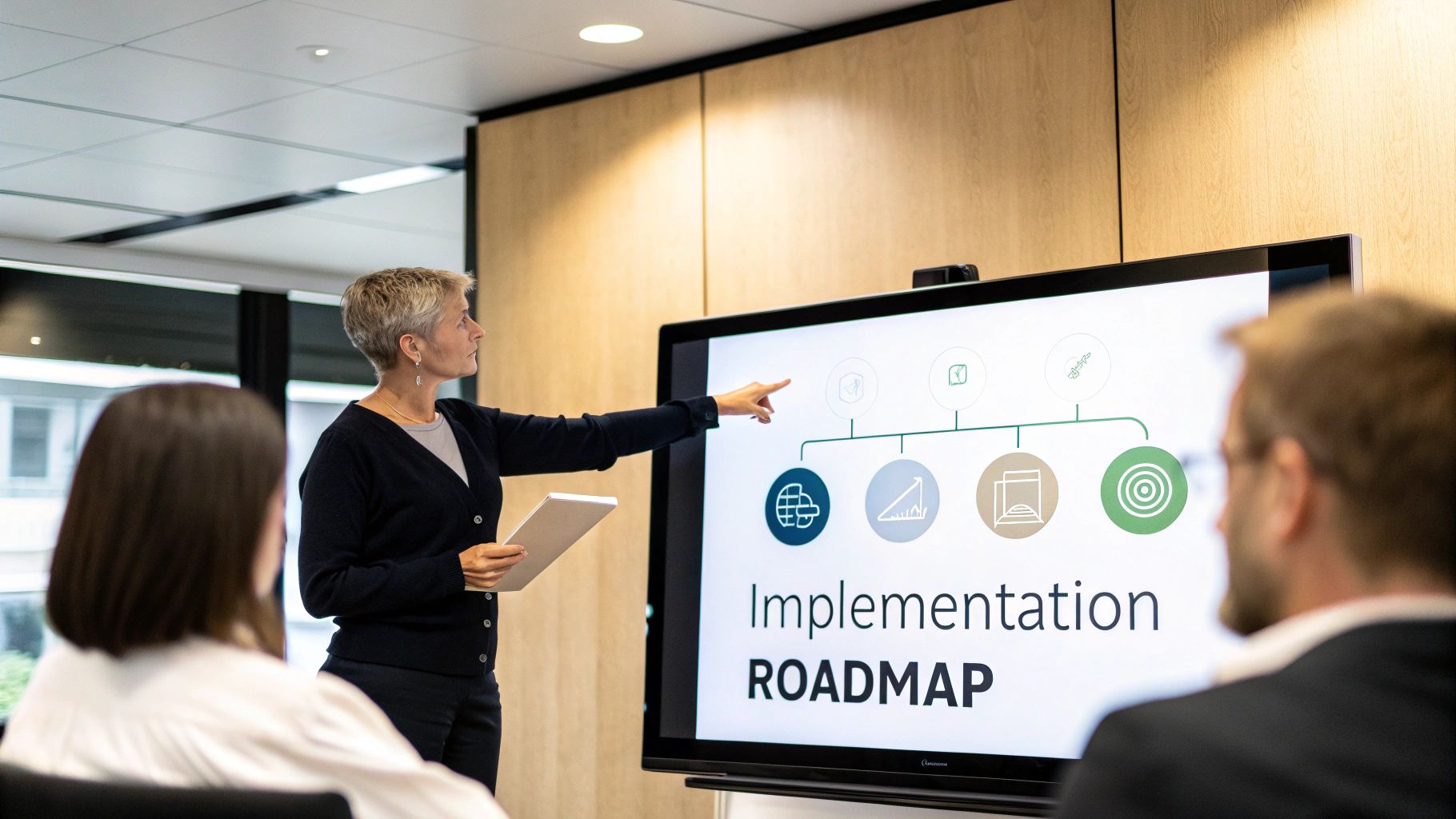
Without a structured plan, projects go off the rails. It happens all the time. Scope creep, messy data, and poor training are the classic pitfalls that can turn a brilliant tool like Odoo into an expensive headache. An experienced partner is your project manager, risk mitigator, and technical expert all in one, making sure every phase is executed properly.
Phase 1: Discovery and Planning
This is, without a doubt, the most critical stage of the entire project. It’s where we get in the trenches with you to understand your current workflows, your biggest frustrations, and your ultimate business goals. Think of it as creating the architectural blueprint for your new system.
We don’t just ask what you want the software to do; we dig deeper to understand why. This is the only way to guarantee the final solution solves the right problems.
Key activities here include:
- Workflow Analysis: We map out everything, from how a new sales lead travels through your pipeline to how a Shopify order is picked, packed, and shipped.
- Gap Analysis: We pinpoint exactly where Odoo’s standard features fit your needs perfectly and where a bit of customisation might be necessary to handle your unique processes.
- Defining Scope: We lock in a detailed project plan. It clearly outlines deliverables, timelines, and who is responsible for what, which is your best defence against scope creep down the line.
Getting this initial deep dive right is what separates a successful Odoo implementation from one that stumbles. It’s all about measuring twice and cutting once, building your new system on the solid foundation of your real-world business needs.
Phase 2: Configuration and Customisation
With the blueprint signed off, it’s time to start building. This phase is all about configuring Odoo’s standard modules to mirror the workflows we defined during discovery. For most businesses, the out-of-the-box apps for CRM, inventory, and accounting are incredibly powerful.
But sometimes, your secret sauce—that unique process that gives you a competitive edge—needs a tailored solution. This is where our expert software development Sydney Adelaide team comes in. If you have a specialised manufacturing process or a complex quoting system, our developers can build custom applications right inside the Odoo framework. The platform adapts to your business, not the other way around.
The goal of configuration is to make Odoo feel like it was built just for you. Every field, report, and dashboard should be relevant to your team, making their jobs easier and more productive from day one.
Phase 3: Data Migration
Your business data is one of your most valuable assets. We’re talking about all your customers, products, sales history, and supplier information. Moving it from old, clunky systems into Odoo has to be handled with military precision.
The process involves carefully extracting data from legacy systems (like old accounting software or a mountain of spreadsheets), cleaning it up to get rid of duplicates and errors, and then importing it into Odoo in just the right format. Trust us, poor data is a notorious project killer. Starting with “dirty” data means your shiny new system will be inaccurate from the get-go. We manage this meticulously to ensure you have a clean, reliable dataset when you go live.
This is also where we pull in data from platforms like WooCommerce or Shopify, creating a single, unified view of your entire business. The official rollout of Odoo 19 in Australia makes this even better, with advanced tools and deep localisation for Aussie standards like Single Touch Payroll (STP) Phase 2 and Peppol e-invoicing. This makes financial data migration smoother and more compliant than ever. You can discover more insights about Odoo 19’s features for Australian businesses to see how it simplifies these technical hurdles.
Phase 4: Training and Go-Live
The final phase is all about your people. The most powerful system in the world is useless if your team doesn’t know how to use it. We provide comprehensive, role-based training to make sure every user is confident and capable from day one. This isn’t just a quick one-off session; it includes ongoing support to handle questions as they pop up.
The “Go-Live” is the big moment—when you switch off the old systems and start running your entire business on Odoo. With a well-planned implementation, this should feel smooth and almost anti-climactic. And with a partner providing post-launch support, you’ve got a safety net to quickly sort out any initial teething issues.
Ready to start your journey with a clear, strategic roadmap? Contact Wistec today for a no-obligation consultation and let’s build your path to success.
Ready to Transform Your Business with Odoo?
We’ve walked through how Odoo isn’t just another piece of software. It’s a complete, all-in-one platform built for ambitious Australian businesses like yours—scalable, smart with your budget, and seamlessly integrated. It gives you the power to iron out your operations, get a crystal-clear view of your data, and handle local compliance without the headache.
So, what’s the next step?
You can’t afford to let clumsy, disconnected systems, mind-numbing manual data entry, and operational roadblocks dictate your future. It’s time to stop patching things together and start building a foundation for real, sustainable growth.
Choosing the right system is one thing, but choosing the right partner to implement it is everything. A great implementation means your technology becomes your biggest asset, not another problem to solve.
This is where we come in. The expert team at Wistec is ready to sit down with you for a one-on-one consultation. We live and breathe this stuff. Whether you’re after a full Odoo implementation Sydney Adelaide businesses trust, custom software development Sydney Adelaide teams require, or need a slick Shopify implementation and WooCommerce integration, we’ve got your back.
Let’s work together to build a system that doesn’t just run your business—it fuels your ambition.
Book Your Free Consultation with an Odoo Expert Today!
Common Questions We Hear About Odoo in Australia
When businesses in Australia start looking into Odoo, a few questions always pop up. Let’s tackle some of the most common ones to give you a clearer picture of what to expect.
Is Odoo Going to Be More Expensive Than Other Systems?
It’s a fair question, and the answer often surprises people. Odoo’s pricing is one of its most compelling features, especially compared to the traditional ERP giants. It’s built on a modular system, which is just a fancy way of saying you only pay for the specific tools—or “apps”—your business actually needs.
For most businesses, this ends up being a lot more affordable than paying separate monthly subscriptions for a CRM, an accounting package, and an inventory system. An Odoo implementation consolidates all that into one platform. As your business grows, you just bolt on new apps. This “pay-as-you-grow” approach sidesteps the massive upfront investment that usually comes with big-name ERPs.
Can We Bring Our Data Across from Shopify or Xero?
Yes, absolutely. In fact, you must. A clean and complete data migration is non-negotiable for a successful Odoo project. Any good implementation partner will have this down to a fine art, ensuring all your critical business information makes the journey smoothly.
We’re talking about things like:
- Your complete customer database and their order history
- Every product in your catalogue, right down to current stock levels
- All your historical sales orders and financial data
So, whether your data currently lives in Shopify, WooCommerce, or an accounting platform like Xero, an expert partner can make sure it all lands in Odoo correctly. This careful process is what turns your new system into a reliable single source of truth from the moment you go live.
Just How Customisable Is Odoo for Our Unique Industry?
This is where Odoo really shines. Because it’s built on an open-source foundation, it’s incredibly flexible. Think of it less like off-the-shelf software and more like a set of powerful building blocks. Its API allows for deep customisation to handle the unique quirks of almost any industry, from complex manufacturing processes to bespoke service-based businesses.
Odoo is designed to mould itself to your business, not force your processes into a rigid, one-size-fits-all box. The software should support what makes you different, not water it down.
This is exactly what our software development Sydney Adelaide teams live and breathe. Whether you need to adjust a small workflow or build an entirely new custom module from scratch, we can shape the platform to your precise operational needs. This level of tailoring is what transforms Odoo from a handy tool into an asset that’s truly fundamental to your business.
Ready to see how Wistec can build an Odoo solution that fits your business like a glove? Contact us today for a personalised consultation and let’s talk about what our expertise in Odoo implementation and software development can do for you.