

Picture your business as a boat full of rowers. If every rower has a different oar and rows at their own pace, what happens? You move slowly, erratically, maybe even in circles. Odoo ERP software is like the coxswain in that boat, getting everyone—sales, inventory, accounting, HR—to pull together in perfect sync, driving your business forward with real speed and direction.
Unifying Your Business Operations with Odoo

So many growing businesses end up with a messy patchwork of different software. You might be juggling one tool for accounting, another for your CRM, and a completely separate system to run your Shopify implementation or WooCommerce store. This creates “data silos,” where crucial information gets trapped in one department, invisible to others. The result? Wasted time, endless manual data entry, and costly mistakes.
This is exactly the problem that Enterprise Resource Planning (ERP) software was designed to solve. It brings all these scattered functions into one, unified platform, breaking down the walls between departments and creating a single source of truth for your entire organisation.
Odoo is much more than just a piece of software. It’s a business management philosophy built on one powerful idea: all your operational tools should talk to each other, seamlessly. It gives you a complete picture of your business, from the very first customer interaction right through to the final financial report.
The benefits of this integrated approach are immediate and obvious. When your sales team closes a deal, the inventory and accounting teams know about it instantly. The invoice can be generated automatically, stock levels are updated in real-time, and leadership gets an accurate, up-to-the-minute view of how the business is performing.
Built for Australian Business Ambition
What really makes Odoo stand out is its incredible flexibility. Unlike rigid, one-size-fits-all systems, Odoo is completely modular. Think of it like building with LEGO bricks: you start with the essential pieces you need right now—maybe a CRM, Invoicing, and Inventory—and simply add new modules as you grow. This scalability is a massive advantage for Australian SMEs.
A Sydney-based startup could begin with just the basics, while an established manufacturing firm in Adelaide could roll out a full suite of production and supply chain management tools. It’s this adaptability that’s fuelling its widespread adoption across the country.
The market for Odoo ERP software is booming in Australia for this very reason. The entire Australian ERP market was valued at around USD 930.2 million in 2024 and is expected to climb to over USD 1.17 billion by 2030. This growth shows a clear trend towards flexible systems like Odoo that help businesses operate with more agility and insight. You can discover more about Australia’s expanding ERP market and see how Odoo fits in.
From Disconnected Tools to a Powerful Engine
Shifting to an integrated system like Odoo isn’t just an IT upgrade; it’s a strategic business move. It’s about swapping operational friction for streamlined efficiency. Instead of your team wrestling with spreadsheets and manual updates, they can focus on what actually matters: growing the business.
Here’s a look at some of the common headaches that SMEs face and how Odoo provides a direct solution.
Common Business Problems Solved by Odoo ERP
| Business Challenge | How Odoo ERP Software Solves It |
|---|---|
| Double Data Entry & Errors | Information is entered once and is instantly available across all relevant apps, dramatically cutting down on human error. |
| Wasted Time on Manual Tasks | Odoo automates repetitive workflows like purchase orders, invoicing, and customer follow-ups, freeing up your team’s time. |
| Poor Visibility & Decision-Making | With a central dashboard, you get real-time, accurate data on sales, inventory, and financials for smarter, faster decisions. |
| Inconsistent Customer Service | A complete 360-degree view of every customer allows your team to provide faster, more personalised, and consistent service. |
| Systems Don’t Scale with Growth | Odoo’s modular design means you only pay for what you need and can easily add new functionality as your business expands. |
By moving to a unified platform, you’re not just solving today’s problems; you’re building a solid foundation for sustainable growth.
Investing in a platform that grows with you is one of the smartest decisions you can make. Ready to see how a unified system can reshape your operations? Let’s talk about how custom software development in Sydney can tailor Odoo to fit your business perfectly.
A Practical Tour of Odoo’s Core Modules
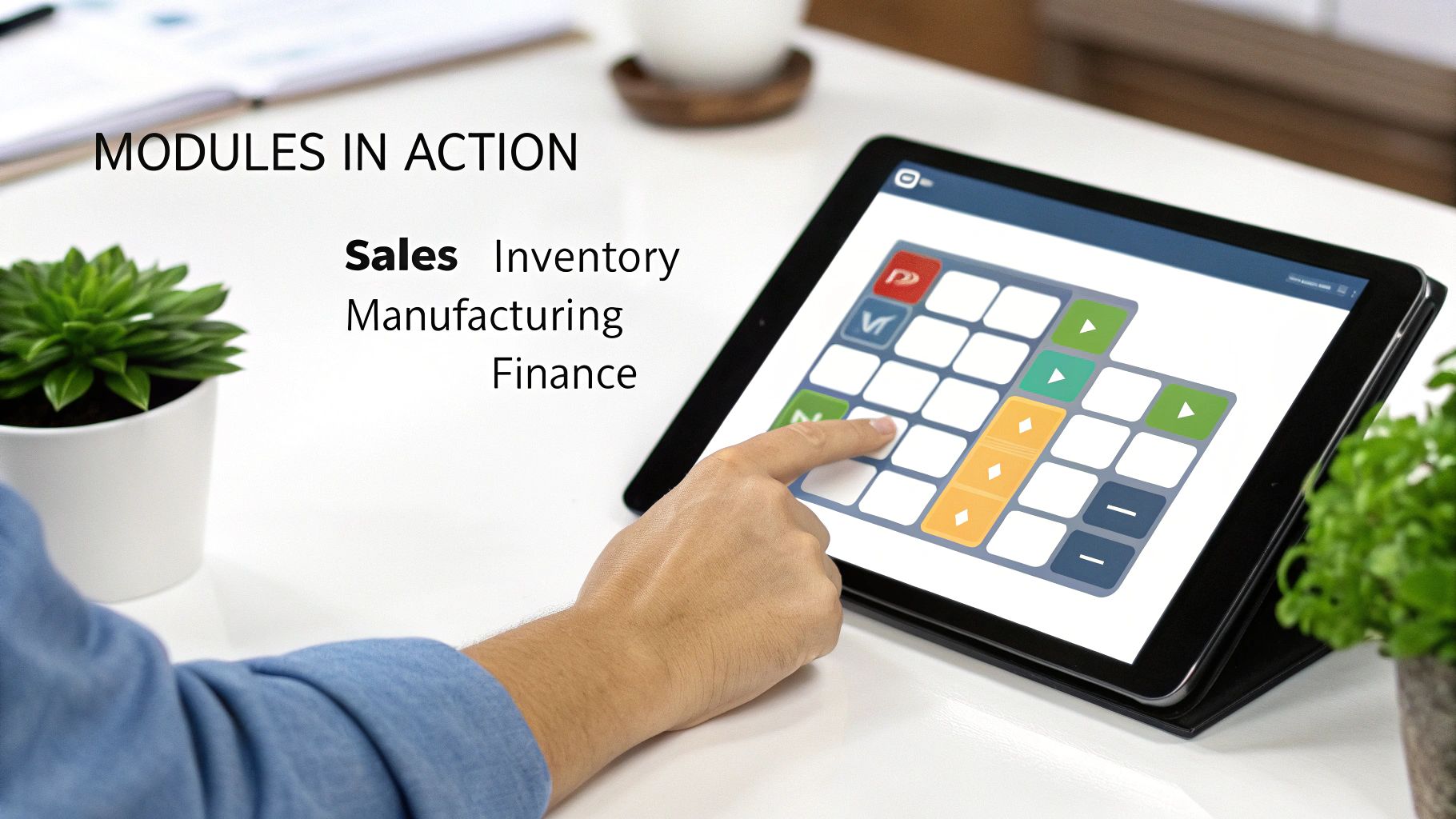
The real magic of Odoo ERP software isn’t found in a long list of features. It’s in how all its different parts talk to each other to solve genuine business problems. Think of the modules less like separate apps and more like highly skilled teams that communicate flawlessly.
Let’s take a look at how these core components actually work on the ground for Australian businesses. We can break down Odoo’s most important modules into three key areas: winning customers, managing your stock, and keeping your finances in order. While each tool can stand on its own, its true power is unlocked when they work together.
Sales and Customer Relationship Management
This is where the money is made. Odoo’s Sales and CRM modules are built to handle the entire customer journey, from the first hello to the final invoice and all the follow-ups in between. They give your team a complete history of every conversation and transaction, so nothing ever slips through the cracks.
- CRM App: This is your command centre for tracking leads, opportunities, and every customer email or phone call. You can set up a visual sales pipeline to see exactly where every deal is at, automate reminders for your team, and get a much clearer picture of future revenue.
- Sales App: This tool makes creating professional-looking quotes and sales orders incredibly simple. Because it’s connected to your inventory, the pricing and stock levels are always right.
- Point of Sale (POS) App: For any business with a physical shopfront, the POS app gives you a clean, modern interface for handling in-store sales. It even works if the internet goes down.
Practical Case: A retail business in Sydney uses Odoo. When a customer buys something in-store through the POS, that sale is instantly logged in the Sales app. At the same time, the CRM updates that customer’s profile with what they bought. Now they have a unified view of their customer, ready for their next marketing campaign.
Inventory and Operations Management
Profitability hinges on how well you manage what you make, store, and ship. Odoo’s operational modules give you total control over your physical goods, from ordering from suppliers to getting the product into your customer’s hands. For many businesses, this is where they see the fastest and biggest wins.
A successful Shopify implementation or a well-oiled WooCommerce store lives and dies by accurate, real-time stock levels. When your website doesn’t know what’s actually in the warehouse, you end up selling products you don’t have. That means cancelled orders, unhappy customers, and a logistical nightmare. Odoo prevents this by connecting everything.
The modules that run your operations:
- Inventory App: This is the heart of your stock control. You can use barcode scanners, set up rules to automatically reorder popular items, and run detailed reports to avoid stockouts and cut down on storage costs.
- Manufacturing App: If you make your own products, this app is a lifesaver. It helps you manage recipes (bills of materials), work orders, and production schedules, giving you a clear view of everything happening on the workshop floor.
- Purchase App: This module smooths out the whole process of buying from your suppliers. It helps you create purchase orders, see which vendors are performing best, and even automate purchasing based on your current stock levels.
Practical Case: An e-commerce business based in Adelaide runs on Odoo. An order comes through their WooCommerce site, and the Odoo Inventory app instantly reserves the stock. If that product’s stock level dips below a certain point, the Purchase app can automatically create a draft purchase order to their supplier. They never run out of their bestsellers. That kind of automation changes everything.
Finance and Project Management
Finally, Odoo pulls all your financial data and project workflows under one roof. This means your bookkeeping is always accurate, you can send invoices faster, and you can manage service-based work without needing separate accounting software or project management tools.
For any professional services firm, this tight integration is crucial. The success of a project is tied directly to its financial health. A smart Odoo implementation in Adelaide can connect your team’s timesheets, project tasks, and client invoicing into one smooth, unbroken workflow.
- Accounting App: This module handles the lot—invoicing, getting paid, bank reconciliation, and generating financial reports, all built to comply with Australian tax standards.
- Project App: Manage all your client work using easy-to-read Kanban boards, Gantt charts, and task tracking. You get a crystal-clear overview of deadlines, who’s responsible for what, and how every project is progressing.
- Timesheets App: Your team can log their hours against specific projects or tasks. That information flows straight into both the Project and Accounting apps, making client billing a breeze.
All these modules are designed to work in sync, giving you a true 360-degree view of your business from a single screen. The only way to really know how they can fit your specific needs is to chat with someone who knows them inside and out.
Ready to see how these modules could work for you? Let’s explore a customised software development in Sydney solution to build your perfect system. Contact Wistec today for a personalised consultation!
So, Why Choose Odoo? The Real Business Pay-Offs
Picking an ERP system isn’t just a software decision; it’s a foundational choice that dictates how your business will run and grow for years to come. So why do so many smart companies bank on Odoo ERP software? It comes down to a few core advantages that rigid, old-school systems simply can’t offer. This is more than a tech upgrade—it’s about building a smarter, more agile business from the ground up.
The first thing you’ll notice is how much kinder it is to your budget. Odoo’s open-source model and modular pricing flip the traditional ERP cost on its head. Forget about the eye-watering, all-or-nothing price tags. With Odoo, you start with what you need right now and only pay for that, making it accessible for businesses of all sizes.
Built to Grow With You, Not Hold You Back
Your business is constantly evolving, and your software should keep up. Odoo is designed to scale right alongside you, whether you’re a two-person startup or a growing enterprise with multiple locations. It’s like a set of building blocks for your business.
You might kick things off with just the CRM and Sales apps to manage your customer pipeline. Later, as you expand into e-commerce, you can bolt on a full Shopify implementation and the Inventory module without missing a beat. There’s no painful migration, just seamless growth.
This adaptability is a huge deal. An Odoo implementation in Sydney for a new retail store could start lean with just Point of Sale and Inventory. A year down the track, when they’re ready to sell online, they can switch on the eCommerce and Marketing apps. It’s a true pay-as-you-grow model that ensures your tech is an enabler, not a roadblock.
The Power of Having Everything in One Place
Data chaos is a silent killer of productivity. When your sales numbers, stock levels, and financials are all living in different systems and spreadsheets, you’re flying blind. You’re forced to make decisions with fragmented, often outdated, information.
Odoo fixes this by pulling everything into one unified database.
When your entire team is working from the same playbook, the guesswork disappears. Sales knows exactly what’s in stock, marketing sees what customers are buying, and the finance team has a live view of the company’s health. This “single source of truth” is what lets you make faster, smarter decisions with real confidence.
Practical Case: Imagine a services company running a custom software development project. With Odoo, they can track timesheets, project progress, and client invoices all in one spot. They can instantly see which projects are making money and which are draining resources, allowing them to pivot their strategy in real-time.
A System That Bends to Your Business
Let’s be honest: no two businesses run the same way. Odoo gets this. Its open-source nature means you can mould it to fit your unique processes, not the other way around. Need a special feature for your WooCommerce integration or a custom dashboard that shows the exact KPIs you care about? Odoo is built for it.
This flexibility is a major reason for its popularity in the competitive Australian market. Recent data shows that while Netsuite.com.au has a strong market presence with 17.68% of clicks, Odoo.com is a powerful contender at 10.16%. Its strength lies in this ability to be tailored to specific needs without the astronomical costs often charged by competitors. You can dive deeper into the ERP market share in Australia to see the full picture.
Working with an expert partner for an Odoo implementation in Adelaide means you can shape the software to be a perfect mirror of your ideal workflow. They can automate those repetitive, time-sucking tasks and build real efficiency right into the core of your operations.
Ready to build a system that perfectly matches your business needs? Contact us today to discuss a customised Odoo solution and get a free quote!
Real-World Wins: How Australian Businesses are Thriving with Odoo
Theory is one thing, but seeing Odoo ERP software solve real problems for Aussie businesses is where it really clicks. It’s easy to talk about “integrated modules,” but what does that actually mean for a company on the ground? It means swapping operational chaos for a well-oiled machine that just works.
Let’s move past the jargon and dive into three practical cases of Australian businesses that turned their daily headaches into major competitive advantages with Odoo.
A Sydney Retailer Finally Unites Its Online and In-Store Worlds
Practical Case: A growing fashion boutique with a bustling Sydney storefront and a popular WooCommerce website. Before Odoo, their operations were a mess. The shop’s POS system was an island, completely disconnected from their online store, which led to a constant tug-of-war with their inventory.
Staff were burning hours manually cross-checking stock levels, and the dreaded “sorry, we’ve oversold that item” email became a regular, and costly, part of their week.
The Fix:
They brought in an expert for an Odoo implementation in Sydney to finally connect all the dots.
- Odoo POS now runs the show for every in-store purchase.
- Odoo Inventory became the single source of truth for all stock.
- The WooCommerce connector was set up to sync online sales in real-time.
The change was like night and day. When a dress sells in the Sydney store, the website stock is updated before the customer has even left. An online order instantly reserves the item in the warehouse, meaning it can’t be accidentally sold in-store. This simple change eliminated overselling, slashed admin work by over 15 hours a week, and gave the owners a clear, accurate picture of their entire business for the first time.
An Adelaide Service Firm Discovers True Project Profitability
Practical Case: A digital marketing agency in Adelaide was juggling dozens of client projects. They had one tool for project management, another for time tracking, and a completely separate system for invoicing. This created a massive blind spot. They often had no idea if a project was actually profitable until weeks after it wrapped up. Billing for all those hours was a slow, manual grind riddled with potential errors.
The Fix:
An Odoo implementation Adelaide project zeroed in on their core workflow.
- Odoo Project was used to map out every client task and deadline.
- Odoo Timesheets gave the team a simple way to log hours directly against those tasks.
- Odoo Accounting now automatically converts those logged hours into precise client invoices with just a click.
The impact was immediate. The agency suddenly had a live dashboard showing project budgets, hours burned, and real-time profitability. They could finally see which clients were their best performers and where their team’s time was being stretched too thin. Invoicing, a process that used to take days, now takes minutes. This is a common outcome for firms that invest in expert software development in Adelaide to perfectly tailor Odoo to their unique processes.
A Local Manufacturer Radically Improves Production Flow
Practical Case: A small furniture maker whose entire operation ran on a maze of complex spreadsheets. They used them to track raw materials, production orders, and every step of the assembly line. This manual approach was not only slow but incredibly fragile. One unexpected large order could derail their entire schedule, and calculating the true cost of materials for each piece was a constant guessing game.
The Fix:
They rolled out Odoo’s manufacturing and inventory apps.
- Odoo Manufacturing took over their bills of materials (BOMs) and organised their work orders.
- Odoo Inventory automated the reordering of timber and other supplies when stock ran low.
- Odoo Barcode gave workers on the floor a scanner to quickly update progress and track material use.
This completely revolutionised their workshop. They now have a dynamic production schedule that can easily absorb new orders. Running out of materials is a thing of the past, and they know the exact cost of every table and chair they build. The result? A 20% jump in production output without adding a single new staff member.
The Australian retail sector, in particular, has seen huge benefits from adopting Odoo ERP software. It gives them a single command centre for stock, customers, and sales data, helping them perfect their operations and deliver a far better customer experience. You can read more about how Odoo is optimising Australia’s retail market to keep up with modern demands.
These examples are just the start. Whether you’re integrating a Shopify store or streamlining a complex service, Odoo provides the unified platform you need to operate smarter.
Ready to write your own success story? Contact Wistec today for a personalised consultation, and let’s build the perfect Odoo solution for your business.
Your Blueprint for a Successful Odoo Implementation
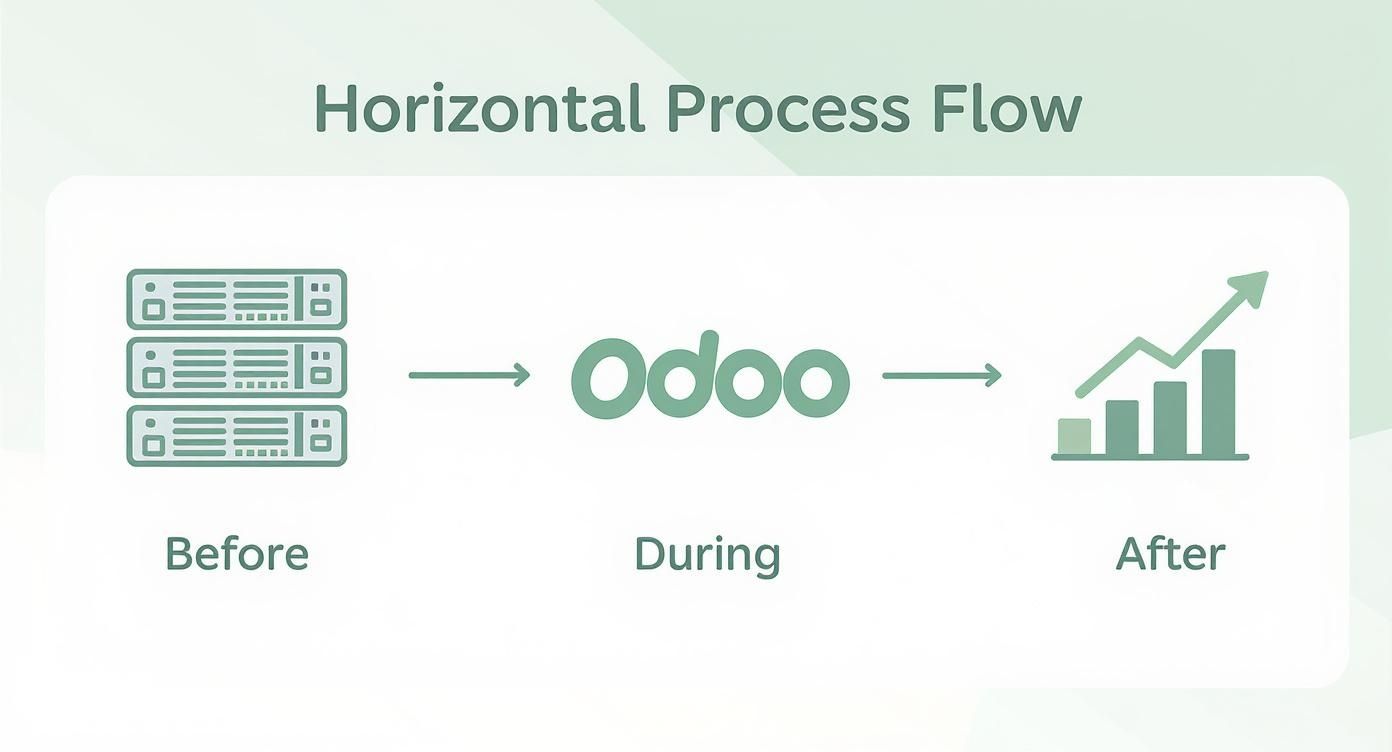
This process flow maps out the journey of bringing Odoo into a retail business, from the initial planning stages right through to analysing how it’s performing once live. The main thing to grasp is that a successful rollout isn’t a single event; it’s a process with distinct phases—preparation, execution, and optimisation—and each one is vital for long-term success.
Defining Your Goals Before You Begin
The biggest mistake I see businesses make is treating an ERP project as just an IT upgrade. It’s so much more than that. A successful Odoo implementation in Sydney or Adelaide always starts with crystal-clear business goals. Before you even look at a single module, you need to ask some hard questions. What, specifically, are we trying to fix? Are we aiming to slash inventory errors, get invoices out the door faster, or finally get a real-time view of project profitability?
Get these goals down on paper. They become your North Star, guiding every single decision you make, from which modules to pick to how you configure a specific workflow. This initial planning stage is where you lay the groundwork for a solid return on investment.
Without this clarity, projects fall victim to “scope creep”—that dreaded state where new features and requests keep getting tacked on, blowing out the timeline and the budget. A focused plan ensures you get the results you need, without the drama.
The Phased Approach to a Smoother Rollout
Trying to launch every Odoo module at once is, frankly, a recipe for disaster. It completely overwhelms your team, makes training a nightmare, and turns troubleshooting into an impossible task. A much smarter way forward is a phased implementation, where you roll out the software in manageable, logical stages.
Start with the biggest pain point in your business. If your number one headache is managing stock between your physical store and a Shopify implementation, then begin with the Inventory and POS modules. Get that right, make sure your team is comfortable, and then move on to the next priority.
This approach delivers quick wins, which is fantastic for morale. It builds momentum and gets your team genuinely on board with the new system. It also gives you the space to learn and adapt as you go, making each following phase even smoother. This is a go-to strategy for expert partners offering software development in Sydney to guarantee a project’s success.
Choosing the Right Partner Is Non-Negotiable
For the vast majority of businesses, setting up an Odoo ERP software system isn’t a DIY job. The implementation partner you choose will be the single most important factor determining whether your project succeeds or fails. A great partner does far more than just install software; they become a strategic advisor who takes the time to understand your business inside and out.
They’ll help you map your current processes, recommend the best-fit modules, and handle all the technical heavy lifting like data migration and system configuration. Look for a partner with proven, hands-on experience in your industry and a deep understanding of Australian business requirements.
Crucial Questions to Ask a Potential Odoo Partner:
- Can you show us case studies from businesses similar to ours?
- What’s your project management methodology?
- How do you handle user training and support after we go live?
- Do you have direct experience with a WooCommerce integration or other specific tools we rely on?
An experienced local partner for an Odoo implementation in Adelaide will also make sure your system is set up from day one to handle Australian tax laws, payroll, and other local compliance needs.
Ultimately, a successful implementation is a team sport. It takes a clear vision from your leadership, active involvement from your staff, and the expert guidance of a partner you can trust. With this blueprint, you can move forward with confidence, knowing you have a solid plan for success.
Are you ready to create a customised implementation roadmap for your business? Contact Wistec today for a free, no-obligation consultation!
Got Questions About Odoo? We’ve Got Answers.
Deciding to bring a system like Odoo ERP software into your business is a big move, and it’s completely normal to have a few questions. This is where we cut through the noise and give you the straight answers we share with business owners every day, helping you make the right call with confidence.
How Does Odoo Stack Up Against NetSuite or SAP for an Aussie SME?
For most small and medium-sized Australian businesses, pitting Odoo against giants like NetSuite or SAP really boils down to two things: flexibility and cost. Think of it this way: NetSuite and SAP are like massive container ships – incredibly powerful, but often expensive, slow to turn, and loaded with features you may never use.
Odoo, on the other hand, is more like a fleet of speedboats. Its modular design means you only pay for what you need right now, which keeps your initial investment lean. You can start with the essentials and add more capability as you grow. Plus, because it’s open-source, an expert in software development in Sydney can tailor it to your unique way of working far more easily and affordably than with the big, rigid systems.
Can We Connect Odoo to Our Existing Tools like Shopify or Xero?
You absolutely can. In fact, this is one of the best things about Odoo. It’s built to play well with others. You’ll find solid, off-the-shelf connectors for the tools Aussie businesses rely on, including slick Shopify implementation and deep WooCommerce integration for your online store. This keeps your sales, customers, and stock data perfectly in sync everywhere.
A lot of businesses ease into it. They might start by linking Odoo to their current accounting software, like Xero or MYOB, letting them upgrade their operations without turning their financial world upside down. A skilled partner for an Odoo implementation, Adelaide can map this all out, building a single, connected tech setup that just works.
The ability to plug into the tools you already know and trust makes the whole process so much smoother. It’s not about ripping everything out and starting again. It’s about building smart bridges between your systems to create something far more powerful.
What’s a Realistic Cost and Timeline for an Odoo Project?
This is the classic “how long is a piece of string?” question, because it all comes down to the size and complexity of your project. But to give you a rough idea, a straightforward implementation for a small business using standard modules can be up and running in as little as two to four months.
If your project is more involved—say, with large amounts of data to move, custom features for your specific workflows, and several third-party connections—you might be looking at a timeline of six to twelve months. Your costs will generally fall into three buckets:
- Odoo’s subscription fees (based on users and the apps you choose)
- The implementation partner’s service fees (for setup, customisation, and training)
- Optional ongoing support plans (for extra peace of mind)
The real advantage here is that you’re in the driver’s seat. By starting with just the essentials, you keep initial costs down and get a return on your investment much faster.
How Do We Find the Right Odoo Partner in Australia?
Choosing the right partner is hands down the most important decision you’ll make. They aren’t just an installer; they’re your strategic guide who will make or break the project.
Start by looking for official Odoo Partners in Australia—these are the ones who have been vetted and certified by Odoo. Then, dig into their track record. Have they worked with businesses like yours, whether in retail, manufacturing, or services? Ask for references from businesses in Sydney or Adelaide and actually talk to them.
A good partner will spend time understanding your business pains before they even talk about technology. Make sure you’re clear on their project management process, how they’ll train your team, and what their support looks like after you go live.
Ready to get clear, personalised answers to your specific questions? The team at Wistec is here to help you navigate your options and build a solution that drives real results for your business.
Book your free, no-obligation consultation with a Wistec expert today!