

Think of an Odoo application as a specialised tool in a much larger, integrated toolkit for your business. You’ve got apps for everything—sales, inventory, accounting, you name it. The real magic happens when you start combining these individual apps. They click together to form one seamless system that runs your entire business from a single, central hub.
Odoo: The Conductor for Your Business Orchestra
Ever felt like you’re trying to manage a business where every department is on a different planet? Your sales team has one version of customer data, the warehouse is working off another spreadsheet for stock levels, and your accountant is left to piece it all together manually. It’s a recipe for chaos.
This kind of disconnection creates what we call ‘data silos’, and they’re absolute killers for efficiency. They lead to costly mistakes, wasted hours, and opportunities that just slip through the cracks. It’s like an orchestra where every musician is playing from a different sheet of music—you don’t get harmony, you get noise.
That’s where Odoo steps in. It acts as the central nervous system for your whole operation, connecting every moving part and getting them all to work in perfect sync.
Tearing Down the Data Silos for Good
At its core, Odoo’s greatest strength lies in creating a single, reliable source of truth for your entire company. For example, when your sales team closes a deal in the CRM, that one action sets off a perfectly coordinated chain reaction across the business.
- Inventory: Stock levels are instantly and automatically updated.
- Accounting: An invoice is generated and queued up, ready to go.
- Logistics: The warehouse team receives an immediate notification to pick, pack, and ship the order.
As a result, this seamless flow ensures everyone is making decisions based on accurate, up-to-the-minute information, rather than last week’s outdated spreadsheet. Unsurprisingly, Australian businesses are catching on. In fact, the local ERP software market was valued at USD 930.2 million in 2024 and is projected to reach USD 1.17 billion by 2030. Clearly, this isn’t just a trend; it represents a fundamental shift towards smarter, more connected ways of working. You can explore more about these market trends and their drivers.
By knitting every function together, Odoo gives you a complete, 360-degree view of your business. This clarity allows you to spot patterns, manage your resources with precision, and make the kind of sharp, data-driven decisions that truly fuel growth.
Let’s quickly summarise the core advantages that an integrated system like Odoo brings to the table for Australian businesses.
Odoo Application Core Benefits at a Glance
| Benefit | Impact on Your Business |
|---|---|
| Centralised Data | Everyone works from a single source of truth, eliminating errors and confusion. |
| Real-Time Visibility | Make smarter decisions with live data from sales, inventory, and finance. |
| Improved Efficiency | Automate routine tasks and let your team focus on high-value activities. |
| Enhanced Collaboration | Break down departmental silos and foster seamless communication. |
| Scalability | Add new applications and users as your business grows, without the growing pains. |
| Cost Savings | Reduce manual work, prevent costly stockouts, and optimise resource allocation. |
This table really just scratches the surface, but it highlights how a unified platform moves beyond just software and becomes a strategic asset for growth.
A Real-World Example: Tying It All Together
Let’s make this more concrete with a practical case. Imagine you’re running a growing retail business with a brick-and-mortar store in Adelaide and a bustling online store built on Shopify or WooCommerce. Without a unified system, managing your inventory is a daily nightmare.
This is where an expert in Odoo implementation in Sydney, Adelaide can make a world of difference. They connect these two separate sales channels into one cohesive ecosystem.
Now, when a product sells on your website, the Odoo application instantly adjusts the stock count available in your Adelaide store. This simple, automated update prevents the cardinal sin of retail: selling an item you don’t actually have. This level of coordination is made possible through expert software development in Sydney and Adelaide, ensuring your Shopify implementation or WooCommerce store speaks the same language as your physical POS. It’s this practical, results-driven integration that turns fragmented operations into a powerful, efficient machine.
Ready to bring that kind of harmony to your business? Contact Wistec today for a consultation and discover how a tailored Odoo solution can centralise your data and drive your success.
Exploring Core Odoo Applications Your Business Needs
So, we’ve looked at the big picture. Now, it’s time to get our hands dirty and dive into the specific tools that make the Odoo application such a workhorse for modern businesses. Importantly, don’t think of Odoo as a single, clunky piece of software. Instead, it’s more like a master toolkit, where every tool is designed for a specific job but also fits together seamlessly with the others.
This seamless integration is exactly what sets Odoo apart. For instance, for a retailer, the Point of Sale (POS) system isn’t just a fancy cash register. Rather, it’s a live link to your inventory levels and customer database. As a result, every sale becomes more than just a transaction; it transforms into a piece of business intelligence you can actually use.
The Essential Toolkit for Growth
Most businesses can get off to a flying start by focusing on a few core Odoo applications. These are the command centres for your most vital operations, designed to turn messy, manual tasks into smooth, automated workflows. Nailing these fundamentals is the first step towards building a smarter, more efficient company.
- CRM (Customer Relationship Management): Think of this as the brain for all your customer interactions. It keeps track of leads, organises your sales pipeline, and gives your team the insights they need to build real relationships and, ultimately, close more deals.
- Sales & Invoicing: This app puts your entire sales process on autopilot. It helps you whip up professional quotes, fire off invoices, and chase up payments without breaking a sweat. It also talks directly to your accounting and inventory modules, so everything stays in sync.
- Inventory Management: Say goodbye to painful, manual stocktakes. This module provides a real-time, bird’s-eye view of your stock across every warehouse or shopfront. It can even automate reordering and track every single item from the moment it arrives to the moment it’s sold.
This diagram shows how Odoo acts as a central hub, connecting all these critical business functions—from sales and inventory to accounting—into one powerful, cohesive system.
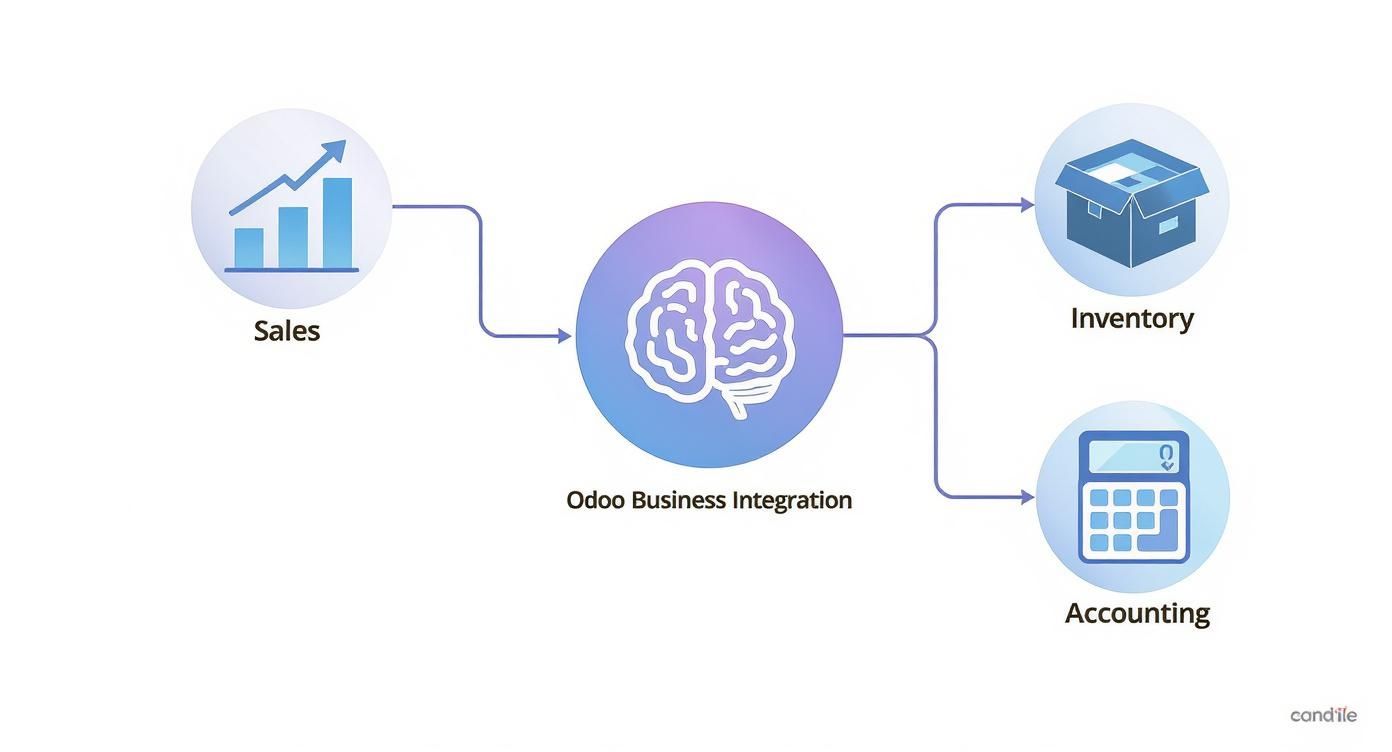
The magic is in how data flows effortlessly between these modules. This completely gets rid of double-handling and gives you one single source of truth for your entire operation.
A Practical Case: A Sydney Retailer’s Success Story
Let’s make this real. For example, a growing retailer in Sydney was tearing their hair out trying to juggle their brick-and-mortar store alongside a booming online presence on Shopify and WooCommerce. As a result, their inventory was a constant headache, often leading to overselling popular items online and leaving customers frustrated.
To solve this, they decided to work with an expert in Odoo implementation in Sydney and Adelaide to connect all their sales channels. Consequently, their Shopify implementation was hooked directly into Odoo’s Inventory app. Now, the moment an item sells online, the stock count is instantly updated for their in-store POS system, and vice versa.
This one change wiped out stock discrepancies, automated purchase orders when stock ran low, and freed up staff to focus on serving customers instead of doing tedious manual data entry.
That’s the real power of an integrated Odoo application. It’s not just a piece of software; it’s a better way of doing business. The right software development in Sydney and Adelaide can shape these tools to solve the exact problems you’re facing, whether you’re in retail, manufacturing, or professional services.
Ready to see how these core applications can be tailored to your unique business needs? Contact Wistec for a personalised consultation, and let’s start building your perfect toolkit.
Why More Aussie Businesses are Turning to the Odoo Application
So, what’s all the fuss about? Odoo is gaining traction among Australian businesses not for a single feature, but for its mix of flexibility and affordability that older systems can’t match.
Traditional ERPs often force you into a rigid, one-size-fits-all model and charge a fortune, which doesn’t suit today’s agile businesses. By contrast, Odoo works like LEGO blocks: you pick the apps you need now and only pay for those. A new online store might start with Inventory and Sales, while a growing workshop can add Manufacturing later. This ‘pay-for-what-you-use’ approach is a real budgeting advantage.
As a result, businesses in fast-moving markets like Adelaide and Sydney can scale their software in step with growth, avoiding bloated features and running operations efficiently and cost-effectively.
Built for Australian Compliance
One of the biggest headaches with any business software in Australia is wrestling with local tax and payroll rules. Odoo comes out of the box ready to handle our specific requirements, which is a massive weight off any business owner’s shoulders.
- Goods and Services Tax (GST): Odoo sorts out all the GST calculations and reporting for you automatically.
- Business Activity Statements (BAS): The accounting module makes generating your BAS reports for the ATO straightforward.
- Single Touch Payroll (STP): Odoo is fully STP-compliant, so your payroll reporting is always spot-on and seamless.
Having this local compliance built in means you can have confidence that your financial data is accurate from the get-go, without needing clunky workarounds or expensive third-party plugins.
The real magic of Odoo is that it grows with you. It’s a platform that bends to fit your business, not the other way around. That kind of agility is vital for any company wanting to stay competitive.
The numbers don’t lie. Since 2022, Odoo’s Australian user base has skyrocketed by over 300%, with the retail and manufacturing sectors leading the charge. With subscriptions starting from around AUD $45 per user per month, Australian SMEs can finally tap into a suite of over 80 integrated applications. It’s the kind of power that was once reserved for massive corporations, now without the eye-watering price tag. Discover more insights into ERP trends for Australian businesses.
To get a clearer picture of how Odoo stacks up against the old guard, let’s look at a direct comparison.
Odoo vs Traditional ERPs for Australian SMEs
For small to medium-sized enterprises in Australia, the choice of an ERP can significantly influence their growth trajectory. Consequently, understanding the differences between systems is crucial. The table below highlights the key distinctions between a modern, modular system like Odoo and the legacy platforms that once dominated the market.
| Feature | Odoo Application | Traditional ERP Systems |
|---|---|---|
| Cost Structure | Affordable monthly subscription per user. Pay only for the apps you need. | High upfront licensing fees, plus ongoing maintenance costs. |
| Implementation Time | Rapid deployment, often within weeks or a few months, for standard setups. | Lengthy and complex, frequently taking 6-12+ months to implement. |
| Scalability | Highly scalable. Add new users and applications as your business grows. | Rigid and difficult to scale. Adding functionality is often costly. |
| Customisation | Open-source and highly customisable to fit unique Australian business needs. | Limited and expensive customisation, often locking you into a vendor. |
| Ease of Use | Modern, intuitive user interface designed for non-technical users. | Often outdated, complex interfaces require extensive user training. |
| Integration | Seamlessly integrates with hundreds of popular apps (e.g., Shopify, Xero). | Integration is often difficult and requires expensive custom work. |
| Local Compliance | Comes pre-configured for Australian GST, BAS, and Single Touch Payroll (STP). | May require expensive, third-party add-ons for local compliance. |
As you can see, the contrast is stark. Odoo is built for the way modern Australian businesses operate: with agility, a close eye on the budget, and a need for tools that just work.
Let’s bring this to life with a practical case. Imagine a Sydney-based retailer who has a physical store and a popular Shopify implementation. A skilled partner providing software development in Sydney or Adelaide can integrate both channels into Odoo. This gives them a single, unified view of all sales and inventory levels—a task that used to be a manual, time-consuming nightmare.
Or think of a service-based business in Adelaide. They can use Odoo to track project hours, manage client tasks, and send out accurate invoices, all from one central hub.
Whether you’re looking for a full-blown Odoo implementation in Sydney, Adelaide, or just want to start by integrating your WooCommerce store, the platform provides a clear, logical path for your business to grow.
Ready to see how an affordable, scalable, and locally compliant Odoo application could work for your business? Book a no-obligation consultation with Wistec today.
Seeing Odoo In Action
It’s one thing to talk about what an Odoo application can do, but it’s another thing entirely to see it solve real-world problems. In fact, the true value of a system like this becomes clear when you see how it untangles the operational knots that Aussie businesses face every day.
With that in mind, let’s walk through two practical cases, starting with a classic challenge in retail.
Case Study 1: The Sydney Retailer Unifying Online and In-Store Sales
Imagine a growing Sydney retailer. They had a busy physical shop, but at the same time, they were also thriving online with two separate eCommerce stores – one on Shopify and the other on WooCommerce. The sales were strong; however, behind the scenes, it was complete chaos. In fact, they were dealing with endless spreadsheets and constant double-checking just to keep things afloat.
Their biggest headache? Inventory. For example, a product sold in the shop wouldn’t update online immediately, which meant they were constantly overselling and dealing with unhappy customers. Consequently, the team was wasting hours every week manually syncing stock levels across three different platforms, a process that was both tedious and prone to errors.
The Odoo Solution
Working with a specialist in Odoo implementation in Sydney and Adelaide, they successfully pulled all three sales channels into a single, unified Odoo database. As a result, the Odoo Inventory and Sales apps became the one source of truth for the entire business.
- Shopify & WooCommerce Connectors: Their existing Shopify implementation and WooCommerce site were plugged directly into Odoo. Consequently, a sale on either website now automatically updates the master inventory in real time, eliminating any lag.
- Integrated Point of Sale (POS): Meanwhile, the checkout counter in their physical store was switched over to Odoo’s POS system. This ensured every in-person sale drew from the same stock pool as their online stores.
- Automated Purchasing: In addition, they set up smart reordering rules. Whenever a popular item’s stock fell below a set level, Odoo automatically drafted a purchase order to the supplier.
The change was felt almost instantly. Annoying stockouts from overselling vanished, and all the time previously lost to manual data entry was redirected back into what really matters: serving customers and growing the business.
Case Study 2: The Adelaide Service Firm Finally Getting Project Clarity
Now, let’s look at a practical case for a service-based firm in Adelaide that specializes in consulting. Initially, their main struggle was figuring out which projects were actually profitable. Staff were logging their hours in one system, while project managers were tracking milestones in another, and invoicing was a completely separate, manual chore. Consequently, they were flying blind, with no clear, live view of which clients were making them money and which were quietly draining their resources.
The Odoo Solution
Here, the Odoo application deployment was surgical. The focus was entirely on connecting their service delivery workflow from start to finish.
By linking timesheets, project tasks, and invoicing in one fluid system, the firm could finally see the direct cost and revenue associated with every client engagement.
They rolled out a trio of Odoo apps that work brilliantly together:
- Project: This lets them map out project scopes, hand out tasks, and watch progress unfold.
- Timesheet: Team members could now log their hours directly against specific tasks within a project.
- Invoicing: The system could automatically generate an invoice based on the billable hours logged in the Timesheet app.
This simple but powerful change gave them immediate visibility into project budgets and profitability. The expert software development Sydney Adelaide team made sure the system was tailored to their specific billing rates and reporting needs. For the first time, they could make sharp, data-driven decisions about pricing, who to assign to which job, and where to focus their business development efforts.
These stories show that a great Odoo implementation isn’t about installing every app under the sun. It’s about strategically using the right tools to solve your most pressing business challenges.
Ready to see how an Odoo implementation could solve your unique operational headaches? Book a free consultation with Wistec and let’s map out your path to greater efficiency.
Your Roadmap to a Successful Odoo Implementation
So, you’ve decided an Odoo application is the right move for your business. That’s a fantastic first step. Now, the exciting part begins: bringing it to life. A successful rollout isn’t about just flicking a switch; instead, it’s a carefully planned journey. When done right, it empowers your team and becomes a serious engine for growth.
Think of it less as a technical project and more as a business transformation, guided by a clear, phased roadmap. From there, we break this journey down into manageable stages, ensuring the transition stays smooth and doesn’t overwhelm your people. Ultimately, it’s a structured process that turns a powerful piece of software into a genuine, hard-working asset for your company.
The Five Core Phases of Adoption
Every successful project follows a logical path. Whether you’re in a competitive market like Sydney or Adelaide, sticking to a proven framework is the best way to minimise risk and get the most out of your investment.
-
Discovery: This is where it all begins. We roll up our sleeves and dive deep into your current workflows, pinpointing the pain points and defining what success looks like for you. It’s all about understanding exactly what problems you need Odoo to solve.
-
Configuration: With a clear picture of your needs, we start moulding the system to fit your business like a glove. We set up the core modules, customise fields, and configure user permissions to perfectly mirror how your team operates.
-
Data Migration: Your existing data—customers, products, sales history—is the lifeblood of your business. We carefully and securely move it all into your new Odoo system, making sure business continuity is seamless from day one.
-
Training: This is the make-or-break stage. A new system is only as good as the people using it. We provide practical, hands-on training for your team, ensuring everyone feels confident and comfortable using the platform for their daily tasks.
-
Go-Live & Support: After final checks and testing, we launch the system. But our job doesn’t end there. Ongoing support means any initial hiccups are sorted out fast, and your team always has the help it needs to thrive.
Partnering with an expert isn’t just a recommendation; it’s the single most important factor for success. An experienced team navigates the complexities of data migration and user training, turning potential roadblocks into smooth transitions.
Why Expert Guidance Is Non-Negotiable
Trying to tackle an implementation in-house might seem like a way to save money, but it often leads to costly mistakes and frustrating delays. Moreover, an expert partner specialising in Odoo implementation in Sydney and Adelaide brings years of hands-on experience to the table. They’ve seen it all, from integrating a complex Shopify implementation to streamlining a WooCommerce store, and they understand how to avoid the pitfalls that commonly slow businesses down.
This expertise is absolutely vital when it comes to customisation. In addition, a skilled software development Sydney Adelaide partner can tailor the Odoo application to your unique processes, making sure the platform works for you, not the other way around. They also know what challenges to look for before they become problems, ensuring your project stays on track and on budget.
Finally, this structured approach transforms what could be a daunting task into a clear, strategic plan for empowering your team and future-proofing your business, while also giving you the confidence to scale without unnecessary stress.
Ready to build your custom implementation plan? Contact Wistec for a no-obligation consultation, and let’s discuss your specific business needs.
Got Questions About Odoo? We’ve Got Answers
So, you’ve seen what an all-in-one platform like Odoo can do, but it’s completely normal to have a few more questions buzzing around. Let’s tackle some of the most common things business owners ask when they’re thinking about making the switch.
What’s the Real Cost of an Odoo Implementation in Australia?
Honestly, there’s no one-size-fits-all answer. The final cost really depends on your specific needs — factors like how complex your business is, how many people will be using the system, and which apps you decide to activate. Because of that, pricing can shift quite a bit from one business to another.
For a smaller business in Sydney or Adelaide that needs a fairly standard setup with core apps and some team training, you might be looking at a starting point of around $10,000–$15,000. In many cases, this is enough to get the essentials running smoothly without unnecessary extras.
However, once your project becomes more involved — for example, if you need custom software development in Sydney or Adelaide, a large data migration, or integrations with other systems like a Shopify or WooCommerce setup — then the costs naturally increase. At that stage, it makes more sense to map out a custom quote so everything is planned properly.
Ultimately, a good local partner will always give you a clear and transparent breakdown based on what you truly need, ensuring you get a solution that actually helps your business run better rather than paying for things you won’t use.
Can Odoo Genuinely Replace My Current Accounting Software?
Yes, without a doubt. The Odoo Accounting app is built from the ground up to be a full-fledged replacement for systems like Xero or MYOB. More importantly, the power isn’t just in its features; instead, it shines through the way everything is seamlessly connected. Whenever you create a sales order or record a purchase, the accounting entries are generated automatically, which immediately streamlines your workflow.
As a result, this level of integration eliminates double-handling of data, significantly reducing human error and keeping your financial reports consistently up to date. In addition, it’s fully equipped for Australian businesses, with GST, BAS, and Single Touch Payroll (STP) reporting already built in, so you don’t have to worry about compliance gaps.
The true power of Odoo’s accounting module isn’t just what it does, but how it connects. It turns your financial data from a historical record into a real-time pulse of your business’s health.
Is the Odoo Application a Smart Move for a Startup?
Absolutely. In fact, Odoo is an excellent choice for startups because you don’t need to invest in a massive system from day one. Instead, you can start incredibly lean with just one or two apps, like CRM and Invoicing, which help keep your initial costs down. Moreover, it follows a true “pay for what you use” model, making it perfect when you’re watching every dollar.
As your business grows, you can then gradually activate more apps—Inventory, eCommerce, Manufacturing—whenever you’re ready. This means you avoid the usual frustration of migrating to a completely new system later. Additionally, an expert in Odoo implementation in Sydney or Adelaide can help you plan a phased rollout that aligns with your budget and growth plans, ensuring you stay on a solid foundation without overspending.
Ultimately, if you’re ready to get clear, personalised answers for your business, the team at Wistec is here to support you. From custom ERP implementations to high-converting eCommerce websites, Wistec specialises in creating practical solutions that deliver real results.
Book your no-obligation consultation today and discover how a tailored Odoo solution can transform your operations.