

Building a mobile app is all about turning a great idea into a tangible tool that works for your business. It’s the process of creating a piece of software that runs on a smartphone, connecting you directly with customers through the Apple App Store and Google Play. More than just code, a well-built app can be a game-changer, helping you engage users, smooth out your operations, or even open up new revenue streams. Let’s explore how.
Decoding Australian App Development
Jumping into mobile app development in Australia means you’re entering a bustling, competitive, and incredibly exciting space. A few years ago, having a “mobile-first” mindset was a forward-thinking strategy. Today? It’s table stakes. Your customers are already on their phones for almost everything, so a dedicated app isn’t a luxury—it’s your most direct and powerful line of communication with them.
This isn’t just a fleeting trend; it’s a fundamental shift in how people live and interact with businesses. An app gives you a unique chance to craft a perfect user experience, build genuine brand loyalty, and gather insights that help you make your services even better. It’s about being exactly where your audience is, ready to help.
Understanding the Financial Commitment
Naturally, one of the first questions on everyone’s mind is, “What’s this going to cost?” The truth is, the investment can swing wildly depending on how complex your app is, what features you need, and the tech stack you choose. Australia’s mobile app development market is a behemoth, valued at over AUD 4.5 billion as of 2025, which gives you an idea of the sheer range of projects out there.
To put some numbers on it, a Minimum Viable Product (MVP) could land somewhere between AUD 25,000 and AUD 50,000. On the other end of the spectrum, a sophisticated, enterprise-level app can easily run from AUD 225,000 to AUD 600,000 or more. If you want to dig deeper into what drives these figures, you can find more insights on app development costs in Australia.
This is exactly why sharp, upfront planning is non-negotiable. Nailing down a detailed budget and a realistic scope before development kicks off is the best way to keep your costs in check.
Timelines and Development Rates
Just like the budget, the timeline is another “it depends” factor. A straightforward app with a core set of features might take a solid three to six months to get right. But if you’re building something more ambitious with complex integrations, like a slick Shopify implementation for e-commerce or a bespoke WooCommerce setup, you’re realistically looking at nine months or longer.
Developer rates also play a huge part, especially when you’re looking for top talent in tech hubs. If you’re sourcing software development sydney Adelaide, the rates will reflect the high calibre of expertise available. Think of it as an investment in a quality, secure, and scalable product that won’t just launch well but will also stand the test of time.
A common mistake I see is people underestimating what happens after launch. The initial build cost is just the start. You absolutely have to factor in ongoing maintenance, updates, and marketing from day one if you want to see sustained success and a healthy return on your investment.
Integrating with Your Business Ecosystem
In today’s connected world, an app can’t be an island. To deliver real value, it needs to talk to your other core business systems. This is where smart integration planning comes in.
For many Aussie businesses, that means planning an Odoo implementation Sydney Adelaide. By linking your mobile app to an ERP like Odoo, you can automate workflows, sync inventory in real-time, manage customer data, and get a single, clear picture of your entire operation. It’s this backend plumbing that turns a neat app into an indispensable business machine.
Getting your head around these fundamentals—the market, the costs, the timelines, and the integration strategy—is the first, most crucial step. It’s what ensures your app project starts on solid ground, ready for success.
Ready to turn your app idea into a reality? Contact the Wistec team today to discuss your project and get a clear roadmap for development.
From a Great Idea to an Actionable Blueprint
Every successful app starts not with a line of code, but with a rock-solid plan. This is the crucial stage where you transform a promising concept into a strategic blueprint, ensuring every decision you make from here on out is intentional and aimed squarely at success. I’ve seen too many brilliant ideas fall flat simply because this foundational work was rushed or skipped entirely.
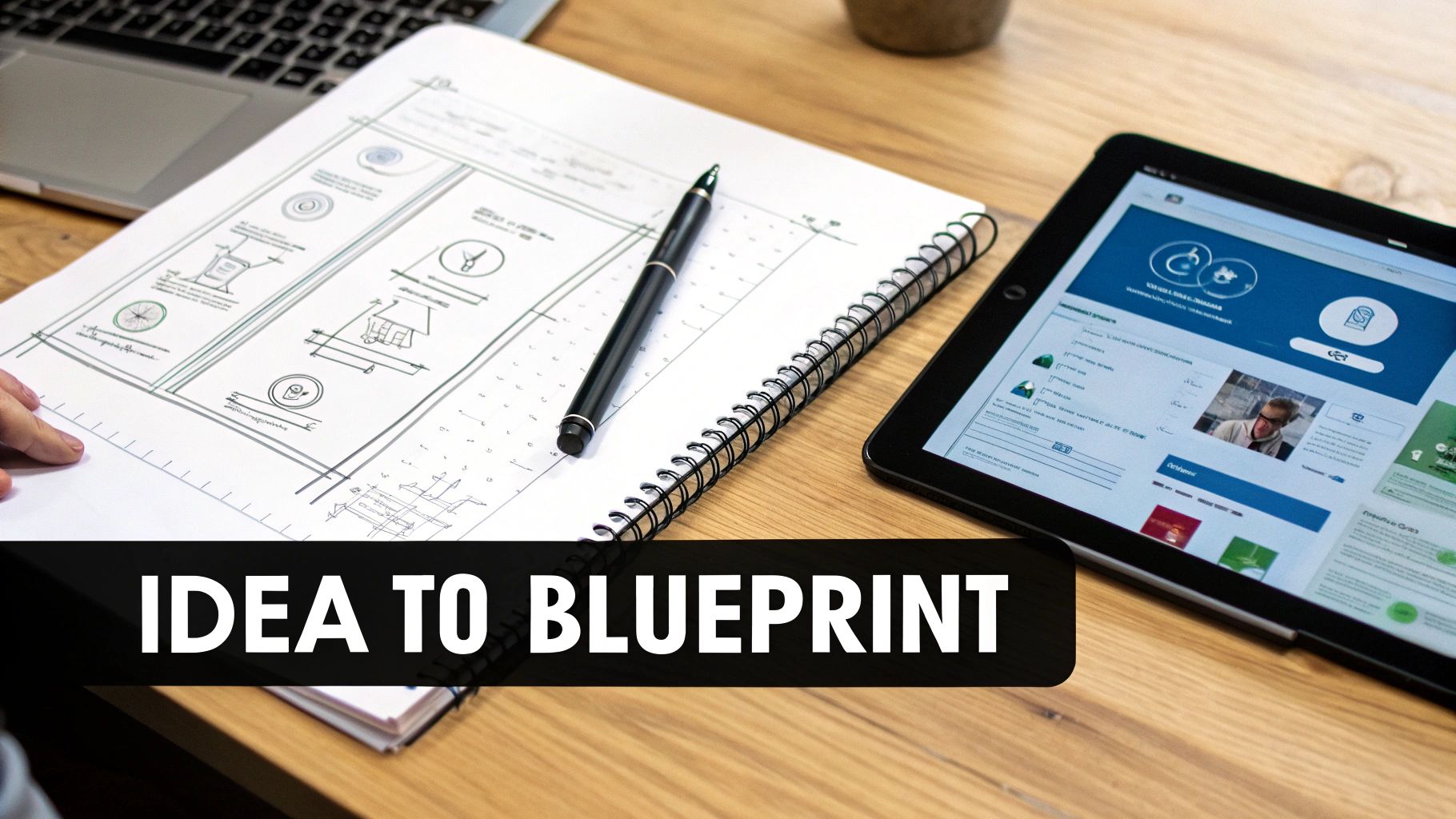
First things first, you need to get your hands dirty with market research. Who are you actually building this for? Creating detailed user personas—fictional, but realistic, profiles of your ideal customers—is an incredibly powerful exercise. It forces you to think beyond basic demographics and get into their heads: what are their motivations, their biggest frustrations, and their ultimate goals?
Once you have a crystal-clear picture of your audience, you can nail down your unique value proposition. What specific problem does your app solve for these people, and how does it do it better than any other solution out there? This single, clear statement will become your north star throughout the entire mobile phone apps development journey.
Defining Success and Pinpointing Your Target
Setting clear, measurable objectives is non-negotiable. Vague goals like “increase engagement” just don’t cut it. You need specific Key Performance Indicators (KPIs) to track your progress and know exactly what success looks like for your project.
These KPIs might look something like this:
- User Acquisition: Aiming for a concrete number of downloads in the first quarter.
- Retention Rate: Targeting a 20% user retention rate after the first 30 days.
- Conversion Rate: For an e-commerce app, this could be the percentage of users who add an item to their cart and complete a purchase.
Practical Case: A Sydney-based fashion retailer planning a Shopify implementation for its new app would set a primary KPI of a 5% in-app conversion rate. Their strategy would involve mapping the user journey meticulously, from initial app download to final purchase, to identify and remove any friction points that might cause a potential customer to abandon their cart.
Defining your KPIs isn’t just a box-ticking exercise. It’s about creating a scorecard for your project. When you know precisely what you’re measuring, you can make smarter decisions and pivot your strategy when needed.
Choosing Your Development Path
Now for one of the biggest forks in the road: choosing the right platform. Your choice between iOS, Android, or a cross-platform approach will have a massive impact on your budget, timeline, and market reach.
You have to consider the Australian market dynamics. Here in Australia, consumers spend over 90% of their mobile time inside apps, not on web browsers. This mobile-first behaviour is deeply ingrained across both major platforms. Globally, you’re looking at around 2.475 million iOS apps and 2.095 million Android apps, and Aussie users are highly engaged with both ecosystems. In fact, projections show the iOS App Store alone will see 37 billion downloads in Australia by 2025. You can dig deeper into these mobile app usage statistics.
- iOS (Native): This is your best bet for targeting a premium user base with higher spending potential. It generally offers a faster, more streamlined development timeline but a more limited market share.
- Android (Native): Gives you access to a much larger, more diverse global audience. Be prepared, though, as development can be more complex due to the sheer variety of devices out there.
- Cross-Platform (e.g., React Native, Flutter): This is a really cost-effective solution. It allows you to share a single codebase for both platforms, which is ideal for getting a Minimum Viable Product (MVP) out the door or for businesses that need to reach both audiences quickly.
For businesses that rely on integrated systems, like those needing an Odoo implementation Sydney Adelaide, the platform choice also affects how the app will talk to their backend ERP. The goal is always to create a seamless, invisible flow of data between the app and the core business operations. In the same way, a WooCommerce store owner would need to ensure their chosen platform integrates flawlessly with their e-commerce backend.
Ultimately, this blueprinting stage is all about making informed choices. When you combine thorough market research with clear objectives and a strategic platform decision, you lay the groundwork for an app that doesn’t just launch—it thrives. An expert team at a software development Sydney Adelaide firm can be an invaluable partner to guide you through this critical planning phase.
Ready to turn your vision into a detailed blueprint? Get in touch with Wistec today for a strategic consultation.
Bringing Your App to Life: Design and Development
With a solid strategy in place, we can now get to the exciting part: actually building the thing. This is where your app idea starts to feel real, moving from concepts on a whiteboard to a tangible experience people can see and touch. A brilliant idea is a great start, but it’s the design and feel that will make people fall in love with your app and keep coming back.
We don’t jump straight into code, though. First, we need a blueprint. This starts with wireframes – simple, black-and-white layouts that act as the app’s skeleton. Think of them like an architect’s floor plan. They’re not meant to be pretty; their job is to map out where everything goes—buttons, images, text—and to make sure the user can navigate from A to B without getting lost.
Once the structure feels right, we create high-fidelity prototypes. These are interactive mockups that look and feel almost exactly like the finished product. This step is absolutely crucial in modern mobile phone apps development. It lets you test drive the entire user experience (UX) and user interface (UI) before committing to code, saving a massive amount of time and money down the track.
The Build: From Mockup to A Working App
With the prototype approved and polished, the real build begins. One of the first big decisions is how we build it: native or cross-platform. Native apps are developed specifically for one operating system (iOS or Android), which often results in the slickest performance and the most seamless user experience.
On the other hand, cross-platform development lets us build the app once and deploy it on both platforms from a single codebase. It’s an incredibly efficient way to go, especially for businesses that need to get to market quickly and reach the biggest audience possible without blowing the budget.
This is also when we connect the app to your core business systems. An app that works in isolation is a missed opportunity. The real magic happens when it becomes part of a connected digital ecosystem.
Your app shouldn’t just be a shiny new object; it should be a hardworking extension of your business. The aim is to create a seamless flow of information that makes your operations smarter and gives your customers a better experience.
Plugging into Your Business Brain
For an e-commerce brand, this could mean a perfect Shopify implementation or a deep integration with WooCommerce. Your app has to sync everything—inventory, orders, customer accounts—with your online store in real time. If a customer adds a product to their cart in the app, it needs to show up in their cart on your website. That kind of consistency is just expected these days.
For businesses with more complex needs, a powerful Odoo implementation Sydney Adelaide is often the answer. By plugging your app directly into an Enterprise Resource Planning (ERP) system like Odoo, you can automate everything from your supply chain and inventory to customer relationships (CRM) and financials.
Practical Case: Manufacturing Made Easy
We worked with a manufacturing client in Adelaide who needed a mobile app for supervisors on the factory floor. They wanted a way to track production and manage stock without being tied to a desk.
- The Problem: Their old process relied on people manually typing data into a desktop ERP system, which was slow and prone to errors.
- The Solution: We built a cross-platform app that talked directly to their Odoo ERP. Supervisors could now use tablets to scan barcodes, instantly updating inventory levels and logging production milestones on the spot.
- The Result: Real-time data completely wiped out manual errors, cut production delays by 15%, and gave the management team a live, accurate picture of what was happening on the floor. It’s a perfect illustration of how a smart Odoo implementation Sydney Adelaide can completely change how a business operates.
Building Smarter with Agile
Trying to manage a project with so many moving parts requires a flexible approach. That’s why agile methodologies have become the gold standard for any serious software development Sydney and right across Australia.
Instead of following a rigid, step-by-step plan from start to finish, agile breaks the project down into short, manageable cycles called “sprints.” At the end of each sprint, we deliver a small, working piece of the app. This allows for constant feedback and testing, making sure the final product is exactly what your business and your users need.
This iterative rhythm is priceless. It gives you regular chances to see the progress, make tweaks, and ensure the project stays on track and on budget. Building an exceptional app is a journey of constant refinement, and agile gives us the map to get there successfully.
Ready to see your app design become a functional, fully integrated, and unforgettable experience? Connect with the Wistec team and let’s talk about how our agile process can bring your vision to life.
Choosing The Right Tech To Build Your App
Picking the right technology for your app is one of those foundational decisions that can make or break your project down the track. It’s not just about what works right now; it’s about setting your app up for future growth, making it scalable, and ensuring it doesn’t become a dinosaur in a year. Think of it as laying the foundations for a house – you want them to be solid enough to support whatever you decide to build on top later.
The first big piece of the puzzle is the frontend framework. This is everything your user sees, touches, and interacts with. Get this wrong, and you’re left with a clunky, slow experience that nobody wants to use. Get it right, and you’ve got the engine for a slick, responsive app that people will love.
This decision tree gives you a good visual on the initial path you’ll need to take.
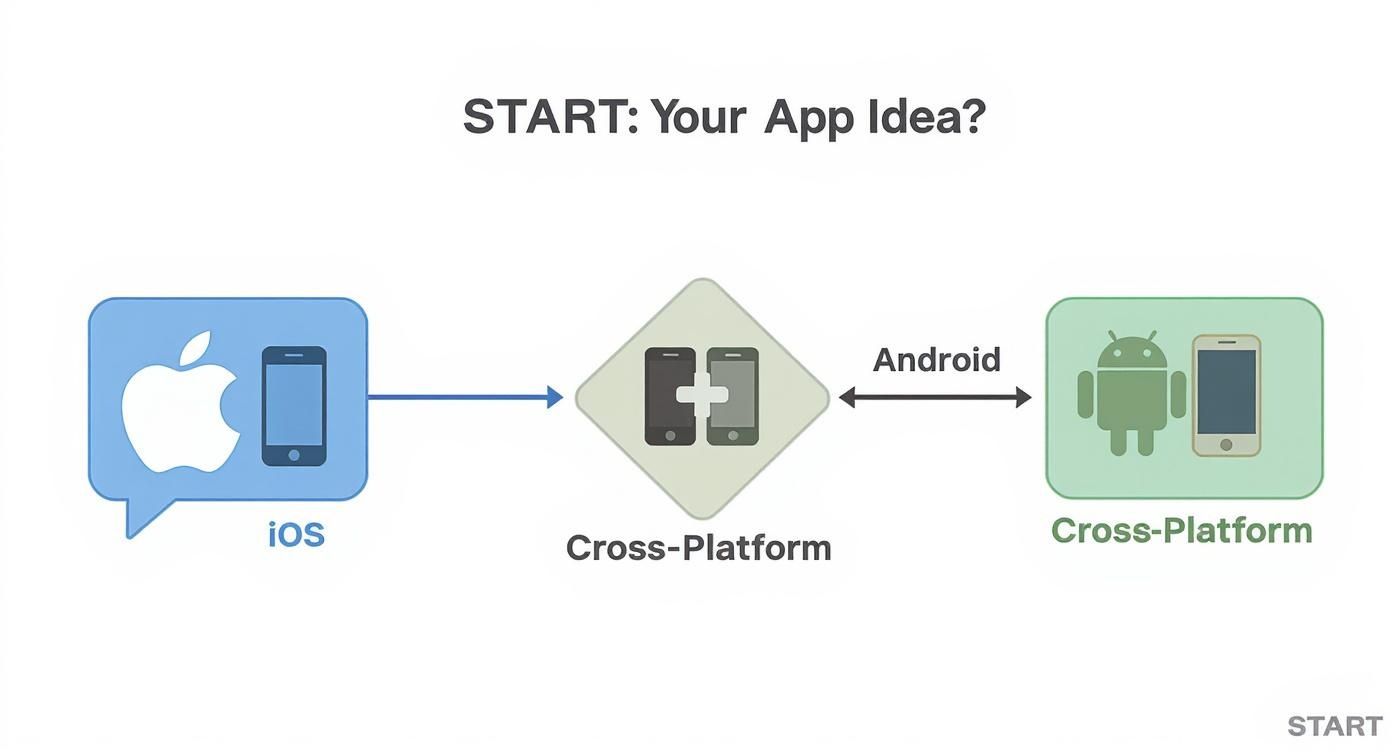
As you can see, whether you start by focusing purely on iOS or Android, the road often leads to cross-platform development. It’s simply a more efficient way to reach the widest audience.
The Frameworks Powering Today’s Best Apps
Here in Australia, the tech scene has a few clear favourites, and for good reason. When it comes to the frontend, you’ll hear developers talking a lot about React and Next.js. For building apps that work seamlessly across both Apple and Android devices, Flutter is an absolute powerhouse.
- React and Next.js are brilliant for building complex, yet easy-to-manage, user interfaces. Their component-based approach means you can build things like Lego, piecing together a sophisticated app without it turning into a tangled mess.
- Flutter is the go-to for efficiency. It lets you write the code once and deploy it as a native-feeling app on mobile, web, and even desktop. This can seriously cut down your development time and budget.
Ultimately, the choice comes down to what you’re trying to achieve. Are you building an e-commerce store that needs a slick Shopify implementation? Or maybe a custom business tool that needs to talk to a unique backend? The right framework depends entirely on the job at hand.
The smartest tech stack isn’t just about what’s trendy today. It’s about choosing tools that will still be strong in two, three, or even five years. That means looking for technologies with big, active communities, clear plans for the future, and the flexibility to play nice with whatever new tech comes along.
To help you get a clearer picture of the landscape, I’ve put together a quick comparison of the top choices right now.
Modern App Development Technology Choices
This table breaks down some of the most popular frameworks and technologies, giving you a snapshot of what they’re best at and why they’re a good fit for the Australian market.
| Technology/Framework | Primary Use Case | Key Advantage in Australian Market |
|---|---|---|
| React | Dynamic, interactive user interfaces for web & mobile | Huge local talent pool and strong community support. Excellent for data-heavy, single-page applications. |
| Next.js | Server-side rendered (SSR) React applications | Delivers exceptional SEO performance and faster initial page loads, crucial for customer-facing sites. |
| Flutter | Cross-platform mobile, web, and desktop apps | “Code once, run anywhere” significantly reduces cost and time-to-market for reaching both iOS/Android users. |
| Swift | Native iOS and macOS applications | Offers the best possible performance and deepest integration with Apple’s hardware and software ecosystem. |
| Kotlin | Native Android applications | Google’s preferred language for Android; provides modern features and safety for robust app development. |
Each of these has its place. Your job, or the job of the team you hire, is to match the right tool to your specific project goals.
Don’t Ignore AI and 5G
These days, a great app often needs more than just a slick interface. Two game-changers are already here: Artificial Intelligence (AI) and 5G. They’re not just buzzwords; they’re the tools we’re using to create genuinely smart and powerful experiences for users.
The numbers coming out of the Australian market speak for themselves. Frameworks like React and Next.js have hit an 85% adoption rate among local developers. But what’s really interesting is that AI and machine learning integration is already at 55% and growing by an incredible 45% each year. This boom is being fuelled by Australia’s expanding 5G network, which makes it possible to build apps that need lightning-fast speeds and near-instant response times. You can dig deeper into these Australian mobile app development trends to see where things are headed.
So, what does this look like in the real world? Imagine a retail app built on WooCommerce. With AI, it could use predictive analytics to show customers products they’ll genuinely want to buy. Or think of a logistics company with an Odoo implementation Sydney Adelaide; a 5G-powered app could provide hyper-accurate, real-time tracking of its entire fleet. These features aren’t novelties anymore—they’re what give you a serious edge over the competition.
Making the Final Call
Choosing your tech stack isn’t something you do on a whim. It needs a solid understanding of your business goals, who you’re building this for, and what you want the app to become in the future.
This is where talking to a seasoned software development Sydney Adelaide team can be invaluable. A good partner will help you weigh up the pros and cons of each option, ensuring the architecture of your app is solid, secure, and ready for what’s next.
Getting these choices right from the start means you’re not just building an app for today. You’re engineering it for the challenges and opportunities of tomorrow.
Taking Your App From Launch to Legend
Getting your app built is a huge achievement, but let’s be honest—that’s where the real game begins. The decisions you make from this point forward are what separate a flash in the pan from a genuine success story. A well-orchestrated launch and a smart growth plan are the final, critical pieces of the puzzle in mobile phone apps development.

Before your app gets anywhere near the public, it needs to survive a trial by fire: rigorous testing. This is about so much more than squashing a few bugs. We’re talking about polishing every interaction, shoring up security, and making sure the entire experience is seamless. A single glitch can be fatal—after all, a staggering 88% of users will ditch an app for good if they run into problems.
This stage involves layers of quality assurance. We put the app through its paces with usability testing, where real people try to accomplish tasks. We push it to its breaking point with performance testing. And if you’re handling sensitive data or connecting to systems like a Shopify implementation or WooCommerce, then robust security testing isn’t just a good idea, it’s non-negotiable.
Getting Ready for the App Stores
With a polished, bug-free app in hand, the next hurdle is getting it approved and listed on the Apple App Store and Google Play. This isn’t just a technical upload; it’s your first major marketing campaign, known as App Store Optimisation (ASO).
Think of ASO as SEO for the app world. It’s all about making your app easy for the right people to find. This means you need to get inside your customers’ heads.
- Nail your keywords: What words would they actually type into the search bar to solve the problem your app addresses?
- Write a killer title and description: They need to be sharp, persuasive, and crystal clear about what your app does and why it’s a must-have.
- Create stunning visuals: Your app icon and screenshots are your shop window. They need to grab attention instantly and communicate your app’s value in a split second.
Getting your ASO right from the get-go is the key to driving organic downloads and keeping your marketing budget in check down the line.
So many founders pour all their energy into the build and just flick a switch for the launch. The truth is, your launch strategy needs to be developed right alongside the app itself. A brilliant product with a botched launch will almost always fail to find its audience.
The Real Work Starts After You Go Live
Okay, you’ve launched. Pop the champagne, but don’t get too comfortable. Now the real hustle of growing your user base and creating a sustainable product truly begins. The post-launch phase is a constant loop: listen, learn, and iterate.
Your top priority should be collecting user feedback. Actively ask for reviews, send out surveys, and keep a close eye on social media chatter. This feedback is absolute gold. It gives you a direct line into what users love, what frustrates them, and what they wish your app could do next.
This user intelligence should directly fuel your update schedule. Pushing out regular updates, even small ones, shows your community that you’re listening and committed to making the experience better. These can be anything from minor bug fixes to major new features that deliver even more value.
A Practical Case of Scaling Smart
Let’s look at a growing Sydney-based retailer. They launched an e-commerce app linked to their WooCommerce website, and it took off, driving a 30% increase in mobile sales. Fantastic, right? But behind the scenes, a storm was brewing. Manually trying to sync inventory between the app, the website, and their physical warehouse was quickly becoming a logistical nightmare.
The solution wasn’t just another app feature; it was a deeper, more robust integration. By bringing in a full Odoo implementation Sydney, they were able to connect their entire operation.
- The Result: Inventory management became completely automated, syncing in real-time across every single sales channel.
- The Impact: This wiped out the risk of overselling, dramatically streamlined their fulfilment process, and let their team focus on helping customers instead of wrestling with spreadsheets.
- The Lesson: This story perfectly illustrates how scaling an app often means you have to scale the backend systems that power it. Expert software development Sydney transformed their successful app into an indispensable, fully integrated business machine.
Grow Your App with a Partner You Can Trust
Juggling the launch, gathering user feedback, crunching the numbers, and planning the next big feature is a lot to handle. Partnering with an experienced software development Adelaide or Sydney firm gives you the strategic insight and technical firepower you need to not only launch successfully but to ensure your app thrives in a crowded marketplace.
Ready to map out a winning launch and build a roadmap for your app’s long-term success? Reach out to the Wistec team today, and let’s make sure your app realises its full potential.
Got App Development Questions? We’ve Got Answers
So you’ve got a plan, but diving into the world of mobile phone apps development can still feel a bit daunting. It’s completely natural for questions to bubble up, and honestly, we’ve heard them all before. Let’s tackle some of the most common ones we get from businesses just like yours, so you can move forward with total confidence.
How Long Does It Really Take to Build an App?
Ah, the million-dollar question! It’s a bit like asking “how long is a piece of string?”, but we can definitely give you a realistic ballpark.
For a straightforward app with a focused set of features—what we call a Minimum Viable Product (MVP)—you’re generally looking at a 3 to 6-month timeframe from a blank canvas to launch day. This is for something solid, functional, and ready for your first users.
If your vision is more ambitious, the timeline naturally stretches. Think about apps that need to talk to complex backend systems. For instance, connecting to a bustling WooCommerce store with thousands of products or integrating with a sophisticated Odoo implementation Sydney Adelaide requires more heavy lifting. For these kinds of projects, it’s wise to plan for 9 months or even longer. The golden rule here? Good things take time. Rushing is a surefire recipe for a glitchy app that nobody wants to use.
What Is the Biggest Hidden Cost in App Development?
Hands down, the most overlooked expense is ongoing maintenance. It’s so easy to pour your entire budget into the initial build, but an app isn’t a “set and forget” project. It’s a living, breathing thing.
A lot of people see the launch day as the finish line. It’s not. It’s the starting line. You absolutely must factor in costs for regular updates, security patches, server hosting, and future feature upgrades to keep your app running smoothly and securely.
Forgetting to budget for this post-launch life can turn your exciting new app into a real financial headache down the track.
Do I Need Separate Apps for iOS and Android?
Not always! Building two separate ‘native’ apps gives you the peak of performance and platform-specific polish, but it’s also the priciest and most time-intensive path. Honestly, it’s overkill for many businesses.
A much savvier approach for most is to go cross-platform with frameworks like Flutter or React Native. This means a talented software development Sydney Adelaide team can build one codebase that works beautifully on both the Apple App Store and Google Play. It’s a game-changer for efficiency, letting you capture the whole market without blowing the budget. We see this work brilliantly for everything from retail apps with a Shopify implementation to custom internal tools.
How Do I Protect My App Idea?
This is a smart question to ask. Your idea is valuable, and you should protect it. The first practical step is a Non-Disclosure Agreement (NDA). Before you dive into the nitty-gritty with any developer or agency, get them to sign an NDA. It’s a simple legal document that ensures your conversation stays confidential.
Then, when you’re ready to kick off the project, make sure your contract explicitly states that you—and only you—own 100% of the intellectual property and source code. No ambiguity, no grey areas.
At Wistec, our job is to make technology your competitive advantage. Whether you’re ready to start mapping out your app or just have a few more things you’d like to clear up, we’re here to help.