

Every great mobile development app starts not with code, but with a crystal-clear vision. It's about taking that brilliant spark of an idea and forging it into a solid, strategic plan. This first stage is everything; get it right, and you've built a foundation for long-term success.
From Vision to Viable App Concept
Before a developer even thinks about writing code, your app needs to exist as a solution to a real problem. Think of it like drawing up the architectural blueprints for a skyscraper. You wouldn't start pouring concrete without a plan, and the same goes for app development. This is where you make sure your idea actually has a place in the market and a genuine purpose for its users.
This foundational work is even more critical in competitive local markets. An app designed for users in Sydney or Adelaide, for example, has to speak directly to their specific needs and habits. It means ditching assumptions and digging into real data to prove your concept has legs.
Defining Your Core Value Proposition
Your value proposition is the promise you make to every single user. It boils down to one simple question: "Why should someone download my app instead of the dozen others out there?" A powerful value proposition is sharp, to the point, and focuses on a real, tangible benefit.
To nail yours, you need to:
- Identify a Specific Problem: What’s the precise pain point your audience is dealing with? Is it clunky inventory management, a frustrating customer experience, or a gap in local service access?
- Offer a Unique Solution: How does your app solve that problem better than anyone else? Maybe it’s through a ridiculously simple interface, a killer feature no one else has, or flawless integration with existing tools.
- Communicate the Benefit: Spell out the main advantage. A practical case: an app we build that links to an Odoo implementation in Sydney could promise to slash admin time by 50%. That’s a benefit people understand immediately.
A great app isn’t about cramming in a million features. It’s about doing one thing exceptionally well. Simplicity and focus are your best friends at this stage.
Setting the Stage with Market Research
Solid market research is your reality check. It’s what stops you from pouring time and money into an app that nobody actually wants. This is especially true here in Australia, where user behaviour is overwhelmingly mobile-first. In fact, mobile devices now drive 59.27% of all web traffic in the country, which shows just how big the opportunity is for apps that are planned properly. You can get a broader view of global mobile app trends on Wikipedia.
When you dive into your research, zero in on the local landscape. Our experience with software development in Sydney and Adelaide has taught us that what resonates in one city might completely miss the mark in another. This initial homework, paired with a sharp value proposition, is what sets the stage for a mobile app that truly connects with people.
Ready to turn your app vision into a detailed plan? Contact our experts to explore how strategic planning can lead to a successful launch.
2. Choosing Your Development Pathway: Native vs. Hybrid
With your big idea mapped out, it’s time to tackle one of the most important decisions you'll make: how your app will actually be built. This isn't just a technical detail; it’s a choice that shapes everything from your budget and timeline to how your app feels in your customers' hands.
Think of it less as picking the "best" technology and more about choosing the right tool for the job.
The Native App Approach: Built for Performance
A native app is like a bespoke suit, tailored perfectly for one specific environment—either Apple's iOS or Google's Android. It’s written in the platform’s mother tongue (like Swift for iOS or Kotlin for Android), which gives it direct, unfiltered access to every feature on the device, from the camera to the GPS. The result? Unbeatable speed and a buttery-smooth user experience.
This means you’re essentially building two separate apps, one for the Apple App Store and another for Google Play. The performance is second to none, and the app will look and feel exactly as users expect it to on their device, following all the familiar design cues.
Of course, this premium approach often means a bigger investment. You'll need developers who specialise in each platform. For businesses looking for a truly robust software development Sydney solution where performance is king and deep hardware integration is a must, native is almost always the way to go.
The Hybrid App Approach: The Best of Both Worlds
A hybrid app, on the other hand, is more like a versatile, multi-tool. Using clever frameworks like React Native or Flutter, your team can write the code once and deploy it across both iOS and Android. It’s a game-changer for getting to market fast.
The biggest win here is efficiency. One codebase means a faster development cycle and, often, a more manageable budget. This makes it an incredible option for startups or businesses needing to make a splash quickly. The trade-off? While modern hybrid apps are incredibly powerful, they might not always achieve that pixel-perfect, lightning-fast feel of a true native app.
The choice between native and hybrid isn't just technical, it's a core business strategy. You're balancing the demand for flawless performance against the need for speed and budget efficiency.
For instance, a retailer launching a Shopify implementation could use a hybrid app to get a beautiful mobile shop into the hands of both iPhone and Android users at the same time. But a logistics company whose app relies on constant, real-time GPS tracking might find that only a native build offers the rock-solid reliability they need.
It’s the same for a business rolling out an Odoo implementation Sydney Adelaide clients depend on. A practical case: an internal app for field staff in Adelaide needs to be bulletproof, making native the obvious choice. A customer-facing rewards app, however, could be a perfect candidate for the speed and cost-effectiveness of a hybrid build.
To make this choice clearer, let's break down the key differences side-by-side.
Native vs Hybrid App Development At a Glance
Here’s a direct comparison of the key factors you’ll need to weigh up when deciding which path is right for you.
| Factor | Native App (iOS/Android) | Hybrid App (React Native, Flutter) |
|---|---|---|
| Performance | Excellent. Unmatched speed and responsiveness. | Good to Great. Fast, but can have limitations with complex tasks. |
| User Experience (UX) | Seamless. Looks and feels exactly like the device's native OS. | Consistent. A uniform look across platforms, but may not feel 100% native. |
| Development Cost | Higher. Requires separate teams and codebases for iOS and Android. | Lower. One codebase means less development time and fewer resources. |
| Time to Market | Slower. Building two separate apps takes more time. | Faster. Develop once, deploy everywhere. Ideal for quick launches. |
| Access to Device Features | Full Access. Direct, immediate access to all hardware and APIs. | Good Access. Most features are accessible via plugins, but can have delays. |
| Maintenance | More Complex. Two codebases to update and manage. | Simpler. Updates are pushed to a single codebase, saving time. |
Ultimately, there's no single right answer. The best approach is the one that perfectly aligns with your app's purpose, your budget, and your long-term business goals.
Ready to figure out which development pathway makes the most sense for your project? Let's connect and map out your strategy to get you started on the right foot.
The Blueprint for Building Your App
A brilliant app is far more than just slick code; it's the result of a deliberate, well-executed plan that takes a great idea and makes it real. This is the blueprint stage, where we bridge the gap between creative design and solid engineering. The goal is to build an experience so intuitive that users feel like they've used it a thousand times before, all while resting on a technical foundation that’s built to last.
This process really boils down to two critical, interconnected parts: what the user sees and touches (the front-end) and the heavy-lifting engine humming away in the background (the back-end). Nail both, and you’ve got an app that not only works perfectly but also keeps your customers coming back.
This diagram gives you a bird's-eye view of the different paths your app could take, from a dedicated native build to a more flexible hybrid or web app solution.
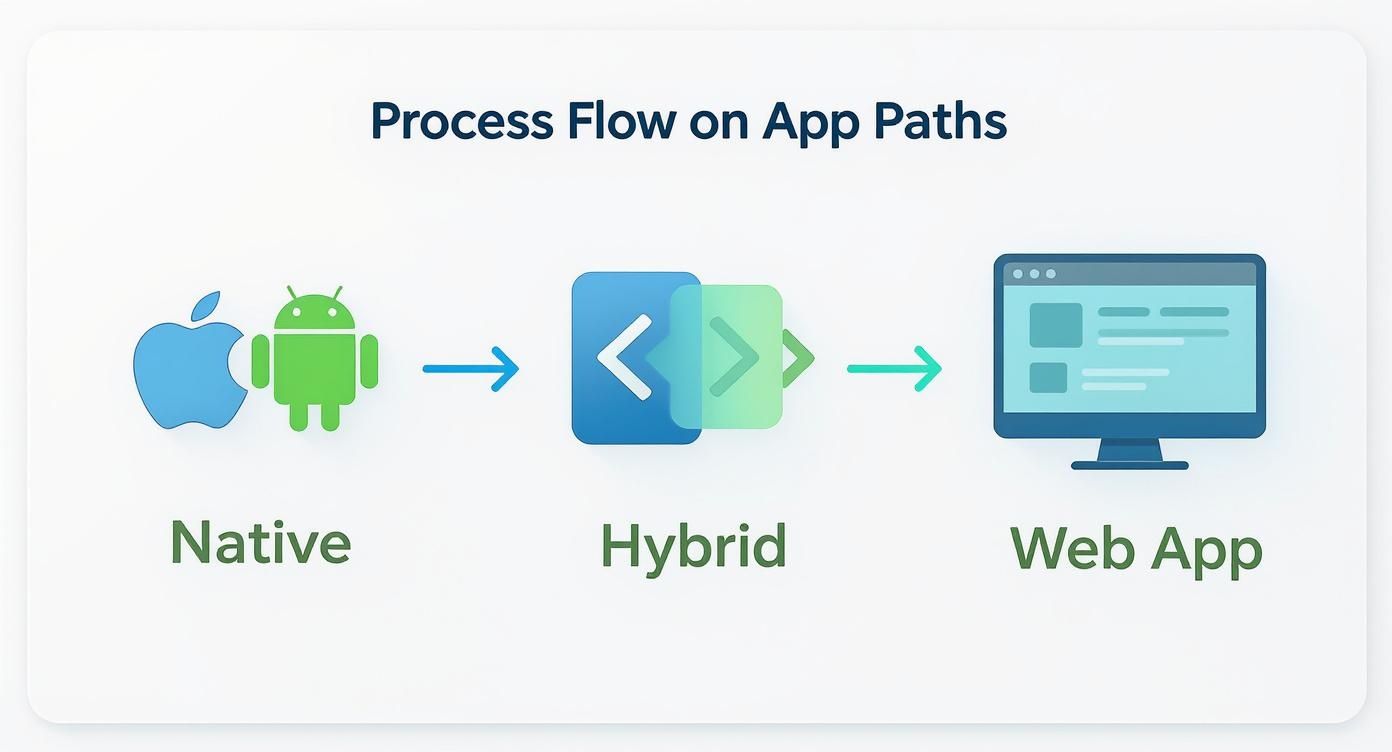
As you can see, while the app might look similar on the surface, the technology powering it is fundamentally different depending on the path you choose. This decision has a huge impact on performance, budget, and how quickly you can get to market.
Designing an Unforgettable User Experience
Before a single line of code is written, everything has to start with the user. We’re talking about User Interface (UI) and User Experience (UX) design.
Think of it like this: UI is the visual flair of a car—the paint colour, the sleek body, the layout of the dashboard. But UX is the feel of the drive. Is the steering tight and responsive? Are the controls within easy reach? Is it a smooth ride?
An app can be gorgeous, but if it's a nightmare to navigate, people will simply delete it. In fact, a staggering 88% of users say they won't return to an app after a bad experience. That’s why our approach to software development Sydney Adelaide is always user-first. We meticulously map out every screen, button, and tap to create a natural flow that gets users where they need to go, without any friction.
A strong UX/UI foundation is what separates a merely functional app from one that people genuinely love to use.
Building the Core: Front-End and Back-End
Once we've locked in the design blueprint, it’s time for the engineers to step in and turn those static designs into a living, breathing application.
- Front-End Development: This is everything the user sees and interacts with. It’s about bringing the UI to life, making sure buttons feel right, animations are buttery smooth, and the app looks pixel-perfect on every single device. It's the visible, tangible part of the iceberg.
- Back-End Development: This is the powerful, unseen engine room. The back-end is where you find the server, the database, and the core application logic that crunches data, manages user accounts, and keeps everything running securely and efficiently. It’s what makes all the front-end magic possible.
A beautifully designed app with a weak back-end is like a supercar with a lawnmower engine. It might look the part, but it won’t get you very far. The two have to work in perfect harmony.
For example, when we build an e-commerce app that needs a WooCommerce integration, the front-end is what beautifully displays your product catalogue. At the same time, the back-end is securely processing payments, updating your stock levels in real-time, and managing customer orders without skipping a beat.
Creating a Unified Business Ecosystem
In today's world, a mobile app rarely works in isolation. Its real power is unleashed when it’s plugged directly into your core business systems, creating a unified ecosystem where data flows freely. This automates workflows and unlocks incredible value.
Just think about these real-world scenarios:
- Odoo Implementation: A practical case: a field service company in Adelaide using a mobile app connected to their Odoo implementation Sydney system. Technicians on-site can update job statuses, log the parts they've used, and generate invoices right from their phones. All that information instantly syncs back to head office. No more paperwork.
- Shopify Implementation: For a retailer, integrating their app with a Shopify implementation creates a seamless shopping journey. A customer might browse on the app, add items to their cart, and then decide to check out later on their laptop—with their loyalty points and order history perfectly synced across both.
This kind of deep integration elevates your mobile app from a simple tool into a central, indispensable hub for your entire business.
By following this blueprint—starting with a user-obsessed design, building a rock-solid technical architecture, and ensuring seamless integration—you create more than just an app. You build a powerful asset that drives real efficiency and growth for your business.
Ready to build an app that works as hard as you do? Contact our team about creating a powerful mobile solution that integrates with your core systems.
How Real Businesses Win with Mobile Apps
Theory is great, but let's talk results. The true measure of any mobile app is the real, tangible value it brings to a business. It’s about moving past the blueprints and code to see a genuine impact on your bottom line. A well-crafted mobile development app isn't just another piece of tech; it becomes a powerful engine for growth, solving everyday problems and opening up new ways to connect with customers.
To give you a clearer picture of what this looks like, let's dive into a couple of real-world stories from businesses that completely changed their game with a strategic app. These aren't just abstract ideas—they're concrete examples of problems solved and goals smashed.
Case Study: Sydney Retailer Boosts Sales with Shopify Integration
A popular Sydney-based fashion retailer had a classic problem. Their physical stores were buzzing and their website was doing well, but they were finding it tough to build real loyalty with their online shoppers. They needed a more direct, personal way to keep their best customers coming back.
Our solution? A sleek, beautiful mobile app that integrated seamlessly with their existing Shopify implementation. This wasn't just a copy of their website. We designed it to be a curated, VIP experience for their most dedicated fans.
We focused on a few core features:
- Exclusive App-Only Offers: Users got first dibs on sales and special discounts they couldn't find anywhere else.
- Personalised Push Notifications: We used their purchase history to send smart alerts about new arrivals from brands they loved.
- Streamlined Checkout: The app saved user details for a quick, one-tap purchase, eliminating the friction that so often kills a sale.
The results were incredible. In just six months, the retailer saw a 40% increase in repeat customer sales coming directly through the app. It quickly became their most powerful tool for building loyalty and turning one-time buyers into lifelong brand advocates. It just goes to show what the right software development in Sydney can achieve.
True success in mobile development isn’t about just building an app. It's about building a direct, valuable connection with your customers that lives right in their pocket.
Case Study: Adelaide Service Company Transforms Field Operations
An industrial maintenance company in Adelaide was practically drowning in paperwork. Their field technicians were juggling paper forms, messy job sheets, and endless phone calls back to the office to give updates. This old-school process was causing delays, data entry mistakes, and a mountain of administrative work.
They needed a digital fix that could connect their team in the field with the central office in real-time. We engineered a custom mobile app that acted as a digital toolkit for every technician, powered by a robust back-end tied into their Odoo implementation Sydney Adelaide ERP system.
The app completely overhauled their workflow:
- Job assignments popped up directly on their devices.
- Client history, equipment manuals, and parts inventories were all accessible on-site.
- Job completion reports, client signatures, and invoicing were all handled right there in the app.
The impact was immediate and massive. The company cut its paperwork by a staggering 90% and drastically reduced admin time. This mobile app didn't just save them money; it gave their technicians the tools they needed to provide faster, more accurate service.
The Australian mobile app market is buzzing with activity. Right now, there are 2,574 Australian mobile app developers publishing over 7,800 apps, which shows just how competitive and opportunity-rich this space is. You can discover more insights about the Australian app market to see for yourself.
These examples make it clear: a mobile app is so much more than a marketing gimmick. Whether it’s driving sales with a clever WooCommerce integration or fixing operational headaches, a thoughtfully developed app delivers a clear and powerful return on investment.
Ready to see how a custom mobile app could solve your biggest business challenges? Contact Wistec today for a consultation and let's start writing your success story.
Getting Your App Live and Keeping It There
So, your app is built. It’s tempting to think the hard work is over, but launch day is really just the beginning. This is the moment your polished creation steps out into the real world, and its long-term success depends entirely on what happens next.
Many see the launch as the finish line, but that's a mistake. A truly winning app strategy understands that the post-launch phase—testing, launching, and maintaining—is where the real value is built.
The Final Polish: Quality Assurance and Testing
Before a single user gets their hands on your app, it needs to be put through its paces. Think of it like a final, exhaustive dress rehearsal. This is the Quality Assurance (QA) phase, where we try to break things so your users don't have to. Every button, every screen, and every function is tested across a range of devices and network conditions to hunt down and fix any lingering bugs.
It’s a non-negotiable step. One small, frustrating glitch is often all it takes for someone to hit that uninstall button and never look back.
Our approach to software development Sydney Adelaide is built on a rock-solid, multi-layered testing process:
- Functional Testing: We check that every feature does precisely what it’s supposed to do, without any surprises.
- Usability Testing: Is the app actually easy to use? We put it in front of real people to ensure the experience feels natural and intuitive from the get-go.
- Performance Testing: How does it hold up under pressure? We test it on slow connections, with low battery, and under heavy use to make sure it stays fast and responsive.
- Security Testing: In a world of digital threats, we make sure your user data and business information are locked down tight.
This painstaking process is all about making sure that first impression is a great one. When a user opens your app for the first time, it should just work.
Navigating the App Store Maze
Getting your app listed on the Apple App Store and Google Play isn't as simple as just uploading it. Both platforms have their own rulebooks, with strict guidelines covering everything from user privacy to design consistency. Getting through the review process requires careful planning and a deep understanding of what they’re looking for.
But just getting listed isn’t enough. You need people to actually find your app. This is where App Store Optimisation (ASO) comes in. It’s the art and science of making your app’s store page as visible and appealing as possible, using powerful descriptions, smart keywords, and eye-catching screenshots to draw people in.
A successful launch isn’t just about being available; it's about being discoverable. Your app store listing is your digital storefront—it has to convince people to step inside.
For instance, if your app is a companion to your Shopify implementation, we'd target keywords like "fashion deals" or "easy checkout" to connect with shoppers. Likewise, an app for a WooCommerce site needs to speak directly to what its customers are searching for.
The Long Game: Proactive Maintenance
An app is never really ‘finished’. It’s a living piece of software that needs constant care and attention to stay relevant and reliable. Proactive maintenance is about much more than just fixing bugs when they pop up; it’s a continuous cycle of monitoring, updating, and improving.
A solid maintenance plan always includes:
- Performance Monitoring: Keeping a close eye on app speed, stability, and crash reports to catch problems before they impact your users.
- Regular Security Updates: Staying one step ahead of new threats by patching vulnerabilities and keeping user data secure.
- OS Compatibility: Making sure your app runs perfectly on the latest versions of iOS and Android as they’re released.
- Feature Enhancements: Listening to user feedback and diving into the data to plan and roll out new features that keep people coming back.
Whether it’s an internal business tool built around an Odoo implementation Sydney Adelaide company depends on, or a public-facing retail app, this ongoing commitment is what separates a good app from a truly great one.
Ready to ensure your app has the support it needs to thrive long after launch? Contact Wistec today to discuss our comprehensive development and maintenance plans.
Turning Your App into a Revenue Engine
Let's be blunt: a great mobile app should make you money, not just cost you money. You’ve built something technically impressive, but now it's time to turn that achievement into a genuine business asset. This is where a smart commercial playbook comes in, blending a solid monetisation strategy with clever tactics to grow your user base and, more importantly, keep them coming back.
The opportunity in Australia alone is massive. The local mobile app market is on track to hit $2.8 billion in revenue, growing at a steady clip of 6.74% each year. This isn't just a fleeting trend; it’s being driven by more and more Aussies using smartphones for everything. You can dive deeper into the numbers on Statista's analysis of Australia's app economy.
Finding the Right Way to Make Money
Choosing how your app will generate revenue is one of the most critical decisions you'll make. There's no magic bullet here. The right model depends entirely on what your app does and what your users expect. What works brilliantly for a mobile game could be a complete disaster for a B2B productivity tool.
Here are the most common paths people take:
- In-App Purchases (IAP): Perfect for selling digital goodies. Think extra lives in a game, special filters in a photo app, or premium content. A practical case: this model is a natural fit for a WooCommerce integrated app where users can buy virtual items or unlock new features on the fly.
- Subscription Model: This is all about creating recurring revenue. Users pay a regular fee (monthly or yearly) for ongoing access to your app's content or services. It’s the go-to model for media platforms, fitness trackers, or enterprise tools, especially if you're running something like an Odoo implementation Sydney Adelaide.
- Advertising: You can make money by showing banner ads, videos, or native ads that blend into the app's content. This can be a goldmine for free apps with a huge audience, but you have to walk a fine line. Annoy your users with too many intrusive ads, and they'll be gone in a flash.
- Freemium: This is a classic for a reason. You offer a basic, free version of the app to attract as many people as possible, then offer a paid upgrade for those who want more powerful features. It’s a hugely popular strategy in software development Sydney Adelaide, particularly for SaaS products.
The best monetisation strategy never feels like a cash grab. It should feel like a natural extension of the app, offering genuine value that users are happy to pay for—whether it's unlocking game-changing features or accessing content they can't get anywhere else.
Getting Users and Keeping Them Hooked
Making money is only half the battle. You also need a constant flow of people downloading and using your app. That's where growth and retention come in.
Your first port of call is App Store Optimisation (ASO). Think of it as SEO, but for the Apple App Store and Google Play. By carefully choosing your app’s title, keywords, and description, you can make it much easier for people to find you organically.
But getting the download is just the start. The real secret to a successful mobile development app is retention. Honestly, it’s far cheaper and easier to keep a user you already have than to find a new one. This is where things like push notifications come in handy. Used thoughtfully, they can pull users back in with special offers, new content alerts, or helpful reminders. Imagine an app linked to a Shopify implementation sending a notification about a flash sale—that’s a direct path to driving engagement and sales.
Ultimately, a profitable app is built on a simple cycle: attract users, give them incredible value, and then offer a seamless way for them to pay for that value.
Ready to build a mobile app that not only works beautifully but also grows your bottom line? Contact Wistec today, and let's map out a strategy to turn your idea into a profitable reality.
So, You're Ready to Build Your Mobile App?
And there you have it—a complete roadmap for turning your app idea into a reality. We’ve covered everything from that first spark of inspiration to the final launch, showing that the journey requires a careful mix of big-picture strategy and nitty-gritty technical skill. The chance to completely change how you connect with customers and streamline your operations is right in front of you.
This guide has pulled back the curtain on each stage. It proves that a great app isn't just about clever coding; it’s a genuine solution. Think of it as a growth engine for your business, a direct channel to your audience, and a powerful way to work smarter, not harder.
Turning Your Vision into a Tangible Product
We've seen how a solid plan, built on proper research, is the foundation for everything that follows. It doesn't matter if you're building a simple utility app or a massive, complex platform—the fundamentals never change. A truly great app solves a real-world problem, feels effortless to use, and is built on a technical backbone strong enough to grow with you.
Real-world examples make it clear that integration is everything. A fantastic Shopify implementation, for instance, can become even more powerful when paired with a mobile app designed to foster loyalty and drive repeat business. In the same way, an app linked to an Odoo implementation Sydney Adelaide can totally revolutionise how a service-based business manages its day-to-day workflow.
The best mobile apps are never just standalone tools. They’re critical, deeply integrated parts of a broader business strategy, built to deliver tangible results and a serious competitive edge.
What's Your Next Move?
Now is the time to take that first step. Don't let your brilliant concept stay on the drawing board. Whether you’re a Sydney-based business looking for end-to-end software development Sydney Adelaide services or you're in Adelaide needing a specific WooCommerce integration for your new app, having the right team in your corner changes everything. The path from a simple idea to a thriving app is intricate, but you don’t have to walk it alone.
Ready to bring your vision to life? The team at Wistec is here to help you build a powerful mobile app that delivers results. Let's work together to create a solution that drives your business forward. Get in touch with us today!