

Partnering with an external team to build your mobile app isn't just about saving a few dollars anymore. For smart Australian businesses, it's a strategic play to tap into specialised skills, get to market faster, and gain a serious competitive edge. It's about handing over the complex technical heavy lifting to a team of experts so you can focus on what you do best: running your business.
Why Outsourcing App Development is a Strategic Advantage
Let's be honest, building a top-notch in-house development team is a massive undertaking. It’s slow, expensive, and a huge distraction. Outsourcing flips the script. It’s a deliberate choice to focus on your core strengths while a seasoned team handles the intricate process of designing, building, and launching your app. This is how businesses innovate faster and grow more efficiently.
A practical case: imagine a mid-sized logistics firm in Adelaide. Their whole operation is tangled up in manual tracking and clunky communication, leading to frustrating and costly delays. By outsourcing the development of a real-time tracking app that plugs straight into their existing systems, they can unlock huge operational efficiencies. This isn't just a hypothetical; it's a practical roadmap to slashing overheads and delighting customers. This is a common challenge we see solved with expert software development in Adelaide.
Gaining a Competitive Edge Through Expertise
The biggest win with outsourcing? You get instant access to a deep well of talent. We're talking about experienced designers, developers, and project managers who live and breathe this stuff, all without the headaches of recruitment, onboarding, and retention.
This is especially critical when you're dealing with specialised tech. Say your business needs a tricky ERP integration. Finding an in-house developer with that specific skill set is like finding a needle in a haystack. But you can partner with a team that has that deep experience built-in. A great Odoo partner in Sydney or Adelaide, for example, can make sure your new app talks perfectly with your back-office systems—a task that would bring a generalist team to its knees. You're buying proven expertise, not just extra hands.
Outsourcing is less about saving a few dollars and more about investing in a guaranteed outcome. It's about ensuring your project is built right the first time by people who have done it before, minimising risk and maximising your return on investment.
It's no surprise the Australian software development market is booming. Projections show the sector will blow past AUD 18 billion by 2026, growing at a healthy clip of 7.1% annually. This surge is being driven by industries like retail, manufacturing, and logistics, where custom mobile apps for everything from stock control to customer loyalty are now essential.
Deciding between building a team from scratch and partnering with an external one is a major decision. This matrix can help you quickly assess if outsourcing is the right strategic move for you by comparing key business metrics.
In-House vs Outsourced App Development
| Factor | In-House Development | Outsourcing with a Local Partner |
|---|---|---|
| Speed to Market | Slower. Time needed for recruitment, hiring, and team integration. | Faster. An established team is ready to start immediately. |
| Cost | High initial and ongoing costs (salaries, benefits, office space, tools). | More predictable. Pay only for the project, avoiding long-term overheads. |
| Talent Access | Limited to the local talent pool and your ability to attract them. | Immediate access to a diverse team of specialists (UI/UX, QA, backend, etc.). |
| Risk | High. Project success is tied to a small team; key person dependency is a big risk. | Lower. Risk is shared with the partner, who has proven processes in place. |
| Scalability | Difficult. Scaling the team up or down is slow and costly. | Flexible. Easily scale resources based on project needs. |
| Focus | Management's attention is divided between core business and the tech team. | Allows you to stay 100% focused on your core business goals. |
Ultimately, choosing to outsource with a local partner gives you the speed, expertise, and flexibility that's nearly impossible to replicate in-house without a massive, ongoing investment.
Focus on Core Business, Not Technical Hurdles
Every hour your leadership team spends untangling technical roadblocks is an hour they’re not spending on strategy, sales, or looking after customers. Mobile application development outsourcing lets you completely offload the development lifecycle.
Here’s a real-world example: a growing retail business wants to launch a mobile storefront. Their genius is in merchandising and marketing, not in writing code. By outsourcing their Shopify implementation or a custom WooCommerce app, they can pour all their energy into the launch campaign and sourcing great products. Meanwhile, their development partner handles the technical build, testing, and deployment.
This clear separation is a powerful catalyst for growth. It lets you excel at what you do best, while your tech partner excels at what they do best. For a better handle on the numbers involved, you can check out our guide on mobile app development costs.
Ready to see how outsourcing can give your business the edge it needs? Contact our team for a no-obligation consultation to discuss your project.
How to Select the Right Development Partner
Let’s be honest: picking a partner for your mobile application development outsourcing journey is the single most important decision you'll make. This isn't just about finding people to write code. It’s about finding a strategic ally who genuinely gets your business goals and the nuances of the Australian market.
The right team can transform a solid idea into a market-dominating app. The wrong one? Well, that path leads to blown budgets, frustrating delays, and a product that just doesn't connect with users.
So, how do you find the right fit? It goes far beyond a quick Google search. You need to dig deep, evaluating a potential partner’s technical chops, real-world industry experience, and, just as importantly, their cultural alignment with your own team. You're looking for an extension of your business, a team that’s as invested in your success as you are.
The app development scene in Australia is buzzing, but local development costs can be eye-watering, often ranging from AUD 70,000 to over AUD 700,000. This reality is pushing many businesses, especially in retail and logistics, to find smarter outsourcing solutions. We're now seeing many firms offer starter MVPs for a more manageable AUD 20,000-50,000, which is a game-changer for smaller eCommerce stores trying to get their foot in the door.
This strategic approach to outsourcing isn't just about saving money; it's a clear path to innovate, compete, and grow your business.
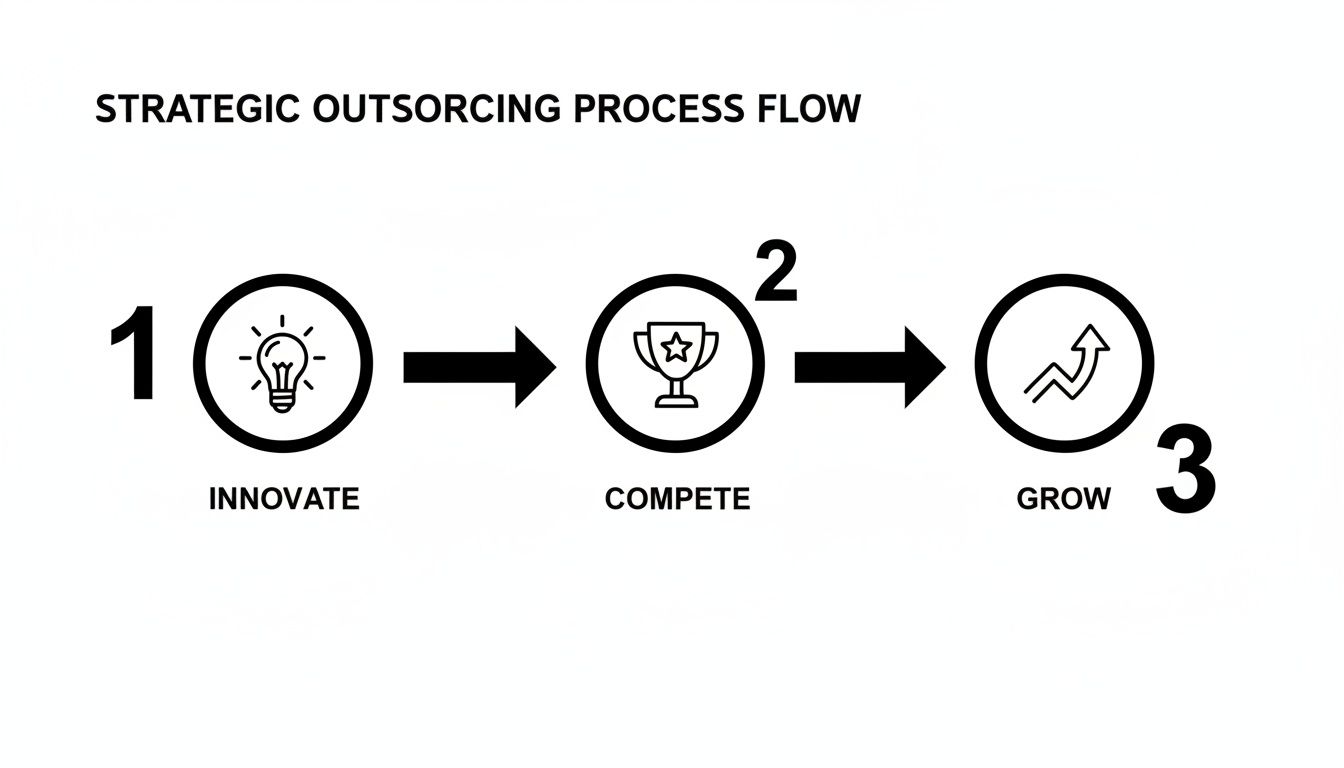
As you can see, partnering with genuine experts lets you build superior products, stay ahead of the competition, and scale your operations far more effectively.
Evaluating Technical Prowess and Relevant Experience
A slick website and a polished sales pitch are easy to come by. Proven experience is not. When you’re looking at a potential partner’s portfolio, you need to look past the pretty screenshots and get a feel for the real-world performance of their past projects.
Are you in retail? Then you should be asking to see successful apps they’ve built with complex Shopify implementation or a custom WooCommerce integration. A beautiful-looking app is completely useless if it can’t talk to your inventory and payment gateways.
If you’re in manufacturing or logistics, your questions will be different. You need to probe their experience with sophisticated backend systems. For instance, have they ever worked as an Odoo partner in Sydney or Adelaide? A successful Odoo implementation demands a profound understanding of business workflows, not just flashy UI design. This kind of niche experience is a massive green flag.
Don't just ask, "Have you built an app like mine?" A far better question is, "Can you show me a project where you solved a business problem similar to the one I'm facing?" This simple reframe shifts the conversation from aesthetics to actual problem-solving capability.
Assessing Cultural Fit and Communication Protocols
Technical skill is only half the equation. A truly successful partnership is built on a foundation of crystal-clear communication and a shared vision. From your very first email or call, pay close attention to how they communicate.
Here are a few things I always look for:
- How do they structure project updates? You want a team committed to regular, scheduled check-ins and completely transparent progress reports. No surprises.
- Who will be your main point of contact? Insist on a dedicated project manager who is accessible, responsive, and speaks your language.
- What collaboration tools are they using? Familiarity with industry-standard tools like Jira, Slack, or Trello is a good sign of an organised and professional workflow.
Entrusting your project to an external team means you also need to be confident in their security posture. A crucial, but often overlooked, part of vetting is to properly evaluate their approach to third-party risk management. This ensures they have solid processes in place to protect your intellectual property and your customers' data.
To make this process easier, I've put together a checklist of key questions to ask any potential development partner. Think of it as your vetting cheat sheet.
Vendor Vetting Checklist
| Category | Essential Question | Why It Matters |
|---|---|---|
| Technical Expertise | Can you walk me through the tech stack you'd recommend for our project and explain why? | This reveals their depth of knowledge and whether they're just pushing a preferred stack or choosing what's best for you. |
| Project Management | What's your process for handling scope changes or unexpected roadblocks? | Their answer shows how agile and communicative they'll be when things don't go exactly to plan (which they rarely do). |
| Communication | What does a typical weekly/fortnightly progress update look like from your team? | This sets clear expectations for transparency and ensures you won't be left in the dark. |
| Quality & Security | How do you integrate QA testing and security reviews into your development lifecycle? | You need a partner who builds in quality and security from day one, not as an afterthought. |
| Post-Launch Support | What do your maintenance and support packages include after the app goes live? | The project isn't over at launch. You need to know they'll be there to support you long-term. |
This table isn't exhaustive, but it provides a strong foundation for a meaningful conversation that goes beyond the surface-level sales pitch.
Beyond the Portfolio: The Power of a Consultation
Ultimately, the best way to gauge a partner is to have a real conversation. This is your chance to see if they truly understand your industry and the specific dynamics of the local market. For example, their approach to software development in Sydney should be different from a project targeting Adelaide consumers, and they should be able to articulate why.
Use this consultation to ask direct, pointed questions, but also pay attention to the questions they ask you. A true partner will be curious. They'll want to know about your business model, your customers, and your big-picture goals. You can get more insights on what to expect by reading about what defines a great custom software development company.
Ready to find a partner who will bring your vision to life? Contact our expert team today for a no-obligation consultation.
Getting the Contract and Pricing Right
So, you’ve whittled down your list of potential development partners. Now comes the pointy end of the process: talking money and signing on the dotted line. This part can feel intimidating, but it’s where you lay the foundation for a successful partnership. A well-defined contract and a clear pricing model are your best defence against misunderstandings and scope creep later on.
Don't get bogged down thinking there's a single "best" way to structure a deal. The right approach is the one that fits your project. It all comes down to how well-defined your scope is, how much flexibility you need, and what your long-term goals are. Let’s look at the common models you’ll come across.
Which Pricing Model Works for You?
You'll generally encounter three main options: Fixed Price, Time & Materials, or a Dedicated Team. Each has its place, and knowing the difference is key to making the right call.
Fixed Price
This is exactly what it says on the tin. You agree on a single, total cost for a very specific, unchanging scope of work. It’s perfect when you know exactly what you need, and you’re confident nothing will change.
- Practical Case: Imagine a small retail business in Adelaide wanting a simple inventory management app. They've mapped out every feature and screen. A fixed price contract gives them the budget certainty they need, which is their number one priority.
Time & Materials (T&M)
This model offers a lot more wiggle room. You pay an agreed-upon hourly or daily rate for the actual time your development team spends on the project. T&M is brilliant for complex, long-term projects where you expect requirements to evolve.
- Practical Case: A Sydney-based manufacturing firm is building a complex workflow app, including a custom Odoo implementation. They know that as they start integrating with machinery on the factory floor, new ideas and requirements will pop up. T&M gives them the agility to adapt and add features without having to renegotiate a whole new contract.
The Contract Clauses You Absolutely Cannot Skim Over
A good contract is more than a price tag; it’s the rulebook for your entire engagement. Before you sign anything, you need to be a hawk on these specific clauses. They protect your business and your ideas.
- Intellectual Property (IP) Rights: This is a deal-breaker. The contract must state, without any ambiguity, that you own 100% of the source code and all related IP once the final invoice is paid.
- Confidentiality (NDA): Your app idea and business data are valuable. A non-disclosure agreement legally binds your partner to keep your trade secrets under wraps.
- Payment Schedule & Milestones: Insist on a clear payment schedule tied to tangible, verifiable deliverables. Vague terms like "Phase 1 complete" aren't good enough. What does "complete" mean? Define it.
- Termination Clause: What’s the exit strategy if things just aren’t working out? A fair termination clause lays out how either party can end the agreement cleanly, including what happens with payments and IP handover.
Remember, a good contract isn't about winning a negotiation. It's about creating a clear, fair agreement that builds trust and prevents problems before they start.
The financial case for mobile application development outsourcing becomes crystal clear when you look at the local Australian market. App developer rates for 2026 are already showing a serious supply-demand issue, with senior developers here commanding AUD 90-130 per hour.
For an e-commerce business looking at a Shopify implementation or a mobile app integrated with WooCommerce, the total project cost can easily land between AUD 70,000 and 250,000. Outsourcing gives you a strategic lever to access world-class software development talent from Sydney to Adelaide without carrying those hefty local costs. You can get a full breakdown in this guide on Australian app development costs for 2026.
With this knowledge, you can walk into negotiations ready to build a partnership that works for your budget and sets your project up for a win.
Ready to discuss a project model that fits your vision? Talk to our team for a transparent, no-obligation quote today.
Managing Your Outsourced Project for Success
You've signed the contract, so the hard part is over, right? Not quite. The success of your mobile application development outsourcing journey truly begins now. The day-to-day management of your new partnership is where the magic happens—or where things can fall apart. It's time to shift gears from negotiation to execution.
Think of it this way: you've hired an expert pilot (your development partner), but you're still the one who knows the destination. You need to be the co-pilot, watching the instruments, communicating clearly, and making course corrections together. This whole phase is about finding a groove, setting clear expectations, and building a genuinely collaborative relationship.
Establishing Your Communication Rhythm
Great communication isn't something you can just hope for; you have to design it. You need a structured plan that everyone buys into, supported by tools that make working together easy, not another chore.
I've found that for most projects, a simple stack like Jira for tracking tasks and Slack for day-to-day chat is a winning combination. The real trick is to be disciplined about how you use them. Jira should be the absolute source of truth for all tasks and progress. Slack is for the quick questions and informal check-ins that keep things moving without burying crucial decisions in a chaotic message thread.
A solid communication cadence could look like this:
- Daily Stand-ups: A quick 15-minute chat each morning to set the day's goals and get ahead of any roadblocks. No fluff, just focus.
- Weekly Progress Reports: A more formal check-in to review what was done, what’s coming up next, and how the project is tracking against the timeline and budget.
This simple rhythm builds trust and momentum. You’ll never be left in the dark wondering what's going on. To get a better feel for the nuts and bolts, you can learn more about our proven mobile app development process.
Defining Roles to Prevent Scope Creep
If I had to point to one thing that derails outsourced projects, it’s fuzzy roles and responsibilities. Who gives the final sign-off on a new design? Who’s on the hook for providing the copy for the onboarding screens? If these aren't crystal clear from day one, you're asking for confusion, delays, and budget blowouts.
Before a single line of code gets written, map out exactly who does what.
- Product Owner (Your Team): This person owns the vision. They prioritise features and have the final say on all deliverables.
- Project Manager (Their Team): Your main point of contact. They orchestrate the dev team and keep the project on track.
- Development Team (Their Team): The builders. They execute the technical work based on the agreed-upon tasks.
I’ve seen this go wrong so many times: multiple people from the client’s team start giving feedback directly to the developers. It creates chaos and conflicting priorities. To keep the project streamlined, funnel every piece of feedback and every request through your single, designated Product Owner.
A tight-knit, collaborative environment is crucial when your team is remote. It's worth looking into practical strategies on how to improve team collaboration to make sure your outsourced partner feels like a true extension of your own team.
A Practical Case Study
Let me give you a real-world example. We worked with a professional services firm in Sydney building a client portal app. The initial scope was locked in, but halfway through, their marketing manager began emailing new feature ideas directly to the developers, completely bypassing the project manager. The result? The timeline went haywire.
We quickly put a stop to it by enforcing a simple rule: all change requests had to be formally submitted in Jira by the official Product Owner. Suddenly, there was clarity. The developers knew exactly what to work on, and the firm’s leadership could see precisely how each new request would affect the launch date and budget. This one structural tweak saved the project. This principle is universal, whether it's a Shopify implementation for an e-commerce brand or a complex Odoo implementation for a logistics company.
Strong project management isn't just about ticking boxes; it transforms a simple client-vendor arrangement into a powerful partnership. It ensures the software development talent you’ve brought on in Sydney or Adelaide is aimed squarely at your goals, turning your vision into a successful, polished mobile app.
Ready to build a partnership that delivers? Let's discuss how our project management approach can get your app launched on time and on budget.
Nailing the Launch: Your Guide to Quality and Security
You've spent months planning and building. Now comes the moment of truth: the launch. But getting your app across the finish line isn't just about flipping a switch. The final stretch is where you lock in quality, guarantee security, and ultimately determine whether users will love or delete your app.
This is where meticulous Quality Assurance (QA) and a rock-solid security strategy become your most valuable assets. I've seen too many projects stumble at this last hurdle because they rushed the final checks. Cutting corners here to save a few dollars or days almost always costs more in the long run—in bad reviews, user churn, and a damaged reputation.
Quality Assurance is More Than Just Bug Hunting
Let's get one thing straight: QA isn't just about finding typos or glitches. It's a holistic process designed to ensure your app is functional, reliable, and genuinely enjoyable to use. A top-tier development partner won’t just test for bugs; they’ll work to perfect the entire user experience.
Your partner’s testing protocol should be comprehensive. Make sure they cover these critical layers:
- Functional Testing: This is the nuts and bolts. Does every button, form, and feature do exactly what it’s supposed to do? From login flows to push notifications, this confirms the core mechanics are solid.
- Performance Testing: Here's where we see how the app behaves under pressure. How fast does it load on a spotty 4G connection? Is it a battery hog? An app that feels sluggish or drains a phone will be uninstalled without a second thought.
- User Acceptance Testing (UAT): This is your final, real-world gut check. You and a hand-picked group of your target users get to put the app through its paces. It’s the ultimate test to confirm the app not only works but is also intuitive and solves the problem you set out to fix.
Security and Compliance: The Australian Rules of the Road
In Australia, data security is not optional—it's the law. If your app collects any user data, you absolutely must comply with the Australian Privacy Act. This means your outsourced team needs a deep, practical understanding of secure coding and data protection regulations. It's non-negotiable.
A truly secure launch plan must bake in these elements from day one:
- Secure Coding: This means writing code that actively defends against common threats like SQL injection and cross-site scripting right from the start.
- Data Encryption: All sensitive user information needs to be locked down with strong encryption, both when it's stored on a device (at rest) and when it's sent over the internet (in transit).
- API Security: The connection points (APIs) between your app and its backend are a prime target for attackers. They must be rigorously secured to prevent any unauthorised access.
I once worked on a project where the client, a healthcare provider, was so focused on features they almost skipped a formal security audit. We insisted on it. The audit found a minor vulnerability in an API that could have exposed patient data. Fixing it took half a day. The cost of a breach would have been catastrophic.
For any business in Sydney or Adelaide, working with a local software development expert who lives and breathes these Australian regulations is a massive advantage. This holds true whether you're building a straightforward WooCommerce retail app or a complex Odoo implementation handling sensitive financial data. Any credible Odoo partner in Sydney or Adelaide will have this expertise built right into their DNA.
Your Pre-Launch Checklist
A smooth app store submission doesn't just happen. It’s the result of a well-executed plan. A detailed pre-launch checklist is your best friend in the final, often hectic, days before going live.
- Finalise App Store Listings: Are your descriptions, keywords, and screenshots optimised to grab attention and rank well?
- Prepare Marketing Materials: Get your launch announcements, social media assets, and email campaigns queued up and ready to fire.
- Set Up Analytics: Is your analytics platform, like Google Analytics for Mobile, properly integrated? You need to track user behaviour from the very first session.
- Plan for Post-Launch Support: What’s the plan for day one? You need a team ready to monitor performance, respond to user feedback, and quickly push out any necessary bug fixes. For example, a successful Shopify implementation for an e-commerce app requires constant monitoring after launch to ensure a smooth experience for that first wave of customers.
Following this disciplined approach ensures that when you finally hit "publish," you’re not just releasing code—you’re launching a high-quality, secure, and valuable product for your users and your business.
Ready to build an app that's secure, reliable, and ready for success? Contact our team to discuss your project today.
So, where do you go from here? You've walked through the entire playbook for outsourcing your mobile app development in Australia. You've got the framework for turning a spark of an idea into a solid plan, finding the right team, and steering the project all the way to a successful launch. Now, it's time for the most important part: taking that first step.
An idea is one thing; a tangible, high-performing app is another. The only thing separating them is action.
Turning Your Vision into a Reality
Whether you’re a retailer in Sydney looking for a seamless Shopify implementation or a manufacturing business in Adelaide needing a certified Odoo partner, the path to a finished product always starts with a simple conversation. Think about it—every great app you use started as just an idea before expert collaboration brought it to life.
The biggest risk isn’t getting the app wrong. It’s the risk of never starting at all. The moment you decide to explore your options with a professional team is the moment your project goes from a concept on a whiteboard to a concrete plan with real potential.
With development teams anchored in both Sydney and Adelaide, we’ve seen first-hand what it takes to build successful digital products for the Australian market. We know the local challenges and, more importantly, the opportunities. We’ve been in the trenches on complex Odoo implementation projects that have completely modernised supply chains and built engaging WooCommerce storefronts that have become serious sales drivers. We build the tools that help Aussie businesses thrive.
Are you ready to build something that truly connects with your customers and delivers real, measurable results? The time to innovate is right now—before a competitor beats you to it.
The next move is easy.
Reach out to our team for a no-obligation chat. Let's talk about your idea and see how our software development experience can bring your vision to life.
Your Questions Answered
Diving into mobile app development outsourcing for the first time? It's natural to have a few questions. Let's tackle some of the most common ones we hear from Australian business owners to give you the clarity and confidence you need to move forward.
What's the Real Cost of Outsourcing an App in Australia?
This is the big one, and the honest answer is: it depends. The price tag is tied directly to your app's complexity.
For a simple app with a handful of core features, you might be looking at a starting point around AUD 20,000. On the other end of the spectrum, a complex enterprise-level solution—think something requiring a custom Odoo implementation—can easily climb past AUD 250,000.
What drives these costs? The main factors are the number of features, the platforms you target (iOS, Android, or cross-platform), and the complexity of the back-end. For example, integrating with systems like Shopify or WooCommerce will add to the scope and budget.
Should I Go for a Fixed-Price or an Hourly Rate Contract?
This decision really comes down to how well-defined your project is from the outset. There's no single "best" answer, only what's right for your situation.
- A fixed-price contract is your best bet for a Minimum Viable Product (MVP). If you have a crystal-clear vision of every feature and can document it precisely, this model gives you complete budget certainty. No surprises.
- An hourly rate (Time & Materials) model, however, is far better suited to complex, long-term projects. When you anticipate that requirements will shift and evolve, this approach provides the agility you need. It's the standard for sophisticated software development in Sydney or Adelaide where flexibility is key.
How Do I Ensure My App Is High Quality When Outsourcing?
You can't just hand over a brief and hope for the best. Quality assurance is a collaborative effort, not something you delegate entirely.
It all starts with picking the right partner—a team with a proven history and transparent workflows, like a trusted Odoo partner in Sydney or Adelaide. But your involvement is the secret ingredient.
To truly guarantee a quality result, you need to be an active participant in the process. Insist on a clear project plan, show up for the regular progress reviews, and make sure a dedicated Quality Assurance (QA) phase—including thorough User Acceptance Testing (UAT)—is locked into the timeline from day one.
This hands-on approach is the only way to ensure the final product doesn't just work, but that it genuinely solves your business problem and delights your users.
What Happens After My App Goes Live?
Launching your app is a huge milestone, but it's far from the finish line. Any credible development partner will offer post-launch support and maintenance plans to protect your investment.
This ongoing service is crucial. It typically covers things like fixing any bugs that pop up, monitoring performance, applying security patches, and updating the app to stay compatible with new OS versions from Apple and Google. Think of it as insurance for your digital asset, ensuring it remains secure, functional, and valuable for years to come.
Ready to transform your app idea from a concept into a powerful business tool? The team at Wistec lives and breathes solution-driven technology. Let's chat about how our expertise in mobile app and software development can bring your vision to life. Contact us for a no-obligation consultation today.