

Think of your factory floor for a moment. Is it a well-oiled machine, or more like organised chaos? Imagine it as a perfectly synchronised orchestra, where every person, machine, and piece of material plays its part at the exact right moment. That’s the reality that manufacturing production scheduling software brings to life.
For too long, Australian manufacturers have been wrestling with messy spreadsheets and putting out fires. The smart ones are now turning to technology that gives them a genuine competitive advantage. This guide will show you how.
Your Control Tower for Manufacturing Success
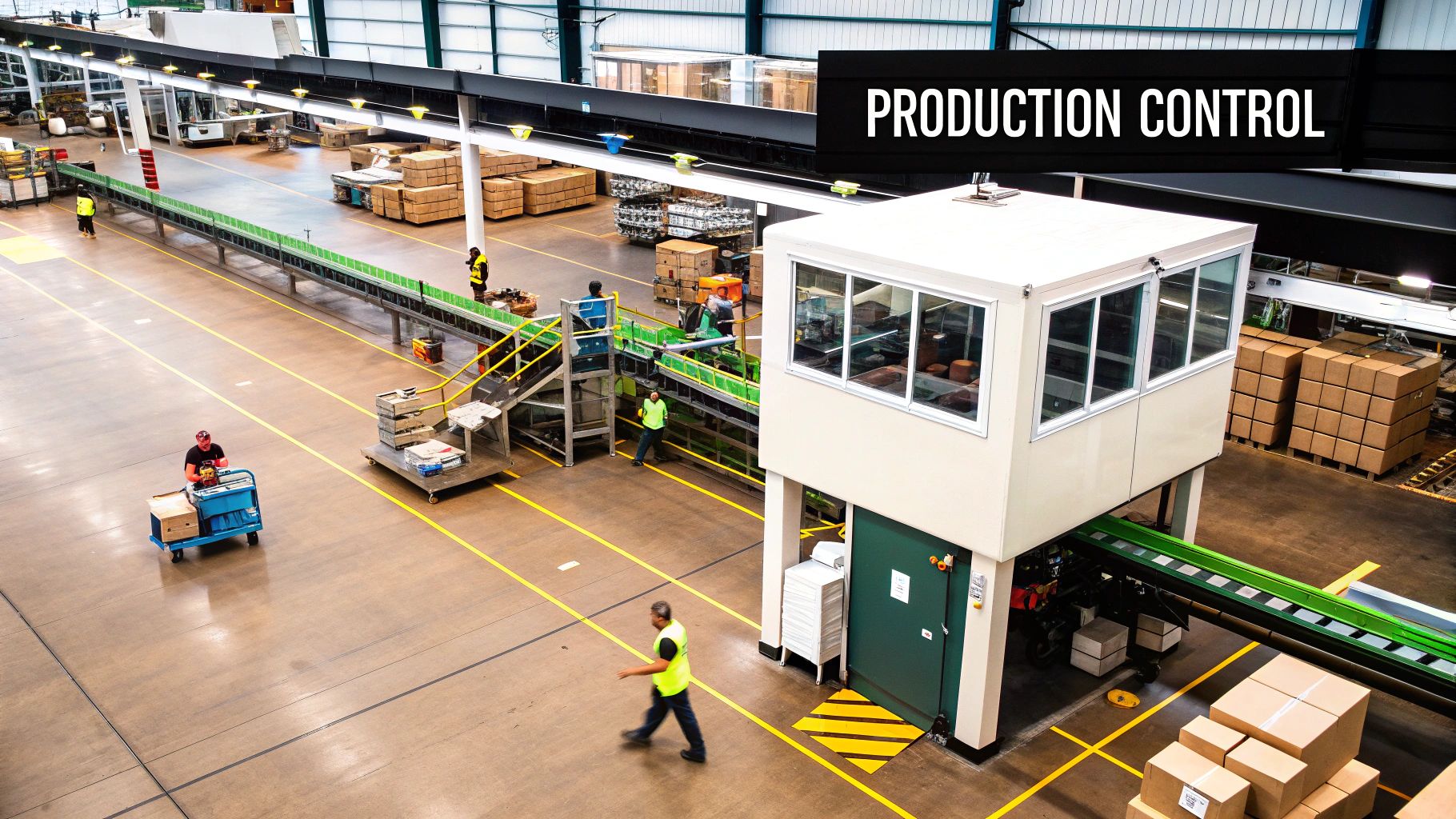
This guide is all about that control tower. We’ll unpack how this software oversees your entire production process, fine-tuning everything from who works on what to when a customer gets their order. It’s a fundamental shift from guesswork to data-driven precision, turning your biggest production headaches into simple, clear workflows. We’ll also show you how pairing it with a powerful ERP system like Odoo can take things to a whole new level.
At its core, manufacturing production scheduling software is a purpose-built tool designed to create, manage, and optimise your production runs. It’s built to answer the three most important questions on any shop floor:
- What should we be making right now?
- When do we need to make it?
- What’s the best way to use our people and machines to get it done?
This isn’t just another piece of tech; it’s a vital component of the broader industrial automation landscape that’s reshaping modern manufacturing.
A Market Fuelled by a Need for Efficiency
The demand for this kind of technology in Australia is booming. The national ERP Software Market, which these scheduling tools are a part of, hit a value of USD 930.18 million in 2024 and is on a steep upward curve. This isn’t surprising. Manufacturers are pouring investment into tools that can tie their production planning, resource management, and real-time scheduling together.
It wasn’t always this way. Historically, a heavy reliance on spreadsheets was a major culprit behind 25-30% idle time on shop floors. The wake-up call of the post-pandemic era has accelerated the move to smarter software. You can dig deeper into the Australian ERP software market on nextmsc.com.
Practical Cases: How It Works in the Real World
Picture this: a custom Odoo implementation that automates workflows, slashing production delays before they even happen. A practical case involves a Sydney-based custom furniture maker whose growth stalled due to manual scheduling errors. After working with an ODOO partner in Sydney Adelaide, their new system automatically converts online orders into production schedules, cutting lead times by 30% and boosting customer satisfaction.
Or consider an eCommerce business running on Shopify or WooCommerce where new sales automatically trigger production orders, keeping stock levels perfectly balanced without anyone lifting a finger. This level of automation is achievable with the right software development in Sydney Adelaide.
For any growing manufacturer, this is more than just an efficiency boost—it’s about survival. When you can confidently promise a delivery date and hit it every single time, you build the kind of customer trust that creates lasting success.
Ready to see what this could look like on your production floor? Our team specialises in custom solutions that solve the real-world challenges Australian manufacturers face every day. Let’s start a conversation about the solution we can build for you.
Core Features That Drive Production Efficiency
Not all scheduling software is built the same. A great platform isn’t just a digital calendar; it’s the central nervous system of your factory floor, coordinating every single moving part with military precision. Let’s look at the non-negotiable features that turn a basic tool into a true engine for operational excellence.
At its heart, manufacturing production scheduling software is a highly specialised form of workflow automation software designed to untangle the knotted web of factory processes. It’s purpose-built to solve the real-world headaches—bottlenecks, machine downtime, and inaccurate delivery forecasts—that kill productivity.
Advanced Planning and Scheduling (APS)
Think of standard planning as looking at a paper road map. You can see the destination, but that’s about it. Advanced Planning and Scheduling (APS), on the other hand, is like having a live GPS that constantly analyses traffic, road closures, and even finds the most fuel-efficient route. It doesn’t just list what needs to be done; it calculates the optimal way to do it.
APS uses smart algorithms to juggle countless variables all at once: material availability, machine capacity, labour skills, and even planned maintenance. This allows you to run “what-if” scenarios on the fly. You can instantly see the ripple effect a delayed shipment or an urgent rush order will have across the entire production line, long before it becomes a crisis.
Real-Time Data Tracking and Visibility
Old-school scheduling methods rely on information that’s out of date the second it’s printed on a sheet of paper. Modern systems, however, plug directly into your shop floor, giving you a live, accurate picture of what’s happening, right now.
This real-time visibility is what allows you to be agile. You can see immediately if a machine is running slow or if a job is falling behind, letting you step in before a small hiccup snowballs into a major delay. For businesses running Shopify or WooCommerce storefronts, this live data can even power accurate stock-level information for customers, preventing overselling.
A production manager at a Sydney-based custom fabrication shop once told me the shift to real-time tracking was like “going from driving with a blindfold to having a crystal-clear windscreen.” It’s that level of clarity that eliminates guesswork and empowers you to manage proactively.
Resource Management and Allocation
Your most valuable resources are your people and your machines. How well you manage them directly impacts your bottom line. Proper scheduling software gives you the tools to allocate these resources with surgical precision.
This feature makes sure the right person with the right skills is assigned to the right machine at exactly the right time. It stops you from overloading key staff, which leads to burnout, while also preventing under-utilisation of equipment, which is just money down the drain. For companies seeking custom software development in Sydney or Adelaide, achieving this granular control is often at the top of their list.
A side-by-side look really highlights why spreadsheets just can’t keep up.
Manual Scheduling vs Automated Software: A Head-to-Head Comparison
For years, spreadsheets were the go-to tool, but they create as many problems as they solve. When you compare them directly to a dedicated system, the difference is night and day.
| Feature | Manual Scheduling (e.g., Spreadsheets) | Automated Scheduling Software |
|---|---|---|
| Data Accuracy | Riddled with human error and often outdated within hours. | Live, real-time data straight from the shop floor, ensuring total accuracy. |
| Responsiveness | Slow and clunky to adjust when the unexpected happens. | Instantly recalculates schedules based on new information. |
| Visibility | Limited to a single user or department, creating data silos. | Provides a single, unified view for all stakeholders. |
| Optimisation | Relies on guesswork and experience, which is rarely optimal. | Uses powerful algorithms to find the most efficient production path. |
| Integration | A disconnected island, separate from systems like inventory or sales. | Connects seamlessly with ERPs (e.g., through an Odoo implementation). |
The contrast is stark. While spreadsheets might feel familiar, they are a major operational disability compared to the dynamic, intelligent, and integrated nature of a purpose-built system.
Ready to give your team the tools for true visibility and control? As a leading ODOO partner in Sydney and Adelaide, we specialise in implementing systems that deliver these core features and more. Contact us to discuss how we can build a solution that drives your production efficiency.
From Theory to the Factory Floor: The Real-World Wins of Smart Scheduling
Let’s be honest. Investing in new technology isn’t about collecting flashy features; it’s about seeing a real, measurable impact on your bottom line. Good manufacturing production scheduling software does just that. It translates its clever capabilities into tangible business outcomes—the kind you can actually see in your cost reports, output numbers, and customer feedback.
This isn’t a minor tweak. It’s about fundamentally changing how you operate, moving from constantly reacting to problems to proactively preventing them. The right software isn’t just another expense; it’s a strategic investment in growth, profitability, and your ability to stand out in a tough market. It’s the difference between always fighting fires and having the foresight to stop them from ever igniting.
Practical Case: From Chaos to Control in Adelaide
Picture a mid-sized manufacturer in Adelaide—we’ll call them “Precision Parts.” For years, their production floor was run on a chaotic mix of spreadsheets, gut feelings, and shouting across the workshop. Rush orders would throw the entire week’s plan into disarray, leading to blown deadlines, a stressed-out team, and clients who were losing their patience. They were always busy, but never truly profitable, and their growth had hit a wall.
At a breaking point, they decided to bring in a local expert for a custom Odoo implementation. The change was almost immediate. With a live view of the whole operation, the production manager could spot a potential bottleneck forming on CNC Machine 3 two days before it happened. Instead of a last-minute scramble, they simply re-routed a lower-priority job to an open machine. The high-value order stayed perfectly on track, without a single minute of lost time.
This newfound control sent ripples through the entire business. Because their forecasts were suddenly reliable, they could give customers delivery dates they could actually trust, slowly rebuilding relationships that were starting to fray. This is what smart scheduling does in the real world: it turns unpredictable daily hurdles into simple, data-driven decisions.
Driving Down Costs and Pushing Up Output
One of the first things you’ll notice is a significant drop in your operational costs. By optimising how every resource is used, the software makes sure your expensive machinery isn’t just sitting there collecting dust, and your skilled team members are always working on the most critical tasks.
This efficiency naturally leads to getting more done. Precision Parts discovered they could produce 15% more with the same equipment and staff, all because they’d eliminated the dead time and created a smooth, continuous workflow. They stopped leaving money on the table.
The core benefit is simple: you get more out of the resources you already have. It’s about maximising your existing capacity before even thinking about costly new machinery or expansions.
This is a massive advantage for any business in Australia. In a market where production bottlenecks can cost companies 10-15% in lost productivity annually, a tool that helps you use what you have more effectively is no longer a luxury—it’s essential. This is why businesses are actively seeking expert software development in Sydney and Adelaide to build custom solutions.
Building Unbreakable Customer Trust
In the end, perhaps the most valuable benefit is the ability to consistently deliver on your promises. In a competitive market, reliability is your strongest currency. When you can give a customer a delivery date with complete confidence, you start to build unbreakable loyalty.
- Improved On-Time Delivery: Late shipments—a huge source of customer frustration—are drastically reduced.
- Proactive Communication: You can see potential delays coming and inform customers well in advance, turning a negative into a positive, trust-building moment.
- Enhanced Reputation: You become known as the company that gets it right, attracting more and better clients.
It doesn’t matter if your business requires a Shopify implementation, a WooCommerce integration, or handles complex B2B orders; keeping your word is everything.
Ready to see these benefits on your own factory floor? As a leading ODOO partner in Sydney and Adelaide, our team provides expert software development to turn your operational headaches into a serious competitive advantage. Contact Wistec today for a no-obligation consultation.
Choosing Your Software: The Power of Odoo ERP Integration
Picking the right manufacturing production scheduling software isn’t just another item on your to-do list; it’s a strategic decision that will shape the future of your operations. While standalone scheduling tools can offer some improvement, their real power is unleashed when they’re woven into the fabric of your business. This is where integration with a comprehensive Enterprise Resource Planning (ERP) system like Odoo gives you an almost unfair advantage.
Imagine a standalone scheduler as a brilliant, highly-skilled factory manager. They can absolutely optimise their own department, making it run like a well-oiled machine. The problem? They have no real-time insight into sales forecasts, fluctuating inventory levels, or overarching financial constraints.
An integrated Odoo solution, on the other hand, is like having the entire executive board in the same room, all looking at the same live data. It creates a single source of truth that connects your shop floor directly to your sales team, your warehouse, and your finance department.
Why a Unified System is a Game Changer
When your scheduling module is a natural part of your ERP, the conversation between departments is seamless and instant. A new sales order doesn’t just land in someone’s inbox. It automatically checks material availability, assesses machine capacity, and slots itself into the production schedule in the most efficient way possible.
This completely breaks down the data silos that lead to so many expensive mistakes. No more production managers working off last week’s sales figures. No more procurement teams ordering materials for jobs that were pushed back yesterday. The entire business is finally working from the same, synchronised playbook.
The flow diagram below shows just how elegantly data moves through an integrated Odoo ERP, from initial customer inputs right through to final production.
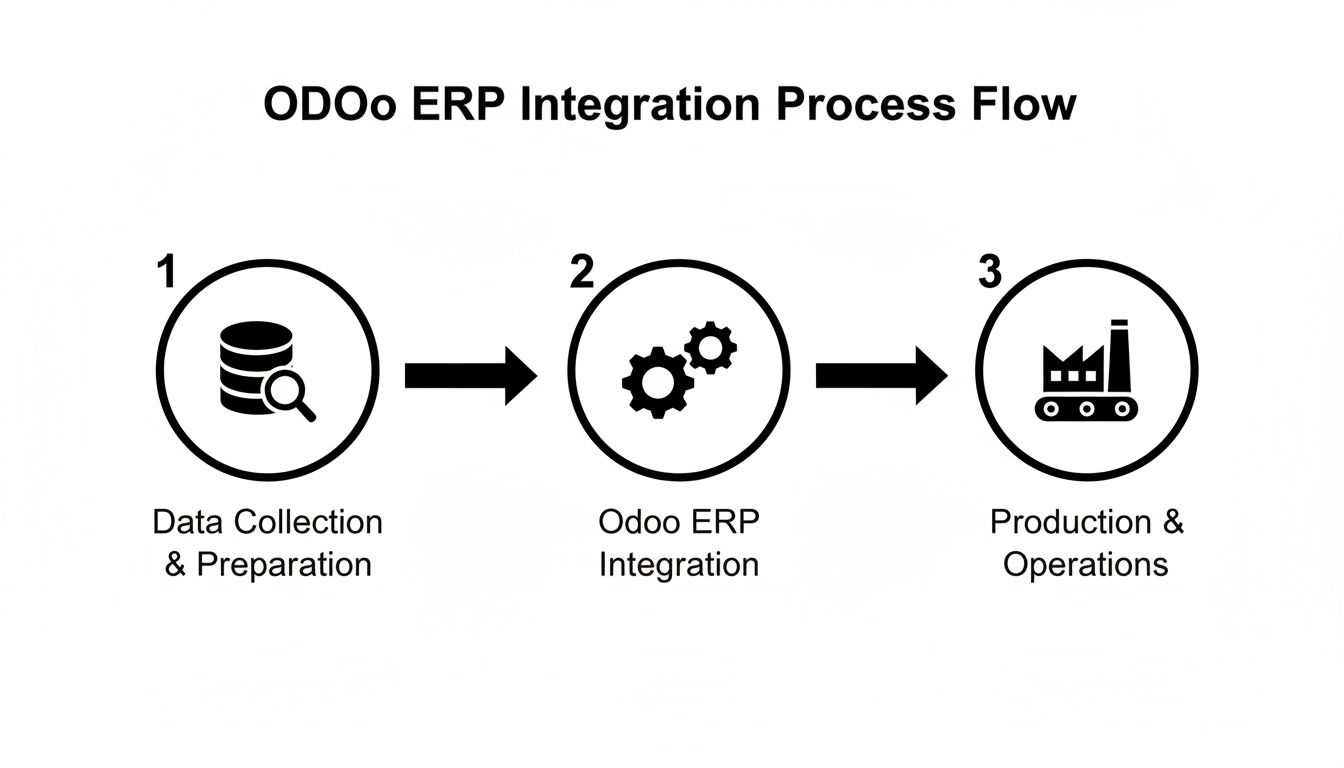
As you can see, when your data is centralised within an Odoo ERP, production becomes an intelligent response to real business information, not guesswork.
Key Criteria for Selecting Your Solution
When you start evaluating your options, try to look beyond a simple feature-for-feature comparison. Instead, focus on three critical pillars that will truly determine the long-term success of your investment.
- Scalability to Grow With You: The software you choose today has to support the business you want to be tomorrow. A scalable platform like Odoo lets you start with the core modules you need right now and simply add more functionality as you expand. You won’t face the daunting prospect of ripping out and replacing your entire system down the track.
- Customisation for Your Unique Workflows: Let’s be honest, no two manufacturing businesses are exactly alike. A rigid, “one-size-fits-all” system will force you to contort your proven processes to fit its limitations. The smarter approach is finding a flexible platform that can be tailored to you, which is where expert software development in Sydney or Adelaide becomes invaluable.
- Local Support and Partnership: When you hit a snag, you need to talk to someone who genuinely understands your business and the local market. Working with an Australian Odoo partner in Sydney or Adelaide means you have accessible expertise to guide you through implementation, training, and any challenges that pop up.
Choosing software isn’t just about buying a product; it’s about forming a partnership. The right local partner will act as an extension of your team, ensuring the technology serves your business goals, not the other way around.
Practical Cases: Integration in Action
Let’s move away from theory and look at how this delivers tangible results for real businesses. These aren’t just bullet points on a sales brochure; they are practical applications driving efficiency every single day.
- eCommerce and Manufacturing Synergy: An Australian furniture maker uses a Shopify storefront to sell beautiful custom pieces. Thanks to their Odoo implementation, every new order automatically creates a manufacturing order. The system instantly reserves the right timber from inventory and schedules the job on the workshop floor, all while giving the customer an accurate, automated completion date. This is a prime example of a successful Shopify implementation working in harmony with production.
- Streamlined Logistics and Production: A food processing company in Adelaide has integrated its warehouse management system with its production scheduler through Odoo. As soon as a batch of goods is packaged and ready, the system notifies the warehouse, generates the right shipping labels, and schedules the freight pickup. This tight synchronisation with their WooCommerce-powered B2B portal minimises storage time and makes sure fresh products get out the door immediately.
These examples clearly show how an integrated system gets rid of the manual handoffs and communication gaps, creating a smooth, automated flow from the moment a customer clicks “buy” to final delivery.
Choosing the right manufacturing production scheduling software is a huge decision. By prioritising a unified solution with a powerful ERP backbone like Odoo, you aren’t just optimising your factory floor; you’re building a more resilient, agile, and future-proof foundation for your entire business. Are you ready to create a single source of truth for your operations?
Your Implementation Roadmap from Plan to Production
Choosing the right manufacturing production scheduling software is a massive step, but it’s just the starting line. The real win comes from a smooth, successful implementation that actually brings your vision to life on the factory floor. A well-planned rollout is what turns a powerful piece of software into a genuine competitive edge.
Think of it like building a high-performance engine. You can have the best parts in the world, but if they aren’t assembled with precision, the engine will just sputter and fail. Your implementation process is that careful assembly, making sure every component works in perfect harmony to deliver the power you expect.
This roadmap will walk you through the essential stages of a successful rollout, helping you sidestep common pitfalls and get your team across the finish line on time and within budget.
Phase 1: The Discovery and Planning Stage
This is the foundation. It’s where you define what success actually looks like for your business. Rushing this step is easily the biggest mistake a company can make. It’s all about digging deep into your current processes to understand not just what you do, but why you do it that way.
The aim here is to set clear, measurable goals. Are you looking to slash machine downtime by 20%? Get on-time delivery rates up to 98%? Or maybe boost throughput by 15% without adding more staff? These specific targets will be your guide for every decision that follows.
Bringing in an experienced ODOO partner in Sydney or Adelaide at this early stage is a game-changer. Their expertise in both the software and the realities of manufacturing can help you spot opportunities you might have missed and set realistic goals from day one.
Phase 2: Data Migration and System Customisation
With a solid plan in your hands, the next move is to get your data ready and configure the software to fit your unique world. This is far more than a simple data dump. It’s a careful process of cleaning and organising all your existing information—from Bills of Materials (BOMs) to supplier lead times—to ensure the new system starts with a clean, accurate slate.
At the same time, the software needs to be moulded to your specific workflows. A great platform like Odoo is incredibly flexible, but it takes skilled software development to make it feel like it was built just for you. This could involve:
- Configuring custom capacities for your work centres.
- Building integrations with your existing machinery or quality control systems.
- Creating specialised reports that give your managers the exact insights they need to make smart decisions.
A successful implementation isn’t about forcing your business to bend to the software. It’s about making the software adapt to your business, amplifying what you do best and smoothing out the rough edges.
Phase 3: Training and Driving User Adoption
You could have the most powerful system on the planet, but if your team doesn’t know—or doesn’t want—to use it, the whole project is a write-off. Effective training is so much more than a quick one-hour presentation. It needs to be hands-on, role-specific, and laser-focused on showing each team member “what’s in it for them.”
Your shop floor operators need to see how the new system makes their daily jobs easier, not more complicated. Your production planners need to feel how it gives them better visibility and control. Forgetting to get buy-in from the people who will live in the software every day is a guaranteed path to failure.
This is where a local partner really proves their worth. An expert in Odoo implementation can provide on-site training in Sydney or Adelaide, offering direct support and ensuring everyone feels confident from day one. They become the bridge between the technology and your people.
Phase 4: Go-Live and Continuous Improvement
Flicking the switch on “go-live” day is a huge milestone, but it’s certainly not the end of the journey. The first few weeks will involve close monitoring, ironing out any minor wrinkles, and actively gathering feedback from your team. A phased rollout, where you might introduce the system to one production line at a time, is a great way to reduce risk.
Once the system is stable, the focus shifts to continuous improvement. Your software partner can help you analyse all the new data you’re collecting to find even more efficiencies. This could be anything from optimising the e-commerce workflow from a Shopify implementation to fine-tuning inventory levels for your WooCommerce store.
A successful implementation does more than just install software; it transforms your business. It demands careful planning, technical know-how, and a relentless focus on your people.
Ready to build your roadmap to production excellence? Contact Wistec today. Our team provides the expert Odoo implementation and software development in Sydney and Adelaide needed to ensure your project is a resounding success.
It’s Time to Take Control of Your Production Floor
We’ve walked through the whole journey, from the all-too-familiar chaos of manual scheduling to the calm and control of a modern, integrated system. The difference isn’t just about being a bit more efficient; it’s about survival and growth. In the competitive Australian market, sticking with outdated spreadsheets and educated guesses is more than just an old habit—it’s a liability that’s actively holding you back.
The way forward is clear. It’s about shifting from constantly putting out fires to making smart, proactive decisions based on real data. By bringing in proper manufacturing production scheduling software, especially when it’s part of a unified ERP like Odoo, you get a clear line of sight across your entire operation. This is what lets you truly optimise your resources, nail your deadlines every time, and build the kind of trust that keeps customers coming back.
Your Next Step to a Smarter Operation
Don’t let old methods decide your company’s future. Now is the perfect time to take a hard look at how you’re doing things and see just how powerful a unified solution could be for your bottom line. Take that crucial next step and secure your place in the market.
The biggest risk is doing nothing at all. The technology to completely change your production floor isn’t some far-off dream for massive corporations; it’s here, it’s accessible, and it’s ready to work for your business today.
The right solution has to fit your business. You might need a full Odoo implementation, some custom software development in Sydney or Adelaide, or just a smooth integration with your Shopify or WooCommerce store. A local expert, an experienced ODOO partner, gets the specific challenges and opportunities that Australian manufacturers face.
Ready to see the difference? Contact Wistec today for a no-obligation chat. Our team can show you exactly how a purpose-built production scheduling solution can deliver real, measurable results for your business in Sydney, Adelaide, and right across Australia. A more efficient and profitable future is waiting.
Got Questions? We’ve Got Answers
Stepping into the world of manufacturing production scheduling software often brings up a few questions. It’s a big decision, so let’s clear up some of the common queries we hear from manufacturers just like you.
How is This Different From Our Current ERP?
That’s a great question. Think of your ERP as the company’s command centre—it manages the big picture stuff like finance, high-level inventory, and sales orders. Production scheduling software, on the other hand, is your on-the-ground general. It takes those high-level plans from the ERP and translates them into a minute-by-minute battle plan for the factory floor.
It’s all about the nitty-gritty details: which job runs on which machine, in what order, and with which operator. An integrated system, like a tailored Odoo implementation, connects the command centre directly to the front line. This creates a seamless flow of information, so your business strategy is perfectly aligned with what’s actually happening on the shop floor.
Is This Really for a Small or Medium-Sized Business?
Absolutely. In fact, for many small to medium-sized enterprises (SMEs), it’s even more critical. You’re often competing with bigger players, so you can’t afford waste, miss deadlines, or underutilise capacity. Modern, cloud-based scheduling tools are no longer just for the corporate giants.
A good ODOO partner in Sydney or Adelaide can build a solution that fits your scale and budget. You get access to the same powerful optimisation tools, but packaged in a way that works for a growing Australian business without the enterprise-level price tag.
What Kind of ROI Can We Realistically Expect?
The return on investment here is tangible and hits several parts of your business. Financially, you’ll see operational costs drop, often within the first year, thanks to smarter material use and a serious reduction in machine idle time.
Operationally, it’s not uncommon to see a 15-25% jump in production output without buying a single new piece of equipment. But the biggest win? Hitting your delivery dates, every single time. That builds trust and keeps customers coming back. A well-implemented system usually pays for itself in just 12 to 18 months.
Can This Be Adapted to Our Unique Way of Doing Things?
It has to be. No two manufacturing floors are identical, and a one-size-fits-all solution is a recipe for frustration. A rigid, off-the-shelf program just won’t cut it. This is where a flexible platform like Odoo truly shines—it’s built to be moulded to your reality.
This is why expert software development in Sydney or Adelaide is so important. A skilled partner will sit down with you, map out your specific workflows and constraints, and then configure the software to match. Whether you’re integrating eCommerce orders from a Shopify implementation, running a complex assembly line, or juggling custom jobs with a WooCommerce-powered portal, the system is built around your process, not the other way around.
Ready to stop guessing and start optimising? The team at Wistec is here to help. As a leading Odoo partner, we provide the expert implementation and custom software development that Australian manufacturers need to thrive.
Take control of your production floor by contacting us for a no-obligation consultation today!