

At its core, a manufacturing ERP is the central nervous system of your entire production operation. It's a specialised software system built to connect every moving part of your business, from the moment raw materials arrive to the second a finished product is shipped out the door.
Think of it as the single source of truth for your whole facility.
What Exactly Is Manufacturing ERP Software?
Ever tried to build something complex with a team where everyone has a different set of blueprints? It’s a recipe for disaster. That’s what running a manufacturing business without a proper ERP feels like—a chaotic mix of spreadsheets, standalone software, and siloed data that just doesn't communicate.
A manufacturing ERP software solution gets rid of that fragmentation. It brings everything—procurement, inventory, production scheduling, quality control, and finance—under one digital roof. This ensures everyone is working from the same, up-to-the-minute information. To really see how this changes the game, it's worth exploring in-depth what is ERP system in manufacturing and the way it ties these different functions together.
The Conductor of Your Operations
The ERP acts like the conductor of an orchestra, making sure every section plays in perfect harmony. It’s not just a passive database; it actively coordinates workflows across the entire business.
For instance, when a new sales order comes in, a well-configured ERP doesn't just log it. It automatically checks your stock levels, slots the job into the production schedule, and even flags the purchasing team to order more raw materials if needed. Trying to manage that manually is a constant, uphill battle.
From Manual Guesswork to a Data-Driven Powerhouse
The biggest change an ERP brings is the move from reactive problem-solving to proactive, data-driven decision-making. Forget about guessing your inventory levels or hoping you have the capacity for a new order. You get precise, real-time information with a few clicks.
This level of visibility is what allows Australian manufacturers to stay agile and competitive. You can confidently give customers accurate delivery dates because your ERP shows you exactly what your machine availability and material lead times look like. It replaces guesswork with certainty.
A well-implemented manufacturing ERP transforms complex, messy processes into a streamlined and efficient operation. It's not just another piece of software; it's the very foundation for growth, control, and profitability in today’s market.
The table below paints a clearer picture of this operational shift.
From Chaos to Control: A Look at Operational Shifts with ERP
This table highlights the transformation from fragmented, manual processes to a unified, automated approach powered by a manufacturing ERP.
| Business Area | Traditional Method (Siloed) | Integrated ERP Approach |
|---|---|---|
| Inventory Management | Manual counts, spreadsheets, frequent stock-outs or overstocking. | Real-time tracking, automated reorder points, full warehouse visibility. |
| Production Scheduling | Whiteboards, guesstimates, frequent bottlenecks and rushed orders. | Automated scheduling based on capacity, materials, and demand. |
| Sales & Quoting | Disconnected from production, inaccurate lead time estimates. | Sales orders instantly update inventory and production schedules. |
| Procurement | Manual purchase orders based on gut feel, lack of supplier data. | Automated PO generation based on production needs, supplier tracking. |
| Financial Reporting | Manual data entry, delayed and often inaccurate financial reports. | Real-time financial data linked directly to operational activities. |
As you can see, the shift isn't just about efficiency; it's about gaining total control over your business.
Making this transition is a significant step, but it’s essential for any business looking to scale. Getting expert guidance from an Odoo partner in Sydney or Adelaide can smooth out the bumps, especially if you need to connect your ERP to an online store. A skilled team specialising in software development in Sydney and Adelaide can ensure your Odoo implementation integrates seamlessly with your Shopify implementation or WooCommerce website.
Ready to bring this level of harmony to your operations? A manufacturing ERP built for your unique needs could be the answer. Contact our team today for a personalised consultation and let's explore how we can get your production perfectly synchronised.
The Core Modules That Power Your Production
A manufacturing ERP isn't one giant piece of software; it's more like a highly coordinated team of specialists. Think of it as the central nervous system of your factory floor. Each module has a distinct role, but they all communicate in real-time to drive your entire operation forward, turning raw materials into finished products with precision and speed.
These modules work together to bring order to the beautiful chaos of manufacturing. They replace scattered spreadsheets and manual tracking with a single, unified system, giving you a clear view of everything from initial design to final shipment.
This image shows how a central ERP acts as the brain, connecting key functions like inventory, scheduling, and shipping into one intelligent system.
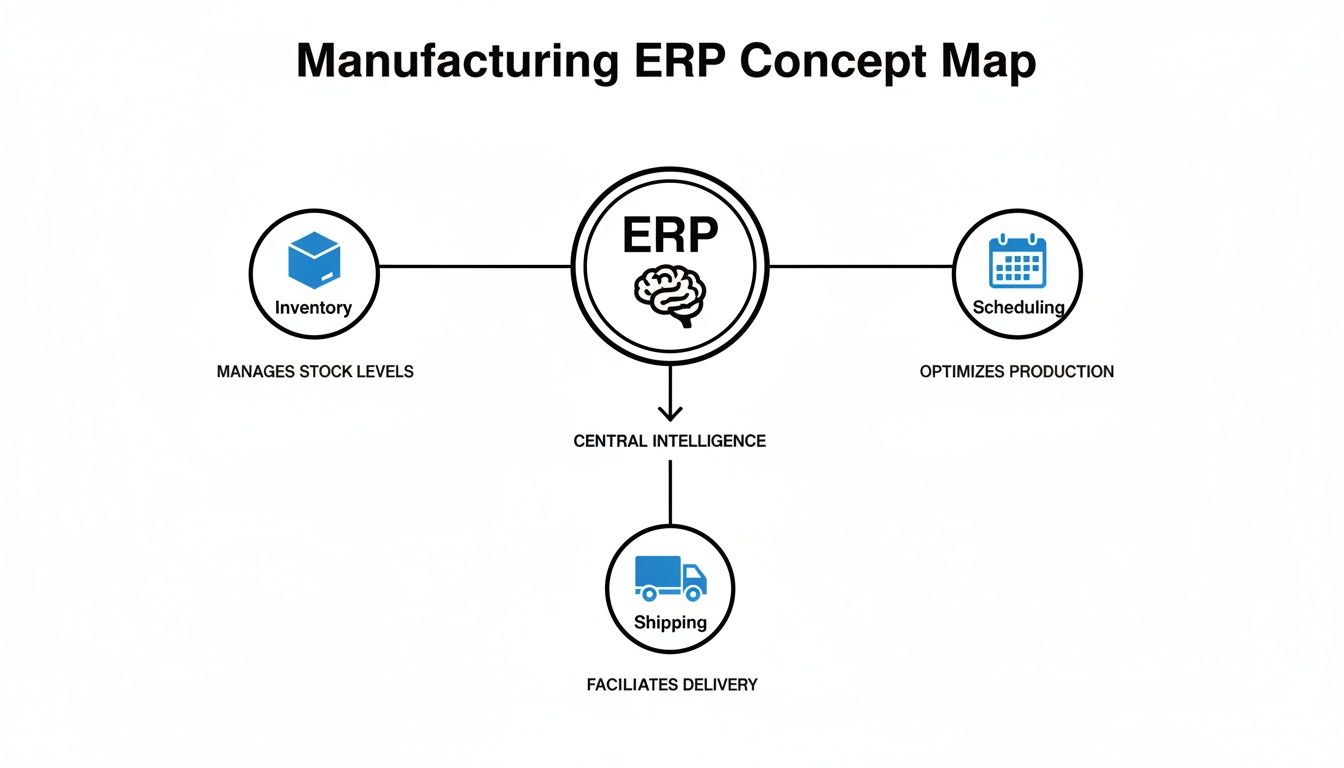
It’s this interconnectedness that’s the real game-changer, ensuring a decision made in one area instantly informs what happens next down the line.
Bill of Materials (BOM): Your Master Recipe
First up is the Bill of Materials, or BOM. This is the absolute foundation of your product—it’s the master recipe detailing every single component, screw, and bit of raw material needed to make one unit. For any manufacturer, a perfect BOM is non-negotiable. One small mistake here can bring an entire production run to a grinding halt.
Imagine a custom furniture maker in Adelaide crafting an oak dining table. Their BOM is a meticulous list:
- The exact dimensions of the required oak timber.
- The precise count of every screw, bolt, and bracket.
- The specific type and amount of wood stain and varnish.
Without this granular detail, ordering supplies or pricing the job would be a shot in the dark. Your manufacturing ERP software treats the BOM as the single source of truth that feeds directly into purchasing, inventory, and production.
Manufacturing Resource Planning (MRP): The Supply Chain Strategist
While the BOM tells you what you need, the Manufacturing Resource Planning (MRP) module figures out when you need it and how much to get. It’s your strategic brain for the supply chain, constantly analysing sales forecasts, production schedules, and what you’ve got on the shelves to make sure the right materials arrive at the right time.
For our Adelaide furniture maker with an order for 10 tables, the MRP instantly calculates the total timber, hardware, and varnish needed. It checks the current stock, and if there's a shortfall, it automatically generates purchase orders to trusted suppliers. This ensures materials land just as production is about to start, cutting out both costly delays and the expense of holding too much stock. This is a vital first step in effective manufacturing process automation, a move that seriously boosts efficiency.
Shop Floor Control: The Air Traffic Controller
Once the materials are in-house, the Shop Floor Control (SFC) module takes the reins. Think of it as the air traffic controller for your factory, managing the moment-to-moment flow of jobs across the production line. It steers work orders through every station, from the first cut to the final polish.
The SFC gives your team digital work instructions, tracks time spent on each task, and keeps an eye on machine performance. For the table maker, it would:
- Release a work order to the cutting station.
- Track the timber as it moves to assembly.
- Log labour hours and machine time against the job.
- Capture data on any material waste or quality control flags.
This real-time visibility lets you spot bottlenecks before they become roadblocks, track progress accurately, and make smart adjustments on the fly to keep everything on schedule.
An effective manufacturing ERP connects the 'what' (BOM), the 'when' (MRP), and the 'how' (Shop Floor Control) into a single, cohesive system. This integration eliminates data silos and empowers you to manage your entire production lifecycle from a unified platform.
Of course, these core modules are just the beginning. A complete Odoo implementation can also bring in quality management, procurement, maintenance, and product lifecycle management. And for businesses serious about mastering their stock, we have a detailed guide on choosing the best inventory management software that works seamlessly with these systems.
A trusted Odoo partner in Sydney or Adelaide can help you configure these modules to fit your unique processes, whether you’re making furniture, processing food, or assembling complex electronics. With expert software development in Sydney and Adelaide, your ERP won't just run production; it will connect to everything else, like your Shopify implementation or WooCommerce store.
Ready to see how these modules could transform your production floor? Contact us for a no-obligation chat about your manufacturing challenges.
Is an ERP Really Worth the Investment? Let's Talk ROI.
Thinking about a new manufacturing ERP is a big decision, and it’s not just about getting new software. It’s a strategic move that should directly pump fuel into your bottom line. Forget the long, flashy feature lists for a moment; the real value is in the tangible, measurable results you see day-to-day. A well-oiled ERP connects the dots between what happens on the shop floor and what lands in your bank account, turning raw data into dollars.
This isn’t about some vague promise of "getting better." It’s about seeing a genuine financial impact. When your system gives you dead-on data accuracy, your purchasing team stops tying up cash by over-ordering expensive materials. When your workflows are smooth, you can get more product out the door with the same crew and the same machines, which directly lowers your cost to produce each unit.
Pinpointing the Real-World Gains
The return on your ERP investment becomes crystal clear when you stop looking at it as an expense and start seeing it as an engine for cutting waste and saving money.
A powerful ERP gives you a bird's-eye view of your entire supply chain, which is your best defence against the kind of costly delays that kill profits and customer trust. You can spot potential disruptions before they happen and pivot fast, keeping the production lines humming and customer orders on schedule.
Here’s a practical case: A food processor in Sydney was throwing out a huge amount of product because their inventory tracking and production scheduling were a mess. After we helped them with a targeted Odoo implementation, they gained live visibility into stock expiry dates and real demand forecasts. This meant they could fine-tune their production runs, cutting spoilage by 20% and saving over $75,000 in the first year alone.
Driving Down Day-to-Day Operational Costs
Every little inefficiency in your process is a hidden cost, a slow leak in your profitability. A modern manufacturing ERP software solution is built to find and systematically plug these financial drains.
- Slash Labour Costs: Think about all the time spent on manual data entry or pulling together reports. By automating that grunt work, your team is freed up to focus on what really matters—improving quality, innovating processes, or talking to customers. It’s not about cutting heads; it’s about using those heads for higher-value work.
- Drop Inventory Holding Costs: An ERP helps you walk the tightrope of inventory management, ensuring you have just enough material to meet demand without having a fortune tied up in stock sitting on a shelf. This directly cuts your warehousing and insurance costs and reduces the risk of stock becoming obsolete.
- Make Smarter, Faster Decisions: When everyone is working from the same playbook—a single source of truth—managers can make quick, informed decisions. This puts an end to costly mistakes that come from working with outdated spreadsheets or gut feelings based on incomplete information.
We're seeing this shift happen right across the country. Manufacturing businesses in Australia are ditching their old, clunky ERP systems for more flexible, cloud-based platforms that let them move faster. The mid-market, which drives a massive 23% of Australia's national GDP, is leading the charge. With nearly 72% of these businesses looking for funding to grow, modernising their ERP is a non-negotiable part of their strategy, allowing them to add new capabilities without getting bogged down in heavy customisation. You can read more about these ERP trends shaping Australian businesses.
At the end of the day, an ERP is there to make your whole operation more profitable by eliminating waste in every form—wasted time, wasted materials, and wasted opportunities. It pays for itself by turning operational excellence into financial success.
Whether you need a top-notch Odoo partner in Sydney or Adelaide for a brand-new system, or require specialised software development in Sydney or Adelaide to link your ERP with an existing Shopify implementation or WooCommerce store, the goal is always the same: to deliver a return you can actually measure.
Ready to build a business case for an ERP that actually makes sense for your bottom line? Contact our expert team today to talk about how a solution built for your business can deliver a powerful, real-world ROI.
How to Choose the Right Manufacturing ERP Software
Picking a new manufacturing ERP is one of the biggest decisions you'll make. This isn't just another software purchase; it's the foundation for your operations for the next decade. Get it right, and you set your business up for growth. Get it wrong, and you're looking at years of painful workarounds, frustrated staff, and costs that keep piling up long after the initial sale.
A hasty choice, often swayed by a slick demo or a deceptively low price tag, is a recipe for disaster. What you need is a clear, methodical approach. This is about finding a system that solves your headaches today and has the legs to carry you into the future. It means digging deeper than a surface-level feature list and really understanding the core capabilities, the quality of support, and the true long-term value.
Start with Your Must-Have Checklist
Before you even think about watching a demo, you need to map out what you actually need. Don't let a salesperson's pitch become your priority list. The first step is to build your own buyer's checklist, one that’s firmly rooted in the realities of your factory floor.
Get your team together and start asking the tough questions:
- Scalability: What happens if we double our production volume? Can this system handle a 50% or 100% increase without grinding to a halt? What about adding new product lines or even a whole new facility down the track?
- Manufacturing DNA: Is this a genuine manufacturing ERP software solution built from the ground up for producers? Or is it just a glorified accounting package with a few manufacturing features tacked on? You need deep functionality in areas like BOM, MRP, and shop floor control.
- Local Expertise: When things go sideways at 3 PM on a Tuesday, who do you call? Having an expert Odoo partner in Sydney or Adelaide who can be on-site or on a call immediately is infinitely more valuable than being stuck in a queue for an overseas call centre.
Look Beyond the Sticker Price at Total Cost
The upfront price of an ERP is just the tip of the iceberg. A system that seems like a bargain at first can quickly become a money pit. To get a real sense of the investment, you need to calculate the Total Cost of Ownership (TCO), which factors in every single cost over the life of the system.
A smart ERP choice isn't about finding the cheapest option—it's about finding the best value. That means investing in a flexible platform that supports your long-term vision, backed by a partner who genuinely understands the local business landscape.
When you're comparing your options, make sure to account for these often-hidden costs:
- Implementation and Customisation: How much will it really cost to mould the system to your unique workflows? This is where having access to quality software development in Sydney or Adelaide is non-negotiable.
- Integration Fees: Will it play nicely with the other tools you rely on? For many manufacturers today, a smooth Shopify implementation or a robust WooCommerce connection is essential.
- Ongoing Licensing and Support: What are the annual costs for licenses, maintenance, and support? Are critical software updates included, or are they an extra charge?
- Training and Adoption: How much time and effort will it take to get your team not just trained, but actively and efficiently using the new system?
Choosing the right manufacturing ERP software is a strategic move that will define your company's potential. By focusing on scalability, genuine manufacturing functionality, local support, and the true TCO, you can move forward with confidence. An Odoo implementation, for instance, provides a powerful and adaptable foundation that a skilled partner can tailor perfectly to your operations.
Ready to find an ERP that actually works the way you do? Talk to our team of experts today for a no-obligation chat about your specific needs.
Your Practical ERP Implementation Roadmap
Think of a powerful manufacturing ERP as a high-performance engine; it’s useless until it's properly installed in your business. Getting from the point of purchase to a fully operational system isn't like flipping a switch. It's a structured project, and this roadmap is here to demystify the process, breaking it down into clear, manageable phases.
Following a proven path is what separates a smooth transition that delivers immediate value from a frustrating, budget-draining ordeal. Getting it right the first time really comes down to a methodical approach that gives equal weight to planning, data, configuration, and, most importantly, your people. Rushing any of these steps is a recipe for long-term headaches.
Phase 1: Discovery and Planning
This is where the foundation for the entire project is laid, making it the most critical phase of all. It all starts with a deep dive into your current workflows—the good, the bad, and the outright broken. This isn’t about just copying your old processes into a new system; it's your chance to fundamentally improve them.
By working with an expert Odoo partner in Sydney or Adelaide, you’ll map out every part of your operation. This detailed analysis ensures the manufacturing ERP software is set up to solve your real-world problems, not just digitise existing inefficiencies. By the end of this phase, you'll have a defined project scope, a realistic timeline, and a clear budget to guide the entire project.
Phase 2: Clean Data Migration
Your new ERP is only as good as the data you put into it. One of the most common—and costly—mistakes we see is migrating messy, outdated, or inaccurate information from old spreadsheets and legacy systems. This phase is all about the essential groundwork of data cleansing and preparation.
Think of it like moving into a brand-new, state-of-the-art workshop. You wouldn't just dump in all your old, broken tools and scrap metal. You’d clean, sort, and organise everything first so the new space can run at peak efficiency from day one.
This means consolidating customer lists, standardising part numbers, and meticulously verifying the accuracy of every Bill of Materials. It's a detailed, painstaking process, but clean data is completely non-negotiable if you want reliable reports, accurate inventory counts, and financial insights you can actually trust. This is a core focus area for any professional ERP system implementation.
Phase 3: System Configuration and Testing
With a solid plan and clean data, the focus now shifts to moulding the software to your specific operational needs. This is where expert software development in Sydney and Adelaide becomes truly invaluable. Your implementation partner will configure the necessary modules, set up user permissions, and build any required integrations, like connecting your ERP to a Shopify implementation or WooCommerce store.
Once it's configured, the system goes through rigorous testing. A hand-picked team of your key users will run real-world scenarios through the software to catch and fix any issues long before you go live. This crucial step ensures the system works exactly as you need it to and builds vital confidence among your team early on.
Phase 4: Training and Go-Live
Finally, it's all about your people. The ultimate measure of success is whether your team actually uses the system. Comprehensive, role-specific training is essential to make sure everyone understands not just how to use the new tools, but why their work will be better for it.
The "go-live" event usually happens over a weekend to minimise business disruption. Your old systems are switched off, and the new ERP becomes the central nervous system of your operation. With a skilled Odoo implementation partner providing post-launch support, you can quickly iron out any teething issues and start reaping the rewards of a truly connected business.
Ready to start your implementation journey on the right foot? Contact our expert team today for a consultation and let's build your personalised roadmap to success.
Why Odoo is the Smart Choice for Australian Manufacturers
When it comes to choosing a manufacturing ERP, the classic dilemma has always been power versus flexibility. You could get a powerful, rigid legacy system that locks you into an expensive contract that doesn't quite fit how you actually work. Or you could get something flexible that lacks the grunt you need. Odoo completely changes this conversation, offering a smarter, more adaptable path forward for Australian manufacturers.
Unlike older, monolithic platforms, Odoo has a modular design. Think of it like a set of LEGOs for your business. You start with the core pieces you need today—say, inventory and manufacturing—and then simply click in specialised blocks like quality control, maintenance, or even a full-blown eCommerce site as your business evolves. This approach means you only pay for what you use, making it a refreshingly affordable and scalable choice.
That kind of agility is vital in Australia's fast-moving market. Local manufacturers are embracing ERP systems like never before, with the market projected to reach USD 1,048.18 million by 2025. This growth is being driven by manufacturers investing in modern systems that can finally get a handle on complex supply chains and production analytics. You can learn more about Australia's growing ERP market.
Expert Partnership Makes the Difference
The real magic of Odoo happens when it’s tailored to your specific workflows, and that’s where an expert partner is indispensable. As a dedicated Odoo Partner in Sydney and Adelaide, we bring serious software development expertise to the table. We don't just install software; we shape it to the reality of your factory floor, making sure it solves your most pressing production challenges right from the start.
Odoo provides the powerful toolkit, but an experienced implementation partner provides the craftsmanship. We ensure every module, workflow, and integration is purpose-built to drive efficiency and profitability for your manufacturing business.
A practical case for this is the growing trend of Australian manufacturers selling directly to consumers online. We specialise in building seamless bridges between your Odoo ERP and leading eCommerce platforms.
- Shopify Implementation: We can connect your Shopify store directly to Odoo. This means online orders automatically generate manufacturing orders, your inventory levels are updated in real-time, and shipping workflows kick off without anyone needing to lift a finger.
- WooCommerce Integration: We do the same for WooCommerce sites, creating a fully automated process from the moment a customer clicks "buy" to the package landing on their doorstep.
This level of integration stops your business from feeling like a collection of siloed departments and transforms it into a single, cohesive operation. You can dive deeper into our customisation approach in our detailed look at Odoo ERP solutions.
Ready to see how a flexible, powerful, and affordable Odoo implementation can genuinely change your business?
Contact us for a personalised consultation and discover how a custom Odoo solution can solve your biggest production challenges.
Your Manufacturing ERP Questions, Answered
Stepping into the world of manufacturing ERP software often feels like learning a new language. It's natural to have questions. We've put together some plain-English answers to the questions we hear most often from Australian manufacturers.
How Long Will an ERP Implementation Actually Take?
This is the big one, isn't it? For a small to medium-sized manufacturer, you're typically looking at a timeframe of 3 to 9 months for a system like Odoo.
What pushes the timeline one way or the other? It comes down to the complexity of your business, how many specialised modules you need, and the state of your current data. We find a phased rollout, guided by an expert Odoo partner in Sydney or Adelaide, works best. It lets you get some quick wins on the board and makes the whole transition feel much more manageable.
Can an ERP Talk to Our Shopify or WooCommerce Store?
Yes, and it absolutely should. One of the best things about a modern ERP is its ability to connect with other critical systems. A skilled Odoo implementation partner, especially one with solid software development experience in Sydney and Adelaide, can create a seamless, real-time bridge between your ERP and your online store.
A practical case: a local Adelaide-based fashion label uses WooCommerce for their online sales. Their Odoo implementation allows a new order to instantly create a manufacturing work order for their specific 'cut-and-sew' process, allocate the right fabric from inventory, and schedule production, all without manual intervention. It’s a completely connected process from the first click to the final payment, whether you're running a Shopify implementation or a WooCommerce site.
User adoption is the ultimate measure of an ERP project's success. Success hinges on early team involvement, clear communication about how the software makes their jobs easier, and comprehensive, role-specific training.
What's the Real Difference Between a Generic ERP and One Built for Manufacturing?
Think of it like this: a generic ERP is a family sedan—it handles the basics like finance and HR just fine. A manufacturing ERP software solution, on the other hand, is a purpose-built ute. It's designed specifically for the heavy lifting of production.
It comes with specialised tools you simply won't find in a generic system, such as:
- Bill of Materials (BOM) management to track every component.
- Shop floor control to manage work orders and scheduling.
- Quality management to ensure standards are met.
- Manufacturing Resource Planning (MRP) to balance supply and demand.
It’s engineered from the ground up to handle the unique journey from raw materials to finished products.
Ready for clear, straightforward answers about your own business? The team at Wistec has the on-the-ground experience to guide you through every stage. We focus on building practical solutions that deliver real results, from the first conversation to ongoing support.