

Machine learning app development is all about creating applications that don’t just follow instructions but actually learn from data. They spot patterns and make smart decisions on their own, with very little help from us. This approach lets us build apps that feel more personal and predictive, moving way beyond static, boring functions to offer genuinely intelligent solutions.
Why Your Next App Needs Machine Learning to Compete
Let’s be honest, just having an app that works isn’t enough anymore. That’s just the starting point. Today’s users expect intuitive experiences, seem to know what they want next, and feel like they were made just for them.
Adding machine learning isn’t some futuristic add-on; it’s now a fundamental part of staying relevant and growing your business. We’re not just talking about tacking on a “smart” feature. This is about completely rethinking what your app can do for your customers.

The numbers tell the story. The machine learning market in Australia, valued at a solid USD 620 million in 2024, is set to absolutely explode. Projections show it rocketing to USD 15,503 million by 2033 – that’s a compound annual growth rate of roughly 43%. This massive growth is happening because everyone from e-commerce giants to financial startups is jumping on board. You can read more about the projected growth of the Australian machine learning market to see just how it’s shaking up industries.
Unlocking Business Value with Intelligent Apps
Machine learning completely changes the game for how an app serves both its users and the business behind it. By digging into user behaviour, ML models can predict what a customer might want next, opening up new doors for keeping them engaged and boosting revenue.
Think about these practical cases:
- Hyper-Personalisation: A great Shopify implementation can use ML to suggest products based on more than just past purchases. It can look at browsing habits, abandoned carts, and even what similar shoppers have bought. Suddenly, your generic online store feels like a personal stylist.
- Operational Efficiency: If your business relies on an Odoo implementation in Sydney, ML can put inventory management on autopilot. It predicts demand to cut down on waste and avoid frustrating stockouts, turning your old sales data into smart supply chain decisions.
- Enhanced User Engagement: A mobile app can quietly learn a user’s preferences over time. It then customises the content, notifications, and even the layout to create an experience that keeps them coming back for more.
The real shift is from being reactive to being predictive. Machine learning lets you get ahead of your users’ needs instead of just responding to them. This creates a powerful competitive edge that’s incredibly tough for anyone else to copy.
Practical Cases in Australian Businesses
We’re seeing this happen all over Australia. A software development Sydney firm might create a fintech app that uses ML to spot fraudulent transactions the second they happen, protecting the company and its customers.
Or, a WooCommerce store could use a dynamic pricing model. This model would automatically adjust prices based on what competitors are doing, customer demand, and how much stock is left, ensuring profit margins are always maximised.
These aren’t just pie-in-the-sky ideas; they are real strategies delivering tangible results. From Adelaide to Sydney, businesses are figuring out that the secret to standing out is to build smarter.
Ready to see how machine learning can reshape your business? Contact Wistec today for a free consultation, and let’s build the intelligent solution your business deserves.
Planning Your ML App for Strategic Success
Let’s be honest. A technically brilliant machine learning model that doesn’t solve a real business problem is just a very expensive science experiment. I’ve seen it happen time and again: teams get excited about a cool new algorithm and jump straight into coding, only to realise months later that they’ve built something nobody actually needs.
Real success starts with a rock-solid plan. It’s about thinking strategically before a single line of code is written. This is where you bridge the gap between what the technology can do and what your business desperately needs it to do, saving yourself a world of pain down the track.
Define a Specific Business Problem
First things first, you need to pinpoint the exact challenge you’re trying to solve. Vague goals like “improving the user experience” are a recipe for disaster. You have to get granular. Are you trying to slash customer churn by a specific percentage? Or maybe you want to boost the average order value on your WooCommerce store?
A crystal-clear problem statement becomes your North Star, guiding every single decision you make. For instance, a firm offering software development in Sydney might set a goal to build an ML feature that predicts project timelines with 90% accuracy. This isn’t just a technical challenge; it’s a business solution that helps them manage resources and keep clients happy.
Think in terms of concrete, measurable outcomes:
- eCommerce: “We need to cut cart abandonment by 15% by predicting when a user is about to leave and hitting them with a targeted, real-time discount.”
- Logistics: “Let’s slash delivery delays by 20% with a model that predicts traffic jams and dynamically optimises driver routes.”
- Service Business: “Our goal is to improve lead scoring to lift the marketing-to-sales conversion rate by 25%.”
Sourcing and Validating Your Data
Data is the lifeblood of any machine learning project. Without high-quality, relevant data, even the most sophisticated model is doomed to fail. This early planning stage is the perfect time to figure out what data you have, what you’ll need to get, and—most importantly—if it’s any good.
Start by taking stock of your current data sources. This could be customer information from your CRM, sales figures from an Odoo implementation in Adelaide, or user behaviour analytics from your app. The critical part is making sure this data is clean, complete, and directly tied to the problem you’ve defined.
I can’t stress this enough: the ‘garbage in, garbage out’ principle is brutally unforgiving in machine learning. Every hour you spend cleaning and validating your data now will save you ten hours of frustration later.
Choosing the Right ML Model Type
You don’t need a PhD in data science to grasp the basics of ML models. The right choice comes down to your business goal. Are you trying to predict a number, sort something into a category, or find natural groupings in your data?
Thinking about your goal in this way makes the technical side much simpler.
Choosing the Right ML Model for Your App
To help you connect your business goal to the right technology, here’s a quick comparison of the most common model types you’ll encounter.
| Model Type | Primary Function | Example App Feature |
|---|---|---|
| Regression | Predicting a continuous value (e.g., price, quantity). | A real estate app that predicts property prices based on location, size, and features. |
| Classification | Assigning an item to a specific category (e.g., spam/not spam). | An email client that automatically sorts incoming messages into folders like ‘Primary’ or ‘Promotions’. |
| Clustering | Grouping similar items without prior labels. | A Shopify implementation that identifies customer segments for targeted marketing campaigns. |
Matching the model type to your strategic goal from the very beginning ensures your technical team is building the right tool for the job.
Assembling Your Cross-Functional Team
Building an ML-powered app is a genuine team sport. You need a mix of skills that you’ll rarely find in one person. A dream team usually brings together data scientists, software developers, and UX/UI designers who can speak the same language and work together seamlessly.
Here in Australia, we’re fortunate to have a rich talent pool and a thriving innovation ecosystem for machine learning development. Australian AI developers and ML engineers are known for their expertise in building advanced AI systems, which has really cemented the country’s position as a hub for smart applications. There’s a fantastic synergy between academia and industry that’s pushing new research into real-world solutions. You can explore more insights into Australia’s AI talent pool and development trends to get a better sense of the local advantage.
Setting Realistic KPIs and Metrics
Finally, you have to decide what success actually looks like. For an ML app, Key Performance Indicators (KPIs) are a two-sided coin: you need to track how well the model is working and what impact it’s having on the business.
- Model Metrics: These are the technical report cards—things like accuracy, precision, and recall. They tell your data scientists if the model is doing its job correctly.
- Business Metrics: This is what the C-suite cares about. We’re talking about customer lifetime value, conversion rates, or savings in operational costs.
A truly successful project moves the needle on both. A model might be 99% accurate, but if it doesn’t improve a key business metric, it’s a failure. A solid plan that nails down these goals, secures the right data, and brings together a skilled team is your best bet for building an intelligent app that delivers genuine value.
Ready to start planning your machine learning app? Get in touch with the experts at Wistec for a strategic consultation.
Building and Training Your AI Core
Alright, you’ve got your blueprint. Now comes the fun part—actually building the brains of the operation. This is where your machine learning app truly comes to life. Think of this phase less as a straight line and more as a continuous cycle of building, training, and tweaking. You’re not aiming for perfection on the first go; you’re looking for steady improvement until your model is sharp, reliable, and ready for whatever the real world throws at it.
The very first thing we need to tackle is data preprocessing. You’ve probably heard the old saying that data scientists spend 80% of their time just cleaning and organising data. I can tell you from experience that’s no exaggeration. This isn’t just busywork; it’s the bedrock of your entire AI. Get this wrong, and nothing else matters.
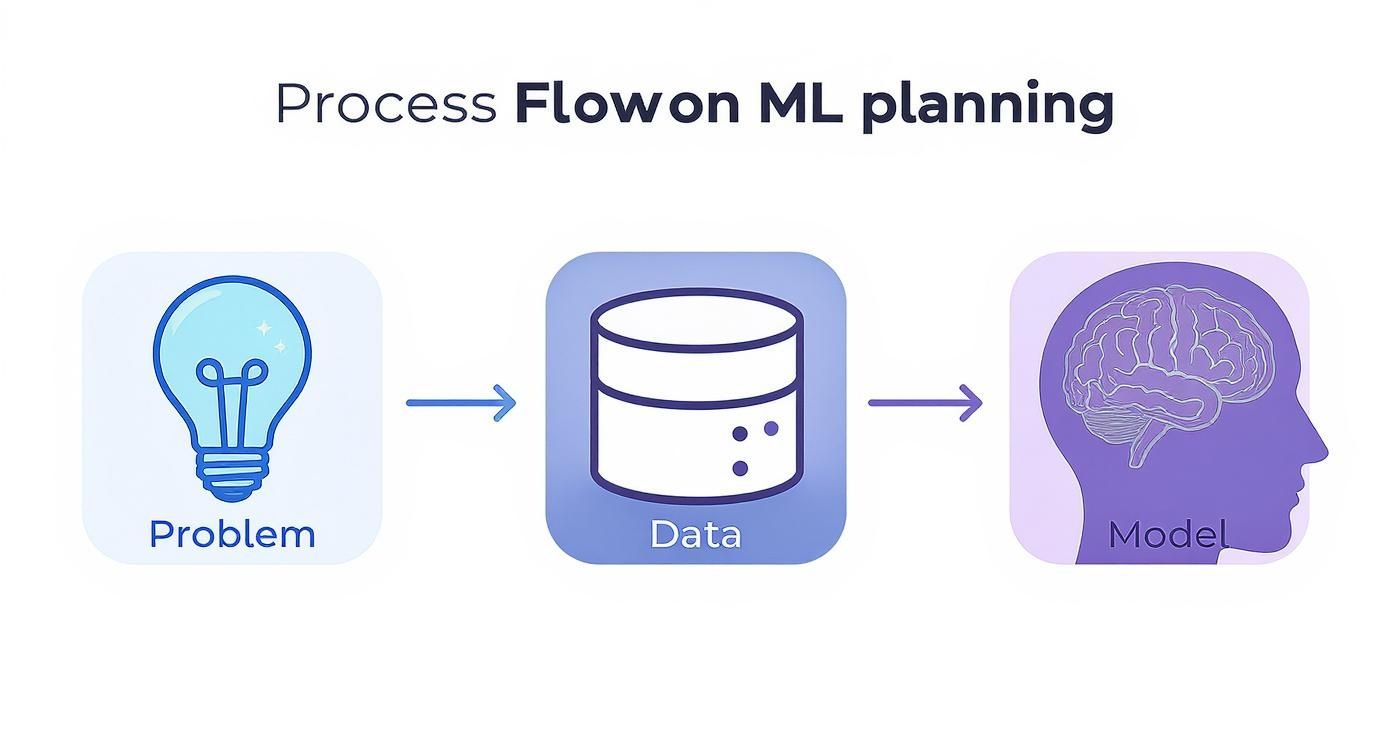
This whole process really starts with understanding the path from a business problem to the final model.
As you can see, a well-defined problem dictates exactly what data you need, which in turn points you toward the right kind of model. It’s a logical flow that sets you up for success.
The Art and Science of Data Preprocessing
Before any algorithm can learn, its “textbook”—your data—has to be squeaky clean. Raw data pulled straight from your systems is almost always a mess. It’s often incomplete, inconsistent, and riddled with errors that will completely throw your model off track.
Getting your data ready involves a few crucial steps:
- Cleaning the Data: This is where you deal with missing values (like a customer record without an age), fix obvious errors (think typos in postcodes), and get rid of any duplicate entries.
- Transforming Data: Algorithms speak in numbers. This step is about converting categorical data, like product colours (“Red,” “Blue,” “Green”), into a numerical format the model can actually process.
- Normalising Data: You might have data on completely different scales, like a customer’s age (0-100) and their annual income ($50,000 – $250,000). Normalisation puts everything on a level playing field so one feature doesn’t accidentally overshadow the others.
A practical case: a Sydney-based business is working on a Shopify implementation and wants to build a product recommendation engine. Their raw data would be a jumble of purchase histories, browsing logs, and customer profiles. Preprocessing here would mean standardising all the product names, intelligently filling in missing customer details, and turning browsing session times into a consistent, numerical value.
A model learning from messy data is like a student learning from a textbook full of typos and missing pages. No matter how smart the algorithm is, its conclusions will be flawed.
Selecting Your Tech Stack: Frameworks and Libraries
With clean data in hand, it’s time to pick your tools. The great thing about machine learning is the wealth of powerful open-source frameworks available, so you don’t have to build everything from scratch. The tech stack you choose will directly impact how fast you can develop, how well your app scales, and what kinds of models you can realistically build.
You’ll almost certainly come across these heavy hitters:
- TensorFlow: Built by Google, this is the beast you turn to for large-scale neural networks. It’s perfect for complex jobs like image recognition or understanding natural language.
- PyTorch: A favourite among researchers for its flexibility. PyTorch is brilliant for quickly prototyping new ideas and building highly customised models.
- Scikit-learn: This is your workhorse for traditional machine learning. If your task involves classification, regression, or clustering, Scikit-learn has a clean, efficient toolkit that just works.
For most projects, Python is the language of choice, with libraries like Pandas for wrangling data and NumPy for heavy-duty numerical work. A typical software development Sydney team building an ML app would likely use Python, start with Scikit-learn for initial modelling, and then bring in TensorFlow if they need to tackle more advanced deep learning problems.
The Training and Validation Loop
This is where the magic really begins. During training, the algorithm churns through your prepared data, hunting for patterns and figuring out the relationships between your inputs and the desired outputs. But this isn’t a “set it and forget it” deal. It’s a meticulous loop: you feed the model data, it makes a prediction, you measure how wrong it was, and it adjusts itself to do better next time.
A crucial part of this process is splitting your data into three distinct piles:
- Training Set: This is the biggest chunk, used to actually teach the model.
- Validation Set: Used during training to fine-tune the model’s settings and make sure it’s learning correctly.
- Testing Set: This is your final exam. It’s kept completely separate until the very end to give you an honest grade on how the model performs on data it has never seen before.
This separation is your best defence against overfitting—a classic trap where a model memorises the training data, noise and all. An overfitted model looks like a genius on the data it was trained on, but falls apart completely when it encounters new, real-world information.
A Practical Example: A WooCommerce Store in Adelaide
Imagine a WooCommerce store in Adelaide is having trouble with inventory. They want to use machine learning to forecast which products will be hot sellers next month.
Their team would start by preprocessing years of sales data, making sure to account for things like seasonality, past promotions, and stock levels. They might pick a regression model from Scikit-learn to predict sales numbers. During the training loop, they’d feed it historical data, letting it learn how different factors influence sales. The validation set helps them tweak the model for better accuracy, and the final test set proves whether its predictions for a past month (that it was never shown) were on the money.
To really get the most out of your AI core, you should look into applying principles of context engineering for AI. This is all about helping the model better grasp the specific nuances of your business problem, leading to much more effective results.
Ultimately, building the AI core is a disciplined dance of preparation, experimentation, and rigorous testing. Whether it’s an Odoo implementation Adelaide firm automating invoicing or a major retailer personalising customer offers, this iterative cycle is what turns a pile of raw data into a smart, reliable engine that creates genuine business value. Need help building your AI core? Contact us for expert guidance.
Putting Your Model to Work in a Live Application
Let’s be honest, a brilliant, highly accurate machine learning model is completely useless if it just sits on a data scientist’s laptop. Its real value is only unlocked when you get that intelligence into the hands of your users. This is where deployment comes in—it’s the crucial bridge between the theoretical world of data science and the practical reality of software development.
This stage is all about transforming your trained model into a living, breathing feature within your application. The choices you make here will directly shape your app’s speed, how well it scales, and the overall user experience. It demands careful thought to ensure the final product is not just smart, but also robust, responsive, and something your users can trust.

Choosing Your Deployment Strategy
Your first big decision is figuring out where your model will actually live and run. There’s no single “best” answer here; the right choice comes down to what your app needs to do. You’re looking at two main paths: running the model on the user’s device or hosting it in the cloud.
-
On-Device Deployment: This means you embed the model directly into the mobile or web application. It’s incredibly fast because there’s no network lag, and it works offline—a massive plus for apps that need to function anywhere. Think of a real-time photo filter; it has to process the image instantly on your phone, not a second later.
-
Cloud-Based Deployment: In this setup, the model lives on a server, and your app talks to it through an API. This approach is fantastic for scalability, allowing you to handle millions of users without breaking a sweat. It also makes updating the model a piece of cake, as you can roll out a new version without forcing everyone to update their app.
Of course, for many businesses, a hybrid approach offers the best of both worlds. You might have a simple, lightweight model run on the device for quick tasks, while the more complex, heavy-lifting computations get sent to a powerful cloud server.
Building a Robust API Bridge
If you go with a cloud-based strategy, your Application Programming Interface (API) essentially becomes the central nervous system of your ML feature. The API acts as the messenger, taking input from your app, zipping it over to the model for processing, and then returning the model’s prediction.
A well-designed API is absolutely critical for a smooth experience. It needs to be:
- Fast: Users simply won’t wait around for a feature that takes several seconds to give them an answer.
- Secure: You have to protect both the user data being sent and the intellectual property of your model itself.
- Well-Documented: Clear documentation is a must, so your app developers can integrate the ML feature without any guesswork.
Here’s a practical case: a logistics company with an Odoo implementation in Sydney. They might build an ML model to predict delivery times. Their mobile app would use an API to send the start and end points to the cloud model, which then returns an estimated time of arrival to display to the driver.
A poorly constructed API is a classic bottleneck. It doesn’t matter how brilliant your model is; if the communication link is slow or unreliable, the user experience will suffer dramatically.
Designing the User Experience for AI
Presenting the output of a machine learning model is a whole different ball game from displaying simple, static information. Models often give predictions with a degree of uncertainty or probability, and your UI/UX design has to communicate this clearly to build user trust.
For example, if your WooCommerce store has a feature to detect potentially fraudulent orders, you shouldn’t just block the transaction outright. A much better approach is to flag it with a probability score (e.g., “85% likely fraudulent”) and present this information to a human for the final say-so. This keeps the user in control and makes the AI feel like a helpful assistant, not an unforgiving judge.
Practical Cases of Live Deployment
Let’s see how this plays out in the real world. A Shopify implementation for a fashion retailer in Adelaide might deploy a visual search model. A user could upload a photo of a dress they like, and the app would instantly show similar items from the store’s inventory. This model would almost certainly be cloud-based to handle the heavy image processing demands.
Meanwhile, a professional services firm offering software development in Adelaide could build a custom mobile app for its clients that uses an on-device model to categorise expenses from receipt photos. It’s fast, private, and works even when you’re offline.
Ultimately, successful machine learning app development hinges on a deployment strategy that lines up perfectly with your business goals and user needs. Getting this right is what makes an app not just intelligent, but a genuine delight to use.
Ready to bring your intelligent app to life? Talk to the Wistec team today to discuss the best deployment strategy for your project.
Keeping Your App Intelligent After Launch
Getting your machine learning app out the door feels like a massive win, and it is. But here’s the thing I’ve seen time and again: launch day is the starting line, not the finish. The moment your app goes live, it’s interacting with a dynamic, messy, and constantly changing world. New trends pop up, people change their habits, and the very data you so carefully trained your model on starts to go stale. This is just the reality of machine learning app development.
There’s a name for this natural decay in performance: model drift. It’s what happens when your model, which learned its smarts from historical data, slowly becomes less accurate because the new, real-world data it’s seeing no longer fits the old patterns. If you ignore model drift, you’re essentially letting your intelligent app get foolish by the day.
Monitoring Performance in the Real World
You can’t fix a problem you don’t even know you have. The first and most critical step in fighting model drift is to have a rock-solid monitoring system in place. I’m not just talking about a simple check to see if the app is online. This is about diving deep and constantly tracking how well your model is actually predicting things and what impact that has on your business goals.
Let’s look at a practical case: you’ve got a Shopify implementation with an ML model that serves up product recommendations. Post-launch, you absolutely need to be keeping an eye on:
- Prediction Accuracy: Are people actually clicking on and buying the products the model recommends? Or are the suggestions starting to miss the mark?
- Business Impact: Is the average order value from these recommendations staying strong, or is it starting to dip?
This constant feedback loop is your canary in the coal mine. It’ll give you a heads-up the moment your model starts to lose its edge, long before it becomes a real headache for your customers or a drag on your revenue.
A model’s intelligence isn’t a permanent state; it’s a resource that needs constant maintenance and replenishment. Proactive monitoring ensures your app stays sharp, effective, and valuable.
The Cycle of Retraining and Improvement
So, what happens when your monitoring flags a drop in performance? It’s retraining time. Now, this doesn’t mean you have to throw everything out and start from scratch. It’s more about feeding your model a fresh diet of new, relevant data, letting it learn from the latest trends and adjust its logic.
The process is pretty straightforward: you collect recent data, fold it into your original training set, and kick off the training process again. The aim here is to create a newer, sharper version of the model that you can swap in to replace the outdated one, with zero downtime for your users. After launching your application, this kind of continuous optimisation is crucial. It often means navigating the tricky AI speed-accuracy trade-off to make sure your model is both fast and effective.
Think of a business in Sydney using an Odoo implementation for its supply chain. A predictive model that forecasts inventory might need a refresh every quarter to bake in new sales figures and seasonal buying habits. This is how you keep those forecasts on point.
This cycle—monitor, retrain, redeploy—is the beating heart of any ML application that delivers long-term value. It doesn’t matter if you need custom software development in Adelaide or an enhancement for your WooCommerce store; partnering with people who get this full lifecycle is non-negotiable. This is how you make sure your app doesn’t just start smart—it stays smart.
Ready to build an intelligent application with a plan for long-term success? Contact Wistec today for a free consultation and let’s create a solution that evolves with your business.
Your Questions on Machine Learning App Development Answered
Diving into a machine learning project for the first time? It’s natural to have a lot of questions. Let’s walk through some of the most common ones I hear from clients, so you can move forward with a clearer picture.
How Long Does It Take to Build an ML App?
This is probably the biggest question on everyone’s mind, and the honest answer is, “it depends.” I’ve seen a simple proof-of-concept, using a nice, clean dataset and a standard model, come together in just a few months. On the other hand, a highly complex application with custom-built algorithms sifting through massive, messy datasets can easily push past the one-year mark.
What really dictates the timeline? It usually boils down to a few key things:
- Data Quality and Availability: If your data is pristine and ready to use, you’ve got a massive head start. Sourcing, cleaning, and preparing messy data can be a project in itself, sometimes adding months to the schedule.
- Model Complexity: There’s a world of difference between training a simple regression model and building a sophisticated deep neural network from scratch. The more complex the problem, the longer it takes.
- Integration Requirements: How tightly does this new brain need to be wired into your existing setup? A straightforward API call is one thing, but a deep, seamless integration with something like an Odoo implementation in Sydney is a much bigger job.
What Does It Cost?
Just like the timeline, the cost can vary dramatically. You might be able to integrate a basic ML feature into an existing app for a few tens of thousands of dollars. But if you’re talking about a full-scale, custom software development Sydney project with a dedicated team of data scientists and engineers, you’re looking at an investment that can easily climb into the hundreds of thousands.
The main things driving the cost are the size of the team, how long the project runs, and the sheer computing power needed to train and host the model. Specialised expertise doesn’t come cheap, but it’s what gets you the results.
Can I Use an Off-the-Shelf Model?
You absolutely can, and honestly, it’s often the smartest place to start. Pre-trained models from providers like Google AI or Amazon SageMaker are brilliant for common tasks like image recognition or analysing customer sentiment. They can slash your development time and budget.
However, when you get to problems that are unique to your business—like predicting customer churn based on your specific user behaviour—a custom-built model is almost always going to perform better. If you’re in e-commerce, for instance, a team experienced with Shopify implementation can help you figure out whether a pre-trained model is good enough or if you need something bespoke to really move the needle.
Think of it this way: an off-the-shelf model is like a well-made suit off the rack—it fits pretty well. A custom model is a bespoke suit, tailored perfectly to your measurements for an impeccable fit.
Do I Need a Data Scientist on My Team?
Look, it’s technically possible to build some simple ML features without a dedicated data scientist. But for any project that’s meant to be more than a novelty, having that expertise is a genuine game-changer. A data scientist’s deep understanding of statistical analysis, model selection, and validation is what transforms a functional app into a truly intelligent one.
For businesses in Adelaide or Sydney, a great middle ground is to partner with a development firm that has both data science and platform-specific skills, like WooCommerce expertise, under one roof. It gives you access to that top-tier talent without the long-term cost and commitment of hiring someone full-time.
Ready to build an intelligent app that delivers real business value? The team at Wistec has the expertise to guide you through every stage of machine learning app development, from strategic planning to post-launch support. Contact us today for a free consultation.