

If you’re running a small business, you know the daily grind of managing stock. It’s a constant balancing act — order too much and your cash sits in products collecting dust; order too little and you risk frustrated customers and lost sales. That’s where inventory management software for small businesses becomes essential. It’s not just a tool but a command centre that helps you stay in control of every moving part of your operation.
Think of it as the upgrade from a paper map to a live GPS. It automates your stock tracking, prevents those all-too-common (and costly) errors, and keeps your sales data perfectly synced, whether you sell online, in-store, or both. It gives you the clear, real-time picture you need to make smart, profitable decisions and keep up with customers who expect fast, reliable delivery. Ready to take control? Let’s dive in.
Why Manual Inventory Tracking Is Holding You Back

Does this sound familiar? You’re constantly wrestling with stockouts, drowning in overstocked items, or cleaning up after simple human errors. If you’re nodding along, you’re definitely not alone. Relying on spreadsheets or a notepad to track your inventory is like trying to navigate peak-hour city traffic with a street directory from the ’90s. It’s stressful, inefficient, and you’re bound to make a few wrong turns.
For a growing business, those wrong turns aren’t just minor bumps in the road; they’re direct hits to your bottom line. Every time a customer buys something online that you’ve already sold out of, you’re chipping away at their trust. Every dollar you have tied up in slow-moving stock is capital that could be fuelling your marketing or next big idea.
The True Cost of Guesswork
Let’s be honest: manual methods are built on a foundation of guesswork and old information. A single typo in a spreadsheet can set off a chain reaction, leading to incorrect stock counts, panicked last-minute orders, and sales opportunities that simply vanish. This constant firefighting keeps you stuck in a reactive loop, preventing you from ever getting ahead and planning for real growth.
And in today’s market, customer expectations are higher than ever. Shoppers want to see accurate stock levels online and get their orders on their doorstep, fast. A clunky, manual system makes it nearly impossible to deliver that experience consistently, especially if you’re juggling sales across multiple platforms.
Practical Case: An Adelaide-based e-commerce store selling handmade jewellery was using a spreadsheet to manage stock for their WooCommerce site and weekend market stall. A simple data entry error showed 10 necklaces in stock when there were only two. They sold eight online overnight, leading to six cancelled orders, six unhappy customers, and a scramble to update their processes. This is a classic example of how manual tracking can directly damage customer relationships.
The Australian Small Business Challenge
This isn’t just a hypothetical problem; it’s a very real one for Australian businesses. Recent data shows that a staggering 62% of Australian retail brands and manufacturers have inventory accuracy rates sitting below 80%. That gap is what causes frequent stockouts, bloated warehouses, and significant lost revenue—a massive hurdle for any small or medium business.
Getting a proper system in place is no longer a “nice-to-have.” It’s a fundamental requirement for staying competitive. You can read more about the state of inventory management in Australia and see how other businesses are tackling this head-on.
For small businesses here in Australia, the solution is a strategic move towards the right technology. A well-chosen software system provides the visibility and control needed to compete with the big players. For example, a professional Odoo implementation that Sydney businesses often turn to can seamlessly connect every part of the operation, from the shop floor to the warehouse. A successful Shopify implementation can also provide a single source of truth for your stock.
Ultimately, clinging to manual methods is an active choice to limit your potential. It’s an approach that simply can’t keep pace with modern commerce. If you’re ready to ditch the spreadsheets and unlock genuine efficiency, adopting the right tools is your first and most important step.
If your business is based in Sydney or Adelaide and you’re ready to see how a custom solution can solve these headaches, our team can help. We specialise in the kind of software development Sydney and Adelaide businesses rely on to build systems that grow with them.
Take the next step and schedule a free consultation to discuss your inventory management needs today!
Core Features Your Business Software Must Have

When you’re choosing the right inventory management software for small businesses, it’s not about finding a program with the longest list of features. It’s about solving the real, day-to-day problems that are holding you back. The aim is to find a set of tools that transforms stock control from a constant headache into one of your biggest strengths.
Think of it like a pilot’s cockpit. You don’t need every single button and dial, but you absolutely need the core instruments that give you a clear view and complete control. Without them, you’re essentially flying blind, just hoping you don’t run out of fuel halfway to your destination.
These key functions are what truly separate a simple spreadsheet from a powerful business system. They’re built to handle the repetitive stuff for you, stop costly mistakes before they happen, and arm you with the data to make sharp decisions that boost your bottom line.
To get a clearer picture, let’s look at the essential features and the real-world impact they have on a business.
Key Software Features and Their Business Impact
| Feature | What It Does | Impact on Your Business |
|---|---|---|
| Real-Time Stock Tracking | Instantly updates inventory levels across all sales channels as soon as a sale is made. | Prevents overselling and customer frustration. Gives you a single, reliable view of what you actually have in stock. |
| Automated Reordering | Let’s you set minimum stock levels that trigger automatic purchase orders when reached. | Stops stockouts of your best sellers, ensuring you never miss a sale. Frees up cash by avoiding overstocking slow-moving items. |
| Barcode Scanning | Uses scanners or mobile apps to quickly process items during receiving, picking, and stocktakes. | Massively increases speed and virtually eliminates human error from data entry, leading to highly accurate inventory records. |
| Multi-Channel/Location Sync | Centralises inventory data from all your sales channels (e.g., online, retail) and physical locations (e.g., warehouses). | Provides a unified view of your entire inventory, simplifying order fulfilment and allowing for smarter stock distribution. |
| Reporting & Analytics | Generates reports on sales trends, stock turnover, profitability, and supplier performance. | Turns raw data into actionable insights. Helps you identify best-sellers, clear out dead stock, and make smarter buying decisions. |
These features work together to create a system that’s much more than the sum of its parts, giving you a firm grip on your business operations.
Real-Time Stock Tracking
This is the absolute cornerstone of any decent system. Real-time tracking means your stock count updates automatically and instantly everywhere, the second a transaction happens.
Imagine you’re running a flash sale. A customer buys the last available item from your Shopify store. Without real-time tracking, that same product might still show as ‘in stock’ on your WooCommerce site or in your physical shop, setting you up for the nightmare of overselling. A proper system stops this dead in its tracks, giving you one source of truth for your stock levels, always.
Automated Reordering and Purchasing
Fed up with constantly checking stock levels and manually raising purchase orders? This is your solution. Automated reordering lets you set minimum stock thresholds for each product. Once your inventory dips below that “reorder point,” the software flags it and can even generate a draft purchase order for you to approve.
It’s like having a vigilant assistant who never forgets to restock the shelves. This ensures your most popular items are always available, preventing lost sales from stockouts and helping you maintain a much leaner inventory.
Practical Case: A boutique in Sydney was constantly selling out of its most popular dress during peak season. After getting software with automated reordering, they set the reorder point to five units. Now, the moment stock hits that number, a purchase order is automatically drafted, ensuring they never miss a sale because the rack is empty. This simple automation freed up the owner to focus on customer service and marketing instead of manual stock checks.
Barcode and Scanning Capabilities
Let’s be honest, manual data entry is slow and a magnet for mistakes. Barcode scanning completely changes the game, bringing speed and accuracy to receiving goods, picking orders, and doing stocktakes. Your team can use a simple mobile app or a dedicated scanner to process items in a fraction of the time.
This feature is critical for keeping your inventory records pristine. An expert software development Sydney team can integrate this functionality seamlessly, making your warehouse operations incredibly efficient and almost entirely error-free from the moment a delivery arrives.
Multi-Channel and Multi-Location Syncing
Today’s businesses sell everywhere—online stores, physical shops, marketplaces. Your software absolutely must centralise inventory from all these different streams. Whether you need a powerful Shopify implementation or a system that links to your POS, that seamless connection is everything.
This is also vital if you hold stock in more than one place. A business owner in Adelaide needs to see exactly what’s in their main warehouse versus their city storefront with just a few clicks. This complete, unified view is essential for fulfilling orders efficiently and moving stock to where it’s needed most.
Reporting and Analytics
Good data fuels great decisions. Your inventory software should give you easy-to-understand reports on sales trends, how fast your stock is turning over, and even how reliable your suppliers are. Which products are flying off the shelves? And which ones are just gathering dust?
These analytics help you understand your business at a much deeper level. For instance, an Odoo implementation Adelaide businesses might use can create reports that highlight seasonal sales patterns. This allows them to forecast demand with far greater accuracy and fine-tune their purchasing to maximise profit.
Ready to equip your business with the tools it needs to thrive? Don’t let outdated processes dictate your potential.
The Real-World Wins of an Automated Inventory System
Bringing in new software isn’t just about ticking boxes on a features list; it’s a genuine strategic move that can set you up for growth. Think of an automated inventory system less like a digital version of your old clipboard and more like an engine for efficiency. Its main job? To free up your two most precious resources: your cash and your time. It’s the difference between constantly reacting to problems and proactively running your business.
Imagine you’re in a rowboat. You can spend all your energy bailing out water with a bucket, or you can install a small automatic pump. One approach keeps you frantically busy just trying to stay afloat. The other lets you pick up the oars and actually steer towards your destination. That’s exactly what good inventory management software for small businesses does—it takes over the thankless, repetitive work so you can focus on the bigger picture.
Unlock Your Cash Flow
Every single item sitting on your shelf is money you can’t use. Overstocking is a quiet but deadly drain on profits, tying up your capital in products that just aren’t moving. That’s cash that could be fuelling your next marketing campaign, funding product development, or simply sitting in your bank account as a healthy reserve.
When you have precise, up-to-the-minute inventory data, you can finally stop guessing. You get the clarity to keep stock levels lean without ever running the risk of a stockout. This means you order what you need, just when you need it, turning your products over faster and getting that cash back into your business where it belongs.
Practical Case: A small hardware store in Adelaide struggled with overstocking seasonal items. After implementing an inventory system, they analysed sales data from the previous year and reduced their order of winter gear by 30%. This freed up thousands of dollars, which they immediately reinvested into marketing for their more profitable, year-round product lines.
Get Your Team’s Precious Time Back
Be honest—how many hours a week do you or your team lose to manual stocktakes, double-checking spreadsheets, or running to the storeroom to confirm you have something? Automation gives you all those hours back. When routine jobs like updating stock levels after a sale or generating purchase orders happen automatically, your team is suddenly free to work on things that actually make a difference.
This reclaimed time can be put to much better use:
- Building real relationships with customers and delivering standout service.
- Creating and running marketing campaigns that bring new people through the door.
- Digging into sales data to spot the next big opportunity.
A well-built system, like one from a specialist in software development that Sydney businesses rely on, makes sure these processes just hum along in the background. Your whole operation becomes more productive without anyone having to work harder.
Build Rock-Solid Customer Loyalty
In a crowded market, being reliable is your superpower. Nothing builds trust faster than consistently delivering on your promises, and accurate stock levels are the bedrock of that trust. When your system gives you a live, real-time view of your inventory, you can tell customers exactly what’s available and when they’ll get it—with confidence.
This simple act of reliability prevents that gut-wrenching moment when a customer orders something, only for you to call them back and say it’s actually out of stock. It builds trust, earns you repeat business, and strengthens your reputation. A seamless Shopify implementation or WooCommerce integration, powered by accurate inventory data, ensures your online shopfront is a true reflection of what’s on your shelves.
This move towards automation is happening all across Australia. The Australian ERP software market, which covers inventory solutions, was valued at around USD 930 million in 2024 and is set to grow as more businesses wise up to the need for efficiency. This isn’t just a trend for big corporations; rising IT budgets are finally allowing small businesses to get their hands on powerful tools. These systems integrate inventory with other parts of the business, helping them compete and meet the modern customer’s demand for fast, reliable service. You can discover more insights about this growing market trend and its impact on Australian SMEs.
An automated system isn’t an expense—it’s a direct investment in a more efficient, profitable, and scalable future for your business.
Ready to see what that looks like? Contact our experts in Sydney and Adelaide today to explore a solution that’s built for your goals.
How to Choose the Right Inventory Software
Let’s be honest, picking the right inventory management software for small businesses can feel overwhelming. With a sea of options out there, it’s easy to get lost. The secret isn’t finding the software with the most bells and whistles; it’s about finding the one that solves your real-world problems. This is a big decision, one that will directly shape how efficiently and profitably you operate for years.
So, where do you start? The best place is to look inwards at your own business. What are the daily headaches and operational logjams that are holding you back? Getting a clear picture of these pain points is the first step toward finding a solution that actually works for you.
This infographic really nails the core benefits a great inventory system brings to the table, showing how it frees up cash, buys back your time, and helps build lasting customer loyalty.
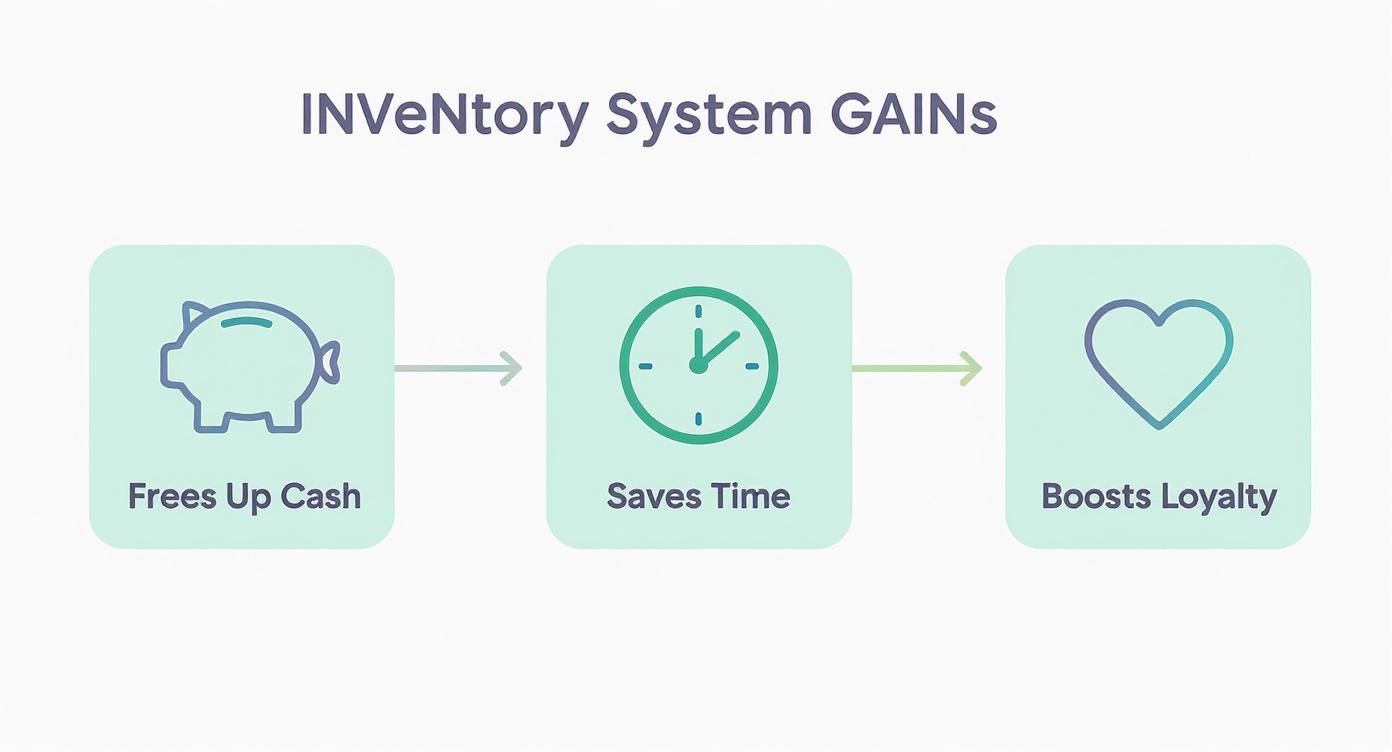
As you can see, the right software turns your inventory from a headache and a cost centre into a powerful asset that actually drives growth.
Map Your Current Workflows
Before you even think about watching a software demo, grab a whiteboard or a notebook. Seriously. Trace a product’s entire journey through your business, from the moment you hit ‘order’ with your supplier to the second it’s in a courier’s hands on its way to a happy customer.
You need to identify every single touchpoint and manual step. Where are the delays? Where do mistakes creep in? Maybe it’s during receiving, in the picking and packing process, or trying to reconcile stock levels between your Shopify store and your physical shop. Pinpointing these specific bottlenecks will give you a rock-solid “must-have” list for your new software.
Define Your Non-Negotiable Requirements
With your workflow map in hand, you can start building your list of essentials. Don’t let yourself get sidetracked by flashy features you’ll never touch. Your focus should be squarely on what will make the biggest, most immediate difference to your daily grind.
Ask yourself these critical questions:
- Multi-Channel Needs: Do you need to sync inventory across different platforms, like WooCommerce and a brick-and-mortar store?
- Product Complexity: Are you selling products that need batch or expiry date tracking, like food, cosmetics, or pharmaceuticals?
- Warehouse Management: Is your stock spread across multiple warehouses or locations that need to be managed from one central hub?
- Integration Essentials: What other tools does it absolutely have to talk to? Think about your accounting software, shipping carriers, or your point-of-sale (POS) system.
Having a prioritised list of these requirements is your best defence against choosing a system that looks good on paper but falls flat in practice. This clarity ensures you invest in a tool that solves today’s problems and is ready to support tomorrow’s growth.
Off-the-Shelf vs Custom Software Development
Next up is a major fork in the road: do you go for a ready-made, off-the-shelf solution, or do you invest in a custom-built system? There’s no single right answer here; it all comes down to your business’s complexity and your ambitions for the future.
An off-the-shelf system is usually quicker to get up and running and has a lower upfront cost. It’s a fantastic starting point for businesses with fairly standard workflows. The trade-off, however, is that you might have to bend your processes to fit the software’s rigid structure, and customisation options can be very limited.
A custom solution, on the other hand, is built from the ground up around your exact processes. A professional software development Sydney team can craft a system that perfectly mirrors your unique operational DNA, giving you a serious competitive advantage. For businesses with specialised needs or big growth plans, this is often the smarter long-term play. For instance, a tailored Odoo implementation Sydney businesses often choose is designed to scale with them, integrating every part of the operation from day one.
Questions to Ask Every Vendor
Once you start having conversations with vendors, you need to be prepared. Arming yourself with a checklist of sharp, specific questions will help you slice through the sales pitch and get to the information that truly matters.
Make sure your checklist includes:
- Onboarding and Training: What does the implementation process actually look like? What kind of training do you provide to get my team up to speed?
- Customer Support: When things go wrong, what are your support hours? What’s the typical response time for a critical issue?
- Scalability and Pricing: How does your pricing model work as my business grows? What happens when I add more users, products, or locations?
- Integration Capabilities: Can you show me a real-world example of a successful Shopify implementation you’ve done, or how you connect with my specific accounting software?
Choosing the right software is a foundational move for scaling your business. By taking a thoughtful, strategic approach, you can find a partner and a platform that will be a driver of efficiency for years to come.
If you’re in Sydney or Adelaide and think a custom solution might be the right path for you, let’s have a chat.
See It in Action: Real-World Business Stories
It’s one thing to talk about features and benefits in theory, but the real power of inventory management software for small businesses shines when you see it solve actual, day-to-day problems. Let’s move past the jargon and look at how smart technology gives Australian businesses a genuine competitive edge, turning operational headaches into streamlined success.
These aren’t tales of massive corporations with unlimited budgets. They’re about businesses just like yours that hit a wall, decided to make a change, and saw incredible results. From a local fashion boutique to a food producer, the right system can be a complete game-changer.
Case Study One: The Sydney Fashion Retailer
Picture a boutique fashion brand in Sydney. They were living the modern retail dream—and nightmare—selling through a buzzing Shopify store while also running popular pop-up shops on weekends. Before they got their systems in sync, managing their stock was a constant source of anxiety.
Their inventory was tracked on separate spreadsheets that were only reconciled at the end of the day. This lag created that dreaded scenario every retailer fears: a dress would sell out at the pop-up but still show as ‘in stock’ online. This led to a painful string of oversold items, forcing them to cancel orders, apologise to frustrated customers, and watch their hard-earned reputation take a hit.
The fix? A professional Shopify implementation that linked everything to one central inventory hub.
- Real-Time Syncing: The moment a sale was made at the pop-up, stock levels updated on their Shopify store instantly. Overselling became a thing of the past.
- A Single Source of Truth: For the first time, they had one clear, accurate picture of their sales data. They could finally see what was flying off the virtual shelves versus what customers loved in person.
- Smarter Stocking: Armed with this insight, they could cleverly allocate stock to each channel, making sure their bestsellers were always where their customers were.
By connecting the dots between their sales channels, they didn’t just plug a hole; they created a stronger, more reliable business that kept customers happy and boosted the bottom line.
Case Study Two: The Adelaide Food Producer
Now, let’s head to Adelaide and check in with a small-batch food producer. They were selling their artisanal products directly to customers via their WooCommerce site and also supplying a network of local cafes. Their biggest challenge was a make-or-break issue in the food industry: managing expiry dates and batch numbers.
Manually trying to track every batch was not only painfully slow but also riddled with errors. It made packing orders a logistical nightmare. They were constantly fighting to ensure older stock was sent out first (the crucial ‘First-In, First-Out’ or FIFO method), which led to perfectly good products expiring on the shelf and going to waste.
This is where a purpose-built system makes all the difference. For a business with specific needs like batch tracking, a generic, off-the-shelf solution just won’t cut it. They needed something designed for their precise workflow.
They opted for a custom Odoo implementation Adelaide businesses often turn to for its adaptability. A local software development Sydney Adelaide team configured the system to tackle their exact challenges head-on.
The results were immediate and transformative. The new system automated their entire process, from the moment ingredients arrived to when the final product was shipped. When it was time to pack an order, the system told warehouse staff exactly which batch to pick, enforcing the FIFO rule flawlessly. This one change dramatically cut down on product waste and guaranteed their customers always received the freshest goods possible.
As these stories show, the right software is so much more than an expense—it’s a problem-solver. It zeroes in on your specific industry pain points, creates powerful efficiencies, and gives you the clear data you need to grow your business with confidence.
Ready to write your own success story?
What’s Next for Small Business Inventory Management?
The way we manage inventory is changing, and fast. What keeps you afloat today might not be enough to stay competitive tomorrow. It’s not about jumping on every new trend, but about choosing a system built to handle the challenges of the future, not just the problems you have right now.
Imagine a system that does more than just count what’s on the shelf. Picture one that can predict, with startling accuracy, what your customers will want to buy next month. That’s the reality of Artificial Intelligence (AI) and machine learning. These tools dive deep into your sales history, market trends, and even seasonal shifts to give you demand forecasts that are sharper than ever. This means you can optimise your stock levels automatically, slash waste, and keep your cash flow in a much healthier state.
Your Stock, Anywhere, Anytime: The Cloud Revolution
Gone are the days of being chained to a single desktop computer to check on your inventory. Cloud-based systems are the new normal, and they offer a level of flexibility that was once unthinkable. Whether you’re at a trade show, meeting a supplier, or just working from home, all your inventory data is right there at your fingertips, on any device.
This kind of accessibility is a massive win for agile small businesses. It means you can make crucial decisions on the fly and your team can stay in sync, no matter where they are. This shift to the cloud is a huge reason the Australian inventory management software market is tipped to grow at a compound annual rate of around 8.4% from 2025 to 2033. This boom is being driven by small businesses just like yours, who are using cloud systems to get a better grip on their operations and trim down costs. You can get a deeper dive into these key industry findings and see how they could impact your business.
It’s All About Connection: The Power of an Integrated System
In the near future, your inventory software won’t just be a standalone program. Its true strength will lie in how seamlessly it talks to all the other tools you rely on. Think of it as the central nervous system of your business, effortlessly sharing information with your:
- eCommerce Platforms: Keeping stock levels perfectly aligned between your warehouse and your Shopify or WooCommerce storefront.
- Point of Sale (POS) Systems: Merging your online and physical store sales into one clear picture.
- Accounting Software: Automating financial records so you always have a real-time view of your profitability.
When everything is connected, you can finally say goodbye to tedious manual data entry and the costly errors that come with it. You get a single, trustworthy source for your entire business performance. A smart Odoo implementation, Sydney businesses are adopting, for instance, linking inventory directly to sales, purchasing, and accounting. Similarly, expert software development Sydney Adelaide teams can create custom integrations that give you a serious competitive advantage.
Ready to build an inventory system that’s ready for whatever comes next?
Contact Wistec today for a free consultation, and let’s discuss a solution that grows with you!
Your Questions, Answered
Jumping into the world of inventory management software for small businesses can feel a bit daunting. Let’s clear up some of the most common questions that pop up so you can move forward with confidence.
What’s This Going to Cost My Small Business?
The price tag really depends on the path you take. Most off-the-shelf software runs on a subscription, meaning you’ll pay a monthly fee based on things like how many users you have, the features you need, or your sales volume. It’s a great way to start because the initial outlay is low and the costs are predictable.
The other route is a custom-built solution from a firm that specialises in software development, Sydney Adelaide businesses rely on. This will cost more upfront, no doubt about it. But the trade-off is a system perfectly moulded to your unique processes, which can deliver massive efficiency gains and a much better return over the long haul.
Will It Play Nicely with My Shopify or WooCommerce Store?
Yes, it should—but you have to do your homework. Modern inventory platforms are designed to connect with the big e-commerce players. A smooth Shopify implementation or WooCommerce connection is all about having solid, pre-built connectors.
Don’t just take a vendor’s word for it. Ask them to show you specific examples of integrations they’ve done before. This is the only way to be sure your online shop and your stock system will talk to each other without any hiccups, saving you from the nightmare of overselling or endless manual updates.
Is Inventory Software Just a Stripped-Down ERP?
Not exactly. It’s better to think of them as different tools for different jobs.
Dedicated inventory software is a specialist. It’s laser-focused on one thing: mastering your stock control, purchasing, and order fulfilment. It does that one job incredibly well.
An Enterprise Resource Planning (ERP) system, like Odoo, is the whole toolbox. It’s an all-in-one suite designed to run your entire operation—from inventory and accounting to your customer relationships and HR. Many businesses start with a focused inventory tool and grow into an ERP later. A strategic Odoo implementation, Sydney Adelaide teams recommend, usually happens when a company gets to a point where it needs to bring all its operations under one roof, not just its stock.
Ready to get answers tailored to your business? The team at Wistec has seen it all and can help you find the perfect fit.
Book your free consultation today, and let’s build a solution that drives your growth!