

For any Australian manufacturer still juggling inventory on spreadsheets, let's be frank: you're playing with fire. It's a high-risk game that inevitably leads to production grinding to a halt, cash being tied up in storage, and sales evaporating due to stockouts. The reality is that purpose-built inventory management software for the manufacturing industry isn't just an optional upgrade anymore—it's a fundamental strategic tool for survival and growth.
Why Smart Inventory Management Is No Longer Optional
Trying to run a modern manufacturing operation on spreadsheets is like trying to navigate a ship through a storm with a paper map. It's messy, unreliable, and bound to get you into trouble. This isn't just about minor inconveniences; it’s about real money lost to production mistakes, inflated carrying costs, and the customer fallout from missed deadlines.
Think of modern inventory management software for the manufacturing industry as your central nervous system. It connects and controls the complex flow of raw materials, work-in-progress (WIP), and finished goods, turning potential chaos into a smooth, profitable operation. It's about gaining complete visibility and command over every single item, from the moment it arrives at your door to the second it’s shipped out as a finished product.
The Real-World Impact of Outdated Systems
The consequences of sticking with manual inventory methods are stark. One simple data entry error can stall an entire production line, putting contracts at risk and damaging hard-won client relationships. You could be sitting on a mountain of expensive, slow-moving stock while simultaneously being out of the critical parts needed to fulfil your next big order.
The market growth tells the story. In Australia, this software sector was valued at USD 105.3 million in 2024 and is on track to double by 2033. It’s not just numbers on a page; it’s about real results. We've seen a practical case where a Sydney-based metal fabricator was losing nearly $500,000 annually from production stoppages caused by stockouts. After an Odoo implementation with predictive analytics, they cut these costly incidents by 65%. That's the power of moving beyond spreadsheets with the help of an expert Odoo partner Sydney Adelaide.
Moving Beyond Basic Stock Counting
Truly effective inventory management in manufacturing is about so much more than just counting what's on the shelf. A robust system gives you the intelligence to make sharp, strategic decisions. It provides clear, immediate answers to the questions that keep you up at night:
- How much raw material do we really need for next quarter's production schedule?
- Where are the hidden bottlenecks in our work-in-progress stages?
- What is the true holding cost of this specific component, and is it worth it?
Answering these questions with confidence is what separates a business that's merely surviving from one that's truly thriving. It empowers manufacturers to operate with precision, slash waste, and pivot quickly when the market shifts. The principle of specialised systems creating efficiency is universal, seen in sectors from manufacturing to complex environments using healthcare asset management software.
This is where the difference between manual and automated systems becomes crystal clear. The table below breaks down the stark contrast in outcomes.
Manual Spreadsheets vs Automated Software
| Aspect | Manual System (Spreadsheets) | Automated Software (Odoo ERP) | Business Impact |
|---|---|---|---|
| Data Accuracy | Prone to human error, typos, and outdated information. | Real-time, automated updates from scanning and system triggers. | High accuracy prevents costly ordering mistakes and production delays. |
| Visibility | Siloed information; impossible to get a complete picture. | Centralised dashboard showing all inventory stages (raw, WIP, finished). | Full operational clarity allows for proactive decision-making, not reactive fixes. |
| Forecasting | Guesswork based on historical data, often inaccurate. | AI-powered forecasting based on sales trends and production data. | Optimises stock levels, reducing both holding costs and the risk of stockouts. |
| Labour Efficiency | Requires hours of manual data entry and reconciliation. | Barcode scanning and automated workflows eliminate manual tasks. | Frees up valuable team members to focus on production and quality, not admin. |
| Scalability | Breaks down quickly as the business grows. | Easily scales with your operations, handling more products and orders. | Supports business growth without the system becoming a bottleneck. |
The takeaway is simple: while spreadsheets might feel free, the hidden costs in errors, inefficiency, and missed opportunities are enormous. An automated system is an investment in stability and growth.
A purpose-built solution like Odoo creates a single source of truth to manage all this complexity. A skilled team specialising in software development in Sydney Adelaide can tailor this to integrate with platforms like Shopify or WooCommerce.
Ready to stop the chaos and start conducting a more profitable operation?
Contact Wistec today for a free consultation and discover how a tailored Odoo solution can orchestrate your success.
The Must-Have Features for Modern Manufacturers
When you're running a factory, not just any inventory platform will do. A retailer might be happy tracking stock levels and sales, but manufacturers are in a different league entirely, juggling raw materials, sub-assemblies, and finished goods. Choosing the right inventory management software for the manufacturing industry means zeroing in on features built for the production floor.
Think of it like this: a generic inventory system is a standard spanner set. It’s fine for basic jobs, but it’s useless when you’re working on the specialised bolts of a high-performance engine. You need the right tool for the job. Anything less leads to waste, costly delays, and a direct hit to your bottom line.
These aren’t just fancy add-ons; they are the core functions that turn your software from a glorified spreadsheet into the nerve centre of your entire production line.
Multi-Level Bill of Materials (BOM) Management
Every manufacturer knows the Bill of Materials (BOM) is the recipe for their product. A simple item might have a single-level BOM, like a shopping list. But for anything complex, you need multi-level BOMs that account for sub-assemblies, each with its own list of parts.
Practical Case: A custom bicycle manufacturer. The main BOM lists the frame, wheels, and handlebars. But the "wheel" itself is a sub-assembly with its own BOM: the rim, spokes, hub, and tyre. Your software has to manage these nested relationships without breaking a sweat.
This is where a true manufacturing ERP proves its worth. A well-configured Odoo implementation handles dynamic BOMs effortlessly. It can instantly calculate the total quantity needed for every single screw, bracket, and gram of raw material across all sub-assemblies for a production run. It’s what stops that nightmare scenario of halting a massive order because you’ve run out of a tiny, but critical, component.
Real-Time Work-in-Progress (WIP) Tracking
The moment you pull raw materials for a production order, they become Work-in-Progress (WIP). This is where spreadsheets and basic systems go dark, creating a “black hole” on your balance sheet where valuable inventory simply vanishes from view until it’s finished. Real-time WIP tracking lights it all up.
- Component Consumption: See exactly when materials are taken from stock and committed to a job.
- Stage-by-Stage Visibility: Follow the value and status of your goods as they move from assembly and finishing through to quality control.
- Bottleneck Identification: Instantly see where work is piling up, giving you the chance to fix constraints before they bring the whole schedule to a standstill.
This isn't just tracking for tracking's sake. It connects your inventory data directly to what's happening on the floor, a crucial link that requires expert software development in Sydney Adelaide to get right.
Lot and Serial Number Traceability
For many manufacturers—especially in food and beverage, electronics, or medical devices—traceability isn’t a choice. It's a legal and commercial necessity.
- Lot Tracking (or Batch Tracking): This groups items made from the same batch of raw materials. If a supplier flags a bad batch of ingredients, you can find and recall only the specific products affected, not your entire stock.
- Serial Number Tracking: This assigns a unique ID to every single finished item. It's non-negotiable for managing warranties, service histories, and high-value goods.
Here’s a practical case: A food manufacturer in Adelaide uses Odoo to track lots of spices. Their supplier issues a recall on a specific batch of paprika. Within minutes, they run a report, identify the exact pallets of finished goods containing that batch, and execute a surgical recall. This is the power an expert Odoo partner Sydney Adelaide delivers—turning a potential catastrophe into a manageable task.
Integrating these features with your sales channels, whether through a Shopify implementation or WooCommerce, is the final piece of the puzzle. It ensures this deep inventory intelligence flows to your storefront, preventing you from ever selling complex, made-to-order products you can’t actually build.
Are you ready to equip your operation with the features it truly needs to compete?
Get in touch with Wistec today. Our experts can demonstrate how a customised Odoo system will solve your biggest production challenges.
How AI and Analytics Predict Your Inventory Needs
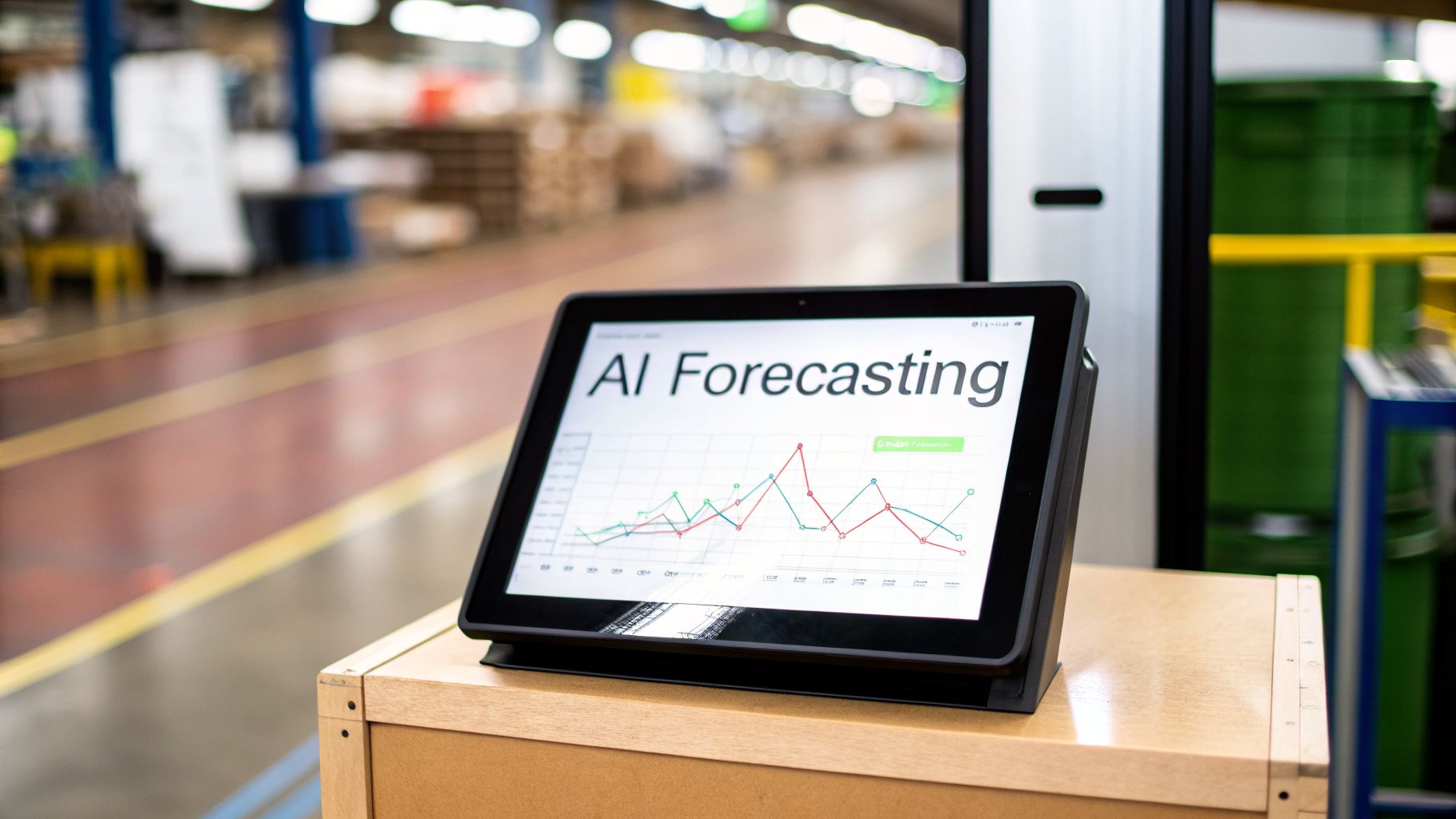
This is where your inventory management software for the manufacturing industry goes from simply recording history to actively predicting the future. Think about it: traditional inventory control is a lot like driving a car while only looking in the rearview mirror. Predictive analytics, driven by artificial intelligence (AI), gives you a powerful GPS for the road ahead, highlighting potential traffic jams and suggesting smarter routes.
It’s time to move beyond educated guesses about next month's material requirements. The real power lies in using your own data to build an incredibly sophisticated forecast for your entire supply chain. You can finally get ahead of demand spikes and spot supply chain risks before they ever threaten your production line, making your capital work smarter for you.
For manufacturers, using advanced AI for business intelligence isn't just a nice-to-have; it's becoming the key to turning mountains of data into clear, predictive insights and securing a serious competitive advantage.
From Reactive Guesswork to Proactive Intelligence
At its heart, predictive analytics dives deep into your historical sales data, production cycles, and market trends to generate forecasts with stunning accuracy. An AI algorithm can analyse years of information in mere seconds, uncovering subtle patterns a human could easily miss. It learns the unique seasonality of your products, understands the ripple effects of a marketing campaign, and can even account for external factors like public holidays or economic shifts.
This fundamentally changes how you operate. You shift from a reactive model—scrambling to order more materials when you’re already running low—to a proactive one. The system can automatically suggest purchase orders with precise quantities and timing to keep your stock at its absolute sweet spot, drastically cutting down on both costly overstocking and damaging stockouts.
The results speak for themselves. Australian manufacturers who have embraced AI-powered inventory management are seeing huge efficiency gains. We’re talking about 70% reductions in unplanned downtime and 25% cuts in total maintenance costs. By letting AI analyse sales and seasonality to automate replenishment, they’re slashing forecasting errors by 20-50% and cutting lost sales from stockouts by up to 65%.
A Practical Case for Predictive Ordering
Let’s make this real. Imagine you manufacture outdoor furniture. You know sales always pick up in spring, but an AI-powered system sees much more. It might identify that an unseasonably warm week in late winter reliably leads to a 15% jump in orders for patio sets exactly three weeks later.
Armed with that insight, your inventory system can automatically raise a purchase order for more aluminium frames and weather-resistant fabric before the demand surge even begins. This is the power of predictive analytics in action—it turns data into decisive, profitable moves that keep your production line humming and your customers happy. This is a common outcome for a well-executed Odoo implementation.
This kind of foresight is becoming foundational for any modern manufacturer. To dig deeper into how this all works, take a look at our guide on the core concepts of predictive analytics.
Beyond Forecasting: The Role of AI in Optimisation
But AI’s job doesn’t stop at just forecasting. It actively works to optimise your entire stock profile. Here are a few ways it gets to work:
- Dynamic Reorder Points: Forget static min/max levels. AI constantly fine-tunes your reorder points based on real-time sales velocity and changing supplier lead times.
- Supplier Performance Analysis: The system can track and analyse supplier reliability, flagging those who consistently deliver late and even suggesting alternative sources to minimise your supply chain risk.
- Dead Stock Identification: It quickly pinpoints slow-moving or obsolete inventory, suggesting markdowns or bundling promotions to clear it out and free up cash that’s tied up on the shelves.
When you have this level of intelligence running in the background, your business operates on a whole new level of efficiency. Want to see how this could work for you? Contact us for a personalised demo.
From Shop Floor Chaos to Complete Control: A Sydney Manufacturer's Story
It's one thing to talk about the benefits of inventory management software for the manufacturing industry in theory. It’s another to see it completely turn a real business around. Let me walk you through a classic practical case: a custom metal fabrication company in Western Sydney that was buckling under the pressure of its own success.
Before they made a change, their workshop was pure, organised chaos. Everything ran on manual systems. A shared spreadsheet governed the entire production schedule, but it was almost always out of date, which meant costly delays were just part of the daily routine. Stocktakes were a full-day, all-hands-on-deck affair, yet they were still riddled with errors. This led to frantic, last-minute scrambles for materials and, worst of all, broken delivery promises to their customers. They simply couldn't scale and were being forced to turn away bigger, more profitable contracts.
The Moment Everything Had to Change
The management team knew they were at a breaking point. Their tangled web of spreadsheets and guesswork wasn't just inefficient; it was actively strangling the business. The constant firefighting meant there was zero time to think strategically or actually improve their processes. They needed one system—a single source of truth—that could finally connect their stock, their production floor, and their sales orders.
This realisation sent them searching for a specialist Odoo partner in Sydney. They needed more than just software off the shelf; they needed a technology partner who genuinely understood the unique headaches of Australian manufacturing. The goal was not just to fix the immediate problems, but to build a solid foundation that would support their growth for the next ten years.
"We were drowning in paperwork and educated guesses. Every day felt reactive. We knew we had a good product, but our back-end processes were preventing us from delivering on our promises and growing our business."
— Operations Manager, Sydney Fabricator
The answer was a ground-up Odoo implementation. This wasn't just about installing some new programs. It was a complete rethink of their core workflows, guided by an expert software development Sydney Adelaide team that knew how to connect the dots.
The Odoo Rollout and Real-World Results
The project focused on knitting together three of Odoo's most powerful modules to create one seamless system:
Odoo Inventory: This was the first big win. It gave them instant, real-time visibility over every single nut, bolt, and sheet of metal. Barcode scanners took over from manual checklists, which not only stopped data entry mistakes in their tracks but also gave them 100% accurate stock levels on demand.
Odoo Manufacturing: This module was the real game-changer. For the first time, they could build proper, multi-level Bills of Materials (BOMs) for their complex assemblies. Production jobs were now automatically tied to inventory, making sure the right materials were allocated and even triggering automatic alerts to reorder stock before it ran low.
Odoo Sales: By integrating the sales module, a new customer order would instantly and automatically generate the corresponding manufacturing order. The communication black hole between the sales team and the shop floor vanished overnight. Everyone was finally working from the same live information.
Was it a walk in the park? Of course not. It took commitment, training, and a willingness to leave old habits behind. But the results, just one year after going live, were stunning.
The company saw:
- A 40% reduction in holding costs, because they finally stopped over-ordering and holding onto obsolete stock.
- A 98% on-time order fulfilment rate, which helped them rebuild customer trust and start winning those larger contracts they'd been turning away.
- A 25% jump in production capacity without buying a single new machine—simply by getting more out of their day and cutting out the dead time.
This isn't just a one-off story; it’s a blueprint for any manufacturer who feels trapped by outdated processes. It shows that with the right partner and a powerful platform like Odoo, the results aren't just incremental—they're transformative. You can see more on how Wistec helps businesses with Odoo inventory management. And while this fabricator focused on their internal operations, it’s just as common to see businesses link their ERP to a Shopify implementation or WooCommerce store to bring all their sales channels under one roof.
Is your manufacturing business ready for a similar transformation? Contact Wistec today for a no-obligation consultation to discuss your challenges and explore a tailored Odoo solution.
So, you're ready to make a change but staring at a mountain of software options, not sure which way to climb? Choosing and rolling out new inventory management software for the manufacturing industry is a big project, there's no doubt about it. But it doesn’t have to be a nightmare. Let's walk through how to make a smart choice and nail the launch.
The very first move—and this is crucial—is to look inwards. You need a crystal-clear picture of your own operations. Are you in discrete manufacturing, crafting individual products like electronics or furniture? Or are you in process manufacturing, where you're mixing ingredients for food or chemicals? Your answer fundamentally shapes the features you'll need, so getting this right from the start saves a lot of headaches later.
This journey is about moving from daily chaos to structured, manageable growth. The right system is the bridge that gets you there.
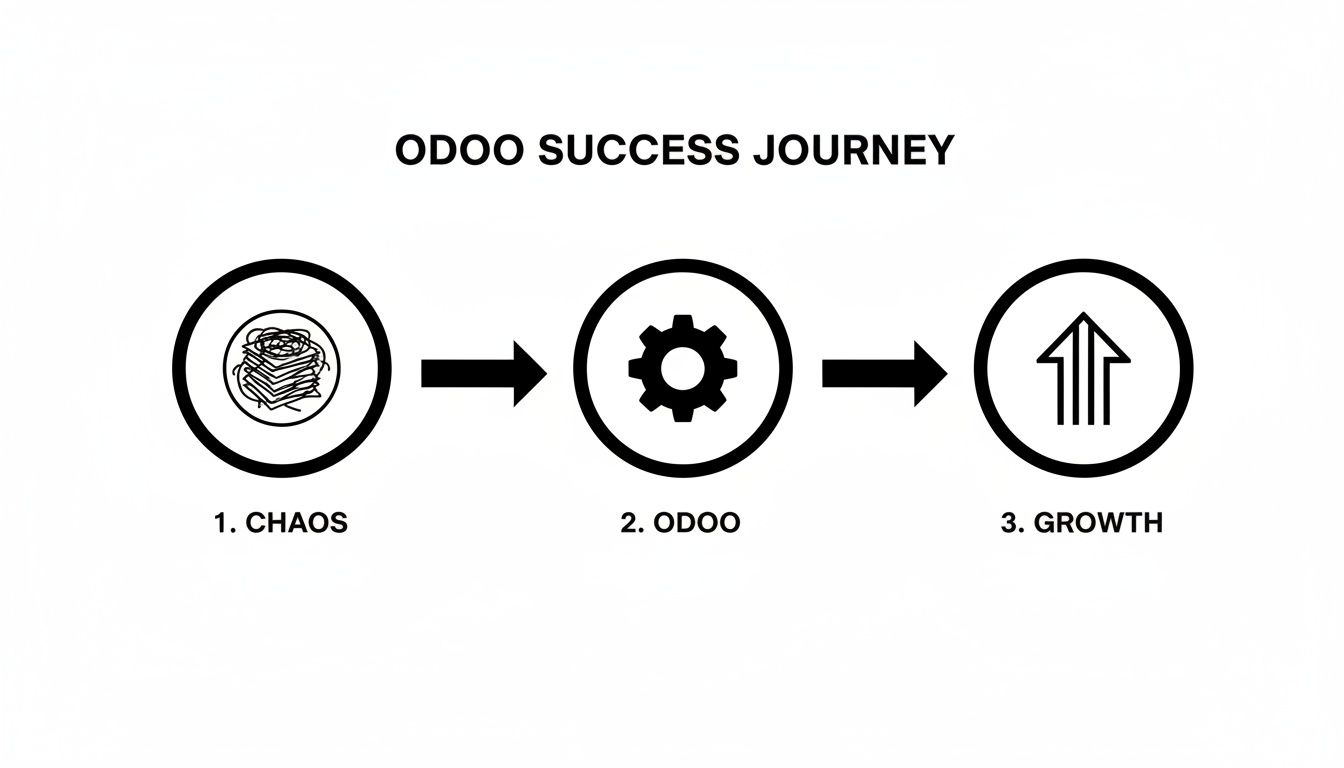
As you can see, implementing a powerful system like Odoo acts as the central organising force. It takes all the disjointed parts of your operation and transforms that disorder into a solid foundation for real, scalable success. It’s what finally allows a business to break past its old operational limits.
How to Evaluate Software Vendors
Once you’ve mapped out your needs, it’s time to start looking at vendors. And let's be clear: you're not just buying a piece of software. You're choosing a long-term partner who will play a key role in your company’s future. The goal is to find a specialist who genuinely understands manufacturing, not just a reseller pushing a generic solution.
One of the biggest factors to consider is scalability. Your business is going to grow, and your software absolutely must be able to keep pace. Can the platform handle new product lines? Can it manage more warehouses? What happens when your order volume doubles? Even more importantly, can it talk to the other systems you rely on, like a Shopify store for your e-commerce sales or a WooCommerce-powered site? A system that can’t grow with you will quickly become a roadblock.
The real value isn't just in the software itself. It's in finding a partner who offers strategic guidance. An expert Odoo partner in Sydney or Adelaide, for instance, won't just install the system; they’ll help you mould it to fit your unique workflows, rather than forcing your proven processes into a rigid, one-size-fits-all box.
The Implementation Process Demystified
The word "implementation" can sound intimidating, but a good partner will break it down into clear, manageable stages. Think of it as a collaborative project, typically moving through data migration, system configuration, and team training.
Data Migration: This is the careful process of moving all your critical information—item masters, bills of materials (BOMs), supplier details—from scattered spreadsheets into your new, centralised system.
Configuration & Customisation: This is where an expert team really proves their worth. They'll work side-by-side with you to tailor the software to your precise operational needs, from specific quality control checks to custom reports. This is the heart of effective software development in Sydney and Adelaide.
Training & Go-Live: Your team has to feel confident using the new tools from day one. Proper training isn't optional; it's what guarantees you see a real return on your investment and that the system is actually used to its full potential.
Choosing the right implementation partner is every bit as important as picking the right software. Use the checklist below to properly vet your options and find a team that will truly set you up for long-term success.
Checklist for Vetting Your Implementation Partner
This checklist is designed to help you dig deep when evaluating potential partners. Asking the right questions now ensures you find a team that understands your world and can deliver a solution that truly works.
| Evaluation Criteria | Key Questions to Ask Your Potential Partner | Why This Is Critical for Your Success |
|---|---|---|
| Manufacturing Expertise | Do you have practical cases from manufacturers in our specific industry? Can you explain how you'd handle our multi-level BOMs and production scheduling? | A partner who already speaks your language won't need you to teach them the basics of manufacturing. They’ll bring solutions to the table, not just more questions. |
| Customisation Capability | How do you approach customising the software for unique workflows? What's your process for developing and testing new features for us? | The software must bend to your business, not the other way around. A rigid system forces you to change proven processes, which just creates new inefficiencies. |
| Integration Experience | Show us examples of an Odoo implementation integrated with platforms we use, like Shopify implementation or WooCommerce. | A properly integrated system creates a single source of truth. It eliminates the soul-crushing task of manual data entry and makes your entire technology stack work in harmony. |
| Post-Launch Support | What does your support structure look like after we go live? Do you offer ongoing training, system health checks, and optimisation services? | Your business doesn't stop evolving after launch day, and your needs will change. A true partner provides ongoing support to help you adapt, improve, and get more value over time. |
Making the right choice here is a defining moment for any manufacturing business. It’s the foundation for a more resilient, efficient, and profitable future.
Ready to build that future? Contact Wistec for a free, no-obligation consultation to map out your implementation journey.
Your Questions, Answered
Diving into inventory management software for the manufacturing industry often brings up more questions than answers. Let's tackle some of the most common ones we hear from manufacturers, giving you the straight-up, practical advice you need to make a confident decision.
How Much Does Manufacturing Inventory Software Cost?
The price tag can swing wildly. You might find a simple, off-the-shelf cloud tool for a few hundred dollars a month. On the other end of the spectrum, you have a comprehensive platform like Odoo, fully configured by an expert team. While this involves a more significant upfront investment, the return it delivers is in another league entirely.
The real conversation shouldn't be about the initial price, but about the total cost of ownership versus the potential returns. A practical case to consider is the cost of not investing: think about what you'll save by slashing material waste, cutting down on carrying costs, and the massive efficiency boost you'll get from having production run smoothly. That’s why we always suggest a discovery call to get a realistic quote that actually maps to your business goals.
Can It Integrate With My Shopify Store and Accounting Tools?
Absolutely, and frankly, it must. A well-executed Odoo implementation doesn’t just sit on its own; it becomes the central hub connecting your inventory, manufacturing floor, sales channels (like a Shopify implementation or WooCommerce site), and your accounting software.
The whole point is to create a single source of truth for your entire operation. An experienced software development Sydney Adelaide partner is skilled at building these digital bridges. This eliminates mind-numbing manual data entry and ensures your team—from the factory floor to finance—is always working with the same live information.
How Long Does It Take to Implement a New Inventory System?
This really depends on the complexity of your manufacturing operations. A basic, out-of-the-box system could be up and running in a matter of weeks. However, for a custom manufacturing business needing a full ERP implementation—which involves migrating old data, configuring new processes, and training your team—you're typically looking at a three to nine-month project.
We often recommend a phased approach. Let's get the core inventory and manufacturing modules running first to give you a quick win. Partnering with a skilled Odoo partner Sydney Adelaide is the surest way to keep the project on track and minimise disruption to your daily business.
My Manufacturing Process Is Unique. Can the Software Be Customised?
Yes, and for most manufacturers, this is a deal-breaker. A generic, one-size-fits-all software package almost never fits a specialised production environment. The power of an open-source platform like Odoo is its incredible flexibility.
A knowledgeable Odoo partner Sydney Adelaide can mould the system to your specific workflows. This means tailoring it to your unique Bill of Materials (BOM) structures, your exact quality control checkpoints, and the specific reports you need to run the business. This is a vital step to make sure the software works for your business, not the other way around, protecting the very processes that make you competitive.
Ready to stop guessing and start knowing? The team at Wistec has the real-world manufacturing and technology expertise to show you the way. We build practical, results-focused solutions that just work.