

So, you’re thinking about launching an online store in Australia. It’s an exciting prospect, but it’s more than just a great idea and a flashy website. The real journey involves a few key stages: validating that your product will actually sell, picking the right tech to power your store, designing a brand people trust, and then, finally, planning a launch that makes a splash.
It’s a straightforward path on paper, but success is all in the details. Making clever, strategic choices at each point is what will set you up to win in Australia’s booming digital marketplace. Ready to build something great?
Your Blueprint for Australia’s Booming eCommerce Market
Let’s be honest, generic advice from overseas won’t cut it here. Launching an online store in Australia means tapping into a unique and thriving digital economy. This guide is your no-fluff roadmap, built specifically to navigate the opportunities and quirks of the Aussie eCommerce scene.
And what a time to jump in. The Australian market is absolutely flying. Revenue is projected to hit a staggering USD 43.61 billion in 2025, and it’s not stopping there. It’s expected to surge at an incredible 21.87% compound annual growth rate, reaching USD 108.16 billion by 2030. That’s a goldmine waiting for savvy new retailers. You can explore more about these market trends and what they mean for your new venture.
Capitalising on Current Trends
This growth isn’t just happening in one corner of the market, either. While direct-to-consumer (B2C) sales command a solid 62% market share in 2024, the business-to-business (B2B) space is quickly catching up.
In fact, B2B eCommerce is forecast to grow at 14.8% annually through 2030. This opens up huge potential for everyone from local manufacturers to logistics firms ready to modernise their sales process.
This is where your technology foundation becomes absolutely critical. The right platform can be the difference between struggling to keep up and scaling smoothly.
- For retail brands wanting to get to market fast: A professional Shopify implementation gives you a powerful, user-friendly solution to start selling almost immediately.
- For businesses with more complex needs: A flexible WooCommerce store offers limitless customisation, especially when you need to integrate it with other powerful backend systems.
A classic mistake I see all the time is picking a platform based on the cheapest upfront cost. The true value lies in a solution that can grow with you, whether that’s a simple storefront today or a complex system tomorrow requiring expert Odoo implementation in Sydney or Adelaide.
To help you keep these critical steps in mind, here’s a quick-start checklist summarising the journey ahead.
eCommerce Launch Quick-Start Checklist
| Phase | Key Action | Critical Consideration |
|---|---|---|
| 1. Foundation | Niche & Product Validation | Is there a proven demand in the Australian market for your idea? |
| 2. Technology | Platform Selection | Does the platform (e.g., Shopify, WooCommerce) fit your long-term growth? |
| 3. Build & Design | Store Setup & Branding | Does your store design inspire trust and make checkout easy? |
| 4. Operations | Payments & Shipping | Have you streamlined logistics for the Australian customer? |
| 5. Launch | Marketing & Promotion | How will you drive your first 100 customers to the store? |
This table maps out the core milestones. Choosing the right partner for software development in Sydney or Adelaide ensures your store isn’t just built for launch day, but for the long haul.
Ready to build a powerful and scalable online store? Contact Wistec today for a consultation on the perfect technology solution for your business.
Finding Your Niche and Validating Your Big Idea
Let’s be blunt: the most successful online stores don’t try to sell to everyone. That’s a surefire way to get lost in the crowd. Instead, they find a specific group of people with a specific problem and become their go-to solution. This is what niching down is all about, and it’s the first real step to building a brand people actually care about.
So, how do you carve out a profitable corner of the market for yourself? It’s all about spotting underserved needs or putting a fresh spin on an existing category. Think less about “selling clothes” and more about “selling sustainably sourced linen wear for professional women in Australia.” See the difference? The second idea has a built-in audience and a clear reason to exist.
Spotting Opportunities in the Market
Your first job is to move past vague ideas and find specific, data-backed opportunities. Stop guessing what people want and start using the tools that show you what they’re actively looking for.
- Google Trends: This should be your first stop for spotting rising interest. You can compare search terms, see how demand changes with the seasons, and even pinpoint which parts of Australia are most interested. Are searches for “vegan leather bags” on the up? That could be your niche right there.
- Social Media Listening: Jump into forums like Reddit, relevant Facebook groups, and even TikTok comments. What are people constantly complaining about? What products do they wish someone would make? These online conversations are absolute goldmines for spotting gaps in the market.
Doing this groundwork first saves you from pouring time and money into an idea that nobody was asking for. It’s the difference between building a business on solid ground versus wishful thinking.
Practical Validation That Works
Got a promising niche? Great. Now it’s time to test it. This is where you challenge your assumptions before you go all-in, because an idea isn’t a business until you’ve proven people will actually pay for it.
One of the biggest mistakes I see first-time entrepreneurs make is sinking thousands into a full-scale Shopify implementation or custom software development in Sydney before they’ve made a single sale. You need to start small, prove the concept, and then scale up your tech.
Here’s a practical case. A startup in Adelaide noticed there were no good eco-friendly, durable pet toys made from recycled materials. Instead of ordering a massive shipment from a factory, they created a small test batch of just 50 toys. They put up a simple landing page, ran a highly targeted social media campaign aimed at local pet owner groups, and sold out in less than a week.
That tiny experiment validated three critical things for them:
- People were genuinely interested in sustainable pet products.
- The price they set was right for their target market.
- Their marketing message actually worked.
With that proof in hand, they could confidently invest in a more robust WooCommerce store and order more inventory. Even complex operations that eventually need something like an Odoo implementation in Adelaide for serious inventory management often start with a simple, smart test just like this one.
When you know exactly who you’re selling to and what problem you solve for them, everything else falls into place. Your brand story, your marketing, your entire value proposition—it all becomes clearer, making you the only logical choice for your customer.
Ready to validate your big idea and build a brand that lasts? Get in touch with us to chat about how the right tech strategy can set you up for a successful launch.
Choosing the Right Tech Stack for Australian Growth
Picking your eCommerce platform is one of those foundational decisions that can make or break your online store. This isn’t just about a website builder; it’s the engine that will run your entire operation, from handling sales to scaling up when things take off. Get it right, and you’re set for smooth sailing. Get it wrong, and you could be facing some expensive and frustrating roadblocks down the track.
The Australian online shopping scene is absolutely buzzing right now, and it’s a massive opportunity. The industry is on track to hit $64.9 billion in 2025, and all the recent data shows that online sales are still on a steep climb. It’s the perfect time to get in the game, but your choice of technology will be the key to grabbing your slice of the pie. You can see the full breakdown of Australia’s eCommerce growth on IBISWorld.
The Main Contenders: Shopify, WooCommerce, and Custom Builds
For most Aussie entrepreneurs, the choice really comes down to three main paths. Each one has its own set of pros and cons, and the best fit depends entirely on your business model, how tech-savvy you are, and where you see your business in a few years.
- Shopify Implementation: Think of this as the all-in-one, ready-to-go solution. It’s incredibly user-friendly, secure, and fast to set up because they handle all the tricky stuff like hosting and updates for you.
- WooCommerce: This is a super powerful and flexible plugin that turns a WordPress site into a full-blown online store. You get total control over everything, but it does mean you’ll need to be a bit more hands-on with management.
- Custom Software Development: This is the bespoke, built-from-scratch option. It offers a level of uniqueness and specific functionality you just can’t get off the shelf, but it’s also the most complex and requires the biggest initial investment.
To make the right call, you have to look past the shiny features and think about what each platform means for your specific goals, especially in a crowded local market.
Before you even commit to a platform, you need to be sure your idea has legs. This little flowchart is a great way to visualise those early validation steps.
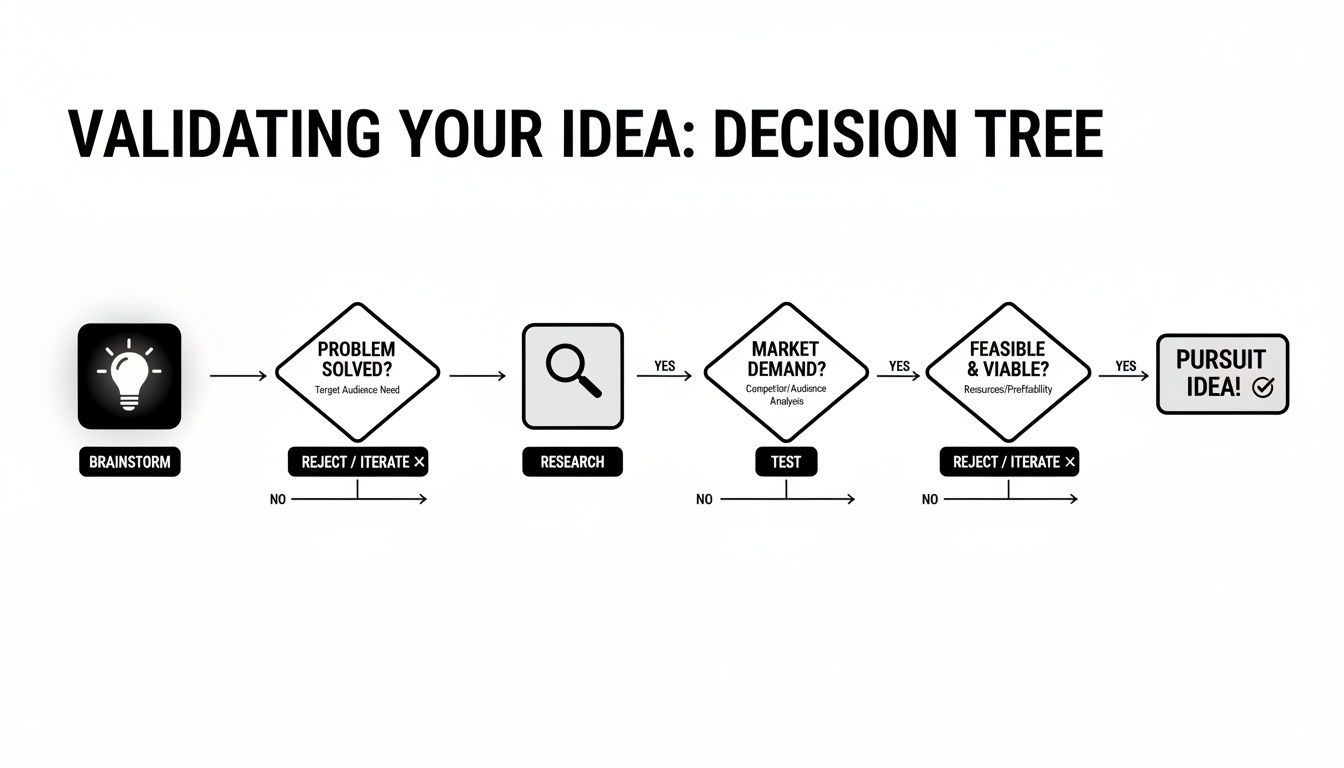
Working through that process—from brainstorming to proper research—is a crucial first step. It proves your concept is solid before you start spending serious money on the tech.
Practical Scenarios for Australian Businesses
Let’s get practical. The best platform for a fashion startup in Sydney is going to be worlds away from what a B2B supplier in Adelaide needs.
Case Study 1: The Sydney Fashion Startup
Imagine a new fashion label in Sydney trying to jump on a hot trend. Their biggest priorities are getting to market fast, having a gorgeous-looking site, and plugging straight into social media. For them, a professional Shopify implementation is a no-brainer. They can get a stunning, mobile-friendly store up and running in a matter of weeks, not months. This means they can start pushing products through Instagram and TikTok Shopping almost immediately.
Case Study 2: The Adelaide B2B Supplier
Now picture an industrial parts supplier based in Adelaide. They’ve got a massive, complex inventory with thousands of individual parts, different pricing tiers for different clients, and very specific shipping rules. They need a system that can talk to their existing operational software. This is where WooCommerce really shines. Its open-source nature means you can customise it to do almost anything. More importantly, it can be integrated with their ERP system. For instance, an Odoo implementation in Adelaide would let them sync inventory, orders, and customer data automatically. That creates a powerful, efficient operation that a standard Shopify store just couldn’t handle out of the box.
Your tech stack should be a business enabler, not a limitation. The goal is to choose a foundation that supports your five-year plan, not just your first five months. This often means partnering with a software development Sydney or Adelaide expert who can foresee challenges you haven’t even considered yet.
A Head-to-Head Comparison
To help you weigh it all up, here’s a straightforward comparison of the three main options.
eCommerce Platform Comparison: Shopify vs WooCommerce vs Custom
| Feature | Shopify | WooCommerce | Custom Development |
|---|---|---|---|
| Ease of Use | Excellent – designed for non-technical users. | Good – requires some familiarity with WordPress. | Varies – depends on the final build. |
| Initial Cost | Low – monthly subscription model. | Low – plugin is free, but hosting and themes cost. | High – significant upfront investment required. |
| Scalability | Good – scales well up to a certain point (Shopify Plus). | Excellent – limitless potential with the right hosting. | Excellent – built specifically for your scale. |
| Customisation | Limited to themes and apps in the ecosystem. | Nearly infinite – full control over code and plugins. | Total – anything you can imagine can be built. |
| Best For | Startups, retail brands, and speed-to-market. | B2B, content-heavy stores, and complex integrations. | Unique business models and enterprise-level needs. |
Ultimately, the platform you choose lays the groundwork for everything that comes next. While something like Shopify is an amazing launchpad for many, businesses with more complex needs should seriously look at the flexibility of WooCommerce, especially when it’s paired with a robust backend system. The right tech partner can guide you through this decision, ensuring you build a store that’s not just live, but built to last.
Are you ready to build a scalable foundation for your Australian online store? Let’s discuss the right solution for your unique business needs.
Designing a Store That Converts Clicks Into Customers
Let’s be honest. A beautiful website might get a few compliments, but a store that turns browsers into buyers is what actually builds a business. Once you get serious about how to start an online store, you quickly learn that every single design choice has one job: guiding a customer from your homepage to that sweet “thank you for your order” page.
This is where user experience (UX) stops being a buzzword and becomes your most valuable sales tool. It’s not about picking trendy colours; it’s the craft of making your site feel intuitive, trustworthy, and genuinely helpful. To really get this right, you need to explore proven strategies to increase online sales and make conversion optimisation your new best friend.
The Psychology of Smart Store Design
Great e-commerce design is never an accident. It leans heavily on user psychology to build immediate trust and make it easy for people to say “yes”. It’s the small details that often have the biggest impact on your bottom line.
Take your product photography, for instance. Are you just showing a picture, or are you telling a story? Crisp, professional images aren’t a luxury; they’re an absolute must-have. Your customers can’t touch or feel the product, so your photos have to do all the work. Show items from every angle, show them in use, and use video to truly bring them to life.
Your product descriptions are just as vital—think of them as your 24/7 digital sales team. Don’t just list specs; sell the outcome. Instead of “100% merino wool,” paint a picture: “Stay warm without the itch in our ultra-soft merino wool jumper, perfect for those crisp Sydney mornings.”
Creating a Frictionless Journey
The path from seeing a product to buying it needs to be dead simple. Every extra click, every confusing step, is an open invitation for a potential customer to leave. This is where a professional Shopify implementation can be a game-changer, as the entire platform is engineered to make this journey as smooth as possible.
Put yourself in your customer’s shoes and map out their journey:
- Intuitive Navigation: Can shoppers find what they’re looking for in seconds? Clear categories and a powerful search bar are non-negotiable.
- Clear Calls-to-Action (CTAs): Your “Add to Cart” or “Buy Now” buttons should pop off the page. Use contrasting colours and direct, active language.
- A Flawless Mobile Experience: With more than half of all online shopping happening on phones, your store must look and work perfectly on a smaller screen.
Practical Case: We worked with a Sydney-based retailer whose site had decent traffic but a frustratingly low conversion rate. After a quick audit, we completely overhauled their product filtering and simplified the main navigation on their WooCommerce site. The result? A 30% lift in conversions within a month, all without spending a single extra dollar on ads.
Nailing the Australian Checkout Experience
The checkout is the final, crucial step. It’s where countless sales are won or lost. Your mission here is to remove every shred of doubt or frustration. For Aussie shoppers, that means providing familiarity and trust.
A streamlined checkout process should always have these elements:
- A Guest Checkout Option: Forcing someone to create an account is one of the fastest ways to kill a sale. Let people buy as a guest.
- Multiple Ways to Pay: Give customers the options they expect. Offer Stripe for credit cards, PayPal, and especially popular “Buy Now, Pay Later” services like Afterpay or Zip.
- Upfront Shipping Costs: Nobody likes a nasty surprise at the final step. Unexpected shipping fees are the number one cause of abandoned carts. Be transparent about costs from the beginning.
For more complex businesses, like those needing to sync real-time inventory with online sales, a WooCommerce store can offer more flexibility. Pairing it with a sophisticated Odoo implementation in Sydney or Adelaide automates your entire backend, ensuring your stock levels are always spot-on.
At the end of the day, a store that converts is one that respects the customer’s time and anticipates their needs. Whether you’re building on Shopify or need custom software development in Sydney or Adelaide, focusing on these core design principles will turn your website from a simple online catalogue into your most powerful sales machine. Contact us to learn how we can optimize your store design for maximum sales.
Fine-Tuning Your Engine Room: Shipping and Logistics
A beautiful storefront gets customers to hit the ‘buy’ button, but what happens after that click is what truly makes or breaks your business. This is where you get into the real nuts and bolts: the engine room of payments, shipping, and stock management.
Get this part right, and you’ll earn a reputation for being a reliable, professional outfit. Get it wrong, and you’re looking at a future filled with customer complaints and logistical chaos. It’s time to shift from building a website to building an actual, functioning business.
How Will You Get Products to Your Customers?
Before you can even think about shipping rates, you need a solid plan for storing and handling your products. There’s no one-size-fits-all answer here; the best model for you depends on your budget, what you’re selling, and how much control you want to maintain.
- Doing It Yourself: This is the classic in-house model. You pick, pack, and ship every order from your own space, be it a garage or a dedicated warehouse. You get total control over quality, but it’s a huge time and space commitment. Perfect for those just starting out.
- Dropshipping: With this hands-off approach, you never physically touch the inventory. When an order comes in, you simply pass it on to your supplier, who ships it directly to the customer. The startup costs are incredibly low, but you’re sacrificing control over shipping times, packaging, and product quality.
- Using a Third-Party Logistics (3PL) Partner: This is the middle ground. You send your stock to a specialised warehouse, and their team handles all the picking, packing, and shipping for you. It’s a fantastic way to scale and free up your time, though it does come with ongoing management fees.
The operational foundation you lay down today directly impacts how easily you can scale up tomorrow. Don’t just plan for your first 100 orders; think about what your business looks like at 1,000 orders. This is where a bit of forward-thinking pays off in a big way.
Making Payments and Shipping Effortless
For Aussie shoppers, a clunky checkout is a deal-breaker. You absolutely need to offer familiar, trusted payment options and be upfront about shipping costs. Modern platforms like Shopify or WooCommerce make it a breeze to integrate popular gateways like Stripe, PayPal, and Afterpay.
Calculating shipping, on the other hand, can feel like a dark art. You’ve got to juggle package weight, dimensions, and where it’s headed. Most e-commerce platforms can connect directly with carriers like Australia Post to fetch live shipping rates, which helps ensure you aren’t accidentally undercharging (or overcharging) your customers. A massive piece of this puzzle involves finding the best courier service in Australia that aligns with your products and customer expectations.
Practical Case: An Adelaide Manufacturer’s Big Win
We worked with an Adelaide-based manufacturer selling highly specialised industrial parts. They started out with a basic WooCommerce store, but as orders climbed, trying to manage everything manually became a nightmare. Stock levels were all over the place, and the team was drowning in paperwork just trying to process orders.
Their game-changer was a strategic Odoo implementation in Adelaide. By integrating the Odoo ERP system with their WooCommerce site, they automated their entire workflow. Now, when an order lands, inventory is updated instantly, a picking list is automatically generated, and shipping labels are printed with a single click. This wasn’t just about saving time; it eliminated costly errors and let them scale their operations without needing to hire more people. It’s a perfect example of how smart software development in Adelaide can completely transform a business.
The Boring (But Crucial) Stuff: ABN and GST
Finally, let’s talk about staying on the right side of the law. To operate a business in Australia, you need an Australian Business Number (ABN). It’s free to register for one, and it’s non-negotiable for tax purposes.
You’ll also need to register for the Goods and Services Tax (GST) if your annual business turnover hits $75,000 or more. Once you’re registered, you must add 10% GST to your prices and file regular Business Activity Statements (BAS) with the ATO. Sorting this out from day one will save you a world of pain later on.
Ready to build an operational backbone that can actually support your growth? Contact us today to talk about a Shopify implementation or a custom software development in Sydney that sets you up for long-term success.
Your Launch Strategy for Attracting Your First Customers
Flipping the switch and taking your store live is a brilliant feeling, but it’s really just the starting line. Now comes the real work: getting people through your digital door and making sales. A killer launch isn’t about luck. It’s about a deliberate, multi-channel marketing plan that puts your brand in front of the right people, right from the get-go.
Hoping customers will just stumble across your site is a recipe for disappointment. You need to be proactive. That means building a foundation with solid Search Engine Optimisation (SEO) so Google starts to notice you, while at the same time, using social media to build a genuine community around your brand.
Nailing Your Launch-Week Marketing Blitz
That first week is your golden window. It’s your chance to create a wave of momentum that can carry your business for months. A scattergun approach just won’t cut it; you need a coordinated plan that builds excitement and drives people to act.
- Build Pre-Launch Buzz: Don’t wait until you’re live. A few weeks out, start dropping hints on your social channels. Show behind-the-scenes snaps of your products. Offer an exclusive “early bird” discount to anyone who signs up for your email list. This way, you’re not launching to crickets—you have a primed audience ready to buy.
- Go All-In on Launch Day: This is the time to make some noise. Run a tightly targeted ad campaign on Instagram or Facebook. Team up with a local micro-influencer for a shoutout. And of course, send that “We’re Live!” announcement to your email list.
- Keep the Momentum Going: What you do in the days after you launch is just as important. Follow up with your first customers personally. Ask them for a review. Share any photos they post with your product. This is how you build real social proof.
The Australian eCommerce market is ripe with opportunity for new players. With total revenue expected to hit US$45,377 million in 2024, there’s a huge slice of the pie up for grabs, especially for businesses in hospitality, healthcare, or manufacturing. Dive into some of Australia’s booming eCommerce statistics to see just how much potential there is.
Practical Case: We helped a Sydney-based craft beverage company smash their first 100 sales in under 30 days. This wasn’t achieved with a single launch-day blast, but with a sustained marketing push that combined targeted social media ads with local influencer partnerships, keeping the excitement rolling and driving consistent traffic to their new WooCommerce store.
For businesses with more complex operations, a smart launch strategy needs a solid tech backbone. Imagine a WooCommerce store seamlessly integrated with an Odoo implementation in Sydney or Adelaide to handle a flood of new orders. For simpler retail setups, a professional Shopify implementation can get you to market incredibly fast.
At the end of the day, you’re not just building a store; you’re building a business. The right strategy, backed by expert software development in Sydney, is what turns a great idea into a profitable reality.
If you’re ready to launch a store that doesn’t just look good but actually converts, let’s partner together to make it happen.
Your Top Questions About Starting an Online Store, Answered
Jumping into the world of eCommerce can feel like you’re trying to solve a puzzle with a thousand pieces. It’s totally normal to have a heap of questions. Let’s tackle some of the most common ones I hear from budding Aussie entrepreneurs to give you the clarity you need to push forward.
Do I Really Need an ABN to Sell Online in Australia?
Straight up, yes. If you’re running your store like a proper business (and you should be!), you’ll need an Australian Business Number (ABN). Think of it as your business’s official ID card – it’s crucial for tax time and makes you look legitimate to customers and suppliers.
Just keep in mind, you’ll also need to register for GST once your annual turnover hits that $75,000 mark. Don’t let that sneak up on you!
What’s the Real-World Cost to Get Started?
Honestly, you can get the ball rolling for less than the cost of a few fancy coffees a month. A basic Shopify setup, for example, can start for under $50 per month. Your initial outlay will mostly be for your platform subscription, a domain name (which is only about $20 a year), and whatever you spend on your first batch of products.
The key is to start lean. Get your store live, make some sales, and then reinvest the profits back into the business.
I’ve seen so many people make the mistake of overinvesting in complicated systems right out of the gate. A simple WooCommerce store is often more than enough to prove your concept. You can always scale up later with a full-blown Odoo implementation in Sydney or Adelaide once you need serious inventory management.
How Long Does It Take to Get That First Sale?
This is the million-dollar question, isn’t it? The timeline is different for everyone, and it’s almost never overnight. If you have a really focused launch plan and an existing audience, you could see your first sale within a day or two. For most people, though, it takes a few weeks of consistent effort with SEO and social media to start getting traction.
Practical Case: A client of ours in Sydney did this brilliantly. They built a pre-launch email list by offering a 15% launch day discount. They managed to lock in their first 20 sales on the very first day. They proved people wanted what they were selling before they spent big on professional software development in Sydney to build a more robust WooCommerce platform.
Ready to stop wondering and start building? At Wistec, we specialise in creating powerful, scalable online stores that give Australian businesses a real competitive edge. Whether you need a quick Shopify implementation or a tailored WooCommerce solution, we’ve got the technical expertise to bring your vision to life.